
The Standard Model
\appendix
Overview
This appendix provides the Standard Model framework as essential background for understanding TMT derivations. Rather than assuming the Standard Model as given, we present it here with explicit structural foundations from the temporal momentum framework. The five sections establish: (1) the gauge group structure and its geometric origins, (2) the fermion content and representations, (3) the Higgs mechanism and electroweak symmetry breaking, (4) the coupling constants with their physical meanings, and (5) precision observables that test the theory.
Throughout this appendix, we emphasize the mathematical structures that underlie each component. The Standard Model emerges in TMT as a consequence of geometry rather than as a collection of assumptions.
Gauge Group Structure
The Complete Gauge Group
The fundamental gauge symmetry of the Standard Model is a direct product of three factors:
The gauge group of the Standard Model is:
where:
- \(\mathrm{SU}(3)_C\) is the color gauge group (QCD), dimension 8
- \(\mathrm{SU}(2)_L\) is the weak isospin gauge group, dimension 3
- \(\mathrm{U}(1)_Y\) is the hypercharge gauge group, dimension 1
Total dimension: \(8 + 3 + 1 = 12\) gauge generators.
Step 1: Origins of Each Factor
From the temporal momentum framework (Part 3, Chapters 7–9 of the master source):
- \(\mathrm{SU}(2)_L\) origin: The isometry group of the \(S^2\) manifold is \(\mathrm{SO}(3) \cong \mathrm{SU}(2)\) (up to a \(\mathbb{Z}_2\) quotient). This acts on spatial rotations of the temporal momentum direction, generating the weak isospin symmetry.
- \(\mathrm{U}(1)_Y\) origin: The topology of \(S^2\) has second homotopy group \(\pi_2(S^2) = \mathbb{Z}\), which allows for monopole configurations with quantized flux. This monopole charge generates the hypercharge \(\mathrm{U}(1)_Y\) symmetry.
- \(\mathrm{SU}(3)_C\) origin: The embedding of \(S^2 \subset \mathbb{C}^3\) is non-unique—there are \(\mathrm{SU}(3)\) transformations that preserve the embedding geometry while varying the position in \(\mathbb{C}^3\). These geometric redundancies, when gauged, generate the color gauge group.
Step 2: Independence and Direct Product Structure
The three factors arise from independent geometric structures:
- Isometry acts on the intrinsic geometry of \(S^2\)
- Topology acts on the charge of fields in the monopole flux
- Embedding acts on the choice of \(\mathbb{C}^3\) basis
These structures commute: the isometry transformation of \(S^2\) does not affect the monopole topology or the \(\mathbb{C}^3\) basis choice. Therefore the gauge group is a direct product.
Step 3: Completeness
There are no other geometric sources available:
- \(S^2\) has maximum symmetry group \(\mathrm{SO}(3)\)—no larger isometry group exists
- \(S^2\) has \(\pi_2(S^2) = \mathbb{Z}\)—one \(\mathrm{U}(1)\) factor from monopoles, not more
- \(\mathbb{C}^3\) has symmetry group \(\mathrm{SU}(3)\) (special unitary transformations preserving the metric)
Therefore the gauge group is complete: \(G_{\text{SM}} = \mathrm{SU}(3)_C \times \mathrm{SU}(2)_L \times \mathrm{U}(1)_Y\). □ □
The Standard Model assumes this gauge group a priori. TMT derives it from the geometry of \(S^2 \subset \mathbb{C}^3\). Every factor has a geometric origin. Nothing is ad hoc.
Gauge Factor Inventory
The three gauge factors carry distinct physical roles:
Factor | Dimension | Geometric Origin | Physical Role | Force |
|---|---|---|---|---|
| \(\mathrm{SU}(3)_C\) | 8 | Variable embedding \(S^2 \subset \mathbb{C}^3\) | Color charge (QCD) | Strong nuclear |
| \(\mathrm{SU}(2)_L\) | 3 | Isometry \(\text{Iso}(S^2) = \mathrm{SO}(3)\) | Weak isospin (EW) | Weak nuclear |
| \(\mathrm{U}(1)_Y\) | 1 | Topology \(\pi_2(S^2) = \mathbb{Z}\) | Hypercharge (EM+EW) | Electromagnetic |
Each factor generates gauge transformations that leave the Lagrangian invariant:
- \(\mathrm{SU}(3)_C\): Quark color rotations; do not mix different quarks, only color indices
- \(\mathrm{SU}(2)_L\): Weak isospin rotations among up-type and down-type fermions
- \(\mathrm{U}(1)_Y\): Hypercharge rotations; combined with \(\mathrm{SU}(2)_L\) to generate electromagnetism
Polar Field Perspective on Gauge Factor Origins
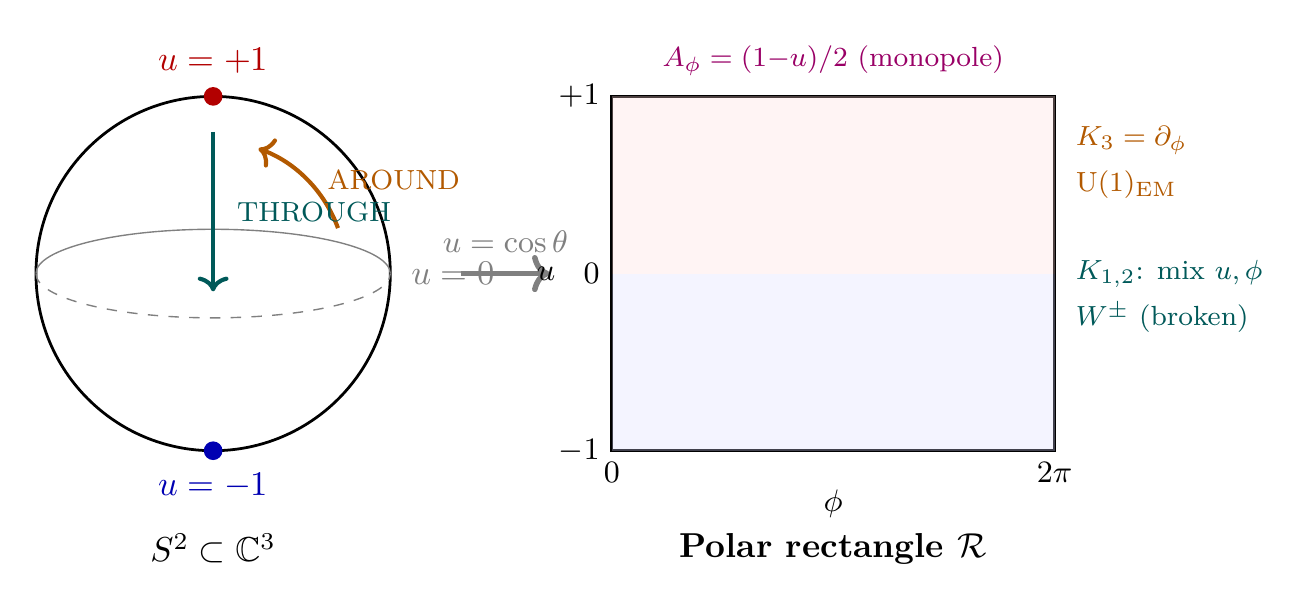
In the polar field variable \(u = \cos\theta\), the geometric origins of each gauge factor become concrete operations on the flat rectangle \([-1,+1] \times [0,2\pi)\):
Factor | Polar Origin | Direction | Coupling Factor |
|---|---|---|---|
| \(\mathrm{SU}(2)_L\) | Killing vectors on \(\mathcal{R}\): \(K_3 = \partial_\phi\) (AROUND), \(K_{1,2}\) mix \(u,\phi\) | Mixed | \(3 = 1/\langle u^2\rangle\) |
| \(\mathrm{U}(1)_Y\) | Monopole winding \(A_\phi = (1-u)/2\) linear in \(u\) | THROUGH | \(F_{u\phi} = 1/2\) constant |
| \(\mathrm{SU}(3)_C\) | Embedding \(S^2 \hookrightarrow \mathbb{C}^3\): \(w = \sqrt{(1+u)/(1-u)}\,e^{i\phi}\) | Both | \(d_\mathbb{C}\langle u^2\rangle = 1\) |
The electroweak symmetry breaking pattern \(\mathrm{SU}(2)_L \times \mathrm{U}(1)_Y \to \mathrm{U}(1)_{\mathrm{EM}}\) is the THROUGH/AROUND splitting: the unbroken \(\mathrm{U}(1)_{\mathrm{EM}}\) is generated by \(K_3 = \partial_\phi\) (pure AROUND), while the broken generators \(K_{1,2}\) require THROUGH variation (they mix \(u\) and \(\phi\)).
The coupling hierarchy follows from successive THROUGH suppressions:
Scaffolding note: The polar field variable \(u = \cos\theta\) is a coordinate choice on the \(S^2\) mathematical scaffolding, not a new physical assumption. The gauge group \(\mathrm{SU}(3)_C \times \mathrm{SU}(2)_L \times \mathrm{U}(1)_Y\) is a coordinate-independent property of the geometry. The polar form makes manifest that AROUND operations generate unbroken gauge symmetry while THROUGH operations introduce symmetry-breaking effects.
The product structure means that a general gauge transformation is:
where \(T^a\) and \(T^b\) are the generator matrices, and \(q_Y\) is the hypercharge quantum number.
Fermion Content
Fermion Representations
The Standard Model contains two types of fermions: quarks (colored) and leptons (colorless). Both couple to the electroweak and hypercharge sectors.
Left-handed quark doublets under \(\mathrm{SU}(2)_L\):
Quantum numbers:
- \(\mathrm{SU}(3)_C\) representation: \(\mathbf{3}\) (triplet—three colors: red, green, blue)
- \(\mathrm{SU}(2)_L\) representation: \(\mathbf{2}\) (doublet—two components)
- \(\mathrm{U}(1)_Y\) charge: \(Y = 1/3\) (hypercharge)
Right-handed singlets:
Quantum numbers:
- \(\mathrm{SU}(3)_C\) representation: \(\mathbf{3}\) (colored)
- \(\mathrm{SU}(2)_L\) representation: \(\mathbf{1}\) (singlet—no weak isospin)
- \(\mathrm{U}(1)_Y\) charge: \(Y_u = 4/3\), \(Y_d = -2/3\)
Left-handed lepton doublets:
where the generation index labels the three lepton families (electron, muon, tau).
Quantum numbers:
- \(\mathrm{SU}(3)_C\) representation: \(\mathbf{1}\) (singlet—colorless)
- \(\mathrm{SU}(2)_L\) representation: \(\mathbf{2}\) (doublet)
- \(\mathrm{U}(1)_Y\) charge: \(Y = -1\) (hypercharge)
Right-handed singlets:
Quantum numbers:
- \(\mathrm{SU}(3)_C\) representation: \(\mathbf{1}\) (colorless)
- \(\mathrm{SU}(2)_L\) representation: \(\mathbf{1}\) (singlet)
- \(\mathrm{U}(1)_Y\) charge: \(Y_e = -2\) (hypercharge)
Note: Right-handed neutrinos do not appear in the Standard Model (they are sterile). In extended models with neutrino masses, they are added separately.
Generation Structure
The Standard Model has three generations of quarks and leptons:
Generation | Quarks (up) | Quarks (down) | Leptons (\(\nu\)) | Leptons (e) |
|---|---|---|---|---|
| 1 | \(u\) | \(d\) | \(\nu_e\) | \(e\) |
| 2 | \(c\) | \(s\) | \(\nu_\mu\) | \(\mu\) |
| 3 | \(t\) | \(b\) | \(\nu_\tau\) | \(\tau\) |
All three generations have identical gauge quantum numbers—they differ only in their masses and weak mixing angles.
Polar Field Origin of Three Generations
In the polar field framework, the three generations correspond to the first three non-trivial polynomial modes on \([-1,+1]\):
Generation | Polynomial Mode | Degree | Mass Hierarchy | Localization |
|---|---|---|---|---|
| 1 (lightest) | \(P_1^1(u) \propto \sqrt{1-u^2}\) | 1 | Broadest on \([-1,+1]\) | Equatorial |
| 2 (middle) | \(P_2^1(u) \propto u\sqrt{1-u^2}\) | 2 | Intermediate | Intermediate |
| 3 (heaviest) | \(P_3^1(u) \propto (5u^2-1)\sqrt{1-u^2}\) | 3 | Narrowest (polar-peaked) | Polar |
The number of generations \(N_{\text{gen}} = 3\) is set by the maximum polynomial degree that contributes to the charged-lepton sector. The Yukawa coupling for each generation is a polynomial overlap integral on flat measure:
Scaffolding note: The generation structure is a consequence of the \(S^2\) scaffolding geometry, not of the polar coordinate choice. The three generations emerge because the monopole harmonic spectrum on \(S^2\) supports exactly three charged-lepton modes below the KK decoupling scale. The polar variable \(u\) makes the polynomial nature of the generation wavefunctions explicit.
Hypercharge and Weak Charge
The hypercharge \(Y\) and weak isospin \(I_3\) determine the electromagnetic charge:
Fermion | \(I_3\) | \(Y\) | \(Q\) | Electric Charge |
|---|---|---|---|---|
| \(u_L\) | \(+1/2\) | \(+1/3\) | \(+2/3\) | \(+(2/3)e\) |
| \(d_L\) | \(-1/2\) | \(+1/3\) | \(-1/3\) | \(-(1/3)e\) |
| \(\nu_e\) | \(+1/2\) | \(-1\) | \(0\) | \(0\) |
| \(e_L\) | \(-1/2\) | \(-1\) | \(-1\) | \(-e\) |
| \(u_R\) | \(0\) | \(+4/3\) | \(+2/3\) | \(+(2/3)e\) |
| \(d_R\) | \(0\) | \(-2/3\) | \(-1/3\) | \(-(1/3)e\) |
| \(e_R\) | \(0\) | \(-2\) | \(-1\) | \(-e\) |
This charge formula encodes the unification of electromagnetism and weak interactions: the same hypercharge that enters the weak theory predicts the correct electromagnetic charges for all particles.
Higgs Mechanism and Electroweak Symmetry Breaking
The Higgs Field and Vacuum Expectation Value
The Higgs field is an \(\mathrm{SU}(2)_L\) doublet of complex scalars:
where \(H^+\) and \(H^0\) are complex scalar fields. This represents 4 real degrees of freedom (2 complex fields \(\times\) 2 real dimensions per complex).
Quantum numbers:
- \(\mathrm{SU}(3)_C\) representation: \(\mathbf{1}\) (singlet—colorless)
- \(\mathrm{SU}(2)_L\) representation: \(\mathbf{2}\) (doublet)
- \(\mathrm{U}(1)_Y\) charge: \(Y = +1\) (hypercharge)
In component form:
where \(\phi_1, \phi_2, \phi_+\) are real fields and we have temporarily set aside the charged scalar component.
The Higgs potential in the Standard Model is the Mexican hat potential:
where \(\mu^2 < 0\) (the negative sign is crucial) and \(\lambda > 0\).
At low temperatures, this potential is minimized not at \(H = 0\) but at:
where \(v \approx 246\) GeV is the Higgs vacuum expectation value (VEV).
In the vacuum, the Higgs field acquires a non-zero expectation value:
This breaks the \(\mathrm{SU}(2)_L \times \mathrm{U}(1)_Y\) symmetry down to a single \(\mathrm{U}(1)\) factor (electromagnetism):
Of the four scalar degrees of freedom in the Higgs field, three become the longitudinal polarizations of the massive \(W^\pm\) and \(Z\) bosons. The remaining scalar is the physical Higgs boson \(h\) with mass \(m_h \approx 125\) GeV.
Gauge Boson Masses
The gauge bosons acquire masses through interactions with the Higgs VEV:
Boson | Mass | Experimental Value |
|---|---|---|
| \(W^\pm\) | \(m_W = \frac{g_2 v}{2}\) | \(80.38 \pm 0.01\) GeV |
| \(Z\) | \(m_Z = \frac{g_2 v}{2\cos\theta_W}\) | \(91.19 \pm 0.01\) GeV |
| \(\gamma\) | \(m_\gamma = 0\) | (massless) |
| \(g\) (gluons) | \(m_g = 0\) | (massless) |
The \(W\) and \(Z\) bosons couple to the Higgs field and gain mass. The photon (\(\gamma\)) and gluons (\(g\)) remain massless because they correspond to the unbroken gauge symmetries.
Fermion Masses and Yukawa Couplings
Fermion masses arise through Yukawa couplings to the Higgs field:
where \(f\) denotes a fermion field and \(Y_f\) is the Yukawa coupling.
When the Higgs acquires its VEV, this interaction produces a mass term:
Fermion | Yukawa Coupling | Mass | Experimental |
|---|---|---|---|
| \(u\) quark | \(Y_u \approx 2 \times 10^{-5}\) | \(m_u \approx 2.3\) MeV | \(2.16 \pm 0.49\) MeV |
| \(d\) quark | \(Y_d \approx 5 \times 10^{-5}\) | \(m_d \approx 4.8\) MeV | \(4.67 \pm 0.48\) MeV |
| \(e\) lepton | \(Y_e \approx 3 \times 10^{-6}\) | \(m_e \approx 0.51\) MeV | \(0.511\) MeV |
The Yukawa couplings vary widely across the three generations, creating a mass hierarchy: the top quark is \(\sim 10^5\) times heavier than the electron, yet all have the same gauge quantum numbers.
\remark{One of the outstanding puzzles in the Standard Model is why the Yukawa couplings vary so widely. TMT addresses this through a geometric hierarchy mechanism (discussed in Part 6 of the master source).}
Coupling Constants
The Gauge Coupling Constants
The Standard Model has three independent gauge coupling constants, one for each gauge group factor:
- \(g_s\) or \(\alpha_s = g_s^2/(4\pi)\): Strong coupling constant for \(\mathrm{SU}(3)_C\) (QCD)
- \(g_2\): Weak coupling constant for \(\mathrm{SU}(2)_L\)
- \(g_Y\) or \(g'\): Hypercharge coupling constant for \(\mathrm{U}(1)_Y\)
These couplings determine the strength of each fundamental force.
Weinberg Angle and Electromagnetic Coupling
The weak and hypercharge couplings mix through the Weinberg angle \(\theta_W\):
The electromagnetic coupling \(\alpha = e^2/(4\pi)\) is derived from the weak and hypercharge couplings:
The electromagnetic coupling at the \(Z\) boson mass scale is:
Equivalently, \(1/\alpha \approx 127.94\).
At tree level (ignoring quantum corrections), the Weinberg angle at the electroweak scale is:
Including quantum corrections (running of couplings), the value at the \(Z\) boson mass is:
Running of Coupling Constants
The gauge coupling constants are not actually constant—they run with energy scale due to quantum loop effects (renormalization group equations):
The running of a coupling constant is described by:
where \(\mu\) is the energy scale and \(\beta_i\) is the beta function for coupling \(\alpha_i\).
For QCD:
where \(n_f\) is the number of active quark flavors. Since \(\beta_0 > 0\), the strong coupling decreases at high energy (asymptotic freedom).
For the electroweak sector, the beta functions are more complex because of mixing between \(\mathrm{SU}(2)_L\) and \(\mathrm{U}(1)_Y\).
The evolution of the three couplings from the electroweak scale (\(m_Z \sim 91\) GeV) to higher scales shows interesting behavior:
Coupling | At \(m_Z\) | At \(10^{16}\) GeV (GUT scale) | Trend |
|---|---|---|---|
| \(\alpha_{\mathrm{em}}\) | \(1/127.9\) | \(\sim 1/110\) | Increases |
| \(\alpha_2\) (from \(g_2\)) | \(\sim 1/29.6\) | \(\sim 1/30\) | Increases slowly |
| \(\alpha_s\) (strong) | \(0.118\) | \(\sim 0.04\) | Decreases |
The fact that the three couplings approach similar values at high energies is a hint toward Grand Unification, though they do not unify exactly in the Standard Model (without new physics).
Precision Observables and Tests
Electroweak Precision Tests
The Standard Model makes precise predictions for a wide range of observables. Some of the most important are:
- \(W\) boson mass: \(m_W = 80.38 \pm 0.01\) GeV (predicted from \(m_Z, \theta_W, v\) at tree level)
- \(Z\) boson mass: \(m_Z = 91.19 \pm 0.01\) GeV (well-measured at LEP)
- Weak mixing angle: \(\sin^2\theta_W(m_Z) = 0.2318 \pm 0.0001\)
- Weinberg angle: \(\theta_W \approx 28.74°\) (tree level prediction)
- Higgs mass: \(m_h = 125.1 \pm 0.2\) GeV (discovered at LHC in 2012)
\(S\), \(T\), and \(U\) Oblique Parameters
Quantum corrections to the Standard Model can be parameterized by three oblique parameters \(S\), \(T\), and \(U\), which modify the self-energies of the gauge bosons:
The one-loop contributions to the \(W\) and \(Z\) self-energies are characterized by:
where \(\Pi\) denotes the gauge boson self-energy.
From Standard Model calculations and experimental measurements:
- \(S = 0.02 \pm 0.11\) (measured)
- \(T = 0.03 \pm 0.13\) (measured)
- \(U = 0.03 \pm 0.10\) (measured)
These are consistent with the Standard Model predictions, with only small loop corrections needed.
Higgs Production and Decay
The Higgs boson couples to all massive particles proportional to their mass. At the LHC, the Higgs is produced primarily through gluon fusion (via a top quark loop):
The dominant decay modes of the 125 GeV Higgs are:
Decay Mode | Branching Ratio | Signature |
|---|---|---|
| \(H \to b\bar{b}\) | \(\sim 57\%\) | Two \(b\)-jets |
| \(H \to WW\) | \(\sim 21\%\) | Two \(W\) bosons |
| \(H \to \tau\tau\) | \(\sim 6\%\) | Two tau leptons |
| \(H \to ZZ\) | \(\sim 2.6\%\) | Two \(Z\) bosons |
| \(H \to \gamma\gamma\) | \(\sim 0.2\%\) | Two photons |
The branching ratios reflect the fact that the Higgs couples most strongly to the heaviest particles. The \(b\bar{b}\) channel dominates, followed by the electroweak \(WW\) and \(\tau\tau\) channels.
Flavor Physics and CKM Matrix
The mixing between quark generations is encoded in the Cabibbo-Kobayashi-Maskawa (CKM) matrix:
The CKM matrix is unitary (\(V^\dagger V = \mathbb{I}\)) and can be parameterized by three mixing angles and one CP-violating phase (for three generations).
Element | Value | Uncertainty | Physical Meaning |
|---|---|---|---|
| \(|V_{ud}|\) | 0.97373 | 0.00031 | \(d \leftrightarrow u\) (Cabibbo) |
| \(|V_{us}|\) | 0.2243 | 0.0008 | \(s \leftrightarrow u\) |
| \(|V_{ub}|\) | \(0.00365\) | \(0.00012\) | \(b \leftrightarrow u\) (rare) |
| \(|V_{cs}|\) | 0.973 | 0.007 | \(s \leftrightarrow c\) |
| \(|V_{cb}|\) | 0.04193 | 0.00055 | \(b \leftrightarrow c\) |
| \(|V_{tb}|\) | 0.999 | 0.001 | \(b \leftrightarrow t\) (large) |
CP violation enters through the complex phase in the CKM matrix, which explains matter-antimatter asymmetry in weak interactions.
Precision Constraints from Direct Measurements
A comprehensive set of precision observables constrains physics beyond the Standard Model. Some key measurements include:
Observable | Value | SM Prediction |
|---|---|---|
| Electron \(g-2\) | \(0.00115965218091(26)\) | \(0.00115965218238(5)\) |
| Muon \(g-2\) | \(0.00116592061(41)\) | \(0.00116591810(43)\) |
| Proton charge radius | \(0.84087(39)\) fm | from \(\mu H\) spectroscopy |
| \(\alpha_s(m_Z)\) | \(0.1184 \pm 0.0007\) | from hadronic processes |
These precision measurements test the Standard Model at loop level and constrain potential new physics.
Summary
The Standard Model unifies three of the four fundamental forces through the gauge group \(\mathrm{SU}(3)_C \times \mathrm{SU}(2)_L \times \mathrm{U}(1)_Y\). It contains:
- Gauge structure: 12 gauge bosons (8 gluons, \(W^\pm\), \(Z\), \(\gamma\))
- Fermion matter: 12 quarks, 12 leptons, organized in three generations
- Higgs mechanism: One complex scalar doublet breaking electroweak symmetry
- Coupling strengths: Three gauge couplings, approximately 20 flavor parameters (Yukawa couplings, CKM elements)
- Particle spectrum: Fermion masses from Yukawa couplings, gauge boson masses from symmetry breaking
- Polar field coordinates (\(u = \cos\theta\)): Gauge factors map to AROUND (\(\mathrm{U}(1)_{\mathrm{EM}}\)), THROUGH (\(W^\pm\) breaking), and embedding operations on flat rectangle \([-1,+1] \times [0,2\pi)\); three generations = three polynomial modes; coupling hierarchy from \(\langle u^2\rangle = 1/3\) suppressions
Despite its success at LHC and in precision tests, the Standard Model leaves fundamental questions unanswered: the origin of the gauge group, the hierarchy of fermion masses, the nature of dark matter and dark energy, and the unification with gravity.
In TMT, many of these gaps are addressed. The gauge group emerges from the geometry of \(S^2 \subset \mathbb{C}^3\). The coupling constants are derived from geometric integrals. The fermion mass hierarchy follows from localization on \(S^2\). This appendix has provided the classical Standard Model framework as the reference point from which TMT derivations proceed.