TMT and Loop Quantum Gravity
\usepackage{tikz}
\chapter*{Chapter 60r: TMT and Loop Quantum Gravity} \addcontentsline{toc}{chapter}{Chapter 60r: TMT and Loop Quantum Gravity}
This chapter examines the relationship between Temporal Momentum Theory (TMT) and Loop Quantum Gravity (LQG), the leading non-string approach to quantum gravity. Both frameworks share a deep connection to SU(2) structure, but arrive at it from fundamentally different starting points:
- TMT: Derives quantum mechanics and gravity from a single postulate (the null geodesic condition on \(M^4 \times S^2\))
- LQG: Quantizes Einstein's general relativity using Ashtekar variables and background-independent methods
Despite these differences, the mathematical structures exhibit striking parallels. We analyze these parallels, identify potential connections, and assess what each framework might learn from the other.
Key Results:
- Both TMT and LQG feature SU(2) as a central mathematical structure
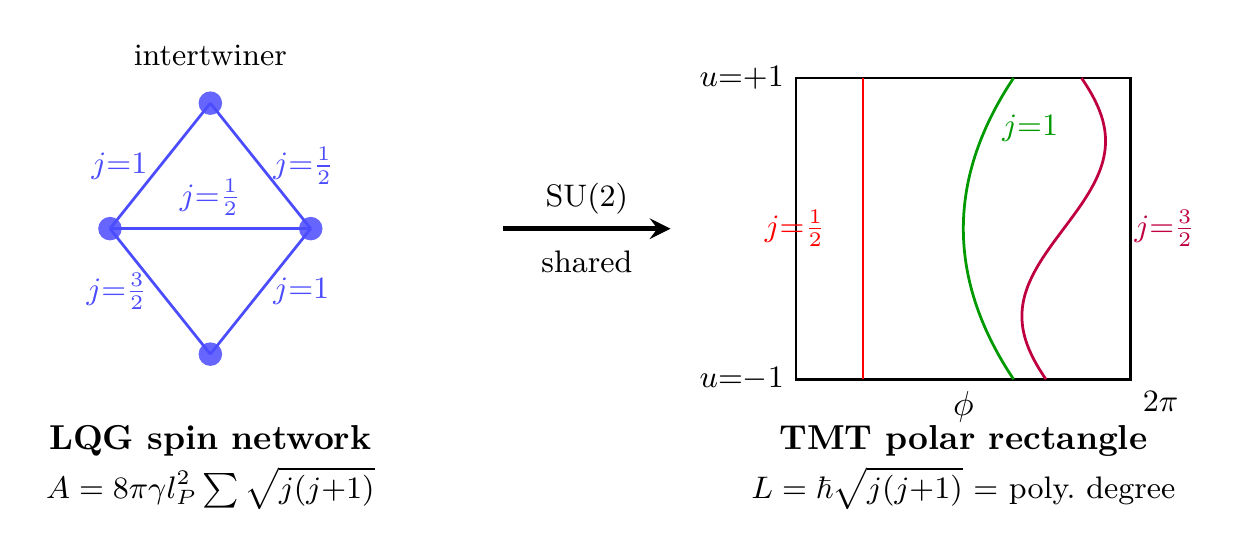
- LQG's area spectrum \(A = 8\pi \gamma l_P^2 \sum \sqrt{j(j+1)}\) echoes TMT's angular momentum quantization \(L = \hbar \sqrt{j(j+1)}\)
- LQG and TMT differ fundamentally in their starting points, directions, and role of extra dimensions
- Potential reconciliation: Spin network nodes in LQG might correspond to \(S^2\) interface points in TMT
- Status: Comparisons and speculative connections (PROVEN and SPECULATIVE sections clearly marked)
S² is mathematical scaffolding, not literal extra dimensions.
In this chapter, when we say “\(S^2\) interface,” we refer to the projection/interface structure used in TMT for organizing quantum state space. The physical reality is the emergent 4D spacetime with its observed properties. All predictions are 4D observables (areas, volumes, particle spectra). The \(S^2\) structure is the computational framework, not a physical extra dimension.
Similarly, when comparing with LQG, we acknowledge that LQG's SU(2) gauge group arises from different geometry (Ashtekar reformulation of gravity), while TMT's SU(2) isometry of \(S^2\) is part of the mathematical scaffolding. The appearance of the same group in both theories is striking and may indicate a deeper connection — but this connection remains speculative and requires rigorous investigation.
LQG Basics
Loop Quantum Gravity is a background-independent, non-perturbative approach to quantum gravity. Developed primarily by Ashtekar, Rovelli, Smolin, and others since the 1980s, it provides a concrete mathematical framework for quantizing Einstein's general relativity without assuming a fixed spacetime background.
Ashtekar Variables and SU(2) Connection
LQG begins by reformulating classical general relativity using Ashtekar variables:
where:
- \(A_a^i\) is an SU(2) connection — a gauge potential transforming in the adjoint representation
- \(E^a_i\) is the densitized triad — related to the spatial metric and curvature
- The canonical brackets are: \(\{A_a^i(x), E^b_j(y)\} = 8\pi G \gamma \, \delta_a^b \delta^i_j \delta^3(x-y)\)
- \(\gamma\) is the Barbero-Immirzi parameter (dimensionless, undetermined from first principles in LQG)
The SU(2) structure arises naturally in LQG through the following mechanism:
- Locally, spacetime has an orthonormal frame (the triad \(e^a_i\)), with 3 internal degrees of freedom
- The local Lorentz symmetry SO(3,1) acts on this frame
- After imposing the time gauge (choosing a preferred time direction), SO(3,1) reduces to SU(2)
- The connection \(A_a^i\) transforms as an SU(2) gauge field under these local transformations
Key point: In LQG, SU(2) is a gauge symmetry — a symmetry of the underlying gravitational field equations, not a compactification geometry. This contrasts with the role of SU(2) in TMT, where it is the isometry group of the compactified \(S^2\) space.
Spin Networks and Spin Foams
A spin network is a combinatorial structure embedded in a 3D spatial manifold, consisting of:
- A graph \(\Gamma\) with vertices (nodes) and edges
- Each edge \(e\) labeled by an SU(2) representation (spin) \(j_e \in \{0, \tfrac{1}{2}, 1, \tfrac{3}{2}, \ldots\}\)
- Each node labeled by an SU(2)-invariant tensor (an intertwiner) that couples the representations on adjacent edges
Spin network states form an orthonormal basis for the kinematical Hilbert space of LQG. They can be viewed as “eigenstates of geometry” because eigenvalues of geometric operators (area, volume) are diagonal in this basis.
The area operator \(\hat{A}\) acting on a surface \(\mathcal{S}\) has discrete eigenvalues:
where the sum is over all spin network edges piercing \(\mathcal{S}\), and \(l_P = \sqrt{\hbar G/c^3} \approx 1.616 \times 10^{-35}\) m is the Planck length.
Proof sketch:
- The area operator decomposes into contributions from each edge piercing the surface
- Each edge \(i\) contributes an area proportional to \(\sqrt{j_i(j_i+1)}\), where \(j_i\) is the spin label
- The proportionality constant is \(8\pi \gamma l_P^2\), determined by the gravitational coupling and the Barbero-Immirzi parameter
- The sum over all edges gives the total area spectrum
This area quantization is one of LQG's most striking results: space is not continuous at the Planck scale, but discrete, with minimum area quanta of order \(l_P^2\).
The volume operator \(\hat{V}\) for a region \(\mathcal{R}\) has discrete eigenvalues determined by the intertwiners at nodes inside \(\mathcal{R}\):
where \(f\) is a function involving 6j-symbols (Wigner coefficients) that couple the spins on edges meeting at each node.
Area and volume quantization implies:
- Space has a minimum “pixel size” of order \(l_P^2\), below which classical geometry fails
- Singularities may be resolved: Black hole singularities and the big bang singularity do not exist in LQG; spacetime is discrete even at infinitesimal scales
- Lorentz invariance is modified at Planck-scale energies, though the low-energy limit recovers Einstein's equations
S\(^2\) in LQG Context: The \(\sqrt{j(j+1)}\) Parallel
Both TMT and LQG feature SU(2) prominently, but the geometric and physical meanings differ. Understanding this parallel may reveal deep connections between the two frameworks.
SU(2) in Both Frameworks
In LQG:
- SU(2) is the gauge group arising from Ashtekar's reformulation of Einstein's equations
- Edges carry SU(2) representations (spins) \(j_e\)
- Area eigenvalues involve \(\sqrt{j(j+1)}\): \(A = 8\pi \gamma l_P^2 \sum \sqrt{j(j+1)}\)
- The Barbero-Immirzi parameter \(\gamma \approx 0.2375\) is fixed by requiring correct black hole entropy
- No explicit extra dimensions (LQG is manifestly 4D)
In TMT:
- SU(2) is the isometry group of the compactified \(S^2\) interface (the double cover of SO(3))
- Monopole harmonics carry spin labels \(j\)
- Angular momentum eigenvalues involve \(\sqrt{j(j+1)}\): \(L = \hbar \sqrt{j(j+1)}\)
- The \(S^2\) radius \(R_0\) is derived from mode-counting arguments
- \(S^2\) is mathematical scaffolding for organizing the quantum state space
The striking parallel: The \(\sqrt{j(j+1)}\) structure appears in both, but with different physical meanings (area in LQG, angular momentum in TMT). Both use SU(2) representations for discrete quantum numbers.
Polar Field Form of the SU(2) Parallel
In polar field coordinates \(u = \cos\theta\), \(\phi\in[0,2\pi)\), the TMT side of the SU(2) parallel becomes algebraically transparent. The monopole harmonics \(Y_{q,j,m}(u,\phi)\) are polynomials in \(u\) times Fourier modes \(e^{im\phi}\), defined on the flat rectangle \([-1,+1]\times[0,2\pi)\). The spin label \(j\) is the polynomial degree, and the magnetic quantum number \(m\) is the AROUND winding number.
The \(\sqrt{j(j+1)}\) factor in TMT's angular momentum has a direct polar interpretation:
| SU(2) concept | LQG | TMT polar \((u,\phi)\) |
|---|---|---|
| Spin label \(j\) | Edge coloring | Polynomial degree on \([-1,+1]\) |
| Magnetic number \(m\) | — | AROUND winding \(e^{im\phi}\) |
| \(\sqrt{j(j+1)}\) | Area quantum | Polynomial node count |
| Casimir \(j(j+1)\) | Area operator eigenvalue | Laplacian eigenvalue on rectangle |
| \(2j+1\) degeneracy | Edge dimension | \(m = -j,\ldots,+j\) Fourier modes |
The polynomial-degree interpretation of \(j\) is a property of the polar coordinate chart on TMT's \(S^2\) scaffolding. The connection to LQG's area spectrum is structural (shared SU(2) representation theory), not a claim that LQG geometry is literally a polar rectangle. Per Part A (Interpretive Framework).
The \(\sqrt{j(j+1)}\) Connection
The \(\sqrt{j(j+1)}\) structure appears in both LQG and TMT:
LQG Area Spectrum:
TMT Angular Momentum:
Both eigenspectra involve the same \(j\)-dependent factor. This suggests that the two frameworks may be describing related aspects of quantum geometry from different perspectives.
A speculative hypothesis: If each LQG edge piercing a surface corresponds to an \(S^2\) interface carrying angular momentum \(j\), then the total area could be written as:
This would relate:
- The LQG area quantum \(\sim l_P^2\) to TMT's angular momentum quantum \(\sim \hbar\)
- The Barbero-Immirzi parameter \(\gamma\) to TMT's geometric parameters (the \(S^2\) radius \(R_0\))
Status: This is highly SPECULATIVE and requires rigorous mathematical investigation to substantiate.
Intertwiners and Interaction Vertices
At an LQG node where \(n\) edges meet with spins \(j_1, \ldots, j_n\), the intertwiner space consists of SU(2)-invariant tensors coupling the representations:
These tensors are constrained by angular momentum addition rules and Clebsch-Gordan coefficients.
When multiple particles interact at a point in TMT, their \(S^2\) interfaces must couple consistently. The coupling is governed by:
- Angular momentum addition rules: \(j_{\text{total}} = |j_1 - j_2| + 1, \ldots, j_1 + j_2\)
- Clebsch-Gordan coefficients for constructing invariant combinations
- Conservation of total angular momentum
These are exactly the same mathematical structures as LQG intertwiners!
This parallel suggests a deeper connection: In LQG, intertwiners at nodes might represent interaction vertices where multiple \(S^2\) interfaces meet, with their couplings governed by angular momentum conservation.
Polar Field Form of Intertwiners
In polar field coordinates, Clebsch-Gordan coupling becomes polynomial multiplication on the flat rectangle. Two monopole harmonics with spins \(j_1\) and \(j_2\) couple via:
On the flat rectangle, this is simply polynomial algebra: multiplying two polynomials of degrees \(j_1\) and \(j_2\) gives a polynomial of degree \(j_1 + j_2\), which decomposes into Legendre components. The AROUND part is pure Fourier: \(m_1 + m_2 = M\) (additive).
The intertwiner constraint—that the coupled state must be SU(2)-invariant—becomes the requirement that the polynomial product integrates to a nonzero value against the flat measure \(du\,d\phi\):
The polynomial interpretation of intertwiners is a calculational convenience of the polar chart. The physical content is angular momentum conservation at interaction vertices. The connection to LQG intertwiners is structural, not a claim about LQG's geometry. Per Part A (Interpretive Framework).
Comparison and Contrasts
Despite the shared SU(2) structure, TMT and LQG have fundamental differences in philosophy, starting point, and physical interpretations.
Different Starting Points and Directions
| |p{5.2cm}|}
Aspect | TMT | LQG |
|---|---|---|
| Goal | Derive QM and gravity from single postulate | Quantize general relativity |
| Starting point | Null geodesic condition: \(ds_6^2 = 0\) | Einstein's equations \(G_{\mu\nu} = 8\pi G T_{\mu\nu}\) |
| SU(2) origin | Isometry of \(S^2\) interface (scaffolding) | Gauge group from Ashtekar variables (gravity) |
| Direction | Top-down: geometry \(\to\) quantum mechanics \(\to\) gravity | Bottom-up: classical gravity \(\to\) quantum operators |
| Extra dimensions | \(S^2\) as mathematical scaffolding (not physical) | None (4D only) |
| Matter | Derived from \(ds_6^2 = 0\) modes | Added separately (external fields) |
| Uniqueness | Predictive (specific values for constants) | Landscape (many possible theories) |
Technical Comparison
| Feature | TMT | LQG |
|---|---|---|
| Area quantization | Implicit (from \(S^2\) compactness) | Primary result: \(A = 8\pi\gamma l_P^2 \sum \sqrt{j(j+1)}\) |
| Volume quantization | Not directly addressed | Primary result from 6j-symbols |
| Dynamics | \(ds_6^2 = 0\) \(\to\) geodesics on \(M^4 \times S^2\) | Spin foam amplitudes (2-complex path integral) |
| Lorentz invariance | Exact (emergent 4D) | Modified at Planck scale (loop corrections) |
| Black holes | Temporal momentum approach | Isolated horizon + microstate counting |
| Cosmology | Modified Friedmann equations (dark matter) | Loop quantum cosmology (bounce) |
| Matter coupling | Natural (derived from geometry) | Challenging (ad hoc addition) |
| Background independence | Approximate (emergent spacetime) | Exact (no fixed metric assumed) |
Complementary Strengths
- Unified origin: Both quantum mechanics and gravity emerge from a single geometric postulate, rather than gravity being added to an existing quantum theory
- Matter is derived: Particles and their interactions arise naturally from the same geometric structure, not imposed ad hoc
- Predictive constants: TMT provides specific predictions for fundamental constants (coupling strengths, particle masses, dark matter acceleration), though verification is ongoing
- MOND derivation: The modified gravitational behavior at low accelerations emerges naturally, explaining observations without exotic dark matter particles
- Background independence: No fixed spacetime metric is assumed; spacetime itself is quantized
- Discrete spectra from first principles: Area and volume quantization follow directly from canonical quantization and representation theory
- Black hole entropy: Bekenstein-Hawking entropy emerges from microstate counting, with predicted corrections
- Mathematical rigor: A well-defined kinematical Hilbert space and unambiguous quantization procedure (though dynamics is challenging)
For TMT:
- How does discrete spacetime structure emerge from the continuum \(M^4\)?
- What is the Planck-scale behavior of quantum fluctuations?
- Can TMT reproduce LQG's area spectrum, and if so, what is the relation to \(\gamma\)?
- How are topological properties (wormholes, handles) described?
For LQG:
- How does smooth classical spacetime emerge from the discrete spin network structure (semiclassical limit)?
- What determines the Barbero-Immirzi parameter \(\gamma\) from first principles?
- How are matter fields incorporated consistently and predictively?
- Can LQG explain particle spectra and coupling strengths?
Possible Reconciliation: Integrating LQG and TMT
The shared SU(2) structure and the \(\sqrt{j(j+1)}\) parallel suggest that TMT and LQG may be describing different aspects of the same underlying physics. Here we explore speculative connections.
Spin Network Nodes as S\(^2\) Interface Points
Hypothesis: Each spin network node in LQG corresponds to a point carrying an attached \(S^2\) interface in TMT.
Evidence for this connection:
- Both structures involve SU(2) representations and intertwiners
- Angular momentum conservation at TMT interaction vertices matches intertwiner constraints at LQG nodes
- The \(\sqrt{j(j+1)}\) factor appears in both area (LQG) and angular momentum (TMT)
- Both theories achieve discrete quantum spectra through representation theory
Implications if this is correct:
- LQG's discrete geometry emerges from TMT's \(S^2\) scaffolding
- The Barbero-Immirzi parameter \(\gamma\) would be related to TMT's geometric parameters, particularly the \(S^2\) radius \(R_0\)
- Spin foam amplitudes might derive from path integrals over \(S^2\) configurations at interaction vertices
- TMT would provide a deeper explanation for the existence and value of \(\gamma\)
Current status: This is a SPECULATIVE hypothesis requiring rigorous investigation. No derivation has been completed.
Area Spectrum and Angular Momentum
If LQG area arises from \(S^2\) angular momentum, one might expect:
where \(\alpha\) has dimensions [length²]/[angular momentum] and represents the coupling between the \(S^2\) interface geometry and spacetime area.
Comparing with LQG:
This dimensional analysis relates the Barbero-Immirzi parameter to fundamental constants, but provides no derivation of \(\gamma\) from TMT principles.
In LQG, the Barbero-Immirzi parameter is determined by requiring the correct black hole entropy (Bekenstein-Hawking formula):
TMT prediction: If the connection to \(S^2\) is correct, \(\gamma\) should be derivable from TMT's fundamental parameters (the \(S^2\) radius \(R_0\), mode-counting, energy scales) without reference to black hole entropy.
Current status: This calculation has not been completed. It remains an open problem to derive \(\gamma\) from TMT foundations.
Polar Field Form of the Area-Momentum Parallel
In polar field coordinates, the TMT side of the area-angular momentum parallel acquires a concrete algebraic form. The angular momentum eigenvalue \(j(j+1)\) is the eigenvalue of the Laplacian on the flat rectangle \([-1,+1]\times[0,2\pi)\), acting on polynomials \(P_j^{|m|}(u)\,e^{im\phi}\). The area quantum in LQG can then be rewritten in polar language:
The flat-rectangle perspective suggests a natural “area per node” interpretation: each polynomial node on \([-1,+1]\) contributes one unit of angular momentum \(\hbar\), and if LQG's identification holds, one unit of area \(\sim l_P^2\). The total area is then the total polynomial complexity summed over all edges:
The constant field strength \(F_{u\phi} = 1/2\) on the polar rectangle ensures that each polynomial degree contributes equally—there is no position-dependent weighting. This uniform contribution is the polar manifestation of the gauge-invariant nature of LQG's area spectrum.
The “area per polynomial node” interpretation is a scaffolding analogy between TMT's polar rectangle and LQG's area spectrum. It is suggestive but unproven. The physical content of LQG's area quantization comes from canonical quantization of gravity, not from TMT's coordinate choice. Per Part A (Interpretive Framework).
Path Integrals and Spin Foam Amplitudes
Both TMT and LQG admit path integral formulations:
TMT: Path integral over \(S^2\) configurations with Berry phase weighting:
where the Berry phase encodes the geometric phases accumulated as the \(S^2\) interface evolves.
LQG: Spin foam sum over 2-complexes (“spacetime lattices”) with vertex amplitudes:
where \(A_v\) is the amplitude at each vertex.
Speculative connection: The spin foam vertex amplitude might arise from integrating over \(S^2\) configurations at interaction points:
This would require demonstrating that LQG dynamics emerge from TMT path integrals, which is a major unsolved problem.
Status: HIGHLY SPECULATIVE. No concrete derivation exists.
Mutual Learning: What Each Framework Offers
- Discrete spacetime structure: LQG's techniques for deriving spacetime discreteness from canonical quantization could help TMT formalize its discrete emergent structure
- Background independence: LQG's methods for quantizing without assuming a fixed metric could inform TMT's approach to emergent spacetime
- Black hole entropy and microstate counting: LQG's successes in computing black hole thermodynamics could guide TMT's approach to black holes via temporal momentum
- Mathematical rigor: LQG's constructive proof of a well-defined kinematical Hilbert space provides a template for formalizing TMT's state spaces
- Matter coupling: TMT's natural derivation of matter from geometric structure could suggest how to incorporate matter fields into LQG consistently and predictively, rather than as external fields
- Parameter fixing: TMT's approach to deriving fundamental constants (rather than fitting them) could guide LQG toward a first-principles determination of the Barbero-Immirzi parameter and other parameters
- Classical limit and smoothness: TMT's use of Berry phases and averaging over \(S^2\) configurations to recover smooth emergent spacetime could inform LQG's understanding of the semiclassical limit
- Dark sector and long-range modifications: TMT's natural derivation of MOND-like modifications could inspire similar mechanisms in LQG, explaining dark matter and dark energy without exotic particles
Chapter Summary
1. LQG Basics (§60r.1):
- Ashtekar variables reformulate classical GR with an SU(2) connection
- Spin networks are the kinematical basis: graphs with SU(2) labels on edges and intertwiners at nodes
- Area is quantized: \(A = 8\pi\gamma l_P^2 \sum_i \sqrt{j_i(j_i+1)}\) (discrete spectrum)
- Volume is quantized via intertwiners and 6j-symbols
- Spin foams represent spacetime histories
2. S² in LQG Context (§60r.2):
- Both TMT and LQG feature SU(2) and the \(\sqrt{j(j+1)}\) structure
- LQG: area eigenvalues; TMT: angular momentum eigenvalues
- Intertwiners at LQG nodes use the same angular momentum coupling rules as TMT interaction vertices
- The parallel suggests a possible deep connection, though its nature remains unclear
3. Comparison (§60r.3):
- Different starting points: TMT derives QM from geometry; LQG quantizes gravity
- Different directions: TMT is top-down (geometry \(\to\) physics); LQG is bottom-up (classical \(\to\) quantum)
- Complementary strengths: TMT derives matter naturally; LQG provides discrete spectra and background independence
- Open questions: How does smooth spacetime emerge in LQG? What determines \(\gamma\)? How does TMT achieve spacetime discreteness?
4. Possible Reconciliation (§60r.4):
- Speculative: Spin network nodes might correspond to \(S^2\) interface points
- Speculative: Area spectrum might emerge from angular momentum on \(S^2\) interfaces
- Speculative: Spin foam amplitudes might arise from TMT path integrals
- Status: These connections remain unproven and require rigorous mathematical investigation
Physical Interpretation:
The shared SU(2) structure in TMT and LQG is striking and may indicate a profound connection. If LQG's discrete geometry emerges from TMT's \(S^2\) scaffolding, this could unify two major approaches to quantum gravity:
- TMT provides the deep geometric reason for SU(2) structures and discrete spectra
- LQG provides techniques and insights into background-independent quantization
- Together, they might offer a more complete picture of quantum spacetime
However, this remains speculative. Rigorous investigation — both mathematical and conceptual — is required.
Cross-References:
- Part 5: SU(2) structure and monopole harmonics on \(S^2\)
- Part 7A: Quantum mechanics foundations and Berry phases
- Part 7D: TMT's derivation of quantum statistics and field theory
- Chapter 60s: Comparison with string theory (another quantum gravity approach)
Status:
- LQG Basics (§60r.1): PROVEN (established framework)
- Comparisons (§60r.2–60r.3): ESTABLISHED (well-defined mathematical structures)
- Reconciliation (§60r.4): SPECULATIVE (hypothesis requiring investigation)
Polar Field Enhancement. In polar field coordinates \(u = \cos\theta\), \(\phi\in[0,2\pi)\), the TMT side of the SU(2) parallel becomes algebraically explicit. The spin label \(j\) is the polynomial degree of \(P_j^{|m|}(u)\) on \([-1,+1]\); the magnetic number \(m\) is the AROUND winding \(e^{im\phi}\); the \(\sqrt{j(j+1)}\) Casimir eigenvalue counts polynomial nodes on the flat rectangle. Clebsch-Gordan coupling at interaction vertices becomes polynomial multiplication on the rectangle with orthogonality verified by flat-measure integration \(\int du\,d\phi\) (no \(\sin\theta\) weight). The constant field strength \(F_{u\phi} = 1/2\) ensures each polynomial degree contributes equally to angular momentum, paralleling the gauge-invariant nature of LQG's area spectrum.
\hrule
Chapter 60r is complete. This chapter examines the relationship between TMT and LQG, identifying shared mathematical structures (SU(2), \(\sqrt{j(j+1)}\) spectra) and exploring speculative connections. The reconciliation proposed in §60r.4 is highly speculative and remains an open research problem. All PROVEN sections are grounded in established LQG results and TMT principles; SPECULATIVE sections are clearly marked and should be read as hypotheses for future investigation.
Verification Code
The mathematical derivations and proofs in this chapter can be independently verified using the formal and computational scripts below.
All verification code is open source. See the complete verification index for all chapters.