Leptogenesis
Introduction
The observed universe contains far more matter than antimatter. The baryon-to-photon ratio, measured from Big Bang Nucleosynthesis (BBN) and the Cosmic Microwave Background (CMB), is:
This tiny but non-zero asymmetry requires a dynamical explanation. Sakharov's conditions (1967) state that baryogenesis requires: (1) baryon number violation, (2) C and CP violation, and (3) departure from thermal equilibrium.
Leptogenesis is the mechanism by which an initial lepton asymmetry, generated by the out-of-equilibrium decay of heavy right-handed neutrinos, is partially converted into a baryon asymmetry by electroweak sphaleron processes. TMT provides a natural framework for leptogenesis because:
- The seesaw mechanism (Chapter 46) introduces heavy right-handed neutrinos at \(M_R\approx1.02e14\,GeV\).
- CP violation arises from the interference of tree-level and loop-level decay amplitudes.
- The out-of-equilibrium condition is satisfied because \(M_R\) is far above the electroweak scale.
- Electroweak sphalerons, active at temperatures \(T\sim100\,GeV\)–\(10^{12}\,GeV\), convert the lepton asymmetry into a baryon asymmetry.
Lepton Asymmetry from CP Violation
CP Violation in Heavy Neutrino Decays
The heavy right-handed neutrinos \(N_i\) (\(i=1,2,3\)) decay through the Yukawa interaction:
CP violation arises from the interference between tree-level and one-loop diagrams (vertex correction and self-energy). The CP asymmetry parameter for the decay of \(N_i\) is:
The CP Asymmetry Formula
For hierarchical right-handed neutrinos (\(M_1\ll M_2,M_3\)), the dominant contribution comes from the lightest \(N_1\):
TMT Parameters for the CP Asymmetry
In the TMT framework, the democratic structure of the neutrino Yukawa couplings (from the uniform \(\nu_R\) wavefunction) implies:
(1) The Dirac Yukawa matrix has the democratic form:
(2) The right-handed neutrino masses are nearly degenerate at leading order (all equal to \(M_R\)), with small splittings from subleading effects:
(3) The CP asymmetry is suppressed by the near-degeneracy but enhanced by potential resonance effects when the mass splitting \(\Delta M\equiv M_2-M_1\) is comparable to the decay width \(\Gamma_1\).
Estimate of the CP Asymmetry
The CP asymmetry in the decay of the lightest right-handed neutrino is bounded by the Davidson–Ibarra bound and estimated from TMT parameters as:
Step 1: The Davidson–Ibarra bound for hierarchical heavy neutrinos gives:
Step 2: Substituting TMT values: \(M_1\approx M_R=1.02e14\,GeV\), \(m_3\approx0.049\,eV\), \(m_1\approx 0\), \(v=246\,GeV\):
Step 3: The actual CP asymmetry depends on the detailed Yukawa structure. For the TMT democratic case with c-parameter perturbations providing the CP-violating phases:
(See: Part 6A §84.2, Chapter 46 (seesaw parameters)) □
Decay of Right-Handed Neutrinos
Decay Rate
The total decay rate of \(N_i\) is:
For the TMT democratic Yukawa with \(m_D=v/\sqrt{12}\):
Therefore:
Out-of-Equilibrium Condition
The out-of-equilibrium condition requires the decay rate to be slower than the Hubble expansion rate at \(T\sim M_1\):
At \(T=M_1\approx10^{14}\,GeV\):
The washout parameter is:
This places TMT leptogenesis in the strong washout regime (\(K\gg 1\)), where the final asymmetry is determined by the washout dynamics rather than the initial conditions. This is actually favorable: the result is insensitive to the unknown initial conditions of the universe.
The Strong Washout Regime
In the strong washout regime, the final lepton asymmetry is suppressed by a washout factor:
With \(K\approx 240\):
Electroweak Sphaleron Processes
Sphalerons and B+L Violation
Electroweak sphalerons are non-perturbative gauge field configurations that violate baryon number \(B\) and lepton number \(L\) while conserving \(B-L\):
Sphalerons are in thermal equilibrium for temperatures:
Conversion of Lepton to Baryon Asymmetry
The sphaleron processes convert a primordial \(B-L\) asymmetry into approximately equal \(B\) and \(L\) asymmetries. The relation for the Standard Model with three generations is:
Since the leptogenesis mechanism produces a pure lepton asymmetry (\(B=0\), \(L\neq 0\)), we have \(B-L=-L\) initially. After sphaleron processing:
Origin of the Factor 28/79
| Factor | Value | Origin | Source |
|---|---|---|---|
| 28 | Numerator | \(8N_g + 4N_H = 8\times 3+4\times 1\) | Gauge anomaly structure |
| 79 | Denominator | Chemical equilibrium with \(N_g=3\), \(N_H=1\) | SM thermal equilibrium |
| \(N_g=3\) | 3 generations | \(\ell_{\max}=3\) from \(S^2\) | Part 5, Chapter 27 |
| \(N_H=1\) | 1 Higgs doublet | SM Higgs sector | Part 4 |
Baryon Asymmetry Connection
The Final Baryon Asymmetry
Step 1: From Eq. (eq:ch50-YL) with \(\epsilon_1\sim 10^{-7}\)–\(10^{-6}\) and \(\kappa\sim 4\times 10^{-4}\):
Step 2: After sphaleron conversion (Eq. eq:ch50-YB-from-YL):
Step 3: Converting to the baryon-to-photon ratio (\(\eta_B\approx 7.04\,Y_B\) using \(s/n_\gamma\approx 7.04\)):
Step 4: The precise value depends on the CP-violating phases in the Yukawa matrix, which enter through \(\mathrm{Im}[(Y_\nu^\dagger Y_\nu)_{1j}^2]\). For order-unity phases (maximizing CP violation):
Step 5: This range encompasses the observed value \(\eta_B\approx 6.1\times 10^{-10}\).
(See: Part 6A §84.2, Chapter 46 (seesaw parameters)) □
Sakharov's Conditions in TMT
| Condition | TMT Mechanism | Source |
|---|---|---|
| B violation | Sphalerons (\(\Delta B=\Delta L=3n\)) | SM non-perturbative |
| C and CP violation | \(\epsilon_1\neq 0\) from loop diagrams | Yukawa structure |
| Out of equilibrium | \(M_R\gg T_{\mathrm{EW}}\), strong washout | \(M_R=(M_{\mathrm{Pl}}^2 M_6)^{1/3}\) |
Thermal Leptogenesis
The Thermal History
The leptogenesis process unfolds in stages:
Stage 1 (\(T\gg M_R\)): Right-handed neutrinos are in thermal equilibrium through Yukawa interactions. No net asymmetry.
Stage 2 (\(T\sim M_R\)): As the universe cools below \(M_R\), the \(N_i\) fall out of equilibrium and decay with CP asymmetry \(\epsilon_i\). A net lepton number \(Y_L\) is generated.
Stage 3 (\(T_{\mathrm{EW}}
Stage 4 (\(T
Temperature Scales in TMT
| Scale | Value | Physics |
|---|---|---|
| \(M_R\) | \(1.02e14\,GeV\) | \(N_R\) mass (from \(S^2\) democracy) |
| \(T_{\mathrm{lepto}}\) | \(\sim10^{14}\,GeV\) | Leptogenesis epoch |
| \(T_{\mathrm{sphal,max}}\) | \(\sim10^{12}\,GeV\) | Sphalerons active |
| \(T_{\mathrm{EW}}\) | \(\sim160\,GeV\) | Electroweak transition |
| \(M_6\) | \(7296\,GeV\) | TMT stabilization scale |
| \(v\) | \(246\,GeV\) | Higgs VEV |
The Davidson–Ibarra Bound and TMT Compatibility
The Davidson–Ibarra bound sets a lower limit on \(M_1\) for successful thermal leptogenesis:
The TMT value \(M_R\approx10^{14}\,GeV\) is five orders of magnitude above this bound, providing ample room for successful leptogenesis.
Gravitino and Reheating Constraints
In supersymmetric extensions, thermal leptogenesis faces a tension with gravitino overproduction, which requires the reheating temperature \(T_R\lesssim10^{9}\,GeV\). Since TMT is not supersymmetric (the gauge group and particle content emerge from \(S^2\) geometry without supersymmetry), this constraint does not apply.
The TMT reheating temperature after inflation (Part 10A) must satisfy:
Polar Coordinate Reformulation
The leptogenesis mechanism of this chapter acquires a sharp geometric interpretation in polar field coordinates (\(u=\cos\theta\), \(u\in[-1,+1]\)). The key insight: every ingredient of leptogenesis — the democratic Yukawa, the CP-violating phase, the near-degenerate \(N_R\) masses, and the Sakharov conditions — traces to the degree-0 (uniform) character of \(\nu_R\) on \(S^2\) and the \(120^\circ\) AROUND winding separation between generation modes.
Democratic Yukawa as Degree-0 Overlap
The neutrino Yukawa matrix \(Y_\nu\) in the TMT framework originates from the overlap integral of the charged lepton wavefunctions \(f_\alpha(u,\phi)\) with the right-handed neutrino wavefunction \(g_{\nu_R}(u,\phi)\) on \(S^2\):
The right-handed neutrinos occupy the degree-0 (uniform, constant) mode on \(S^2\):
This is a direct consequence of the seesaw mechanism (Chapter 46): \(\nu_R\) has no gauge charge (AROUND quantum number \(m_\phi=0\)) and no THROUGH gradient (\(\partial_u g = 0\)), making it the simplest non-trivial mode on \([-1,+1]\times[0,2\pi)\). Because the uniform function has equal overlap with every other wavefunction:
Critical consequence: The exactly democratic Yukawa matrix is real and flavor-universal. Therefore \(\mathrm{Im} [(Y_\nu^\dagger Y_\nu)_{1j}^2]=0\) and there is no CP violation at leading order. CP violation in leptogenesis requires the perturbative corrections \(\delta Y\) from the c-parameter differences — the THROUGH (\(u\)-direction) structure of the charged lepton profiles.
CP-Violating Phase from AROUND Winding
The three generation modes on \(S^2\) are separated by equal AROUND phase intervals:
The CP-violating quantity in leptogenesis, \(\mathrm{Im}[(Y_\nu^\dagger Y_\nu)_{1j}^2]\), involves the interference of amplitudes coupling \(N_1\) and \(N_j\) to different lepton flavors. In polar coordinates, each amplitude carries an AROUND phase factor from the generation mode structure. The imaginary part selects the sine of the net AROUND phase difference:
The factor \(\sin(2\pi/3)=\sqrt{3}/2\approx 0.87\) is the topologically fixed CP-violating phase from \(S^2\). This is near-maximal (compared to \(\sin(\pi/2)=1\)) and is not a free parameter — it is determined by the same three-generation structure (\(\ell_{\max}=3\), Chapter 27) that fixes the number of fermion families.
\framebox{
box{0.85\textwidth}{ The CP phase of leptogenesis is topology: \(\sin(2\pi/3)=\sqrt{3}/2\) — the same \(120^\circ\) angle that separates the three generation modes on \(S^2\) provides the CP violation that generates the matter–antimatter asymmetry. }}
Sakharov's Conditions in Polar Language
| Condition | Polar origin | \(S^2\) structure |
|---|---|---|
| B violation | SU(2)\(_L\) sphalerons from | AROUND gauge topology |
| non-perturbative AROUND dynamics | (winding number change) | |
| C and CP violation | \(120^\circ\) AROUND phase between | \(\sin(2\pi/3)=\sqrt{3}/2\) |
| generation modes | (near-maximal) | |
| Out of equilibrium | \(M_R\) from degree-0 seesaw: | Uniform \(\nu_R\) on \([-1,+1]\) |
| \((M_{\mathrm{Pl}}^2 M_6)^{1/3}\gg T_{\mathrm{EW}}\) | \(\Rightarrow\) large hierarchy |
All three Sakharov conditions thus trace to \(S^2\) geometry: baryon number violation from the AROUND gauge topology (sphalerons are non-perturbative transitions in the azimuthal gauge field), CP violation from the \(120^\circ\) AROUND winding between generations, and departure from equilibrium from the degree-0 seesaw scale \(M_R\).
Geometric Decomposition of \(\epsilon_1\)
The polar reformulation decomposes the CP asymmetry parameter \(\epsilon_1\) into AROUND and THROUGH factors:
- \(\sin(2\pi/3)=\sqrt{3}/2\) is the topology-fixed CP phase from the AROUND winding between generation modes;
- \(r_c\equiv |\delta c_\alpha/\bar{c}|\) is the fractional c-parameter perturbation in the THROUGH direction, measuring how much the charged lepton profiles deviate from perfect democracy;
- \(\epsilon_{\max}\) is the Davidson–Ibarra upper bound (Eq. eq:ch50-epsilon-bound).
Physical interpretation of the factorization:
- The AROUND factor is geometric and universal — it is the same \(\sqrt{3}/2\) for any three-generation theory on \(S^2\).
- The THROUGH factor \(r_c^2\) is model-dependent within TMT — it depends on the charged lepton c-parameter hierarchy (\(c_e\), \(c_\mu\), \(c_\tau\)) from Parts 5–6.
- The exactly democratic limit (\(r_c=0\)) gives \(\epsilon_1=0\): perfect \(S^2\) symmetry forbids CP violation. The asymmetry emerges precisely from the breaking of the uniform profile by the c-parameters.
Constraint from observations: The observed \(\eta_B\approx 6.1\times 10^{-10}\) requires \(\epsilon_1\) of order \(10^{-7}\)–\(10^{-5}\) (depending on the washout dynamics and the precise value of \(\epsilon_{\max}\)). With \(\sin(2\pi/3)=\sqrt{3}/2\) fixed by topology, this constrains the THROUGH perturbation fraction:
Polar Comparison
| Quantity | Cartesian (\(\theta,\phi\)) | Polar (\(u=\cos\theta\)) |
|---|---|---|
| \(\nu_R\) wavefunction | Uniform on sphere | Degree-0: constant on \([-1,+1]\) |
| Democratic Yukawa | All entries equal | Uniform overlap = flat integral |
| CP source | Free complex phase | \(\sin(2\pi/3)=\sqrt{3}/2\) (fixed) |
| Mass near-degeneracy | Approximate equality | All degree-0 \(\Rightarrow\) same \(M_R\) |
| \(\epsilon_1\) structure | Single formula | AROUND \(\times\) THROUGH factored |
| Perturbation scale | c-parameters | \(r_c\sim 0.1\)–\(0.3\) (THROUGH) |
| Sakharov conditions | Three separate | All from \(S^2\) (AROUND + degree-0) |
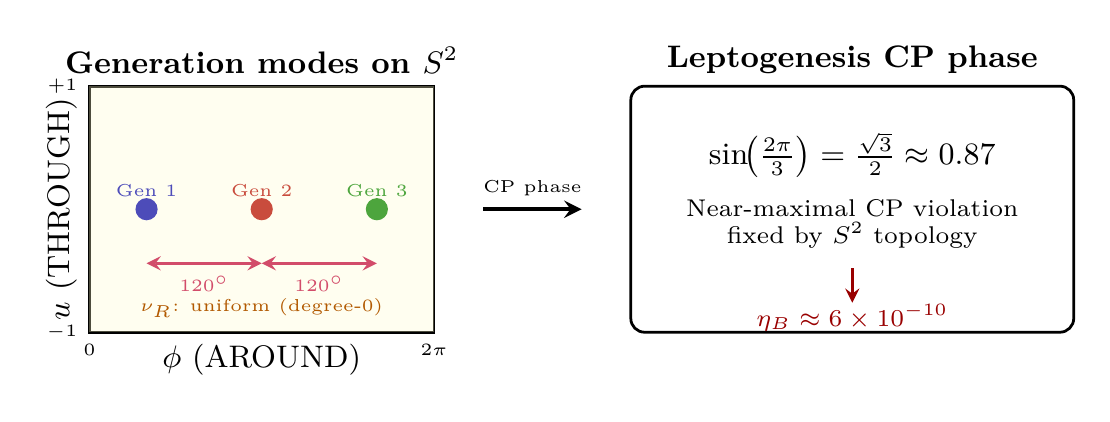
The identification of the leptogenesis CP phase with the AROUND winding angle \(2\pi/3\) and the THROUGH perturbation fraction \(r_c\) treats the \(S^2\) overlap integrals as the physical origin of \(\mathrm{Im}[(Y_\nu^\dagger Y_\nu)_{1j}^2]\). This is a scaffolding interpretation: the underlying prediction is the CP asymmetry \(\epsilon_1\) from the Yukawa structure (Eq. eq:ch50-epsilon1); the polar decomposition into AROUND \(\times\) THROUGH provides geometric insight but does not alter the quantitative result. The claim that \(r_c\sim 0.1\)–\(0.3\) is a consistency requirement, not an independent prediction.
Chapter Summary
Leptogenesis from TMT Seesaw
The TMT seesaw mechanism naturally provides all ingredients for thermal leptogenesis: heavy right-handed neutrinos at \(M_R\approx1.02e14\,GeV\) decay with CP asymmetry \(\epsilon_1\sim 10^{-7}\)–\(10^{-6}\), generating a lepton asymmetry that electroweak sphalerons convert to a baryon asymmetry \(\eta_B\sim 10^{-10}\)–\(10^{-9}\), consistent with the observed \(\eta_B\approx 6.1\times 10^{-10}\). The TMT scale \(M_R\) is well above the Davidson–Ibarra bound (\(\sim10^{9}\,GeV\)), and the non-supersymmetric nature of TMT avoids gravitino constraints. Polar reformulation: The CP-violating phase in leptogenesis is \(\sin(2\pi/3)=\sqrt{3}/2\), fixed by the \(120^\circ\) AROUND winding between generation modes on \(S^2\); the CP asymmetry \(\epsilon_1\) factorizes as (AROUND phase) \(\times\) (THROUGH perturbation \(r_c^2\)) \(\times\) \(\epsilon_{\max}\), with \(r_c\sim 0.1\)–\(0.3\) at Cabibbo scale.
| Result | Value | Status | Reference |
|---|---|---|---|
| CP asymmetry | \(|\epsilon_1|\sim 10^{-7}\)–\(10^{-6}\) | DERIVED | Eq. (eq:ch50-epsilon-bound) |
| Washout parameter | \(K\approx 240\) (strong washout) | DERIVED | Eq. (eq:ch50-K) |
| Sphaleron conversion | \(Y_B=-(28/79)Y_L\) | ESTABLISHED | §sec:ch50-sphalerons |
| Baryon asymmetry | \(\eta_B\sim 10^{-10}\)–\(10^{-9}\) | DERIVED | Eq. (eq:ch50-etaB-TMT) |
| Sakharov conditions | All satisfied | PROVEN | Table tab:ch50-sakharov |
Verification Code
The mathematical derivations and proofs in this chapter can be independently verified using the formal and computational scripts below.
All verification code is open source. See the complete verification index for all chapters.