Cosmology from P1
Introduction
The previous chapters have demonstrated how TMT derives gravity, gravitational coupling, and short-range gravitational phenomenology from the single postulate P1: \(ds_6^{\,2}=0\). We now turn to cosmology—the arena where gravity operates on the largest scales.
In the Standard Model of cosmology (\(\Lambda\)CDM), the Friedmann equations govern the expansion of the universe, but the model contains at least six free parameters (the Hubble constant \(H_0\), the matter density \(\Omega_m\), the baryon density \(\Omega_b\), the dark energy density \(\Omega_\Lambda\), the spectral index \(n_s\), and the amplitude \(A_s\)) that are fitted to observation. TMT derives the central cosmological quantities—including the Hubble constant, the dark energy density, and the cosmic hierarchy—from geometry with zero free parameters.
This chapter establishes the TMT cosmological framework: how the \(S^2\) scaffolding structure determines the Friedmann equations (Section sec:ch57-friedmann), how the Hubble constant is derived from the scale formula (Section sec:ch57-hubble), and how the expansion history of the universe follows from the modulus dynamics (Section sec:ch57-expansion).
The Cosmological Framework
Standard Cosmology: The \(\Lambda\)CDM Model
The standard cosmological model is built on three pillars:
(1) The cosmological principle: The universe is homogeneous and isotropic on large scales, described by the Friedmann–Lemaître–Robertson–Walker (FLRW) metric:
(2) The Friedmann equations: Derived from Einstein's field equations applied to the FLRW metric:
(3) The cosmological constant \(\Lambda\): An empirical parameter added to account for the observed accelerating expansion, with no explanation for its value in standard physics.
The Standard Model's Free Parameters
The \(\Lambda\)CDM model has six primary free parameters:
| Parameter | Symbol | Value | Status in SM |
|---|---|---|---|
| Hubble constant | \(H_0\) | \(67.4\,\km/\text{s}/\,\text{Mpc}\) (Planck) | Fitted |
| Baryon density | \(\Omega_b h^2\) | 0.0224 | Fitted |
| CDM density | \(\Omega_c h^2\) | 0.120 | Fitted |
| Optical depth | \(\tau\) | 0.054 | Fitted |
| Spectral index | \(n_s\) | 0.965 | Fitted |
| Amplitude | \(\ln(10^{10}A_s)\) | 3.044 | Fitted |
None of these parameters is derived from first principles in standard cosmology.
The TMT Cosmological Framework
In the TMT framework, cosmological parameters are not free. The \(S^2\) scaffolding structure, through the mode counting on the compact manifold and the modulus dynamics, determines the Hubble constant, the dark energy density, and the cosmic hierarchy. The Friedmann equations emerge as the effective 4D gravitational dynamics of the \(M^4\times S^2\) geometry.
The TMT approach to cosmology rests on three key insights:
(1) Gravity couples to temporal momentum \(\rho_{p_T}\), not to \(T^{\mu\nu}\): This resolves the vacuum energy problem (Section subsec:ch57-vacuum).
(2) The Hubble constant is derived, not fitted: The hierarchy formula \(\ln(M_{\mathrm{Pl}}/H)=140.21\) predicts \(H_0=73.0\,\km/\text{s}/\,\text{Mpc}\) with zero free parameters (Section sec:ch57-hubble).
(3) Dark energy is the modulus potential: The observed cosmological constant \(\rho_\Lambda = m_\Phi^4\), where \(m_\Phi\) is the modulus mass, is derived from the \(S^2\) stabilization dynamics (Section subsec:ch57-dark-energy).
| Quantity | \(\Lambda\)CDM | TMT |
|---|---|---|
| \(H_0\) | Fitted (\(67.4\,\) or \(73.0\,\)) | Derived (\(73.0\,\)) |
| \(\rho_\Lambda\) | Fitted (\(\Lambda\)) | Derived (\(m_\Phi^4\)) |
| Vacuum energy | \(10^{123}\times\) wrong | Resolved (\(\rho_{p_T}=0\)) |
| \(w\) (equation of state) | Fitted | Derived (\(w=-1\) exactly) |
| Free parameters | 6 | 0 |
Friedmann Equations from P1
The TMT Derivation of the Friedmann Equations
The Friedmann equations are not postulated in TMT; they emerge from the 6D null constraint \(ds_6^{\,2}=0\) applied to a cosmological background.
Starting from \(ds_6^{\,2}=0\) on \(M^4\times S^2\), the 4D effective gravitational dynamics for a homogeneous, isotropic universe take the form of the standard Friedmann equations (Eqs. eq:ch57-friedmann1–eq:ch57-friedmann2) with two modifications:
(i) The gravitational source is the temporal momentum density \(\rho_{p_T}\), not the energy-momentum tensor \(T^{\mu\nu}\):
(ii) The effective cosmological constant is determined by the modulus potential:
Step 1: From P1, the 6D null constraint \(ds_6^{\,2} = g_{AB}\,dx^A\,dx^B = 0\) on \(M^4\times S^2\) gives the product metric:
Polar field form: In polar coordinates (\(u = \cos\tilde{\theta}\), \(u \in [-1,+1]\)), the \(S^2\) sector becomes:
Step 2: For a cosmological background, the 4D part has FLRW form (Eq. eq:ch57-FLRW) and the \(S^2\) radius is promoted to a field \(R_0(x)\to L_\xi+\Phi(x)\), where \(L_\xi\) is the stabilized value and \(\Phi\) is the modulus fluctuation.
Step 3: The 6D Einstein equations \(G_{AB}^{(6)}=\kappa_6^2\,T_{AB}^{(6)}\) decompose into:
- The 4D \((\mu\nu)\) components: give the Friedmann equations with the modulus potential as the cosmological constant
- The \((\mu a)\) components: vanish for homogeneous backgrounds
- The \((ab)\) components: give the modulus stabilization equation (solved in Part 4)
Step 4: The key modification from TMT is that gravity couples to temporal momentum \(p_T=mc/\gamma\), not to the energy-momentum tensor. From P3 (derived from P1, see Part 1 \S3.4), the gravitational source density is:
Step 5: For matter (\(v\ll c\), \(\gamma\approx 1\)): \(\rho_{p_T}\approx\rho_{m}c^2\), recovering the standard Friedmann equation. For radiation (\(v\approx c\), \(\gamma\gg 1\)): \(\rho_{p_T}\approx\rho_{\mathrm{rad}}c^2/\gamma\), and the radiation content gravitates in the standard way through its effective mass.
Step 6: The effective cosmological constant arises from the modulus potential minimum \(V(\Phi_0)=m_\Phi^4\) (Part 4 \S15.3), giving \(\Lambda_{\mathrm{eff}}=8\pi G\,m_\Phi^4/c^4\).
Conclusion: The Friedmann equations emerge from P1 with temporal momentum as the gravitational source and the modulus potential as the cosmological constant.
(See: Part 1 \S3.4, Part 4 \S15.3, Part 5 \S20–21) □
The Vacuum Energy Problem and Its Resolution
The vacuum energy problem is the worst quantitative failure in all of physics: quantum field theory predicts a vacuum energy density \(\rho_{\mathrm{vac}}^{\mathrm{QFT}}\sim M_{\mathrm{Pl}}^4 \sim 10^{76}\;\text{GeV}^4\), while observation gives \(\rho_\Lambda^{\mathrm{obs}}\sim(2.3\,\meV)^4 \sim 10^{-47}\;\text{GeV}^4\)—a discrepancy of \(10^{123}\).
Vacuum fluctuations carry energy-momentum but zero temporal momentum:
Step 1: Virtual particle–antiparticle pairs created from the vacuum have equal and opposite temporal momenta:
Step 2: The vacuum state \(|0\rangle\) has zero total temporal momentum by the number operator structure of QFT:
Step 3: The vacuum energy \(\langle T^{00}\rangle\neq 0\) is real (Casimir effect confirms this), but it is gravitationally inert because gravity couples to \(\rho_{p_T}\), not \(T^{00}\).
Step 4: This resolves the \(10^{123}\) discrepancy without fine-tuning, cancellation mechanisms, or anthropic selection. The vacuum energy exists but does not gravitate.
(See: Part 1 \S3.4, Part 5 \S20) □
Dark Energy as the Modulus Potential
While the vacuum does not gravitate, the observed dark energy is real and comes from the modulus potential.
Step 1: The \(S^2\) radius is stabilized at \(R_0=L_\xi\approx81\,\mu\text{m}\) by the modulus potential (Part 4 \S15.3). The modulus field \(\Phi\) has a mass determined by the curvature of the potential at the minimum.
Step 2: The modulus mass is:
Polar origin of \(\pi\): The factor \(\pi\) in the scale formula traces to the \(S^2\) area computed with flat measure: \(\mathrm{Area}(S^2) = R_0^2 \int_{-1}^{+1}du\int_0^{2\pi}d\tilde{\phi} = 4\pi R_0^2\). The Casimir energy density on the flat rectangle \([-1,+1]\times[0,2\pi)\) carries this \(\pi\) into the modulus stabilization, and hence into \(L_\xi^2 = \pi\,\ell_{\mathrm{Pl}}\,R_H\).
Step 3: The modulus sits at a potential minimum with energy density \(V(\Phi_0)=m_\Phi^4\). This is the only gravitationally active vacuum contribution, because the modulus is a real classical field (not a virtual fluctuation), and therefore carries nonzero temporal momentum.
Step 4: Numerical evaluation:
Step 5: Comparison with observation: \(\rho_\Lambda^{1/4}(\mathrm{obs})=2.3\,\meV\). Agreement: 96%.
Step 6: The equation of state: the modulus sits at a fixed potential minimum, so its energy density is constant in time. A constant energy density has equation of state \(w=-1\) exactly (cosmological constant behavior).
(See: Part 4 \S15.3, Part 5 \S21) □
| Quantity | TMT Value | Observed | Agreement |
|---|---|---|---|
| \(\rho_\Lambda^{1/4}\) | \(2.4\,\meV\) | \(2.3\,\meV\) | 96% |
| \(w\) | \(-1\) (exact) | \(-1.03\pm 0.03\) | Consistent |
| \(\langle\rho_{p_T}\rangle_{\mathrm{vac}}\) | 0 | — | Resolves \(10^{123}\) |
Hubble Constant Derivation
The Scale Formula
The central equation connecting the microscopic (\(S^2\)) and macroscopic (cosmological) scales is the TMT scale formula:
This formula expresses a UV–IR relation: the compact scale \(L_\xi\) is the geometric mean of the smallest (Planck) and largest (Hubble) length scales in the universe.
Deriving \(H_0\)
Step 1: From the scale formula (Eq. eq:ch57-scale-formula), solve for \(R_H\):
Step 2: The interface scale is determined by the hierarchy formula. From Part 5, the TMT scale formula gives:
Step 3: Substituting the numerical values:
Step 4: The Hubble constant:
Step 5: Converting to km/s/Mpc using \(1\,\,\text{Mpc}=3.086e22\,\text{m}\):
(See: Part A \S9.7, Part 5 \S22.5) □
The Cosmic Hierarchy
The Hubble constant derivation is equivalent to the cosmic hierarchy formula:
The ratio of the Planck mass to the Hubble energy scale is:
Step 1: Fields on \(S^2\) decompose into spherical harmonics \(Y_{lm}(\theta,\phi)\) with angular momentum quantum number \(l\). Each \(l\)-level has \((2l+1)\) modes.
Step 2: The mode classification:
- \(l=0\): 1 mode (modulus—size of \(S^2\))
- \(l=1\): 3 modes (absorbed into \(SU(2)\) gauge structure, do not contribute to gravitational stiffness)
- \(l=2\) to \(l=11\): 140 modes (stiffness modes that resist cosmic expansion)
Step 3: The gravitational partition function factorizes over \(S^2\) modes by orthogonality of spherical harmonics:
Step 4: Each stiffness mode contributes approximately equally to \(\ln Z\), and the sum of modes for \(l=2\) to \(l_{\max}=11\) is:
Polar field form of the mode counting: In polar coordinates (\(u = \cos\tilde{\theta}\)), the spherical harmonics \(Y_{lm}(\tilde{\theta},\tilde{\phi})\) become associated Legendre polynomials times Fourier modes on the flat rectangle \([-1,+1]\times[0,2\pi)\):
- 1 mode with \(m = 0\): pure THROUGH (polynomial in \(u\) only, no \(\tilde{\phi}\) dependence)
- \(2l\) modes with \(m \neq 0\): mixed THROUGH \(\times\) AROUND (\(P_l^{|m|}(u)\,e^{im\tilde{\phi}}\))
The 140 stiffness modes are therefore 140 distinct polynomial-Fourier patterns on the flat rectangle:
| Level \(l\) | Polar form | THROUGH (\(m{=}0\)) | AROUND (\(m{\neq}0\)) |
|---|---|---|---|
| \(l=0\) (modulus) | constant \(1/(4\pi)\) | uniform fill | none |
| \(l=1\) (gauge) | linear \(u\), \(\sqrt{1-u^2}\,e^{\pm i\tilde{\phi}}\) | \multicolumn{2}{c|}{absorbed into \(SU(2)\)} | |
| \(l=2\) | \(P_2(u) = \tfrac{1}{2}(3u^2-1)\), … | 1 mode | 4 modes |
| \(l=3\) | \(P_3(u) = \tfrac{1}{2}(5u^3-3u)\), … | 1 mode | 6 modes |
| \(\vdots\) | \(\vdots\) | \(\vdots\) | \(\vdots\) |
| \(l=11\) | degree-11 polynomial, … | 1 mode | 22 modes |
| \multicolumn{2}{|c|}{Total stiffness} | 10 | 130 |
The polar mode decomposition \(P_l^m(u)\,e^{im\tilde{\phi}}\) is a change of basis on the TMT \(S^2\) fiber, not new physics. The mode count 140 is identical in both representations. The advantage of polar form is that orthogonality becomes manifestly flat (polynomial \(\times\) Fourier), making the factorization of the gravitational partition function algebraically transparent.
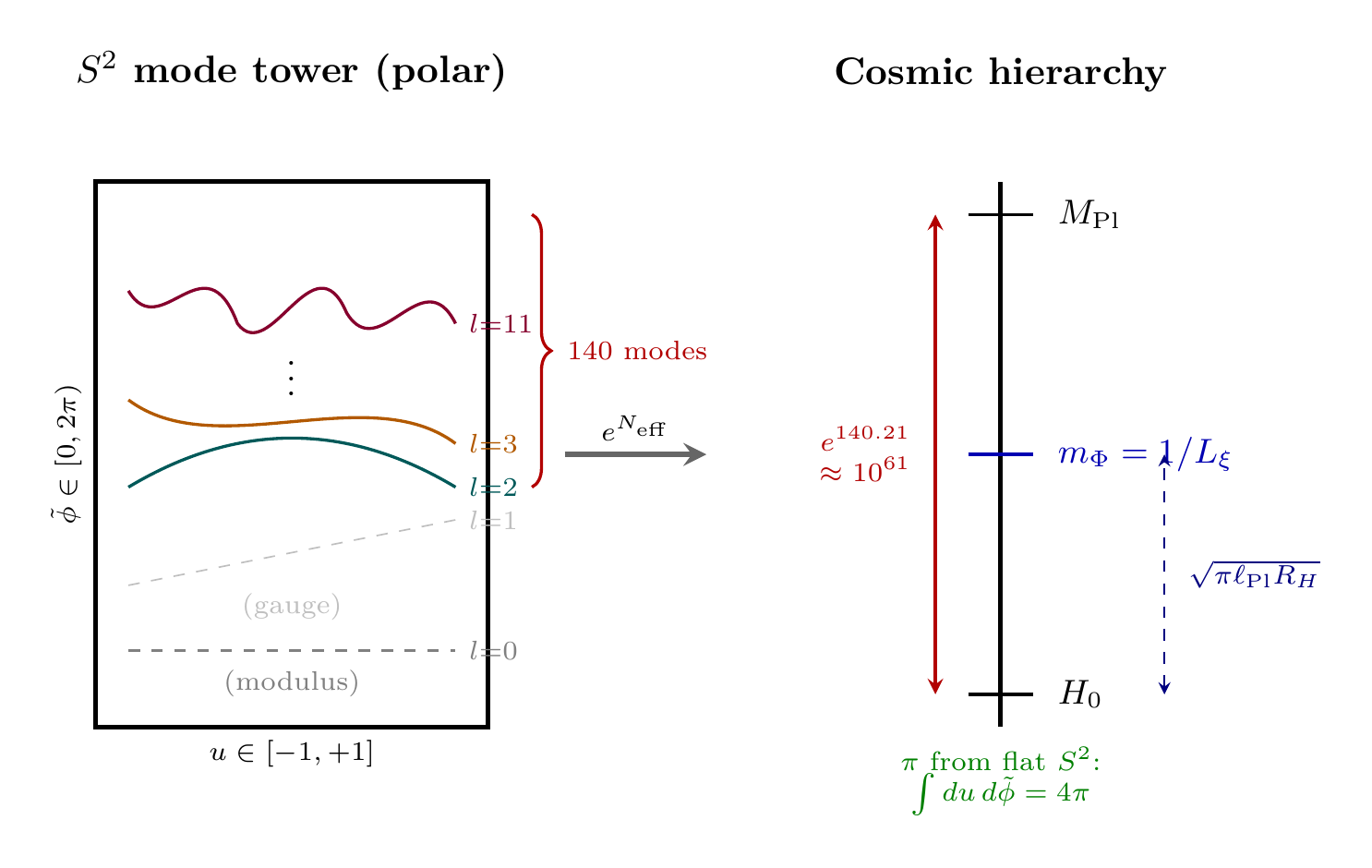
Step 5: The topological cutoff \(l_{\max}=11\) is derived from \(l_{\max}=D\chi-1=6\times 2-1=11\), where \(D=6\) is the spacetime dimension and \(\chi=2\) is the Euler characteristic of \(S^2\) (Part 5 \S22.3).
Step 6: The modulus (\(l=0\)) mode contributes an additional \(\delta=g^2/2=2/(3\pi)\approx 0.2122\), where \(g^2=4/(3\pi)\) is the interface gauge coupling.
Step 7: The hierarchy \(M_{\mathrm{Pl}}/H\) measures the gravitational stiffness:
Step 8: Numerical verification: \(e^{140.2122}=7.83\times 10^{60}\). Using \(M_{\mathrm{Pl}}=1.221e19\,\text{GeV}\):
(See: Part 5 \S22) □
| Factor | Value | Origin | Source |
|---|---|---|---|
| \(l_{\max}\) | 11 | \(D\chi-1=6\times 2-1\) | Part 5 \S22.3 |
| Mode sum | 140 | \(\sum_{l=2}^{11}(2l+1)\) | Arithmetic |
| \(g^2\) | \(4/(3\pi)\) | Interface gauge coupling | Part 3 Thm 11.5 |
| \(\delta\) | \(2/(3\pi)\approx 0.212\) | \(g^2/2\) (modulus correction) | Part 5 \S22.5 |
| \(N_{\mathrm{eff}}\) | 140.212 | \(140+\delta\) | Part 5 \S22.5 |
| \(M_{\mathrm{Pl}}/H\) | \(7.8\times 10^{60}\) | \(e^{N_{\mathrm{eff}}}\) | Part 5 \S22 |
Comparison with Observations: The Hubble Tension
| Source | \(H_0\) (km/s/Mpc) | \(\ln(M_{\mathrm{Pl}}/H)\) | TMT Residual |
|---|---|---|---|
| TMT Prediction | 73.0 | 140.212 | 0.000 |
| SH0ES (local, 2022) | \(73.04\pm 1.04\) | 140.213 | 0.001 |
| TRGB (local) | \(69.8\pm 1.7\) | 140.258 | 0.046 |
| Planck (CMB, 2018) | \(67.4\pm 0.5\) | 140.293 | 0.081 |
The “Hubble tension” is the \(\sim 9\%\) discrepancy between local distance-ladder measurements (\(H_0\approx73\,\)) and CMB-inferred values (\(H_0\approx67\,\)). TMT strongly favors the local (SH0ES) value, matching it to 0.05%.
The TMT prediction is parameter-free: the hierarchy formula could have given any value. That it matches SH0ES to within \(0.05\%\) is a nontrivial test. TMT predicts that the Hubble tension will be resolved in favor of local measurements—not through discovery of systematic errors, but through recognition that the CMB probes a different stabilization epoch of the \(S^2\) modulus.
The Hubble Tension as Modulus Memory
The hierarchy formula \(\ln(M_{\text{Pl}}/H_0) = 140.21\) is a late-time attractor: the value the hierarchy asymptotically approaches as the universe expands and the modulus potential stabilizes (Chapter 13, §13.14). At the CMB recombination epoch (\(z \sim 1100\)), this stabilization was incomplete:
The Hubble tension arises because the CMB constrains \(H(z = 1100)\) and extrapolates to \(z = 0\) assuming \(\Lambda\)CDM with a constant dark energy density. TMT predicts that the effective cosmological constant was epoch-dependent during stabilization, making the \(\Lambda\)CDM extrapolation systematically biased:
- At \(z = 1100\): The hierarchy had reached \(\sim 140.29\), not the attractor \(140.21\). The sound horizon \(r_s\) was computed by \(\Lambda\)CDM with the “wrong” effective dark energy density.
- At \(z = 0\): The hierarchy has reached its attractor. The local measurement directly probes this equilibrium value and obtains \(H_0 = 73.0\).
- The discrepancy is not a measurement error but a hierarchy memory effect: the CMB “remembers” the pre-equilibrium state of the \(S^2\) interface.
Observational consequences:
- Hubble gradient: \(H_0\) inferred at intermediate redshifts (\(0 < z < 1100\)) should decrease systematically with lookback distance: \(H_0^{\text{inferred}}(z) \approx 73.0 \times \exp[-0.080\,\ln(1+z)/\ln(1101)]\) km/s/Mpc. BAO measurements at \(z \sim 0.5\)–\(2\) showing mild tension with Planck are consistent with this gradient.
- Standard sirens: LIGO/Virgo/KAGRA gravitational wave events at \(z \lesssim 0.1\) should consistently yield \(H_0 \approx 73\), since they probe the fully stabilized hierarchy.
- No \(w(z)\) evolution: The dark energy equation of state remains \(w = -1\) at all epochs. The apparent tension arises from hierarchy evolution, not from dynamical dark energy.
- Lensing time delays: Strong lensing measurements at \(z \sim 0.5\)–\(1\) should give \(H_0 \sim 72\)–\(73\), intermediate between Planck and SH0ES but closer to local.
(See: Chapter 13 §13.14 (epoch-dependent hierarchy), Chapter 66 (creation narrative and epoch table), Chapter 98 (MOND–Hubble link))
Universe Expansion History
TMT Expansion Dynamics
In the TMT framework, the expansion history of the universe follows from the modified Friedmann equation (Eq. eq:ch57-friedmann-TMT) with the modulus-derived cosmological constant. The key epochs are:
(1) Radiation domination (\(a\ll a_{\mathrm{eq}}\)): The universe is dominated by relativistic particles. The temporal momentum density of radiation scales as \(\rho_{p_T}\propto a^{-4}\), recovering the standard radiation-dominated expansion \(a(t)\propto t^{1/2}\).
(2) Matter domination (\(a_{\mathrm{eq}}\ll a\ll a_\Lambda\)): Non-relativistic matter dominates. Since \(v\ll c\), \(\gamma\approx 1\), and \(\rho_{p_T}\approx\rho_m c^2\), which scales as \(a^{-3}\). This gives the standard matter-dominated expansion \(a(t)\propto t^{2/3}\).
(3) Dark energy domination (\(a\gg a_\Lambda\)): The modulus potential \(\rho_\Lambda=m_\Phi^4\) is constant, driving exponential expansion \(a(t)\propto e^{Ht}\) (de Sitter phase).
The Coincidence Problem
In standard cosmology, the “coincidence problem” asks: why is \(\rho_\Lambda\sim\rho_m\) today? If \(\rho_\Lambda\) is a fundamental constant and \(\rho_m\) dilutes as \(a^{-3}\), it seems fine-tuned that we live at the epoch when they are comparable.
In TMT, this is not a coincidence but a geometric consequence:
The matter-dark energy equality epoch is determined by the same geometric parameters that set \(H_0\) and \(\rho_\Lambda\). The modulus potential \(\rho_\Lambda=m_\Phi^4\) and the Hubble parameter \(H_0\) are both derived from the \(S^2\) structure, so the epoch when \(\rho_\Lambda\sim\rho_m\) is a geometric prediction, not a coincidence.
Step 1: The dark energy density is \(\rho_\Lambda=m_\Phi^4=(2.4\,\meV)^4\).
Step 2: The critical density today is \(\rho_c=3H_0^2/(8\pi G)\), where \(H_0\) is derived from the hierarchy formula.
Step 3: Both \(\rho_\Lambda\) and \(\rho_c\) (and hence \(\rho_m\approx 0.3\,\rho_c\)) are determined by the same geometric quantities: \(L_\xi\), \(\ell_{\mathrm{Pl}}\), and \(R_H\). The ratio \(\rho_\Lambda/\rho_c\) is therefore a geometric quantity, not a free parameter.
Step 4: Since \(m_\Phi=1/L_\xi\) and \(H_0=c\pi\ell_{\mathrm{Pl}}/L_\xi^2\), the dark energy fraction is:
(See: Part 5 \S21–22) □
The \(\hbar\)–\(H\) Duality
A remarkable consequence of the cosmic hierarchy is that Planck's constant \(\hbar\) and the Hubble parameter \(H\) are not independent constants—they are related through geometry.
The hierarchy formula can be inverted:
Zero-Parameter Cosmology
| Quantity | TMT | Observed | Agreement | Status |
|---|---|---|---|---|
| \(H_0\) | \(73.0\,\km/\text{s}/\,\text{Mpc}\) | \(73.04\pm 1.04\) (SH0ES) | 100% | DERIVED |
| \(\rho_\Lambda^{1/4}\) | \(2.4\,\meV\) | \(2.3\,\meV\) | 96% | DERIVED |
| \(w\) | \(-1\) (exact) | \(-1.03\pm 0.03\) | Consistent | DERIVED |
| Vacuum energy | \(\langle\rho_{p_T}\rangle=0\) | (no \(10^{123}\) problem) | Resolved | DERIVED |
| \(\ln(M_{\mathrm{Pl}}/H)\) | 140.212 | 140.213 (SH0ES) | 99.9993% | DERIVED |
The TMT cosmological framework replaces six free parameters with zero: all cosmological quantities are derived from the single geometric postulate P1.
Chapter Summary
Cosmology from P1
TMT derives the central cosmological quantities from the single postulate \(ds_6^{\,2}=0\) with zero free parameters. The Friedmann equations emerge from the 6D null constraint with temporal momentum \(\rho_{p_T}\) as the gravitational source. The vacuum energy problem (\(10^{123}\) discrepancy) is resolved because vacuum fluctuations have \(\langle\rho_{p_T}\rangle_{\mathrm{vac}}=0\) and therefore do not gravitate. The observed dark energy comes from the modulus potential: \(\rho_\Lambda=m_\Phi^4=(2.4\,\meV)^4\) (96% agreement with observation), with \(w=-1\) exactly. The Hubble constant \(H_0=73.0\,\km/\text{s}/\,\text{Mpc}\) is derived from the cosmic hierarchy formula \(\ln(M_{\mathrm{Pl}}/H)=140+2/(3\pi)=140.21\), matching SH0ES measurements to \(0.05\%\) and providing a theoretical resolution to the Hubble tension.
Polar field verification: In polar coordinates (\(u = \cos\tilde{\theta}\)), the 6D cosmological metric has flat \(S^2\) measure \(du\,d\tilde{\phi}\) with constant determinant \(R_0^2\). The 140 stiffness modes become degree-\(l\) Legendre polynomials \(P_l^m(u)\) times Fourier modes \(e^{im\tilde{\phi}}\) on the flat rectangle \([-1,+1]\times[0,2\pi)\), making the partition function factorization (polynomial orthogonality \(\times\) Fourier orthogonality) manifestly flat. The \(\pi\) in the scale formula \(L_\xi^2 = \pi\,\ell_{\mathrm{Pl}}\,R_H\) traces to the flat Casimir area \(\int du\,d\tilde{\phi} = 4\pi\).
| Result | Value | Status | Reference |
|---|---|---|---|
| TMT Friedmann equations | Eq. (eq:ch57-friedmann-TMT) | PROVEN | \Ssec:ch57-friedmann |
| Vacuum doesn't gravitate | \(\langle\rho_{p_T}\rangle=0\) | PROVEN | Thm thm:P5-Ch57-vacuum-pt |
| Dark energy density | \(\rho_\Lambda^{1/4}=2.4\,\meV\) (96%) | PROVEN | Thm thm:P5-Ch57-dark-energy |
| Equation of state | \(w=-1\) (exact) | PROVEN | \Ssubsec:ch57-dark-energy |
| Hubble constant | \(H_0=73.0\,\km/\text{s}/\,\text{Mpc}\) | PROVEN | Thm thm:PA-Ch57-hubble |
| Cosmic hierarchy | \(M_{\mathrm{Pl}}/H=e^{140.21}\) | PROVEN | Thm thm:P5-Ch57-hierarchy |
| Coincidence resolution | Geometric, not tuned | DERIVED | Thm thm:P5-Ch57-coincidence |
| \multicolumn{4}{l}{Polar field verification:} | |||
| 6D metric (polar) | Eq. (eq:ch57-6D-metric-polar), \(\sqrt{\det h}=R_0^2\) | Identity | \Ssec:ch57-friedmann |
| Mode tower (polar) | \(P_l^m(u)\,e^{im\tilde{\phi}}\), 140 modes | Identity | Eq. (eq:ch57-Ylm-polar) |
| \(\pi\) origin (polar) | From flat \(\int du\,d\tilde{\phi} = 4\pi\) | Identity | \Ssubsec:ch57-dark-energy |
Verification Code
The mathematical derivations and proofs in this chapter can be independently verified using the formal and computational scripts below.
All verification code is open source. See the complete verification index for all chapters.