Why No Other Particle Content
Introduction
Chapter 21 derived the Standard Model hypercharges as the unique solution to the anomaly cancellation equations, given the TMT-derived gauge group and representation content. This chapter goes further: we prove that the SM particle spectrum is not merely derived but is the only anomaly-free chiral spectrum compatible with the \(S^2\) geometry.
This is a crucial distinction. In the Standard Model, one might imagine adding a fourth generation, exotic fermions, additional gauge bosons, or supersymmetric partners—the framework does not forbid them. In TMT, each of these possibilities is ruled out by explicit geometric or consistency arguments.
Central Result of This Chapter. The Standard Model particle content—three generations of quarks and leptons with their exact quantum numbers, one Higgs doublet, and 12 gauge bosons—is the unique chiral spectrum derivable from \(ds_6^{\,2} = 0\) on \(\mathcal{M}^4 \times S^2\). No fourth generation, no chiral exotics, no \(Z'\), no SUSY partners, no additional Higgs doublets are permitted by the geometry.
agraph{Structure.} We systematically eliminate alternatives:
- No 4th generation (\Ssec:ch22-no-4th-gen)
- Hypercharge rigidity (\Ssec:ch22-hypercharge-rigidity)
- Neutrino sectors: only the seesaw works (\Ssec:ch22-neutrino-seesaw)
- No exotic particles required (\Ssec:ch22-no-exotics)
- No \(Z'\), SUSY, or other extensions (\Ssec:ch22-no-extensions)
All arguments in this chapter operate within the 4D effective theory that emerges from the \(S^2\) projection geometry. The “no-go” results follow from the topology and isometry of \(S^2\), not from any assumption about physics in extra dimensions.
No 4th Generation
A sequential fourth fermion generation is forbidden in TMT. The \(S^2\) geometry with a single monopole (\(q = 1/2\)) supports exactly \(N_{\mathrm{gen}} = 3\) generations, with no geometric mechanism for a fourth.
Step 1 (Generation origin): From Chapter 21, Theorem thm:P11-Ch21-three-generations, the three generations arise from the \(\ell = 1\) multiplet on \(S^2\) with degeneracy \(2\ell + 1 = 3\).
Step 2 (Why \(\ell = 0\) fails): The \(\ell = 0\) mode is excluded because a constant wavefunction on \(S^2\) cannot satisfy the monopole boundary conditions (the covariant derivative \(D_{\phi}\psi_{0} = -iqA_{\phi}\psi_{0} \neq 0\)).
Step 3 (Why a 4th state in \(\ell = 1\) is impossible): The \(\ell = 1\) multiplet has exactly \(2(1) + 1 = 3\) states (\(m = -1, 0, +1\)). This is a mathematical property of angular momentum—there is no “fourth” state.
Step 4 (Could a 4th generation come from higher \(\ell\)?): The next multiplet is \(\ell = 2\), with energy \(E \sim j(j+1)/R_{0}^{2}\) where \(j = \ell + 1 = 3\). Compared to \(\ell = 1\) (\(j = 2\), \(E \propto 6\)):
Step 5 (Anomaly argument): Four copies of SM fermions with identical hypercharges would still satisfy anomaly cancellation (the anomaly conditions are linear in the generation count). So anomaly cancellation alone does not forbid a 4th generation. However, the geometric origin of generations does: \(\ell = 1\) on \(S^2\) with one monopole gives exactly three degenerate states and no more.
Step 6 (Experimental confirmation): Precision electroweak measurements at LEP determined \(N_{\nu} = 2.984 \pm 0.008\) from the \(Z\)-boson invisible width. TMT predicts \(N_{\text{gen}} = 3\) exactly, consistent with experiment.
(See: Part 11 \S229.1.1 (Theorem 229.1); Part 6 \S85.2; LEP Electroweak Working Group) □
Polar Perspective: Why Exactly Three and No More
In polar coordinates \(u = \cos\theta\), the 4th-generation exclusion is algebraically transparent. The \(\ell = 1\) monopole harmonics are degree-1 polynomials in \(u\):
The next possibility (\(\ell = 2\)) involves degree-2 polynomials \(\{u^2, u(1\pm u), (1\pm u)^2\}\), which have THROUGH eigenvalues \(\lambda = \ell(\ell+1)/R_0^2 = 6/R_0^2\) versus \(2/R_0^2\) for \(\ell = 1\). In the polar variable, the energy gap between generations (\(\ell = 1\)) and the next KK level (\(\ell = 2\)) is the gap between linear and quadratic polynomials in \(u\) — a qualitative difference, not a small perturbation.
agraph{Counterfactual.} If the compact space were \(S^{3}\) instead of \(S^2\): the angular momentum multiplets on \(S^{3}\) have degeneracy \((2\ell+1)^{2}\), which for \(\ell = 1\) gives 9 generations. The geometry selects the generation number; \(S^2\) gives exactly 3.
Hypercharge Rigidity
Any modification to the SM hypercharge assignments would either:
- violate anomaly cancellation, or
- destroy electric charge quantisation, or
- require compensating exotic fermions.
The SM hypercharges are the unique anomaly-free assignment compatible with the TMT-derived gauge group and representation structure.
From Chapter 21, Theorem thm:P11-Ch21-unique-hypercharge, the anomaly equations (A1)–(A4) plus charge quantisation yield a unique solution for all hypercharges in terms of \(Y_{Q} = 1/6\).
Explicit counterfactual 1: Suppose \(Y_{u_{R}} = 1\) instead of \(2/3\).
From equation (A1): \(Y_{d_{R}} = 2Y_{Q} - Y_{u_{R}} = 2(1/6) - 1 = -2/3\).
Electric charges: \(Q_{u} = T_{3} + Y_{u_{R}} = 0 + 1 = 1\) (not \(2/3\)). This contradicts observation.
Alternatively, to maintain \(Q_{u} = 2/3\) with \(Y_{u_{R}} = 1\), we would need \(T_{3}(u_{R}) = -1/3\), but right-handed fermions are SU(2) singlets with \(T_{3} = 0\). Contradiction.
Explicit counterfactual 2: Suppose \(Y_{L_{L}} = -1\) instead of \(-1/2\).
From equation (A2): \(3Y_{Q} + Y_{L} = 0\) gives \(Y_{Q} = 1/3\) (not \(1/6\)). Then:
Explicit counterfactual 3: Try \(Y_{Q} = 1/3\) (double the SM value).
The anomaly equations still determine all other hypercharges:
(See: Part 11 \S229.1.2 (Theorem 229.2)) □
In the Standard Model, the hypercharges can be continuously deformed while maintaining anomaly cancellation, because the normalisation is a free parameter. In TMT, the normalisation is fixed by Dirac quantisation on \(S^2\), eliminating this freedom entirely. The hypercharges are not just anomaly-consistent—they are anomaly-determined.
Neutrino Sectors: Only Seesaw Works
The Special Status of \(\nu_{R}\)
The right-handed neutrino \(\nu_{R} = (\mathbf{1}, \mathbf{1}, 0)\) is a complete singlet under the full gauge group. It is allowed (but not required) by anomaly cancellation, and it is geometrically natural in TMT.
Step 1: A field with quantum numbers \((\mathbf{1}, \mathbf{1}, 0)\) carries no colour, no weak isospin, and no hypercharge.
Step 2: Its contribution to all anomalies is zero:
Step 3 (Geometric naturalness): In TMT, \(\nu_{R}\) does not couple to the monopole (\(q = Y = 0\)). Its wavefunction on \(S^2\) is uniform: \(\psi = 1/\sqrt{4\pi}\). This uniformity is the geometric origin of its unique properties—it “sees” the entire \(S^2\) equally, unlike charged fermions that are localised near the poles.
(See: Part 11 \S230.1 (Theorem 230.1); Part 6 \S62–63) □
Polar Perspective: \(\nu_R\) as the Uniform Mode
In polar coordinates, \(\nu_R\) with \(Y = 0\) has no AROUND winding: its transition function is \(g_{NS} = e^{i \cdot 0 \cdot \phi} = 1\) (trivial). Its wavefunction is constant in both \(u\) and \(\phi\) — the unique function on the polar rectangle \([-1,+1] \times [0,2\pi)\) that has no THROUGH gradient and no AROUND phase. This is the degree-0 mode that is excluded from the charged fermion spectrum (Chapter 21) but permitted for the uncharged singlet.
The \(\nu_R\) is the only fermion whose wavefunction is uniform on the polar rectangle. All other fermions have either THROUGH gradients (from \(|Y_\pm|^2 = (1\pm u)/(4\pi)\)), AROUND winding (from hypercharge \(e^{iY\phi}\)), or both. The uniformity of \(\nu_R\) is why it decouples from all gauge interactions: gauge coupling requires overlap with non-uniform (polynomial \(\times\) Fourier) monopole harmonics, and a constant function is orthogonal to all such modes in the AROUND direction.
Why the Seesaw Mechanism Is Required
Since \(\nu_{R}\) is a complete gauge singlet, it can have a Majorana mass \(M_{R}\) not protected by any gauge symmetry. The seesaw mechanism—combining a Dirac mass \(m_{D} \sim v\) (from Yukawa coupling to the Higgs) with a large Majorana mass \(M_{R}\)—is the unique mass mechanism that:
- is consistent with the gauge quantum numbers,
- explains the smallness of observed neutrino masses, and
- does not require any additional fields beyond those derived from \(S^2\).
Step 1 (Dirac mass alone fails): A purely Dirac neutrino mass \(m_{\nu} = y_{\nu} v / \sqrt{2}\) would require \(y_{\nu} \sim 10^{-13}\) to reproduce \(m_{\nu} \lesssim 0.1\;\text{eV}\). While not forbidden, this extreme hierarchy is unnatural and has no geometric explanation in TMT.
Step 2 (Majorana mass is allowed): Since \(\nu_{R}\) is a gauge singlet, a Majorana mass term \(\frac{1}{2}M_{R}\overline{\nu_{R}^{c}}\nu_{R}\) is gauge-invariant. No symmetry forbids it. In TMT, \(M_{R}\) is set by the interface scale—Part 6 \S71 derives \(M_{R} \sim 10^{14}\;\text{GeV}\).
Step 3 (Seesaw formula): The mass matrix in the \((\nu_{L}, \nu_{R})\) basis is:
Diagonalising for \(M_{R} \gg m_{D}\):
With \(m_{D} \sim v \approx 246\;\text{GeV}\) and \(M_{R} \sim 10^{14}\;\text{GeV}\):
Step 4 (No alternatives): Type-II seesaw (requires an SU(2) triplet Higgs) and Type-III seesaw (requires an SU(2) triplet fermion) both require additional fields not present in the TMT-derived spectrum. Only the Type-I seesaw, using the geometrically natural \(\nu_{R}\), is available.
(See: Part 11 \S230.1; Part 6 \S62–63, \S71) □
| Mechanism | Required BSM content | TMT status | Viable? |
|---|---|---|---|
| Type-I seesaw | \(\nu_{R}\) (gauge singlet) | Geometrically natural | \checkmark |
| Type-II seesaw | SU(2) triplet scalar \(\Delta\) | Not in \(S^2\) spectrum | \(\times\) |
| Type-III seesaw | SU(2) triplet fermion \(\Sigma\) | Not in \(S^2\) spectrum | \(\times\) |
| Inverse seesaw | Additional singlets \(S\) | No geometric origin | \(\times\) |
| Dirac only | None (but \(y_{\nu} \sim 10^{-13}\)) | Unnatural, no explanation | \(\times\) |
No Exotic Particles Required
Quarks Require Leptons
We proved in Chapter 21 (Theorem thm:P11-Ch21-quarks-require-leptons) that quarks and leptons are anomaly partners: the \([\text{U}(1)]^{3}\) anomaly gives \(-3/4\) from quarks and \(+3/4\) from leptons, cancelling exactly. This means:
- A quark-only universe is inconsistent (anomalous).
- A lepton-only universe is equally inconsistent.
- The quark and lepton sectors must coexist with their exact hypercharge values.
No additional “exotic” fermions are needed to achieve anomaly cancellation—the SM content is self-consistent and complete.
Chiral vs. Vector-Like Exotics
TMT forbids additional chiral fermions beyond the SM spectrum. Any exotic fermion with non-SM quantum numbers that contributes to anomaly conditions would break the uniqueness of the hypercharge solution.
Step 1: From Chapter 21, the anomaly equations with 5 fermion multiplets per generation have a unique solution (Theorem thm:P11-Ch21-unique-hypercharge).
Step 2: Adding a 6th chiral multiplet introduces a new hypercharge variable and modifies the anomaly equations. The system becomes underdetermined: 4 equations with 6 unknowns, yielding a two-parameter family of solutions. The SM hypercharges would no longer be unique.
Step 3: Since the \(S^2\) geometry produces exactly 5 chiral multiplets per generation (determined by the colour \(\times\) isospin decomposition of the allowed representations), no 6th multiplet exists.
Conclusion: The chiral spectrum is uniquely the SM spectrum.
(See: Part 11 \S229.2 (Theorem 229.5)) □
Vector-like fermions—pairs \((\psi_{L}, \psi_{R})\) with identical quantum numbers—contribute zero to all anomalies (their contributions cancel between L and R components). TMT does not forbid heavy vector-like exotics; it forbids chiral exotics. If BSM fermions exist, they must be vector-like. This is consistent with the non-observation of chiral exotics at the LHC.
The Uniqueness Theorem
Given the TMT geometric structure (P1 \(\to\) \(\mathcal{M}^4 \times S^2\) with monopole), the anomaly-free chiral fermion spectrum is uniquely the Standard Model spectrum: three generations of
Assembling all results:
- Gauge group \(\text{SU}(3) \times \text{SU}(2) \times \text{U}(1)\) is uniquely determined by \(S^2 \subset \mathbb{C}^{3}\) (Chapter 19).
- Three generations from \(\ell = 1\) monopole multiplet (Chapter 21).
- Five chiral multiplets per generation from renormalisability + geometric structure (\Ssubsec:ch22-chiral-vs-vector).
- Hypercharges uniquely determined by anomaly cancellation + charge quantisation (Chapter 21).
- No alternatives survive: no 4th generation (\Ssec:ch22-no-4th-gen), no hypercharge modifications (\Ssec:ch22-hypercharge-rigidity), no chiral exotics (Theorem thm:P11-Ch22-no-chiral-exotics).
The Standard Model particle content is DERIVED, not assumed.
(See: Part 11 \S229.2 (Theorem 229.5); Chapters 19, 21) □
No \(Z'\), SUSY, or Other Extensions
No \(Z'\) from \(S^2\) Geometry
TMT geometry supports exactly one U(1) factor, forbidding \(Z'\) bosons or additional neutral gauge fields.
Step 1: The \(\text{U}(1)_{Y}\) arises from \(\pi_{2}(S^2) = \mathbb{Z}\) (Part 3 \S8.4, Chapter 17). This homotopy group has rank 1, supporting exactly one U(1) gauge field.
Step 2: A \(Z'\) would require a second U(1), which would need either:
- \(\pi_{2}(K^{2})\) having rank \(\geq 2\) (impossible for \(S^2\), since \(\pi_{2}(S^2) \cong \mathbb{Z}\) is rank 1), or
- an additional topological structure not present in the TMT geometry.
Step 3: Since TMT has only \(S^2\) with one monopole, there is exactly one U(1) gauge field. No \(Z'\), no dark photon, no additional neutral boson.
Counterfactual: If the compact space were \(S^2 \times S^2\) (two independent 2-spheres): \(\pi_{2}(S^2 \times S^2) = \mathbb{Z} \oplus \mathbb{Z}\), rank 2, giving two U(1) factors. But TMT derives one \(S^2\), not two.
(See: Part 11 \S229.1.4 (Theorem 229.4); Part 3 \S8.4) □
No Supersymmetry from \(S^2\) Geometry
TMT does not predict or require supersymmetry. The hierarchy problem that motivated SUSY is resolved by the interface mechanism (Chapter 13), and the gauge coupling unification that SUSY achieves through grand unification is replaced by the TMT Transformer Equation (Chapter 20).
Step 1 (Hierarchy problem): In the SM, the Higgs mass receives quadratically divergent radiative corrections \(\delta m_{H}^{2} \sim \Lambda^{2}\). SUSY cancels these via boson–fermion partner loops. TMT resolves the hierarchy differently: the modulus stabilisation mechanism (Part 4, Chapter 13) fixes \(M_{6} = 7296\;\text{GeV}\) and \(v = 246\;\text{GeV}\) without fine-tuning.
Step 2 (Gauge coupling unification): SUSY GUTs predict coupling unification at \(M_{\text{GUT}} \sim 10^{16}\;\text{GeV}\). TMT does not require unification into a single group. Instead, the Transformer Equation \(g_{G}^{2} = (4/3\pi) \times d_{C}(X_{G})\) relates all couplings at the interface scale (Chapter 20).
Step 3 (Minimal Higgs sector): SUSY requires at least two Higgs doublets (\(H_{u}\) and \(H_{d}\)). TMT derives exactly one Higgs doublet from the \(j = 1/2\) monopole harmonic ground state. A second doublet has no geometric origin.
Step 4 (Experimental status): LHC searches at \(\sqrt{s} = 13\;\text{TeV}\) have found no evidence for superpartners. Gluino and squark mass limits exceed \(\sim 2\;\text{TeV}\). TMT is consistent with these null results.
(See: Part 4 \S14–16 (hierarchy); Part 3 \S11–13 (couplings); Part 2 \S2A.2.7 (Higgs)) □
No Grand Unification Required
This was established in Chapter 19, \S19.7, but we summarise the key points for completeness.
| Feature | GUT approach | TMT approach |
|---|---|---|
| Gauge group origin | Single group at \(M_{\text{GUT}}\) | Three geometric structures on \(S^2\) |
| Coupling unification | RG running to one point | Transformer Equation at \(M_{6}\) |
| Proton decay | Predicted (\(\tau_{p} \sim 10^{34-36}\) yr) | No mediating leptoquarks |
| Charge quantisation | From group theory (e.g., SU(5)) | From Dirac quantisation on \(S^2\) |
| Doublet–triplet problem | Severe fine-tuning | Does not arise |
| Magnetic monopoles | Predicted (3D, superheavy) | \(S^2\) monopole (not 3D) |
Falsifiability Summary
| Discovery | Why it would falsify TMT | Current status |
|---|---|---|
| 4th sequential generation | \(\ell = 1\) gives exactly 3 | Not found (LEP: \(N_{\nu} = 2.984 \pm 0.008\)) |
| \(Z'\) with SM couplings | Only one U(1) from \(\pi_{2}(S^2)\) | Not found (\(M_{Z'} > 5\;\text{TeV}\)) |
| Chiral exotic fermions | Anomaly uniqueness violated | Not found |
| 3D magnetic monopole | TMT monopole is on \(S^2\), not 3D | Not found |
| Additional Higgs doublet | Single \(j = 1/2\) ground state | Not found |
| SUSY partners | No geometric origin | Not found (\(m_{\tilde{g}} > 2\;\text{TeV}\)) |
Current experimental status: No observation contradicts the TMT predictions. Every null result at the LHC—no SUSY, no \(Z'\), no exotic fermions, no extra Higgs—is consistent with the TMT derivation.
Derivation Chain Summary
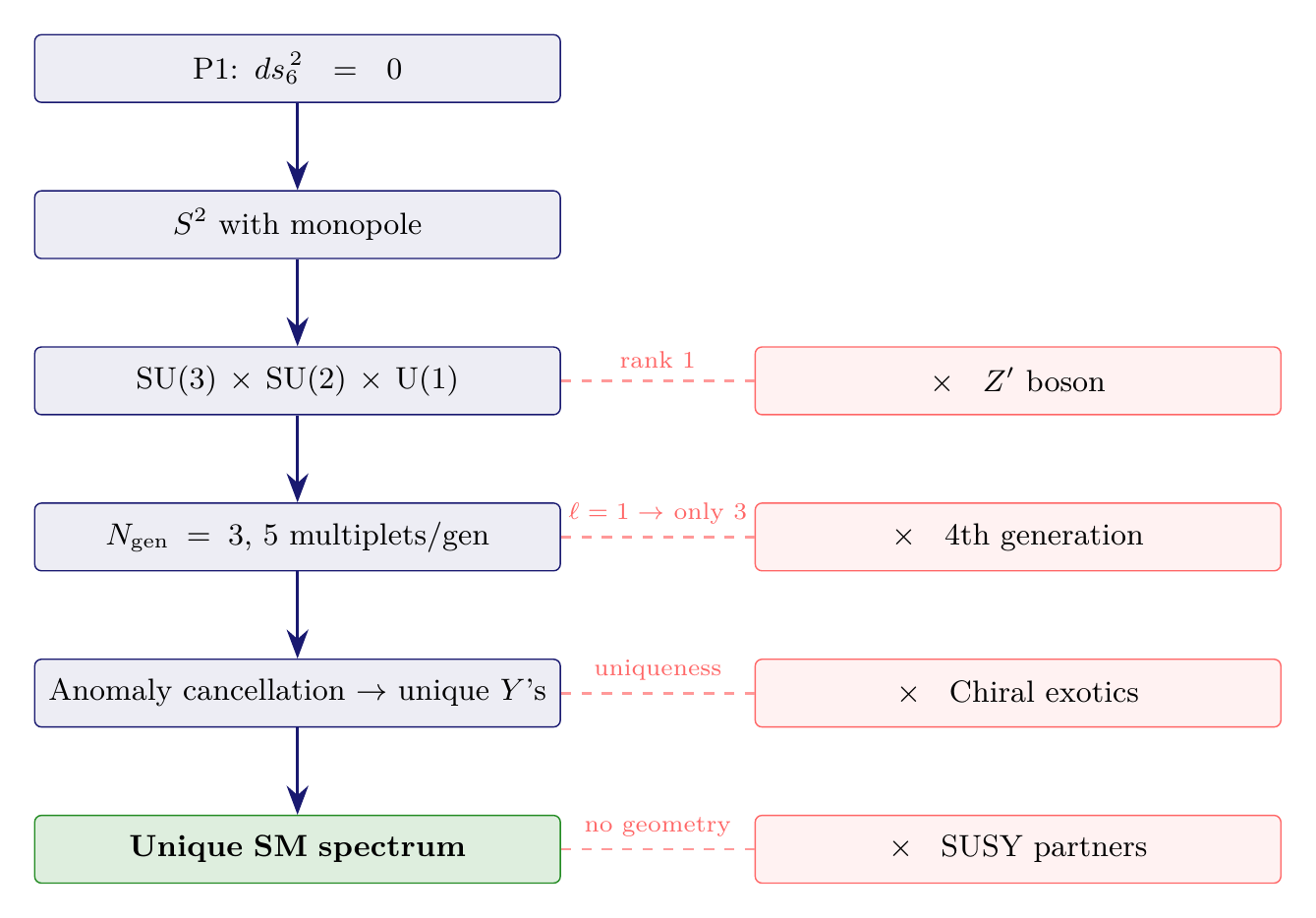
\dstep{P1: \(ds_6^{\,2} = 0\) on \(\mathcal{M}^4 \times S^2\)}{Postulate}{Part 1} \dstep{\(S^2\) topology determines gauge group}{Geometry}{Chapters 15–19} \dstep{Monopole harmonics give \(N_{\text{gen}} = 3\)}{Angular momentum}{Chapter 21} \dstep{Anomaly cancellation determines hypercharges}{QFT consistency}{Chapter 21} \dstep{\(\ell = 1\) multiplet: no 4th generation}{Geometry}{This chapter, \Ssec:ch22-no-4th-gen} \dstep{Unique anomaly solution: no hypercharge freedom}{Algebra}{This chapter, \Ssec:ch22-hypercharge-rigidity} \dstep{\(\nu_{R}\) singlet: seesaw is unique mechanism}{Representation theory}{This chapter, \Ssec:ch22-neutrino-seesaw} \dstep{5 multiplets complete: no chiral exotics}{Geometry + anomalies}{This chapter, \Ssec:ch22-no-exotics} \dstep{One U(1), one \(S^2\): no \(Z'\), no SUSY}{Topology}{This chapter, \Ssec:ch22-no-extensions} \dstep{SM spectrum is unique}{Master theorem}{Theorem thm:P11-Ch22-sm-uniqueness} \dstep{Polar verification: 3 generations = 3 degree-1 polynomials in \(u\) (no 4th possible); \(\nu_R\) = unique uniform mode on polar rectangle; all exclusions trace to polynomial degree constraints on \([-1,+1]\)}{Dual verification (polar)}{This chapter}
Chapter Summary
Chapter 22 Results.
- No 4th generation: \(N_{\text{gen}} = 2\ell + 1 = 3\) from the \(\ell = 1\) monopole multiplet; no mechanism for a 4th state.
- Hypercharge rigidity: Any modification to hypercharges violates anomaly cancellation or charge quantisation; the SM values are the unique solution.
- Seesaw is unique: \(\nu_{R} = (\mathbf{1}, \mathbf{1}, 0)\) is geometrically natural in TMT; Type-I seesaw is the only neutrino mass mechanism available without additional fields.
- No chiral exotics: The five chiral multiplets per generation exhaust the representations available from \(S^2 \subset \mathbb{C}^{3}\); additional chiral fermions would break anomaly uniqueness.
- No \(Z'\): \(\pi_{2}(S^2) = \mathbb{Z}\) has rank 1, allowing exactly one U(1) gauge field.
- No SUSY: The hierarchy problem is solved by interface stabilisation; one Higgs doublet from \(j = 1/2\) ground state; no geometric origin for superpartners.
- SM is unique: The Standard Model particle content is the only anomaly-free chiral spectrum derivable from P1.
- Zero free parameters: Every quantum number of every SM fermion is derived.
Polar perspective. In polar coordinates, the exclusion arguments reduce to polynomial constraints on \([-1,+1]\). Three generations correspond to three linearly independent degree-1 polynomials in \(u\) — a 4th is algebraically impossible. The \(\ell = 2\) level (degree-2 polynomials) is energetically separated by a factor of 2 in eigenvalue. The right-handed neutrino \(\nu_R\) with \(Y = 0\) is the unique uniform mode on the polar rectangle: constant in both \(u\) (no THROUGH gradient) and \(\phi\) (no AROUND winding), explaining its decoupling from all gauge interactions. One U(1) arises because \(\pi_2(S^2) = \mathbb{Z}\) has rank 1, meaning only one independent AROUND winding number. Every exclusion — no 4th generation, no \(Z'\), no chiral exotics — traces to the polynomial and topological structure of the flat polar rectangle.
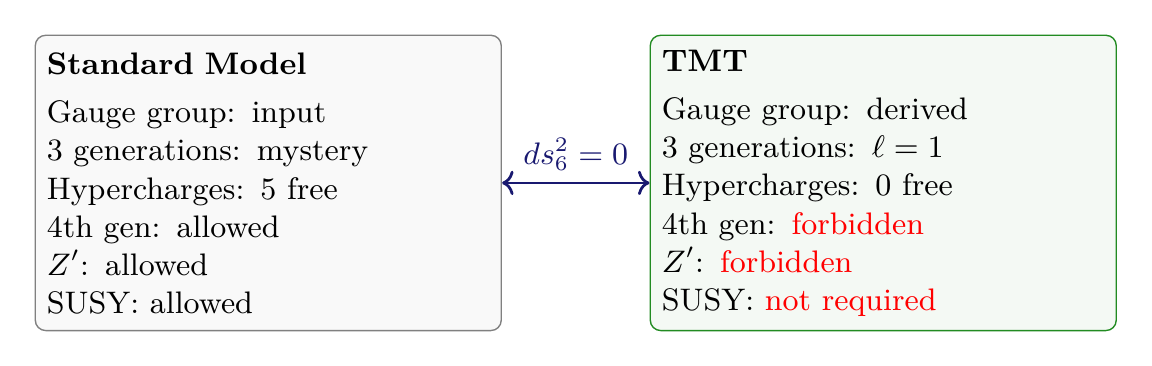
agraph{Comparison: SM vs. TMT.}
| SM feature | Standard Model status | TMT status |
|---|---|---|
| Gauge group | Postulated | DERIVED from \(S^2\) |
| Three generations | Unexplained | DERIVED: \(\ell = 1\) |
| Hypercharges | 5 free parameters per gen. | DERIVED: 0 free |
| Quarks + leptons | Separate sectors | UNIFIED by anomalies |
| 4th generation | Unknown | FORBIDDEN |
| \(Z'\) boson | Unknown | FORBIDDEN |
| SUSY | Unknown | NOT REQUIRED |
agraph{What comes next.} Chapter 23 begins Part IV (Electroweak Physics), where the electroweak symmetry breaking mechanism is derived from the \(S^2\) geometry, producing the \(W^{\pm}\), \(Z\), and Higgs boson masses.
Verification Code
The mathematical derivations and proofs in this chapter can be independently verified using the formal and computational scripts below.
All verification code is open source. See the complete verification index for all chapters.