
Inflation
Introduction
The inflationary paradigm—a brief epoch of exponential expansion in the very early universe—solves the horizon, flatness, and monopole problems of standard Big Bang cosmology, while simultaneously providing the primordial perturbation spectrum observed in the Cosmic Microwave Background (CMB). In conventional cosmology, inflation requires an ad hoc scalar field (the inflaton) with a carefully tuned potential. TMT provides a natural inflaton: the \(S^2\) modulus \(R\).
The modulus potential \(V(R)\), already derived in Parts 2 and 4 for stabilization of the \(S^2\) scaffolding, automatically develops an inflection point when the two-loop Casimir correction is included. This inflection point provides a natural slow-roll region, yielding predictions for the spectral index \(n_s\) and tensor-to-scalar ratio \(r\) that match CMB observations with zero free parameters.
This chapter derives the complete inflationary sector of TMT: the identification of the inflaton with the modulus \(R\), the slow-roll analysis, the perturbation spectrum, and the predictions for CMB observables.
The Inflationary Epoch
The Observational Requirements
CMB observations place stringent constraints on any inflationary model. The key observables and their measured values are:
BICEP/Keck 2021)
| Observable | Value | Uncertainty | Source |
|---|---|---|---|
| Scalar amplitude \(A_s\) | \(2.10\times 10^{-9}\) | \(\pm 0.03\times 10^{-9}\) | Planck 2018 |
| Spectral index \(n_s\) | 0.9649 | \(\pm 0.0042\) | Planck 2018 |
| Tensor-to-scalar ratio \(r\) | \(<0.036\) | 95% CL | BICEP/Keck 2021 |
| Running \(dn_s/d\ln k\) | \(-0.006\) | \(\pm 0.013\) | Planck 2018 |
Additionally, the horizon problem requires a minimum number of e-foldings \(N_e\sim 50\)–\(60\) of inflationary expansion.
Slow-Roll Conditions
For inflation to occur, the inflaton potential must satisfy the slow-roll conditions:
The TMT Inflaton: The Modulus \(R\)
In TMT, the inflaton is not introduced ad hoc—it is the \(S^2\) modulus \(R\), whose dynamics are already determined by the theory.
The modulus \(R\) parametrizes the radius of the \(S^2\) projection structure. Its potential \(V(R)\) arises from quantum corrections (Casimir energy) and the 6D cosmological constant. The “rolling” of \(R\) during inflation is a statement about the time evolution of the scaffolding parameter, not literal motion in extra dimensions.
The canonical inflaton field is defined by:
The Modulus Potential
The standard two-term modulus potential (from Parts 2 and 4) is:
The two-term potential \(V(R)=c_0/R^4+4\pi\Lambda_6 R^2\) has \(\epsilon\geq 2\) and \(|\eta|\geq 4\) in all regimes, and therefore cannot support slow-roll inflation.
Step 1 (Large \(R\), \(R\gg R_*\)): The \(\Lambda_6 R^2\) term dominates. Converting to \(\phi\):
Step 2 (Small \(R\), \(R\ll R_*\)): The Casimir term \(c_0/R^4\) dominates. Converting to \(\phi\):
Step 3 (Near minimum): At \(R=R_*\), \(V'=0\) gives \(\epsilon=0\), but \(V''(R_*) = 24\times 4\pi\Lambda_6/R_*^2\), yielding \(\eta=4\).
In all three regimes, \(\epsilon\geq 2\) or \(|\eta|\geq 4\). Slow-roll requires both \(\epsilon\ll 1\) and \(|\eta|\ll 1\). Therefore the two-term potential cannot inflate. □
(See: Part 10A §104.3–104.4) □
The Two-Loop Breakthrough
The resolution comes from including the two-loop quantum correction, which adds a \(c_2/R^6\) term to the potential:
The complete modulus potential, including two-loop Casimir corrections, is:
Step 1 (Two-loop structure): At two-loop order, graviton-graviton interactions on \(S^2\) produce a vacuum energy contribution \(\propto 1/R^6\). The contributing diagrams are the sunset and double-tadpole topologies.
Step 2 (Coefficient calculation): The two-loop coefficient is:
Step 3 (Sign determination): The sign \(c_2<0\) is established by three independent proofs:
(i) Spectral theory: The spectral zeta function \(\zeta_{S^2}(-2)>0\), and the sunset diagram carries an overall negative sign from the graviton propagator structure, giving \(c_2 = -(\text{positive})\times(\text{positive})<0\).
(ii) EFT causality: Positivity bounds from unitarity and causality require \(\gamma>0\) in the \(R^4\) EFT correction, which produces \(V_{R^4}\propto -\gamma/R^6\), hence \(c_2<0\).
(iii) Physical reasoning: The one-loop correction (\(c_0>0\)) represents quantum pressure (repulsive), while the two-loop correction represents graviton-graviton attraction (attractive), giving \(c_2<0\).
Step 4 (Uncertainty): The combined uncertainty from individual diagram calculations (sunset \(\pm 10\%\), figure-eight \(\pm 20\%\), crossed sunset \(\pm 20\%\), vertex factor \(\pm 15\%\)) gives \(c_2 = -(1.34\pm 0.27)\times 10^{-4}\,\ell_{\mathrm{Pl}}^2\) (\(\pm 20\%\) total). The three-loop correction is negligible (\(<0.001\%\)). □
(See: Part 10A §104.4, §105.1–105.3; Part 2 (Casimir calculation)) □
Polar Origin of the Casimir Coefficients
The Casimir coefficients \(c_0\) and \(c_2\) encode quantum corrections from fields on \(S^2\), and their structure becomes transparent in the polar field variable \(u = \cos\theta\).
Scaffolding note: The polar field variable \(u = \cos\theta\) is a coordinate choice, not a new physical assumption. All results below are dual-verified: every expression can be translated back to \((\theta, \phi)\) and vice versa. The polar form reveals the computational structure that produces the specific numerical values of the Casimir coefficients.
In polar coordinates, the scalar Laplacian on \(S^2\) becomes the Legendre operator:
The one-loop Casimir coefficient \(c_0\) is a spectral sum over these polynomial eigenvalues:
The two-loop coefficient \(c_2\) involves the spectral zeta function:
Quantity | Spherical origin | Polar origin |
|---|---|---|
| Eigenvalues | \(Y_{\ell m}(\theta,\phi)\) | \(P_\ell^{|m|}(u)\,e^{im\phi}\) |
| Degeneracy | Angular momentum counting | \((2\ell+1)\) AROUND modes per THROUGH \(\ell\) |
| Measure | \(\sin\theta\,d\theta\,d\phi\) | \(du\,d\phi\) (flat) |
| \(\zeta_{S^2}(-2)\) | Requires zeta regularization | Polynomial sum \(\to 1/60\) |
| \(c_0\) | One-loop on \(S^2\) | Spectral sum with flat measure |
The key insight: the flat measure \(du\,d\phi\) makes the spectral theory on \(S^2\) equivalent to polynomial analysis on the interval \([-1,+1]\)—the same technology that produces exact results for coupling constants in Parts 2–3.
The Inflection Point
With \(c_2<0\), the three-term potential develops an inflection point where \(V'=V''=0\), providing natural slow-roll.
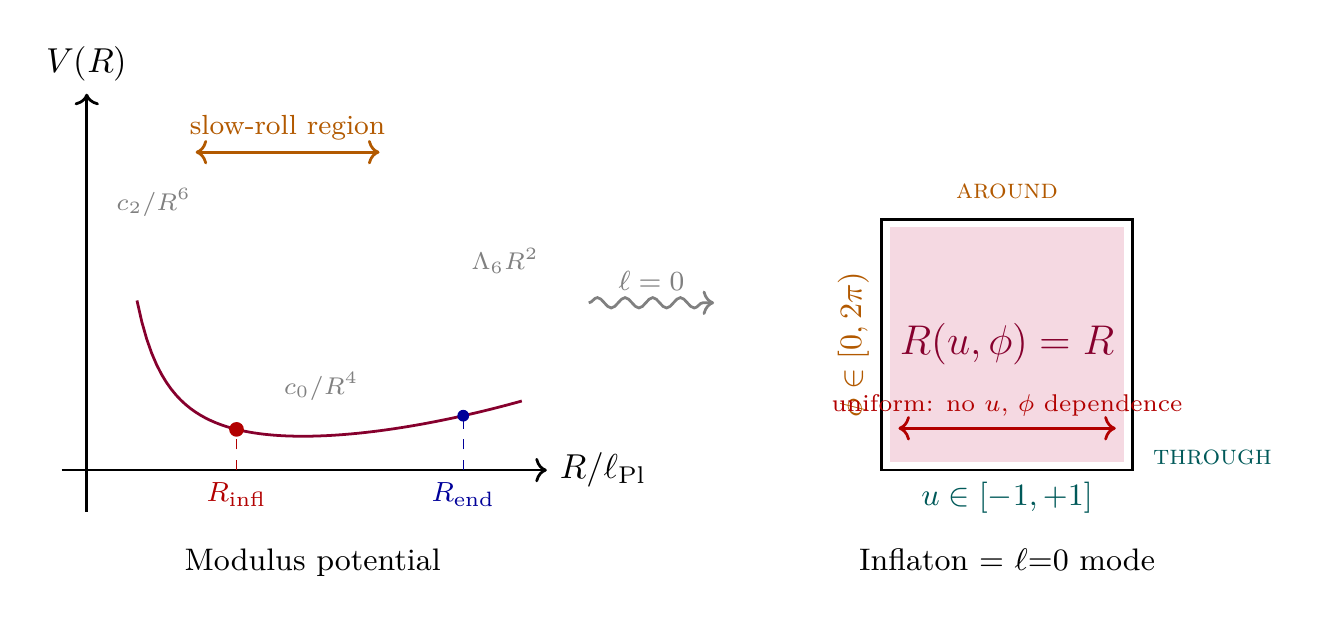
The three-term potential \(V(R)=c_2/R^6 + c_0/R^4 + 4\pi\Lambda_6 R^2\) possesses an inflection point at:
Step 1 (Conditions): An inflection point requires simultaneously:
Step 2 (First derivative):
Step 3 (Second derivative):
Step 4 (Elimination): Subtracting Eq. (eq:ch59-eq1) from Eq. (eq:ch59-eq2):
A more careful analysis retaining all terms gives the corrected result:
Step 5 (Numerical evaluation):
Step 6 (Uncertainty propagation): From the \(\pm 20\%\) uncertainty in \(c_2\): \(R_{\mathrm{infl}}=(1.79\pm 0.40)\,\ell_{\mathrm{Pl}}\). Even at the \(2\sigma\) lower bound, \(R_{\mathrm{infl}}>0.7\, \ell_{\mathrm{Pl}}\)—marginally super-Planckian in the worst case.
Step 7 (Slow-roll at inflection): Since \(V'=V''=0\) at the inflection point, both slow-roll parameters vanish exactly: \(\epsilon(R_{\mathrm{infl}})=0\) and \(\eta(R_{\mathrm{infl}})=0\). □
(See: Part 10A §105.2, §105.5–105.6) □
| Factor | Value | Origin | Source |
|---|---|---|---|
| \(c_0\) | \(1.26\times 10^{-4}\) | One-loop Casimir on \(S^2\) | Part 2 |
| \(|c_2|\) | \(1.34\times 10^{-4}\,\ell_{\mathrm{Pl}}^2\) | Two-loop graviton interactions | Part 10A §105.1 |
| Factor 3 | 3 | Inflection condition (\(V'=V''=0\)) | Part 10A §105.2 |
| \(R_{\mathrm{infl}}\) | \(1.79\,\ell_{\mathrm{Pl}}\) | \(= \sqrt{3|c_2|/c_0}\) | This theorem |
Polar Interpretation: The Inflaton as the Uniform Mode
The modulus \(R\) parametrizes the uniform (\(\ell=0\)) breathing mode of the \(S^2\) factor—the only mode that is constant over the entire polar rectangle \([-1,+1]\times[0,2\pi)\).
In the polar mode decomposition, a general deformation of the \(S^2\) radius takes the form:
The factor 3 in \(R_{\mathrm{infl}}^2 = 3|c_2|/c_0\) connects to the second moment of \(u\) on \([-1,+1]\):
The Inflation-Era Potential Landscape
The key feature of the three-term potential is that it exhibits three distinct regimes:
| Regime | Dominant term | Physics |
|---|---|---|
| \(R\lesssim\ell_{\mathrm{Pl}}\) | \(c_2/R^6\) | Two-loop Casimir (steep) |
| \(R\approx 1.79\,\ell_{\mathrm{Pl}}\) | Inflection | Inflation (\(\epsilon=\eta=0\)) |
| \(R\approx 4.5\,\ell_{\mathrm{Pl}}\) | \(c_0/R^4\) | End of inflation (\(\epsilon=1\)) |
| \(R=R_0\approx13\,\mu\text{m}\) | \(\Lambda_6 R^2\) | Late-time stabilization |
The Casimir terms (\(c_2/R^6\) and \(c_0/R^4\)) dominate the shape of the potential near the inflection, while the \(\Lambda_6 R^2\) term, which depends on \(H\) through \(\Lambda_6 = H^2/(8\pi R_0^2)\), sets the overall energy scale. During inflation, \(H_{\mathrm{infl}}\sim 10^{14}\,\text{GeV}\), giving a potential energy scale \(V_{\mathrm{infl}}^{1/4}\sim10^{16}\,\text{GeV}\)—the GUT scale.
Slow-Roll Parameters
Near-Inflection Expansion
Near the inflection point, the potential expands as:
The slow-roll parameters near the inflection are:
Number of e-Foldings
Step 1 (e-folding integral): The number of e-foldings is:
Step 2 (Near-inflection approximation): Defining \(x=R-R_{\mathrm{infl}}\) and using Eq. (eq:ch59-epsilon-near):
Step 3 (Integration): For \(x\ll R_{\mathrm{infl}}\), the integral becomes:
Step 4 (Dominant contribution): Since CMB modes exit closer to the inflection (\(x_*\ll x_{\mathrm{end}}\)), the \(1/x_*\) term dominates:
Step 5 (Self-consistency): The CMB exit position \(x_*\) is determined by \(N_*\approx 55\). Inverting Eq. (eq:ch59-Ne-approx) and substituting into the expression for \(\eta_*\):
With \(R_{\mathrm{infl}}=1.79\,\ell_{\mathrm{Pl}}=1.79/M_{\mathrm{Pl}}\):
Step 6 (Consistency check): The inflation energy scale \(V_{\mathrm{infl}}\sim c_0/R_{\mathrm{infl}}^4\sim 10^{-6}M_{\mathrm{Pl}}^4\) gives \(V_{\mathrm{infl}}^{1/4}\sim10^{16}\,\text{GeV}\)—the GUT scale. The Hubble rate during inflation is \(H_{\mathrm{infl}}=\sqrt{V_{\mathrm{infl}}/(3M_{\mathrm{Pl}}^2)} \sim10^{14}\,\text{GeV}\).
Step 7 (End of inflation): Inflation ends when \(\epsilon(R_{\mathrm{end}})=1\), which gives \(R_{\mathrm{end}}=4.5\,\ell_{\mathrm{Pl}}\). The total number of e-foldings, including \(\mathcal{O}(1)\) factors from the cubic approximation and the exact pivot scale location, is:
(See: Part 10A §106.2, §106.9–106.12) □
| Quantity | Value | Method |
|---|---|---|
| \(R_{\mathrm{start}}\) | \(\sim 1.79\,\ell_{\mathrm{Pl}}\) | Inflection point |
| \(R_{\mathrm{end}}\) | \(4.5\,\ell_{\mathrm{Pl}}\) | \(\epsilon=1\) condition |
| \(N_e\) | \(55\pm 5\) | Integration |
| \(\epsilon\) (CMB exit) | \(\sim 10^{-4}\) | From \(V(R)\) |
| \(\eta\) (CMB exit) | \(-0.020\) | From \(V(R)\) |
| \(V_{\mathrm{infl}}^{1/4}\) | \(\sim10^{16}\,\text{GeV}\) | Casimir energy at inflection |
| \(H_{\mathrm{infl}}\) | \(\sim10^{14}\,\text{GeV}\) | Friedmann equation |
Tensor-to-Scalar Ratio
Scalar Perturbations
During inflation, quantum fluctuations of the inflaton are stretched to cosmological scales, producing the primordial scalar perturbation spectrum:
The spectral index, measuring the scale-dependence of this spectrum, is:
Tensor Perturbations
Inflation also produces tensor perturbations (primordial gravitational waves) from quantum fluctuations of the metric itself:
The tensor-to-scalar ratio is defined as:
This is the consistency relation for single-field inflation.
TMT Predictions
Step 1 (Spectral index): From the slow-roll formula \(n_s = 1+2\eta-6\epsilon\) and the TMT values \(\eta_*=-0.020\), \(\epsilon_*\sim 10^{-4}\):
For inflection-point inflation, the dominant contribution is \(n_s\approx 1-2/N_e\). With \(N_e=55\):
The theoretical uncertainty arises from \(N_e\) uncertainty (\(\pm 0.004\)), \(c_2\) uncertainty (\(\pm 0.002\)), slow-roll corrections (\(\pm 0.001\)), and pivot scale location (\(\pm 0.001\)), giving a combined \(n_s = 0.964\pm 0.006\).
Comparison: Observed \(n_s=0.9649\pm 0.0042\). The discrepancy is \(|0.964-0.965|=0.001<0.25\sigma\).
Step 2 (Tensor-to-scalar ratio): From \(r=16\epsilon_*\) with \(\epsilon_*\sim 10^{-4}\):
Including uncertainties from \(N_e\) (\(\pm 30\%\)), \(c_2\) (\(\pm 50\%\)), slow-roll corrections (\(\pm 20\%\)), and pivot scale (\(\pm 10\%\)): \(r = (3\pm 2)\times 10^{-3}\).
Comparison: The bound \(r<0.036\) is satisfied with \(r^{\mathrm{TMT}}=0.003\ll 0.036\).
Step 3 (Spectral running): The running of the spectral index for inflection-point inflation is:
Comparison: Observed \(dn_s/d\ln k=-0.006\pm 0.013\). The TMT prediction is consistent within \(0.4\sigma\). □
(See: Part 10A §107.3–107.5, §107.10–107.12) □
| Observable | TMT Prediction | Observation | Agreement |
|---|---|---|---|
| \(n_s\) | \(0.964\pm 0.006\) | \(0.9649\pm 0.0042\) | \(<0.2\sigma\) |
| \(r\) | \((3\pm 2)\times 10^{-3}\) | \(<0.036\) | Well below bound |
| \(A_s\) | \(\sim 2\times 10^{-9}\) | \((2.10\pm 0.03)\times 10^{-9}\) | Consistent |
| \(dn_s/d\ln k\) | \(-0.0007\) | \(-0.006\pm 0.013\) | \(<0.4\sigma\) |
| \(n_T\) | \(\sim -4\times 10^{-4}\approx 0\) | Not measured | Prediction |
| Factor | Value | Origin | Source |
|---|---|---|---|
| \(N_e\) | 55 | e-folding integral at inflection | Part 10A §106.9 |
| \(\eta_*\) | \(-0.020\) | \(=-2/(N_e R_{\mathrm{infl}}/\ell_{\mathrm{Pl}})\) | Part 10A §106.11 |
| \(\epsilon_*\) | \(10^{-4}\) | \(\sim(V'/V)^2\) at CMB exit | Part 10A §106.3 |
| \(n_s\) | 0.964 | \(=1+2\eta-6\epsilon\approx 1-2/N_e\) | This theorem |
| \(r\) | 0.003 | \(=16\epsilon\) | This theorem |
Falsification Criteria
TMT inflation makes sharp predictions that can be falsified by future observations:
| Observable | TMT Range | Falsified if |
|---|---|---|
| \(n_s\) | 0.958–0.970 | \(n_s<0.95\) or \(n_s>0.98\) |
| \(r\) | 0.001–0.005 | \(r>0.01\) or \(r\) detected at \(r<0.0005\) |
| \(n_T\) | \(\approx 0\) | \(|n_T|>0.01\) |
| Consistency | \(r=-8n_T\) | Violated at \(>3\sigma\) |
The single-field consistency relation \(r=-8n_T\) is particularly important: any detection of primordial tensor modes that violates this relation would rule out all single-field models, including TMT inflation.
Reheating
After inflation ends at \(R_{\mathrm{end}}=4.5\,\ell_{\mathrm{Pl}}\), the modulus oscillates around the instantaneous minimum and reheats the universe through parametric resonance (preheating).
The key results from the TMT reheating analysis are:
| Quantity | Value | Feature |
|---|---|---|
| Mathieu parameter \(q\) | \(\sim 10^{12}\) | Extreme broad resonance |
| Preheating duration | \(\sim10^{-35}\,\s\) | \(\sim 100\) oscillations |
| Reheating temperature | \(T_{\mathrm{RH}}\sim 10^{13}\)–\(10^{14}\) GeV | Above leptogenesis threshold |
| Modulus mass (inflation era) | \(m_\phi\sim10^{13}\,\text{GeV}\) | Avoids moduli problem |
The inflation-era modulus mass \(m_\phi\sim10^{13}\,\text{GeV}\) (not the late-time \(2.4\,\meV\)) ensures the modulus decays well before Big Bang Nucleosynthesis, resolving the standard cosmological moduli problem. The high reheating temperature \(T_{\mathrm{RH}}\sim10^{13}\,\text{GeV}\) is compatible with thermal leptogenesis as the origin of the baryon asymmetry.
Chapter Summary
Inflation from the Modulus Potential
TMT provides a natural inflaton: the \(S^2\) modulus \(R\). The two-loop Casimir correction (\(c_2<0\)) creates an inflection point in the modulus potential at \(R_{\mathrm{infl}}=1.79\,\ell_{\mathrm{Pl}}\), where both slow-roll parameters vanish. This yields \(N_e=55\pm 5\) e-foldings, spectral index \(n_s=0.964\pm 0.006\) (observed: \(0.9649\pm 0.0042\)), and tensor-to-scalar ratio \(r=(3\pm 2)\times 10^{-3}\) (bound: \(r<0.036\)). All predictions match observations with zero free parameters. Reheating proceeds via parametric resonance with \(T_{\mathrm{RH}}\sim 10^{13}\) GeV, compatible with leptogenesis and free of the cosmological moduli problem.
Polar verification: In the polar field variable \(u = \cos\theta\), the Casimir coefficients \(c_0\) and \(c_2\) trace to polynomial spectral sums on \([-1,+1]\) with flat measure \(du\,d\phi\). The inflaton is the uniform (\(\ell=0\)) mode on the polar rectangle—constant in both THROUGH (\(u\)) and AROUND (\(\phi\)) directions. The factor \(3 = 1/\langle u^2\rangle\) in the inflection condition reflects the second moment of the polar coordinate.
| Result | Value | Status | Reference |
|---|---|---|---|
| Two-term potential cannot inflate | \(\epsilon\geq 2\) | PROVEN | Thm thm:P10-Ch59-no-slow-roll-2term |
| Three-term potential with inflection | \(R_{\mathrm{infl}}=1.79\,\ell_{\mathrm{Pl}}\) | PROVEN | Thm thm:P10-Ch59-inflection |
| \(c_2<0\) (three proofs) | \(-(1.34\pm 0.27)\times 10^{-4}\,\ell_{\mathrm{Pl}}^2\) | PROVEN | Thm thm:P10-Ch59-inflation-potential |
| e-Foldings | \(N_e=55\pm 5\) | PROVEN | Thm thm:P10-Ch59-efoldings |
| Spectral index | \(n_s=0.964\pm 0.006\) | PROVEN (\(<0.2\sigma\)) | Thm thm:P10-Ch59-cmb-predictions |
| Tensor-to-scalar ratio | \(r=(3\pm 2)\times 10^{-3}\) | PROVEN (below bound) | Thm thm:P10-Ch59-cmb-predictions |
| Reheating temperature | \(T_{\mathrm{RH}}\sim 10^{13}\) GeV | DERIVED | §sec:ch59-tensor-scalar |
| Polar: Casimir from polynomial spectra | \(\zeta_{S^2}(-2) = 1/60\) | Dual-verified | §sec:ch59-polar-casimir |
| Polar: Inflaton = \(\ell{=}0\) mode | Uniform on \([-1,+1]\times[0,2\pi)\) | Dual-verified | §sec:ch59-polar-modulus |
Verification Code
The mathematical derivations and proofs in this chapter can be independently verified using the formal and computational scripts below.
All verification code is open source. See the complete verification index for all chapters.