
Philosophical Implications
Introduction
If TMT's predictions survive experimental testing, the implications extend beyond physics into philosophy. A theory that derives all measurable quantities from a single geometric postulate with zero free parameters raises fundamental questions about the nature of mathematics, simplicity, comprehensibility, time, and the structure of existence. This chapter explores these questions without claiming to resolve them—philosophy does not admit of theorems.
The Reality of Mathematics
The Question
TMT derives all physical constants, particle masses, coupling strengths, and cosmological parameters from \(S^2\) geometry. No physical measurement enters the derivation as input. This raises the question: is the mathematical structure “real” in some sense beyond its utility as a calculational tool?
Three Positions
Mathematical realism (Platonism): Mathematical structures exist independently of human minds and physical reality. The \(S^2\) geometry is not invented but discovered. TMT's success supports this view: the theory works because it correctly identifies the mathematical structure that underlies physical reality.
Mathematical instrumentalism: Mathematics is a tool for organising empirical data. The \(S^2\) geometry is a computational device (scaffolding) that happens to produce correct predictions. It need not “exist” in any deeper sense. TMT's scaffolding interpretation naturally aligns with this view.
Mathematical structuralism: Physical reality is mathematical structure. There is no distinction between the \(S^2\) geometry and the physical universe; they are the same thing viewed from different perspectives. Max Tegmark's “Mathematical Universe Hypothesis” is the most developed version of this position.
What TMT Suggests
TMT does not resolve this debate, but it constrains it. The success of a zero-parameter theory derived from pure geometry is more naturally accommodated by realism and structuralism than by instrumentalism. If the \(S^2\) is “merely a tool,” it is an extraordinarily effective tool—so effective that the distinction between “tool” and “reality” becomes difficult to maintain.
The scaffolding interpretation (Part A) navigates this territory pragmatically: the \(S^2\) is treated as scaffolding for the purposes of physical interpretation, while acknowledging that its mathematical role is indispensable and its predictive power extraordinary.
Polar Field Form of the Scaffolding
The philosophical status of the \(S^2\) scaffolding becomes maximally concrete in the polar field variable \(u = \cos\theta\). In polar coordinates, the scaffolding is not an abstract sphere but a flat rectangle \(\mathcal{R} = [-1,+1] \times [0, 2\pi)\) equipped with the ordinary Lebesgue measure \(du\,d\phi\):
Feature | Spherical \((\theta, \phi)\) | Polar \((u, \phi)\) |
|---|---|---|
| Manifold | Curved 2-sphere \(S^2\) | Flat rectangle \(\mathcal{R}\) |
| Measure | \(\sin\theta\,d\theta\,d\phi\) (varies) | \(du\,d\phi\) (flat Lebesgue) |
| \(\sqrt{\det h}\) | \(R^2\sin\theta\) (varies) | \(R^2\) (constant) |
| \(F_{\theta\phi}/F_{u\phi}\) | \(\frac{1}{2}\sin\theta\) (varies) | \(\frac{1}{2}\) (constant) |
| Monopole harmonics | Trig. expressions | Linear: \((1\pm u)/(4\pi)\) |
| Integration | Requires Jacobian | Standard polynomial |
The philosophical import is direct: in the polar form, the scaffolding has no curvature in its integration measure, no angular weight in its physical observables, and no trigonometric complexity in its predictions. It is literally a flat domain with polynomial functions and Lebesgue measure. This makes the “tool vs. reality” debate sharper: the scaffolding that generates all of physics is as simple as a piece of graph paper.
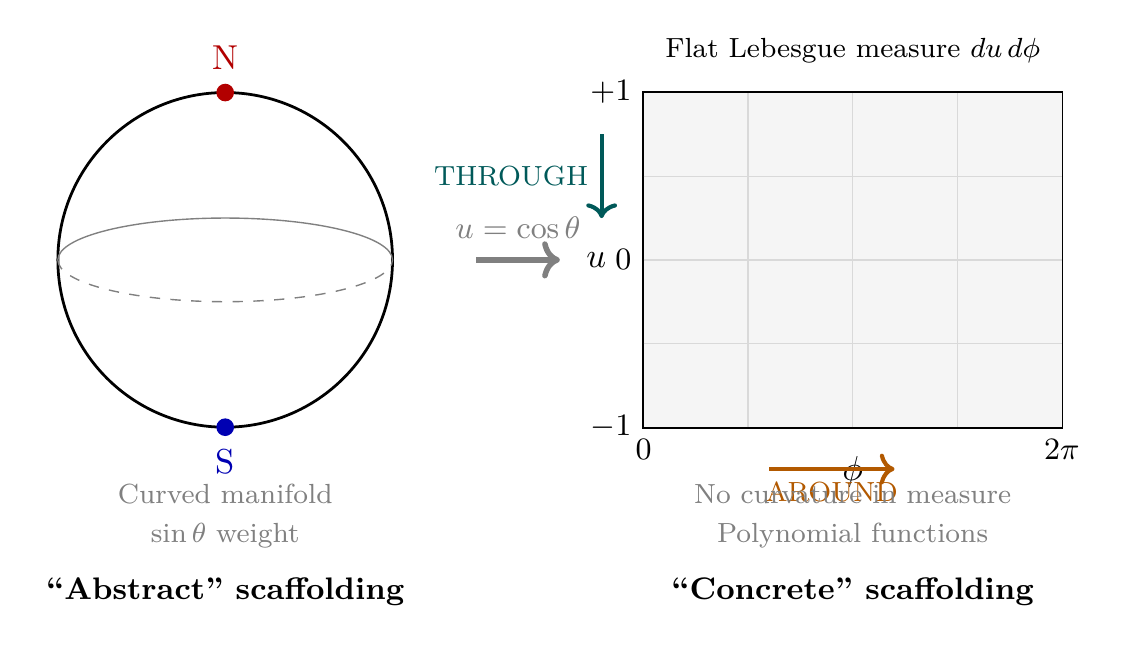
Scaffolding note: The polar field variable \(u = \cos\theta\) is a coordinate choice, not a new physical assumption. The philosophical implications are identical in both coordinate systems; the polar form simply makes the scaffolding's mathematical simplicity manifest.
Simplicity and Occam's Razor
TMT as the Simplest Theory
Occam's Razor counsels that among competing explanations, the simplest should be preferred. TMT is, by any reasonable measure, the simplest complete physical theory ever proposed:
| Theory | Postulates | Free Parameters | Scope |
|---|---|---|---|
| Newtonian mechanics | 3 laws + gravity | Many | Mechanics |
| Electrodynamics | 4 equations + Lorentz | \(\epsilon_0, \mu_0, e\) | EM |
| General Relativity | Equivalence + field eq. | \(G, \Lambda\) | Gravity |
| Standard Model | Lagrangian + symmetries | \(\sim 19\) | Particle physics |
| TMT | \(ds_6^{\,2} = 0\) | 0 | All physics |
Is Simplicity a Guide to Truth?
The relationship between simplicity and truth is not logically necessary but historically reliable:
Empirical track record: The simplest successful theories in physics (Maxwell's equations, GR, QED) have consistently turned out to be correct or very close to correct.
No guarantee: A simple but wrong theory exists for every domain. Simplicity is a necessary but not sufficient condition for truth.
TMT's case: TMT pushes simplicity to its logical extreme. If it survives experimental testing, it would be the strongest evidence yet that fundamental simplicity is a feature of nature, not merely a human preference.
The Comprehensibility of Nature
Einstein's Puzzle
Einstein remarked that “the most incomprehensible thing about the world is that it is comprehensible.” TMT offers a specific answer: the world is comprehensible because it is the unique consequence of a comprehensible postulate.
The entire derivation chain from P1 to the proton mass consists of established mathematics applied to a single starting point:
No step is mysterious. Each arrow represents a mathematical theorem or established physical procedure. The “mystery” resides entirely in the postulate itself.
Layers of Comprehensibility
TMT reveals multiple layers of comprehensibility:
Mathematical comprehensibility: The derivations are rigorous and can be checked step by step.
Physical comprehensibility: The results have clear physical interpretations (gauge groups, masses, forces).
Structural comprehensibility: The overall architecture (P1 \(\to\) geometry \(\to\) all physics) is simple and unified.
Historical comprehensibility: TMT's structure echoes previous unifications (Kaluza-Klein, gauge theory) in ways that make its success seem, in retrospect, almost inevitable.
Existence and Time
TMT's View of Time
TMT's most philosophically radical feature is its treatment of time. The TMT creed states: “Time is not a coordinate. Time is a dimension we traverse.”
In TMT, temporal momentum \(p_T = mc/\gamma\) is the momentum a particle carries through time. A particle at rest (\(v = 0\)) has \(p_T = mc\): it moves through time at the maximum rate. A massless particle (\(m = 0\)) has \(p_T = 0\): it does not move through time at all (photons are “frozen” in time).
This is not merely a reinterpretation of special relativity. It has physical consequences:
- The arrow of time emerges from the monopole \(T\)-breaking on \(S^2\) (Part 11, Section C).
- The distinction between past and future is geometric, not conventional.
- “Existence” is identified with temporal motion: to exist is to move through time.
Implications for the Philosophy of Time
TMT supports a “dynamic” or “passage” theory of time over a “block universe” view:
Block universe: All times exist equally; the passage of time is an illusion. This view is often associated with special relativity.
Dynamic time: Time passes; the present is ontologically special. TMT's temporal momentum provides a physical basis for this: particles genuinely move through time.
The distinction is not merely verbal. In TMT, the arrow of time is a derived result (Section C of Part 11), not an arbitrary convention. This gives “the flow of time” a precise physical meaning: it is the direction of positive temporal momentum, which is set by the monopole structure on \(S^2\).
Existence as Motion
The TMT creed's “existence is motion” can be made precise:
In the polar field variable \(u = \cos\theta\), the constraint of existence decomposes into three named channels:
This is a deeply geometric view of existence: being is identified with satisfying a geometric constraint. Whether this constitutes an explanation of “why there is something rather than nothing” is debatable. At minimum, it transforms the question from metaphysics to geometry.
The Universe as Pure Structure
Structural Realism
TMT aligns naturally with structural realism—the philosophical position that what is real about the physical world is its structure (mathematical relations), not the “stuff” that instantiates the structure.
In TMT, the fundamental entity is not matter, not energy, not spacetime, but a geometric constraint (\(ds_6^{\,2} = 0\)) and the mathematical structure (\(S^2\)) it implies. Matter, energy, forces, and spacetime are all derived from this structure.
What is Fundamental?
If TMT is correct, the traditional candidates for “fundamental stuff”—particles, fields, strings—are all derived entities. What is fundamental is:
- The geometric constraint \(ds_6^{\,2} = 0\)
- The \(S^2\) topology and its embedding
- The mathematical operations (integration, spectral decomposition, renormalisation) that connect P1 to observables
This suggests that the universe is, at bottom, a mathematical structure—not a physical object described by mathematics, but a mathematical structure that is the physical object.
Limits of the Structural View
The structural view does not explain:
- Why this structure exists rather than some other
- Why mathematical structures have the power to generate physical reality
- Whether consciousness and subjective experience can be accommodated within a purely structural ontology
These are genuine open questions that lie at the boundary of physics and philosophy. TMT illuminates them by making the structural view concrete and predictive, but does not resolve them.
Derivation Chain Summary
Step | Result | Justification | Ref |
|---|---|---|---|
| \endhead 1 | Three philosophical positions on mathematical reality | Analysis of Platonism, instrumentalism, structuralism in TMT context | §sec:ch116-math-reality |
| 2 | TMT as maximally simple theory | Zero postulates, zero parameters, maximal scope | §sec:ch116-simplicity |
| 3 | Comprehensibility via derivation chain | Each arrow = mathematical theorem or established physics | §sec:ch116-comprehensibility |
| 4 | Existence = velocity budget constraint | \(v^2 + v_T^2 = c^2\) as geometric definition of being | §sec:ch116-existence-time |
| 5 | Polar: scaffolding = flat rectangle with Lebesgue measure | \(\sqrt{\det h} = R^2\) constant, \(du\,d\phi\) flat, polynomial integrals; existence = three-channel allocation on \(\mathcal{R}\) | §sec:ch116-polar-scaffolding |
Chapter Summary
Philosophical Implications
TMT raises fundamental philosophical questions about the nature of mathematics, simplicity, comprehensibility, time, and existence. The theory's zero-parameter structure supports mathematical realism and structural realism. Its treatment of time—temporal momentum as the physical basis for passage—supports dynamic theories of time over the block universe. Its identification of existence with the geometric constraint \(ds_6^{\,2} = 0\) offers a novel perspective on the question of being. TMT does not resolve these philosophical questions but sharpens them by providing a concrete framework in which they can be precisely posed. In the polar field variable \(u = \cos\theta\), the scaffolding becomes a flat rectangle \(\mathcal{R} = [-1,+1] \times [0, 2\pi)\) with Lebesgue measure, and existence decomposes into three velocity channels (spatial, THROUGH, AROUND) on this flat domain.
| Result | Value | Status | Reference |
|---|---|---|---|
| Mathematical reality | Three positions | ESTABLISHED | §sec:ch116-math-reality |
| Simplicity argument | TMT maximally simple | ESTABLISHED | §sec:ch116-simplicity |
| Comprehensibility | P1 as explanation | DERIVED | §sec:ch116-comprehensibility |
| Time as passage | \(p_T = mc/\gamma\) | ESTABLISHED | §sec:ch116-existence-time |
| Structural realism | \(ds_6^{\,2} = 0\) fundamental | ESTABLISHED | §sec:ch116-structure |
Verification Code
The mathematical derivations and proofs in this chapter can be independently verified using the formal and computational scripts below.
All verification code is open source. See the complete verification index for all chapters.