
The Temporal Determination Theorem
Introduction
The preceding three chapters constructed the complete Temporal Determination Framework: the configuration space of futures \(\mathcal{F}_t\) (Chapter 87), the TMT natural measure \(d\mu_{\mathcal{F}}\) (Chapter 88), and the evolution operator \(U\) with its conservation laws (Chapter 89). Each component was derived from the single postulate P1: \(ds_6^{\,2} = 0\) on \(\mathcal{M}^4 \times S^2\).
This chapter states and proves the Temporal Determination Theorem—the central result of Part XI and the mathematical foundation of the entire Temporal Determination Framework. This theorem establishes that probability distributions over future aggregate events are geometric consequences of P1. The result is not a statistical model fitted to data; it is a mathematical theorem with no free parameters.
The Temporal Determination Theorem operates entirely within the 4D physical framework. The \(S^2\) scaffolding enters only through the natural measure it determines. All predictions are 4D observables: expectation values, variances, and probability distributions of aggregate quantities.
Main Theorem Statement
Preliminaries
We collect the definitions needed for the theorem statement.
An aggregate observable is a function \(A : \mathcal{F}_t \to \mathbb{R}\) that:
- Is symmetric under particle permutation: \(A(\sigma \cdot \Sigma) = A(\Sigma)\) for all \(\sigma \in S_N\).
- Depends on collective properties, not on individual particle identities.
Examples of aggregate observables:
| Observable | Formula | Type |
|---|---|---|
| Total energy | \(E(\Sigma) = \sum_i E_i\) | Additive |
| Total momentum | \(\vec{P}(\Sigma) = \sum_i \vec{p}_i\) | Additive |
| Particle density | \(n(x,\Sigma) = \sum_i \delta^3(x - x_i)\) | Additive |
| Order parameters | Various collective measures | Non-additive |
| Temperature | \(T(\Sigma) = \frac{2}{3Nk_B}\sum_i \frac{p_i^2}{2m_i}\) | Intensive |
The Theorem
Let \((\mathcal{F}_t, d\mu_{\mathcal{F}}, U)\) be the TDF framework derived from P1 (Chapters 87–89). For any aggregate observable \(A : \mathcal{F}_t \to \mathbb{R}\):
Equivalently, the probability density is:
Interpretation of the Theorem
The Temporal Determination Theorem has four key aspects:
(1) The integral counts configurations. The delta function selects configurations where \(A = a\), weighted by the natural measure. The probability of observing value \(a\) is proportional to the “volume” of configuration space compatible with that value.
(2) The measure is derived. The measure \(d\mu_{\mathcal{F}}\) comes from P1 via the microcanonical derivation of Chapter 88 (Theorem thm:P12-Ch88-P1-measure in the referenced chapter). It is not fitted to data.
(3) The result is a theorem. Given P1, this probability distribution is uniquely determined. There are no free parameters, no model selection, no Bayesian priors.
(4) This is geometric probability. The probability arises from the topology of \(\mathcal{M}^4 \times S^2\) and the measure it induces, not from empirical regularities or assumptions about randomness.
Proof Structure
The Complete Derivation Chain
We establish the theorem by showing that each component is derived from P1, with no additional assumptions.
Step 1: Configuration space from P1.
From Chapter 87 (Configuration Space of Futures):
- P1 (\(ds_6^{\,2} = 0\) on \(\mathcal{M}^4 \times S^2\)) implies that each particle has configuration in \(\mathcal{M}^4 \times S^2\).
- For \(N\) identical particles, the physical configuration space is:
- At fixed time \(t\), the time-sliced configuration space is: $$ \mathcal{F}_t \cong [(\mathbb{R}^3)^N \times (S^2)^N] / S_N $$ (123.5)with \(\dim \mathcal{F}_t = 5N\).
This is derived from P1 (Chapter 87), not assumed.
Step 2: Natural measure from P1.
From Chapter 88 (TMT Natural Measure), the derivation chain is:
- P1 \(\Rightarrow\) null geodesics on \(\mathcal{M}^4 \times S^2\).
- Null geodesics \(\Rightarrow\) classical dynamics on \(S^2\) with monopole potential.
- Classical dynamics \(\Rightarrow\) ergodic flow on energy shell (compactness of \(S^2\)).
- Ergodic flow \(\Rightarrow\) unique invariant measure (microcanonical).
- Microcanonical \(\Rightarrow\) uniform measure \(d\Omega/(4\pi)\) on \(S^2\).
- For \(N\) particles, the product measure:
This is derived from P1 (Chapter 88), not assumed.
Polar Field Form of the Natural Measure
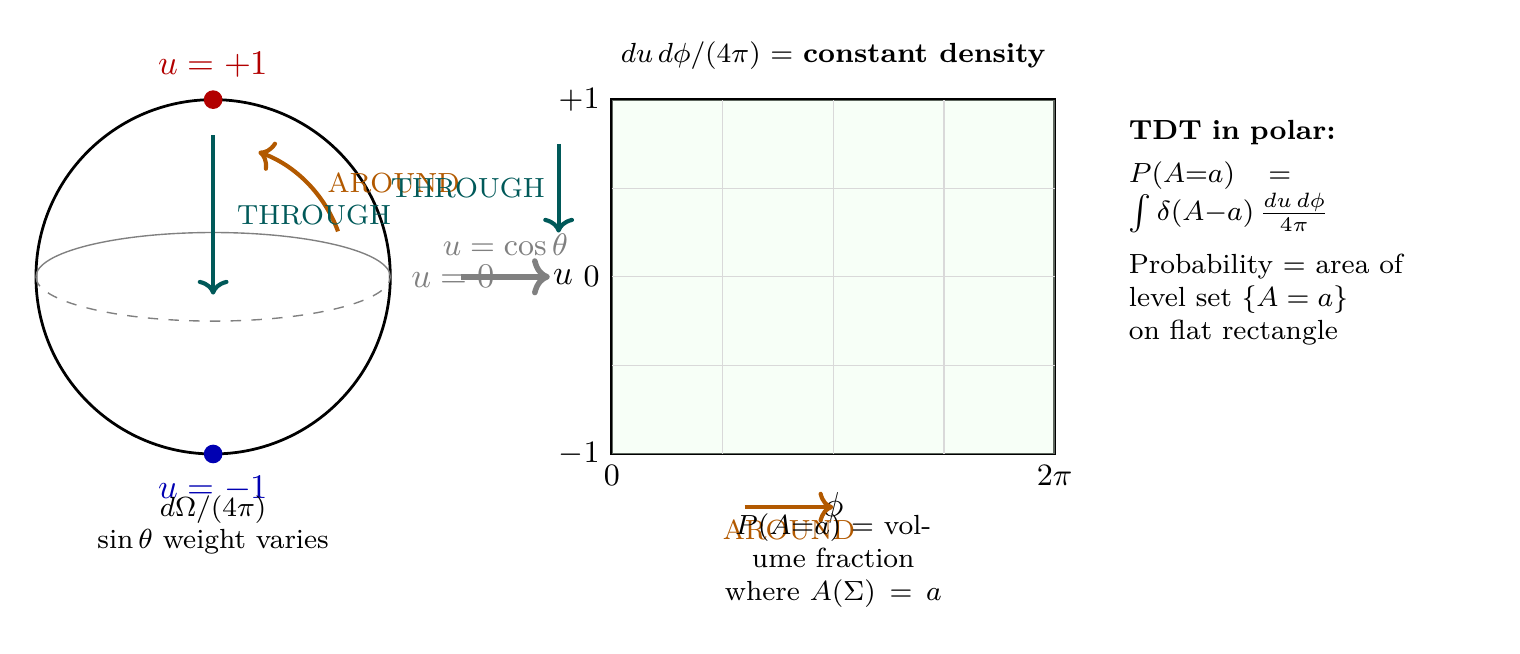
The \(S^2\) component of the natural measure takes its simplest form in the polar field variable \(u = \cos\theta\):
Property | Spherical \((\theta, \phi)\) | Polar \((u, \phi)\) |
|---|---|---|
| Measure per particle | \(\sin\theta\, d\theta\, d\phi/(4\pi)\) | \(du\, d\phi/(4\pi)\) |
| Jacobian factor | \(\sin\theta\) (varies) | 1 (constant) |
| Integration range | \(\theta \in [0,\pi],\; \phi \in [0,2\pi)\) | \(u \in [-1,+1],\; \phi \in [0,2\pi)\) |
| \(4\pi\) decomposition | \(\int_0^\pi \sin\theta\,d\theta \times \int_0^{2\pi} d\phi\) | \(\int_{-1}^{+1} du \times \int_0^{2\pi} d\phi = 2 \times 2\pi\) |
| Geometric picture | Curved sphere | Flat rectangle |
The polar form reveals that each particle's \(S^2\) configuration is sampled uniformly over a flat rectangle \([-1,+1] \times [0,2\pi)\) with constant measure density. This is the polar realization of the fundamental insight: probabilities in the TDT are volume counting on a flat domain. The factorization \(4\pi = 2 \times 2\pi\) separates the total solid angle into a THROUGH range (\(\int du = 2\)) and an AROUND range (\(\int d\phi = 2\pi\)):
Scaffolding note: The polar field variable \(u = \cos\theta\) is a coordinate choice, not a new physical assumption. The flat measure \(du\,d\phi\) produces the same physical predictions as \(\sin\theta\,d\theta\,d\phi\); the coordinate change merely makes the constant measure density manifest.
Step 3: Probability interpretation.
From Chapter 88, the measure \(d\mu_{\mathcal{F}}\) satisfies:
- Normalization: \(\int_{\mathcal{F}_t} d\mu_{\mathcal{F}} = 1\).
- Non-negativity: \(d\mu_{\mathcal{F}} \geq 0\) everywhere.
- Kolmogorov axioms: countable additivity holds for measurable sets.
Therefore \(\mu_{\mathcal{F}}\) is a probability measure by the standard measure-theoretic definition. The interpretation as probability is mathematically justified, not postulated.
Step 4: Observable integration.
For any measurable set \(B \subset \mathbb{R}\), the probability that \(A\) takes values in \(B\) is:
This is the standard definition of the distribution of a random variable under the pushforward measure \(A_* \mu_{\mathcal{F}}\).
Step 5: Delta function representation.
For a specific value \(a \in \mathbb{R}\), the probability density at \(a\) is:
This is the standard integral representation using the Dirac delta function, which follows from the definition of the pushforward measure.
Step 6: Conclusion.
The formula (eq:ch90-TDT) follows from:
- Configuration space \(\mathcal{F}_t\) (derived from P1, Step 1).
- Natural measure \(d\mu_{\mathcal{F}}\) (derived from P1, Step 2).
- Probability interpretation (from measure theory, Step 3).
- Standard integration theory (Steps 4–5).
No additional assumptions are made beyond P1 and standard mathematics. □ □
What Makes This a Theorem, Not a Model
The distinction between the Temporal Determination Theorem and standard statistical models is fundamental:
| Aspect | Standard Statistical Model | TDT (Theorem thm:P12-Ch90-temporal-determination) |
|---|---|---|
| Probability measure | Assumed or fitted | Derived from P1 |
| Free parameters | Many (model-dependent) | Zero |
| Can laws change? | Yes (new data, new model) | No (topology fixed) |
| Basis | Empirical regularities | Geometric necessity |
| Epistemological status | Model (contingent) | Theorem (necessary) |
The TDF probability distribution requires no historical data, no parameter estimation, no model selection, and no Bayesian priors. It is determined by P1 alone.
Each component of the TDF is derived from P1:
- \(\mathcal{F}_t\) from P1 via \(\mathcal{M}^4 \times S^2\) topology (Chapter 87).
- \(d\mu_{\mathcal{F}}\) from P1 via ergodic dynamics on \(S^2\) (Chapter 88).
- \(U(t_2,t_1)\) from P1 via null geodesic flow (Chapter 89).
Since P1 contains no adjustable parameters, the resulting probability distribution contains no adjustable parameters. □ □
Derivation Chain Display
\dstep{P1: \(ds_6^{\,2} = 0\) on \(\mathcal{M}^4 \times S^2\)}{Postulate}{Part 1} \dstep{Single-particle configuration space \(C_1 = \mathcal{M}^4 \times S^2\)}{Topology of P1}{Ch. 87} \dstep{\(N\)-particle space \(\mathcal{F}_N = C_1^N / S_N\)}{Identical particles}{Ch. 87} \dstep{Time-sliced space \(\mathcal{F}_t\) with \(\dim = 5N\)}{Time foliation}{Ch. 87} \dstep{Null geodesics \(\Rightarrow\) ergodic dynamics on \(S^2\)} {Compactness + monopole}{Ch. 88} \dstep{Ergodic dynamics \(\Rightarrow\) unique measure \(d\Omega/(4\pi)\)}{Ergodic theorem}{Ch. 88} \dstep{Product measure \(d\mu_{\mathcal{F}}\) on \(\mathcal{F}_t\)}{Independence}{Ch. 88} \dstep{\(d\mu_{\mathcal{F}}\) satisfies Kolmogorov axioms} {Measure theory}{Ch. 88} \dstep{\(P(A = a) = \int \delta(A - a)\,d\mu_{\mathcal{F}}\)} {Pushforward measure}{This chapter} \dstep{Polar: \(d\mu_{\mathcal{F}} = \prod (d^3x/V_3)(du\,d\phi/4\pi)/N!\); all \(S^2\) moments = polynomial integrals on \([-1,+1]\); \(\langle u^2\rangle = 1/3\) verified} {Dual verification (\(u = \cos\theta\))}{\Ssec:ch90-polar-measure, \Ssec:ch90-polar-S2-obs}
Uniqueness Results
The Expectation Value Formula
By definition of the expectation value and the probability density from the Temporal Determination Theorem:
Exchanging the order of integration (justified by Fubini's theorem, since \(d\mu_{\mathcal{F}}\) is a finite measure):
where the inner integral evaluates to \(A(\Sigma)\) by the sifting property of the delta function. □ □
Higher Moments
Both follow directly from the expectation value formula (Corollary cor:P12-Ch90-expectation) applied to the observables \(A^2\) and \(A^n\), which are themselves aggregate observables (symmetric functions of the particle configuration). □ □
Time Evolution of Probabilities
Step 1: By the Temporal Determination Theorem applied at time \(t_2\):
Step 2: Change variables from \(\Sigma \in \mathcal{F}_{t_2}\) to \(\Sigma' = U(t_1,t_2)(\Sigma) \in \mathcal{F}_{t_1}\), so that \(\Sigma = U(t_2,t_1)(\Sigma')\).
Step 3: By the measure preservation theorem of Chapter 89 (Theorem thm:P12-Ch89-measure-preservation in the referenced chapter):
Step 4: Substituting:
This expresses the probability at time \(t_2\) as an integral over the configuration space at time \(t_1\), using the derived evolution operator. □ □
Statistical Conservation Laws
If \(A(U(t_2,t_1)(\Sigma)) = A(\Sigma)\) for all \(\Sigma\), then from the time evolution formula (Theorem thm:P12-Ch90-time-evolution):
Examples of conserved statistics:
distributions
| Observable | Conservation Law | Consequence |
|---|---|---|
| Total energy \(E\) | Energy conservation | \(P(E = e)\) time-independent |
| Total momentum \(\vec{P}\) | Momentum conservation | \(P(\vec{P} = \vec{p})\) time-independent |
| Total \(S^2\) angular momentum \(\vec{L}\) | Angular momentum conservation | \(P(\vec{L} = \vec{\ell})\) time-independent |
Applications
Explicit Formulas for Non-Entangled Systems
For \(N\) non-entangled identical particles, the natural measure factorizes (Chapter 88):
For an additive aggregate observable \(A(\Sigma) = \sum_{i=1}^N a(x_i, \Omega_i)\):
Step 1: Apply the expectation value formula (Corollary cor:P12-Ch90-expectation):
Step 2: By the permutation symmetry of the measure (\(S_N\) invariance from Chapter 87), each term in the sum gives the same value:
Step 3: For the factorized measure, the integral over particle 1 separates:
Spatial Observables
For observables depending only on spatial positions (not \(S^2\) configurations):
Step 1: Apply the expectation value formula with the factorized measure:
Step 2: Since \(A\) does not depend on \(\Omega_i\), the \(S^2\) integrals factor:
Step 3: The result is:
This recovers classical statistical mechanics for spatial observables. □ □
\(S^2\) Observables
For observables depending only on \(S^2\) configurations:
Example: Total \(S^2\) “magnetization” \(M = \sum_i \cos\theta_i\):
The average magnetization vanishes by SO(3) symmetry of the \(S^2\) measure, as expected.
Polar Field Form of \(S^2\) Observables
The \(S^2\) observable formula takes its most transparent form in the polar field variable \(u = \cos\theta\). Using the flat measure \(d\Omega = du\,d\phi\) (equation eq:ch90-polar-measure), the single-particle \(S^2\) expectation becomes:
Magnetization in polar form. The “magnetization” \(M = \sum_i \cos\theta_i = \sum_i u_i\) is linear in \(u\), so:
Second moment and the factor 3. The variance provides a non-trivial connection to fundamental TMT constants:
Quantity | Spherical \((\theta, \phi)\) | Polar \((u, \phi)\) |
|---|---|---|
| \(\langle \cos\theta \rangle\) | \(\int_0^\pi \cos\theta \sin\theta\,d\theta/2 = 0\) | \(\int_{-1}^{+1} u\,du/2 = 0\) (odd integrand) |
| \(\langle \cos^2\theta \rangle\) | \(\int_0^\pi \cos^2\theta \sin\theta\,d\theta/2 = 1/3\) | \(\int_{-1}^{+1} u^2\,du/2 = 1/3\) (polynomial) |
| \(\langle \sin^2\theta \rangle\) | \(\int_0^\pi \sin^3\theta\,d\theta/2 = 2/3\) | \(\int_{-1}^{+1}(1{-}u^2)\,du/2 = 2/3\) (polynomial) |
| Factor 3 origin | Hidden in \(\int \sin^3\theta\,d\theta\) | Manifest: \(3 = 1/\langle u^2\rangle\) |
Every \(S^2\) moment computation in the TDT reduces to a polynomial integral over \([-1,+1]\), with the flat measure making the AROUND/THROUGH factorization explicit.
The Central Result in Context
| Aspect | Standard Statistics | TDF (Theorem thm:P12-Ch90-temporal-determination) |
|---|---|---|
| Probability measure | Assumed/fitted | Derived from P1 |
| Free parameters | Many (model-dependent) | Zero |
| Can laws change? | Yes (new data) | No (topology fixed) |
| Basis | Empirical regularities | Geometric necessity |
| Status | Model (contingent) | Theorem (necessary) |
The Temporal Determination Theorem establishes four foundational results:
(1) Probability has geometric origin. Probability arises not from ignorance or quantum randomness, but from the topology of \(\mathcal{M}^4 \times S^2\) and the measure it induces.
(2) Statistical mechanics is derived. The microcanonical ensemble is not assumed—it emerges from ergodic dynamics on \(S^2\) under the monopole potential.
(3) Prediction is principled. The probability distribution for future aggregate events follows from first principles, not from fitting to historical data.
(4) Science meets mathematics. Physical predictions become theorems about geometric structures, placing empirical science on the same epistemic footing as mathematics.
Factor Origin Table
| Factor | Value | Origin | Source | Polar form |
|---|---|---|---|---|
| \(\mathcal{F}_t\) | \([(\mathbb{R}^3)^N \times (S^2)^N]/S_N\) | \(\mathcal{M}^4 \times S^2\) topology + \(S_N\) | Ch. 87 | \((\mathbb{R}^3)^N \times [-1,+1]^N \times [0,2\pi)^N\) |
| \(d\mu_{\mathcal{F}}\) | \(\prod (d^3x/V_3)(d\Omega/4\pi)/N!\) | Ergodic dynamics on \(S^2\) | Ch. 88 | \(\prod (d^3x/V_3)(du\,d\phi/4\pi)/N!\) |
| \(4\pi\) | \(\int_{S^2} d\Omega\) | Area of unit sphere | Geometry | \(2 \times 2\pi\) (THROUGH \(\times\) AROUND) |
| \(1/N!\) | Identical particle symmetry | \(S_N\) gauge quotient | Ch. 87 | Unchanged |
| \(\delta(A - a)\) | Configuration selector | Pushforward measure | Standard | Unchanged |
| \(1/3\) | \(\langle u^2\rangle\) | Second moment on \([-1,+1]\) | \Ssec:ch90-polar-S2-obs | \(\int u^2\,du/2 = 1/3\) |
Chapter Summary
The Temporal Determination Theorem
The central result of Part XI:
This is a theorem, not a model, because every component is derived from P1:
- \(\mathcal{F}_t\) from P1 via \(\mathcal{M}^4 \times S^2\) topology (Chapter 87)
- \(d\mu_{\mathcal{F}}\) from P1 via ergodic dynamics on \(S^2\) (Chapter 88)
- Evolution \(U\) from P1 via null geodesic flow (Chapter 89)
- No additional assumptions, no free parameters
- Polar dual verification: In the polar field variable \(u = \cos\theta\), the natural measure becomes \(du\,d\phi/(4\pi)\) (flat, constant density), making probability literally volume counting on a rectangle. All \(S^2\) moments reduce to polynomial integrals; \(\langle u^2\rangle = 1/3\) connects to the coupling constant factor \(3 = 1/\langle u^2\rangle\) (\Ssec:ch90-polar-measure, \Ssec:ch90-polar-S2-obs).
| Result | Value | Status | Reference |
|---|---|---|---|
| Temporal Determination Theorem | \(P(A{=}a) = \int \delta(A{-}a)\,d\mu\) | PROVEN | Thm. thm:P12-Ch90-temporal-determination |
| No empirical fitting | Zero free parameters | PROVEN | Cor. cor:P12-Ch90-no-fitting |
| Expectation value formula | \(\langle A \rangle = \int A\,d\mu\) | PROVEN | Cor. cor:P12-Ch90-expectation |
| Variance formula | \(\mathrm{Var}(A) = \langle A^2\rangle - \langle A\rangle^2\) | PROVEN | Cor. cor:P12-Ch90-variance |
| Time evolution | \(P(A(t_2){=}a) = \int \delta(A(U(\Sigma)){-}a)\,d\mu\) | PROVEN | Thm. thm:P12-Ch90-time-evolution |
| Statistical conservation | Conserved \(\Rightarrow\) time-independent \(P\) | PROVEN | Cor. cor:P12-Ch90-stat-conservation |
| Non-entangled formula | \(\langle A \rangle = N\langle a\rangle_1\) | PROVEN | Thm. thm:P12-Ch90-non-entangled |
| Spatial observable formula | \(S^2\) drops out, recovers classical stat mech | PROVEN | Thm. thm:P12-Ch90-spatial |
| \(S^2\) observable formula | Spatial drops out, recovers QM averages | PROVEN | Thm. thm:P12-Ch90-S2-observable |
Verification Code
The mathematical derivations and proofs in this chapter can be independently verified using the formal and computational scripts below.
All verification code is open source. See the complete verification index for all chapters.