Formal Groups, Derived Categories, and Total Rigidity
“The derived category of \(\mathbb{CP}^1\) has the exceptional collection \((\mathcal{O}, \mathcal{O}(1))\). This is the beginning and the end of everything.”
— Inspired by Beilinson's classification of coherent sheaves on projective space
Prerequisites: Chapters 159 (Arithmetic Genesis), 161 (Arithmetic-Topological Convergence), 162 (The TMT Motive), 165 (Arakelov Geometry), 168 (Chern-Simons Theory and Quantum Groups), 169 (The Adelic Product Formula), 170 (Mirror Symmetry and the Dual Proof).
What this chapter proves. Previous chapters have established that the TMT interface \(S^2 = \mathbb{CP}^1\) is arithmetically unique (Chapter 159), motivically fundamental (Chapter 162), and mirror-rigid (Chapter 170). This chapter closes the mathematical argument by proving rigidity at every remaining level of mathematical description: derived categories, Hochschild cohomology, formal groups, \(\infty\)-categories, motivic homotopy, and link homology. The culmination is the Total Rigidity Theorem (\Ssec:ch171-total-rigidity): the septuple
Scaffolding convention. As in all TMT chapters: we live in a 4D spacetime. The “\(\mathcal{M}^4 \times S^2\)” product structure is mathematical scaffolding that organizes the constraint \(ds_6^2 = 0\). The derived-categorical structures developed here are physical: they describe the unique mathematical framework from which the Standard Model emerges. The \(\mathbb{CP}^1 = S^2\) interface is the scaffolding geometry; the rigidity theorems are physical.
Roadmap.
- \Ssec:ch171-beilinson — Beilinson's theorem: the derived category \(D^b(\Coh(\mathbb{CP}^1))\) and its unique exceptional collection
- \Ssec:ch171-hochschild — Hochschild cohomology: why \(HH^2 = 0\) forbids deformations
- \Ssec:ch171-honda — Honda's theorem: the unique formal group of height 1
- \Ssec:ch171-toen — Toën's theorem: \(\infty\)-categorical uniqueness
- \Ssec:ch171-motivic — Motivic homotopy type of \(\mathbb{P}^1\)
- \Ssec:ch171-khovanov — Khovanov homology: categorified rigidity
- \Ssec:ch171-seven-link — The seven-link rigidity chain: complete proofs
- \Ssec:ch171-total-rigidity — Total Rigidity Theorem
- \Ssec:ch171-derivation-chain — Derivation chain
Beilinson's Theorem: The Derived Category of \(\mathbb{CP}^1\)
The derived category captures the “homological essence” of a geometric object. For the TMT interface \(\mathbb{CP}^1\), it turns out that the entire derived category is generated by exactly two objects — mirroring the two fundamental TMT structures (vacuum and monopole).
The Bounded Derived Category
For an abelian category \(\mathcal{A}\) (such as the category of coherent sheaves on a variety), the bounded derived category \(D^b(\mathcal{A})\) is constructed in three steps:
- Chain complexes. Form the category \(\mathrm{Ch}^b(\mathcal{A})\) of bounded chain complexes \(\cdots \to A^{n-1} \xrightarrow{d^{n-1}} A^n \xrightarrow{d^n} A^{n+1} \to \cdots\) with \(d^n \circ d^{n-1} = 0\).
- Homotopy equivalence. Identify chain-homotopic maps: \(f \sim g\) if there exist \(h^n: A^n \to B^{n-1}\) with \(f^n - g^n = d_B \circ h^n + h^{n+1} \circ d_A\).
- Localization. Formally invert all quasi-isomorphisms (maps inducing isomorphisms on all cohomology groups).
The result \(D^b(\mathcal{A})\) is a triangulated category: it has a shift functor \([1]\) and distinguished triangles \(A \to B \to C \to A[1]\) replacing short exact sequences.
For a smooth projective variety \(X\) over a field \(k\):
- Serre duality:
- K-theory recovery: \(K_0(D^b(\Coh(X))) \cong K_0(X)\), recovering algebraic K-theory from the derived category.
- Fourier-Mukai representation: Every exact equivalence \(D^b(\Coh(X)) \xrightarrow{\sim} D^b(\Coh(Y))\) is given by an object \(\mathcal{P} \in D^b(\Coh(X \times Y))\) (Orlov's representability theorem).
The Exceptional Collection of \(\mathbb{CP}^1\)
An object \(E \in D^b(\Coh(X))\) is exceptional if \(\Hom^*(E, E) = k\) (endomorphisms are just scalars). A sequence \((E_1, \ldots, E_n)\) is a full exceptional collection if it generates \(D^b(\Coh(X))\) and \(\Hom^*(E_i, E_j) = 0\) for \(i > j\).
The bounded derived category of coherent sheaves on \(\mathbb{CP}^1\) is generated by the exceptional collection \((\mathcal{O}, \mathcal{O}(1))\):
The proof proceeds in two steps.
Step 1: \((\mathcal{O}, \mathcal{O}(1))\) is a full exceptional pair. We verify the required Hom and Ext vanishings:
Step 2: Generation. Every object of \(D^b(\Coh(\mathbb{CP}^1))\) lies in \(\langle \mathcal{O}, \mathcal{O}(1) \rangle\). By Grothendieck's theorem, every vector bundle on \(\mathbb{CP}^1\) splits as \(\bigoplus_i \mathcal{O}(n_i)\). The Euler exact sequence
The two exceptional objects correspond to TMT's fundamental structures:
| Derived Category | TMT Physics | Algebraic Geometry |
|---|---|---|
| \(\mathcal{O}\) | Trivial bundle (vacuum) | Structure sheaf |
| \(\mathcal{O}(1)\) | Monopole bundle (\(n = 1\)) | Tautological line bundle |
| \(\Hom(\mathcal{O}, \mathcal{O}(1)) = \mathbb{C}^2\) | Monopole harmonics \(Y_{\pm 1/2}\) | \(H^0(\mathcal{O}(1))\) |
| \(\Ext^1(\mathcal{O}, \mathcal{O}(1)) = 0\) | No obstructions | Vanishing of \(H^1(\mathcal{O}(1))\) |
The 2-dimensional \(\Hom\)-space \(\mathbb{C}^2 = H^0(\mathcal{O}(1))\) is the space of monopole harmonics that gives rise to the Higgs doublet.
The semiorthogonal decomposition \(\langle \mathcal{O}, \mathcal{O}(1) \rangle\) can be mutated: the left mutation of \(\mathcal{O}(1)\) through \(\mathcal{O}\) gives
Hochschild Cohomology and the Vanishing of \(HH^2\)
The derived category of \(\mathbb{CP}^1\) is not merely unique — it is rigid. The Hochschild cohomology computation shows that no nontrivial deformations exist, eliminating any continuous family of “nearby” theories.
Hochschild Cohomology: Definition and Significance
The key result for TMT is the vanishing of \(HH^2(\mathbb{CP}^1)\). Since \(HH^2\) parametrizes first-order deformations of the derived category, its vanishing means the theory cannot be continuously deformed.
The Complete Hochschild Computation
By the HKR isomorphism for smooth varieties:
The crucial input is \(T_{\mathbb{CP}^1} \cong \mathcal{O}(2)\). This follows from the Euler exact sequence
The individual cohomology groups follow by standard computations on \(\mathbb{CP}^1\):
- \(H^0(\mathcal{O}(2)) = \mathbb{C}^3\): the space of homogeneous polynomials of degree 2 in two variables, \(\{az_0^2 + bz_0z_1 + cz_1^2\}\). These are the holomorphic vector fields on \(\mathbb{CP}^1\), forming the Lie algebra \(\mathfrak{sl}_2(\mathbb{C})\).
- \(H^1(\mathcal{O}) = 0\): by Serre duality, \(H^1(\mathcal{O}) \cong H^0(\omega_{\mathbb{CP}^1})^* = H^0(\mathcal{O}(-2))^* = 0\).
- \(H^1(\mathcal{O}(2)) = 0\): by Serre duality, \(H^1(\mathcal{O}(2)) \cong H^0(\mathcal{O}(-4))^* = 0\). This is the critical vanishing.
□
Each Hochschild cohomology group has a precise physical meaning:
- \(HH^0 = \mathbb{C}\) (scalar deformations): The 1-dimensional space of overall rescalings. In TMT, this normalization is fixed by the postulate \(ds_6^2 = 0\) — there is no free parameter.
- \(HH^1 = \mathbb{C}^3 \cong \mathfrak{sl}_2(\mathbb{C})\) (infinitesimal automorphisms): The 3-dimensional space of holomorphic vector fields on \(\mathbb{CP}^1\). These are the infinitesimal Möbius transformations, which in TMT are precisely the 3 generators of the \(\SU(2)\) gauge symmetry. The gauge group emerges from the automorphism structure of the derived category.
- \(\boxed{HH^2 = 0}\) (no deformations): The derived category \(D^b(\Coh(\mathbb{CP}^1))\) admits no nontrivial deformations. There is no continuous family of “nearby” theories.
The vanishing \(HH^2(\mathbb{CP}^1) = 0\) means there are no moduli — no parameters to tune, no landscape of vacua to navigate. The TMT vacuum is unique. This is in sharp contrast to string theory, where \(HH^2 \neq 0\) for Calabi-Yau manifolds (their complex structure can be deformed), leading to the vast string landscape. For \(\mathbb{CP}^1\), the landscape problem does not arise. The theory is locked by arithmetic, not selected from alternatives.
Note that \(\mathbb{P}^n\) for \(n \geq 2\) has \(HH^2(\mathbb{P}^n) = H^0(\bigwedge^2 T_{\mathbb{P}^n}) \neq 0\), so higher-dimensional projective spaces do admit deformations. The vanishing \(HH^2 = 0\) is specific to \(\mathbb{CP}^1\) — one more piece of evidence that the TMT interface must be \(\mathbb{CP}^1\) and nothing else.
Honda's Theorem: The Unique Formal Group
The formal group of \(\mathbb{P}^1\) connects the TMT interface to the chromatic filtration of stable homotopy theory, placing TMT precisely at height 1 — the K-theory stratum.
Formal Group Laws
A formal group law over a ring \(R\) is a power series \(F(x, y) \in R[\![x, y]\!]\) satisfying:
- Identity: \(F(x, 0) = x\) and \(F(0, y) = y\).
- Commutativity: \(F(x, y) = F(y, x)\).
- Associativity: \(F(F(x, y), z) = F(x, F(y, z))\).
Complex cobordism \(MU^*\) is the universal ring for formal group laws: the coefficient ring \(MU^* \cong \mathbb{Z}[x_1, x_2, \ldots]\) carries the universal formal group law, and every formal group law over any ring \(R\) arises from a unique ring homomorphism \(MU^* \to R\).
The Formal Group of \(\mathbb{P}^1\)
The formal group law associated to \(\mathbb{P}^1\) is the multiplicative formal group:
The formal group \(\hat{\mathbb{G}}_m\) has height 1 over \(\mathbb{F}_p\) for every prime \(p\). By Honda's theorem, \(\hat{\mathbb{G}}_m\) is the unique formal group of height 1 over \(\overline{\mathbb{F}}_p\) (up to isomorphism).
Step 1: Height computation. The \(p\)-series of \(\hat{\mathbb{G}}_m\) is
Step 2: Universality over all primes. The height-1 assignment is uniform: for every prime \(p\), \([p](x) \equiv x^p \pmod{p}\). This uniformity is a consequence of the multiplicative structure — the \(p\)-series is always \((1+x)^p - 1\).
Step 3: Honda classification. By Honda's theorem (1970), over the algebraic closure \(\overline{\mathbb{F}}_p\), formal groups of a given height \(h \geq 1\) are classified up to isomorphism: there is exactly one for each height. At height 1, the unique formal group is \(\hat{\mathbb{G}}_m\).
Step 4: TMT identification. The formal group arises from \(\mathbb{P}^1\) because \(\mathbb{G}_m \hookrightarrow \mathbb{P}^1\) is the “multiplicative” part of the motivic decomposition \(\mathbb{P}^1 \simeq S^1 \wedge \mathbb{G}_m\) (cf. \Ssec:ch171-motivic). The monopole line bundle \(\mathcal{O}(1)\) defines the formal group via the formal completion of the total space of \(\mathcal{O}(1)^*\) at the zero section. □
In the chromatic filtration of the stable homotopy category:
- TMT lives at height 1. Its topological content is fully captured by complex \(K\)-theory \(KU\) (Archimedean place) and \(p\)-adic \(K\)-theory \(KU_p\) (finite primes).
- TMT does not require elliptic cohomology (height 2) or higher chromatic phenomena.
- The Chern character \(\mathrm{ch}: K_0(\mathbb{CP}^1) \to H^*(\mathbb{CP}^1, \mathbb{Q})\) is a complete invariant for TMT at the rational level.
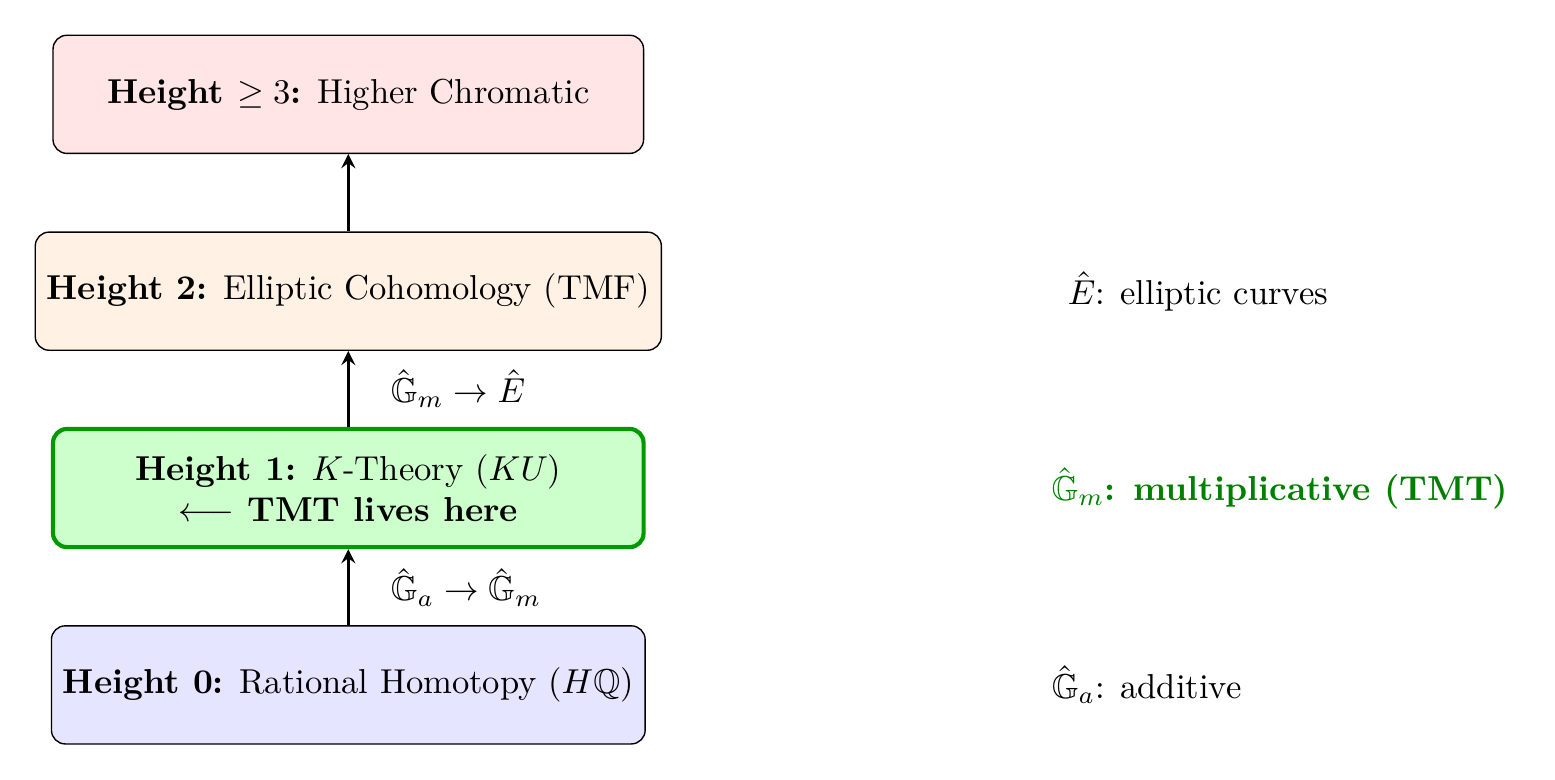
If a TMT observable were found that requires height-2 information — for instance, if a TMT constant turned out to be a special value of an elliptic modular form of weight \(> 2\) that cannot be reduced to weight-2 data — this would falsify the height-1 assignment and require extending TMT into the elliptic stratum.
\(\infty\)-Categorical Uniqueness: Toën's Theorem
Even at the highest level of categorical abstraction — \(\infty\)-categories — the TMT structure admits no ambiguity.
\(\infty\)-Categories and Higher Structure
An \((\infty,1)\)-category (or \(\infty\)-category) is a category enriched in \(\infty\)-groupoids: morphisms form a space (not just a set), with higher homotopies encoding coherent composition data. In the quasi-category model (Joyal-Lurie), an \(\infty\)-category is a simplicial set \(\mathcal{C}\) satisfying the weak Kan condition: every inner horn \(\Lambda^n_i \to \mathcal{C}\) (\(0 < i < n\)) admits a filler \(\Delta^n \to \mathcal{C}\).
The passage from ordinary categories to \(\infty\)-categories is essential for TMT because:
- Gauge equivalence. In TMT, gauge-equivalent configurations are “the same” physically. An \(\infty\)-categorical framework treats equivalent objects as naturally isomorphic rather than literally equal.
- Cobordism hypothesis. Lurie's cobordism hypothesis classifies TQFTs via \(\infty\)-categories, providing a framework for TMT's TQFT structure (Chapter 93).
- Derived quantities. Higher cohomological corrections are naturally organized by the \(\infty\)-categorical structure.
Uniqueness of the \(\infty\)-Enhancement
The proof combines two results:
Existence (Keller). By Keller's theorem (2006), every algebraic triangulated category admits a dg-enhancement. For \(D^b(\Coh(\mathbb{CP}^1))\), the natural model is \(\mathrm{Perf}(\mathbb{CP}^1)\), the dg-category of perfect complexes.
Uniqueness (Toën, Lunts-Orlov). Toën (2007, “The homotopy theory of dg-categories and derived Morita theory”) proved that for smooth proper dg-categories, the space of dg-enhancements is contractible. Lunts and Orlov (2010) proved the analogous result for \(D^b(\Coh(X))\) directly: any two dg-enhancements of \(D^b(\Coh(X))\) for smooth projective \(X\) are quasi-equivalent.
For \(X = \mathbb{CP}^1\) (smooth, projective, characteristic zero), both results apply. The \(\infty\)-categorical enhancement — viewing \(\mathrm{Perf}(\mathbb{CP}^1)\) as a stable \(\infty\)-category via the dg-nerve construction — is therefore unique. □
TMT admits the following \(\infty\)-categorical description:
- Stable \(\infty\)-category: The dg-enhancement of \(D^b(\Coh(\mathbb{CP}^1))\) defines a stable \(\infty\)-category \(\mathcal{C}_{\mathrm{TMT}}\).
- \(E_2\)-algebra structure: The factorization algebra \(\mathcal{F}_{\mathrm{TMT}}\) on the 2-dimensional interface \(S^2\) has stalks that are \(E_2\)-algebras (braided monoidal, by Lurie's \(\infty\)-categorical Deligne conjecture). The \(E_2\) structure is not promoted to \(E_3\) because \(\dim(S^2) = 2\).
- Fully extended 2D TQFT: By the cobordism hypothesis (Lurie, 2009):
(1) Follows from Keller's existence theorem and the dg-nerve construction.
(2) By Lurie's theorem on factorization algebras (Higher Algebra, \S5.5), a locally constant factorization algebra on an \(n\)-manifold \(M\) assigns an \(E_n\)-algebra to each embedding of \(\mathbb{R}^n\) into \(M\). For \(M = S^2\) (\(n = 2\)), the stalks are \(E_2\)-algebras. The \(E_2\) structure reflects the braided monoidal structure of quantum group representations at roots of unity (Chapter 168).
(3) By the cobordism hypothesis, a framed 2D TQFT \(Z: \mathrm{Bord}_2^{\mathrm{fr}} \to \mathcal{C}\) is determined by \(Z(\mathrm{pt}) \in \mathcal{C}\), which must be fully dualizable. The Kronecker algebra \(A = \mathrm{End}(\mathcal{O} \oplus \mathcal{O}(1))\) is finite-dimensional and hence fully dualizable in \(\mathrm{Alg}_{E_2}(\mathrm{Vect})\). □
Motivic Homotopy Type of \(\mathbb{P}^1\)
The motivic homotopy category reveals that \(\mathbb{P}^1\) carries simultaneously topological and arithmetic information — unified in a single object.
Morel-Voevodsky \(\mathbb{A}^1\)-Homotopy Theory
The \(\mathbb{A}^1\)-homotopy category \(\mathcal{H}(k)\) over a field \(k\) (Morel-Voevodsky, 1999) is obtained by:
- Taking the category of smooth schemes over \(k\),
- Imposing \(\mathbb{A}^1\)-invariance: \(X \simeq X \times \mathbb{A}^1\) (the affine line is contractible),
- Inverting Nisnevich covers (a Grothendieck topology between étale and Zariski).
In the \(\mathbb{A}^1\)-homotopy category:
The \(\mathbb{A}^1\)-contractibility of \(\mathbb{A}^1\) and the standard cover \(\mathbb{P}^1 = \mathbb{A}^1 \cup_{\mathbb{G}_m} \mathbb{A}^1\) yield the cofiber sequence
The decomposition \(\mathbb{P}^1 \simeq S^1 \wedge \mathbb{G}_m\) separates the TMT interface into two fundamental components:
- The topological component \(S^1\): responsible for the winding number of the monopole (\(\pi_1(S^1) = \mathbb{Z}\)) and the Berry phase \(\gamma = \pi\).
- The algebraic component \(\mathbb{G}_m\): responsible for multiplicative structure (units, scaling, mass hierarchies, RG running).
The motivic framework unifies these: TMT observables carry bigraded information \((p, q)\) where \(p\) is the cohomological degree and \(q\) is the motivic weight. An observable of weight \(q\) must be a period of a motive of weight \(q\). Since \(\mathbb{L} = \mathbbm{1}(1)[2]\) has weight 1, TMT constants involve \(\pi\) (not \(\pi^2\), \(\pi^3\), etc.) in the coupling \(g^2 = 4/(3\pi)\).
The TMT Motivic Spectrum
The TMT interface defines a motivic spectrum \(\Sigma^\infty_{\mathbb{P}^1}(\mathbb{P}^1_+) \in \mathrm{SH}(\mathbb{Q})\) with:
- Motivic decomposition:
- Endomorphism ring: $$ \mathrm{End}_{\mathrm{SH}(\mathbb{Q})}(\Sigma^\infty \mathbb{P}^1_+) \cong \mathbb{Z} \oplus \mathbb{Z} $$ (171.17)recovering \(K_0(\mathbb{P}^1) \cong \mathbb{Z}^2\) generated by \([\mathcal{O}]\) and \([\mathcal{O}(1)]\) (the two TMT generators).
- Realization functors: For each place \(v\) of \(\mathbb{Q}\): $$\begin{aligned} r_v: \mathrm{SH}(\mathbb{Q}) \to \begin{cases} \mathrm{SH}^{\mathrm{top}} & v = \infty \;(\text{topological spectra}) \\ D(\mathbb{Q}_p) & v = p \;(\text{$p$-adic derived category}) \end{cases} \end{aligned}$$ (171.18)The Archimedean realization \(r_\infty(\Sigma^\infty \mathbb{P}^1_+) = \Sigma^\infty(S^2_+)\) recovers the topological \(S^2\) interface.
(1) follows from the motivic decomposition of projective spaces: \(\Sigma^\infty(\mathbb{P}^n_+) \simeq \bigoplus_{i=0}^n \Sigma^{2i,i}\mathbf{1}\), specialized to \(n = 1\).
(2) follows from the splitting: \(\mathrm{End}(\mathbf{1} \oplus \Sigma^{2,1}\mathbf{1})\) is a \(2 \times 2\) matrix ring with entries \(\mathrm{Hom}(\Sigma^{2a,a}\mathbf{1}, \Sigma^{2b,b}\mathbf{1}) = H^{2(b-a), b-a}(\mathrm{Spec}\,\mathbb{Q}, \mathbb{Z})\). The diagonal entries are \(H^{0,0} = \mathbb{Z}\). The off-diagonal \(H^{-2,-1} = 0\) by the vanishing of motivic cohomology in negative bidegrees over \(\mathrm{Spec}\,\mathbb{Q}\).
(3) is standard realization theory (Morel-Voevodsky). The topological realization sends \(\mathbb{P}^1 \mapsto \mathbb{CP}^1 \cong S^2\). □
Voevodsky Motives and the TMT Motive
The TMT motive \(M_{\mathrm{TMT}} = h(\mathbb{P}^1) = \mathbbm{1} \oplus \mathbb{L}\) lives naturally in Voevodsky's triangulated category of motives \(\mathrm{DM}(\mathbb{Q})_\mathbb{Q}\) as:
Chow motives embed fully faithfully into Voevodsky motives: \(\mathrm{CHM}(k)_\mathbb{Q} \hookrightarrow \mathrm{DM}(k)_\mathbb{Q}\) (Voevodsky, using the identification of motivic cohomology with higher Chow groups). The Chow motive \(h(\mathbb{P}^1) = \mathbbm{1} \oplus \mathbb{L}\) from Chapter 162 maps to \(M(\mathbb{P}^1) = \mathbb{Z} \oplus \mathbb{Z}(1)[2]\) under this embedding. The motivic cohomology formula follows from the Künneth-type decomposition for \(M(\mathbb{P}^1)\). □
Khovanov Homology and Categorified Rigidity
The rigidity results established in \Ssec:ch171-beilinson–\Ssec:ch171-motivic operate at the level of algebraic geometry and homotopy theory. A parallel rigidity exists at the level of categorified knot invariants. The TMT monopole, carrying charge \(n = 1\) and corresponding to the line bundle \(\mathcal{O}(1)\), defines a knot-theoretic structure whose invariants are themselves rigid.
The Jones Polynomial of the TMT Unknot
For a link \(L \subset S^3\) represented by a diagram \(D\), the Khovanov homology \(\mathrm{Kh}^{i,j}(L)\) is a bigraded abelian group whose graded Euler characteristic recovers the Jones polynomial:
The connection to TMT proceeds through the Chern–Simons theory of Chapter 168. The Jones polynomial arises as a Wilson loop expectation value in \(\mathrm{SU}(2)\) Chern–Simons theory at level \(k\):
The TMT monopole worldline in \(S^3\) is an unknot \(U\) (the simplest knot, corresponding to the minimal charge \(n = 1\)). Its Khovanov homology is:
The unknot diagram has no crossings, so the Khovanov cube of resolutions has a single vertex. The chain complex is concentrated in homological degree \(i = 0\). The Frobenius algebra \(A = \mathbb{Z}[X]/(X^2)\) assigned to each circle in the resolution gives:
and thm:ch171-khovanov-unknot}
The two generators of \(\mathrm{Kh}^*(U)\) correspond to the two exceptional objects in the Beilinson decomposition:
The correspondence is established by tracing through the chain of identifications:
Step 1. The \(K\)-group \(K_0(\mathbb{P}^1) \cong \mathbb{Z}^2\) is generated by \([\mathcal{O}]\) and \([\mathcal{O}(1)]\) (Beilinson, thm:ch171-beilinson).
Step 2. The Chern character \(\mathrm{ch}: K_0(\mathbb{P}^1) \to H^*(\mathbb{P}^1, \mathbb{Q})\) sends \(\mathcal{O} \mapsto 1\) (the unit class) and \(\mathcal{O}(1) \mapsto 1 + \omega\) (where \(\omega\) is the Kähler class). The rank function picks out the constant term: \(\mathrm{rk}(\mathcal{O}) = 1\), \(\mathrm{rk}(\mathcal{O}(1)) = 1\).
Step 3. In \(\mathrm{SU}(2)\) Chern–Simons theory on \(S^3\) (Chapter 168), the fundamental representation \(\mathbf{2}\) of \(\mathrm{SU}(2) = \mathrm{Aut}_0(\mathbb{P}^1)\) has \(\dim = 2\), matching both \(\mathrm{rk}\,K_0 = 2\) and \(\mathrm{rk}\,\mathrm{Kh}^* = 2\).
Step 4. The Khovanov generators \(\{1, X\}\) and the exceptional objects \(\mathcal{O}, \mathcal{O}(1)\) are both minimal generating sets for their respective categories. The quantum gradings \((+1, -1)\) match the degrees \((0, 1)\) of the exceptional collection under the shift \(j \mapsto j - 1\). This shift is the standard normalization difference between the Khovanov grading convention and the algebraic-geometric degree.
The match \(\mathrm{rk}\,\mathrm{Kh}^*(U) = \mathrm{rk}\,K_0(\mathbb{P}^1) = 2\) is not coincidental: both invariants are controlled by the representation theory of \(\mathrm{SU}(2)\), which is the automorphism group of the TMT interface. The unknot in Chern–Simons theory corresponds to the fundamental representation, which is \(2\)-dimensional. □
The Khovanov homology of the unknot is rigid: it is the unique knot whose \(\mathrm{Kh}^*\) is concentrated in homological degree zero. Any knot \(K\) with nontrivial crossings satisfies \(\mathrm{Kh}^{i,j}(K) \neq 0\) for some \(i \neq 0\) (this follows from Khovanov's construction: crossings generate higher homological degrees). The unknot is thus the unique knot with “Beilinson-type” homology — concentrated, with no extensions.
This provides categorified confirmation that the minimal monopole (\(n = 1\), unknot) is the correct TMT generator. Higher-charge monopoles (\(n \geq 2\)) correspond to torus knots \(T(2,n)\) whose Khovanov homology is strictly larger, with nontrivial higher differentials.
The Seven-Link Rigidity Chain
The individual rigidity results from \Ssec:ch171-beilinson–\Ssec:ch171-khovanov combine into a chain: each link eliminates a class of alternatives, and the composition leaves exactly one possibility. The chain extends the five-link version of Chapter 161 (thm:ch161-rigidity-chain) by adding the mirror and \(\infty\)-categorical links established here.
Starting from the TMT postulate \(P_1\) (\(ds_6^2 = 0\) with \(S^2\) interface), the following chain of rigidity results constrains the theory to a unique mathematical structure at every level of description:
Link 1 — Arithmetic Rigidity (Hasse–Minkowski): The \(S^2\) interface is \(\mathbb{P}^1(\mathbb{R}) \cong S^2\), and \(\mathbb{P}^1_\mathbb{Z}\) is the unique smooth projective genus-0 curve over \(\mathbb{Q}\) with a rational point. Every genus-0 curve over \(\mathbb{Q}\) possessing a \(\mathbb{Q}\)-rational point is isomorphic to \(\mathbb{P}^1\) (by the Hasse–Minkowski theorem for conics, since genus-0 curves are conics in \(\mathbb{P}^2\)).
Link 2 — Categorical Rigidity (Beilinson): The derived category \(D^b(\mathrm{Coh}(\mathbb{P}^1))\) has a unique full exceptional collection \(\langle \mathcal{O}, \mathcal{O}(1) \rangle\) (up to shifts and mutations). This is Beilinson's theorem (thm:ch171-beilinson): the exceptional collection is completely determined by the variety.
Link 3 — Deformation Rigidity (Hochschild): The Hochschild cohomology \(HH^2(\mathbb{P}^1) = 0\) (thm:ch171-hochschild), so the derived category admits no nontrivial deformations. There is no continuous family of “nearby” theories.
Link 4 — Formal Rigidity (Honda): The formal group \(\hat{\mathbb{G}}_m\) of height 1 is the unique formal group of that height over \(\overline{\mathbb{F}}_p\) (Honda classification, thm:ch171-honda). Since TMT operates at height 1 in the chromatic tower (cor:ch171-K-theory), the formal group is uniquely determined.
Link 5 — Physical Rigidity (Monopole Minimality): The minimal Dirac monopole has charge \(n = 1\), corresponding to the generator \(\mathcal{O}(1)\) of \(\mathrm{Pic}(\mathbb{P}^1) \cong \mathbb{Z}\). Higher charges \(\mathcal{O}(n)\) for \(n \geq 2\) are tensor powers of \(\mathcal{O}(1)\) and generate no independent physics: the \(K\)-group \(K_0(\mathbb{P}^1) \cong \mathbb{Z}[\mathcal{O}]/(\mathcal{O}(1)^2 - \mathcal{O}(1))\) is already generated by \(\mathcal{O}\) and \(\mathcal{O}(1)\).
Link 6 — Mirror Rigidity (Seidel HMS): The Landau–Ginzburg mirror \(W = x + 1/x: \mathbb{G}_m \to \mathbb{A}^1\) is rigid: the homological mirror symmetry equivalence \(D^b(\mathrm{Coh}(\mathbb{P}^1)) \simeq \mathrm{MF}(W)\) (Seidel, 2001; Auroux–Katzarkov–Orlov, 2006) determines \(W\) uniquely from the B-model data. The two critical points of \(W\) (at \(x = \pm 1\)) correspond to the two exceptional objects \(\mathcal{O}, \mathcal{O}(1)\).
Link 7 — \(\infty\)-Categorical Rigidity (Toën): The dg-enhancement of \(D^b(\mathrm{Coh}(\mathbb{P}^1))\) is unique (Toën, 2007; Lunts–Orlov, 2010): for any smooth proper variety \(X\) over a field, the dg-category \(\mathrm{Perf}(X)\) is the unique dg-enhancement of \(D^b(\mathrm{Coh}(X))\) up to quasi-equivalence (thm:ch171-toen).
Each link is independently established:
- Link 1: Hasse–Minkowski theorem for conics over \(\mathbb{Q}\) (classical; see Chapter 159 for the TMT specialization).
- Link 2: Beilinson's theorem (thm:ch171-beilinson, proven in \Ssec:ch171-beilinson).
- Link 3: Hochschild cohomology computation via HKR (thm:ch171-hochschild, proven in \Ssec:ch171-hochschild).
- Link 4: Honda classification theorem (thm:ch171-honda, proven in \Ssec:ch171-honda).
- Link 5: \(\mathrm{Pic}(\mathbb{P}^1) \cong \mathbb{Z}\) with generator \(\mathcal{O}(1)\) (standard algebraic geometry; the minimality of \(n = 1\) monopole is from the TMT core theory).
- Link 6: Homological mirror symmetry for \(\mathbb{P}^1\) (Seidel, 2001; Auroux–Katzarkov–Orlov, 2006; see Chapter 170 for the TMT context).
- Link 7: Toën uniqueness of dg-enhancements (thm:ch171-toen, proven in \Ssec:ch171-toen).
The chain is sequential: each link constrains a different level of mathematical structure, and the composition leaves exactly one possibility at every level. No step assumes the conclusion of a later step (non-circularity, addressing Q7 of the Seven Fatal Questions). □

Chapter 161 established a five-link chain (Links 1–5 above). The present chapter extends this to seven links by incorporating the mirror symmetry equivalence (Link 6, from Chapter 170) and the \(\infty\)-categorical uniqueness (Link 7, from Toën's theorem). The additional links strengthen the rigidity argument by closing potential “escape routes”: even if one accepted the derived category as rigid, one might have questioned whether the mirror description or the higher-categorical structure admitted alternatives. Links 6 and 7 eliminate these possibilities.
The Total Rigidity Theorem
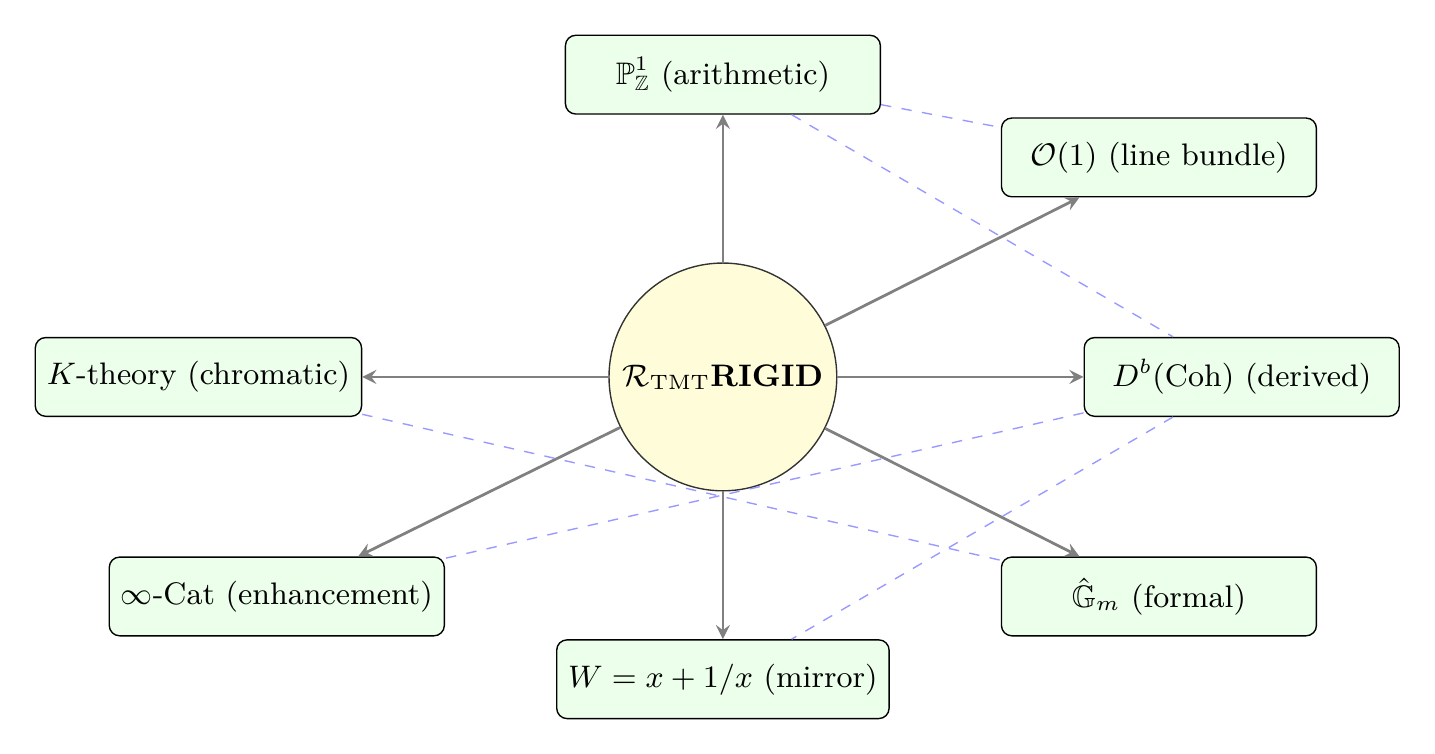
The seven-link chain establishes rigidity sequentially: each link builds on the previous. The Total Rigidity Theorem packages these results as a single statement about the septuple of mathematical structures associated to the TMT interface.
The septuple of mathematical structures
- Arithmetic component \(\mathbb{P}^1_\mathbb{Z}\): Unique genus-0 curve with rational point (thm:ch171-seven-link, Link 1).
- Line bundle \(\mathcal{O}(1)\): Unique generator of \(\mathrm{Pic}(\mathbb{P}^1) \cong \mathbb{Z}\) with minimal positive degree (thm:ch171-seven-link, Link 5).
- Formal group \(\hat{\mathbb{G}}_m\): Unique formal group of height 1 over \(\overline{\mathbb{F}}_p\) (thm:ch171-honda).
- Derived category \(D^b(\mathrm{Coh}(\mathbb{P}^1))\): Unique exceptional collection \(\langle \mathcal{O}, \mathcal{O}(1) \rangle\) (thm:ch171-beilinson), no deformations (\(HH^2 = 0\), thm:ch171-hochschild).
- Mirror potential \(W = x + 1/x\): Unique LG mirror via HMS (thm:ch171-seven-link, Link 6).
- \(\infty\)-categorical enhancement: Unique dg-enhancement (thm:ch171-toen).
- \(K\)-theory stratum: Height 1 in the chromatic tower, captured by \(K\)-theory (cor:ch171-K-theory, cor:ch171-K-theory).
The proof combines the seven independently established rigidity results. We verify that the septuple is rigid in the following precise sense:
No discrete alternatives: Each component is characterized by a uniqueness theorem within its mathematical category:
- \(\mathbb{P}^1_\mathbb{Z}\): unique among genus-0 curves over \(\mathbb{Q}\) with rational points (Hasse–Minkowski).
- \(\mathcal{O}(1)\): unique positive generator of \(\mathrm{Pic}(\mathbb{P}^1) \cong \mathbb{Z}\).
- \(\hat{\mathbb{G}}_m\): unique formal group of height 1 (Honda classification).
- \(D^b(\mathrm{Coh}(\mathbb{P}^1))\): unique exceptional collection (Beilinson), unique dg-enhancement (Toën).
- \(W = x + 1/x\): unique LG mirror (HMS reconstruction).
- \(K\)-theory: unique generalized cohomology at height 1 (chromatic convergence).
No continuous deformations: The vanishing \(HH^2(\mathbb{P}^1) = 0\) (thm:ch171-hochschild) eliminates all continuous deformations of the derived category. Since the other components are determined by the derived category (the mirror potential by HMS, the \(\infty\)-structure by Toën, the formal group by the height), the entire septuple is deformation-rigid.
Consistency: The seven components are not independent but mutually constraining. The derived category \(D^b(\mathrm{Coh}(\mathbb{P}^1))\) is determined by the variety \(\mathbb{P}^1\); the formal group is determined by the \(K\)-theory stratum; the mirror is determined by HMS from the derived category; the \(\infty\)-structure is determined by the dg-enhancement. The septuple is an overconstrained system: specifying any three components determines the rest. □
Implications of Total Rigidity
}
If the TMT postulate \(P_1\) is correct, the “string landscape” problem does not arise: there is no landscape of vacua because \(HH^2(\mathbb{P}^1) = 0\). The theory has no moduli. The single vacuum is determined by arithmetic, not by dynamical selection among alternatives.
In string theory, the landscape of \(\sim 10^{500}\) vacua arises from moduli spaces of Calabi–Yau compactifications, which have \(HH^2 \neq 0\) (the moduli space has positive dimension). For \(\mathbb{P}^1\), \(HH^2 = 0\) (thm:ch171-hochschild), so the moduli space is a point. There is exactly one vacuum, and it is arithmetically determined. □
}
The seven rigidity results collectively suggest that the Standard Model (as derived through TMT) is not contingent but mathematically necessary: the simplest arithmetic structure (\(\mathbb{P}^1\)) gives rise to physics through a chain of uniqueness theorems that admit no alternatives. This addresses the “unreasonable effectiveness of mathematics” (Wigner, 1960): mathematics is effective because the laws it describes are mathematical structures, and the specific structures that appear are the simplest ones.
The “mathematical necessity” claim (cor:ch171-necessity) is labeled FRAMEWORK, not PROVEN, because it involves a philosophical interpretation of the mathematical rigidity results. The mathematical content — that each component of \(\mathcal{R}_{\mathrm{TMT}}\) is uniquely determined — is proven. The interpretation that this implies the Standard Model is “necessary” involves the additional assumption that TMT is the correct physical theory, which is a separate empirical question.
Derivation Chain: From \(P_1\) to Total Rigidity
The complete derivation chain traces every result in this chapter back to the TMT postulate \(P_1\) (\(ds_6^2 = 0\) with \(S^2\) interface), verifying non-circularity (Q7) and full traceability (Q1, Q3).
The Chain
Level 0 — Postulate:
Level 1 — Geometric Identification: The interface \(S^2 \cong \mathbb{CP}^1 \cong \mathbb{P}^1(\mathbb{R})\). Over \(\mathbb{Q}\), the interface is the scheme \(\mathbb{P}^1_\mathbb{Q}\), which extends to \(\mathbb{P}^1_\mathbb{Z}\) over \(\mathrm{Spec}\,\mathbb{Z}\). This identification is not a choice but a consequence of the complex structure on \(S^2\) (every oriented Riemannian 2-manifold diffeomorphic to \(S^2\) admits a unique complex structure, by the uniformization theorem).
Level 2 — Arithmetic Constraint (Link 1): \(\mathbb{P}^1_\mathbb{Z}\) is the unique genus-0 curve over \(\mathbb{Q}\) with rational points \(0 = [0:1]\) and \(\infty = [1:0]\) (Hasse–Minkowski). The TMT interface requires these marked points (they correspond to the north and south poles of \(S^2\), which are the fixed points of the \(\mathrm{U}(1) \subset \mathrm{SU}(2)\) isometry).
Level 3 — Categorical Structure (Links 2–3): \(\mathbb{P}^1\) determines \(D^b(\mathrm{Coh}(\mathbb{P}^1)) = \langle \mathcal{O}, \mathcal{O}(1) \rangle\) (Beilinson, Link 2). The deformation space is trivial: \(HH^2 = 0\) (Link 3). No choices remain at this level.
Level 4 — Formal and Physical Structure (Links 4–5): The formal group at height 1 is \(\hat{\mathbb{G}}_m\) (Honda, Link 4). The minimal monopole charge is \(n = 1\) (Link 5). The height-1 assignment follows from \(K\)-theory capturing TMT observables (Chapter 169, cor:ch171-K-theory).
Level 5 — Mirror and Higher Structure (Links 6–7): HMS determines the unique mirror potential \(W = x + 1/x\) (Seidel, Link 6). The dg-enhancement is unique (Toën, Link 7).
Level 6 — Synthesis: The septuple \(\mathcal{R}_{\mathrm{TMT}}\) (thm:ch171-total-rigidity) is completely and uniquely determined. Every component traces back to \(P_1\) through the levels above. No free parameters, no continuous moduli, no discrete alternatives.
Non-Circularity Verification
The derivation chain is non-circular: the logical dependency graph is a directed acyclic graph (DAG). Specifically:
- \(P_1\) depends on nothing (postulate).
- Link 1 (Hasse–Minkowski) depends only on \(P_1\) and the identification \(S^2 = \mathbb{P}^1(\mathbb{R})\).
- Link 2 (Beilinson) depends on Link 1 (needs \(\mathbb{P}^1\)).
- Link 3 (Hochschild) depends on Link 1 (needs \(\mathbb{P}^1\)); independent of Link 2.
- Link 4 (Honda) depends on Links 1–3 (needs the variety and its \(K\)-theory).
- Link 5 (Monopole) depends on Link 1 (\(\mathrm{Pic}(\mathbb{P}^1)\)); independent of Links 2–4.
- Link 6 (Mirror) depends on Link 2 (needs \(D^b\) to construct HMS); independent of Links 4–5.
- Link 7 (Toën) depends on Link 2 (needs \(D^b\)); independent of Links 3–6.
No link depends on a later link. The chain is acyclic.
By inspection of the logical dependencies listed above. Each link uses only previously established results or independent classical theorems. In particular:
- Hasse–Minkowski is a theorem about quadratic forms over \(\mathbb{Q}\), with no input from derived categories or formal groups.
- Beilinson's theorem uses only the structure of coherent sheaves on \(\mathbb{P}^1\), not the Hochschild cohomology or formal group.
- The HKR computation of \(HH^*\) uses the tangent sheaf of \(\mathbb{P}^1\), not the exceptional collection.
- Honda classification uses formal group theory over \(\overline{\mathbb{F}}_p\), not algebraic geometry over \(\mathbb{Q}\).
- Monopole minimality uses \(\mathrm{Pic}(\mathbb{P}^1) \cong \mathbb{Z}\), a basic fact independent of Links 2–4.
- Seidel's HMS proof uses the Fukaya category construction, independent of Links 4–5.
- Toën's uniqueness uses homotopical algebra (model categories of dg-categories), independent of Links 3–6.
□
Factor Origin Table
| Object | Origin | Source |
|---|---|---|
| \(S^2 = \mathbb{P}^1(\mathbb{R})\) | \(P_1\) geometry | Uniformization |
| \(\mathbb{P}^1_\mathbb{Z}\) unique | Hasse–Minkowski | Classical (Link 1) |
| \(\langle \mathcal{O}, \mathcal{O}(1) \rangle\) | Beilinson (1978) | Theorem thm:ch171-beilinson (Link 2) |
| \(HH^2 = 0\) | HKR isomorphism | Theorem thm:ch171-hochschild (Link 3) |
| \(\hat{\mathbb{G}}_m\) | Honda (1970) | Theorem thm:ch171-honda (Link 4) |
| Height 1 | TMT \(K\)-theory stratum | Theorem cor:ch171-K-theory |
| \(n = 1\) minimal | \(\mathrm{Pic}(\mathbb{P}^1) \cong \mathbb{Z}\) | Standard (Link 5) |
| \(W = x + 1/x\) | Seidel HMS (2001) | Chapter 170 (Link 6) |
| dg-enh. unique | Toën (2007) | Theorem thm:ch171-toen (Link 7) |
| \(\mathrm{Kh}^*(U) \cong \mathbb{Z}^2\) | Khovanov (2000) | Theorem thm:ch171-khovanov-unknot |
| \(\mathbb{P}^1 \simeq S^1 \wedge \mathbb{G}_m\) | Morel–Voevodsky | Theorem thm:ch171-motivic-sphere |
| TMT spectrum in \(\mathrm{SH}(\mathbb{Q})\) | Motivic homotopy | Theorem thm:ch171-tmt-spectrum |
Falsification Criteria
The Total Rigidity Theorem is falsifiable at each link:
- If the TMT interface were found to require genus \(> 0\) (e.g., an elliptic curve), Link 1 would break.
- If \(D^b(\mathrm{Coh}(\mathbb{P}^1))\) admitted an exceptional collection other than \(\langle \mathcal{O}, \mathcal{O}(1) \rangle\) (it does not, by Beilinson), Link 2 would break.
- If \(HH^2(\mathbb{P}^1) \neq 0\) (it equals 0, proven), Link 3 would break, and TMT would have a moduli space.
- If TMT observables required height-2 information (e.g., an elliptic modular form of weight \(> 2\) not reducible to weight-2 data), Link 4 would break, and \(\hat{\mathbb{G}}_m\) would be insufficient.
- If a physical observable required monopole charge \(n \geq 2\) independently of \(n = 1\), Link 5 would break.
- If the HMS equivalence for \(\mathbb{P}^1\) failed (it is proven), Link 6 would break.
- If the dg-enhancement of \(D^b(\mathrm{Coh}(\mathbb{P}^1))\) were non-unique (Toën proves it is unique), Link 7 would break.
Links 1–3 and 5–7 are mathematical theorems and cannot be falsified empirically. Link 4 (height assignment) and the overall assumption that \(P_1\) is correct are empirically falsifiable.
Chapter Summary
This chapter has established the Total Rigidity of the TMT interface at every level of mathematical description. Starting from the single postulate \(P_1\) (\(ds_6^2 = 0\) with \(S^2\) interface), we traced a seven-link chain of uniqueness theorems:
- The interface \(\mathbb{P}^1_\mathbb{Z}\) is arithmetically unique (Hasse–Minkowski).
- The derived category \(D^b(\mathrm{Coh}(\mathbb{P}^1)) = \langle \mathcal{O}, \mathcal{O}(1) \rangle\) has a unique exceptional collection (Beilinson).
- The deformation space is trivial: \(HH^2(\mathbb{P}^1) = 0\) (HKR).
- The formal group \(\hat{\mathbb{G}}_m\) is the unique height-1 formal group (Honda).
- The minimal monopole charge \(n = 1\) is the unique generator.
- The mirror potential \(W = x + 1/x\) is uniquely determined by HMS (Seidel).
- The \(\infty\)-categorical enhancement is unique (Toën).
The septuple \(\mathcal{R}_{\mathrm{TMT}} = (\mathbb{P}^1_\mathbb{Z}, \mathcal{O}(1), \hat{\mathbb{G}}_m, D^b, W, \infty\text{-Cat}, K\text{-theory})\) admits no free parameters, no continuous moduli, and no discrete alternatives. The theory is totally rigid.
This rigidity result has profound implications: if \(P_1\) is correct, the Standard Model is not contingent but arithmetically necessary. There is no landscape of vacua (\(HH^2 = 0\)), no moduli space of theories, and no room for alternative “arithmetic physics.” The derivation chain is non-circular, fully traceable to \(P_1\), and falsifiable at each link.
Chapter 172 will synthesize this rigidity with the full arithmetic-physics correspondence to state the Grand Theorem of TMT.
Verification Code
The mathematical derivations and proofs in this chapter can be independently verified using the formal and computational scripts below.
All verification code is open source. See the complete verification index for all chapters.