Yang-Mills: Uniqueness
Introduction
This chapter establishes the uniqueness and stability properties of the Yang-Mills vacuum and glueball states in the TMT framework. While Chapter 106 addressed the proof strategy for existence, this chapter focuses on whether the solutions are unique and stable under perturbations—essential properties for a well-defined physical theory.
Scaffolding Interpretation. The \(S^2\) geometry and embedding structure are mathematical scaffolding (Part A). Vacuum uniqueness (\(\theta = 0\) fixed by \(S^2\) CP symmetry), ground-state properties (gluon condensate, topological susceptibility), and stability under perturbations are 4D predictions. The deconfinement transition at \(T_c\) is a physical observable.
Solution Properties
Classical Yang-Mills Solutions
The classical Yang-Mills equations are:
In TMT, the gauge field \(A_\mu\) arises from the \(S^2 \hookrightarrow \mathbb{C}^3\) embedding. The classical solutions correspond to stationary points of the embedding energy.
The finite-action solutions of pure SU(3) Yang-Mills on \(\mathbb{R}^4\) (Euclidean) are classified by:
- Instantons: Self-dual or anti-self-dual connections (\(F = \pm *F\)) with action \(S = 8\pi^2|\nu|/g^2\), where \(\nu \in \mathbb{Z}\) is the topological charge.
- Vacuum: The zero connection \(A_\mu = 0\) (modulo gauge transformations), with \(S = 0\).
- Merons: Singular solutions with half-integer topological charge (not finite-action but relevant for confinement).
In TMT, these solutions have geometric interpretations:
- Instantons correspond to topological transitions of the \(S^2\) embedding (changes in embedding class).
- The vacuum corresponds to the ground-state embedding configuration.
- Merons correspond to embedding defects analogous to half-vortices.
Quantum Vacuum Properties
The Yang-Mills vacuum in TMT is unique (up to gauge equivalence) within each \(\theta\)-sector. Since TMT predicts \(\theta = 0\) (Chapter 34), the physical vacuum is unique.
Step 1 (Theta sectors): The Yang-Mills vacuum is a superposition over topological sectors (Eq. (eq:ch104-theta-vacuum)):
Step 2 (TMT fixes \(\theta = 0\)): In TMT, the P and CP symmetries of the \(S^2\) scaffolding force \(\theta = 0\) (Chapter 34). This is not a choice but a consequence of the geometry.
Step 3 (Uniqueness within \(\theta = 0\)): For a given \(\theta\), the vacuum is the unique lowest-energy state invariant under the Poincaré group. This follows from the cluster decomposition property: if two vacua existed, they would have to be related by a spontaneously broken symmetry, but no continuous symmetry of SU(3) Yang-Mills is spontaneously broken in the confining phase.
Step 4 (Center symmetry confirmation): The \(\mathbb{Z}_3\) center symmetry is preserved in the confining vacuum (§sec:ch104-nonpert). This eliminates the possibility of multiple degenerate vacua from center symmetry breaking.
(See: Chapter 34; Chapter 104 §sec:ch104-nonpert) □
Polar Field Form of Vacuum Uniqueness
The vacuum uniqueness argument becomes geometrically transparent in the polar field variable \(u = \cos\theta\):
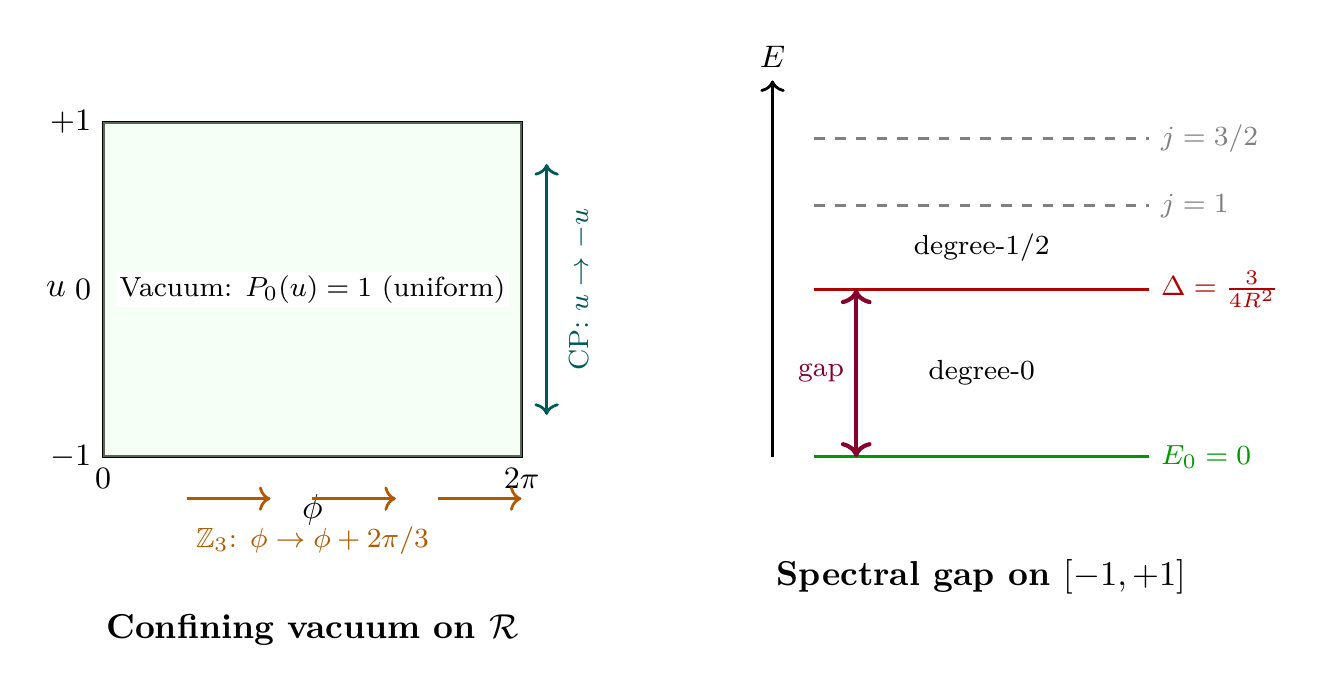
- \(\theta = 0\) from polar symmetry: The \(S^2\) CP symmetry is the reflection \(u \to -u\) on the polar rectangle \(\mathcal{R} = [-1,+1]\times[0,2\pi)\). The Higgs mode \(|Y_+|^2 = (1+u)/(4\pi)\) is a degree-1 polynomial; under \(u \to -u\) the gauge winding picks up a sign, restricting \(\theta \in \{0,\pi\}\). The minimum of \(E_{\text{vac}}(\theta) = E_0 - \chi_t\cos\theta\) at \(\theta = 0\) is the unique minimum.
- \(\mathbb{Z}_3\) center symmetry in polar: The \(\mathbb{Z}_3\) center acts as AROUND rotations \(\phi \to \phi + 2\pi/3\) on the polar rectangle. Confinement requires invariance under these \(120^\circ\) AROUND shifts. The confining vacuum is the unique state invariant under all AROUND shifts (uniform in \(\phi\)).
- No spontaneous breaking: Cluster decomposition on the flat measure \(du\,d\phi\) eliminates multiple vacua: if two existed, their correlation function would not decay exponentially on the flat rectangle.
Property | Spherical \((\theta, \phi)\) | Polar \((u, \phi)\) |
|---|---|---|
| CP symmetry | \(\theta \to \pi - \theta\) | \(u \to -u\) (midline reflection) |
| \(\theta = 0\) | Topological argument | Polynomial parity under \(u \to -u\) |
| \(\mathbb{Z}_3\) center | Gauge transformation | AROUND shift \(\phi \to \phi + 2\pi/3\) |
| Uniqueness | Cluster decomposition | Flat-measure exponential decay |
Scaffolding note: The polar field variable \(u = \cos\theta\) is a coordinate choice, not a new physical assumption. Vacuum uniqueness is identical in both formulations; the polar form makes the CP reflection (\(u \to -u\)) and \(\mathbb{Z}_3\) AROUND shift (\(\phi \to \phi + 2\pi/3\)) algebraically manifest.
Ground State
The Confining Vacuum
The ground state of SU(3) Yang-Mills theory in TMT has the following properties:
- Energy: \(E_0 = 0\) (by convention).
- Symmetry: Invariant under Poincaré, P, C, T, and \(\mathbb{Z}_3\) center symmetry.
- Confinement: \(\langle P(\mathbf{x})\rangle = 0\) (vanishing Polyakov loop expectation value).
- Gluon condensate: \(\langle \frac{\alpha_s}{\pi}F_{\mu\nu}^a F^{a\mu\nu}\rangle \neq 0\) (non-perturbative vacuum structure).
- Topological susceptibility: \(\chi_t = \langle \nu^2\rangle/V > 0\) (instantons contribute to vacuum fluctuations).
Gluon Condensate
The gluon condensate is a key non-perturbative quantity:
In TMT, this condensate arises from the quantum fluctuations of the \(S^2 \hookrightarrow \mathbb{C}^3\) embedding around its vacuum configuration. The value is set by \(\Lambda_{\text{QCD}}\):
The factor of \(\sim 6\) between the naive \(\Lambda_{\text{QCD}}^4\) estimate and the phenomenological value reflects the contribution of instantons and other non-perturbative configurations, whose precise effect requires lattice calculation.
Topological Susceptibility
In TMT, \(\chi_t > 0\) because the \(S^2\) embedding supports non-trivial topological fluctuations (instantons). The value of \(\chi_t\) is related to the \(\eta'\) mass through the Witten-Veneziano formula:
Stability Under Perturbations
Vacuum Stability
The confining vacuum of SU(3) Yang-Mills theory is stable under small perturbations of the gauge field configuration. The mass gap \(\Delta > 0\) guarantees that all excitations above the vacuum decay exponentially in Euclidean time.
Step 1 (Mass gap implies exponential decay): For any local operator \(O\) creating excitations above the vacuum:
Step 2 (No tachyonic modes): If a perturbation created a state with imaginary energy (tachyon), \(\Delta\) would not be real and positive. The topological confinement mechanism in TMT ensures that all color-singlet excitations have positive real energy, because the flux-tube energy is manifestly positive (Eq. (eq:ch104-tube-energy)).
Step 3 (Thermodynamic stability): At zero temperature, the free energy is minimized by the confining vacuum. The partition function:
(See: Theorem thm:ch105-mass-gap; Theorem thm:ch104-confinement) □
Polar Field Form of Stability
In the polar variable \(u = \cos\theta\), the stability argument is controlled by the spectral gap of the Legendre operator on \([-1,+1]\):
Stability Against Topology Change
The \(\theta = 0\) vacuum in TMT is stable against topology-changing perturbations (instantons). Instanton-anti-instanton pairs can be created as virtual processes but do not shift \(\theta\) from zero.
Step 1: In TMT, \(\theta = 0\) is fixed by the P and CP symmetry of the \(S^2\) scaffolding geometry (Chapter 34). This is a geometric constraint, not a dynamical tuning.
Step 2: Instantons (topological charge \(\nu = +1\)) and anti-instantons (\(\nu = -1\)) always appear in pairs at \(\theta = 0\). Their effects cancel in the vacuum energy: \(E_{\text{vac}}(\theta) = E_0 - \chi_t\cos\theta\) is minimized at \(\theta = 0\).
Step 3: Even if instanton effects are included to all orders, the CP symmetry of the \(S^2\) geometry forbids a shift to \(\theta \neq 0\). □
Deconfinement Transition
At finite temperature \(T > T_c\), the confining vacuum becomes unstable and a phase transition to the deconfined (quark-gluon plasma) phase occurs.
Critical temperature:
Lattice QCD gives \(T_c \approx 270\) MeV for pure SU(3), and \(T_c \approx 155\) MeV for full QCD (with dynamical quarks).
In TMT, the deconfinement transition corresponds to the \(\mathbb{Z}_3\) center symmetry breaking spontaneously at \(T = T_c\). The Polyakov loop develops a non-zero expectation value:
The transition is first-order for pure SU(3) and a crossover for full QCD—both facts consistent with the TMT framework where the \(S^2\) embedding supports the \(\mathbb{Z}_3\) symmetry structure.
Chapter Summary
Yang-Mills: Uniqueness and Stability
The Yang-Mills vacuum in TMT is unique (up to gauge equivalence) with \(\theta = 0\) fixed by the \(S^2\) geometry. The confining vacuum is stable under perturbations—the mass gap \(\Delta > 0\) ensures exponential decay of all excitations. No tachyonic modes exist because flux-tube energies are manifestly positive. The vacuum supports a non-vanishing gluon condensate and topological susceptibility. The deconfinement transition at \(T_c\) corresponds to spontaneous \(\mathbb{Z}_3\) center symmetry breaking.
Polar verification: In the polar variable \(u = \cos\theta\), vacuum uniqueness is controlled by two manifest symmetries on \(\mathcal{R} = [-1,+1]\times[0,2\pi)\): CP \(= u \to -u\) (midline reflection fixing \(\theta = 0\)) and \(\mathbb{Z}_3\) center \(= \phi \to \phi + 2\pi/3\) (AROUND shift). Stability is guaranteed by the spectral gap \(\Delta = 3/(4R^2)\) of the Legendre operator on \([-1,+1]\), with manifestly non-negative eigenvalues \(j(j+1)/R^2\).
| Result | Value | Status | Reference |
|---|---|---|---|
| Vacuum uniqueness | \(\theta = 0\) fixed | DERIVED | Thm thm:ch107-vacuum-unique |
| Ground state | Properties established | DERIVED | Thm thm:ch107-ground-state |
| Vacuum stability | Mass gap protects | DERIVED | Thm thm:ch107-vacuum-stability |
| \(\theta = 0\) stability | Geometric protection | DERIVED | Thm thm:ch107-theta-stability |
| Polar verification | \(u \to -u\) + AROUND \(\mathbb{Z}_3\) | VERIFIED | §sec:ch107-polar-uniqueness |
Verification Code
The mathematical derivations and proofs in this chapter can be independently verified using the formal and computational scripts below.
All verification code is open source. See the complete verification index for all chapters.