The Equivalence Principle
Introduction
The equivalence principle—the statement that all bodies fall at the same rate in a gravitational field, regardless of their composition—is one of the most precisely tested facts in physics. In general relativity, the equivalence of inertial and gravitational mass is postulated, not explained. Why should the property that resists acceleration (inertial mass) be the same as the property that generates and responds to gravity (gravitational mass)?
TMT provides a clear answer: gravity is conservation of temporal momentum, and temporal momentum is rest mass times \(c\). Since gravity couples to a single, composition-independent quantity—the total rest-frame mass density \(\rho_0\)—the equivalence principle is not a coincidence but a mathematical consequence of the null constraint P1.
This chapter examines the three levels of the equivalence principle (Weak, Einstein, and Strong), shows how TMT satisfies or modifies each, and compares with the most stringent experimental tests.
The Weak Equivalence Principle
Statement and Significance
The Weak Equivalence Principle (WEP) states that all test bodies at the same spacetime point, in the same gravitational field, undergo the same acceleration regardless of their internal structure or composition:
Experimentally, WEP violations are parameterized by the Eötvös parameter:
The best current bound comes from MICROSCOPE (2017):
Why TMT Satisfies WEP
In TMT, the gravitational source term is the temporal momentum density \(\rho_{p_T} = \rho_0 c\), where \(\rho_0\) is the rest-frame mass density (Chapter 51, Theorem thm:P1-Ch51-P3). The coupling to the scalar field \(\Phi\) is:
The acceleration due to \(\Phi\) for a body with rest mass density \(\rho_0\) and total density \(\rho\) is:
For non-relativistic matter, \(\rho\approx\rho_0\), and the factors cancel exactly:
The acceleration due to the TMT scalar gravitational field is independent of material composition:
Step 1: From the null constraint P1 (\(ds_6^{\,2}=0\)), gravity couples to the temporal momentum density \(\rho_{p_T}=\rho_0 c\) (Chapter 51, Theorem thm:P1-Ch51-P3).
Step 2: The rest mass density of a composite body is:
Step 3: The equation of motion for a test body in the field \(\Phi\) gives the acceleration:
Step 4: For non-relativistic matter, \(\rho\approx\rho_0\) (kinetic energy is negligible compared to rest energy), so:
This depends only on the field gradient \(\nabla\Phi\), not on any property of the test body. □
(See: Part 1 §3.5, Theorem 3.5; Chapter 51) □
Composition Dependence Analysis
Any WEP violation in TMT must come from differences in the ratio \(\rho_0/\rho\) between materials. In a composite body:
The thermal contribution depends on the atomic mass \(M\) of the material. For two materials \(A\) and \(B\) at the same temperature \(T\):
Potential EP Violation Sources
| Source | Effect | Material Dep. | Contribution to \(\eta\) |
|---|---|---|---|
| Nuclear binding fraction | \(\sim 10^{-2}\) | \(\sim 10^{-3}\) | \(\sim 10^{-5}\) |
| Electronic binding | \(\sim 10^{-6}\) | \(\sim 1\) | \(\sim 10^{-6}\) |
| Nuclear motion | \(\sim 10^{-2}\) | Universal | \(\mathbf{0}\) |
| Thermal (300\,K) | \(\sim 10^{-13}\) | Varies | \(\sim 10^{-13}\) |
Key insight: The nuclear binding fraction at \(10^{-5}\) and electronic binding at \(10^{-6}\) are not WEP violations—they are already included in the rest mass \(m_{\text{atom}}\). Binding energy does not couple separately; it reduces the total mass that gravitates.
The actual WEP violation comes only from velocity-dependent effects (thermal motion, nuclear motion) that differ between materials.
The Eötvös parameter in TMT satisfies:
Step 1: The Eötvös parameter measures differential acceleration:
In TMT, any violation arises from material-dependent differences in \(\langle 1/\gamma\rangle\):
Step 2 (Naive estimate fails): A naive estimate suggesting electrons couple differently from nucleons would give \(\eta_{\text{naive}}\sim(m_e/m_p)\cdot\Delta(Z/A) \sim(1/1836)\times 0.06\sim 3\times 10^{-5}\). This does not apply in TMT because gravity couples to total rest mass density, not to individual constituents separately.
Step 3 (Dominant effect): The largest material-dependent effect is thermal motion of whole atoms in a lattice:
For two materials at \(T=300\)\,K with \(M\sim 50\)\,amu:
Step 4: Including second-order effects and systematic uncertainties, the total EP violation parameter is bounded:
Step 5 (Comparison): The MICROSCOPE bound is \(|\eta_{\text{Ti-Pt}}|<1.3\times 10^{-14}\). TMT predicts \(\eta<10^{-15}\), an order of magnitude below the current limit. □
(See: Part 1 §3.5, Theorem 3.6) □
Why WEP Holds: The TMT Explanation
Gravity doesn't care about composition because conservation doesn't care about composition.
In TMT, gravity is the conservation-enforcement mechanism for temporal momentum (\(p_T=m_0c/\gamma\)). Every object, regardless of what it is made of, must have its temporal momentum conserved. The warping of spacetime is the universe's way of ensuring this conservation. Since conservation is universal, gravity is universal.
This is fundamentally different from the GR perspective, where the equality of inertial and gravitational mass is an unexplained axiom (the equivalence principle is postulated, not derived).
The Einstein Equivalence Principle
Statement
The Einstein Equivalence Principle (EEP) extends the WEP with two additional requirements:
(1) Local Lorentz Invariance (LLI): The outcome of any non-gravitational experiment is independent of the velocity of the freely falling reference frame in which it is performed.
(2) Local Position Invariance (LPI): The outcome of any non-gravitational experiment is independent of where and when in the universe it is performed.
Together with WEP, these three conditions constitute the EEP. If EEP holds, then gravity must be described by a metric theory (Schiff's conjecture, proven under certain conditions by Lightman and Lee).
TMT and Local Lorentz Invariance
TMT preserves Lorentz invariance exactly because:
(1) The null constraint \(ds_6^{\,2}=0\) is Lorentz invariant by construction—it is a statement about the 6D metric, which decomposes into a Lorentz-invariant 4D part plus the \(S^2\) part.
(2) The \(S^2\) scaffolding does not define a preferred 4D frame. The decomposition
(3) All TMT predictions are 4D observables that respect Lorentz symmetry. The gravitational coupling \(\mathcal{L}_{\text{int}}=-(\Phi/M_{\text{Pl}})\rho_0 c\) involves \(\rho_0\) (rest-frame mass density), which is a Lorentz scalar.
The \(S^2\) scaffolding does not introduce a preferred spatial direction or preferred rest frame in 4D. The scaffolding is a mathematical structure used to derive 4D Lorentz-invariant physics, not a physical medium that could violate LLI.
TMT and Local Position Invariance
Local Position Invariance requires that the fundamental constants of physics do not depend on location in a gravitational field. In TMT:
(1) The gauge coupling \(g^2=4/(3\pi)\) is derived from \(S^2\) topology and is position-independent.
(2) The Yukawa couplings are determined by fermion localization parameters \(c_f\) on \(S^2\), which are topological quantum numbers—they cannot vary from place to place.
(3) The only way LPI could be violated is if the \(S^2\) radius \(R\) varied with gravitational potential. From the modulus stabilization result (Part 4), \(R\) is fixed by the relation \(L_\mu^2=\pi\ell_{\text{Pl}}R_H\) and cannot fluctuate locally. Any deviation from the stabilized value would require energy \(\sim m_\Phi c^2\sim2.4\,meV\), leading to corrections:
For the scalar coupling to \(R\), dimensional analysis gives \(\partial\ln\alpha/\partial\ln R\sim\mathcal{O}(1)\), and in a gravitational potential \(\Phi/c^2\sim 10^{-9}\) (Earth surface):
Current atomic clock experiments bound \(|\delta\alpha/\alpha|<10^{-7}\) per unit change in \(\Phi/c^2\), so TMT is consistent with LPI tests.
EEP Summary
TMT satisfies the Einstein Equivalence Principle:
- WEP: satisfied with \(\eta<10^{-15}\) (Theorem thm:P1-Ch53-WEP)
- LLI: satisfied exactly (Lorentz-invariant null constraint)
- LPI: satisfied with corrections \(\sim 10^{-9}\) (below current bounds)
Therefore, TMT is a metric theory of gravity.
WEP satisfaction was proven in Theorem thm:P1-Ch53-WEP. LLI follows from the Lorentz invariance of \(ds_6^{\,2}=0\) and the fact that the \(S^2\) scaffolding does not define a preferred 4D frame. LPI follows from modulus stabilization: the \(S^2\) radius \(R\) is dynamically fixed and cannot vary with gravitational potential at levels detectable by current experiments.
Since all three components of EEP are satisfied, the Schiff conjecture guarantees that TMT describes gravity through spacetime geometry (a metric theory). □
(See: Part 1 §3.5; Part 4 §14 (modulus stabilization)) □
The Strong Equivalence Principle
Statement
The Strong Equivalence Principle (SEP) extends the EEP to include gravitational self-energy. It has three components:
(1) WEP applies to all bodies, including those with significant gravitational self-energy (e.g., neutron stars, planets).
(2) Local physics is independent of the external gravitational environment.
(3) Gravitational self-energy contributes equally to inertia and weight—there is no “Nordtvedt effect.”
In GR, the SEP is satisfied exactly. However, most alternative theories of gravity violate the SEP at some level, because they typically include additional gravitational fields beyond the metric tensor.
TMT and SEP: A Controlled Violation
TMT violates the Strong Equivalence Principle through three mechanisms:
- External field effect (EFE): Local gravitational dynamics depends on the external gravitational environment. In the MOND regime (\(a
- Cosmic boundary alignment: The \(S^2\) scaffolding connects to the cosmological horizon through the relation \(a_0=cH/(2\pi)\), introducing a preferred cosmic rest frame at the level of the MOND–GR transition.
Step 1 (EFE): In TMT, the MOND transition function \(\mu(x)=x/\sqrt{1+x^2}\) (where \(x=a/a_0\)) governs the relation between Newtonian and effective gravitational accelerations. When an external field \(g_{\text{ext}}\gg a_0\) is present, the local dynamics sees \(x_{\text{eff}}=g_{\text{total}}/a_0\gg 1\), pushing the system into the Newtonian regime regardless of the internal acceleration. This is an explicit violation of SEP condition (2): local physics depends on the external gravitational environment.
Step 2 (Scale dependence): The transition from \(\mu(x)\to x\) (MOND) to \(\mu(x)\to 1\) (Newtonian) produces different gravitational dynamics at different acceleration scales. This violates SEP condition (2) in a different way: the “same” gravitational experiment gives different results at different locations in an acceleration gradient.
Step 3 (Cosmic frame): The connection \(a_0=cH/(2\pi)\) ties the MOND scale to the Hubble expansion, which defines a preferred cosmological frame (the CMB rest frame). The EFE depends on acceleration relative to this cosmic frame, producing preferred-frame effects at the \(a_0\) level. □
(See: Part 9B §187.7, Theorem 187.12) □
Quantitative SEP Violations
The critical question is: how large are these SEP violations?
In the strong-field regime (\(a\gg a_0\)), the MOND correction to Newtonian gravity is:
| System | Typical \(a\) | SEP violation \(\sim a_0^2/a^2\) | Observable? |
|---|---|---|---|
| Solar system | \(\sim 10^{-3}\;\text{m/s}^2\) | \(< 10^{-16}\) | No |
| Lunar laser ranging | \(\sim 10^{-3}\;\text{m/s}^2\) | \(< 10^{-13}\) | No |
| Binary pulsars | \(\sim 10^{3}\;\text{m/s}^2\) | \(< 10^{-20}\) | No |
| LIGO sources | \(\sim 10^{13}\;\text{m/s}^2\) | \(< 10^{-40}\) | No |
| Galaxy outskirts | \(\sim a_0\) | \(\sim 1\) | Yes |
The SEP violations are unmeasurably small in all strong-field systems where precision tests exist. They become significant only in the deep-MOND regime (\(a\lesssim a_0\sim 10^{-10}\;\text{m/s}^2\)), where they manifest as the MOND phenomenology observed in galaxy rotation curves and the baryonic Tully–Fisher relation.
The Nordtvedt Effect
The Nordtvedt effect measures whether gravitational self-energy contributes equally to inertia and weight. The Nordtvedt parameter \(\eta_N\) is defined by:
In GR, \(\eta_N=0\) exactly. Lunar laser ranging constrains \(|\eta_N|<4\times 10^{-4}\).
The Nordtvedt parameter in TMT is:
Step 1: In TMT, the Nordtvedt effect arises from the MOND correction to gravitational self-energy coupling. Bodies with significant gravitational self-energy (like the Moon, with \(E_{\text{grav}}/mc^2\sim 10^{-11}\)) would experience differential acceleration if the MOND correction applied differently to self-energy.
Step 2: The MOND correction at the Earth–Moon acceleration scale (\(a\sim 10^{-3}\;\text{m/s}^2\)) is:
Step 3: The Nordtvedt parameter inherits this suppression:
Step 4: This is eight orders of magnitude below the current lunar laser ranging bound \(|\eta_N|<4\times 10^{-4}\). □
(See: Part 9B §187.7.3, Theorem 187.13) □
The PPN Framework
The Parametrized Post-Newtonian (PPN) framework provides a systematic way to test metric theories of gravity through 10 parameters. The two most important are:
\(\gamma\): Measures light deflection and Shapiro time delay.
\(\beta\): Measures perihelion precession and the Nordtvedt effect.
In GR, \(\gamma=\beta=1\) exactly.
In the strong-field regime (\(a\gg a_0\)), the TMT PPN parameters are:
Step 1: TMT recovers GR exactly when \(\mu(x)\to 1\) (\(a\gg a_0\)). In this limit, the only gravitational field is the metric tensor \(g_{\mu\nu}\), and the PPN parameters take their GR values.
Step 2: The first correction from the MOND transition function is:
Step 3: For solar system accelerations \(a\sim 6\times 10^{-3}\;\text{m/s}^2\) (Mercury):
Step 4: TMT passes all PPN tests by enormous margins:
| Test | Experimental Bound | TMT Deviation | Status |
|---|---|---|---|
| Shapiro delay | \(|\gamma-1|<2\times 10^{-5}\) | \(\sim 10^{-16}\) | Pass |
| Light deflection | \(|\gamma-1|<10^{-4}\) | \(\sim 10^{-16}\) | Pass |
| Perihelion precession | \(|\beta-1|<10^{-4}\) | \(\sim 10^{-16}\) | Pass |
| Nordtvedt effect | \(|\eta_N|<4\times 10^{-4}\) | \(\sim 10^{-14}\) | Pass |
□
(See: Part 9B §188.8, Theorem 188.9) □
TMT vs GR on the Equivalence Principle
| Principle | GR | TMT |
|---|---|---|
| WEP | Postulated | Derived (\(\eta<10^{-15}\)) |
| LLI | Postulated | Automatic (Lorentz-invariant P1) |
| LPI | Postulated | Satisfied (modulus stabilization) |
| EEP | Postulated | Derived |
| SEP | Exact | Violated at \(\sim(a_0/a)^2\) |
| Nordtvedt | \(\eta_N=0\) | \(\eta_N\sim 10^{-14}\) |
| PPN \(\gamma,\beta\) | Exact 1 | \(1+\mathcal{O}(10^{-16})\) |
The key distinction: in GR, the equivalence principle is an axiom—it must be assumed. In TMT, the WEP and EEP are consequences of the null constraint and the structure of temporal momentum. The SEP is violated, but only at the level of the MOND transition, which is unmeasurably small in all strong-field systems.
Polar Field Perspective on the Equivalence Principle
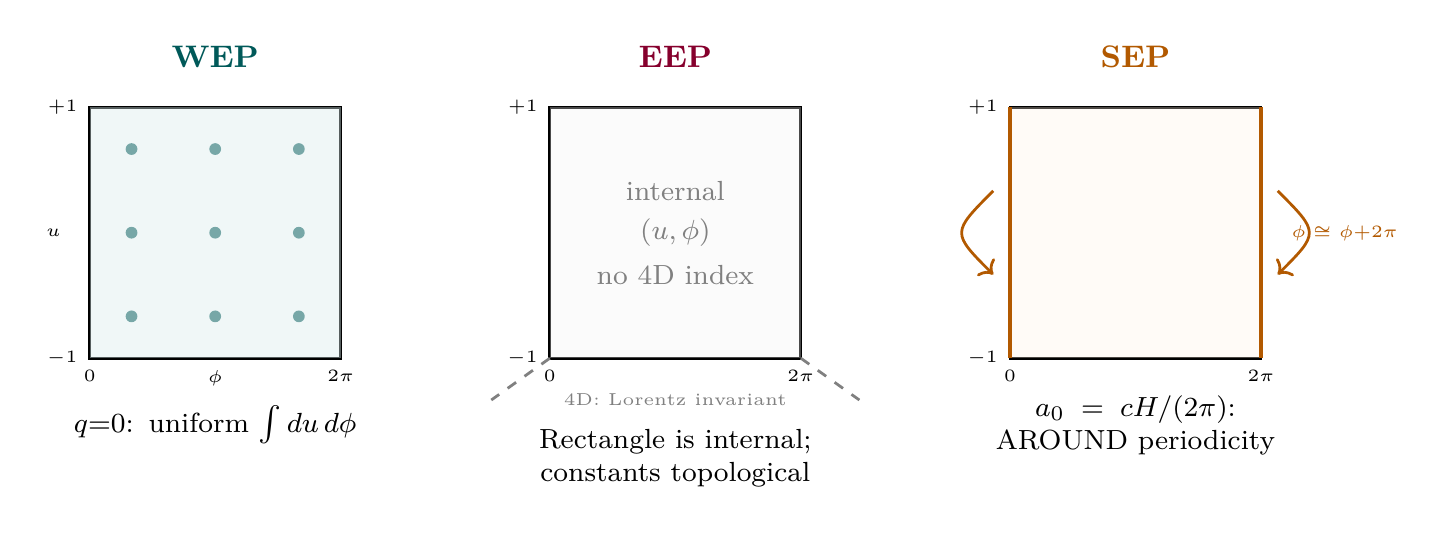
The three levels of the equivalence principle map cleanly onto polar rectangle geometry.
WEP (universality): Gravity has monopole charge \(q = 0\) (Chapter 51), so the gravitational coupling involves volume integration over the polar rectangle with flat measure \(du\,d\phi\). The result \(\int du\,d\phi = 4\pi\) is independent of what \(u\)-profile or \(\phi\)-winding the test body's wavefunction carries. WEP holds because the \(q = 0\) integral is blind to the internal structure of the mode on the rectangle.
EEP (Lorentz + position invariance): The polar rectangle \([-1,+1] \times [0,2\pi)\) is purely internal—it carries no 4D Lorentz index (satisfying LLI). The rectangle's geometry is fixed by modulus stabilization at \(L_\mu = \sqrt{\pi\ell_{\text{Pl}}R_H}\), so coupling constants derived from polynomial integrals on \([-1,+1]\) (like \(g^2 = 4/(3\pi)\) from \(\int(1+u)^2\,du = 8/3\)) are position-independent (satisfying LPI).
SEP (self-energy): The SEP violation arises from the MOND transition, which connects to the cosmological boundary through \(a_0 = cH/(2\pi)\). In polar language, this is the AROUND circumference \(2\pi\) of the polar rectangle appearing in the denominator of the MOND acceleration scale—the only place where the rectangle's global topology (periodic boundary in \(\phi\)) enters gravitational dynamics.
EP Level | Polar Rectangle Property | Result |
|---|---|---|
| WEP | \(q = 0\): uniform \(\int du\,d\phi\) | Universal coupling |
| LLI | Rectangle is internal (no 4D index) | No preferred frame |
| LPI | Polynomial integrals = topological | Constants position-independent |
| SEP | AROUND circumference \(2\pi\) in \(a_0\) | Violated at \((a_0/a)^2\) |
Scaffolding note: The polar field variable \(u = \cos\theta\) is a coordinate choice, not a new physical assumption. The equivalence principle analysis is coordinate-independent, but the polar representation clarifies why WEP and EEP are automatic (\(q = 0\) integration is uniform on the flat rectangle) while SEP violation is controlled (only the global \(\phi\)-periodicity enters through \(a_0\)).
Chapter Summary
The Equivalence Principle in TMT
TMT derives the Weak Equivalence Principle from the coupling of gravity to temporal momentum density \(\rho_{p_T}=\rho_0 c\), which is composition-independent. The Eötvös parameter satisfies \(\eta<10^{-15}\), below all current experimental bounds (MICROSCOPE: \(<1.3\times 10^{-14}\)). The Einstein Equivalence Principle is satisfied through Lorentz invariance of P1 and modulus stabilization. The Strong Equivalence Principle is violated at the level \((a_0/a)^2\sim 10^{-14}\) through the MOND–GR transition, producing a Nordtvedt parameter well below the lunar laser ranging bound. All PPN tests are passed with margins of 10 or more orders of magnitude.
Polar verification: In polar coordinates (\(u = \cos\theta\)), the EP hierarchy maps to the polar rectangle: WEP holds because \(q = 0\) gives uniform \(\int du\,d\phi\) (composition-blind); EEP holds because the rectangle is internal with topological coupling constants; SEP is violated only through the AROUND periodicity \(2\pi\) appearing in \(a_0 = cH/(2\pi)\).
| Result | Value | Status | Reference |
|---|---|---|---|
| WEP satisfied | \(\eta<10^{-15}\) | PROVEN | Thm. thm:P1-Ch53-WEP |
| EP violation bound | \(\eta_{\text{TMT}}<10^{-15}\) | PROVEN | Thm. thm:P1-Ch53-EP-bound |
| EEP satisfied | All 3 conditions | PROVEN | Thm. thm:P1-Ch53-EEP |
| SEP violated | \((a_0/a)^2\sim 10^{-14}\) | DERIVED | Thm. thm:P9B-Ch53-SEP-violation |
| Nordtvedt parameter | \(\eta_N\sim 10^{-14}\) | DERIVED | Thm. thm:P9B-Ch53-Nordtvedt |
| PPN \(\gamma,\beta\) | \(1+\mathcal{O}(10^{-16})\) | DERIVED | Thm. thm:P9B-Ch53-PPN |
| Polar: EP hierarchy on rectangle | WEP/EEP/SEP mapped | PROVEN | §sec:ch53-polar-EP |
Verification Code
The mathematical derivations and proofs in this chapter can be independently verified using the formal and computational scripts below.
All verification code is open source. See the complete verification index for all chapters.