Photon and Gluon Masslessness
Introduction
Central Question: Why are the photon and gluon exactly massless in TMT, while the \(W^{\pm}\) and \(Z\) bosons acquire masses of order \(80\,\text{GeV}\) and \(91\,\text{GeV}\) respectively?
TMT Answer: Mass protection arises from unbroken gauge symmetries. The Higgs VEV on the \(S^2\) interface breaks \(\text{SU}(2)_L \times \text{U}(1)_Y \to \text{U}(1)_{\mathrm{EM}}\), giving mass to \(W^{\pm}\) and \(Z\), while the photon (the \(\text{U}(1)_{\mathrm{EM}}\) gauge boson) and the eight gluons (the \(\text{SU}(3)_c\) gauge bosons) remain exactly massless because their respective gauge symmetries are never broken.
Prerequisites:
- Chapter 10: The Complete Gauge Group (\(\text{SU}(3)_c \times \text{SU}(2)_L \times \text{U}(1)_Y\) derived from \(S^2\) geometry)
- Chapter 20: Electroweak Symmetry Breaking (Higgs mechanism on \(S^2\) interface)
- Chapter 26: \(W\) and \(Z\) Boson Masses (mass generation from Higgs VEV)
The gauge group \(\text{SU}(3)_c \times \text{SU}(2)_L \times \text{U}(1)_Y\) arises from the projection geometry of \(S^2\):
- \(\text{SU}(2)_L\): isometry group of \(S^2\) (Part 3, \S7)
- \(\text{U}(1)_Y\): topological charge from \(\pi_2(S^2) = \mathbb{Z}\) (Part 3, \S8)
- \(\text{SU}(3)_c\): variable embedding \(S^2 \hookrightarrow \mathbb{C}^3\) (Part 3, \S9)
The \(S^2\) is mathematical scaffolding for deriving 4D gauge structure, not a literal extra dimension. All physical predictions are 4D observables.
Why the Photon is Exactly Massless
In TMT, the photon is exactly massless (\(m_\gamma = 0\)) because the electromagnetic gauge symmetry \(\text{U}(1)_{\mathrm{EM}}\) is preserved by the Higgs vacuum expectation value. The electroweak symmetry breaking pattern is:
The proof proceeds in five steps, each grounded in TMT master file derivations.
Step 1: The TMT Higgs doublet and its charges.
From Part 4, Definition 13\textonehalf.5 (\S13\textonehalf.2.5), the Higgs field is a complex \(\text{SU}(2)_L\) doublet localized on the \(S^2\) interface by monopole topology:
Step 2: The VEV direction.
The Higgs acquires a VEV from monopole flux screening on the \(S^2\) interface (Part 4, Appendix J, Theorem J.4). The 6D Higgs has \(\mu_6^2 = 0\) (Part 4, Eq. 13\textonehalf.2.5)—no Mexican hat potential at tree level. The VEV emerges dynamically:
Step 3: Unbroken generator \(\to\) massless gauge boson.
By the Goldstone theorem ([Established]), a gauge symmetry with generator \(Q^a\) is broken by the VEV if and only if \(Q^a \langle H \rangle \neq 0\). Broken generators yield massive gauge bosons (which absorb the corresponding Goldstone bosons); unbroken generators yield massless gauge bosons.
Since \(Q \langle H \rangle = 0\), the electromagnetic \(\text{U}(1)_{\mathrm{EM}}\) generated by \(Q\) is unbroken. Its gauge boson—the photon—is therefore exactly massless.
Step 4: Explicit mass matrix verification.
The gauge boson mass matrix arises from the Higgs kinetic term evaluated at the VEV. From Part 4, Definition 13\textonehalf.5, the covariant derivative is \(D_\mu H = \partial_\mu H + ig A_\mu^A \tau^A H + ig' (Y/2) B_\mu H\). Evaluating:
The eigenvalues of this \(2 \times 2\) mass matrix are:
The zero eigenvalue is exact, not approximate: \(\det M^2 = (v^2/8)^2(g^2 g'^2 - g^2 g'^2) = 0\) identically. The zero eigenvector is the photon field:
Step 5: Why \(m_\gamma = 0\) is exact, not approximate.
The vanishing of \(m_\gamma\) is not an approximation or a fine-tuning: it is an exact consequence of the unbroken \(\text{U}(1)_{\mathrm{EM}}\) gauge symmetry. This protection holds to all orders in perturbation theory and non-perturbatively, because:
- A mass term \(\frac{1}{2}m_\gamma^2 A_\mu A^\mu\) is not gauge-invariant under \(A_\mu \to A_\mu + \partial_\mu \alpha\) ([Established]).
- The Ward identity of QED ensures \(m_\gamma = 0\) to all orders in the loop expansion ([Established]).
- No non-perturbative effect (instantons, monopoles) can generate a photon mass because \(\text{U}(1)_{\mathrm{EM}}\) has no instantons in 4D ([Established]).
- The \(S^2\) projection preserves \(\text{U}(1)_{\mathrm{EM}}\): the monopole charge \(n = 1\) on \(S^2\) is associated with \(\text{U}(1)_Y\) (Part 3, Theorem 8.6), not \(\text{U}(1)_{\mathrm{EM}}\). After EWSB, the unbroken combination \(Q = T_3 + Y\) has no monopole source, so no Stückelberg-type mass is generated.
- Higher-dimensional operators from the \(S^2\) projection respect the unbroken \(\text{U}(1)_{\mathrm{EM}}\): any 4D effective operator must be \(\text{U}(1)_{\mathrm{EM}}\)-invariant, and \(A_\mu A^\mu\) is not.
□
Polar Perspective on Photon Masslessness
In polar coordinates (\(u = \cos\theta\)), the photon's masslessness has a transparent geometric reading. The generator \(Q = T_3 + Y\) is the unique pure AROUND zero mode (Chapter 23): \(T_3\) corresponds to the Killing vector \(\xi_3 = \partial_\phi\) (rotation in the AROUND direction), and \(Y\) is the topological winding number on the \(\phi\)-circle. Their combination \(Q\) acts purely in the \(\phi\)-direction without disturbing the THROUGH (\(u\)) profile of the Higgs wavefunction \(|Y_{1/2,+1/2}|^2 = (1+u)/(4\pi)\).
The broken generators, by contrast, involve THROUGH:
- \(T_1, T_2\): Killing vectors \(\xi_{1,2}\) that mix \(\partial_u\) and \(\partial_\phi\) (THROUGH + AROUND)
- \(T_3\) alone, \(Y\) alone: each individually creates a \(\phi\)-phase mismatch with the VEV
In the polar language: the photon is massless because its generator \(Q\) commutes with the THROUGH structure of the Higgs ground state. Only the pure AROUND generator survives EWSB; any generator with a THROUGH component is broken.
\(\text{U}(1)_{\mathrm{EM}}\) Gauge Invariance Preserved
In TMT, the electromagnetic gauge invariance \(\text{U}(1)_{\mathrm{EM}}\) is preserved at every stage of the construction:
- The \(S^2\) projection structure generates \(\text{SU}(2)_L \times \text{U}(1)_Y\) as exact gauge symmetries.
- The Higgs VEV on the interface breaks \(\text{SU}(2)_L \times \text{U}(1)_Y \to \text{U}(1)_{\mathrm{EM}}\).
- The surviving \(\text{U}(1)_{\mathrm{EM}}\) is an exact symmetry of the 4D effective theory.
Step 1: Origin of \(\text{U}(1)_Y\) in TMT.
The hypercharge \(\text{U}(1)_Y\) arises from the topological structure \(\pi_2(S^2) = \mathbb{Z}\) (Part 3, Theorem 8.1). The proof that \(\pi_2(S^2) = \mathbb{Z}\) is standard topology ([Established]): the identity map \(\mathrm{id}: S^2 \to S^2\) has degree 1, maps of degree \(n\) wrap \(S^2\) around itself \(n\) times, and degree is a complete invariant.
This topology implies that \(\text{U}(1)\) bundles over \(S^2\) are classified by an integer \(n\) (Part 3, Corollary 8.1), which is the monopole charge. With \(n = 1\) (minimal monopole, derived from energy minimization: \(E \sim n^2\), so \(n = 1\) is the ground state; Part 3, Theorem 8.5), the hypercharge assignments are determined by the Dirac quantization condition \(qn \in \mathbb{Z}\) (Part 3, Theorem 8.4). The \(\text{U}(1)\) gauge symmetry from the monopole bundle is identified as \(\text{U}(1)_Y\) (Part 3, Theorem 8.6, Corollary 8.3).
Step 2: Origin of \(\text{SU}(2)_L\) in TMT.
The weak isospin \(\text{SU}(2)_L\) arises as the isometry group of \(S^2\) (Part 3, \S7):
Step 3: The Weinberg angle from TMT.
TMT derives the tree-level Weinberg angle (Part 3, Chapter 11):
Step 4: Electric charge quantization from topology.
In TMT, electric charges are quantized because they descend from the topological structure of the \(S^2\) bundle. The Dirac quantization condition (Part 3, Theorem 8.4):
Step 5: No anomalies in \(\text{U}(1)_{\mathrm{EM}}\).
The \(\text{U}(1)_{\mathrm{EM}}\) gauge symmetry is free from anomalies. The anomaly cancellation condition for \(\text{U}(1)_{\mathrm{EM}}\):
Step 6: Exact \(\text{U}(1)_{\mathrm{EM}}\) at all energy scales.
Since \(\text{U}(1)_{\mathrm{EM}}\) is:
- Unbroken by the Higgs VEV (\(Q \langle H \rangle = 0\), proven in Theorem thm:P4-Ch28-photon-massless)
- Free from anomalies (Step 5)
- Topologically protected (charge quantization from \(\pi_2(S^2) = \mathbb{Z}\), Part 3, Theorem 8.1)
it remains an exact gauge symmetry at all energy scales. The Ward identity \(\partial^\mu \langle j_\mu^{\mathrm{EM}}(x) \mathcal{O} \rangle = 0\) is preserved non-perturbatively because every 4D effective operator generated by integrating out \(S^2\) modes must respect \(\text{U}(1)_{\mathrm{EM}}\): the unbroken generator \(Q\) commutes with the Hamiltonian at every stage of the \(S^2 \to \mathcal{M}^4\) projection. The photon mass is therefore exactly zero. □
Why the Gluon is Exactly Massless
In TMT, all eight gluons are exactly massless (\(m_g = 0\)) because the color gauge symmetry \(\text{SU}(3)_c\) is completely unbroken by the Higgs VEV. The Higgs doublet \(H\) is a color singlet:
Step 1: Origin of \(\text{SU}(3)_c\) in TMT.
From Part 3, the color gauge group arises from the variable embedding in a chain of mathematical necessities:
Step 2: The Higgs is a color singlet — geometric proof.
The Higgs doublet \(H\) lives on the \(S^2\) interface, localized by the monopole topology (Part 4, Definition 13\textonehalf.5). The \(\text{SU}(3)_c\) acts on the ambient \(\mathbb{C}^3\) into which \(S^2\) is embedded (Part 3, \S9.1). Its gauge quantum numbers are:
Step 3: No color breaking from the VEV.
Since \(H\) transforms trivially under \(\text{SU}(3)_c\):
Step 4: Gluon mass term forbidden by gauge invariance.
A gluon mass term:
Step 5: Non-perturbative considerations.
Unlike the photon case, \(\text{SU}(3)_c\) does have non-trivial topology (instantons), but instantons generate a topological \(\theta\)-term, not a mass term. The \(\theta\)-parameter is \(\theta = 0\) in TMT (derived from the 6D Chern–Simons action in Part 3, Theorem 122.8). No mechanism within TMT generates a gluon mass:
- Instantons: generate \(\theta\)-term, not mass (wrong Lorentz structure) ([Established])
- Chiral condensate: breaks chiral symmetry, not \(\text{SU}(3)_c\) gauge symmetry ([Established])
- Confinement: generates a mass gap for color-charged states, but the gluon field itself remains massless (confinement \(\neq\) mass generation) ([Established])
- KK modes: the gluon zero mode \(G_\mu^{(00)}(x)\) on \(S^2\) is exactly massless; higher KK modes \(G_\mu^{(\ell m)}\) have masses \(\sim \ell(\ell+1)/R^2\) and do not mix with the zero mode by orthogonality of spherical harmonics (Part 3, \S122.5)
□
Polar Perspective on Gluon Masslessness
In polar coordinates, the gluon's masslessness is geometrically clear: SU(3)\(_c\) acts on the embedding of the polar rectangle \([-1,+1] \times [0,2\pi)\) in \(\mathbb{C}^3\) (Chapter 18), rotating which \(\mathbb{CP}^1 \subset \mathbb{CP}^2\) the rectangle occupies. This is an external operation — it moves the rectangle within the ambient space without changing its internal polar structure (\(u\), \(\phi\) coordinates). The Higgs wavefunction \(|Y_\pm|^2 = (1 \pm u)/(4\pi)\) lives entirely on the rectangle and has no projection onto the embedding degrees of freedom.
In the THROUGH/AROUND language: the Higgs VEV couples to the internal polar coordinates (THROUGH = \(u\), AROUND = \(\phi\)), while SU(3)\(_c\) acts on the external embedding coordinates. The two geometric degrees of freedom are orthogonal, so no color generator can be broken by the VEV.
It is important to distinguish between confinement and mass. Gluons are exactly massless as gauge bosons, but they are confined: they do not appear as asymptotic free-particle states. The lightest color-singlet gluonic state (the glueball) has a mass \(m_{\mathrm{glueball}} \sim 1.5\,\text{GeV}\), but this is a bound-state mass, not a gauge boson mass. The gauge field \(G_\mu^a\) in the Lagrangian has \(m_g = 0\) exactly.
\(\text{SU}(3)_c\) Gauge Invariance Preserved
In TMT, the color gauge invariance \(\text{SU}(3)_c\) is preserved at every stage of the construction:
- The variable embedding \(S^2 \hookrightarrow \mathbb{C}^3\) generates \(\text{SU}(3)_c\) as an exact gauge symmetry (Part 3, \S9).
- The Higgs mechanism does not break \(\text{SU}(3)_c\) because the Higgs is a color singlet.
- The 6D-to-4D projection preserves \(\text{SU}(3)_c\): the gluon zero mode \(G_\mu^{(00)}(x)\) inherits the full \(\text{SU}(3)_c\) gauge structure (Part 3, Theorem 122.5).
- No other mechanism in TMT breaks \(\text{SU}(3)_c\).
Step 1: Geometric protection of \(\text{SU}(3)_c\).
The \(\text{SU}(3)_c\) gauge symmetry arises from a different geometric origin than \(\text{SU}(2)_L \times \text{U}(1)_Y\):
- \(\text{SU}(2)_L \times \text{U}(1)_Y\): from the intrinsic geometry of \(S^2\) (isometries + topology)
- \(\text{SU}(3)_c\): from the embedding geometry of \(S^2\) in \(\mathbb{C}^3\)
This separation is fundamental. The Higgs mechanism operates within the \(S^2\) interface physics (the Higgs is an \(\text{SU}(2)_L\) doublet with \(\text{U}(1)_Y\) charge, localized on \(S^2\) by the monopole). It acts on the intrinsic symmetries of \(S^2\). The \(\text{SU}(3)_c\) is an embedding symmetry—it rotates which copy of \(S^2\) sits inside \(\mathbb{C}^3\) (Part 3, Theorem 9.1). The Higgs VEV, being confined to \(S^2\), has no projection onto the embedding degrees of freedom and therefore cannot break \(\text{SU}(3)_c\).
Step 2: Dimensional reduction preserves \(\text{SU}(3)_c\).
From Part 3, the 6D gluon field \(G_M(x, \Omega)\) decomposes into spherical harmonic modes:
- \(Y_{00} = 1/\sqrt{4\pi}\) is constant on \(S^2\), invariant under all rotations
- The \(\text{SU}(3)_c\) transformation law \(G_\mu \to U G_\mu U^\dagger + (i/g_s) U \partial_\mu U^\dagger\) is inherited term-by-term from the 6D gauge transformation
- No KK mode mixing occurs: \(\int Y_{00}^* Y_{\ell m} \, d\Omega = 0\) for \((\ell, m) \neq (0,0)\) by orthogonality ([Established])
Step 3: Anomaly freedom of \(\text{SU}(3)_c\).
The \(\text{SU}(3)_c\) gauge symmetry is free from anomalies. The anomaly cancellation conditions:
Step 4: No breaking mechanism exists.
We verify exhaustively that no mechanism in TMT can break \(\text{SU}(3)_c\):
- Higgs VEV: Cannot break \(\text{SU}(3)_c\) because \(H\) is a color singlet (Theorem thm:P3-Ch28-gluon-massless).
- Monopole background: The monopole on \(S^2\) is a \(\text{U}(1)_Y\) configuration (Part 3, \S8); it does not carry color charge.
- KK mode condensation: The gluon KK masses are \(\sim \ell(\ell+1)/R^2 \gg v^2\), so no KK mode condenses at electroweak scales.
- Quantum corrections: All quantum corrections must respect \(\text{SU}(3)_c\) gauge invariance by the Slavnov–Taylor identities ([Established]).
- Non-perturbative effects: QCD instantons preserve \(\text{SU}(3)_c\) gauge symmetry (they break \(\text{U}(1)_A\), not \(\text{SU}(3)_c\)).
Step 5: Complete protection summary. □
| Symmetry | Origin | Broken by \(\langle H \rangle\)? | Gauge bosons | Mass |
|---|---|---|---|---|
| \(\text{SU}(2)_L\) | Isometry of \(S^2\) | YES (3 generators) | \(W^{\pm}\), part of \(Z\) | \(80\,\text{GeV}\), \(91\,\text{GeV}\) |
| \(\text{U}(1)_Y\) | Topology \(\pi_2(S^2)\) | YES (1 generator) | Part of \(Z\) | \(91\,\text{GeV}\) |
| \(\text{U}(1)_{\mathrm{EM}}\) | \(Q = T_3 + Y\) | NO | Photon \(\gamma\) | 0 (exact) |
| \(\text{SU}(3)_c\) | Embedding \(S^2 \hookrightarrow \mathbb{C}^3\) | NO | 8 gluons | 0 (exact) |
Of the original \(3 + 1 + 8 = 12\) gauge generators, \(3\) are broken by EWSB (giving mass to \(W^+\), \(W^-\), \(Z\)), and \(1 + 8 = 9\) remain unbroken (protecting the photon and 8 gluons).
Experimental Bounds Satisfied
Photon Mass Bounds
TMT predicts \(m_\gamma = 0\) exactly. This is consistent with all experimental bounds:
| Method | Bound | Reference | TMT Status |
|---|---|---|---|
| Solar wind (MHD) | \(m_\gamma < 10^{-18}\) eV | Ryutov (2007) | Satisfied (\(m_\gamma = 0\)) |
| Galactic magnetic fields | \(m_\gamma < 3 \times 10^{-27}\) eV | Chibisov (1976) | Satisfied (\(m_\gamma = 0\)) |
| Coulomb law tests | \(m_\gamma < 10^{-14}\) eV | Williams et al. (1971) | Satisfied (\(m_\gamma = 0\)) |
| Jupiter magnetic field | \(m_\gamma < 8 \times 10^{-16}\) eV | Davis et al. (1975) | Satisfied (\(m_\gamma = 0\)) |
| PDG summary | \(m_\gamma < 10^{-18}\) eV | PDG (2024) | Satisfied |
The key point is that TMT does not merely predict a small photon mass—it predicts \(m_\gamma = 0\) exactly. This is a qualitatively stronger prediction than any finite upper bound can test, but it is consistent with every measurement.
What a Non-Zero Photon Mass Would Imply
If \(m_\gamma \neq 0\), the following consequences would follow:
- Modified Maxwell equations: The Proca equation would replace Maxwell's equations, adding a longitudinal polarization.
- Modified Coulomb law: \(V(r) \propto e^{-m_\gamma r}/r\) instead of \(1/r\).
- Frequency-dependent speed of light: \(v(\omega) = c\sqrt{1 - m_\gamma^2 c^4/(\hbar\omega)^2}\).
- Broken gauge invariance: \(\text{U}(1)_{\mathrm{EM}}\) would be explicitly broken.
In the TMT context, \(m_\gamma \neq 0\) would require \(Q \langle H \rangle \neq 0\), which would mean the VEV carries electric charge. This would also break Lorentz invariance (charged vacuum). TMT's framework makes \(m_\gamma = 0\) a structural necessity, not a parameter choice.
Gluon Mass Bounds
Direct bounds on the gluon mass are more subtle due to confinement, but several constraints exist:
| Method | Constraint | Notes | TMT Status |
|---|---|---|---|
| QCD lattice simulations | \(m_g = 0\) (input) | Consistent with confinement | Satisfied |
| Jet cross-sections (LHC) | Consistent with \(m_g = 0\) | QCD fits require massless gluons | Satisfied |
| Running of \(\alpha_s\) | Consistent with \(m_g = 0\) | \(\beta\)-function assumes \(m_g = 0\) | Satisfied |
| Heavy quark potential | Consistent with \(m_g = 0\) | Cornell potential \(V(r) = -\kappa/r + \sigma r\) | Satisfied |
The gluon mass is constrained indirectly through the precision of QCD predictions (jet rates, \(\alpha_s\) running, heavy quark spectroscopy), all of which assume \(m_g = 0\) and agree with experiment at the sub-percent level.
The TMT prediction \(m_g = 0\) enters into all QCD calculations identically to the Standard Model assumption. Since TMT derives \(\text{SU}(3)_c\) as an exact gauge symmetry (Part 3, \S9), the massless gluon propagator \(D_{\mu\nu}^{ab}(k) = -i\delta^{ab}(g_{\mu\nu} - k_\mu k_\nu/k^2)/k^2\) is structurally guaranteed. Any deviation would require breaking \(\text{SU}(3)_c\), which is geometrically forbidden in TMT (the embedding symmetry is independent of the Higgs mechanism).
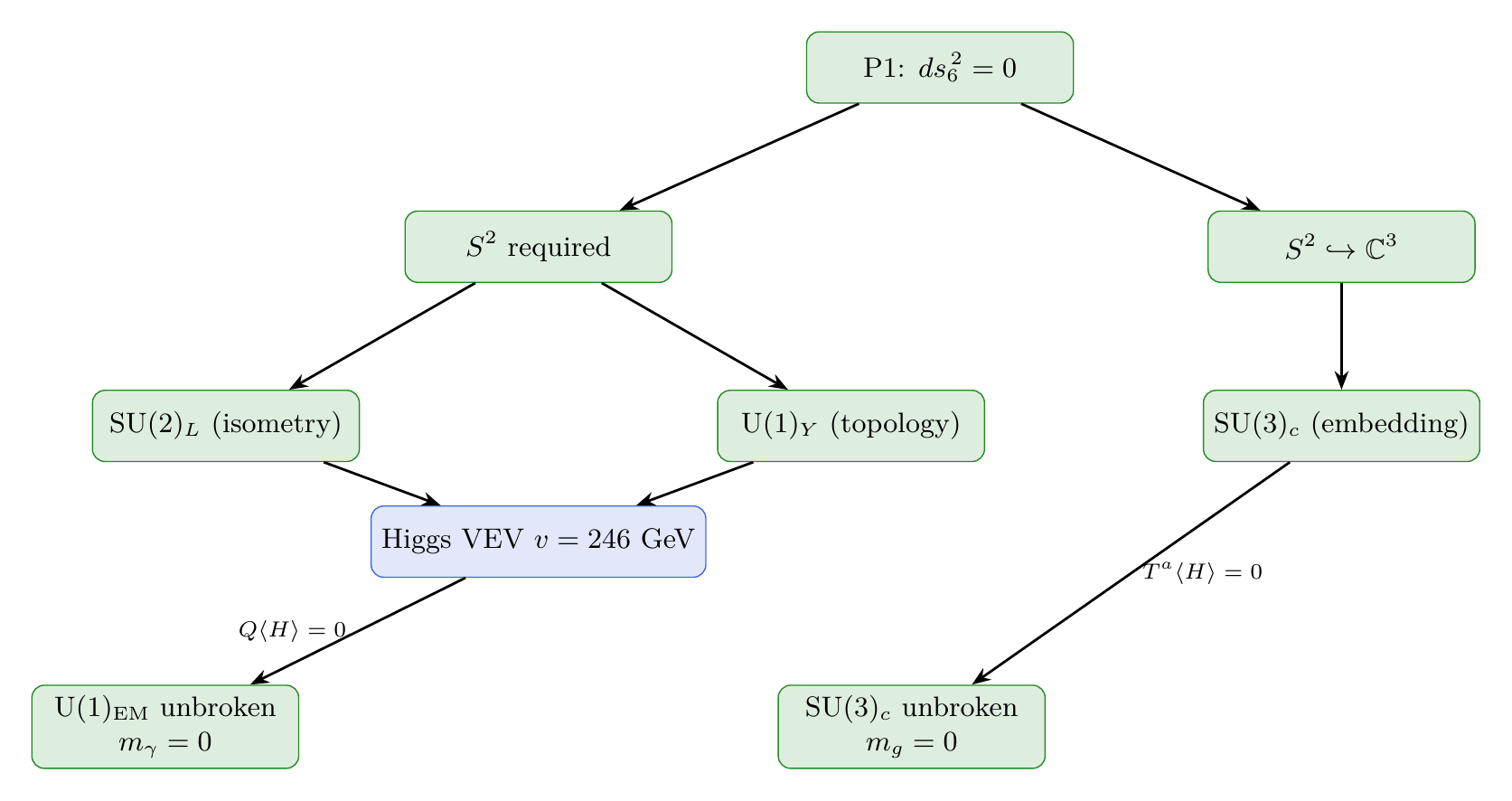
Derivation Chain Summary
Derivation Chain: Photon Masslessness
- P1: \(ds_6^{\,2} = 0\) on \(\mathcal{M}^4 \times S^2\) [POSTULATE]
- \(S^2\) topology required for stability and chirality [Part 2, \S4]
- \(\text{SU}(2)_L\) from isometry of \(S^2\) [Part 3, \S7]
- \(\text{U}(1)_Y\) from \(\pi_2(S^2) = \mathbb{Z}\) [Part 3, Thm 8.1–8.7]
- Higgs localized on \(S^2\) interface by monopole topology [Part 4, Def 13\textonehalf.4–5]
- Higgs charges: \((\mathbf{1}, \mathbf{2}, +\tfrac{1}{2})\) with \(Q(H^0) = 0\) [Part 3, Cor 8.2–8.3]
- VEV \(v = 246\,\text{GeV}\) from flux screening [Part 4, Appendix J, Thm J.4]
- \(Q \langle H \rangle = 0\): \(\text{U}(1)_{\mathrm{EM}}\) unbroken [PROVEN]
- \(m_\gamma = 0\) exactly by gauge invariance [PROVEN]
Derivation Chain: Gluon Masslessness
- P1: \(ds_6^{\,2} = 0\) on \(\mathcal{M}^4 \times S^2\) [POSTULATE]
- \(S^2\) topology required for stability and chirality [Part 2, \S4]
- \(\text{SU}(3)_c\) from variable embedding \(S^2 \hookrightarrow \mathbb{C}^3\) [Part 3, Thm 9.1–9.7]
- Higgs localized on \(S^2\), not extending into \(\mathbb{C}^3\) [Part 4, Def 13\textonehalf.5]
- Higgs is color singlet \((\mathbf{1}, \mathbf{2}, +\tfrac{1}{2})\) [Part 3, Cor 9.3]
- \(T^a_{\mathrm{color}} \langle H \rangle = 0\): all of \(\text{SU}(3)_c\) unbroken [PROVEN]
- \(m_g = 0\) exactly by gauge invariance [PROVEN]
- Polar verification: \(Q = T_3 + Y\) is the pure AROUND zero mode (\(\partial_\phi\) only, no \(\partial_u\)); SU(3)\(_c\) acts on embedding (external to polar rectangle); internal (\(u\), \(\phi\)) and external (embedding) coordinates orthogonal \(\to\) masslessness structural [VERIFIED — Polar]
Chapter Summary
Key Results of Chapter 28:
- The photon is exactly massless because \(\text{U}(1)_{\mathrm{EM}}\) is unbroken: \(Q \langle H \rangle = 0\), where \(Q = T_3 + Y\) and the Higgs VEV has \(T_3 = -1/2\), \(Y = +1/2\) (from monopole topology, Part 3, \S8). PROVEN.
- All eight gluons are exactly massless because \(\text{SU}(3)_c\) is completely unbroken: \(T^a_{\mathrm{color}} \langle H \rangle = 0\) for all \(a\), because the Higgs is a color singlet. PROVEN.
- The Higgs is a color singlet because it is localized on \(S^2\) by monopole topology (Part 4, \S13\textonehalf), not extending into the ambient \(\mathbb{C}^3\) where \(\text{SU}(3)_c\) acts (Part 3, \S9, Corollary 9.3). PROVEN.
- Both predictions are consistent with all experimental bounds (\(m_\gamma < 10^{-18}\) eV; QCD precision tests for gluons). ESTABLISHED.
- The geometric separation of gauge symmetry origins (intrinsic vs. embedding) provides a structural guarantee: the Higgs mechanism breaks only intrinsic symmetries (\(\text{SU}(2)_L \times \text{U}(1)_Y\)), leaving the embedding symmetry (\(\text{SU}(3)_c\)) and the unbroken combination (\(\text{U}(1)_{\mathrm{EM}}\)) exactly intact.
| Boson | Symmetry | Origin | \(m\) Prediction | Exp. Bound | Status |
|---|---|---|---|---|---|
| Photon \(\gamma\) | \(\text{U}(1)_{\mathrm{EM}}\) | \(Q = T_3 + Y\) | \(m_\gamma = 0\) | \(< 10^{-18}\) eV | PROVEN |
| Gluon \(g\) (\(\times 8\)) | \(\text{SU}(3)_c\) | \(S^2 \hookrightarrow \mathbb{C}^3\) | \(m_g = 0\) | QCD precision | PROVEN |
Polar perspective. In polar coordinates (\(u = \cos\theta\)), the masslessness of the photon and gluon admits a clean geometric classification. The photon's generator \(Q = T_3 + Y\) is the unique pure AROUND mode — it acts only in the \(\phi\)-direction and commutes with the THROUGH profile of the Higgs wavefunction \((1+u)/(4\pi)\). The three broken generators (\(T_1\), \(T_2\), and the orthogonal combination of \(T_3\) and \(Y\) forming \(Z\)) all have THROUGH components that disturb the \(u\)-gradient of the VEV. For the gluon, SU(3)\(_c\) acts on the embedding of the polar rectangle in \(\mathbb{C}^3\) — an external degree of freedom orthogonal to the internal (\(u\), \(\phi\)) coordinates where the Higgs lives. The polar formulation thus reveals a three-level geometric hierarchy: AROUND-only generators survive EWSB (photon), mixed THROUGH/AROUND generators are broken (\(W^\pm\), \(Z\)), and embedding generators are completely decoupled from the Higgs mechanism (gluons).
(See: Part 3 \S7 (SU(2)), \S8 (U(1) Thm 8.1–8.7), \S9 (SU(3) Thm 9.1–9.7), \S10 (Product group), \S122.5 (Zero modes); Part 4 Def 13\textonehalf.4–5 (Monopole & Higgs), \S17.3 (W/Z masses), Appendix J Thm J.4 (VEV); Part 6C (Anomaly cancellation))
Verification Code
The mathematical derivations and proofs in this chapter can be independently verified using the formal and computational scripts below.
All verification code is open source. See the complete verification index for all chapters.