
The Epistemology of TMT
Introduction
This chapter examines the epistemological structure of TMT: what the theory knows, how it knows it, and where the boundary lies between derivation and assumption. TMT's unusual structure—a single postulate generating all of physics with zero free parameters—raises questions about the nature of physical knowledge that go beyond the theory's specific predictions.
What is Known vs What is Derived
The Epistemological Hierarchy
TMT's results can be categorised into a strict hierarchy based on their relationship to the postulate P1:
| Level | Category | Examples | Count |
|---|---|---|---|
| 0 | Postulate | \(ds_6^{\,2} = 0\) on \(M^4 \times S^2\) | 1 |
| 1 | Direct consequence | \(M^4 \times S^2\) topology, \(D = 6\) | \(\sim 5\) |
| 2 | Geometric derivation | Gauge group, \(\pi_2(S^2) = \mathbb{Z}\) | \(\sim 20\) |
| 3 | Physical derivation | \(g^2 = 4/(3\pi)\), \(m_H = 126\) GeV | \(\sim 50\) |
| 4 | Chain derivation | \(m_p = 937\) MeV, \(\tau_0 = 149\) fs | \(\sim 30\) |
| 5 | Null prediction | No SUSY, no 4th generation | \(\sim 10\) |
Level 0: The postulate itself. P1 is not derived; it is assumed. Its justification is purely empirical: it works.
Level 1: Direct mathematical consequences of P1, requiring only standard topology and differential geometry. These are as certain as mathematical theorems.
Level 2: Geometric results that follow from the \(S^2\) structure via established mathematics (homotopy theory, representation theory, harmonic analysis). These are mathematically rigorous.
Level 3: Physical results that combine the geometric structure with physical principles (energy minimisation, gauge invariance, renormalisation group). These are as reliable as the physical principles used.
Level 4: Results at the end of long derivation chains, where multiple Level 2 and 3 results are combined. The proton mass, for instance, requires: P1 \(\to\) \(S^2\) \(\to\) SU(3) \(\to\) \(g_3^2 = 4/\pi\) \(\to\) \(\Lambda_{\text{QCD}}\) \(\to\) \(m_p\).
Level 5: Predictions of absence—things TMT says should not exist. These are among the most powerful predictions because they are sharply falsifiable.
The Single Assumption
TMT contains exactly one assumption: the postulate P1 (\(ds_6^{\,2} = 0\) on \(M^4 \times S^2\)). All other inputs to the theory are either mathematical theorems or established physical principles that any theory must satisfy.
The “established physical principles” used in TMT derivations are:
- Energy minimisation (variational principle)
- Gauge invariance (local symmetry)
- Quantum mechanics (used in the derivation of QM itself, which is circular—except that TMT derives QM from geometry, so the circularity is resolved; see Part 7)
- Renormalisation group (standard mathematical procedure)
- Anomaly cancellation (mathematical consistency requirement)
None of these is specific to TMT; they are shared by all successful physical theories.
Polar Field Form of the Epistemological Hierarchy
The epistemological hierarchy of Table tab:ch115-hierarchy becomes geometrically transparent in the polar field variable \(u = \cos\theta\), where the \(S^2\) integration measure becomes the flat Lebesgue measure \(du\,d\phi\) and every derivation maps to a specific property of the polar field rectangle \(\mathcal{R} = [-1,+1] \times [0, 2\pi)\).
Level | Spherical \((\theta, \phi)\) | Polar \((u, \phi)\) |
|---|---|---|
| 0: Postulate | \(ds_6^{\,2} = 0\) on \(M^4 \times S^2\) | \(ds_6^{\,2} = 0\) on \(M^4 \times \mathcal{R}\) |
| 1: Direct | \(\det(h) = R^4 \sin^2\theta\) | \(\sqrt{\det h} = R^2\) (constant) |
| 2: Geometric | \(F_{\theta\phi} = \tfrac{1}{2}\sin\theta\) | \(F_{u\phi} = \tfrac{1}{2}\) (constant) |
| 3: Physical | \(\int |Y_+|^4 \sin\theta\,d\theta\,d\phi\) | \(\int_{-1}^{+1} (1+u)^2\,du = 8/3\) |
| 4: Chain | Multi-step with trig. identities | Polynomial arithmetic on \([-1,+1]\) |
| 5: Null | Topology arguments | Polynomial degree counting |
The pattern is striking: at every level, the polar form replaces a trigonometric expression with a polynomial or constant one. The epistemological hierarchy is therefore not merely logical but computational: each level corresponds to a specific simplification that the flat measure \(du\,d\phi\) makes manifest.
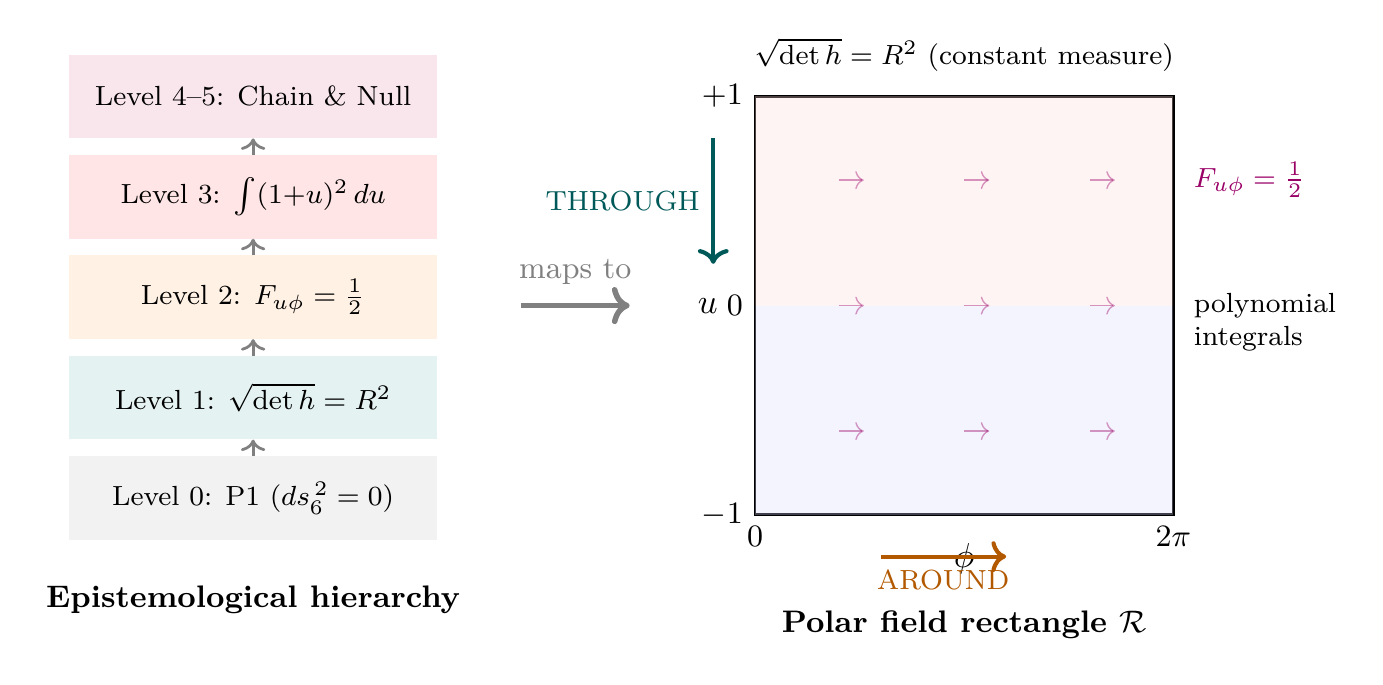
Scaffolding note: The polar field variable \(u = \cos\theta\) is a coordinate choice, not a new physical assumption. The epistemological hierarchy is identical in both coordinate systems; the polar form simply makes the mathematical structure at each level more transparent.
The Role of Postulate P1
P1 as Foundation
P1 plays a role in TMT analogous to the role of the axioms of Euclidean geometry: it is a statement from which everything follows, but which is not itself derivable from anything simpler. The analogy is precise:
| Feature | Euclidean Geometry | TMT |
|---|---|---|
| Foundation | Five postulates | One postulate (P1) |
| Method | Logical deduction | Mathematical derivation |
| Content | All of geometry | All of physics |
| Status | Not derivable | Not derivable |
| Justification | Empirical (locally) | Empirical |
| Alternatives | Non-Euclidean geometries | ? |
What P1 Says
P1 states that the six-dimensional line element vanishes: \(ds_6^{\,2} = 0\). Physically, within the scaffolding interpretation, this means:
In the polar field variable \(u = \cos\theta\), the velocity budget decomposes into three explicitly named channels:
What P1 Does Not Say
P1 does not say:
- Why \(ds_6^{\,2} = 0\) rather than \(ds_6^{\,2} \neq 0\)
- Why spacetime exists at all
- Why there is something rather than nothing
- What preceded the initial conditions of inflation
- Whether other postulates could generate consistent physics
These are legitimate questions, but they lie outside the scope of any physical theory. TMT is maximally ambitious within the domain of physics (deriving all measurable quantities from one postulate) while acknowledging the boundaries of physical explanation.
Could P1 Be Derived from Something Deeper?
The question of whether P1 admits a deeper justification is open. Three possibilities exist:
P1 is fundamental: The null constraint is the irreducible starting point of physical law, analogous to how \(F = ma\) was the starting point for Newtonian mechanics (before being subsumed by the principle of least action).
P1 follows from a deeper principle: Some as-yet-unknown mathematical or logical principle might single out \(ds_6^{\,2} = 0\) as the unique consistent physical law. This would reduce physics to mathematics, supporting the mathematical universe hypothesis.
P1 is contingent: The null constraint is one of many possible “laws of physics,” and our universe happens to obey it. This would raise the question of why this particular law was selected—a question that might require a multiverse framework.
TMT does not commit to any of these possibilities. The theory's predictive success is independent of the meta-physical status of P1.
Necessity vs Contingency
Which Aspects of TMT are Necessary?
Within TMT, some results follow with mathematical necessity from P1, while others depend on contingent features. The distinction is important for understanding the theory's structure.
Necessary (given P1):
- \(D = 6\) (the only dimension compatible with P1 and chirality)
- \(S^2\) topology (unique compact 2-manifold with the required properties)
- The gauge group SU(3)\(\times\)SU(2)\(\times\)U(1) (from \(S^2\) isometry and embedding)
- Three generations of fermions (from the \(\ell = 1\) constraint)
- \(\theta_{\text{QCD}} = 0\) (from \(S^2\) CP symmetry)
- The absence of SUSY (no supersymmetric extension of the \(S^2\) geometry is consistent with P1)
Contingent on P1:
- The specific numerical values of coupling constants (\(g^2 = 4/(3\pi)\), etc.)
- The specific mass ratios of particles
- The specific value of \(H_0\)
- The specific inflationary predictions (\(r\), \(n_s\))
The “contingent” results are contingent only in the sense that they depend on P1: if P1 were different, they would be different. Given P1, they are uniquely determined.
The Spectrum of Necessity
| Result | Necessity Level | Reason |
|---|---|---|
| \(D = 6\) | Mathematical | Unique dimension compatible with P1 |
| SU(3)\(\times\)SU(2)\(\times\)U(1) | Geometric | Unique from \(S^2\) |
| 3 generations | Topological | From \(\ell = 1\) constraint |
| \(g^2 = 4/(3\pi)\) | Physical | Interface + monopole |
| \(m_p = 937\) MeV | Chain | End of long derivation |
| \(r = 0.003\) | Chain | Inflationary parameters |
The results higher in the table have shorter derivation chains and are therefore more robust against potential errors in intermediate steps. The results lower in the table, while still uniquely determined by P1, depend on more intermediate results and are therefore more sensitive to corrections.
Mathematical Beauty and Truth
The Aesthetic Argument
TMT's structure possesses properties traditionally associated with “mathematical beauty” in physics:
Simplicity: One postulate, zero parameters.
Inevitability: Given P1, everything follows; no choices remain.
Surprise: A single equation generates the entire Standard Model, cosmology, quantum mechanics, and thermodynamics—a scope no physicist would have anticipated.
Elegance: The derivation chains use classical mathematics (topology, geometry, harmonic analysis) in ways that feel natural rather than forced.
Beauty as Evidence
Is mathematical beauty evidence for truth? The history of physics offers mixed lessons:
For: Maxwell's equations, general relativity, and quantum electrodynamics are all considered beautiful, and all are spectacularly confirmed.
Against: String theory is considered beautiful by many practitioners, yet produces no unique predictions. The landscape problem shows that mathematical elegance does not guarantee empirical content.
TMT's position: TMT combines mathematical beauty with empirical content. The theory is not merely elegant; it makes specific, falsifiable predictions. The beauty serves as a heuristic guide (it was the simplicity of P1 that motivated the theory), but the justification comes from the predictions, not the aesthetics.
The Unreasonable Effectiveness of Geometry
Wigner's “unreasonable effectiveness of mathematics” takes a specific form in TMT: the unreasonable effectiveness of geometry. The gauge group, particle masses, coupling constants, and cosmological parameters all emerge from the geometry of \(S^2\). This suggests that geometry is not merely a language for describing physics but the substance of physics itself.
Whether this constitutes evidence for mathematical realism (the view that mathematical structures exist independently of human minds) is a philosophical question that TMT illuminates but does not settle.
Derivation Chain Summary
Step | Result | Justification | Ref |
|---|---|---|---|
| \endhead 1 | Epistemological hierarchy (6 levels) | Classification of TMT results by derivation depth from P1 | §sec:ch115-known-derived |
| 2 | Single assumption (P1 only) | All other inputs are mathematical theorems or established physics | Thm thm:ch115-single-assumption |
| 3 | Necessity vs contingency analysis | Given P1, all results uniquely determined; only P1 itself is contingent | §sec:ch115-necessity |
| 4 | Polar: hierarchy maps to \(\mathcal{R}\) properties | Each level corresponds to constant measure, constant \(F_{u\phi}\), or polynomial integral on flat rectangle | §sec:ch115-polar-hierarchy |
Chapter Summary
The Epistemology of TMT
TMT's epistemological structure is uniquely economical: a single postulate (P1: \(ds_6^{\,2} = 0\)) generates a hierarchy of results spanning six levels, from direct mathematical consequences to null predictions. The theory contains exactly one assumption; all other inputs are mathematical theorems or established physical principles. The role of P1 is analogous to axioms in Euclidean geometry: it is the irreducible starting point from which everything follows. Whether P1 admits a deeper justification is an open question. TMT combines mathematical beauty with empirical content, making the theory both aesthetically satisfying and scientifically falsifiable. In the polar field variable \(u = \cos\theta\), the epistemological hierarchy maps directly to properties of the flat rectangle \(\mathcal{R} = [-1,+1] \times [0, 2\pi)\): constant measure (Level 1), constant field strength (Level 2), and polynomial integrals (Levels 3–5).
| Result | Value | Status | Reference |
|---|---|---|---|
| Epistemological hierarchy | 6 levels | ESTABLISHED | §sec:ch115-known-derived |
| Single assumption | P1 only | PROVEN | Thm thm:ch115-single-assumption |
| Necessity analysis | Mixed | DERIVED | §sec:ch115-necessity |
| Beauty + content | Both present | ESTABLISHED | §sec:ch115-beauty |
Verification Code
The mathematical derivations and proofs in this chapter can be independently verified using the formal and computational scripts below.
All verification code is open source. See the complete verification index for all chapters.