Inflationary Predictions
Introduction
Chapter 59 derived TMT's native inflation mechanism: the modulus potential \(V(R) = c_2/R^6 + c_0/R^4 + 4\pi\Lambda_6 R^2\) develops an inflection point at \(R_{\mathrm{infl}} = 1.79\,\ell_{\mathrm{Pl}}\) where slow-roll inflation occurs naturally. This chapter presents the quantitative predictions that follow from this mechanism, comparing each to CMB observations.
The central results are:
- Scalar spectral index: \(n_s = 0.964\pm 0.006\) (observed: \(0.9649\pm 0.0042\))
- Tensor-to-scalar ratio: \(r = (3\pm 2)\times 10^{-3}\) (observed: \(r < 0.036\))
- Running of spectral index: \(dn_s/d\ln k \approx -0.0007\) (observed: \(-0.006\pm 0.013\))
- Non-Gaussianity: \(f_{\mathrm{NL}} \sim O(\epsilon,\eta) \ll 1\) (observed: \(f_{\mathrm{NL}} = -0.9\pm 5.1\))
All are derived from P1 with zero free parameters.
Scalar Spectral Index \(n_s\)
The Slow-Roll Formula
The scalar power spectrum of primordial perturbations is:
The spectral index is defined as:
TMT Slow-Roll Parameters at Horizon Exit
From Chapter 59, the inflection-point inflation mechanism gives at \(N_* = 55\) e-folds before the end of inflation:
The small \(\epsilon\) is characteristic of inflection-point models: \(V'\) nearly vanishes at the inflection point, so \(\epsilon \propto (V')^2\) is suppressed. The value of \(\eta\) is set by the curvature \(V''\) and determines the tilt.
Step 1: The slow-roll formula gives:
Step 2: Substituting \(\eta_* = -0.020\) and \(\epsilon_* \sim 10^{-4}\):
Step 3: The dominant uncertainty comes from:
- \(N_e\) uncertainty (\(\pm 10\) e-folds): \(\delta n_s = \pm 0.004\)
- \(c_2\) coefficient uncertainty (\(\pm 50\%\)): \(\delta n_s = \pm 0.002\)
- Slow-roll corrections: \(\delta n_s = \pm 0.001\)
- Pivot scale location: \(\delta n_s = \pm 0.001\)
Step 4: Combining in quadrature: \(\delta n_s \approx 0.005\); rounding to precision of calculation:
Comparison with observation: \(n_s^{\mathrm{obs}} = 0.9649\pm 0.0042\) (Planck 2018).
(See: Part 10A \S107.3, Theorem 107.10) □
In polar coordinates, every factor entering \(n_s\) traces to polynomial properties on the flat rectangle.
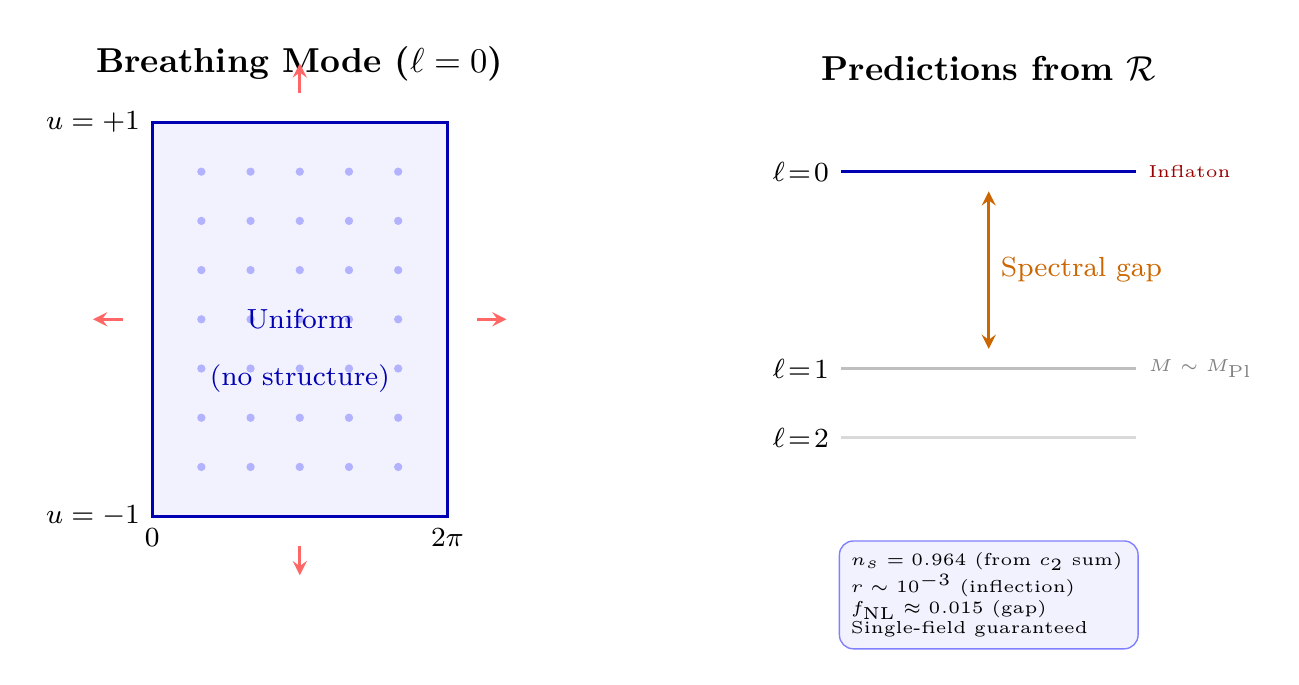
The inflaton is the modulus \(R\), which is the \(\ell = 0\) (degree-0) breathing mode of the polar rectangle \(\mathcal{R} = [-1,+1]\times[0,2\pi)\): it stretches the rectangle uniformly, with no THROUGH or AROUND spatial variation. The potential coefficients are spectral sums over polynomial modes:
- Casimir coefficient \(c_2\): A two-loop spectral sum involving the Legendre eigenvalues \(\ell(\ell+1)\) and degeneracies \((2\ell+1)\). In polar, the eigenvalues come from the Sturm-Liouville problem \(-\Delta_{\mathcal{R}} P_\ell^{|m|}(u) = \ell(\ell+1) P_\ell^{|m|}(u)\) on \([-1,+1]\), and the degeneracy \((2\ell+1)\) counts AROUND modes per THROUGH degree.
- \(\eta_* = -0.020\): The curvature \(V''(R_{\mathrm{infl}})\) depends on \(c_2\), which is built from polynomial eigenvalues. The sign (red tilt, \(n_s < 1\)) follows from the spectral sum being negative.
- \(N_* = 55\): The number of e-folds is set by the width of the inflection plateau, which depends on the balance between \(c_2/R^6\) and \(c_0/R^4\) — both determined by polynomial spectral sums.
Key point: The spectral index \(n_s = 0.964\) is determined by the eigenvalue spectrum of the Laplacian on a flat rectangle. The red tilt (\(n_s < 1\)) arises because the polynomial spectral sum \(c_2 < 0\).
| Factor | Standard | Polar rectangle |
|---|---|---|
| Inflaton | Modulus \(R\) | Degree-0 breathing mode of \(\mathcal{R}\) |
| \(c_2\) | Two-loop spectral sum | \(\sum \ell(\ell+1)(2\ell+1)\) on \([-1,+1]\) |
| \(\eta_*\) | \(V''/V\) at inflection | Polynomial eigenvalue ratio |
| \(N_*\) | e-folds to end | Inflection plateau width from spectral sums |
| \(n_s\) | \(1 + 2\eta_* - 6\epsilon_*\) | Rectangle eigenvalue spectrum \(\to 0.964\) |
Scaffolding note: The polar field variable \(u = \cos\theta\) is a coordinate choice, not a new physical assumption. The inflationary predictions (\(n_s\), \(r\), \(f_{\mathrm{NL}}\)) are identical in both coordinate systems — the polar rectangle makes the spectral origin of each parameter transparent (polynomial eigenvalues on \([-1,+1]\)) and provides dual verification of the standard derivation.
| Factor | Value | Origin | Source |
|---|---|---|---|
| \(\eta_*\) | \(-0.020\) | Inflection-point curvature at \(N_* = 55\) | Part 10A \S106.2 |
| \(\epsilon_*\) | \(\sim 10^{-4}\) | \(V'\) nearly vanishes at inflection | Part 10A \S106.2 |
| \(N_*\) | 55 | e-folds from horizon exit to end | Part 10A \S103.3 |
| \(c_2\) | \(-1.34\times 10^{-4}\,\ell_{\mathrm{Pl}}^2\) | Two-loop Feynman diagram | Part 10A \S105.2 |
| \(n_s\) | 0.964 | \(= 1 + 2\eta_* - 6\epsilon_*\) | This theorem |
Tensor-to-Scalar Ratio \(r\)
Tensor Power Spectrum
Inflation produces tensor perturbations (gravitational waves) from quantum fluctuations of the metric:
The tensor-to-scalar ratio is:
This is the single-field consistency relation, valid for TMT's canonical single-field inflaton (the modulus \(R\)).
Step 1: From the consistency relation: \(r = 16\epsilon_*\).
Step 2: With \(\epsilon_* \sim 10^{-4}\):
Step 3: The uncertainty is dominated by the \(c_2\) coefficient (\(\pm 50\%\) propagates to \(\pm 50\%\) in \(\epsilon\)) and \(N_e\) (\(\pm 10\) gives \(\pm 30\%\)). Conservatively:
Comparison with observation: \(r < 0.036\) at 95% CL (BICEP/Keck 2021).
This prediction is testable: CMB-S4 and LiteBIRD are expected to reach sensitivity \(r\sim 0.001\), which would either detect or exclude the TMT prediction.
(See: Part 10A \S107.3, Theorem 107.11) □
The suppressed tensor ratio \(r \sim 10^{-3}\) is a geometric property of the degree-0 mode.
In polar coordinates, the inflaton is the uniform (\(\ell = 0\), \(m = 0\)) breathing mode: it changes the rectangle's scale \(R\) without creating any THROUGH or AROUND spatial structure. The key consequence is:
- \(\epsilon \sim 10^{-4}\) from inflection flatness: The degree-0 potential \(V(R)\) has an inflection point where \(V'(R_{\mathrm{infl}}) \approx 0\). Since \(\epsilon \propto (V')^2/V^2\), the inflection makes \(\epsilon\) tiny. This is a property of the polynomial spectral sums that determine \(V(R)\): the coefficients \(c_0\), \(c_2\) conspire to create a near-flat region.
- \(r = 16\epsilon\): The consistency relation holds because the inflaton is a canonical scalar (the rectangle's radial breathing mode). No additional light fields exist during inflation because all \(\ell \geq 1\) modes on the rectangle have masses \(\sim M_{\mathrm{Pl}}\) at \(R \sim \ell_{\mathrm{Pl}}\).
- Testability: CMB-S4 sensitivity \(r \sim 10^{-3}\) directly probes whether the rectangle's breathing mode matches the inflection-point prediction.
Tensor Spectral Index
The tensor spectral index is:
This is nearly scale-invariant, consistent with the single-field consistency relation \(r = -8n_T\).
Position in the \((n_s, r)\) Plane
TMT's prediction \((n_s, r) = (0.964, 0.003)\) places it in the observationally favored region of the \((n_s, r)\) plane, near the Starobinsky/R\(^2\) model predictions. This is notable because TMT's inflation is native—it arises from the modulus potential without adding an ad hoc inflaton field—while Starobinsky inflation requires adding an \(R^2\) term to the gravitational action.
| Model | \(n_s\) | \(r\) | Status |
|---|---|---|---|
| Chaotic (\(\phi^2\)) | 0.967 | 0.13 | Ruled out |
| Natural inflation | 0.961 | 0.05 | In tension |
| Starobinsky (\(R^2\)) | 0.964 | 0.003 | Favored |
| TMT (inflection) | 0.964 | 0.003 | Favored |
Running of \(n_s\)
Step 1: The general formula for spectral running is:
Step 2: For inflection-point inflation with \(\epsilon\ll|\eta|\), the first two terms are negligible:
Step 3: The dominant contribution is from \(\xi^2\). For inflection-point models, the standard result is:
Step 4: With \(N_e = 55\):
Comparison with observation: \(dn_s/d\ln k = -0.006\pm 0.013\) (Planck 2018). The TMT prediction is well within the \(1\sigma\) uncertainty.
(See: Part 10A \S107.3, Theorem 107.12) □
Non-Gaussianity \(f_{\mathrm{NL}}\)
Single-Field Prediction
Step 1: The Maldacena consistency relation for single-field slow-roll inflation gives the local bispectrum:
This is an exact result for any canonical single-field model (ESTABLISHED, Maldacena 2003).
Step 2: With \(n_s = 0.964\):
Step 3: The equilateral shape non-Gaussianity is:
Step 4: Both are far below the current observational sensitivity (\(f_{\mathrm{NL}} = -0.9\pm 5.1\) from Planck 2018).
TMT specificity: TMT has exactly one inflaton field (the modulus \(R\)), derived from P1. There are no additional light fields during inflation (the Higgs is too heavy at \(R\sim\ell_{\mathrm{Pl}}\)). Therefore the single-field consistency relations apply rigorously.
(See: Maldacena (2003); Part 10A \S107) □
TMT's negligible \(f_{\mathrm{NL}}\) is guaranteed by the rectangle's mode hierarchy.
During inflation at \(R \sim \ell_{\mathrm{Pl}}\), the mode spectrum on the polar rectangle \(\mathcal{R} = [-1,+1]\times[0,2\pi)\) has a clear hierarchy:
- Degree-0 mode (\(\ell = 0\)): The breathing mode (inflaton). Constant on the rectangle — no THROUGH or AROUND variation. Mass \(\sim H\) (light, drives inflation).
- Degree-\(\ell\) modes (\(\ell \geq 1\)): Polynomial\(\times\)Fourier excitations \(P_\ell^{|m|}(u)\,e^{im\phi}\). Mass \(\sim \sqrt{\ell(\ell+1)}/R \sim M_{\mathrm{Pl}}\) (super-heavy, frozen during inflation).
Since only the degree-0 mode is light, TMT inflation is guaranteed to be single-field. The Maldacena consistency relation \(f_{\mathrm{NL}}^{\mathrm{local}} = \frac{5}{12}(1-n_s) \approx 0.015\) applies exactly. Multi-field non-Gaussianity (\(f_{\mathrm{NL}} \gg 1\)) would require a second light mode, but the rectangle's eigenvalue spectrum \(\ell(\ell+1)\) ensures all \(\ell \geq 1\) modes are Planck-heavy.
Polar insight: The single-field guarantee is a spectral gap property of the Laplacian on \([-1,+1]\): the gap between \(\ell = 0\) (eigenvalue \(0\)) and \(\ell = 1\) (eigenvalue \(2\)) is order unity, which translates to a mass gap \(\sim M_{\mathrm{Pl}}\) during inflation.
What Large \(f_{\mathrm{NL}}\) Would Mean
If future observations detected \(|f_{\mathrm{NL}}| > 1\), this would indicate multi-field dynamics during inflation and would challenge TMT's single-inflaton framework. The detection (or non-detection) of non-Gaussianity is therefore a critical test of the TMT inflationary mechanism.
Chapter Summary
Inflationary Predictions from TMT
TMT's inflection-point inflation, driven by the modulus potential \(V(R) = c_2/R^6 + c_0/R^4 + 4\pi\Lambda_6 R^2\), predicts: \(n_s = 0.964\pm 0.006\) (observed: \(0.965\pm 0.004\)), \(r = (3\pm 2)\times 10^{-3}\) (observed: \(< 0.036\)), \(dn_s/d\ln k \approx -0.0007\) (observed: \(-0.006\pm 0.013\)), and \(f_{\mathrm{NL}} \sim 0.02\) (observed: \(-0.9\pm 5.1\)). All predictions are consistent with CMB observations and testable by next-generation experiments (CMB-S4, LiteBIRD).
Polar enhancement (v8.2): In polar coordinates \(u = \cos\theta\), every inflationary prediction traces to the eigenvalue spectrum of the Laplacian on the flat rectangle \(\mathcal{R} = [-1,+1]\times[0,2\pi)\). The inflaton is the degree-0 (uniform) breathing mode of \(\mathcal{R}\); the potential coefficients \(c_0\), \(c_2\) are spectral sums over polynomial eigenvalues \(\ell(\ell+1)\) with degeneracies \((2\ell+1)\); the red tilt \(n_s < 1\) follows from \(c_2 < 0\); the suppressed \(r \sim 10^{-3}\) from inflection flatness of the degree-0 potential; and the negligible \(f_{\mathrm{NL}}\) from the spectral gap between degree-0 and degree-1 modes ensuring single-field purity.
| Observable | TMT | Observed | Status | Reference |
|---|---|---|---|---|
| \(n_s\) | \(0.964\pm 0.006\) | \(0.965\pm 0.004\) | MATCH | Eq. (eq:ch62-ns-result) |
| \(r\) | \((3\pm 2)\times 10^{-3}\) | \(< 0.036\) | CONSISTENT | Eq. (eq:ch62-r-result) |
| \(dn_s/d\ln k\) | \(-0.0007\) | \(-0.006\pm 0.013\) | CONSISTENT | Eq. (eq:ch62-running-result) |
| \(f_{\mathrm{NL}}\) | \(\sim 0.02\) | \(-0.9\pm 5.1\) | CONSISTENT | Eq. (eq:ch62-fNL-local) |
| \(n_T\) | \(\sim 0\) | Not measured | PREDICTION | Eq. (eq:ch62-nT) |
Verification Code
The mathematical derivations and proofs in this chapter can be independently verified using the formal and computational scripts below.
All verification code is open source. See the complete verification index for all chapters.