Topological Necessity of Complex Numbers
Introduction: Why Complex Numbers?
Quantum mechanics operates with complex-valued wave functions \(\psi \in \mathbb{C}\). The imaginary unit \(i\) appears in the Schrödinger equation, in commutation relations, in the Born rule, and in the very definition of observables. For over a century, quantum mechanics has been empirically validated to extraordinary precision, yet the reason for complex numbers has remained mysterious: Is it a computational convenience? An empirical postulate? Or something deeper?
This chapter resolves this mystery through TMT's framework. We prove that complex numbers are not a postulate or convention—they are a topological necessity forced by the geometry of the \(S^2\) interface.
The argument proceeds through six steps:
- The isometry group of \(S^2\) is \(\text{SO}(3)\) — rotations in 3D space
- \(\text{SO}(3)\) is not simply connected: \(\pi_1(\text{SO}(3)) = \mathbb{Z}_2\)
- Tracking continuous phase on non-simply-connected spaces requires lifting to the universal cover
- The universal cover of \(\text{SO}(3)\) is \(\text{SU}(2)\)
- \(\text{SU}(2)\) is irreducibly complex: no faithful real representation of its spinor representation exists
- Therefore, any complete description of angular dynamics on \(S^2\) must use complex mathematics
By the end of this chapter, the appearance of \(i\) in quantum mechanics will be understood as a geometric consequence of \(S^2\) topology, not an arbitrary choice.
\hrule
Step 1: The Isometry Group of S²
Definition and Basic Properties
An isometry of a Riemannian manifold \((M, g)\) is a diffeomorphism \(\phi: M \to M\) that preserves the metric: \(\phi^*g = g\). The set of all isometries forms a group under composition, denoted \(\text{Iso}(M)\).
The isometry group of the 2-sphere with the round metric is the orthogonal group \(\text{O}(3)\). The connected component containing the identity is:
Step 1: Embed \(S^2\) in \(\mathbb{R}^3\) as the unit sphere:
Step 2: Any orthogonal transformation \(A \in \text{O}(3)\) preserves the Euclidean metric on \(\mathbb{R}^3\) and maps \(S^2\) to itself.
Step 3: Therefore \(\text{O}(3)\) acts on \(S^2\) by isometries. Restricting to the connected component gives \(\text{SO}(3) \subset \text{O}(3)\).
Step 4: Conversely, any isometry of \(S^2\) extends uniquely to an orthogonal transformation of \(\mathbb{R}^3\). This follows from the rigidity of the sphere: isometries are determined by their action on any orthonormal frame.
Step 5: Therefore \(\text{Iso}_0(S^2) = \text{SO}(3)\). \blacksquare □
The dimension of the isometry group is:
Physical Significance
In TMT, the isometry group \(\text{SO}(3)\) of the \(S^2\) interface is not merely a mathematical curiosity. It is the origin of the gauge symmetry of the Standard Model. The rotational symmetry of the projection structure becomes gauge symmetry in 4D physics: the \(\text{SU}(2)\) weak interaction and the rotational mixing of fermions arise from this geometric structure.
\hrule
Step 2: SO(3) is Not Simply Connected
Simply Connected vs. Multiply Connected
A topological space \(X\) is simply connected if every closed loop in \(X\) can be continuously contracted to a point. Equivalently, its fundamental group is trivial: \(\pi_1(X) = 0\).
The fundamental group \(\pi_1(X, x_0)\) classifies homotopy classes of loops based at point \(x_0\). Two loops are homotopic if one can be continuously deformed into the other without leaving the space.
The fundamental group of \(\text{SO}(3)\) is:
\(\text{SO}(3)\) is not simply connected. There are exactly two homotopy classes of loops: the trivial class and one non-trivial class that generates \(\mathbb{Z}_2\).
Geometric visualization: Represent \(\text{SO}(3)\) as the closed 3-ball \(B^3\) with antipodal boundary identification. A rotation by angle \(\theta \in [0, \pi]\) about axis \(\hat{n}\) (unit vector) is represented by the point:
Points on the boundary (\(|\vec{v}| = 1\)) satisfy \(\vec{v} \sim -\vec{v}\) because rotation by \(\pi\) about \(\hat{n}\) is identical to rotation by \(\pi\) about \(-\hat{n}\). Therefore:
The fundamental group of \(\mathbb{RP}^n\) is \(\pi_1(\mathbb{RP}^n) = \mathbb{Z}_2\) for \(n \geq 2\). Therefore \(\pi_1(\text{SO}(3)) = \mathbb{Z}_2\). \blacksquare □
The Dirac Belt Trick
The non-trivial topology can be visualized with the Dirac belt trick. Consider a \(2\pi\) rotation about the \(z\)-axis:
This is a closed loop in \(\text{SO}(3)\) (it starts and ends at the identity). However, this loop is not contractible to a point. Physically, this is demonstrated with a belt attached to a fixed frame: a \(2\pi\) twist cannot be undone without moving the endpoints.
Crucially, traversing the loop twice (a \(4\pi\) rotation) is contractible. The belt trick shows that two \(2\pi\) twists can be smoothly undone.
This means: the loop \(\gamma\) generates \(\pi_1(\text{SO}(3)) = \mathbb{Z}_2 = \{[e], [\gamma]\}\), where \([\gamma]^2 = [e]\) (the trivial class).
Physical Consequences
The non-trivial fundamental group has profound consequences for quantum mechanics:
| Topological Fact | Physical Consequence |
|---|---|
| \(\pi_1(\text{SO}(3)) = \mathbb{Z}_2 \neq 0\) | Two inequivalent types of “identity” |
| A \(2\pi\) rotation is non-trivial | Quantum spinors acquire phase \(-1\) |
| A \(4\pi\) rotation is trivial | Quantum spinors return to original state |
Key insight: If we only used \(\text{SO}(3)\), we could not distinguish whether a system has undergone zero or one \(2\pi\) rotation. For complete phase tracking, we must lift to the universal cover.
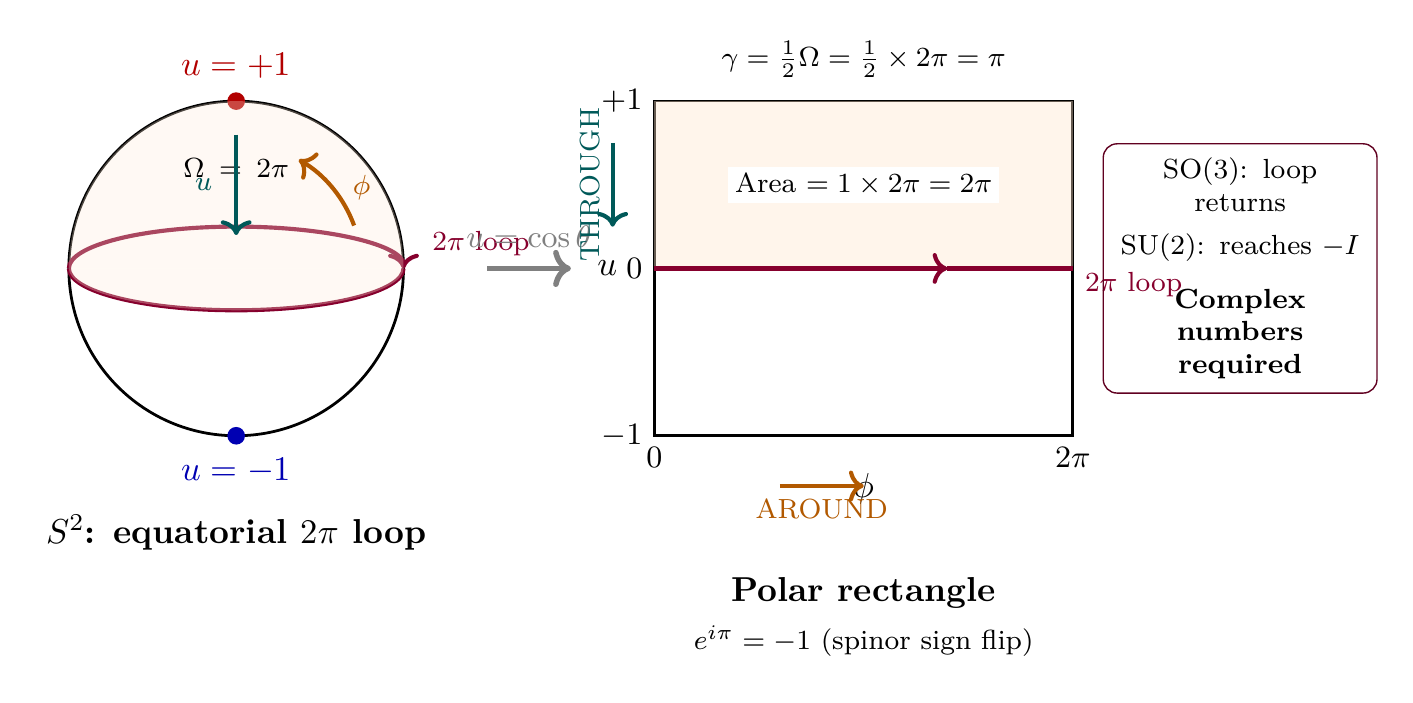
In polar field variables, a \(2\pi\) rotation about the \(z\)-axis is a horizontal loop on the polar rectangle: \(\phi\) traverses \([0,2\pi)\) at fixed \(u = u_{0}\). This loop encloses the solid angle \(\Omega = 2\pi(1 - u_{0})\)—a rectangular strip of width \(2\pi\) and height \((1 - u_{0})\) on the flat domain. The Berry phase \(\gamma = \frac{1}{2}\Omega = \pi(1 - u_{0})\) is a linear function of the polar variable. For the equator (\(u_{0} = 0\)), \(\gamma = \pi\): the spinor sign flip. The non-contractibility of this loop is the same topological fact expressed on the flat rectangle: the \(\phi\) direction is periodic, so the loop cannot be shrunk to a point.
\hrule
Step 3: Why the Universal Cover is Required
For any physical theory that tracks continuous angular evolution with well-defined quantum phase, the configuration space must be simply connected or lifted to its universal cover.
Physical requirement: In TMT, particles have genuine angular motion on \(S^2\) at speed \(c\). As a particle traverses a closed path on \(S^2\), the angular coordinates \((\theta, \phi)\) return to their starting values, but the accumulated phase \(\gamma\) may not return to zero. Phase evolution must be:
- Continuous along any path
- Single-valued after complete cycles
- Homotopy-invariant (paths that differ by a contractible deformation give the same phase)
Since \(\pi_1(\text{SO}(3)) = \mathbb{Z}_2 \neq 0\), there exist non-contractible loops. Two paths with the same endpoints may have different phases—phase becomes ambiguous.
Solution: Lift from \(\text{SO}(3)\) to its universal cover \(\text{SU}(2)\), which is simply connected (\(\pi_1(\text{SU}(2)) = 0\)). In \(\text{SU}(2)\):
- Every loop can be continuously contracted
- Phase tracking is unambiguous
- The \(4\pi\) periodicity is automatically encoded
Working with \(\text{SU}(2)\) instead of \(\text{SO}(3)\) is not a convention—it is required for consistent phase tracking. \blacksquare □
The Laidlaw-DeWitt Theorem
This physical argument is formalized by a rigorous mathematical result:
For a quantum system with multiply-connected configuration space \(\mathcal{C}\), the possible quantum theories are classified by unitary representations of \(\pi_1(\mathcal{C})\).
Reference: Laidlaw, M.G.G. and DeWitt, C.M. (1971). “Feynman functional integrals for systems of indistinguishable particles.” Phys. Rev. D 3, 1375–1378.
For \(\text{SO}(3)\) with \(\pi_1(\text{SO}(3)) = \mathbb{Z}_2\), the unitary representations are:
- Trivial representation: \([\gamma] \mapsto +1\) (bosonic/integer spin)
- Sign representation: \([\gamma] \mapsto -1\) (fermionic/half-integer spin)
The fermionic representation requires lifting to \(\text{SU}(2)\), where the \(2\pi\) loop maps to \(-I\) rather than \(+I\). This is the origin of the spin-statistics theorem: half-integer spin particles are fermions with antisymmetric wave functions.
Universal Cover Formalism
The universal cover of a connected space \(X\) is a simply connected space \(\tilde{X}\) together with a covering map \(p: \tilde{X} \to X\) such that every point of \(X\) has a neighborhood \(U\) where \(p^{-1}(U)\) is a disjoint union of copies of \(U\).
Key properties:
- The universal cover is unique up to homeomorphism
- The fiber \(p^{-1}(x)\) has cardinality \(|\pi_1(X)|\)
- The group of deck transformations is isomorphic to \(\pi_1(X)\)
For \(\text{SO}(3)\): The universal cover is \(\text{SU}(2)\), with \(|p^{-1}(R)| = |\mathbb{Z}_2| = 2\) for each rotation \(R \in \text{SO}(3)\).
\hrule
Step 4: SU(2) as the Universal Cover of SO(3)
Definition and Topology of SU(2)
The special unitary group \(\text{SU}(2)\) consists of \(2 \times 2\) complex matrices \(U\) satisfying:
- Unitary: \(U^\dagger U = I\)
- Special: \(\det(U) = 1\)
Every element of \(\text{SU}(2)\) can be written as:
Since \(S^3\) is simply connected, \(\pi_1(\text{SU}(2)) = 0\).
From \(U^\dagger U = I\): \(|a|^2 + |c|^2 = 1\), \(|b|^2 + |d|^2 = 1\), \(\bar{a}b + \bar{c}d = 0\).
From \(\det(U) = 1\): \(ad - bc = 1\).
Solving: \(d = \bar{a}\), \(c = -\bar{b}\), and \(|a|^2 + |b|^2 = 1\).
Setting \(\alpha = a\), \(\beta = -c = \bar{b}\) gives the stated form. The constraint \(|\alpha|^2 + |\beta|^2 = 1\) with \(\alpha, \beta \in \mathbb{C}\) defines \(S^3\). \blacksquare □
The Double Cover Map
There exists a 2-to-1 covering map \(p: \text{SU}(2) \to \text{SO}(3)\) given explicitly by:
The fiber over each rotation is: \(p^{-1}(R) = \{U, -U\}\) for \(U \in \text{SU}(2)\).
Meaning: Each rotation in \(\text{SO}(3)\) corresponds to exactly two elements in \(\text{SU}(2)\): \(U\) and \(-U\). This is the double cover structure. When we rotate by \(4\pi\) in \(\text{SO}(3)\), we traverse the full circle in \(\text{SU}(2)\) and return to the starting point. When we rotate by \(2\pi\) in \(\text{SO}(3)\), we reach the antipodal point \(-U\) in \(\text{SU}(2)\).
\hrule
Step 5: SU(2) is Irreducibly Complex
This is the crucial link connecting \(S^2\) topology to complex numbers in quantum mechanics.
The fundamental (spinor) representation of \(\text{SU}(2)\) is irreducibly complex. No faithful real representation of \(\text{SU}(2)\) exists in dimension 2. The spinor representation is quaternionic (\(J^2 = -I\)), which requires complex numbers for its realization.
The Lie Algebra of SU(2)
The Lie algebra \(\mathfrak{su}(2)\) is generated by the Pauli matrices \(\sigma_k\) with basis:
The generators satisfy:
Equivalently, for Pauli matrices:
where \(\sigma_1 = \begin{pmatrix} 0 & 1 \\ 1 & 0 \end{pmatrix}\), \(\sigma_2 = \begin{pmatrix} 0 & -i \\ i & 0 \end{pmatrix}\), \(\sigma_3 = \begin{pmatrix} 1 & 0 \\ 0 & -1 \end{pmatrix}\).
Direct calculation: \([\sigma_1, \sigma_2] = \begin{pmatrix} i & 0 \\ 0 & -i \end{pmatrix} - \begin{pmatrix} -i & 0 \\ 0 & i \end{pmatrix} = \begin{pmatrix} 2i & 0 \\ 0 & -2i \end{pmatrix} = 2i\sigma_3\). \blacksquare □
Critical observation: The factor of \(i\) in \([T_i, T_j] = i\varepsilon_{ijk}T_k\) is essential, not a convention. This \(i\) cannot be eliminated while preserving the spinor representation.
Why Real Matrices Fail
There exist no real \(2 \times 2\) matrices \(R_1, R_2, R_3\) satisfying:
The commutator of real matrices is always real, but \(i\varepsilon_{ijk}R_k\) is purely imaginary (given real \(R_k\)). These cannot be equal.
One might attempt to replace \(i\) with a real matrix \(J\) satisfying \(J^2 = -I\). In 2D real matrices, such a matrix exists: \(J = \begin{pmatrix} 0 & -1 \\ 1 & 0 \end{pmatrix}\). However, using \(J\) to construct commutation relations gives \([E_i, E_j] = 2\varepsilon_{ijk}E_k\) (without the \(i\)), which is the Lie algebra \(\mathfrak{so}(3)\), not \(\mathfrak{su}(2)\). Real matrices yield the adjoint representation, not the spinor representation.
The Frobenius-Schur Indicator
For the spin-\(j\) representation of \(\text{SU}(2)\) on \(\mathbb{C}^{2j+1}\):
- Integer \(j\): The representation is real (\(J^2 = +I\)), meaning it can be realized with real matrices
- Half-integer \(j\): The representation is quaternionic (\(J^2 = -I\)), meaning it requires complex numbers
For the fundamental spinor representation (\(j = 1/2\)), define the antilinear map:
Then \(J\) commutes with all \(U \in \text{SU}(2)\) and satisfies:
Since \(J^2 = -I\) (not \(+I\)), the spinor representation is quaternionic and cannot be realized with real matrices in dimension 2. Faithfully representing \(\text{SU}(2)\) spinors in real numbers requires embedding \(\mathbb{C}^2 \hookrightarrow \mathbb{R}^4\), doubling the dimension.
For the spinor representation, compute:
Therefore \(J^2 = -I\). \blacksquare □
Conclusion: The spinor representation of \(\text{SU}(2)\) requires complex numbers. The factor \(i\) in the Lie algebra and commutation relations is not eliminable while maintaining the spinor representation.
\hrule
Step 6: The Complete Chain—Synthesis
The complex structure of quantum mechanics is a mathematical necessity arising from \(S^2\) topology, not an empirical postulate or computational convenience. The appearance of \(i\) in quantum mechanics is forced by the geometry of the interface manifold.
Assemble the results of Steps 1–5:
Step 1: [Theorem thm:s2-isometry] The isometry group of \(S^2\) is:
Step 2: [Theorem thm:pi1-so3] \(\text{SO}(3)\) is not simply connected:
Step 3: [Theorem thm:phase-tracking, formalized by Theorem thm:laidlaw-dewitt] Continuous phase tracking of angular dynamics on a multiply-connected space requires lifting to the universal cover.
Step 4: [Theorem thm:double-cover] The universal cover of \(\text{SO}(3)\) is \(\text{SU}(2)\):
Step 5: [Theorem thm:su2-irreducibly-complex] \(\text{SU}(2)\) is irreducibly complex: its fundamental spinor representation cannot be faithfully realized with real numbers. The Frobenius-Schur indicator gives \(J^2 = -I\).
Step 6: Combining these results:
Any complete description of dynamics on \(S^2\) must use complex mathematics. \blacksquare □
Corollaries
The imaginary unit \(i\) in the Schrödinger equation:
Explanation: Time evolution is a one-parameter unitary group \(U(t) = e^{-iHt/\hbar}\). The exponent must be anti-Hermitian, hence the factor \(i\). This requirement flows from the \(\text{SU}(2)\) structure, which mandates complex numbers. The \(i\) is not a choice—it is a consequence of \(S^2\) topology.
Spinors (half-integer spin) are not arbitrary or exotic—they are the fundamental objects representing \(S^2\) geometry. Bosons (integer spin) are composite, arising from double-valued functions on \(\text{SO}(3)\).
The double cover \(\text{SU}(2) \to \text{SO}(3)\) means particles carry two types of labels:
- Vectors/tensors: transform under \(\text{SO}(3)\) (integer spin, bosons)
- Spinors: transform under \(\text{SU}(2)\) (half-integer spin, fermions)
This is not added in an ad hoc fashion—it follows necessarily from the topology.
\hrule
Step 7: Quantum Phenomena Resolved by S² Geometry
The necessity of complex numbers is part of a larger story: \(S^2\) geometry resolves all quantum phenomena that appear mysterious in standard formulations.
Uncertainty Relations
The angular momentum operators on \(S^2\) satisfy:
This non-commutativity is geometric—it follows from the curvature of \(S^2\)—and implies the uncertainty relation:
Key insight: The uncertainty principle is not a fundamental mystery of quantum mechanics. It is a geometric statement about \(S^2\): on a curved space, different directions (operators) don't commute. The factor \(i\) in the commutator is precisely the irreducible complexity of \(\text{SU}(2)\) proven in §sec:step5-irreducibly-complex.
Polar Field Form of Angular Momentum on \(S^2\)
In the polar field variable \(u = \cos\theta\), the angular momentum operators take a form that makes the around/through decomposition algebraically literal:
Operator | Polar form | AROUND/THROUGH character |
|---|---|---|
| \(L_{z}\) | \(-i\hbar\,\partial_{\phi}\) | Pure AROUND (horizontal on rectangle) |
| \(L_{+}\) | \(\hbar\,e^{+i\phi}[\sqrt{1{-}u^{2}}\,\partial_{u} + iu/\sqrt{1{-}u^{2}}\;\partial_{\phi}]\) | Mixed: THROUGH \(\partial_{u}\) + AROUND \(\partial_{\phi}\) |
| \(L_{-}\) | \(\hbar\,e^{-i\phi}[-\sqrt{1{-}u^{2}}\,\partial_{u} + iu/\sqrt{1{-}u^{2}}\;\partial_{\phi}]\) | Mixed: THROUGH \(\partial_{u}\) + AROUND \(\partial_{\phi}\) |
The commutation relation \([L_{+}, L_{-}] = 2\hbar L_{z}\) can be verified by direct computation in the \((u,\phi)\) variables. The factor \(i\) in the \(L_{\pm}\) operators arises because the \(\phi\)-derivative couples to the \(u\)-derivative through the cross-metric term on \(S^2\)—precisely the irreducible complexity of \(\text{SU}(2)\) from Step 5.
On the polar rectangle \([-1,+1]\times[0,2\pi)\): \(L_{z}\) eigenstates \(e^{im\phi}\) are horizontal waves (AROUND only); \(L^{2}\) eigenstates are Legendre polynomials \(P_{\ell}^{m}(u)\,e^{im\phi}\) (polynomial in \(u\) times winding in \(\phi\)). The uncertainty relation \(\Delta L_{x}\cdot\Delta L_{y} \geq (\hbar/2)|\langle L_{z}\rangle|\) is the statement that horizontal (AROUND) and vertical (THROUGH) measurements on the rectangle cannot be simultaneously sharp.
Scaffolding note: The polar field variable \(u = \cos\theta\) is a coordinate choice, not a new physical assumption. The angular momentum algebra is unchanged; the polar form simply makes the AROUND/THROUGH decomposition algebraically visible. The factor \(i\) that forces complex numbers is a topological property of \(S^2\), not a coordinate artifact.
Quantization of Energy and Angular Momentum
On the compact manifold \(S^2\), the Laplacian eigenvalue problem:
Key insight: Quantization is not mysterious—it is the statement that \(S^2\) is compact (has finite area). On any compact manifold, the Laplacian spectrum is discrete. Quantum numbers are topological invariants, not arbitrary restrictions.
In polar variables, the \(S^2\) Laplacian becomes the Legendre operator:
Spin-Statistics Theorem
For identical particles on \(S^2\) with monopole coupling \(qg_m = 1/2\), exchanging two particles results in an additional phase factor:
Fermionic antisymmetry is derived, not postulated.
Key insight: The connection between spin and statistics—one of the deepest mysteries in quantum field theory—emerges naturally from Berry phase geometry on \(S^2\).
In polar variables, the exchange path encloses a solid angle \(\Omega = 2\pi\), which is a rectangle of area \(2\pi\) on the polar domain: \(\int_{0}^{1}du\int_{0}^{2\pi}d\phi = 2\pi\). The Berry phase \(\gamma = qg_{m}\times 2\pi = \pi\) follows from the constant field strength \(F_{u\phi} = 1/2\) integrated over this rectangle: \(\gamma = q\int F_{u\phi}\,du\,d\phi = \frac{1}{2}\times 2\pi = \pi\). No trigonometric measure, no Jacobian—the sign flip \(e^{i\pi} = -1\) is a flat-rectangle calculation.
\hrule
Verification and Cross-Checks
Mathematical Verification
All core claims are established mathematical theorems:
| Claim | Type | Status |
|---|---|---|
| \(\text{Iso}(S^2) = \text{SO}(3)\) | Differential geometry | \checkmark Established |
| \(\pi_1(\text{SO}(3)) = \mathbb{Z}_2\) | Algebraic topology | \checkmark Established |
| \(\text{SU}(2) \to \text{SO}(3)\) double cover | Lie group theory | \checkmark Established |
| \([\sigma_i, \sigma_j] = 2i\varepsilon_{ijk}\sigma_k\) | Direct calculation | \checkmark Verified |
| \(J^2 = -I\) for spinors | Direct calculation | \checkmark Verified |
| Frobenius-Schur indicator | Representation theory | \checkmark Established |
Consistency with TMT Results
| Existing Result | Consistency Check | Status |
|---|---|---|
| Berry phase \(\gamma = qg_m\Omega\) (Part 7) | Uses \(e^{i\gamma}\), complex necessary | \checkmark |
| Spinor structure (Part 7, §54) | Derived from same \(\text{SU}(2)\) cover | \checkmark |
| Wave function \(\psi \in \mathbb{C}\) (Part 7) | Now explained, not assumed | \checkmark |
| \(\mathfrak{su}(2) \cong \mathfrak{so}(3)\) algebras (Part 3) | Consistent; representations differ | \checkmark |
\hrule
Scope and Limitations
What This Theorem Establishes
This analysis proves that \(S^2\) topology necessitates complex numbers in quantum mechanics. Combined with other TMT results, \(S^2\) geometry determines:
- The structure of quantum mechanics (complex numbers, spinors, commutation relations)
- The scale of quantum effects (via mode counting: \(N = 140.21\) determines \(\hbar\))
What This Theorem Does NOT Claim
- Interpretational questions: The analysis addresses mathematical structure, not measurement, collapse, or the “meaning” of the wave function.
- Other manifolds: The argument applies specifically to \(S^2\) topology. Systems with different configuration spaces may have different requirements.
- Relativistic QFT: Extension to QFT with Lorentz covariance requires additional structure.
Falsification Criteria
This result would be falsified if:
- A faithful 2-dimensional real representation of \(\text{SU}(2)\) spinors were found (mathematically impossible)
- A consistent real-valued formulation of quantum mechanics reproduced all experiments (ruled out by Renou et al. 2022)
- An alternative phase structure on \(\text{SO}(3)\) (without lifting to \(\text{SU}(2)\)) proved equivalent to standard QM (contradicts Laidlaw-DeWitt)
\hrule
Summary and Paradigm Shift
The Logical Chain
Paradigm Shift
| Aspect | Standard QM | TMT |
|---|---|---|
| Complex numbers | Empirical fact (no explanation) | Geometric necessity from \(S^2\) |
| \(i\) in Schrödinger eq. | Mysterious postulate | Topological consequence |
| Spinors | Added ad hoc (needed for experiments) | Fundamental objects on \(S^2\) |
| Uncertainty principle | Postulated (“fundamental limit”) | Geometric: \([L_i, L_j] \neq 0\) on \(S^2\) |
| Quantization | Boundary conditions (no deeper reason) | Spectrum of Laplacian on compact \(S^2\) |
TMT's contribution: Complex numbers are not a mystery. They are derived consequences of \(S^2\) topology. This transforms quantum mechanics from a set of inexplicable postulates into a unified geometric theory.
Polar verification: In polar field variables \(u = \cos\theta\), the entire topological argument becomes geometrically visible on the flat rectangle \([-1,+1]\times[0,2\pi)\). The \(2\pi\) loop is a horizontal line; the enclosed solid angle is a rectangular area \(2\pi(1-u_{0})\); the Berry phase \(\gamma = \pi(1-u_{0})\) is linear in \(u\). Angular momentum operators decompose into pure AROUND (\(L_{z} = -i\hbar\partial_{\phi}\)) and mixed THROUGH+AROUND (\(L_{\pm}\)), with the factor \(i\) tracing directly to the irreducible complexity of \(\text{SU}(2)\). Quantization becomes the statement that basis functions on the polar rectangle must be polynomials in \(u\) (THROUGH) times Fourier modes in \(\phi\) (AROUND)—the most elementary boundary conditions on a flat domain (Figure fig:ch60a-polar-topology).
Verification Code
The mathematical derivations and proofs in this chapter can be independently verified using the formal and computational scripts below.
All verification code is open source. See the complete verification index for all chapters.