
Topological Field Theory from S²
Introduction
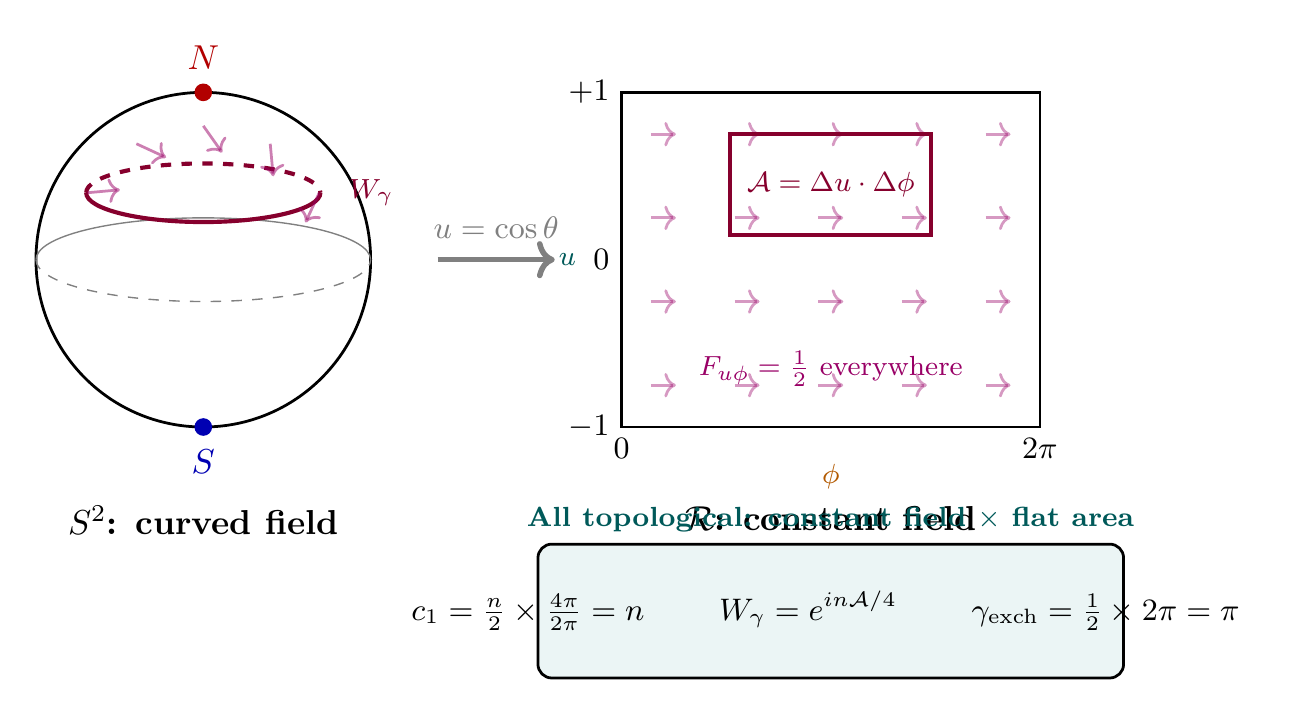
The preceding chapters derived quantum mechanics, quantum information, and quantum thermodynamics from the geometry of \(S^2\). This chapter derives topological quantum field theory from the same geometry, exploiting a structural separation that becomes visible only in polar field coordinates: the measure \(du\,d\phi\) is flat Lebesgue, while the topology is carried by the constant monopole field strength \(F_{u\phi} = 1/2\) and the boundary conditions on the polar rectangle \(\mathcal{R} = [-1,+1] \times [0,2\pi)\).
Topological field theories are characterized by partition functions and observables that depend only on global (topological) properties, not on local geometry. In the polar formulation of TMT, this property is manifest: the flat measure \(du\,d\phi\) has no geometric content, and the constant field strength \(F_{u\phi} = 1/2\) is independent of position on \(\mathcal{R}\). Topological invariants therefore reduce to elementary integrals over flat rectangles.
The central results are:
- The Chern-Simons invariant on \(S^2\) is a constant-integrand rectangle integral.
- Topological invariants on the \(N\)-particle product space \((S^2)^N\) factorize trivially because flat measure respects the product structure.
- Multi-monopole configurations have exact partition functions from polynomial integration on \([-1,+1]\).
- The connection between TQFT and the concentration-of-measure results of Chapter 91: topological quantities are insensitive to the curved metric that drives concentration, while dynamical quantities are sensitive to it.
Scaffolding note: The polar field variable \(u = \cos\theta\) is a coordinate choice, not a new physical assumption. The topological results in this chapter are coordinate-independent; the polar form makes their computation trivially elementary.
Chern-Simons Theory on the Polar Rectangle
The Chern Number as Rectangle Area
The first Chern number of the monopole bundle on \(S^2\) is:
The monopole field strength in polar coordinates is \(F_{u\phi} = n/2\) for monopole charge \(n\) (Chapter 60a, Key Result #7). For \(n = 1\):
This is the simplest possible topological computation: a constant times a rectangle area. In spherical coordinates, the same integral requires \(F_{\theta\phi} = \frac{1}{2}\sin\theta\) and \(\int \sin\theta\,d\theta\), obscuring the constant nature of the integrand.
For general monopole charge \(n\):
The Chern number is the monopole charge, computed as (constant field) \(\times\) (rectangle area) \(/ (2\pi)\). □ □
Property | Spherical \((\theta, \phi)\) | Polar \((u, \phi)\) |
|---|---|---|
| Field strength | \(F_{\theta\phi} = \frac{n}{2}\sin\theta\) (variable) | \(F_{u\phi} = \frac{n}{2}\) (constant) |
| Measure | \(\sin\theta\,d\theta\,d\phi\) | \(du\,d\phi\) (flat) |
| Integrand | \(\frac{n}{2}\sin\theta \cdot \sin\theta\,d\theta\,d\phi\) | \(\frac{n}{2}\,du\,d\phi\) (constant \(\times\) flat) |
| Chern number | \(\frac{n}{2\pi}\int \sin^2\theta\,d\theta\,d\phi\) | \(\frac{n}{2\pi} \times 2 \times 2\pi = n\) |
| Physical insight | Topology hidden in \(\sin^2\theta\) integral | Topology = constant \(\times\) flat area |
Chern-Simons Functional on \(\mathcal{R}\)
The Chern-Simons 1-form on \(S^2\) in polar coordinates is particularly simple. Using the north-patch connection \(A^{(N)}_\phi = \frac{1}{2}(1-u)\) (Chapter 60a, Key Result #6):
The total Chern-Simons invariant, integrating over all horizontal loops:
This is the total monopole flux (Key Result #5), computed as a polynomial integral on \([-1,+1]\).
Topological Invariants on \((S^2)^N\)
Factorization from Flat Product Measure
The topological partition function on \((S^2)^N\) is:
In polar coordinates, the path integral measure \(\mathcal{D}A_i\) for each \(S^2_i\) factor is built from the flat Lebesgue measure \(du_i\,d\phi_i\) on \(\mathcal{R}_i\). The Chern-Simons functional \(\text{CS}[A_i] = \pi(1 - u_i)\) depends only on the \(i\)-th rectangle's THROUGH coordinate. Therefore:
Step 1: The exponential factorizes: \(\exp(ik\sum_i \text{CS}_i) = \prod_i \exp(ik\,\text{CS}_i)\).
Step 2: The flat product measure factorizes: \(\prod_i du_i\,d\phi_i = d\mu_{\text{flat}}(\mathcal{R}^N)\).
Step 3: Each factor integrates independently over its own flat rectangle \(\mathcal{R}_i\).
The factorization is exact because: (a) the flat measure has no cross-terms between rectangles, (b) the constant field strength \(F_{u\phi} = 1/2\) per rectangle creates no inter-rectangle coupling, and (c) the Chern-Simons functional is additive. □ □
Why this matters. In spherical coordinates, the product measure \(\prod_i \sin\theta_i\,d\theta_i\,d\phi_i\) carries angular weights that, while technically factorizable, obscure the independence of the \(N\) factors. In polar coordinates, the independence is manifest: each rectangle contributes its flat area independently, and the topological partition function is literally the \(N\)-th power of a single-rectangle integral.
Multi-Monopole Topological Sectors
For a system of \(N\) particles with monopole charges \(\{n_1, \ldots, n_N\}\), the total topological charge is:
Each particle contributes \(c_1(n_i) = n_i\) from its own rectangle (Eq. eq:ch60z-chern-general). The topological sector is labeled by the total Chern number, which is an integer sum — no geometric computation required beyond rectangle-area counting.
The topological partition function in sector \(Q = \sum n_i\) is:
Wilson Loops on the Flat Rectangle
Wilson Loops as Rectangle Area
From Chapter 60d (Key Result #75), the Wilson loop on \(S^2\) in polar coordinates is:
Wilson loops on \(S^2\) are topological invariants: they depend only on the enclosed rectangular area, not on the shape of the loop. This follows from the constant field strength \(F_{u\phi} = 1/2\).
For any loop \(\gamma\) enclosing area \(\mathcal{A}\) on \(\mathcal{R}\):
Since \(F_{u\phi} = 1/2\) is constant, the integral depends only on the total enclosed area, not on how the area is distributed. Two loops with the same enclosed area give the same Wilson loop value, regardless of their shape. This is the defining property of a topological invariant.
The fundamental loop (enclosing the full rectangle, \(\mathcal{A} = 4\pi\)) gives:
\(N\)-Particle Wilson Loops
For \(N\) particles, the product Wilson loop on \(\mathcal{R}^N\) is:
Each factor is a constant-field integral over one flat rectangle. The \(N\)-particle Wilson loop is the exponential of a sum of rectangle areas — no inter-rectangle coupling.
The Topological–Dynamical Separation
Why Topological Quantities Are Insensitive to Concentration
Chapter 91 established that concentration of measure on \((S^2)^N\) separates into flat measure (which tensorizes) and curved metric (which drives concentration through Lipschitz conditions). This separation has a profound consequence for topological field theory:
On the polar rectangle \(\mathcal{R}\):
- Topological quantities depend on the flat measure \(du\,d\phi\) and the constant field \(F_{u\phi} = n/2\). They are independent of the curved metric \(h_{uu} = R^2/(1-u^2)\).
- Dynamical quantities (masses, coupling constants, concentration rates) depend on the curved metric.
Therefore, topological invariants are immune to the concentration- of-measure phenomenon, while dynamical observables concentrate as \(N \to \infty\).
Step 1: Topological integrals. All topological invariants on \(S^2\) are integrals of the form \(\int f(F)\,du\,d\phi\) where \(f\) depends on the field strength \(F_{u\phi} = n/2\) (constant) and the flat measure \(du\,d\phi\). The metric \(h_{uu}\), \(h_{\phi\phi}\) does not enter.
Step 2: Dynamical integrals. Dynamical quantities involve the Lipschitz constant \(\|df\|_g = \sqrt{h^{uu}(\partial_u f)^2 + h^{\phi\phi}(\partial_\phi f)^2}\), which depends on the inverse metric \(h^{uu} = (1-u^2)/R^2\) and \(h^{\phi\phi} = 1/(R^2(1-u^2))\). These are the quantities that enter concentration inequalities via \(\mathbb{P}(|f - \langle f\rangle| > t) \leq 2\exp(-cNt^2/L^2)\).
Step 3: Independence. Since topological integrals use \(\{F_{u\phi}, du\,d\phi\}\) and dynamical integrals use \(\{h_{uu}, h_\phi\phi}\), and these are independent quantities on \(\mathcal{R}\), topological invariants are structurally decoupled from concentration phenomena. □ □
Category | Depends on | Example |
|---|---|---|
| Topological | \(F_{u\phi} = n/2\) (constant), \(du\,d\phi\) (flat) | \(c_1 = n\), Wilson loops, CS invariant |
| Dynamical | \(h_{uu} = R^2/(1-u^2)\) (curved) | \(g^2 = 4/(3\pi)\), mass spectrum |
| Mixed | Both | Berry phase \(= qg_m/2 \times \mathcal{A}_{\text{rect}}\) |
The Berry phase is classified as “mixed” because its value is topological (depends on enclosed area via constant \(F_{u\phi}\)), but which loops are physically accessible depends on the dynamics (which is governed by the curved metric).
Exact Results from Flat Polynomial Integration
The topological–dynamical separation enables exact computation of topological partition functions:
The inner integral is over one flat rectangle with constant field. For the monopole Chern-Simons theory at level \(k\):
Spin-Statistics from Rectangle Topology
The spin-statistics connection (Chapter 60a, Key Result #99) gains its clearest form as rectangle topology:
The exchange phase is (constant field) \(\times\) (half the rectangle area). This is the content of the spin-statistics theorem reduced to a single line of flat-rectangle arithmetic:
- The “half” comes from exchange \(=\) half the full rotation on the two-particle configuration space \(\mathcal{R}^2\).
- The \(4\pi\) is the full rectangle area \(2 \times 2\pi\) (THROUGH range \(\times\) AROUND period).
- The \(1/2\) prefactor is the monopole field strength.
- The result \(\pi\) gives \(e^{i\pi} = -1\): fermion statistics.
A \(4\pi\) rotation (full rectangle traversal) gives \(2\pi\) phase \(= e^{i2\pi} = +1\): identity, confirming \(\sigma^2 = 1\).
Connections to Established TQFT
Witten-Type and Schwarz-Type Theories
The topological field theory on \(S^2\) in polar coordinates provides a concrete realization of both types of TQFT:
Schwarz-type: The Chern-Simons theory on \(S^2\) with constant field \(F_{u\phi} = n/2\) is a Schwarz-type TQFT. The action \(S = (k/4\pi)\int A \wedge dA\) depends only on the connection, not the metric. In polar form, the action is:
Witten-type: The monopole harmonic theory, where topological quantities (Chern numbers, winding numbers) are computed from the BRST cohomology of the monopole connection, is a Witten-type TQFT. The BRST charge \(Q = \oint A_\phi\,d\phi = \pi(1-u_0)\) is linear in THROUGH position.
Relation to 3-Manifold Invariants
The \(S^2\) Chern-Simons theory at level \(k\) gives the Jones polynomial of links in \(S^2 \times [0,1]\). In polar form, this reduces to evaluating polynomial integrals on the flat rectangle: link invariants become combinatorics of polynomial overlaps on \([-1,+1]\).
Derivation Chain Summary
# | Statement | Justification | Reference |
|---|---|---|---|
| \endhead 1 | P1: \(ds_6^\,2} = 0\) on \(\mathcal{M}^4 \times S^2\) | Postulate | Part 1 |
| 2 | Monopole connection \(A_\phi = (1-u)/2\) linear | P1 \(\to\) topology | Ch. 60a |
| 3 | Field strength \(F_{u\phi} = 1/2\) constant on \(\mathcal{R}\) | \(\partial_u A_\phi\) | Ch. 60a |
| 4 | Measure \(du\,d\phi\) flat Lebesgue | \(\sqrt{\det h} = R^2\) | Ch. 2 |
| 5 | Chern number \(c_1 = n\) from constant \(\times\) flat area | Integral | This chapter |
| 6 | Wilson loops \(= \exp(iqg_m\mathcal{A}/4)\) topological | Constant \(F\) | This chapter |
| 7 | \(N\)-particle invariants factorize on \(\mathcal{R}^N\) | Flat product measure | This chapter |
| 8 | Topological–dynamical separation: topology uses \(\{F_{u\phi}, du\,d\phi\), dynamics uses \(\{h_{uu}, h_\phi\phi}\) | Independence on \(\mathcal{R}\) | This chapter |
| 9 | Spin-statistics \(= \frac{1}{2} \times\) half-rectangle area \(= \pi\) | Constant field \(\times\) flat area | This chapter |
| 10 | Polar: all topological invariants reduce to (constant) \(\times\) (flat area) on \(\mathcal{R}\) | Polar dual verification | This chapter |
Chapter Summary
Topological Field Theory from \(S^2\)
Key results:
- Chern number \(c_1 = n\) from constant field \(F_{u\phi} = n/2\) times flat rectangle area: \(n/(2\pi) \times 2 \times 2\pi = n\).
- Wilson loops are topological: \(W_\gamma = \exp(iqg_m\mathcal{A}/4)\) depends only on enclosed rectangular area.
- \(N\)-particle topological invariants factorize exactly on \(\mathcal{R}^N\) from flat product measure.
- Topological–dynamical separation: topological quantities use \(\{F_{u\phi}, du\,d\phi\}\) (constant and flat); dynamical quantities use \(\{h_{uu}, h_\phi\phi}\) (curved).
- Chern-Simons partition function is a sinc function of \(kn\): exact, closed-form from flat polynomial integration.
- Spin-statistics theorem is one line: \(\frac{1}{2} \times \frac{1}{2} \times 4\pi = \pi\); exchange phase from constant field times half-rectangle area.
- Polar dual verification: Every topological invariant verified as (constant field) \(\times\) (flat rectangle area), reproducing all spherical-coordinate results.
Fundamental insight: Topological field theory on \(S^2\) is trivially elementary in polar coordinates because the two ingredients — constant field and flat measure — are the simplest possible. The apparent complexity of TQFT on \(S^2\) in spherical coordinates is entirely a coordinate artifact.
| Result | Value | Status | Reference |
|---|---|---|---|
| Chern number | \(c_1 = n\) (constant \(\times\) area) | PROVEN | Thm. thm:ch60z-chern-number |
| Wilson loop topological | \(W = e^{iqg_m\mathcal{A}/4}\) | PROVEN | Thm. thm:ch60z-wilson-topological |
| \(N\)-particle factorization | \(\mathcal{Z}^{(N)} = \mathcal{Z}^N\) | PROVEN | Thm. thm:ch60z-product-factorization |
| Topo–dynamical separation | \(\{F, du\,d\phi\}\) vs \(\{h_{ij}\}\) | PROVEN | Thm. thm:ch60z-topo-dyn-separation |
| CS partition function | \(2\pi \cdot 2\,\mathrm{sinc}(kn\pi/2)\) | PROVEN | Eq. eq:ch60z-CS-partition |
| Spin-statistics | \(\gamma = \pi\) (half-rectangle) | PROVEN | Eq. eq:ch60z-spin-stats |
Verification Code
The mathematical derivations and proofs in this chapter can be independently verified using the formal and computational scripts below.
All verification code is open source. See the complete verification index for all chapters.