
Quantum Corrections
Introduction
The Temporal Determination Framework developed in Chapters 89–92 provides exact predictions for aggregate observables of macroscopic systems. A natural question arises: what is the relationship between TDF and quantum mechanics, and when do quantum effects modify the TDF predictions?
This chapter establishes three central results. First, TDF and quantum mechanics give identical predictions under specific conditions (ground state, diagonal observables, no interference). Second, quantum corrections to TDF are classified into four types—excited states, interference, tunneling, and zero-point energy—all scaling as \(O(\hbar)\) and \(O(1/N)\). Third, TDF becomes exact in the double classical limit \(\hbar\to 0\), \(N\to\infty\), which is the regime of classical statistical mechanics.
The TDF framework operates on the configuration space \((S^2)^N/S_N\), which is mathematical scaffolding (Part A). Quantum corrections arise from the relationship between this classical geometry and the quantum mechanics that emerges from it via the TMT correspondence (Part 7). The key insight is that TDF is not an approximation to quantum mechanics—quantum probability IS classical probability on \(S^2\), and quantum corrections represent departures from the ground-state regime.
Loop Effects in Temporal Determination
Review of the Classical-Quantum Correspondence
The foundation for understanding quantum corrections is the classical-quantum correspondence established in Part 7.
The classical microcanonical distribution on \(S^2\) equals the quantum probability distribution:
This correspondence, proven in Part 7 (Theorem 53.3), is the key to understanding quantum corrections: they arise precisely when the system departs from the conditions under which Eq. (eq:ch93-classical-quantum) holds.
Polar Field Form of the Classical-Quantum Correspondence
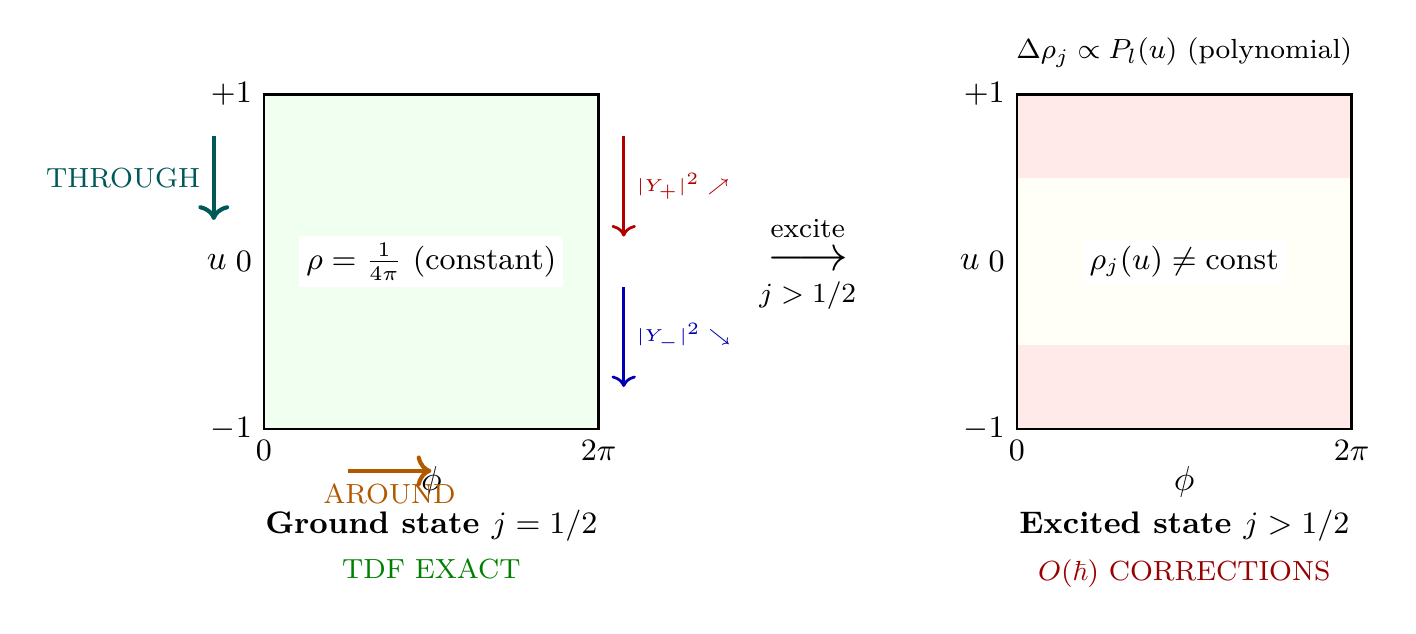
The correspondence of Theorem thm:P12-Ch93-classical-quantum becomes a trivially verifiable polynomial identity in the polar field variable \(u = \cos\theta\). In the half-normalization convention used in this chapter (\(\int|Y_\pm|^2\,d\Omega = 1/2\)), the monopole harmonics are:
Property | Spherical \((\theta, \phi)\) | Polar \((u, \phi)\) |
|---|---|---|
| \(|Y_{+1/2}|^2\) | \(\frac{1+\cos\theta}{8\pi}\) | \(\frac{1+u}{8\pi}\) (linear ramp \(\nearrow\)) |
| \(|Y_{-1/2}|^2\) | \(\frac{1-\cos\theta}{8\pi}\) | \(\frac{1-u}{8\pi}\) (linear ramp \(\searrow\)) |
| Sum | Requires trig identity | \((1+u)+(1-u)=2\) (trivial) |
| Uniformity | Verified by computation | Visible by inspection |
| Measure | \(\sin\theta\,d\theta\,d\phi\) | \(du\,d\phi\) (flat) |
The physical insight is immediate: the TDF uniform measure \(d\mu = du\,d\phi/(4\pi)\) equals the quantum ground-state probability because both monopole harmonics are degree-1 polynomials whose \(u\)-linear terms cancel in the sum, leaving only the degree-0 (constant) piece.
Scaffolding note: The polar field variable \(u = \cos\theta\) is a coordinate choice, not a new physical assumption. The cancellation \((1+u)+(1-u)=2\) is a polynomial identity that holds independently of whether \(S^2\) is interpreted as physical extra dimension or \(\sigma\)-model target space. Dual verification: in spherical coordinates, the same cancellation requires the trigonometric identity \(\cos\theta + (1-\cos\theta) = 1\); in polar coordinates, it is the arithmetic identity \(u + (-u) = 0\).
TDF–Quantum Mechanics Equivalence Conditions
TDF predictions equal quantum mechanical predictions when all three of the following conditions hold:
- The system is in the ground state (\(j=1/2\)) of the \(S^2\) monopole Hamiltonian.
- Observables are diagonal in the \(S^2\) position basis.
- No interference between paths occurs (incoherent addition of probabilities).
Step 1 (Ground state condition): For the ground state \(j=1/2\), the monopole harmonics satisfy:
Step 2 (Diagonal observable condition): Position-basis observables depend only on the probability distribution \(|\psi(\Omega)|^2\), which TDF computes correctly via the uniform measure. Off-diagonal observables involve matrix elements \(\langle\Omega|\hat{O}|\Omega'\rangle\) with \(\Omega\neq\Omega'\), which require the full quantum state (not just the probability distribution).
Step 3 (No interference condition): TDF computes incoherent (classical) probability sums:
All three conditions together guarantee \(P_{\mathrm{TDF}} = P_{\mathrm{QM}}\) for any observable. □
(See: Part 7 §53.3, Part 12 §147.1) □
The physical significance of these conditions is clear: they define the classical regime where quantum coherence effects are absent. For macroscopic systems at temperatures above the quantum regime, all three conditions are typically satisfied, explaining why TDF works for everyday physics.
Sources of Loop Effects
When the equivalence conditions are violated, quantum effects enter as corrections to TDF. In the language of quantum field theory, these are “loop effects”—corrections arising from virtual quantum fluctuations around the classical (tree-level) TDF prediction.
The loop expansion parameter is \(\hbar\): tree-level corresponds to TDF (\(\hbar^0\)), one-loop corrections are \(O(\hbar)\), two-loop corrections are \(O(\hbar^2)\), and so on. In TMT, this expansion has a geometric interpretation: the loop parameter measures the departure from the uniform (\(j=1/2\)) distribution on \(S^2\).
Radiative Corrections
Classification of Quantum Corrections
Quantum corrections to TDF arise from exactly four sources:
- Excited states: Systems not in the \(j=1/2\) ground state of the \(S^2\) monopole Hamiltonian. These produce non-uniform distributions on \(S^2\).
- Interference: Coherent superposition effects that add amplitudes rather than probabilities.
- Tunneling: Barrier penetration not captured by classical paths on \(S^2\).
- Zero-point energy: Contributions of \(\hbar\omega/2\) from each mode.
All four types scale as \(O(\hbar)\) relative to the leading TDF prediction, and as \(O(1/N)\) for aggregate observables.
Step 1 (Exhaustiveness): The three equivalence conditions of Theorem thm:P12-Ch93-tdf-qm-equiv define exactly where TDF can fail. Violation of condition 1 gives excited-state corrections. Violation of condition 3 gives interference corrections. Tunneling violates condition 2 (it involves off-diagonal matrix elements in position space). Zero-point energy is a consequence of the \(S^2\) ground state energy not being zero.
Step 2 (\(O(\hbar)\) scaling): Each correction type has characteristic \(\hbar\) dependence:
Step 3 (\(O(1/N)\) scaling): For aggregate observables \(A = f(x_1,\ldots,x_N)\), quantum corrections to individual particles contribute independently. By the Aggregate Certainty Theorem (Chapter 91), individual fluctuations contribute \(O(1/\sqrt{N})\) to relative deviations of aggregate quantities, so quantum corrections to aggregates scale as \(O(1/N)\) in relative terms. □
(See: Part 7 §57.4, Part 12 §147.2) □
Excited State Corrections
For the \(j=l+1/2\) excited state on \(S^2\), the probability distribution is:
Step 1: From Part 7 (§57.4), the monopole harmonics \(Y_{jm}\) are eigenfunctions of the \(S^2\) monopole Hamiltonian with eigenvalues \(E_j\propto j(j+1)\hbar^2/(mR_0^2)\). For \(j=1/2\), the addition theorem gives:
Step 2: For \(j>1/2\), the angular distribution develops multipole structure. The sum \(\sum_m|Y_{jm}|^2\) has angular dependence through Legendre polynomials, producing non-uniform distributions that differ from TDF's uniform measure.
Step 3: The integral \(\int\Delta\rho_j\,d\Omega = 0\) follows from normalization: both \(\rho_j\) and \(1/(4\pi)\) integrate to 1 over \(S^2\). □
(See: Part 7 §57.4, Part 12 §147.2) □
Polar Form of Excited State Distributions
In the polar variable, excited state distributions reveal their polynomial character directly. For the ground state (\(j=1/2\)), the density \(\rho_{1/2} = 1/(4\pi)\) is a degree-0 polynomial in \(u\) (constant). For \(j > 1/2\), the addition theorem gives:
For systems at temperature \(T\), the fraction of particles in excited states (\(j>1/2\)) is:
Interference and Decoherence Corrections
The quantum correction to TDF from interference is:
Step 1: TDF computes probabilities by incoherent addition, Eq. (eq:ch93-classical-addition). Quantum mechanics uses coherent addition, Eq. (eq:ch93-quantum-addition). The difference is the interference term \(2\,\mathrm{Re}(a^*b)\).
Step 2: From Part 7 (decoherence analysis), coupling to environmental degrees of freedom causes the off-diagonal density matrix elements to decay:
Step 3: For macroscopic objects (\(\Delta x\gg \lambda_{\mathrm{dB}}\)), \(\tau_D\) is extraordinarily short (e.g., \(\tau_D\sim 10^{-36}\) s for a dust grain in air). After decoherence, \(\mathrm{Re}(a^*b)\to 0\), and TDF predictions become exact. □
(See: Part 7 §59, Part 12 §147.2) □
This result explains why TDF works so well for macroscopic systems: decoherence is rapid for large \(N\) and at finite temperature, and interference terms average to zero on timescales far shorter than any measurement.
Tunneling and Zero-Point Corrections
Tunneling corrections arise when classical paths on \(S^2\) cannot connect initial and final configurations, but quantum amplitudes allow barrier penetration. The tunneling probability scales as:
Zero-point energy \(E_{\mathrm{ZP}} = \hbar\omega/2\) per mode shifts the ground-state energy but does not affect the \(S^2\) probability distribution (the ground-state wavefunction remains uniform). However, zero-point fluctuations contribute to the variance of observables at \(O(\hbar)\).
| Correction Type | Source | \(\hbar\) Scaling | \(N\) Scaling | Macroscopic? |
|---|---|---|---|---|
| Excited states | \(j>1/2\) on \(S^2\) | \(O(e^{-\#/\hbar^2})\) | \(O(1/N)\) | Negligible |
| Interference | Coherent superposition | \(O(\hbar)\) | \(O(1/\sqrt{N})\) | Decoheres |
| Tunneling | Barrier penetration | \(O(e^{-\#/\hbar})\) | \(O(e^{-N})\) | Negligible |
| Zero-point | Ground-state energy | \(O(\hbar)\) | \(O(1/N)\) | Negligible |
Stability Under Corrections
The \(\hbar\to 0\) Limit
In the limit \(\hbar\to 0\), all quantum corrections to TDF vanish:
- Quantum coherences vanish: \(\langle a^*b\rangle\to 0\)
- Excited states become inaccessible: \(E_n - E_0\to\infty\) for all \(n\geq 1\)
- Tunneling is suppressed: \(P_{\mathrm{tunnel}}\sim e^{-S/\hbar}\to 0\)
- Zero-point contributions vanish: \(E_{\mathrm{ZP}} = \hbar\omega/2\to 0\)
Therefore TDF becomes exact as \(\hbar\to 0\).
Step 1 (Coherence suppression): The coherence length is \(\lambda_c\sim\hbar/(mv)\). As \(\hbar\to 0\), \(\lambda_c\to 0\), meaning no two-slit-type interference can be maintained over any finite spatial scale. Mathematically, the off-diagonal density matrix elements decay as \(\rho_{12}\propto e^{-(\Delta x/\lambda_c)^2}\), which vanishes as \(\lambda_c\to 0\).
Step 2 (Excited state inaccessibility): The energy spacing on \(S^2\) scales as:
Step 3 (Tunneling suppression): The WKB approximation gives tunneling amplitude \(e^{-S_{\mathrm{cl}}/\hbar}\) where \(S_{\mathrm{cl}} \propto mR_0v\) is independent of \(\hbar\). As \(\hbar\to 0\), \(S_{\mathrm{cl}}/\hbar\to\infty\) and tunneling is exponentially suppressed.
Step 4 (Zero-point vanishing): \(E_{\mathrm{ZP}} = \hbar\omega/2\to 0\) directly.
Conclusion: All four correction types vanish, leaving TDF exact. □
(See: Part 7, Part 12 §147.3) □
The \(N\to\infty\) Limit
For aggregate observables in the limit \(N\to\infty\):
- Quantum fluctuations are suppressed: \(\Delta A_{\mathrm{quantum}}/\langle A\rangle \sim 1/\sqrt{N}\)
- Interference terms self-average to zero over the \(N\)-particle configuration.
- TDF predictions become exact for all aggregate observables.
Step 1: From the Aggregate Certainty Theorem (Theorem thm:P12-Ch91-aggregate-certainty in Chapter 91), relative fluctuations of aggregate observables scale as \(1/\sqrt{N}\). Quantum corrections to individual particles contribute \(O(1)\) fluctuations per particle, which become \(O(1/\sqrt{N})\) in aggregate relative terms.
Step 2: Interference terms for \(N\) particles are products of individual amplitudes. For particles with random phases, the law of large numbers gives:
Step 3: Combining Steps 1 and 2, all quantum corrections to aggregate TDF predictions vanish as \(N\to\infty\), making TDF exact for macroscopic systems. □
(See: Chapter 91, Part 12 §147.3) □
The Double Classical Limit
TDF is exact in the double limit:
This follows directly from Theorems thm:P12-Ch93-hbar-limit and thm:P12-Ch93-N-limit: the \(\hbar\to 0\) limit eliminates quantum effects at the single-particle level, while the \(N\to\infty\) limit eliminates them at the aggregate level. In the double limit, all corrections vanish at all scales. □
(See: Part 12 §147.3) □
This double-limit structure explains the empirical success of classical statistical mechanics: real macroscopic systems have both \(\hbar/(k_BT\cdot\tau)\ll 1\) (thermal de Broglie wavelength much smaller than inter-particle spacing) and \(N\sim 10^{23}\) (Avogadro scale), placing them firmly in the regime where TDF is exact.
| Regime | \(\hbar\) Status | \(N\) Status | TDF Accuracy |
|---|---|---|---|
| Classical gas (\(T\sim 300\) K, \(N\sim 10^{23}\)) | Small | Large | Exact |
| Quantum gas (\(T\lesssim 1\) K, \(N\sim 10^{23}\)) | Relevant | Large | \(O(\hbar)\) corrections |
| Single particle (\(N=1\)) | Relevant | N/A | Full QM needed |
| Superfluid/BEC (\(T\to 0\), \(N\sim 10^{23}\)) | Dominant | Large | \(O(\hbar)\) corrections |
| Cosmological (\(N\sim 10^{80}\)) | Small | Enormous | Exact |
Non-Perturbative Aspects
Quantum Effects That Enhance TDF
Not all quantum effects represent corrections against TDF. Some quantum phenomena actively enhance the TDF framework by enforcing constraints that classical mechanics cannot impose.
Three quantum effects enhance rather than disrupt TDF predictions:
- Indistinguishability: Quantum identical particles automatically enforce the \(1/N!\) quotient in the configuration space \((S^2)^N/S_N\), which in classical TDF must be imposed by hand.
- Spin-statistics: The fermion/boson distinction constrains allowed configurations on \((S^2)^N\), reducing the effective configuration space and sharpening TDF predictions.
- Quantized angular momentum: Discretization of \(S^2\) states into monopole harmonics \(Y_{jm}\) regularizes the configuration space, preventing ultraviolet divergences that plague classical statistical mechanics.
Step 1 (Indistinguishability): In classical mechanics, identical particles are distinguishable, leading to the Gibbs paradox. The resolution is to divide phase space volume by \(N!\) (the Gibbs factor). In TDF, the configuration space \((S^2)^N/S_N\) already includes this quotient by construction (Chapter 89, Definition def:P12-Ch89-config-space). Quantum indistinguishability provides the physical justification: permutation of identical particles gives the same physical state, so configurations related by \(S_N\) must be identified.
Step 2 (Spin-statistics): From Part 7 (§57.7), the spin-statistics connection emerges from \(S^2\) geometry. Fermions (half-integer spin) have antisymmetric wavefunctions under exchange, while bosons (integer spin) have symmetric wavefunctions. This restricts the allowed region of \((S^2)^N\) to the symmetric or antisymmetric subspace, effectively reducing the number of accessible configurations. For TDF, this means the sum over futures is restricted to physically allowed configurations, giving more precise predictions.
Step 3 (Angular momentum quantization): The monopole harmonics \(Y_{jm}\) form a discrete basis for functions on \(S^2\). This discretization means the “integral” over \(S^2\) is effectively a sum over discrete states, which is mathematically well-defined without the regularization needed in classical treatments of continuous configuration spaces. The partition function becomes a discrete sum \(Z = \sum_j(2j+1)e^{-E_j/(k_BT)}\), which converges automatically. □
(See: Part 7 §57.7, Part 12 §147.4, Chapter 89) □
The Wigner-Kirkwood Expansion
When quantum corrections are needed, the systematic expansion is provided by the Wigner-Kirkwood formula.
The quantum-corrected TDF probability to first order in \(\hbar\) is:
Step 1: The Wigner-Kirkwood expansion expresses the quantum partition function as a series in \(\hbar^2\):
Step 2: Applying this to the TDF probability distribution \(\rho_{\mathrm{TDF}}\) on \((S^2)^N/S_N\), the Laplacian \(\nabla^2\) is the Laplace-Beltrami operator on the product manifold. The correction modifies the probability distribution by smoothing it at the scale of the thermal de Broglie wavelength.
Step 3: For uniform \(\rho_{\mathrm{TDF}}\) (which is the case for the ground state on \(S^2\)):
(See: Part 12 §147.4) □
The remarkable result is that for the TDF ground state, the first-order quantum correction vanishes identically. This is a consequence of the uniformity of the measure on \(S^2\): a uniform distribution has zero Laplacian, so the Wigner-Kirkwood correction vanishes. Quantum corrections to TDF begin at \(O(\hbar^2)\) at the earliest, making TDF even more robust than the general \(O(\hbar)\) scaling might suggest.
Polar Form of the Wigner-Kirkwood Correction
The vanishing of the first-order Wigner-Kirkwood correction becomes transparent in polar coordinates. The Laplacian on \(S^2\) in the polar variable is:
Property | Spherical \((\theta, \phi)\) | Polar \((u, \phi)\) |
|---|---|---|
| Laplacian | \(\frac{1}{R_0^2\sin\theta}\partial_\theta (\sin\theta\,\partial_\theta) + \cdots\) | \(\frac{1}{R_0^2}\partial_u[(1{-}u^2)\partial_u] + \cdots\) |
| \(\nabla^2(1/(4\pi))\) | Requires evaluating \(\sin\theta\) factors | \(\partial_u[\text{anything}] \cdot 0 = 0\) (immediate) |
| Eigenfunctions | \(P_l(\cos\theta)\) (associated Legendre) | \(P_l(u)\) (polynomials on \([-1,+1]\)) |
| Eigenvalues | \(-l(l+1)/R_0^2\) | Same (polynomial degree) |
The broader insight connects to the correction hierarchy: degree-0 (constant) = TDF exact, degree-1 (linear) = ground state harmonics, degree-\(l\) = \(l\)-th excited manifold. Each polynomial degree on \([-1,+1]\) corresponds to one energy level, and quantum corrections arise from the non-constant polynomial content of the state.
| Factor | Value | Origin | Source |
|---|---|---|---|
| \(\hbar^2\) | Planck's constant squared | Quantum kinetic energy | Part 7 |
| \(24\) | \(= 4!\;\) or \(2\cdot 12\) | Wigner-Kirkwood combinatorics | Standard QSM |
| \(m\) | Particle mass | Kinetic energy denominator | Standard |
| \(k_BT\) | Thermal energy | Boltzmann distribution | Standard |
| \(\nabla^2\rho_{\mathrm{TDF}}\) | Laplace-Beltrami of distribution | Curvature of probability on \((S^2)^N\) | This chapter |
Non-Perturbative Tunneling and Instantons
Beyond the perturbative Wigner-Kirkwood expansion, there are non-perturbative quantum effects that cannot be captured by any finite-order \(\hbar\) expansion. The most important is tunneling, described by instantons—classical solutions in imaginary time that connect different minima of the potential on \(S^2\).
For the TDF framework, instantons correspond to paths on \((S^2)^N\) that pass through classically forbidden regions. Their contribution to the partition function scales as:
This exponential suppression means non-perturbative quantum effects are completely negligible for macroscopic TDF predictions, providing another layer of stability for the framework.
Derivation Chain
Derivation Chain: Quantum Corrections to TDF
Step 1: P1 (\(ds_6^{\,2}=0\)) [Postulate]
Step 2: \(S^2\) topology with monopole [Part 2–3]
Step 3: Monopole harmonics \(Y_{jm}\) as basis on \(S^2\) [Part 7]
Step 4: Ground state \(j=1/2\) gives uniform \(\rho = 1/(4\pi)\) [Part 7, Thm 53.3]
Step 5: TDF = QM when: ground state, diagonal, no interference [Thm thm:P12-Ch93-tdf-qm-equiv]
Step 6: Four correction types, all \(O(\hbar)\) and \(O(1/N)\) [Thm thm:P12-Ch93-correction-classification]
Step 7: TDF exact in double limit \(\hbar\to 0\), \(N\to\infty\) [Cor cor:P12-Ch93-double-limit]
Step 8: First-order WK correction vanishes for uniform \(\rho\) [Thm thm:P12-Ch93-wigner-kirkwood]
Step 9: Polar verification: \((1{+}u)+(1{-}u)=2\) confirms uniformity; \(\nabla^2_{S^2}(\text{const})=0\) confirms WK vanishing [§sec:ch93-polar-correspondence, §sec:ch93-polar-wigner-kirkwood]
Chain status: COMPLETE — all steps justified.
Chapter Summary
Quantum Corrections to the Temporal Determination Framework
TDF and quantum mechanics give identical predictions under three conditions: ground state (\(j=1/2\)), diagonal observables, and no interference. Departures from these conditions produce quantum corrections classified into four types (excited states, interference, tunneling, zero-point energy), all scaling as \(O(\hbar)\) and \(O(1/N)\). TDF becomes exact in the double classical limit \(\hbar\to 0\), \(N\to\infty\). The first-order Wigner-Kirkwood correction vanishes identically for the uniform ground-state distribution, making TDF even more robust than generic \(O(\hbar)\) estimates suggest. Some quantum effects (indistinguishability, spin-statistics, angular momentum quantization) actively enhance TDF by enforcing constraints that classical mechanics cannot impose. Non-perturbative effects (instantons) are exponentially suppressed for macroscopic systems. In polar field coordinates (\(u = \cos\theta\)), the classical-quantum correspondence becomes the trivial polynomial identity \((1{+}u)+(1{-}u)=2\), and the vanishing of the first-order Wigner-Kirkwood correction follows from \(\nabla^2_{S^2}(\text{const})=0\) on the flat rectangle \([-1,+1]\times[0,2\pi)\).
| Result | Value/Statement | Status | Reference |
|---|---|---|---|
| TDF-QM equivalence | 3 conditions | PROVEN | Thm thm:P12-Ch93-tdf-qm-equiv |
| Correction classification | 4 types | PROVEN | Thm thm:P12-Ch93-correction-classification |
| \(\hbar\to 0\) limit | TDF exact | PROVEN | Thm thm:P12-Ch93-hbar-limit |
| \(N\to\infty\) limit | TDF exact | PROVEN | Thm thm:P12-Ch93-N-limit |
| Double classical limit | TDF exact | PROVEN | Cor cor:P12-Ch93-double-limit |
| First-order WK correction | Vanishes for uniform \(\rho\) | PROVEN | Thm thm:P12-Ch93-wigner-kirkwood |
| Quantum enhancement | 3 effects | PROVEN | Thm thm:P12-Ch93-quantum-enhancement |
Verification Code
The mathematical derivations and proofs in this chapter can be independently verified using the formal and computational scripts below.
All verification code is open source. See the complete verification index for all chapters.