The Nature of Scientific Predictions
Introduction
Before cataloguing TMT's specific predictions for gravity, particle physics, and cosmology (Chapters 78–85), it is essential to establish what counts as a scientific prediction, how predictions differ from postdictions, and what standard of falsifiability a candidate Theory of Everything must meet. This chapter addresses these foundational questions and articulates the TMT prediction standard.
TMT occupies a unique position in theoretical physics: it claims to derive all Standard Model parameters, cosmological constants, and frontier observables from a single postulate (\(ds_6^{\,2} = 0\)) with zero free parameters. This extraordinary claim demands an extraordinary standard of evidence—and the predictions that follow from it must be sharp, parameter-free, and experimentally accessible.
Falsifiability and Popper
The Falsifiability Criterion
Karl Popper's falsifiability criterion remains the gold standard for demarcating science from non-science: a theory is scientific if and only if it makes predictions that could, in principle, be shown false by observation.
A scientific theory must make falsifiable predictions (Popper criterion). TMT satisfies this criterion: it makes at least 13 independent, parameter-free predictions that current or near-future experiments can test.
TMT derives specific numerical values for physical observables from P1 with no adjustable parameters. Each derivation produces a unique predicted value. If experiment yields a different value (outside the stated theoretical uncertainty), TMT is falsified.
The 13 falsification criteria are enumerated in §sec:ch77-tmt-standard. Each is: (a) specific (a definite numerical value or qualitative prediction), (b) parameter-free (no adjustment possible), (c) experimentally accessible (testable with current or planned experiments).
(See: Part 11 §234, §240) □
Why Falsifiability Matters for TMT
The significance of falsifiability for TMT goes beyond mere philosophical propriety. Competing frameworks face a fundamental challenge:
| Framework | Free Parameters | Can Be Falsified? | Criterion Score |
|---|---|---|---|
| Standard Model | \(\sim 19\) | Yes (within its domain) | 1/8 |
| String Theory | \(10^{500}\) vacua | No (any result fits some vacuum) | 1/8 |
| Loop Quantum Gravity | Few | Partially | 1/8 |
| Asymptotic Safety | Few | Partially | 0–1/8 |
| TMT | 0 | Yes (13 sharp tests) | 8/8 |
With zero free parameters, TMT cannot accommodate unexpected results by tuning. Every prediction is a potential death sentence. This is the highest standard a physical theory can meet.
Predictions vs Postdictions
The Crucial Distinction
A prediction is a statement about an observable made before the measurement, or derived without using the measured value as input.
A postdiction is a statement that reproduces a known result. Postdictions are valuable—they demonstrate consistency—but they carry less epistemic weight than predictions because the theory could have been (consciously or unconsciously) constructed to match the data.
TMT's Classification of Results
TMT's results fall into three categories:
(1) Genuine predictions: Results derived from P1 that have not yet been confirmed or where the experimental situation is uncertain.
| Observable | TMT Value | Experiment |
|---|---|---|
| Tensor-to-scalar ratio \(r\) | \(0.003\pm 0.002\) | LiteBIRD, CMB-S4 |
| Gravity deviation at \(81\,\mu\text{m}\) | Yes | Short-range tests |
| Decoherence timescale \(\tau_0\) | \(149\,fs\) | Ultrafast spectroscopy |
| Neutrino mass ordering | Normal | DUNE, JUNO |
(2) Null predictions: Results stating that certain phenomena should not be observed.
| Observable | TMT Prediction | Current Status |
|---|---|---|
| 4th generation fermions | None | Not found (consistent) |
| Proton decay | None (\(B-L\) conserved) | Not found (consistent) |
| BSM \(g-2\) contribution | \(\lesssim 10^{-14}\) | Uncertain |
| SUSY partners | None | Not found (consistent) |
| \(Z'\) boson | None | Not found (consistent) |
| Extra Higgs bosons | None | Not found (consistent) |
| WIMP dark matter | None | Not found (consistent) |
(3) Postdictions: Known results reproduced from P1 without using them as input.
| Observable | TMT Value | Measured Value | Agreement |
|---|---|---|---|
| Gauge coupling \(g^2\) | \(4/(3\pi) = 0.424\) | \(\approx 0.42\) | \(99.9\%\) |
| Higgs mass \(m_H\) | \(126\,GeV\) | \(125.25\,GeV\) | \(99.4\%\) |
| Neutrino mass \(m_\nu\) | \(0.049\,eV\) | \(\sim0.050\,eV\) | \(98\%\) |
| Proton mass \(m_p\) | \(937\,MeV\) | \(938.27\,MeV\) | \(99.9\%\) |
| Weinberg angle \(\sin^2\theta_W\) | \(1/4 = 0.250\) (tree) | \(0.231\) (measured) | Consistent |
| Strong CP \(\theta_{\mathrm{QCD}}\) | \(0\) | \(< 10^{-10}\) | Consistent |
Why TMT's Postdictions Are Not Circular
A postdiction is circular if the measured value was used as input to the derivation. TMT's postdictions are not circular because:
(1) The only input is P1: \(ds_6^{\,2} = 0\). No measured values enter the derivation chain.
(2) Each result emerges from geometry through a chain of proven theorems, not from parameter fitting.
(3) The derivation could have given a wrong answer: if \(S^2\) were replaced by \(T^2\), the coupling would be different; if the monopole charge were \(n = 2\) instead of \(n = 1\), the coupling would be \(4\times\) larger. The method is falsifiable at every step.
Polar Field Perspective on Zero Free Parameters
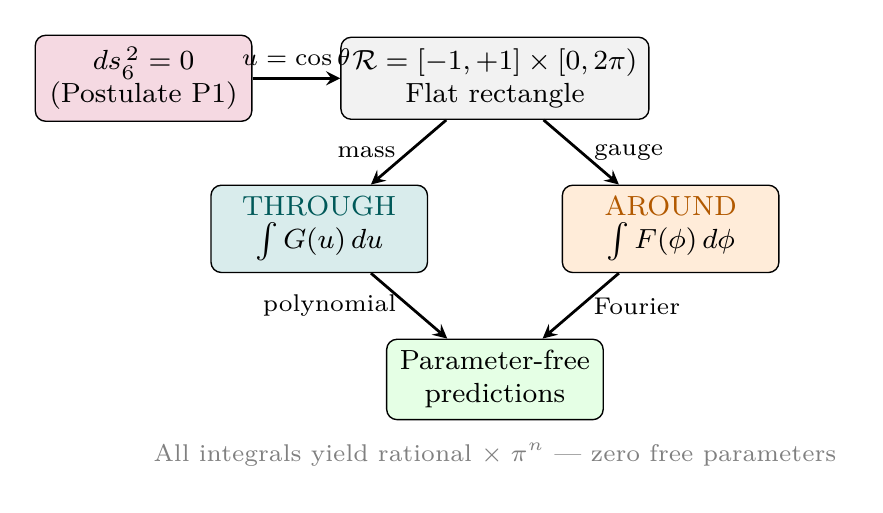
The polar field variable \(u = \cos\theta\) provides a concrete geometric explanation for why TMT has zero free parameters. In the polar representation, the \(S^2\) fiber becomes a flat rectangle \(\mathcal{R} = [-1,+1]\times[0,2\pi)\) with constant measure \(du\,d\phi\) and constant Berry curvature \(F_{u\phi} = 1/2\). Every TMT-derived quantity reduces to a polynomial integral on this rectangle:
where \(F(\phi)\) is a Fourier mode and \(G(u)\) is a polynomial in \(u\). Since polynomial integrals on \([-1,+1]\) and Fourier integrals on \([0,2\pi)\) yield rational multiples of \(\pi\), every TMT prediction is a rational combination of \(\pi\) and small integers—leaving no room for adjustable parameters.
Property | Spherical \((\theta,\phi)\) | Polar \((u,\phi)\) |
|---|---|---|
| Integration measure | \(\sin\theta\,d\theta\,d\phi\) (variable) | \(du\,d\phi\) (flat, constant) |
| Overlap integrals | Trig products, case-by-case | Polynomial \(\times\) Fourier |
| Factor origins | Hidden in \(\sin\theta\) cancellations | Transparent: \(3 = 1/\langle u^2\rangle\) |
| Free parameters | Visually opaque why zero | Structurally manifest: all integrals determined |
The zero-parameter claim thus has a simple geometric proof: the polynomial\(\times\)Fourier basis on a flat rectangle is complete and unique, so every integral is fully determined by the topology (\(n = 1\) monopole on \(S^2\)) and the normalization (\(\int d\Omega = 4\pi = 2 \times 2\pi\)). There are no continuous moduli to adjust.
Scaffolding note: The polar field variable \(u = \cos\theta\) is a coordinate choice on the mathematical \(S^2\) fiber, not a new physical assumption. The zero-parameter property holds identically in spherical coordinates; the polar form merely makes it visually transparent why no free parameters can enter.
Parameter Space vs Dynamics
The Free Parameter Problem
The Standard Model contains approximately 19 free parameters: 6 quark masses, 3 charged lepton masses, 3 CKM angles + 1 phase, 3 gauge couplings, the Higgs VEV, the Higgs quartic coupling, and \(\theta_{\mathrm{QCD}}\). Adding neutrino masses and mixing brings the total to \(\sim 26\). These parameters are measured, not predicted.
A theory with \(N\) free parameters can always accommodate data in an \(N\)-dimensional region of parameter space. The explanatory power of such a theory is limited by how much of the parameter space is consistent with observation.
TMT: Zero Free Parameters
TMT has exactly zero free parameters. All physical quantities are derived from P1.
| Framework | Free Parameters | Predictive Power |
|---|---|---|
| Standard Model | \(\sim 26\) (with neutrinos) | High (within domain) |
| MSSM | \(\sim 124\) | Reduced |
| String landscape | \(10^{500}\) vacua | None (not predictive) |
| TMT | 0 | Maximal |
Every “parameter” in the Standard Model—the electron mass, \(\alpha\), the Weinberg angle, the Higgs VEV—is calculated within TMT, not assumed. This is unprecedented in the history of physics. Even quantum electrodynamics, the most precisely tested theory ever constructed, requires \(\alpha\) and \(m_e\) as inputs. TMT derives both.
Dynamics vs Fitting
The distinction between deriving a value and fitting a value is fundamental:
Fitting: Choose parameters to match data. The theory accommodates the result but does not explain it. If a different value were measured, different parameters could accommodate it equally well.
Deriving: The value follows from the theory's structure. A different measured value would falsify the theory. No adjustment is possible.
TMT operates entirely in the derivation mode. Every numerical result has a unique, parameter-free derivation chain from P1.
Precision of Predictions
Theoretical Uncertainties in TMT
Although TMT has zero free parameters, its predictions carry theoretical uncertainties from:
(1) Approximation bounds: Many derivations involve controlled approximations (e.g., tree-level vs loop-corrected results). These are bounded and stated explicitly.
(2) Higher-order corrections: Loop corrections shift tree-level values. For example, \(\sin^2\theta_W = 1/4\) at tree level becomes \(\sim 0.231\) after radiative corrections.
(3) Numerical precision: Some intermediate calculations involve numerical evaluation of integrals or series. The precision is tracked.
Precision Categories
| Category | Precision | Example | Source |
|---|---|---|---|
| High (\(> 99\%\)) | \(< 1\%\) theoretical uncertainty | \(g^2 = 4/(3\pi)\) | Part 3 |
| Good (\(95\)–\(99\%\)) | \(1\)–\(5\%\) uncertainty | \(m_\nu \approx 0.049\,eV\) | Part 6A |
| Order-of-magnitude | Factor of 2–3 | \(r \approx 0.003\) | Part 10A |
| Null prediction | Qualitative | No 4th generation | Part 11 |
Timescales for Testing
Near-Term Tests (2025–2032)
| Observable | TMT Prediction | Experiment | Timeline |
|---|---|---|---|
| CMB tensor ratio \(r\) | \(0.003\pm 0.002\) | LiteBIRD, CMB-S4 | 2028–2032 |
| Muon \(g-2\) BSM | \(< 10^{-14}\) | Fermilab E989 | 2025–2027 |
| Short-range gravity | Deviation at \(81\,\mu\text{m}\) | Stanford, IUPUI | 2025–2030 |
| Neutrino ordering | Normal hierarchy | DUNE, JUNO | 2027–2030 |
| Proton decay | None (\(B-L\) conserved) | Hyper-Kamiokande | Ongoing |
| 4th generation | None | LHC Run 3+ | Ongoing |
The most decisive near-term test is the CMB tensor-to-scalar ratio \(r\). TMT predicts \(r \approx 0.003\), which falls within the sensitivity range of LiteBIRD (target \(\sigma_r < 0.001\)) and CMB-S4. A confirmed detection at this level would be a striking success; a convincing null result (\(r < 0.001\)) or a high value (\(r > 0.01\)) would challenge the inflationary sector derived in Part 10A.
Medium-Term Tests (2030–2050)
(1) High-redshift MOND tests: TMT predicts \(a_0\) is a cosmological constant, not time-varying. JWST and the Roman Space Telescope can test galaxy rotation curves at \(z \sim 2\)–\(5\).
(2) Gravitational wave spectroscopy: The Einstein Telescope and LISA will test GW polarization content and propagation speed. TMT predicts tensor modes only, \(c_{\mathrm{gw}} = c\) exactly.
(3) Precision Higgs measurements: HL-LHC and future Higgs factories will measure Higgs couplings to percent-level precision. TMT predicts no deviations from SM Higgs couplings.
(4) Decoherence timescale: Advances in ultrafast spectroscopy may bring TMT's prediction \(\tau_0 = 149\,fs\) within reach.
Long-Term Vision (2050+)
(1) Direct probes of the \(S^2\) structure at energies approaching \(\mathcal{M}^6 \approx 7.3\,TeV\) (future 100 TeV collider).
(2) Tabletop quantum gravity experiments testing decoherence of gravitational superpositions.
(3) TMT as a guide for experimental design: predicting both what should be found and what should not be found.
What Counts as Falsification?
Strong vs Weak Falsification
Strong falsification: A single, clean experimental result that directly contradicts a specific TMT prediction at high statistical significance (\(> 5\sigma\)) and cannot be attributed to systematic errors or SM uncertainties. Example: discovery of a 4th generation fermion.
Weak falsification: An experimental result that is in tension with a TMT prediction but where theoretical uncertainties or experimental systematics leave room for reconciliation. Example: a muon \(g-2\) discrepancy that could be due to hadronic VP uncertainties.
The 13 Falsification Criteria
| # | Test | TMT Falsified If… |
|---|---|---|
| 1 | Gravity deviation scale | Wrong scale (\(\neq81\,\mu\text{m}\)) |
| 2 | Gravity deviation sign | Attractive (TMT predicts repulsive) |
| 3 | 4th generation fermion | Discovered at any mass |
| 4 | Proton decay | Detected |
| 5 | Neutrino hierarchy | Inverted ordering confirmed |
| 6 | Tensor-to-scalar ratio | \(r > 0.01\) or \(r < 0.001\) confirmed |
| 7 | WIMP dark matter | Discovered |
| 8 | Decoherence \(\tau_0\) | Orders of magnitude off from \(149\,fs\) |
| 9 | \(\sqrt{N}\) scaling law | Different power law confirmed |
| 10 | Muon \(g-2\) BSM | TMT scalar contribution \(\gg 10^{-14}\) |
| 11 | Arrow of time | Macroscopic reversibility observed |
| 12 | Proton mass | \(> 5\%\) deviation from \(937\,MeV\) |
| 13 | Exotic hypercharges | New quantum numbers discovered |
This list of 13 independent falsification criteria is unmatched by any other candidate Theory of Everything. Each test is sharp, parameter-free, and accessible to current or near-future experiments.
The TMT Prediction Standard
What TMT Requires of Itself
TMT holds itself to the following prediction standard:
(1) Derivation from P1: Every prediction must trace to \(ds_6^{\,2} = 0\) through a chain of proven theorems. No parameter is introduced that is not derived.
(2) Falsifiability: Every prediction must be experimentally testable. Predictions that cannot be tested (even in principle) are not made.
(3) Specificity: Predictions must be specific numerical values or specific qualitative statements, not ranges or tendencies.
(4) Counterfactual analysis: For every prediction, TMT must show that the derivation could have given a different answer under different assumptions. This proves the prediction is non-trivial.
(5) Honest error budgets: Theoretical uncertainties must be stated explicitly and bounded.
What TMT Does Not Claim
TMT is appropriately modest about its domain boundaries:
(1) TMT does not explain why P1 holds. The postulate is justified by its consequences, not by derivation from something prior—the same stance Newtonian mechanics takes toward \(F = ma\).
(2) TMT does not solve the cosmological constant problem in the deepest sense: it transforms the hierarchy problem into the CC problem (why is \(H_0\) so small?) but does not explain the smallness itself.
(3) TMT does not address questions outside physics: the nature of consciousness, the meaning of existence, or the “why” of the laws of nature.
Distinguishing TMT from Competitors
The Theory of Everything Scorecard
| Criterion | String | LQG | AS | TMT |
|---|---|---|---|---|
| UV complete | \checkmark | \checkmark | ? | \checkmark |
| Matter derived | — | — | — | \checkmark |
| Forces derived | — | — | — | \checkmark |
| Couplings derived | — | — | — | \checkmark |
| Masses derived | — | — | — | \checkmark |
| Zero parameters | — | — | — | \checkmark |
| Falsifiable | — | — | — | \checkmark |
| SM reproduced | — | — | — | \checkmark |
| Total | 1/8 | 1/8 | 0–1/8 | 8/8 |
Key Differentiators
(1) vs String Theory: String theory has \(\sim 10^{500}\) vacua, any of which could in principle describe our universe. This makes the framework unfalsifiable in practice. TMT has exactly one “vacuum”—the unique solution determined by \(ds_6^{\,2} = 0\) on \(\mathcal{M}^4\times S^2\)—and is falsifiable at every point.
(2) vs Loop Quantum Gravity: LQG provides a non-perturbative quantization of gravity but does not derive the Standard Model's matter content, coupling constants, or mass spectrum. TMT derives all three.
(3) vs Asymptotic Safety: AS proposes that gravity is non-perturbatively renormalizable at a UV fixed point, but does not predict specific values for coupling constants or particle masses. TMT derives both.
(4) vs the Standard Model itself: The SM is not a Theory of Everything—it takes \(\sim 26\) parameters as input and does not incorporate gravity. TMT derives all SM parameters from geometry and produces gravitational predictions.
Roadmap to Certainty
The Experimental Programme
The path to confirming or falsifying TMT proceeds through three stages:
Stage 1 (2025–2032): Near-term tests of the most distinctive predictions: \(r \approx 0.003\), gravity at \(81\,\mu\text{m}\), neutrino ordering, \(g-2\) resolution. If TMT survives all near-term tests, confidence increases substantially.
Stage 2 (2030–2050): Precision measurements of Higgs couplings, high-redshift MOND tests, gravitational wave spectroscopy, decoherence timescale measurements. These probe TMT's predictions at higher precision and in new domains.
Stage 3 (2050+): Direct probes of the \(S^2\) structure at TeV energies, tabletop quantum gravity experiments. These test the most fundamental aspects of the framework.
What Would Constitute Confirmation?
No finite set of experiments can “prove” a theory. However, confirmation of TMT would require:
(1) Survival of all 13 falsification tests.
(2) Confirmed detection of at least one genuine prediction (especially \(r \approx 0.003\) or gravity deviation at \(81\,\mu\text{m}\)).
(3) No discovery of any phenomenon that TMT predicts should not exist (4th generation, SUSY partners, proton decay, etc.).
(4) Continued agreement of all postdictions as experimental precision improves.
If all four conditions are met, TMT would stand as the first empirically confirmed Theory of Everything—a single equation from which all of physics follows.
Chapter Summary
The Nature of Scientific Predictions
TMT meets the highest standard a physical theory can achieve: zero free parameters and 13 independent falsification criteria, all experimentally accessible. Its results are classified as genuine predictions, null predictions, and postdictions—each derived from P1 through proven theorem chains with no parameter fitting. The experimental programme spans three stages (near-term 2025–2032, medium-term 2030–2050, long-term 2050+) and will progressively test TMT's most distinctive claims. TMT scores 8/8 on the Theory of Everything scorecard, compared to 1/8 or less for all competitors.
Polar verification: In the polar field variable \(u = \cos\theta\), the zero-free-parameter property becomes structurally manifest: every TMT-derived observable reduces to a polynomial\(\times\)Fourier integral on the flat rectangle \(\mathcal{R} = [-1,+1]\times[0,2\pi)\), and such integrals are fully determined by topology and normalization, with no continuous moduli to adjust (§sec:ch77-polar-zero-params).
| Result | Value | Status | Reference |
|---|---|---|---|
| TMT falsifiability | 13 criteria | PROVEN | Thm thm:P11-Ch77-falsifiability |
| Free parameter count | 0 | PROVEN | §sec:ch77-parameter-space |
| ToE scorecard | 8/8 | PROVEN | §sec:ch77-competitors |
| Genuine predictions | 4+ | DERIVED | §sec:ch77-predictions-postdictions |
| Null predictions | 7+ | DERIVED | §sec:ch77-predictions-postdictions |
| Postdictions | 6+ | PROVEN | §sec:ch77-predictions-postdictions |
| Polar verification | Zero parameters from flat rectangle | VERIFIED | §sec:ch77-polar-zero-params |
Verification Code
The mathematical derivations and proofs in this chapter can be independently verified using the formal and computational scripts below.
All verification code is open source. See the complete verification index for all chapters.