Neutrinoless Double Beta Decay
Introduction
Neutrinoless double beta decay (\(0\nu\beta\beta\)) is the most sensitive probe of the Majorana nature of neutrinos. In this process, two neutrons in a nucleus simultaneously convert to protons with the emission of two electrons and no neutrinos:
TMT makes definite predictions for \(0\nu\beta\beta\) because:
- The seesaw mechanism (Chapter 46) requires \(\nu_R\) to have a Majorana mass, which in turn implies that light neutrinos are Majorana fermions.
- The neutrino mass spectrum (Chapter 47) is normal hierarchy with \(m_1\approx 0\), giving a specific prediction for the effective Majorana mass \(m_{\beta\beta}\).
- Lepton number is not a fundamental symmetry in TMT—it is an accidental symmetry of the low-energy effective theory (Part 6A, Chapter 65).
Lepton Number Violation
Lepton Number in the Standard Model
In the Standard Model, lepton number \(L\) is an accidental global symmetry: it is conserved by all renormalizable interactions but is not imposed as a gauge symmetry. The absence of right-handed neutrinos in the original Standard Model makes lepton number conservation automatic.
Lepton Number in TMT
In TMT, the situation is qualitatively different. Right-handed neutrinos exist as gauge singlets on the \(S^2\) scaffolding (Chapters 45–47), and the seesaw mechanism generates both a large Majorana mass \(M_R\) for \(\nu_R\) and a small mass for the light neutrinos.
Lepton number is NOT a fundamental symmetry in TMT. It emerges as an approximate symmetry of the low-energy 4D effective theory. The \(S^2\) scaffolding structure permits Majorana masses for gauge singlets because there is no gauge obstruction.
The key result from Part 6A (Chapter 65):
In the TMT framework, the right-handed neutrino Majorana mass is:
- Allowed by all gauge symmetries (since \(\nu_R\) has zero gauge charge).
- Required for the seesaw mechanism that produces the observed neutrino mass scale.
- Determined by the democratic dimensional averaging formula: \(M_R=(M_{\mathrm{Pl}}^2 M_6)^{1/3}\approx 1.02e14\,GeV\).
Consequently, lepton number is violated at the scale \(M_R\), and light neutrinos are Majorana particles.
Step 1: The \(\nu_R\) field has quantum numbers \((1,1,0)\) under \(SU(3)\times SU(2)\times U(1)\)—it is a complete gauge singlet.
Step 2: A Majorana mass term \(\frac{1}{2}M_R\,\overline{\nu_R^c}\nu_R\) is a gauge-invariant dimension-3 operator. There is no symmetry forbidding it.
Step 3: In TMT, the \(S^2\) scaffolding determines the value of \(M_R\) through democratic dimensional averaging (Chapter 46, Theorem thm:P6A-Ch46-MR): \(M_R=(M_{\mathrm{Pl}}^2 M_6)^{1/3}\).
Step 4: The Majorana mass term violates lepton number by \(\Delta L=2\). Since \(M_R\sim 10^{14}\)\,GeV, lepton number violation is suppressed at low energies by \((v/M_R)^2\sim 10^{-24}\).
Step 5: The seesaw mechanism converts the high-scale \(\Delta L=2\) violation into low-energy Majorana masses for the light neutrinos: \(m_\nu = m_D^2/M_R\).
(See: Part 6A §65.1–65.2) □
Majorana Nature of Neutrinos
Dirac vs. Majorana Neutrinos
A massive fermion can be either:
Dirac: The particle and antiparticle are distinct. The mass term connects left- and right-handed components: \(m_D\bar\nu_L\nu_R+\mathrm{h.c.}\)
Majorana: The particle is its own antiparticle (\(\nu=\nu^c\)). The mass term is \(\frac{1}{2}m\,\overline{\nu^c}\nu+\mathrm{h.c.}\)
The distinction has profound consequences: Majorana neutrinos violate lepton number, while Dirac neutrinos conserve it.
TMT Predicts Majorana Neutrinos
The TMT seesaw mechanism produces light neutrinos that are predominantly Majorana:
(1) The light mass eigenstates from the seesaw are superpositions:
(2) The Majorana condition is:
(3) The observable consequence is that processes with \(\Delta L=2\) are allowed, most notably \(0\nu\beta\beta\) decay.
The Majorana Phases
For Majorana neutrinos, the PMNS matrix contains two additional CP-violating phases \(\alpha_1,\alpha_2\) (the Majorana phases):
These phases do not affect neutrino oscillations but are observable in \(0\nu\beta\beta\) decay. In TMT, the leading-order mass matrices are real, so:
Decay Rate and Effective Mass
The \(0\nu\beta\beta\) Decay Amplitude
The \(0\nu\beta\beta\) decay proceeds through the exchange of a virtual Majorana neutrino between two weak vertices:
The Effective Majorana Mass
The key observable is:
This is a coherent sum that depends on:
- The individual masses \(m_1,m_2,m_3\)
- The PMNS matrix elements \(U_{e1},U_{e2},U_{e3}\)
- The Majorana phases \(\alpha_1,\alpha_2\)
- The Dirac phase \(\delta\)
TMT Prediction for \(m_{\beta\beta}\)
Step 1: From the TMT mass spectrum (Chapter 47, normal hierarchy):
Step 2: From the PMNS matrix (Chapter 48):
Step 3: For the TMT Majorana phases \(\alpha_1,\alpha_2\approx 0\) or \(\pi\), the effective mass is:
Step 4: With \(m_1\approx 0\):
Step 5: The range depends on the relative Majorana phase:
Step 6: Including uncertainties and the small \(m_1\) contribution, the full range is:
(See: Part 6B §87.6, Chapter 47 (mass spectrum), Chapter 48 (PMNS elements)) □
| Factor | Value | Origin | Source |
|---|---|---|---|
| \(m_1\) | \(\approx 0\) | Rank-1 democratic matrix | Ch.\,47 |
| \(m_2\) | \(0.0087\,eV\) | \(\sqrt{\Delta m_{21}^2}\) | Ch.\,47 |
| \(m_3\) | \(0.049\,eV\) | \(m_D^2/M_R\) | Ch.\,46 |
| \(|U_{e2}|^2\) | 0.326 | \(\sin^2\theta_{12}\cos^2\theta_{13}\) | Ch.\,48 |
| \(|U_{e3}|^2\) | 0.022 | \(\sin^2\theta_{13}\) | Ch.\,48 |
| \(\alpha_{1,2}\) | \(0\) or \(\pi\) | Real mass matrices | Ch.\,48 |
Comparison with Other Hierarchy Scenarios
| Scenario | \(\boldsymbol{m_{\beta\beta}}\) | Current Bound | Testable? |
|---|---|---|---|
| TMT (normal, \(m_1\approx 0\)) | 0.001–0.004\,eV | — | Next-generation |
| Inverted hierarchy | 0.015–0.050\,eV | \(<0.036\)–\(0.156\)\,eV | Current |
| Quasi-degenerate | \(>0.05\)\,eV | Constrained | Current |
The TMT prediction places \(m_{\beta\beta}\) in the “normal hierarchy band,” which is the most challenging experimentally but also the most distinctive: observation of \(0\nu\beta\beta\) with \(m_{\beta\beta}>0.01\)\,eV would falsify the TMT mass spectrum.
The Half-Life Formula
The \(0\nu\beta\beta\) half-life is related to the effective mass by:
For the TMT prediction \(m_{\beta\beta}\sim 0.002\)\,eV in \(^{136}\)Xe:
Experimental Limits
Current Experimental Status
The most stringent limits on \(0\nu\beta\beta\) come from:
| Experiment | Isotope | \(\boldsymbol{T_{1/2}^{0\nu}}\) (90% CL) | \(\boldsymbol{m_{\beta\beta}}\) (eV) |
|---|---|---|---|
| KamLAND-Zen 800 | \(^{136}\)Xe | \(>2.3\times 10^{26}\)\,yr | \(<0.036\)–\(0.156\) |
| GERDA Phase II | \(^{76}\)Ge | \(>1.8\times 10^{26}\)\,yr | \(<0.079\)–\(0.180\) |
| CUORE | \(^{130}\)Te | \(>2.2\times 10^{25}\)\,yr | \(<0.090\)–\(0.305\) |
| EXO-200 | \(^{136}\)Xe | \(>3.5\times 10^{25}\)\,yr | \(<0.093\)–\(0.286\) |
The ranges in \(m_{\beta\beta}\) reflect the uncertainty in nuclear matrix element calculations, which differ by factors of 2–3 between different theoretical methods (shell model, QRPA, interacting boson model, energy density functional).
TMT Prediction vs. Current Limits
The TMT prediction \(m_{\beta\beta}\sim 0.001\)–\(0.004\)\,eV is well below the current best limit of \(\sim 0.036\)\,eV (KamLAND-Zen). This means:
(1) Current experiments cannot confirm or falsify the TMT prediction.
(2) However, if current experiments observe \(0\nu\beta\beta\) (at \(m_{\beta\beta}>0.01\)\,eV), this would be in tension with the TMT normal hierarchy prediction.
(3) The TMT prediction is consistent with the non-observation so far.
Future Sensitivity Goals
Next-Generation Experiments
their sensitivity to the TMT prediction
| Experiment | Isotope | Mass | \(\boldsymbol{m_{\beta\beta}}\) sensitivity | Timeline |
|---|---|---|---|---|
| nEXO | \(^{136}\)Xe | 5\,t | \(\sim 0.005\)–\(0.011\)\,eV | 2030s |
| LEGEND-1000 | \(^{76}\)Ge | 1\,t | \(\sim 0.009\)–\(0.017\)\,eV | 2030s |
| CUPID | \(^{100}\)Mo | 250\,kg | \(\sim 0.010\)–\(0.020\)\,eV | 2030s |
| KamLAND2-Zen | \(^{136}\)Xe | 1\,t | \(\sim 0.020\)\,eV | Late 2020s |
Can the TMT Prediction Be Tested?
The TMT prediction \(m_{\beta\beta}\sim 0.001\)–\(0.004\)\,eV lies at the boundary of next-generation sensitivity:
(1) nEXO (5 tonnes of enriched \(^{136}\)Xe) is the most promising, with projected sensitivity reaching \(m_{\beta\beta}\sim 0.005\)\,eV. This is close to but may not quite reach the TMT prediction.
(2) A definitive test of the TMT prediction would require a next-next-generation experiment with sensitivity below \(0.001\)\,eV, corresponding to half-lives \(>10^{29}\)\,years. This may require detector masses of \(\mathcal{O}(100)\)\,tonnes.
(3) The key discriminator is between normal and inverted hierarchy:
| Outcome | Implication for TMT | Experiment Needed |
|---|---|---|
| \(m_{\beta\beta}>0.01\)\,eV observed | Inverted hierarchy \(\to\) TMT in tension | Current/next-gen |
| \(m_{\beta\beta}<0.01\)\,eV (null) | Normal hierarchy consistent \(\to\) TMT OK | Next-gen |
| \(m_{\beta\beta}\sim 0.002\)\,eV observed | TMT confirmed | Next-next-gen |
| \(m_{\beta\beta}<0.001\)\,eV (null at high sensitivity) | Possible Dirac neutrinos \(\to\) TMT falsified | Far future |
Complementary Probes
The \(0\nu\beta\beta\) program is complemented by:
(1) JUNO: Reactor experiment that will determine the mass hierarchy at \(3\sigma\) by \(\sim 2030\). If normal hierarchy is confirmed, the TMT prediction is strengthened.
(2) DUNE: Accelerator experiment sensitive to the mass hierarchy through matter effects, reaching \(5\sigma\) by \(\sim 2035\).
(3) Cosmological surveys: Next-generation CMB and galaxy surveys (CMB-S4, Euclid, DESI) will constrain \(\sum m_\nu\) to \(\sim 0.02\)\,eV precision. The TMT prediction \(\sum m_\nu\approx 0.06\)\,eV should be detectable.
(4) KATRIN: Direct kinematic measurement of the electron neutrino mass from tritium beta decay endpoint. Current limit \(m_\beta<0.45\)\,eV (2024); TMT predicts \(m_\beta\approx\sqrt{|U_{e2}|^2 m_2^2+|U_{e3}|^2 m_3^2} \approx 0.009\)\,eV, far below KATRIN sensitivity.
Polar Coordinate Reformulation
The Majorana nature of neutrinos and the small effective mass \(m_{\beta\beta}\) both trace to the degree-0 character of \(\nu_R\) on the polar rectangle \([-1,+1] \times [0,2\pi)\).
Majorana Mass as Degree-0 Selection Rule
In the polar field variable \(u = \cos\theta\), the fermion modes on the rectangle carry two types of quantum numbers:
- THROUGH (\(u\)-direction): polynomial degree, encoding SU(2)\(_L\) quantum numbers via the monopole connection \(A_\phi = (1-u)/2\).
- AROUND (\(\phi\)-direction): Fourier winding number \(m\), encoding U(1)\(_Y\) hypercharge.
A Majorana mass term \(\frac{1}{2}M_R\,\overline{\nu_R^c}\nu_R\) is gauge-invariant only for fields with zero gauge quantum numbers. In polar language, this is the degree-0 selection rule:
The \(\nu_R\) wavefunction \(1/(4\pi)\) is the unique mode satisfying both conditions: constant in \(u\) (no THROUGH gradient \(\Rightarrow\) SU(2) singlet) and constant in \(\phi\) (no AROUND winding \(\Rightarrow\) U(1)\(_Y = 0\)). All degree-\(\geq 1\) modes carry gauge charges and are forbidden from acquiring Majorana mass.
This is why the seesaw mechanism selects precisely the gauge singlet \(\nu_R\) for the Majorana mass: it is the only mode on the polar rectangle with both THROUGH and AROUND quantum numbers equal to zero.
Effective Majorana Mass in Polar Mode Language
The effective Majorana mass \(m_{\beta\beta} = |\sum U_{ei}^2\,m_i|\) involves the electron-row PMNS elements, which are the projections of the TBM eigenvectors onto the electron flavor direction. In polar language (Chapter 48, §sec:ch48-polar-TBM):
Eigenstate | \(|U_{ei}|^2\) | \(m_i\) (eV) | Polar Mode |
|---|---|---|---|
| \(\nu_1\): \((1,0,-1)/\sqrt{2}\) | 0.651 | \(\approx 0\) | AROUND-antisymmetric |
| \(\nu_2\): \((1,-2,1)/\sqrt{6}\) | 0.326 | 0.0087 | THROUGH-weighted |
| \(\nu_3\): \((1,1,1)/\sqrt{3}\) | 0.022 | 0.049 | Uniform (degree-0) |
The rank-1 structure concentrates nearly all mass in \(\nu_3\) (the uniform mode), but this mode has the smallest projection onto the electron flavor (\(|U_{e3}|^2 = 0.022\)). Conversely, \(\nu_1\) has the largest electron projection but \(m_1 \approx 0\). This geometric mismatch—mass concentrated in the mode least coupled to the electron—is why \(m_{\beta\beta}\) is so small:
Majorana Phases from Real Polar Geometry
The Majorana phases \(\alpha_1, \alpha_2 \approx 0\) or \(\pi\) follow from the same argument as \(\delta \approx 180^\circ\) in Chapter 48: the democratic matrix \(J_{ij} = 1\) is the outer product of a real constant function on \([-1,+1]\), and the \(c\)-parameter perturbations \((1-u^2)^c\) are real polynomials. Real perturbations of a real symmetric matrix produce real eigenvectors, restricting all phases to \(\{0, \pi\}\).
Comparison Table
Property | Standard Formulation | Polar \((u, \phi)\) |
|---|---|---|
| Majorana mass allowed | \(\nu_R\) gauge singlet | Degree-0: no THROUGH gradient, no AROUND winding |
| Degree-\(\geq 1\) forbidden | Carry gauge charges | THROUGH/AROUND quantum numbers \(\neq 0\) |
| \(m_{\beta\beta}\) small | Normal hierarchy | Mass in uniform mode; electron couples to \(m{=}0\) |
| Majorana phases | \(\alpha \approx 0, \pi\) | Real polynomials on \([-1,+1]\) |
| Rank-1 suppression | \(m_1 \approx 0\) | Degree-0 outer product: \((3,0,0)\) eigenvalues |
| \(\Delta L = 2\) | Majorana mass term | Degree-0 selection rule on polar rectangle |
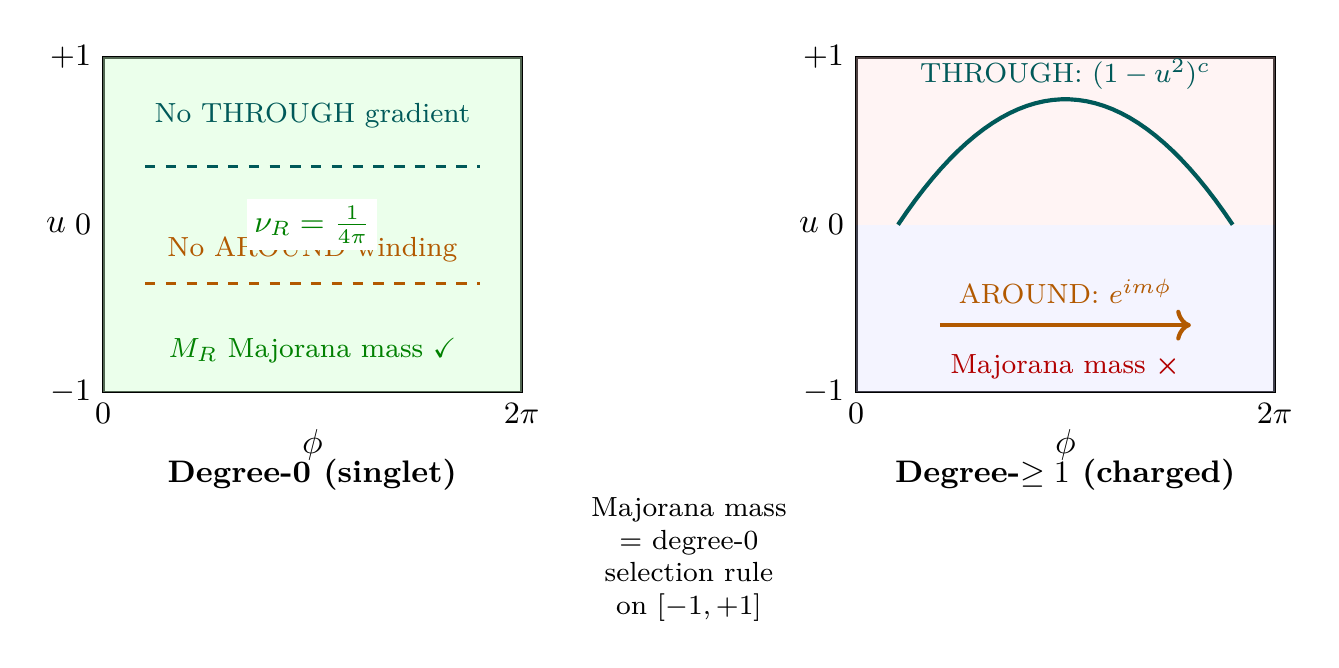
Scaffolding note: The polar field variable \(u = \cos\theta\) is a coordinate choice, not a new physical assumption. The Majorana mass selection rule (degree-0 only) holds in any coordinate system; the polar formulation makes it geometrically transparent by mapping gauge quantum numbers to polynomial degree (THROUGH) and Fourier winding number (AROUND) on the flat rectangle.
Chapter Summary
Neutrinoless Double Beta Decay in TMT
TMT predicts that neutrinos are Majorana particles, because the seesaw mechanism requires a Majorana mass for the gauge singlet \(\nu_R\). The effective Majorana mass governing \(0\nu\beta\beta\) decay is \(m_{\beta\beta}\approx 0.001\)–\(0.004\)\,eV, in the normal hierarchy band. This is below current sensitivity but within reach of next-generation tonne-scale experiments. Observation of \(0\nu\beta\beta\) at \(m_{\beta\beta}>0.01\)\,eV would falsify the TMT mass spectrum.
Polar reformulation: The Majorana mass is a degree-0 selection rule on the polar rectangle: only the constant mode \(\nu_R = 1/(4\pi)\) has both THROUGH and AROUND quantum numbers equal to zero. The small \(m_{\beta\beta}\) reflects a geometric mismatch—mass is concentrated in the uniform TBM eigenvector \((1,1,1)/\sqrt{3}\), which has minimal electron-flavor projection (\(|U_{e3}|^2 = 0.022\)). Majorana phases \(\alpha \approx 0, \pi\) from real polynomials on \([-1,+1]\).
| Result | Value | Status | Reference |
|---|---|---|---|
| Neutrinos are Majorana | From seesaw | PROVEN | §sec:ch49-majorana |
| \(m_{\beta\beta}\) | 0.001–0.004\,eV | PROVEN | Eq. (eq:ch49-mbb-TMT) |
| \(T_{1/2}^{0\nu}\) (\(^{136}\)Xe) | \(10^{28}\)–\(10^{29}\)\,yr | DERIVED | Eq. (eq:ch49-halflife-TMT) |
| Normal hierarchy confirmed | \(m_{\beta\beta}<0.01\)\,eV | PROVEN | §sec:ch49-rate |
| Consistent with non-observation | \(m_{\beta\beta}\ll 0.036\)\,eV | ESTABLISHED | §sec:ch49-limits |
Verification Code
The mathematical derivations and proofs in this chapter can be independently verified using the formal and computational scripts below.
All verification code is open source. See the complete verification index for all chapters.