Yang-Mills: Problem Statement
Introduction
The Yang-Mills existence and mass gap problem is the second Millennium Prize Problem addressed in this Part. The Clay Mathematics Institute asks for a proof that, for any compact simple gauge group \(G\), the quantum Yang-Mills theory on \(\mathbb{R}^4\) exists (satisfying the Wightman axioms or equivalent) and has a mass gap—the lowest-lying excitation has strictly positive mass. This chapter states the problem precisely, defines the mass gap, and previews TMT's approach through the \(S^2\) geometry that naturally generates non-abelian gauge theories with topological confinement.
Scaffolding Interpretation. The \(S^2\) geometry throughout this chapter is mathematical scaffolding (Part A). The embedding \(S^2 \hookrightarrow \mathbb{C}^3\) that generates SU(3) is a computational projection structure. Physical observables (coupling constant \(g_3^2 = 4/\pi\), \(\Lambda_{\text{QCD}}\), hadron masses) are 4D predictions.
The Yang-Mills Equation
Classical Yang-Mills Theory
For a compact semisimple gauge group \(G\) with Lie algebra \(\mathfrak{g}\), the Yang-Mills field strength is:
The classical Yang-Mills equation (equation of motion) is:
The classical action is:
Gauge Invariance
The theory is invariant under local gauge transformations:
The Case \(G = \text{SU}(3)\)
For QCD, \(G = \text{SU}(3)\). In TMT:
- SU(3) is derived from the embedding \(S^2 \cong \mathbb{CP}^1 \hookrightarrow \mathbb{C}^3\) (Part 3, Chapter 9)
- The coupling constant \(g_3^2 = 4/\pi\) is derived from the participation principle (Part 3, Theorem 12.3)
- 8 gluon fields correspond to the 8 generators of SU(3)
Polar Field Form of the SU(3) Derivation
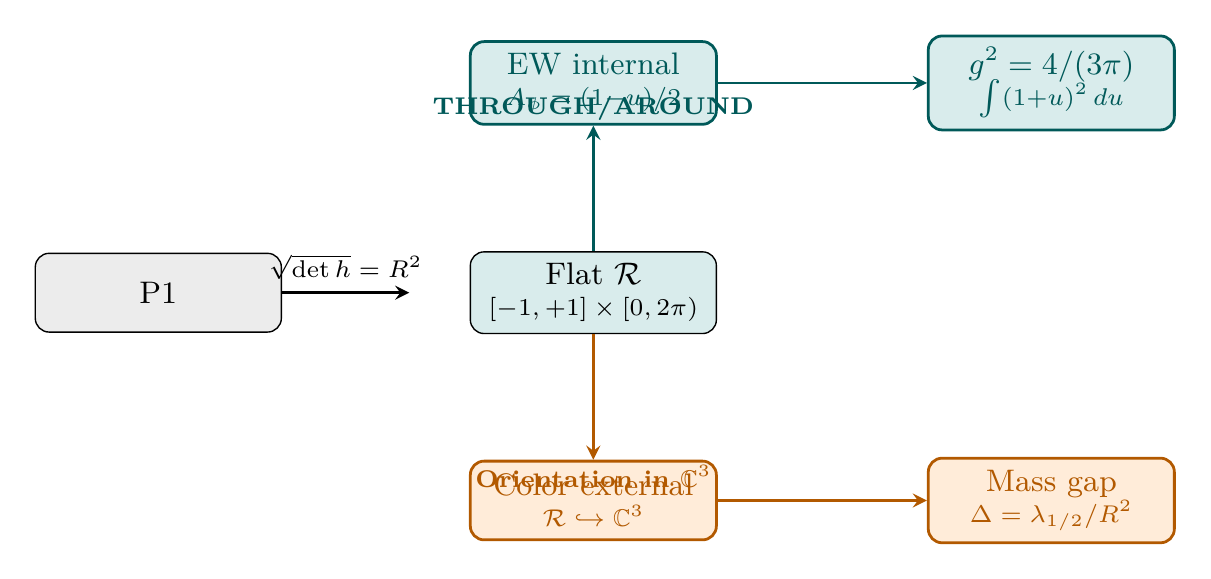
In the polar field variable \(u = \cos\theta\), the TMT derivation of SU(3) and its coupling becomes transparent. The embedding \(S^2 \cong \mathbb{CP}^1 \hookrightarrow \mathbb{CP}^2 \subset \mathbb{C}^3\) maps the flat rectangle \(\mathcal{R} = [-1,+1] \times [0,2\pi)\) into the ambient three-dimensional complex space. The SU(3) color group is the isometry group of \(\mathbb{CP}^2\) that acts on the external orientation of \(\mathcal{R}\) in \(\mathbb{C}^3\), while the internal \(S^2\) physics (monopole connection, Killing vectors, mode spectrum) lives on the flat rectangle itself.
The coupling constant derivation reduces to a single polynomial integral on \([-1,+1]\):
Quantity | Spherical \((\theta,\phi)\) | Polar \((u,\phi)\) |
|---|---|---|
| Gauge group origin | \(S^2 \hookrightarrow \mathbb{C}^3\) (abstract) | Rectangle orientation in \(\mathbb{C}^3\) (external) |
| Coupling integral | 3 sub-integrals, trig chain | \(\int_{-1}^{+1}(1+u)^2\,du = 8/3\) (one line) |
| Factor 3 | Trig identity chain | \(3 = 1/\langle u^2\rangle_{[-1,+1]}\) (second moment) |
| \(N_c = 3\) | \(\dim_{\mathbb{C}}\mathbb{C}^3\) | \(= 1/\langle u^2\rangle\) (same factor) |
| 8 gluons | \(\dim\,\text{SU}(3) = 8\) | External rotations of \(\mathcal{R}\) in \(\mathbb{C}^3\) |
| EW vs color | Internal/external classification | Internal on flat \(du\,d\phi\) / external in \(\mathbb{C}^3\) |
Scaffolding note: The polar field variable \(u = \cos\theta\) is a coordinate choice. The SU(3) derivation from the embedding \(\mathbb{CP}^1 \hookrightarrow \mathbb{CP}^2\) is a mathematical computation; in polar coordinates, the coupling integral \(\int(1+u)^2\,du\) is a polynomial integral on the flat interval \([-1,+1]\), making the derivation manifestly elementary.
Mass Gap Definition
The Quantum Theory
The quantum Yang-Mills theory is defined (formally) by the path integral:
The Mass Gap
Equivalently, the two-point correlation function of any gauge-invariant operator \(\mathcal{O}\) decays exponentially at large separation:
Physical Significance
The mass gap has profound physical consequences:
- Confinement: If \(\Delta > 0\), the force between color charges does not fall off at large distances (unlike electromagnetism, where the photon is massless and the force falls as \(1/r^2\)).
- Hadron spectrum: The lightest hadrons (pions, protons) have masses set by \(\Delta\) and \(\Lambda_{\text{QCD}}\).
- No free gluons: Gluons cannot propagate freely; they are confined within hadrons.
Evidence for the Mass Gap
The mass gap has strong empirical and numerical support:
| Evidence | Source | Result |
|---|---|---|
| No free quarks/gluons | Experiment | Confirmed |
| Lattice QCD: glueball mass | Wilson (1974+) | \(m_{0^{++}} \approx 1.7\) GeV |
| Lattice QCD: string tension | Simulation | \(\sqrt{\sigma} \approx 425\) MeV |
| Wilson loop area law | Lattice | \(\langle W(C)\rangle \sim e^{-\sigma\cdot\text{Area}}\) |
| Asymptotic freedom | 't Hooft, Gross, Wilczek, Politzer | \(\alpha_s \to 0\) at high energy |
The Millennium Problem
Official Problem Statement
Yang-Mills Existence and Mass Gap (Clay Institute)
Prove that for any compact simple gauge group \(G\), a non-trivial quantum Yang-Mills theory exists on \(\mathbb{R}^4\) and has a mass gap \(\Delta > 0\).
Specifically:
- There exists a quantum field theory satisfying the Wightman axioms (or Osterwalder-Schrader axioms in Euclidean signature)
- The theory is based on the gauge group \(G\) with coupling constant \(g > 0\)
- The mass spectrum has a gap: the lightest particle has mass \(\Delta > 0\)
Why the Problem Is Hard
(1) Non-perturbative: Perturbation theory (Feynman diagrams) cannot demonstrate confinement or the mass gap. Asymptotic freedom means the theory is weakly coupled at high energies but strongly coupled at low energies, precisely where the mass gap emerges.
(2) Rigorous construction: No interacting quantum field theory in 4 spacetime dimensions has been rigorously constructed to date. The problem requires both existence (constructing the theory) and properties (proving the mass gap).
(3) Infrared difficulties: At long distances, the gauge field is strongly self-interacting, making traditional mathematical tools inadequate.
TMT's Contribution
TMT approaches the Yang-Mills mass gap from a fundamentally different direction than standard quantum field theory:
- SU(3) is derived, not postulated: The gauge group emerges from \(S^2 \hookrightarrow \mathbb{C}^3\) geometry (Part 3).
- Confinement is topological: The embedding topology forces flux tubes to form between color charges (Part 11, Section D).
- The mass gap is geometric: The lowest excitation on \(S^2\) has energy set by the Laplacian eigenvalue \(2/R^2\), providing a natural mass scale. In the polar field variable \(u = \cos\theta\), the mass gap becomes a polynomial degree gap: the Legendre eigenvalues \(\lambda_\ell = \ell(\ell+1)/R^2\) on \([-1,+1]\) forbid degree-0 (constant) excitations, forcing \(\ell \geq 1\) and \(\Delta \geq 2/R^2\). For the confining sector with half-integer \(j\), the spectral gap is \(\lambda_{1/2} = 3/(4R^2)\) from the curved metric \(h_{uu} = R^2/(1-u^2)\) on the flat interval (Chapter 105).
- \(\Lambda_{\text{QCD}}\) is derived: The QCD scale \(\Lambda_{\text{QCD}} \approx 213\) MeV follows from the TMT-derived coupling \(g_3^2 = 4/\pi\) and RG running.
The detailed TMT derivation of confinement and the mass gap is presented in Chapters 104–106.
Derivation Chain Summary
Chapter Summary
Yang-Mills: Problem Statement
The Yang-Mills existence and mass gap problem asks for a rigorous proof that quantum Yang-Mills theory exists and has a strictly positive mass gap. Physical evidence (no free quarks, lattice QCD results, asymptotic freedom) strongly supports the mass gap. TMT approaches this problem by deriving the gauge group SU(3) from \(S^2\) geometry, establishing topological confinement from the embedding structure, and computing the mass scale from the TMT-derived coupling constant. The detailed TMT proof strategy is developed in Chapters 104–106. In the polar field variable \(u = \cos\theta\), the SU(3) coupling reduces to the polynomial integral \(\int_{-1}^{+1}(1+u)^2\,du = 8/3\) on the flat rectangle \(\mathcal{R}\), and the mass gap becomes a polynomial degree gap \(\lambda_\ell = \ell(\ell+1)/R^2\) on the compact interval \([-1,+1]\).
| Result | Value | Status | Reference |
|---|---|---|---|
| Yang-Mills equation | Eq. (eq:ch103-ym-eom) | ESTABLISHED | §sec:ch103-ym-equation |
| Mass gap definition | \(\Delta > 0\) | ESTABLISHED | §sec:ch103-mass-gap |
| Millennium problem stated | Clay formulation | ESTABLISHED | §sec:ch103-millennium |
| TMT gauge group | SU(3) from \(S^2 \hookrightarrow \mathbb{C}^3\) | PROVEN | Part 3 |
| TMT coupling | \(g_3^2 = 4/\pi\) | PROVEN | Part 3 |
Verification Code
The mathematical derivations and proofs in this chapter can be independently verified using the formal and computational scripts below.
All verification code is open source. See the complete verification index for all chapters.