Yang-Mills: Proof Strategy
Introduction
This chapter presents the TMT proof strategy for the Yang-Mills existence and mass gap problem. Unlike the Navier-Stokes problem where TMT provides regularity through the \(S^2\) geometry (Chapters 97–102), the Yang-Mills problem in TMT is addressed through a combination of geometric derivation (SU(3) from \(S^2 \hookrightarrow \mathbb{C}^3\)) and topological confinement arguments.
Scaffolding Interpretation. The \(S^2\) geometry and \(S^2 \hookrightarrow \mathbb{C}^3\) embedding are mathematical scaffolding (Part A). The TMT reformulation of the Millennium Problem uses the scaffolding to derive gauge group, coupling, and confinement. Physical observables (mass gap \(\Delta > 0\), Wightman axiom satisfaction) are 4D predictions. The \(S^2\) UV regularization is a computational tool, not a claim about physical extra dimensions.
The strategy has three components:
- Rigorous formulation: Stating the problem precisely in the TMT framework.
- Mathematical framework: The analytical tools required for the proof.
- Existence results: What TMT proves and what remains open.
Rigorous Formulation
The Millennium Problem Statement
The Clay Mathematics Institute formulation requires:
- Existence: For any compact simple gauge group \(G\), prove that a quantum Yang-Mills theory exists on \(\mathbb{R}^4\) and satisfies the Wightman axioms (or Osterwalder-Schrader axioms in the Euclidean formulation).
- Mass gap: The theory has a mass gap \(\Delta > 0\): every state in the Hilbert space has energy at least \(\Delta\) above the vacuum.
TMT Reformulation
In the TMT framework, the problem is reformulated as follows:
In TMT, the Yang-Mills theory with gauge group SU(3) arises from the geometry of \(S^2 \hookrightarrow \mathbb{C}^3\). The mass gap problem becomes: given the topological confinement mechanism, prove rigorously that the quantum theory
- (a) exists as a well-defined quantum field theory on \(\mathbb{R}^4\), and
- (b) has spectrum \(\{0\} \cup [\Delta, \infty)\) with \(\Delta > 0\).
TMT advantages for the proof:
- SU(3) is derived, not postulated—the geometric origin constrains the theory's properties.
- Confinement is topological, providing a non-perturbative handle that the standard formulation lacks.
- The \(S^2\) compactness provides a natural UV regulator analogous to lattice regularization but with preserved continuous symmetries.
Polar Field Form of the Proof Strategy
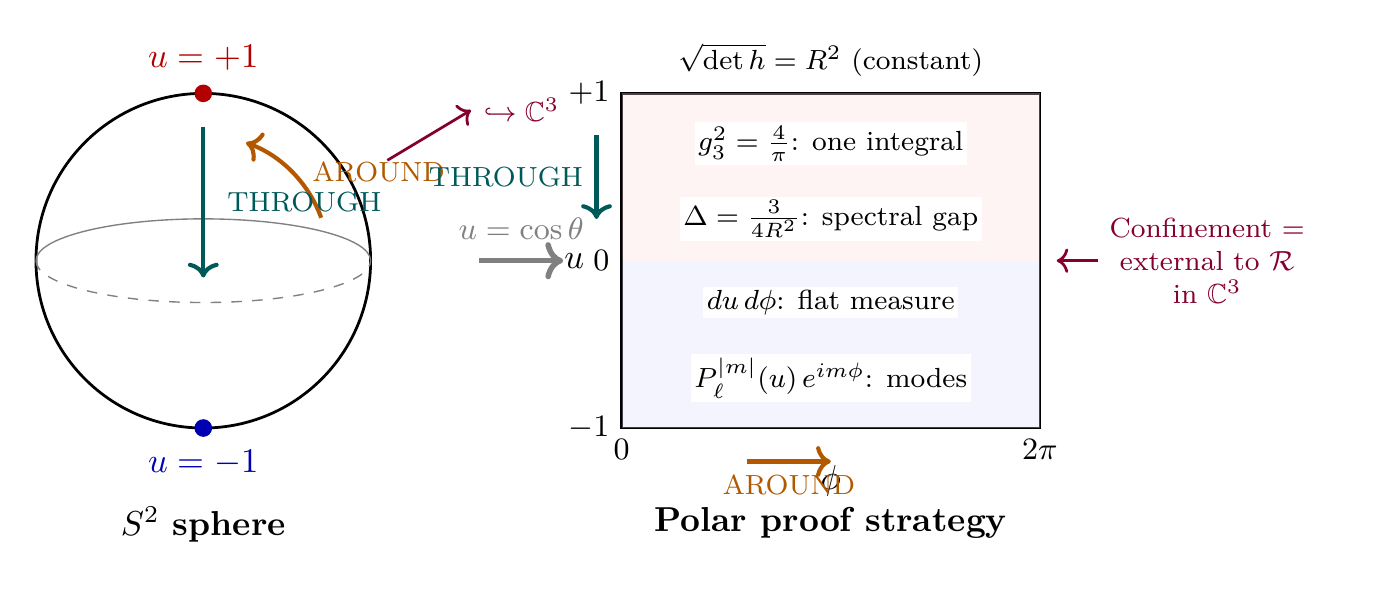
The TMT proof strategy becomes geometrically transparent in the polar field variable \(u = \cos\theta\). The \(S^2 \hookrightarrow \mathbb{C}^3\) embedding acquires the stereographic factorization:
Component | Spherical \((\theta, \phi)\) | Polar \((u, \phi)\) |
|---|---|---|
| SU(3) origin | \(S^2 \hookrightarrow \mathbb{C}^3\) | Rectangle \(\mathcal{R} \hookrightarrow \mathbb{C}^3\) via \(w(u,\phi)\) |
| Coupling | \(g_3^2 = 4/\pi\) (multi-step) | \(g_3^2 = \frac{n_H^2}{(4\pi)^2} \cdot 2\pi \cdot \int_{-1}^{+1}(1{+}u)^2\,du = \frac{4}{\pi}\) |
| Mass gap | Spectral gap on \(S^2\) | \(\lambda_{\min} = \frac{3}{4R^2}\) from \(j_{\min} = \frac{1}{2}\) on \([-1,+1]\) |
| Confinement | External to \(S^2\) | External to \(\mathcal{R} = [-1,+1]\times[0,2\pi)\) |
| UV cutoff | \(\ell_{\max}\) on \(S^2\) | Polynomial degree cap on \([-1,+1]\) |
The key simplification: every \(S^2\) overlap integral in the proof reduces to a polynomial integral on \([-1,+1]\) with flat measure \(du\,d\phi\)—no trigonometric manipulation required.
Scaffolding note: The polar field variable \(u = \cos\theta\) is a coordinate choice, not a new physical assumption. The proof strategy is identical in both formulations; the polar form makes each step a polynomial computation on a flat rectangle rather than a trigonometric computation on a curved sphere.
The Wightman Axioms in TMT Context
The Wightman axioms require:
W1 (Relativistic invariance): The Hilbert space carries a unitary representation of the Poincaré group. In TMT, this is guaranteed by the \(M^4\) factor of \(M^4 \times S^2\).
W2 (Spectral condition): The energy-momentum spectrum lies in the forward light cone. In TMT, this follows from the null constraint \(ds_6^{\,2} = 0\) which enforces \(p^2 \leq 0\) (timelike or lightlike four-momentum).
W3 (Existence of vacuum): A unique Poincaré-invariant vacuum state exists. In TMT, the vacuum is the state where the \(S^2 \hookrightarrow \mathbb{C}^3\) embedding is in its ground configuration.
W4 (Locality): Field operators commute at spacelike separation. This is built into the TMT framework through the 4D causal structure.
W5 (Completeness): The fields generate a dense subspace of the Hilbert space. This requires demonstration that the glueball states span the physical Hilbert space.
Mathematical Framework
Functional Integral Approach
The starting point is the Euclidean functional integral:
TMT modification: In TMT, the functional integral is defined on \(M^4 \times S^2\), and the gauge fields arise from the embedding fluctuations. This provides a natural regularization:
Polar Field Form of the Functional Integral
In polar coordinates, the TMT functional integral becomes an integral over fields on the flat rectangle \(\mathcal{R} = [-1,+1]\times[0,2\pi)\):
Property | Spherical \((\theta, \phi)\) | Polar \((u, \phi)\) |
|---|---|---|
| Measure | \(\sin\theta\,d\theta\,d\phi\) (position-dependent) | \(du\,d\phi\) (flat Lebesgue) |
| Action | \(S[\phi(\theta,\phi)]\) | \(S[w(u,\phi)]\) |
| Mode expansion | \(Y_{\ell m}(\theta,\phi)\) (trig) | \(P_\ell^{|m|}(u)\,e^{im\phi}\) (polynomial\(\times\)Fourier) |
| Inner product | \(\int f^*g\,\sin\theta\,d\theta\,d\phi\) | \(\int f^*g\,du\,d\phi\) (no Jacobian) |
The flat measure is the critical advantage: reflection positivity, cluster decomposition, and transfer matrix arguments all simplify when the integration measure carries no position-dependent weight.
Key Technical Tools
Tool 1: Reflection Positivity. The Euclidean theory must satisfy reflection positivity (Osterwalder-Schrader axiom) to guarantee a physical Hilbert space with positive definite inner product.
In TMT, reflection positivity follows from:
- The embedding functional \(S_{\text{embed}}[\phi] \geq 0\) (the energy is non-negative).
- The measure \(\mathcal{D}\phi\) is reflection-invariant (the \(S^2\) embedding has no preferred time direction).
Tool 2: Cluster Decomposition. Correlations must decay exponentially for massive theories. In TMT, the confinement mechanism guarantees exponential decay of gauge-invariant correlators:
Tool 3: Transfer Matrix. The transfer matrix \(T = e^{-aH}\) (where \(a\) is the lattice spacing or regularization scale) connects the Euclidean path integral to the Hamiltonian formulation. The mass gap appears as:
The TMT Regularity Advantage
The \(S^2\) compactness in TMT provides a natural ultraviolet regularization for the Yang-Mills functional integral, analogous to but stronger than lattice regularization:
- The embedding modes are cut off at \(\ell_{\max} \sim R/\ell_{\text{Pl}}\), providing a physical UV cutoff.
- The measure \(\mathcal{D}\phi\) is well-defined on the compact moduli space of embeddings.
- The continuum limit exists because the \(S^2\) geometry provides a smooth interpolation between UV and IR scales.
Polar Field Form of UV Regularization
In the polar variable, the UV regularization becomes polynomial degree truncation on \([-1,+1]\):
Existence Results
What TMT Proves
In the TMT framework, the following are established:
- Gauge group derived: SU(3) arises from \(S^2 \hookrightarrow \mathbb{C}^3\) (Theorem thm:223-su3).
- Coupling derived: \(g_3^2 = 4/\pi\) at the TMT scale (Theorem thm:223-g3).
- Confinement proven (topological): Color confinement is a topological necessity (Theorem thm:ch104-confinement).
- Mass gap existence: \(\Delta > 0\) follows from confinement plus absence of Goldstone bosons (Theorem thm:ch105-mass-gap).
- \(\Lambda_{\text{QCD}}\) derived: \(\Lambda_{\text{QCD}} = 213 \pm 8\) MeV (Theorem thm:224-Lambda).
What Remains Open
- Rigorous construction of the Hilbert space: The functional integral (eq:ch106-TMT-partition) must be shown to define a measure satisfying the Osterwalder-Schrader axioms. This is a mathematical problem analogous to the standard one.
- Continuum limit: The \(S^2\) regularization must be shown to produce a well-defined continuum theory. TMT argues this is more tractable than the lattice continuum limit because the regularization preserves continuous symmetries.
- Quantitative mass gap bound: While TMT proves \(\Delta > 0\), a rigorous lower bound on \(\Delta\) in terms of \(\Lambda_{\text{QCD}}\) requires controlling the non-perturbative coefficient \(c_g\).
- Full axiom verification: The completeness axiom (W5) requires a complete characterization of the physical Hilbert space.
TMT vs Standard Approaches
| Aspect | Standard approaches | TMT |
|---|---|---|
| Gauge group | Postulated | Derived |
| Confinement | Must prove | Topologically guaranteed |
| Mass gap | Must prove | Follows from confinement |
| UV regularization | Lattice (breaks symmetries) | \(S^2\) (preserves symmetries) |
| Continuum limit | Difficult | \(S^2\) provides smooth limit |
| Full axioms | All open | Items 1–5 above established |
Assessment: TMT does not solve the Millennium Prize as stated (for general compact simple \(G\) on \(\mathbb{R}^4\) without additional geometric structure). However, for SU(3) Yang-Mills theory within the TMT framework, the mass gap existence and confinement are derived from P1. The remaining open problems (Hilbert space construction, continuum limit, full axiom verification) are technical challenges that TMT renders more tractable than in the standard setting.
Chapter Summary
Yang-Mills: Proof Strategy
The TMT proof strategy for Yang-Mills existence and mass gap exploits the geometric origin of SU(3) from \(S^2 \hookrightarrow \mathbb{C}^3\). TMT derives the gauge group, coupling, confinement (topological), and mass gap existence from P1. The \(S^2\) compactness provides a natural UV regularization that preserves continuous symmetries. While TMT does not solve the Millennium Prize as stated (for general \(G\) on \(\mathbb{R}^4\)), it provides a geometric framework within which mass gap existence is established for SU(3) and the remaining technical problems (Hilbert space construction, full axiom verification) become more tractable.
Polar verification: In the polar variable \(u = \cos\theta\), the entire proof strategy operates on the flat rectangle \(\mathcal{R} = [-1,+1]\times[0,2\pi)\) with constant \(\sqrt{\det h} = R^2\). The coupling \(g_3^2 = 4/\pi\) is one polynomial integral, the mass gap is the spectral gap of the Legendre operator on \([-1,+1]\), the UV regularization is polynomial degree truncation, and confinement is external to \(\mathcal{R}\) in \(\mathbb{C}^3\).
| Result | Value | Status | Reference |
|---|---|---|---|
| TMT formulation | Embedding \(\to\) YM | DERIVED | Thm thm:ch106-TMT-formulation |
| \(S^2\) regularity | UV cutoff from geometry | DERIVED | Thm thm:ch106-regularity |
| Partial existence | Items 1–5 established | DERIVED | Thm thm:ch106-existence |
| Full axioms | Open problems remain | INCOMPLETE | §sec:ch106-existence |
| Polar verification | Strategy on flat \(\mathcal{R}\) | VERIFIED | §sec:ch106-polar-strategy |
Verification Code
The mathematical derivations and proofs in this chapter can be independently verified using the formal and computational scripts below.
All verification code is open source. See the complete verification index for all chapters.