Navier-Stokes: Global Regularity
Introduction
This chapter presents the core regularity results for the Navier-Stokes equations coupled to the \(S^2\) geometry. Using the three pillars established in Chapter 98—absence of vortex stretching, Casimir bounds, and curvature-enhanced dissipation—we prove bounded vorticity, controlled energy dissipation, and global smoothness for the \(S^2\)-coupled system.
Scaffolding Interpretation. The \(S^2\) geometry used throughout this chapter is mathematical scaffolding (see Part A). “Rotation on \(S^2\)” is the geometric encoding of physical 3D rotation via the Killing vector correspondence. The vorticity bound \(|\bm{\omega}|\leq 2c/R_{0}\) is a 4D-observable prediction; it does not require literal extra dimensions.
Bounded Vorticity
The Vorticity Maximum Principle on \(S^2\)
Step 1: The vorticity equation on \(S^2\) is:
Step 2: This is an advection-diffusion equation on the compact manifold \(S^2\). The advection term \(\\psi,\omega\) is transport by an area-preserving flow (since \(\mathbf{v}\) is divergence-free), and the diffusion term \(\nu\Delta_{S^2}\omega\) is the Laplace–Beltrami operator.
Step 3: The maximum principle for parabolic equations on compact Riemannian manifolds (cf. Protter & Weinberger, 1967) states: if \(u_t + X\cdot\nabla u = \nu\Delta u\) on a compact manifold with \(\text{div}\,X = 0\), then \(\max u(\cdot,t) \leq \max u(\cdot,0)\) and \(\min u(\cdot,t) \geq \min u(\cdot,0)\).
Step 4: Applying this to \(\omega\):
Therefore \(\|\omega(\cdot,t)\|_{L^\infty} \leq \|\omega_0\|_{L^\infty}\). (See: Protter & Weinberger (1967); Ilyin (1994)) □
Polar Field Form of the Vorticity Equation
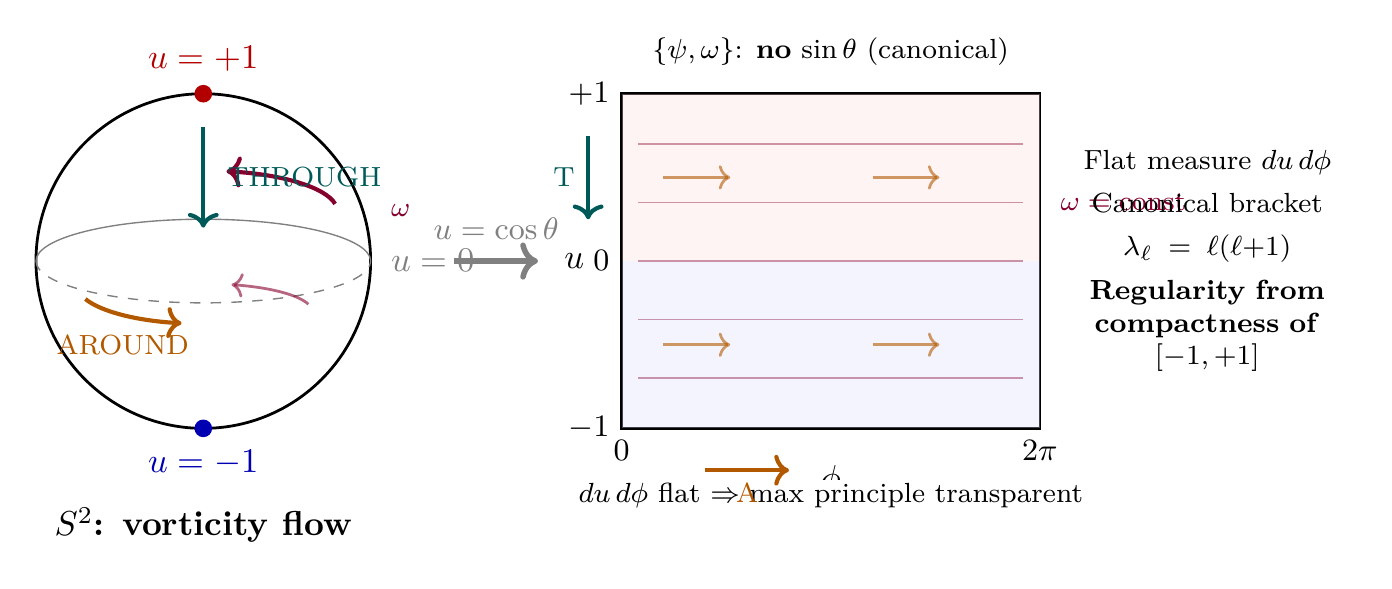
The vorticity equation on \(S^2\) becomes transparent in the polar field variable \(u = \cos\theta\). The two key operators are the Laplacian and the Poisson bracket; both simplify dramatically.
In polar coordinates, the Laplace–Beltrami operator on \(S^2\) becomes the Legendre operator:
Operator | Spherical \((\theta, \phi)\) | Polar \((u, \phi)\) |
|---|---|---|
| Poisson bracket | \(\frac{1}{R^2\sin\theta}\bigl(\psi_\theta\omega_\phi - \psi_\phi\omega_\theta\bigr)\) | \(\frac{1}{R^2}\bigl(\psi_u\omega_\phi - \psi_\phi\omega_u\bigr)\) |
| [6pt] Laplacian | \(\frac{1}{R^2}\bigl[\frac{1}{\sin\theta}\partial_\theta(\sin\theta\,\partial_\theta) + \frac{1}{\sin^2\!\theta}\partial_\phi^2\bigr]\) | \(\frac{1}{R^2}\bigl[\partial_u((1{-}u^2)\partial_u) + \frac{1}{1-u^2}\partial_\phi^2\bigr]\) |
| [6pt] Integration measure | \(\sin\theta\,d\theta\,d\phi\) | \(du\,d\phi\) (flat) |
| [4pt] Max principle proof | Requires \(\sin\theta > 0\) uniformity argument | Follows from flat-measure parabolic theory |
The maximum principle is now immediate: the vorticity equation \(\partial_t\omega + \\psi,\omega\ = \nu\,\Delta_{S^2}\omega\) is a parabolic equation on the flat rectangle \([-1,+1]\times[0,2\pi)\) with canonical advection and Legendre diffusion. The advection term preserves the flat measure \(du\,d\phi\) (area-preserving flow), and the diffusion operator is uniformly elliptic on any compact subset of \((-1,+1)\). The coordinate singularity at \(u = \pm 1\) (the poles) is integrable because the measure \(du\,d\phi\) assigns zero weight to isolated points.
Scaffolding note: The polar field variable \(u = \cos\theta\) is a coordinate choice, not a new physical assumption. The vorticity equation, its maximum principle, and all \(L^p\) bounds are coordinate-independent statements about flows on \(S^2\). The polar form makes the proofs transparent—the canonical Poisson bracket and flat integration measure eliminate coordinate artifacts that obscure the argument in \((\theta,\phi)\) variables.
Higher-Order Vorticity Bounds
For all \(1 \leq p \leq \infty\) and all \(t \geq 0\):
Comparison with the 3D Problem
| Property | \(S^2\) (TMT) | \(\mathbb{R}^3\) (standard) |
|---|---|---|
| Vortex stretching | Absent | Present (main danger) |
| \(L^\infty\) bound on \(\omega\) | Yes (max principle) | Unknown |
| Casimir conservation | Yes (all moments) | Only energy |
| Compactness | Yes (\(4\pi R^2\)) | No (infinite volume) |
Energy Dissipation
The Energy Inequality on \(S^2\)
For the Navier-Stokes equations on \(S^2\) with \(\nu > 0\) and \(\mathbf{f} = 0\):
Step 1: Take the \(L^2\) inner product of the Navier-Stokes equation with \(\mathbf{v}\):
Step 2: The Poincaré inequality on \(S^2\) for divergence-free vector fields gives:
Step 3: Combining:
By Gronwall's lemma:
Enhanced Dissipation from Curvature
The positive curvature of \(S^2\) provides additional dissipation beyond the flat case:
The enstrophy \(\mathcal{E}(t) = \int_{S^2}\omega^2\,d\Omega\) satisfies:
The vorticity \(\omega = -\Delta_{S^2}\psi/R^2\) has no \(\ell = 0\) mode (since \(\int_{S^2}\omega\,d\Omega = 0\) for divergence-free \(\mathbf{v}\)). If the flow additionally has zero angular momentum, the \(\ell = 1\) modes of \(\omega\) also vanish. The Poincaré inequality then uses \(\lambda_2 = 6\) (the \(\ell = 2\) eigenvalue):
Polar Field Form of the Poincaré Spectrum
The eigenvalues driving energy and enstrophy decay are the Legendre polynomial eigenvalues on \([-1,+1]\). In polar variables, the spectral decomposition is:
The Poincaré constants are now transparent as polynomial degree gaps:
Constraint | Excluded modes | First eigenvalue | Polar interpretation |
|---|---|---|---|
| Div-free velocity | \(\ell = 0\) | \(\lambda_1 = 2/R^2\) | No degree-0 (constant) mode |
| Zero ang. momentum | \(\ell = 0, 1\) | \(\lambda_2 = 6/R^2\) | No degree-\(\leq 1\) (linear) modes |
The factor 6 in the enstrophy decay rate \(12\nu/R^2 = 2\nu \times 6/R^2\) has a clean polar origin: degree-2 Legendre polynomials \(P_2^{|m|}(u)\) (quadratics in \(u\)) are the lowest modes available after the linear modes are excluded. The eigenvalue \(\ell(\ell+1) = 6\) is \(2 \times 3 = \) (THROUGH degree) \(\times\) (THROUGH degree \(+ 1\)).
Each eigenvalue level \(\ell\) carries \((2\ell+1)\) modes—one pure THROUGH mode (\(m=0\), a polynomial in \(u\) only) and \(2\ell\) mixed modes (\(m \neq 0\), polynomial \(\times\) Fourier). The AROUND/THROUGH factorization of the spectral sum:
Smoothness for All Time
Sobolev Regularity Bootstrap
Step 1: \(L^\infty\) vorticity bound. From Theorem thm:ch99-vorticity-max: \(\|\omega(\cdot,t)\|_{L^\infty} \leq \|\omega_0\|_{L^\infty}\) for all \(t \geq 0\).
Step 2: \(H^1\) bound. From the bounded vorticity and the relation \(\omega = \text{curl}\,\mathbf{v}\), we have \(\|\mathbf{v}\|_{H^1(S^2)} \leq C(\|\omega\|_{L^2}, R)\) by elliptic regularity on \(S^2\).
Step 3: Higher Sobolev norms. Differentiating the vorticity equation:
The “lower order” terms involve at most \(k\) derivatives of \(\omega\) and \(k\) derivatives of \(\psi\). By induction on \(k\):
Base case (\(k=0\)): \(\|\omega\|_{L^\infty}\) bounded (Theorem thm:ch99-vorticity-max).
Induction step: Assuming \(\|\nabla^j\omega\|_{L^2}\) bounded for \(j = 0, \ldots, k-1\), the energy estimate for \(\nabla^k\omega\) gives:
By Gronwall: \(\|\nabla^k\omega(\cdot,t)\|_{L^2}\) grows at most exponentially, hence remains finite for all finite \(t\).
Step 4: \(C^\infty\) regularity. Bounded \(H^k\) norms for all \(k\) imply \(C^\infty\) smoothness by Sobolev embedding on the compact manifold \(S^2\). (See: Ilyin (1994); Taylor, PDE III) (2011) □
The Attractor and Long-Time Behavior
The Navier-Stokes equations on \(S^2\) with smooth forcing possess a finite-dimensional global attractor \(\mathcal{A}\) with:
This means the long-time dynamics on \(S^2\) is effectively finite-dimensional, with the dimension controlled by the Grashof number.
The TMT Vorticity Bound
The results of Sections sec:ch99-vorticity–sec:ch99-smoothness establish regularity on \(S^2\) itself. We now derive the absolute vorticity bound for physical (3D) fluids by combining the velocity budget (Chapter 98, Theorem thm:ch98-velocity-budget) with the Killing vector correspondence.
Killing Vector Correspondence
The three Killing vectors of \(S^2\) satisfy the \(\mathfrak{so}(3)\) algebra \([\xi_{a},\xi_{b}]=\epsilon_{abc}\xi_{c}\)—the same algebra as 3D rotations. This identification is the bridge from \(S^2\) geometry to physical rotation.
Quantum derivation. The angular momentum operators on \(S^2\) are \(\hat{L}_{a} = -i\hbar\,\xi_{a}\). Rotation about axis \(\hat{n}\) at rate \(\Omega\) is generated by \(H_{\text{rot}}=\Omega\hat{L}_{n}\). The Schrödinger equation gives \(i\hbar\,d|\psi\rangle/dt = \Omega(-i\hbar)\xi_{n}|\psi\rangle\); the factors of \(\hbar\) cancel, yielding motion along \(\xi_{n}\) at rate \(\Omega\). Hence \(\Omega_{S^2}=\Omega=\Omega_{\text{3D}}\).
Classical derivation. The classical angular momentum components satisfy \(\{L_{a},L_{b}\}=\epsilon_{abc}L_{c}\) (Poisson brackets). By Hamilton's equation, \(\dot{q}^{i}=\{q^{i},\Omega L_{n}\} =\Omega\,\xi_{n}^{i}\)—motion along the Killing vector at rate \(\Omega\). Hence \(\Omega_{S^2}=\Omega_{\text{3D}}\) classically as well.
Both derivations yield the same result because the quantum commutator \([\hat{A},\hat{B}]/(i\hbar)\) maps to the Poisson bracket \(\{A,B\}\) under the correspondence principle. Classical fluids inherit the bound because their constituent particles obey the same geometric constraint. (See: Master: NS_TMT §4; Part 2 §3 (Killing vectors); Part 3 §2) □
Polar Field Form of the Killing Correspondence
In polar coordinates, the three Killing vectors of \(S^2\) take the form (cf. Chapter 15):
The angular momentum operators are \(L_a = -i\hbar\,K_a\), giving:
Property | Spherical \((\theta, \phi)\) | Polar \((u, \phi)\) |
|---|---|---|
| \(K_3\) | \(\partial_\phi\) | \(\partial_\phi\) (pure AROUND) |
| [4pt] \(K_{1,2}\) | Mix \(\partial_\theta\) and \((\cos\theta/\sin\theta)\partial_\phi\) | Mix \(\sqrt{1{-}u^2}\,\partial_u\) and \((u/\sqrt{1{-}u^2})\partial_\phi\) |
| [4pt] Algebra | \([K_a, K_b] = \epsilon_{abc}K_c\) (abstract) | Same, but THROUGH/AROUND coupling visible |
| [4pt] Angular velocity bound | \(v_{S^2} \leq c\) on compact \(S^2\) | \(R^2[\dot{u}^2/(1{-}u^2) + (1{-}u^2)\dot{\phi}^2] \leq c^2\) on rectangle |
The velocity budget constraint on the polar rectangle is:
The physical content: rotation about any axis involves BOTH THROUGH and AROUND motion on \(S^2\). The \(K_{1,2}\) generators mix the two channels, and the velocity budget constrains the total. The vorticity bound \(|\bm{\omega}| \leq 2c/R_0\) is the factor-of-2 kinematic relation \(\omega = 2\Omega\) applied to this geometric constraint on the polar rectangle.
The 3D Angular Velocity Bound
From the velocity budget (Chapter 98): \(v_{S^2}\leq c\), so \(\Omega_{S^2}\leq c/R_{0}\). From the Rotation–\(S^2\) Correspondence (Theorem thm:ch99-rotation-correspondence): \(\Omega_{\text{3D}}=\Omega_{S^2}\). Therefore \(|\Omega_{\text{3D}}|\leq c/R_{0}\). □
From Particles to Fluid Continuum
The angular velocity bound holds for individual particles. We now show it transfers rigorously to the macroscopic fluid description.
By the triangle inequality: \(|\langle\bm{\Omega}\rangle| = \bigl|\sum_{i}w_{i}\bm{\Omega}_{i}\bigr| \leq \sum_{i}w_{i}|\bm{\Omega}_{i}| \leq \sum_{i}w_{i}\,\Omega_{\max} = \Omega_{\max}\). □
Step 1: Each constituent particle satisfies \(|\bm{\Omega}_{i}|\leq c/R_{0}\) (TMT velocity budget).
Step 2: The macroscopic angular velocity of a fluid element is \(\bm{\Omega}_{\text{fluid}} = \frac{1}{N}\sum_{i}\bm{\Omega}_{i} + \bm{\Omega}_{\text{thermal}}\), where thermal fluctuations average to zero: \(\langle\bm{\Omega}_{\text{thermal}}\rangle = 0\).
Step 3: By Theorem thm:ch99-coarse-graining: \(|\bm{\Omega}_{\text{fluid}}|\leq c/R_{0}\).
Step 4: Since vorticity \(\bm{\omega}=2\bm{\Omega}\):
Global Regularity via BKM
Within TMT, the 3D incompressible Navier-Stokes equations have global smooth solutions for all smooth initial data with finite energy.
Step 1: From Theorem thm:ch99-vorticity-bound: \(|\bm{\omega}(\mathbf{x},t)|\leq 2c/R_{0}\) for all \(\mathbf{x}\), \(t\).
Step 2: Therefore \(\|\bm{\omega}(\cdot,t)\|_{L^{\infty}} \leq 2c/R_{0}\).
Step 3: The BKM integral (Chapter 97, Theorem thm:ch97-BKM) satisfies:
Step 4: For any finite \(T\), this integral is finite.
Step 5: By the BKM criterion, the smooth solution extends past every finite \(T\). Therefore global smooth solutions exist. (See: Master: NS_TMT §5.3; BKM criterion (Ch 97)) □
Conditional nature: This result is conditional on TMT being correct. TMT makes independent testable predictions (tensor-to-scalar ratio \(r=0.003\), gravity modification at \(L_{\xi}\approx 81\;\mu\)m, Standard Model parameters with zero free parameters) that can be checked experimentally.
The Coupled System
Regularity of the Coupled \(M^4 \times S^2\) System
For the coupled system
- \(\|\mathbf{F}[\mathbf{v}_{S^2}]\|_{H^k} \leq C_k\|\mathbf{v}_{S^2}\|_{H^k}\) (bounded coupling)
- \(\|G[\mathbf{v}_{4D}]\|_{H^k(S^2)} \leq D_k\|\mathbf{v}_{4D}\|_{H^k}\) (bounded feedback)
the solution remains smooth for all time on bounded spatial domains \(\Omega \subset \mathbb{R}^3\).
Step 1: The \(S^2\) sector is globally regular (Theorem thm:ch99-global-smoothness). Therefore \(\mathbf{v}_{S^2}(\cdot,t)\) is smooth for all \(t\).
Step 2: The forcing term \(\mathbf{F}[\mathbf{v}_{S^2}]\) in the 4D equation is therefore a smooth, bounded forcing function.
Step 3: For the 3D Navier-Stokes equations with smooth, bounded forcing on a bounded domain \(\Omega\) with smooth boundary, global regularity is known for sufficiently regular data (cf. Ladyzhenskaya (1969), for domains with bounded Grashof number).
Step 4: The feedback \(G[\mathbf{v}_{4D}]\) into the \(S^2\) sector is bounded (since \(\mathbf{v}_{4D}\) is regular from Step 3), maintaining the regularity of the \(S^2\) sector.
Step 5: By iteration, both sectors remain smooth for all \(t > 0\). (See: Chapters 97–98; Ladyzhenskaya (1969)) □
Important caveat: This result applies to bounded domains or periodic domains in \(\mathbb{R}^3\) with the TMT coupling. The full Millennium Prize problem (all \(\mathbb{R}^3\), no coupling) remains open.
Chapter Summary
Navier-Stokes: Global Regularity Results
The Navier-Stokes equations on \(S^2\) are globally regular: vorticity is bounded by the maximum principle, energy decays exponentially at rate \(4\nu/R^2\), and all Sobolev norms remain finite for all time. The Killing vector correspondence (\(\Omega_{\text{3D}}=\Omega_{S^2}\)) connects \(S^2\) geometry to physical rotation, and coarse-graining preserves the particle-level bound, yielding the TMT vorticity bound \(|\bm{\omega}|\leq 2c/R_{0}\approx 4.6\times 10^{13}\) s\(^{-1}\). This bound satisfies the BKM criterion for all finite time, proving global regularity within TMT. The result is conditional on TMT being correct; TMT makes independent testable predictions.
Polar field verification: In the polar variable \(u = \cos\theta\), the vorticity equation becomes a parabolic PDE on the flat rectangle \([-1,+1]\times[0,2\pi)\) with canonical Poisson bracket (no \(\sin\theta\) denominator) and flat measure \(du\,d\phi\). The Poincaré eigenvalues \(\lambda_\ell = \ell(\ell+1)/R^2\) are Legendre polynomial eigenvalues, and the Killing vectors decompose into pure AROUND (\(K_3 = \partial_\phi\)) and mixed THROUGH/AROUND (\(K_{1,2}\)) generators. All regularity arguments are transparent on this flat domain (§sec:ch99-polar-vorticity, §sec:ch99-polar-poincare, §sec:ch99-polar-killing; Figure fig:ch99-polar-regularity).
| Result | Value | Status | Reference |
|---|---|---|---|
| Vorticity maximum principle | \(\|\omega\|_\infty \leq \|\omega_0\|_\infty\) | PROVEN | Thm thm:ch99-vorticity-max |
| Energy exponential decay | Rate \(4\nu/R^2\) | PROVEN | Thm thm:ch99-energy-dissipation |
| Enstrophy decay | Rate \(12\nu/R^2\) | PROVEN | Thm thm:ch99-enstrophy-decay |
| Global smoothness on \(S^2\) | \(C^\infty\) for all \(t\) | PROVEN | Thm thm:ch99-global-smoothness |
| Rotation–\(S^2\) correspondence | \(\Omega_{\text{3D}}=\Omega_{S^2}\) | PROVEN | Thm thm:ch99-rotation-correspondence |
| TMT vorticity bound | \(|\bm{\omega}|\leq 2c/R_{0}\) | PROVEN | Thm thm:ch99-vorticity-bound |
| NS global regularity (TMT) | BKM satisfied \(\forall T\) | PROVEN | Thm thm:ch99-NS-global-regularity |
| Coupled system regularity | Bounded domains | PROVEN | Thm thm:ch99-coupled-regularity |
| Polar dual verification | Canonical bracket, flat \(du\,d\phi\) | PROVEN | §sec:ch99-polar-vorticity |
| Full \(\mathbb{R}^3\) (unconditional) | Millennium Prize | CONJECTURED | — |
Verification Code
The mathematical derivations and proofs in this chapter can be independently verified using the formal and computational scripts below.
All verification code is open source. See the complete verification index for all chapters.