Why S² is the Unique Compact Space
Requirements for \(K^2\)
The null constraint (P1: \(ds_6^{\,2} = 0\)) requires a projection structure relating 3D observation to 4D temporal momentum. This projection structure is mathematically described by \(M^{6} = \mathcal{M}^4 \times \mathcal{K}^2\), where \(\mathcal{K}^2\) represents the topology of the projection. In this chapter, we determine \(\mathcal{K}^2\) uniquely.
Important: \(\mathcal{K}^2\) is NOT a “compact 2-dimensional space” in the sense of literal hidden spatial dimensions. It is the projection structure—the mathematical encoding of how 4D physics appears when observed from within 3D.
In Chapter 3, we established that \(D = 6\) is the unique spacetime dimension compatible with P1 and the observed structure of physics. In Chapters 4–7, we derived the product structure \(M^{6} = \mathcal{M}^4 \times \mathcal{K}^2\) and its physical consequences. Throughout, we used \(\mathcal{K}^2 = S^2\) without yet proving that \(S^2\) is the only possibility.
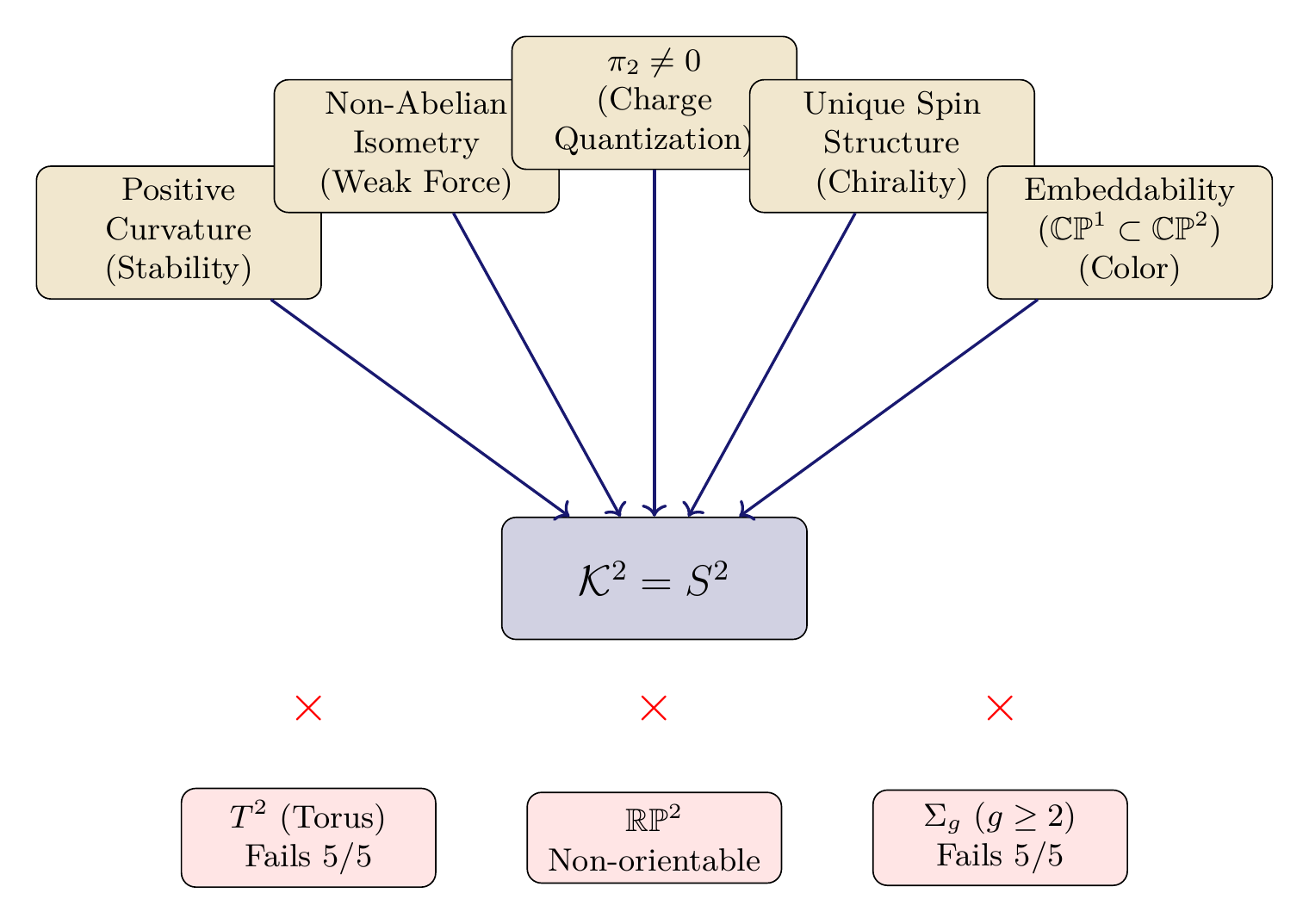
This chapter closes that gap. We identify five independent physical requirements that the projection structure \(\mathcal{K}^2\) must satisfy, and prove that \(S^2\) is the unique compact 2-manifold satisfying all five simultaneously.
The five requirements are:
- Positive Curvature — needed for modulus stabilization (stable vacuum)
- Non-Abelian Isometry — needed for SU(2) gauge symmetry (weak force)
- Non-Trivial \(\pi_2\) — needed for magnetic monopoles (charge quantization)
- Unique Spinor Structure — needed for chiral fermions
- Embeddability in \(\mathbb{R}^3\) — needed for SU(3) color via the chain \(S^2 \subset \mathbb{R}^3 \subset \mathbb{C}^3\)
Each requirement alone eliminates most candidates. Together, they select \(S^2\) uniquely.
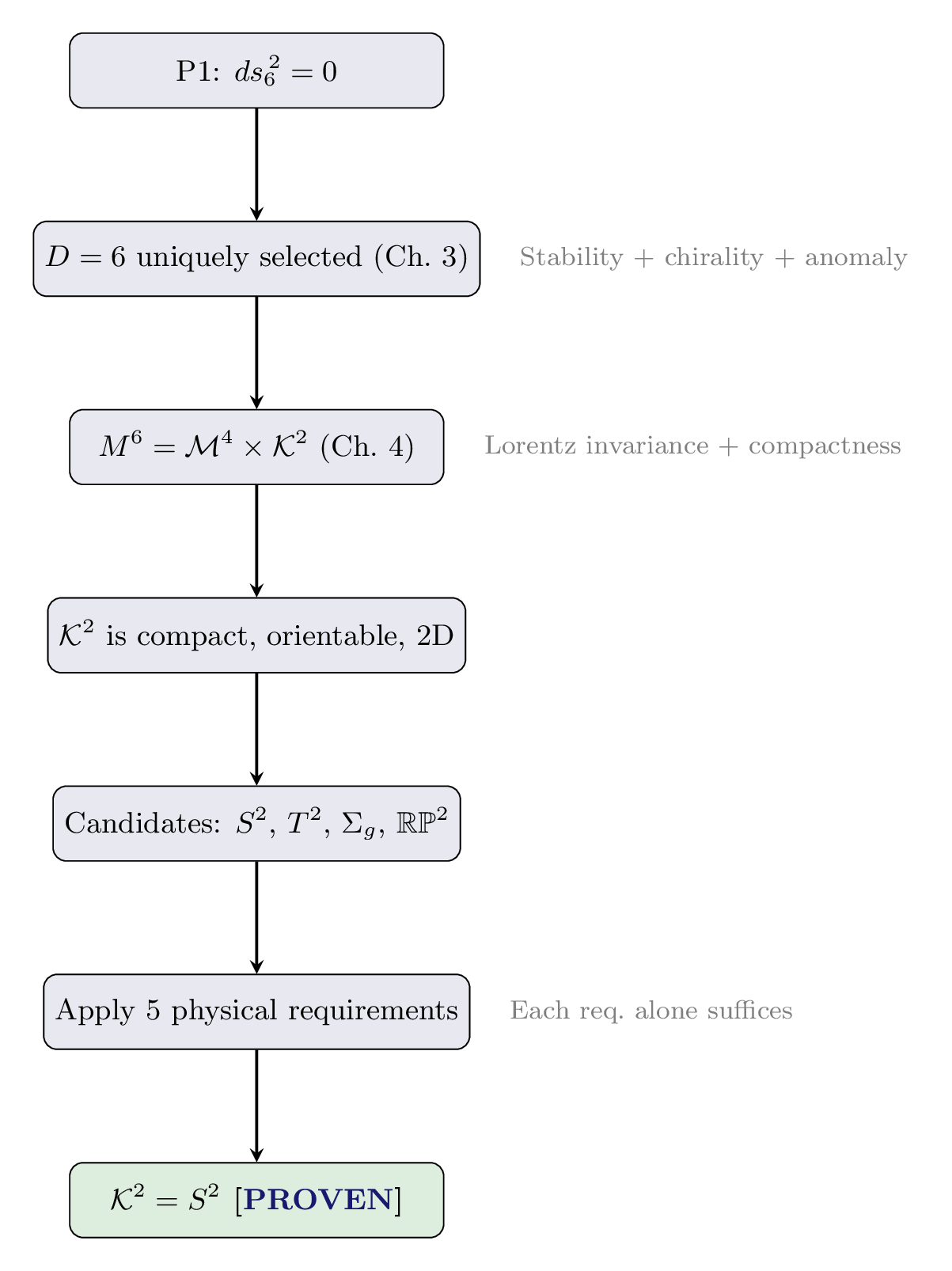
Derivation chain for this chapter:
\dstep{P1: \(ds_6^{\,2} = 0\)}{Postulate}{Ch. 2} \dstep{\(D = 6\) required}{Uniqueness of dimension}{Ch. 3} \dstep{Product structure \(\mathcal{M}^4 \times \mathcal{K}^2\)}{Stability + Lorentz invariance}{Ch. 4} \dstep{\(\mathcal{K}^2\) is compact, orientable, 2D}{From product structure + dimension count}{Ch. 4} \dstep{\(\mathcal{K}^2 = S^2\) (this chapter)}{Five constraints theorem}{Part 2 §4.6}
Positive Curvature (Stability)
“Stability of the compact space” means stability of the projection structure scale parameter \(R\). This is NOT about a physical 2D space being stable against collapse—\(R\) is the scale parameter of the interface between 3D observation and 4D temporal momentum, and it must have a stable value for the theory to have a unique vacuum.
The projection structure \(\mathcal{K}^2\) has a scale parameter \(R\) (the modulus). For the theory to have a unique vacuum state, the effective potential \(V(R)\) must have a stable minimum.
For the modulus \(R\) to be stabilized, the potential \(V(R)\) must satisfy:
- \(V(R) \to +\infty\) as \(R \to 0\) (prevents collapse)
- \(V(R) \to +\infty\) as \(R \to \infty\) (prevents decompactification)
- \(V'(R_{*}) = 0\) for some \(R_{*} > 0\) (existence of extremum)
- \(V''(R_{*}) > 0\) (stability of extremum)
In TMT, the matter Casimir energy does NOT contribute to the modulus potential (Part 1, §3.4: \(\langle\Lambda_{p_T}\rangle_{\text{vac}} = 0\) exactly). The modulus potential receives contributions only from classical geometry and gravitational self-interactions.
The one-loop graviton contribution on \(\mathcal{K}^2\) takes the form \(V_{\text{loop}} \propto c_0/R^4\), where \(c_0\) depends on the topology of \(\mathcal{K}^2\). Combined with the 6D cosmological constant contribution \(V_\Lambda = 4\pi\Lambda_6 R^2\), the complete potential is:
Stability requires \(c_0 > 0\). The sign of \(c_0\) depends on the curvature of \(\mathcal{K}^2\):
- Positive curvature (\(S^2\), \(\chi = +2\)): \(c_0 > 0\) — quantum pressure prevents collapse. The one-loop calculation gives \(c_0 = 1/(256\pi^3)\) (see Appendix 2B of Part 2 for complete derivation).
- Zero curvature (\(T^2\), \(\chi = 0\)): The Epstein zeta function has a flat direction — the shape modulus \(\tau = R_2/R_1\) remains unstabilized. Even if the overall volume is stabilized, the free modulus produces a massless scalar field in 4D, creating a long-range fifth force that contradicts experiment.
- Negative curvature (\(\Sigma_g\), \(g \geq 2\), \(\chi < 0\)): The moduli space has \(6g - 6 \geq 6\) real shape parameters. The Weil-Petersson metric on \(\mathcal{M}_g\) has negative sectional curvature (Wolpert 1986; Tromba 1986), creating potential gradients pointing outward. The moduli run away to the boundary — no stable minimum exists.
The Gauss-Bonnet theorem connects curvature to topology:
| Surface | Genus \(g\) | \(\boldsymbol{\chi}\) | Average Curvature | Stabilizable? |
|---|---|---|---|---|
| \(S^2\) | 0 | \(+2\) | Positive | ✓ Yes |
| \(T^2\) | 1 | \(0\) | Zero | ✗ No (flat direction) |
| \(\Sigma_g\) (\(g \geq 2\)) | \(\geq 2\) | \(\leq -2\) | Negative | ✗ No (runaway) |
Conclusion from stability: Only \(S^2\) (genus 0, positive curvature) can be stabilized.
(See: Part 2 §4.4, Appendix 2B)
Non-Abelian Isometry (Weak Force)
Gauge symmetry emerging from \(S^2\) isometries is one of the most elegant features of TMT. The projection structure \(S^2\) has SO(3) symmetry, and this mathematical symmetry of the interface generates the physical SU(2) gauge symmetry in 4D. The gauge fields are NOT “propagating in extra dimensions”—they are 4D fields whose gauge transformations are structured by the \(S^2\) projection geometry.
In Kaluza-Klein theory, gauge symmetry arises from isometries of the compact space (Bailin & Love 1987; Duff et al. 1986):
The Standard Model requires SU(2) gauge symmetry for the weak interaction, with \(\dim(\text{SU}(2)) = 3\). Therefore:
The continuous isometry groups of compact orientable 2-manifolds are:
| Surface | Isometry Group | \(\dim(\mathrm{Iso})\) |
|---|---|---|
| \(S^2\) | \(\mathrm{SO}(3)\) | \(3\) |
| \(T^2\) | \(\mathrm{U}(1)^2 \rtimes \mathbb{Z}_2^2\) | \(2\) |
| \(\Sigma_g\) (\(g \geq 2\)) | Finite | \(0\) |
where \(\dim(\mathrm{Iso})\) counts only the continuous (Lie algebra) dimension; discrete factors do not contribute.
If \(\mathcal{K}^2\) is a compact orientable 2-manifold and the theory requires SU(2) gauge symmetry, then \(\mathcal{K}^2 = S^2\).
Step 1: The Standard Model requires SU(2) gauge symmetry with \(\dim(\mathrm{SU}(2)) = 3\).
Step 2: Gauge symmetry from Kaluza-Klein reduction requires \(\dim(\mathrm{Iso}(\mathcal{K}^2)) \geq 3\).
Step 3: By Theorem thm:P2-Ch8-isometry-groups:
- \(S^2\): \(\dim(\mathrm{Iso}) = 3\) ✓ — sufficient for SU(2)
- \(T^2\): \(\dim(\mathrm{Iso}) = 2\) ✗ — only U(1)\(^2\) (abelian), cannot generate SU(2)
- \(\Sigma_g\): \(\dim(\mathrm{Iso}) = 0\) ✗ — no continuous gauge symmetry at all
Conclusion: Only \(S^2\) has sufficient isometry to generate SU(2). □
(See: Part 2 §4.5) □
Polar Field Perspective on the Isometry Requirement
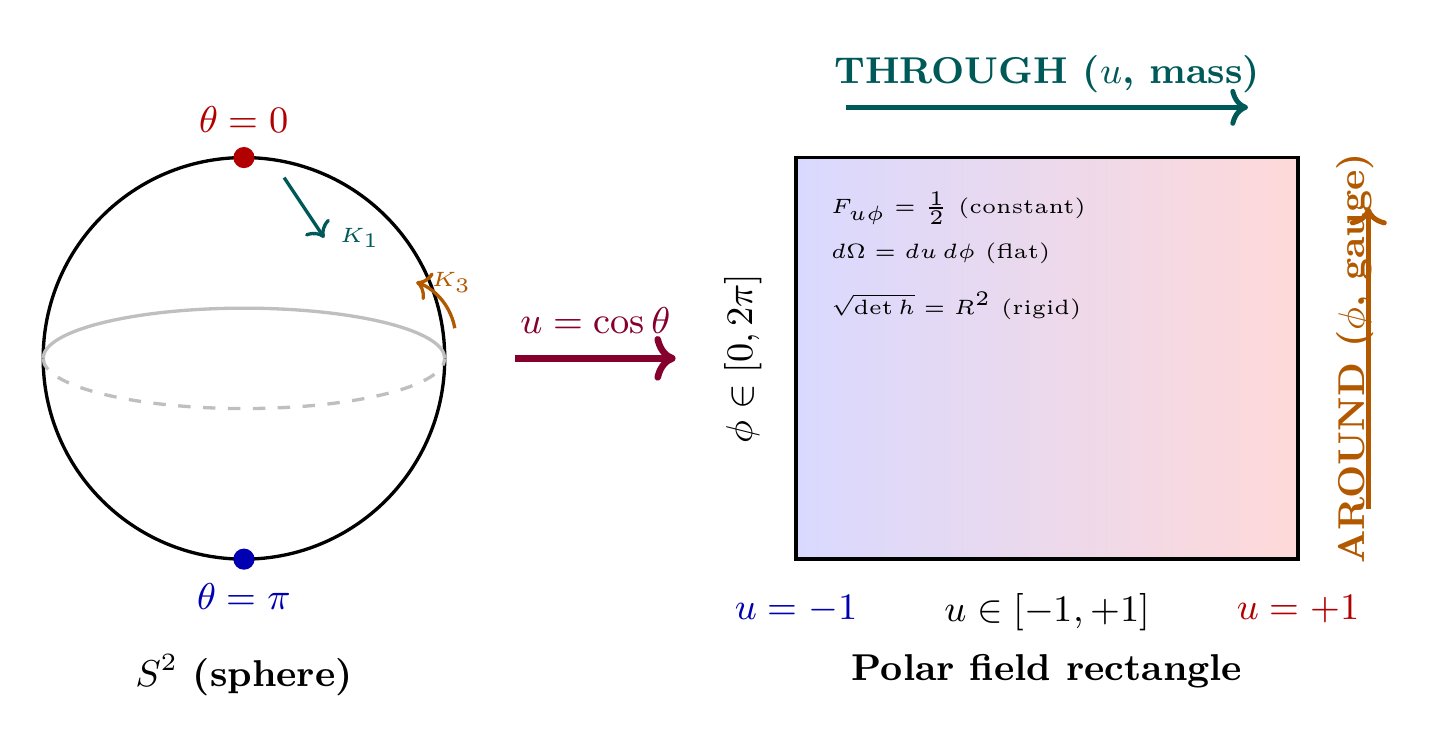
The non-abelian isometry requirement becomes geometrically transparent in the polar field variable \(u = \cos\theta\). In these coordinates, the three Killing vectors of \(S^2\) are:
Property | Spherical \((\theta, \phi)\) | Polar \((u, \phi)\) |
|---|---|---|
| \(K_3\) generator | \(\partial_\phi\) | \(\partial_\phi\) (pure AROUND) |
| \(K_1, K_2\) generators | Mix \(\partial_\theta\) and \(\partial_\phi\) | Mix \(\partial_u\) (THROUGH) and \(\partial_\phi\) (AROUND) |
| Non-abelian structure | \([K_1, K_2] = K_3\) (abstract) | Around-through mixing IS the non-commutativity |
| Physical interpretation | Rotation generators | Electroweak mixing = around-through mixing |
The key insight: \(K_3\) preserves the \(\phi\)-direction alone (it is the unbroken \(U(1)_{\mathrm{em}}\) generator), while \(K_1\) and \(K_2\) necessarily mix the through (\(u\)) and around (\(\phi\)) directions. This mixing is precisely what makes the algebra non-abelian. No other compact 2-manifold has three independent Killing vectors, and therefore no other manifold can produce this around-through mixing structure.
Scaffolding note: The polar field variable \(u = \cos\theta\) is a coordinate choice, not a new physical assumption. Writing the Killing vectors in \((u, \phi)\) form does not change the isometry group; it makes the around-through decomposition that underlies electroweak symmetry breaking geometrically visible. The same SO(3) algebra holds in any coordinate system.
Non-Trivial \(\pi_2\) (Charge Quantization)
Magnetic monopoles are required by TMT for Dirac quantization (giving Higgs charge \(q = 1/2\)), topologically non-trivial gauge bundles (giving the correct Higgs structure), and charge quantization throughout the Standard Model.
Monopoles on a compact space \(\mathcal{K}^2\) require non-trivial U(1) bundles, classified by \(H^2(\mathcal{K}^2; \mathbb{Z})\). For simply connected manifolds, the Hurewicz isomorphism gives \(H^2(\mathcal{K}^2; \mathbb{Z}) \cong \pi_2(\mathcal{K}^2)\). Thus monopoles require \(\pi_2(\mathcal{K}^2) \neq 0\).
For \(k = 2\) (relevant for monopoles):
| Space | \(\pi_2\) | Monopoles? | Charge Quantization? |
|---|---|---|---|
| \(S^2\) | \(\mathbb{Z}\) | ✓ Yes | ✓ Yes |
| \(T^2\) | \(0\) | ✗ No | ✗ No |
| \(\Sigma_g\) (\(g \geq 2\)) | \(0\) | ✗ No | ✗ No |
\(S^2\) is the unique compact orientable 2-manifold supporting magnetic monopoles.
Step 1: Magnetic monopoles on a compact space \(M\) require non-trivial U(1) bundles (Dirac, 1931).
Step 2: U(1) bundles over \(M\) are classified by \(H^2(M; \mathbb{Z})\) (first Chern class). For simply connected \(M\), the Hurewicz isomorphism gives \(H^2(M; \mathbb{Z}) \cong \pi_2(M)\).
Step 3: Among compact orientable 2-manifolds:
- \(S^2\): \(\pi_2(S^2) = \mathbb{Z}\) — non-trivial bundles exist, classified by integer monopole charge \(n\)
- \(T^2\): \(\pi_2(T^2) = 0\) — only trivial bundles, no monopoles
- \(\Sigma_g\) (\(g \geq 2\)): \(\pi_2(\Sigma_g) = 0\) — only trivial bundles, no monopoles
Step 4: Therefore monopoles exist only on \(S^2\) among all compact orientable 2-manifolds. □
(See: Part 2 §4.2.5) □
The monopole requirement is a physical input motivated by the observed Standard Model structure (charge quantization, Higgs mechanism). It is NOT derived from P1 alone. The derivation chain is:
P1 + [Observed: SM has charge quantization] \(\to\) monopoles required \(\to\) \(\pi_2 \neq 0\) \(\to\) \(\mathcal{K}^2 = S^2\)
TMT derives physics from P1 plus the three input parameters \((c, \hbar, G)\). The requirement for monopoles comes from matching to observed physics, not from pure geometry.
Why not higher-dimensional manifolds with \(\pi_2 \neq 0\)?
One might ask: What about \(\mathbb{CP}^2\), which also has \(\pi_2 = \mathbb{Z}\)? Or \(S^2 \times S^2\)? These fail for independent reasons:
- \(\mathbb{CP}^2\) has \(\dim = 4\), which gives the wrong gauge group and is over-constrained by the \(D = 6\) uniqueness (Ch. 3).
- \(S^2 \times S^2\) has dimension 4, exceeding the \(\dim(\mathcal{K}^2) = 2\) requirement.
- Higher-dimensional \(\text{CY}_3\) manifolds have complex structure with many moduli and no stabilization mechanism within TMT.
The minimality principle applies: \(S^2\) is the minimal manifold satisfying all requirements. Adding dimensions adds problems (more moduli, extra gauge bosons, harder stabilization).
Spinor Structure (Fermions)
The requirement for chiral fermions constrains the projection structure topology. This is a mathematical requirement on how 4D physics can manifest through the \(S^2\) interface, not about fermions “living in” extra dimensions.
The Standard Model has chiral fermions: left-handed particles form SU(2) doublets (participating in weak interactions), while right-handed particles are SU(2) singlets. This chirality is essential — without it, there is no electroweak theory.
A spin structure on a manifold \(M\) is a lift of the frame bundle from \(\mathrm{SO}(n)\) to \(\mathrm{Spin}(n)\), allowing spinor fields to be defined.
A spin structure exists if and only if the second Stiefel-Whitney class \(w_2(M) = 0\). All oriented 2-manifolds automatically satisfy \(w_2 = 0\), so all candidates admit spin structures.
The question is not whether a spin structure exists, but how many:
The number of distinct spin structures on a genus-\(g\) surface \(\Sigma_g\) is:
| Surface | Genus \(g\) | Spin Structures |
|---|---|---|
| \(S^2\) | 0 | \(2^0 = 1\) (unique!) |
| \(T^2\) | 1 | \(2^2 = 4\) |
| \(\Sigma_2\) | 2 | \(2^4 = 16\) |
| \(\Sigma_g\) | \(g\) | \(2^{2g}\) |
Key observation: \(S^2\) has a unique spin structure. All other compact orientable 2-manifolds have multiple spin structures.
Chiral fermions require a unique spin structure on \(\mathcal{K}^2\).
Step 1: Chirality is defined relative to a spin structure.
Step 2: If multiple spin structures exist, the theory must either:
- (a) Sum over all spin structures in the path integral \(\to\) averages away chirality, or
- (b) Choose one arbitrarily \(\to\) unnatural, no selection principle.
Step 3: The averaging effect in option (a) is rigorous. When multiple spin structures exist, the partition function sums over all of them:
Step 4: For definite, natural chirality, the spin structure must be unique: \(N_{\mathrm{spin}} = 1\).
Step 5: From Theorem thm:P2-Ch8-spin-count: \(N_{\mathrm{spin}} = 2^{2g} = 1\) requires \(g = 0\), which means \(\mathcal{K}^2 = S^2\). □
(See: Part 2 §4.3) □
Chiral fermions require \(\mathcal{K}^2 = S^2\).
Embeddability (Color)
The fifth requirement connects the projection structure to the SU(3) color gauge group through a chain of mathematical embeddings.
The statement “\(S^2\) embeds in \(\mathbb{R}^3\)” does NOT mean that there is a physical 2-sphere floating inside our 3D space. Rather, the projection structure \(S^2\) has mathematical properties that require at least 3 dimensions to describe without pathologies. The embedding is a mathematical relationship, not physical containment.
\(S^2\) cannot embed in \(\mathbb{R}^2\). It embeds in \(\mathbb{R}^3\) as \(\{x^2 + y^2 + z^2 = R^2\}\). Therefore \(\mathbb{R}^3\) is the minimal ambient Euclidean space for \(S^2\).
By the Jordan-Brouwer separation theorem (Brouwer 1912), \(S^2\) separates \(\mathbb{R}^3\) into “inside” and “outside” regions. This requires exactly 3 dimensions. In \(\mathbb{R}^2\), a sphere would self-intersect. The Whitney embedding theorem guarantees \(S^2\) embeds in \(\mathbb{R}^4\), but the standard embedding \(x^2 + y^2 + z^2 = R^2\) achieves it in \(\mathbb{R}^3\). □
(See: Part 2 §5.1) □
This embedding has a profound consequence. Quantum mechanics requires complex structure, so \(\mathbb{R}^3\) is complexified to \(\mathbb{C}^3\). This gives the embedding chain:
The chain continues through complex projective geometry: \(S^2 \cong \mathbb{CP}^1 \subset \mathbb{CP}^2\), and \(\mathrm{Iso}(\mathbb{CP}^2) = \mathrm{PSU}(3) \cong \mathrm{SU}(3)/\mathbb{Z}_3\). This is how the SU(3) color gauge group emerges (see Ch. 9 for the full derivation).
Embeddability comparison:
| Surface | Minimal Embedding | Leads to \(\mathbb{C}^3\)? | SU(3) Color? |
|---|---|---|---|
| \(S^2\) | \(\mathbb{R}^3\) | ✓ Yes | ✓ Yes |
| \(T^2\) | \(\mathbb{R}^3\) | Abelian only | ✗ No |
| \(\Sigma_g\) (\(g \geq 2\)) | \(\mathbb{R}^3\) | No \(\mathbb{CP}^1\) structure | ✗ No |
The key distinction is that \(S^2 \cong \mathbb{CP}^1\) has a complex projective structure that naturally includes into \(\mathbb{CP}^2\) with its PSU(3) isometry. Neither \(T^2\) nor higher-genus surfaces have this feature. While \(T^2\) also embeds in \(\mathbb{R}^3\), its isometry group \(\mathrm{U}(1)^2\) is abelian and cannot generate SU(3).
Candidate Spaces
Having established the five requirements, we now systematically examine each candidate compact 2-manifold.
Every compact connected orientable 2-manifold is diffeomorphic to exactly one of:
- \(\Sigma_0 = S^2\) (sphere), genus \(g = 0\), \(\chi = +2\)
- \(\Sigma_1 = T^2\) (torus), genus \(g = 1\), \(\chi = 0\)
- \(\Sigma_g\) (\(g\)-holed torus), genus \(g \geq 2\), \(\chi = 2 - 2g < 0\)
This is a theorem of differential topology, proven in the 19th century.
We also consider the non-orientable candidate \(\mathbb{RP}^2\) (real projective plane), which must be ruled out separately.
\(S^2\) (Sphere) — Satisfies All Five Requirements
The 2-sphere \(S^2\) satisfies all five physical requirements for \(\mathcal{K}^2\).
We verify each requirement explicitly.
Requirement 1 — Positive Curvature (Stability):
- \(S^2\) has constant positive Gaussian curvature \(K = 1/R^2\)
- Ricci scalar: \(R_{S^2} = 2/R^2 > 0\)
- Euler characteristic: \(\chi(S^2) = +2\)
- \(S^2\) has zero shape moduli — only the radius \(R\), which is a single parameter
- The one-loop graviton contribution gives \(V_{\text{loop}} = c_0/R^4\) with \(c_0 = 1/(256\pi^3) > 0\)
- Combined with \(V_\Lambda = 4\pi\Lambda_6 R^2\), the potential has a unique stable minimum at \(R_* = (c_0/(2\pi\Lambda_6))^{1/6}\) ✓
Requirement 2 — Non-Abelian Isometry:
- \(\mathrm{Iso}(S^2) = \mathrm{SO}(3)\) with \(\dim = 3\)
- SO(3) is non-abelian and locally isomorphic to SU(2)
- This generates the SU(2) gauge symmetry of the weak interaction ✓
Requirement 3 — Non-Trivial \(\pi_2\):
- \(\pi_2(S^2) = \mathbb{Z}\)
- Supports magnetic monopoles with integer charge \(n \in \mathbb{Z}\)
- Energy minimization selects \(|n| = 1\) (ground state) ✓
Requirement 4 — Unique Spinor Structure:
- \(N_{\mathrm{spin}}(S^2) = 2^{2 \times 0} = 1\)
- Unique spin structure \(\to\) definite chirality ✓
Requirement 5 — Embeddability:
- \(S^2 \subset \mathbb{R}^3\) (minimal embedding)
- \(S^2 \cong \mathbb{CP}^1 \subset \mathbb{CP}^2\)
- \(\mathrm{Iso}(\mathbb{CP}^2) = \mathrm{PSU}(3) \to\) SU(3) color ✓
All five requirements satisfied. □
(See: Part 2 §4.2–§4.6, §5.1) □
\(T^2\) (Torus) — Fails Multiple Requirements
The torus \(T^2\) fails all five requirements for \(\mathcal{K}^2\).
Requirement 1 — Stability: FAILS.
- \(T^2\) has flat curvature (\(K = 0\), \(\chi = 0\))
- \(T^2\) has two independent moduli: overall area \(A = 4\pi^2 R_1 R_2\) and shape \(\tau = R_2/R_1\)
- The one-loop potential involves the Epstein zeta function \(Z_1(s;\tau) = \sum_{(m,n) \neq (0,0)} |m + n\tau|^{-2s}\)
- This function has a flat direction: varying \(\tau\) at fixed volume costs no energy (at one loop)
- Even if overall volume is stabilized, the shape modulus \(\tau\) remains free
- A free modulus produces a massless scalar field in 4D — a long-range fifth force with no mass gap
- Fifth forces are constrained to \(< 10^{-3}\) of gravity at millimeter scales — violated by many orders of magnitude ✗
Requirement 2 — Non-Abelian Isometry: FAILS.
- \(\mathrm{Iso}(T^2) = \mathrm{U}(1)^2 \rtimes \mathbb{Z}_2^2\)
- \(\dim(\mathrm{Iso}) = 2 < 3\)
- U(1)\(^2\) is abelian — cannot generate SU(2) ✗
Requirement 3 — Non-Trivial \(\pi_2\): FAILS.
- \(\pi_2(T^2) = 0\)
- No monopoles, no charge quantization ✗
Requirement 4 — Unique Spinor Structure: FAILS.
- \(N_{\mathrm{spin}}(T^2) = 2^2 = 4\) spin structures
- Chirality averages away in path integral sum ✗
Requirement 5 — Embeddability:
- \(T^2\) embeds in \(\mathbb{R}^3\), but \(T^2 \ncong \mathbb{CP}^1\) — no complex projective structure
- Cannot generate SU(3) color through the \(\mathbb{CP}^2\) route ✗
\(T^2\) fails all five requirements. □
(See: Part 2 §4.4.4, §4.5) □
Counterfactual verification: The derivation method gives genuinely different numerical results for \(T^2\) versus \(S^2\). If \(T^2\) were the compact space, the loop coefficient would be \(c_0^{T^2} = 1/(256\pi^4) \approx 4.01 \times 10^{-5}\), compared to \(c_0^{S^2} = 1/(256\pi^3) \approx 1.26 \times 10^{-4}\). The ratio is \(c_0^{S^2}/c_0^{T^2} = \pi \approx 3.14\), reflecting the different area normalizations (\(4\pi\) for \(S^2\) vs. \(4\pi^2\) for \(T^2\)). This confirms the derivation is topology-dependent and non-circular (see Part 2, §4.4 for full comparison).
\(\mathbb{RP}^2\) (Projective Plane) — Fails Orientability
The real projective plane \(\mathbb{RP}^2\) is a compact 2-manifold, but it is non-orientable.
\(\mathbb{RP}^2\) cannot serve as \(\mathcal{K}^2\) because it is non-orientable.
Step 1: The 6D manifold \(M^6 = \mathcal{M}^4 \times \mathcal{K}^2\) must be orientable for the theory to be well-defined. Specifically:
- The 6D metric \(ds_6^{\,2}\) requires a global volume form
- Spinors on \(M^6\) require orientability
- Parity violation in the Standard Model requires orientation
Step 2: \(\mathcal{M}^4\) is orientable (it is Minkowski space or a Lorentzian manifold with time orientation).
Step 3: For \(\mathcal{M}^4 \times \mathcal{K}^2\) to be orientable, \(\mathcal{K}^2\) must be orientable (product of orientable manifolds is orientable; product with non-orientable is non-orientable).
Step 4: \(\mathbb{RP}^2\) is non-orientable (it contains a Möbius strip).
Step 5: Therefore \(\mathbb{RP}^2\) is excluded. □
(See: Part 2 §4.2.2) □
Additionally, \(\mathbb{RP}^2\) fails multiple other requirements:
- Spinor structure: \(w_2(\mathbb{RP}^2) \neq 0\), so no spin structure exists at all (not merely non-unique)
- Homotopy: \(\pi_2(\mathbb{RP}^2) = \mathbb{Z}\) (this one it passes), but \(\pi_1(\mathbb{RP}^2) = \mathbb{Z}_2\) (not simply connected)
- Isometry: \(\mathrm{Iso}(\mathbb{RP}^2) = \mathrm{SO}(3)\) (this one it passes, since \(\mathbb{RP}^2 = S^2/\mathbb{Z}_2\))
The orientability and spinor structure failures are each independently fatal.
Higher Genus \(\Sigma_g\) (\(g \geq 2\)) — Fails Multiple Requirements
Higher genus surfaces \(\Sigma_g\) (\(g \geq 2\)) fail all five requirements.
Requirement 1 — Stability: FAILS.
- \(\Sigma_g\) has \(6g - 6 \geq 6\) real shape moduli for \(g \geq 2\)
- The moduli space \(\mathcal{M}_g\) has the Weil-Petersson metric with negative sectional curvature (Wolpert 1986; Tromba 1986)
- Negative curvature creates potential gradients pointing outward
- The moduli “run away” to the boundary of \(\mathcal{M}_g\) — no stable minimum exists ✗
Requirement 2 — Non-Abelian Isometry: FAILS.
- \(\mathrm{Iso}(\Sigma_g) = \text{finite group}\) (discrete only) for \(g \geq 2\)
- \(\dim(\mathrm{Iso}) = 0\) — no continuous gauge symmetry at all ✗
Requirement 3 — Non-Trivial \(\pi_2\): FAILS.
- \(\pi_2(\Sigma_g) = 0\) for all \(g \geq 1\) (universal cover of \(\Sigma_g\) is the hyperbolic plane \(\mathbb{H}^2\) for \(g \geq 2\), which is contractible)
- No monopoles possible ✗
Requirement 4 — Unique Spinor Structure: FAILS.
- \(N_{\mathrm{spin}}(\Sigma_g) = 2^{2g} \geq 16\) for \(g \geq 2\)
- Far too many spin structures for definite chirality ✗
Requirement 5 — Embeddability:
- \(\Sigma_g\) (\(g \geq 2\)) embeds in \(\mathbb{R}^3\) (all compact orientable 2-manifolds do), but lacks \(\mathbb{CP}^1\) structure
- No \(\mathbb{CP}^1\) structure, no route to SU(3) color ✗
All five requirements fail. □
(See: Part 2 §4.4.8) □
The Five Constraints Theorem
We now state and prove the main result of this chapter: the theorem that five independent physical requirements, each well-motivated, uniquely select \(S^2\).
Let \(M^6 = \mathcal{M}^4 \times \mathcal{K}^2\) where \(ds_6^{\,2} = 0\) and \(\mathcal{K}^2\) is a compact 2-manifold. If the theory requires:
- Stable vacuum (no runaway moduli)
- SU(2) gauge symmetry (weak force)
- Magnetic monopoles (charge quantization)
- Chiral fermions (electroweak theory)
- SU(3) color via embedding chain
Then \(\mathcal{K}^2 = S^2\).
Step 1: \(\mathcal{K}^2\) must be a compact orientable 2-manifold (orientability required for well-defined spinors and parity violation). By the classification theorem (Theorem thm:P2-Ch8-classification), the candidates are:
Step 2: Non-orientable manifolds (\(\mathbb{RP}^2\), Klein bottle, etc.) are excluded by orientability (Theorem thm:P2-Ch8-rp2-failure).
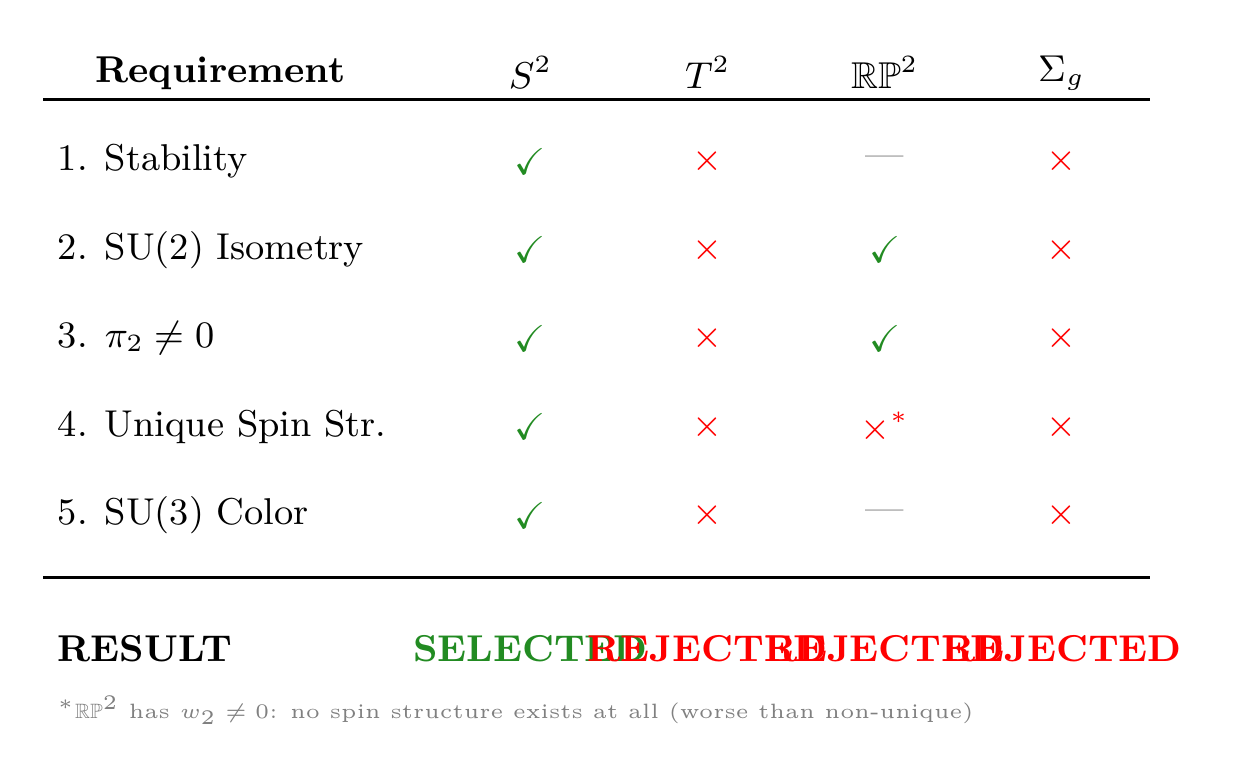
Step 3: Among orientable candidates, apply the five requirements:
| Surface | Stability | SU(2) | \(\pi_2 \neq 0\) | Chirality | SU(3) |
|---|---|---|---|---|---|
| \(S^2\) | ✓ | ✓ | ✓ | ✓ | ✓ |
| \(T^2\) | ✗ | ✗ | ✗ | ✗ | ✗ |
| \(\Sigma_g\) (\(g \geq 2\)) | ✗ | ✗ | ✗ | ✗ | ✗ |
| \(\mathbb{RP}^2\) | — | ✓ | ✓ | ✗\(^*\) | — |
Step 4: Only \(S^2\) satisfies all five requirements.
Step 5: The stabilization mechanism works for \(S^2\): the graviton loop gives \(V_{\text{loop}} = c_0/R^4\) with \(c_0 = 1/(256\pi^3) > 0\) (Appendix 2B), preventing collapse. Combined with \(V_\Lambda = 4\pi\Lambda_6 R^2\), this produces a unique stable minimum.
Conclusion: \(\mathcal{K}^2 = S^2\). □
(See: Part 2 §4.2–§4.6) □
Remarkable feature: Each of the five requirements independently eliminates all candidates except \(S^2\). The requirements are redundant — any single one suffices. This over-determination is a strong consistency check on the theory.
The following are equivalent for a compact orientable 2-manifold \(\mathcal{K}^2\):
- \(\mathcal{K}^2 = S^2\)
- \(\mathcal{K}^2\) is simply connected (\(\pi_1 = 0\))
- \(\mathcal{K}^2\) has unique spin structure (\(N_{\mathrm{spin}} = 1\))
- \(\mathcal{K}^2\) has no shape moduli (\(\dim_{\mathbb{R}}(\mathrm{moduli}) = 0\))
- \(\mathcal{K}^2\) has maximal isometry for 2D (\(\dim(\mathrm{Iso}) = 3\))
(1) \(\Leftrightarrow\) (2): \(S^2\) is the only simply connected compact orientable 2-manifold:
- \(\pi_1(S^2) = 0\)
- \(\pi_1(T^2) = \mathbb{Z}^2 \neq 0\)
- \(\pi_1(\Sigma_g)\) is a non-trivial group for \(g \geq 2\)
(2) \(\Leftrightarrow\) (3): Simply connected \(\Leftrightarrow\) \(\pi_1 = 0\) \(\Leftrightarrow\) \(H^1(\mathcal{K}^2; \mathbb{Z}_2) = 0\) \(\Leftrightarrow\) \(N_{\mathrm{spin}} = 2^{2g} = 1\) \(\Leftrightarrow\) \(g = 0\).
(1) \(\Leftrightarrow\) (4): Only \(S^2\) has trivial moduli space:
- \(S^2\): 0 shape moduli (sphere is rigid up to size)
- \(T^2\): 2 real moduli (complex structure \(\tau\))
- \(\Sigma_g\): \(6g - 6\) real moduli for \(g \geq 2\)
(1) \(\Leftrightarrow\) (5): Only \(S^2\) has 3D isometry group:
- \(S^2\): \(\mathrm{Iso} = \mathrm{SO}(3)\), \(\dim = 3\)
- \(T^2\): \(\mathrm{Iso} = \mathrm{U}(1)^2 \rtimes \mathbb{Z}_2^2\), \(\dim = 2\)
- \(\Sigma_g\): \(\mathrm{Iso} = \text{finite}\), \(\dim = 0\)
All five characterizations are equivalent. □
(See: Part 2 §4.6) □
This equivalence is not coincidence — it reflects the deep mathematical unity of \(S^2\) as the unique compact 2-manifold with maximal symmetry.
Five Characterizations in the Polar Field Variable
The polar field variable \(u = \cos\theta\) makes each of the five equivalent characterizations of \(S^2\) transparent:
Characterization | Spherical \((\theta, \phi)\) | Polar \((u, \phi)\) |
|---|---|---|
| Simply connected | \(\pi_1 = 0\) (abstract) | No winding in \(u\): path from \(-1\) to \(+1\) contracts |
| Maximal isometry | 3 Killing vectors (§sec:ch8-polar-isometry) | \(K_3 = \partial_\phi\) plus two AROUND–THROUGH mixers |
| No shape moduli | Metric has only scale \(R\) | \(\sqrt{\det h} = R^2\) (constant) — shape is rigid |
| Unique spin | \(N_{\mathrm{spin}} = 2^{2g} = 1\) | \(Y_\pm \propto (1 \pm u)^{1/2}\): well-defined on all of \([-1,+1]\) |
| \(\pi_2 \neq 0\) | Non-contractible 2-cycle | \(\int_{-1}^{+1} du \int_0^{2\pi} d\phi \, F_{u\phi} = 2\pi \neq 0\) |
The final row is especially striking: the monopole flux integral becomes \(\int F_{u\phi}\,du\,d\phi = \int \frac{1}{2}\,du\,d\phi = 2\pi\), where \(F_{u\phi} = 1/2\) is constant. The non-trivial \(\pi_2\) that guarantees charge quantization reduces to a constant integrand over a rectangle — the topological content is carried entirely by the boundary conditions, not by any \(\theta\)-dependent structure.
\(S^2\) is Uniquely Selected
What “Physical Consistency” Means. The five requirements used in the proof are not additional postulates — they are observational consistency conditions:
- Chirality: The observed universe HAS chiral fermions. Any theory of our universe must accommodate them.
- Stability: A theory with unstable vacuum predicts we don't exist. Since we exist, the vacuum must be stable.
- Gauge symmetry: The Standard Model HAS SU(2) gauge symmetry. Any unified theory must produce it.
- Charge quantization: Electric charge IS quantized. The theory must explain why.
- Color: QCD IS an SU(3) gauge theory. The compact space must yield it.
These are requirements that any viable theory must satisfy, not arbitrary choices. The remarkable fact is that P1 (\(ds_6^{\,2} = 0\)) combined with these observational requirements uniquely determines the projection structure topology.
\(S^2\) is derived, not assumed.
| \(S^2\) Property | Value | Physical Consequence | Requirement |
|---|---|---|---|
| Genus | \(g = 0\) | Unique spin structure, chirality | Req. 4 |
| Euler characteristic | \(\chi = +2\) | Positive curvature, stabilization | Req. 1 |
| \(\pi_2\) | \(\mathbb{Z}\) | Monopoles, charge quantization | Req. 3 |
| \(\dim(\mathrm{Iso})\) | \(3\) | SO(3) \(\to\) SU(2) gauge symmetry | Req. 2 |
| Embedding | \(S^2 \subset \mathbb{R}^3\) | \(\mathbb{CP}^1 \subset \mathbb{CP}^2 \to\) SU(3) | Req. 5 |
| Shape moduli | \(0\) | Single parameter \(R\), stabilizable | Req. 1 |
| \(c_0\) | \(1/(256\pi^3)\) | Positive quantum pressure | Req. 1 |
Chapter Summary
Main Result: \(\mathcal{K}^2 = S^2\) — the projection structure is uniquely the 2-sphere.
Method: Five independent physical consistency conditions, each alone sufficient to select \(S^2\):
- Positive curvature (stability) \(\to\) \(S^2\)
- Non-abelian isometry (SU(2) gauge) \(\to\) \(S^2\)
- Non-trivial \(\pi_2\) (charge quantization) \(\to\) \(S^2\)
- Unique spin structure (chirality) \(\to\) \(S^2\)
- Embeddability (SU(3) color) \(\to\) \(S^2\)
Polar verification: In the polar field variable \(u = \cos\theta\), all five characterizations become transparent: the isometry requirement separates into AROUND (\(\partial_\phi\)) and THROUGH (\(\partial_u\)) components, the monopole flux becomes \(\int F_{u\phi}\,du\,d\phi\) with constant \(F_{u\phi} = 1/2\), and the rigid metric determinant \(\sqrt{\det h} = R^2\) reflects the absence of shape moduli.
Status: All theorems [PROVEN]{} or [Status: ESTABLISHED].
Derivation chain:
\dstep{P1: \(ds_6^{\,2} = 0\)}{Postulate}{Ch. 2} \dstep{\(D = 6\)}{Dimension uniqueness}{Ch. 3} \dstep{\(\mathcal{M}^4 \times \mathcal{K}^2\)}{Product structure}{Ch. 4} \dstep{\(\mathcal{K}^2 = S^2\)}{Five constraints theorem}{This chapter} \dstep{Polar verification: five characterizations transparent in \((u,\phi)\)}{Coordinate change \(u = \cos\theta\)}{§sec:ch8-polar-five-char}
What comes next: Chapter 9 develops the detailed geometry of \(S^2\) — its metric, curvature, isometries, homotopy, and the embedding chain \(S^2 \subset \mathbb{R}^3 \subset \mathbb{C}^3\) that gives rise to the full gauge group \(\mathrm{SU}(3) \times \mathrm{SU}(2) \times \mathrm{U}(1)\).
Verification Code
The mathematical derivations and proofs in this chapter can be independently verified using the formal and computational scripts below.
All verification code is open source. See the complete verification index for all chapters.