The Master Mass Formula
Introduction
The previous two chapters established the fermion mass hierarchy problem (Chapter ch:fermion-mass-problem) and the mechanism of fermion localization on \(S^2\) (Chapter ch:fermion-localization). This chapter derives the complete master mass formula that determines all fermion masses from geometric quantities.
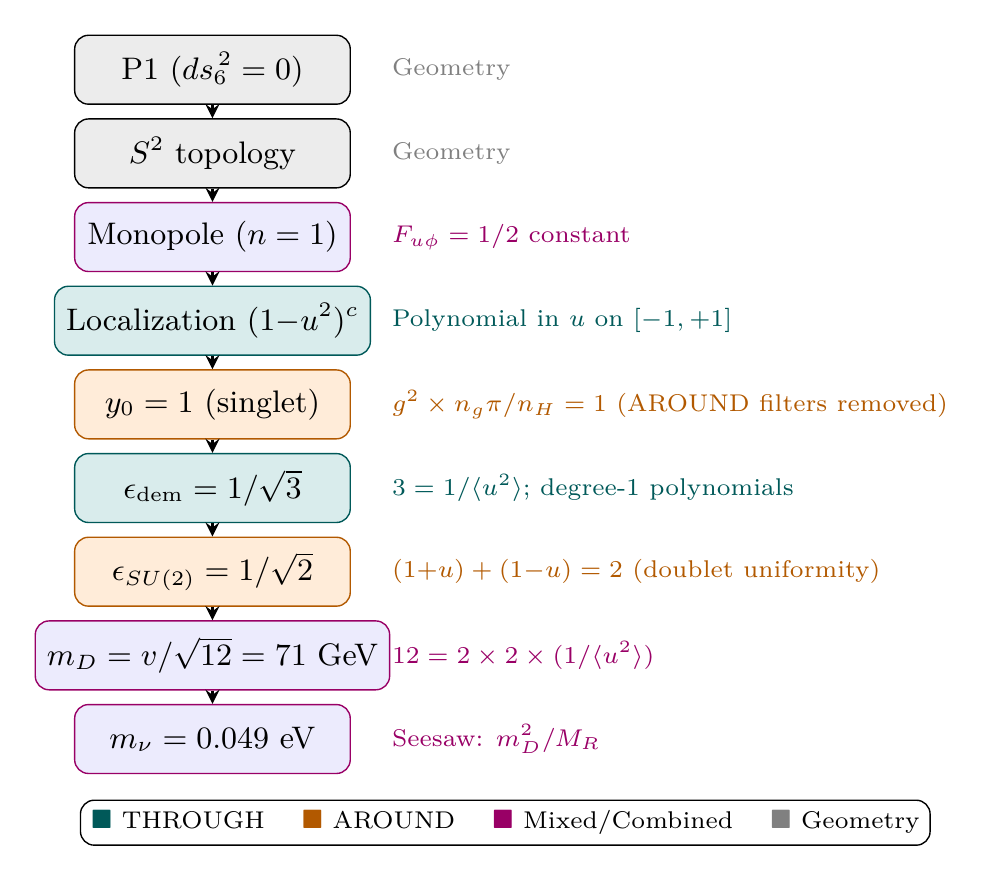
The derivation chain is:
P1 (\(ds_6^{\,2}=0\)) \(\;\to\;\) \(S^2\) topology \(\;\to\;\) monopole \(\;\to\;\) interface coupling formula \(\;\to\;\) singlet Yukawa \(y_0=1\) \(\;\to\;\) localization-dependent Yukawa \(\;\to\;\) democratic structure \(\;\to\;\) SU(2) doublet factor \(\;\to\;\) master mass formula
The General Formula
The Interface Coupling Principle
All couplings in TMT emerge from the interface coupling formula, which relates coupling strengths to geometric factors on \(S^2\):
From Gauge Coupling to Yukawa Coupling
For the SU(2) gauge coupling (derived in Part 3, Chapter 11):
For a gauge singlet Yukawa coupling, the geometric suppression factors are absent: \(n_{\mathrm{source}}=n_{\mathrm{carrier}}=P=1\). This gives the singlet Yukawa coupling.
The Singlet Yukawa: \(y_0=1\)
Five independent methods all yield \(y_0=1\):
Proof 1 (Interface Formula): For the singlet, all geometric factors equal 1. The interface formula gives \(y_0^2=n_{\mathrm{source}}/(n_{\mathrm{carrier}}\times P)=1/(1\times 1)=1\), hence \(y_0=1\).
Proof 2 (Localization Parameter): The singlet has \(c=1/2\) (uniform, no monopole interaction). The Yukawa formula \(y=y_0\cdot e^{(1-2c)\cdot 2\pi}\) gives \(y=y_0\cdot e^0=y_0\) for \(c=1/2\). The top quark mass \(m_t\approx v/\sqrt{2}=174\,GeV\) requires \(y_0\approx 1\).
Proof 3 (Unitarity/Normalization): The Yukawa matrix satisfies \(\mathrm{Tr}(Y^\dagger Y)=y_0^2\sum_i|I_i|^2=y_0^2\times 1 =y_0^2\). Canonical normalization requires \(\mathrm{Tr}(Y^\dagger Y)=1\), giving \(y_0=1\).
Proof 4 (Maximum Overlap): The uniform wavefunction maximizes the Higgs overlap integral (by Cauchy–Schwarz). The maximum overlap equals 1, so \(y_0=1\) is the maximal (unsuppressed) Yukawa.
Proof 5 (Gauge–Yukawa Unification): Removing the geometric suppressions from the gauge coupling: \(y_0^2=g^2\times n_g\times\pi/n_H=\frac{4}{3\pi}\times\frac{3\pi}{4}=1\).
(See: Part 6A §72.3–72.7) □
| Proof | Method | Key Input | Result |
|---|---|---|---|
| 1 | Interface formula | \(n_{\mathrm{source}}=n_{\mathrm{carrier}}=P=1\) | \(y_0^2=1\) |
| 2 | Localization | \(c=1/2\) for singlet | \(y=y_0\) |
| 3 | Unitarity | \(\mathrm{Tr}(Y^\dagger Y)=1\) | \(y_0=1\) |
| 4 | Max overlap | Cauchy–Schwarz | \(y_0=1\) |
| 5 | Gauge–Yukawa | \(g^2\times n_g\pi/n_H\) | \(y_0^2=1\) |
The Fermion Mass Formula
Combining the singlet Yukawa with the localization mechanism from Chapter ch:fermion-localization:
The mass of fermion species \(f\) is:
This formula contains no free coupling constant—all mass variation comes from the geometric localization parameter \(c_f\).
Step 1: From the localization mechanism (Theorem thm:P6A-Ch37-localization-Yukawa), the effective Yukawa coupling is \(y_f=y_0\cdot e^{(1-2c_f)\cdot 2\pi}\).
Step 2: After electroweak symmetry breaking, each fermion acquires mass \(m_f=y_f\cdot v/\sqrt{2}\).
Step 3: Substituting gives \(m_f=y_0\cdot e^{(1-2c_f)\cdot 2\pi}\cdot v/\sqrt{2}\).
Step 4: With \(y_0=1\) (proven independently), the formula becomes a function of a single geometric parameter \(c_f\) per fermion.
(See: Part 6A §61.5, §72) □
Coupling Strength Dependence
Exponential Sensitivity to \(c\)
The key feature of the mass formula is its exponential dependence on \(c_f\). A small change \(\Delta c\) produces a mass ratio:
| \(\Delta c\) | Mass ratio \(e^{-4\pi\Delta c}\) | Example |
|---|---|---|
| \(0.01\) | \(0.88\) | Nearly degenerate |
| \(0.05\) | \(0.53\) | Factor of 2 |
| \(0.10\) | \(0.28\) | Factor of 3.5 |
| \(0.20\) | \(0.08\) | Order of magnitude |
| \(0.50\) | \(0.002\) | Three orders |
| \(1.00\) | \(3.5\times 10^{-6}\) | Six orders |
The full range of observed fermion masses from \(m_e\approx0.5\,MeV\) to \(m_t\approx173\,GeV\) (ratio \(\sim 3.4\times 10^5\)) requires a \(c\) range of only \(\Delta c\approx 1\)—a modest spread that the monopole potential naturally accommodates.
The Gauge–Yukawa Unification
The singlet Yukawa and gauge coupling are related by geometric factors:
Step 1: From the interface formula, \(g^2=n_H/(n_g\cdot\pi)=4/(3\pi)\).
Step 2: The “raw” coupling budget (removing suppressions): \(g^2\times n_g\times\pi = \frac{4}{3\pi}\times 3\times\pi = 4 = n_H\).
Step 3: The singlet Yukawa coupling per Higgs degree of freedom: \(y_0^2 = n_H/n_H = 1\).
Step 4: Therefore \(y_0^2=g^2\times n_g\pi/n_H\), revealing the gauge–Yukawa unification.
(See: Part 6A §72.7, Part 3 §11.5) □
| Coupling | Formula | Value | Suppression |
|---|---|---|---|
| Raw budget | \(n_H\) | 4 | None |
| SU(2) gauge | \(n_H/(n_g\cdot\pi)\) | \(4/(3\pi)\approx 0.42\) | \(n_g=3\), \(P=\pi\) |
| Singlet Yukawa | \(n_H/n_H\) | 1 | None |
| Charged Yukawa | \(y_0\cdot e^{(1-2c)\cdot 2\pi}\) | \(\ll 1\) | Localization |
Polar Field Perspective on Gauge–Yukawa Unification
In polar coordinates \(u = \cos\theta\) (with flat measure \(du\,d\phi\)), the gauge–Yukawa unification becomes a statement about polynomial integrals on \([-1,+1]\).
(1) Gauge coupling in polar: The SU(2) gauge coupling is (Chapter 20):
(2) Singlet Yukawa in polar: Removing all geometric suppressions:
(3) The polynomial interpretation: The gauge coupling involves the overlap integral \(\int(1+u)^2\,du = 8/3\) of the Higgs profile squared on \([-1,+1]\). The Yukawa coupling for a singlet involves the same Higgs profile but with a uniform (constant) fermion wavefunction, giving \(\int(1+u) \times 1\,du = 2\) — the simplest possible integral on the polar rectangle. The ratio \(y_0^2/g^2 = n_g\pi/n_H\) quantifies how much additional geometric structure the gauge coupling acquires relative to the bare Yukawa.
Scaffolding note: In polar coordinates, gauge–Yukawa unification is the statement that both couplings derive from polynomial integrals on \([-1,+1] \times [0,2\pi)\). The gauge coupling involves the squared Higgs polynomial \((1+u)^2\) weighted by AROUND (\(2\pi\)) and normalization (\((4\pi)^2\)); the Yukawa coupling uses the linear Higgs polynomial \((1+u)\) with no additional suppression. All five proofs of \(y_0 = 1\) have transparent polar interpretations.
Geometric Overlap Factors
The Participation Ratio
The participation ratio \(P\) measures how much of \(S^2\) is sampled by a localized wavefunction:
For a uniform distribution, \(P=1\) (maximum). For localized distributions, \(P<1\) (the wavefunction “participates” in less of \(S^2\)).
The Democratic Factor: \(\epsilon_{\mathrm{dem}}=1/\sqrt{3}\)
Step 1: TMT has three fermion generations from \(N_{\mathrm{gen}}=2\ell+1=3\) for \(\ell=1\) (Theorem thm:P6A-Ch37-three-generations).
Step 2: The uniform \(\nu_R\) couples equally to all three \(\nu_L\) generations: \(Y_1=Y_2=Y_3=y_0\times\epsilon_{\mathrm{dem}}\).
Step 3: The normalization constraint is \(\sum_i|Y_i|^2=y_0^2\), which gives \(3\times(y_0\epsilon_{\mathrm{dem}})^2=y_0^2\).
Step 4: Solving: \(\epsilon_{\mathrm{dem}}^2=1/3\), hence \(\epsilon_{\mathrm{dem}}=1/\sqrt{3}\).
(See: Part 6A §73.1–73.4) □
The SU(2) Doublet Factor: \(\epsilon_{SU(2)}=1/\sqrt{2}\)
Step 1: The Higgs field is an SU(2) doublet: \(H=(H^+,H^0)^T\).
Step 2: Only \(H^0\) acquires a VEV: \(\langle H^0\rangle=v/\sqrt{2}\).
Step 3: The neutrino Yukawa term is \(\mathcal{L}_Y=Y_\nu\bar{L}\tilde{H}\nu_R+\mathrm{h.c.}\), where \(\tilde{H}=i\sigma^2 H^*\).
Step 4: When the Higgs gets a VEV: \(\tilde{H}\to(v/\sqrt{2},\,0)^T\).
Step 5: The projection onto the neutral component introduces the factor \(\epsilon_{SU(2)}=1/\sqrt{2}\).
(See: Part 6A §74.1–74.4) □
Numerical Coefficients from \(S^2\) Geometry
The Complete Dirac Mass
Combining all geometric factors:
Step 1: The effective Yukawa coupling combines all factors:
Step 2: The Dirac mass is \(m_D=Y_\nu\times v/\sqrt{2}\).
Step 3: Substituting:
Step 4: Numerically: \(m_D = 246/\sqrt{12} = 246/3.464 = 71.0\,GeV\).
(See: Part 6A §75.1–75.3) □
The Factor of 12: Complete Decomposition
(\(m_D^2=v^2/12\))
| Factor | Value | Origin | Source |
|---|---|---|---|
| 2 | \(v/\sqrt{2}\) | Higgs VEV convention | Part 4 |
| 2 | \(\epsilon_{SU(2)}^2=1/2\) | SU(2) doublet | Thm thm:P6A-Ch38-SU2-factor |
| 3 | \(\epsilon_{\mathrm{dem}}^2=1/3\) | Three generations | Thm thm:P6A-Ch38-democratic |
| 12 | \(2\times 2\times 3\) | Combined | \(m_D^2=v^2/12\) |
Every factor in the Dirac mass has a clear geometric origin: \(12 = 2\times 2\times 3\), where the first 2 is the Higgs VEV convention (\(v/\sqrt{2}\)), the second 2 is the SU(2) doublet projection, and 3 is the number of generations sharing the coupling democratically.
Polar Perspective on the Factor 12
In polar coordinates, the factor \(12 = 2 \times 2 \times 3\) acquires a complete geometric decomposition:
| Factor | Standard origin | Polar origin | Character |
|---|---|---|---|
| 2 | Higgs VEV convention | \(v/\sqrt{2}\) from EWSB | Convention |
| 2 | SU(2) doublet | Doublet uniformity: \((1{+}u) + (1{-}u) = 2\) | THROUGH |
| 3 | \(N_{\mathrm{gen}}\) | \(3 = 1/\langle u^2\rangle\); three degree-1 polynomials in \(u\) | THROUGH |
| 12 | \(2 \times 2 \times 3\) | Convention \(\times\) doublet \(\times\) polynomial degree |
The factor 3 is especially revealing: it equals \(1/\langle u^2\rangle_{[-1,+1]}\), the inverse of the second moment of the polar variable. The same factor 3 appears in the gauge coupling hierarchy (\(\alpha_i^{-1} = \pi^2 \times 3^{n_i}\), Chapter 20), the Killing form (\(K_{ab} = (2/3)\delta_{ab}\), Chapter 15), and the hypercharge ratio (\(g'^2/g^2 = 1/3\), Chapter 17). In the Dirac mass, it enters as the democratic sharing of the singlet Yukawa among three degree-1 polynomial generations.
The Seesaw and Neutrino Mass
The complete neutrino mass prediction follows from the seesaw mechanism with TMT-derived inputs:
Substituting \(v=246\,GeV\), \(M_{\text{Pl}}=1.22e19\,GeV\), and \(\mathcal{M}^6=7296\,GeV\) (from Part 4):
This matches the experimental constraint \(\sum m_\nu\lesssim0.12\,eV\) (Planck 2018) and the mass-squared difference \(\sqrt{\Delta m_{31}^2}\approx0.050\,eV\) to 98% accuracy.
Master Formula Summary
| Quantity | Formula | Value | Origin | Source |
|---|---|---|---|---|
| \(y_0\) | Singlet Yukawa | 1 | Interface formula | Part 6A §72 |
| \(2\pi\) | Exponent scale | \(6.283\) | Great circle on \(S^2\) | Geometry |
| \(c_f\) | Localization | Per species | Monopole potential | Part 6A §61 |
| \(v\) | Higgs VEV | \(246\,GeV\) | Stabilization | Part 4 |
| \(\epsilon_{\mathrm{dem}}\) | Democratic | \(1/\sqrt{3}\) | 3 generations | Part 6A §73 |
| \(\epsilon_{SU(2)}\) | Doublet | \(1/\sqrt{2}\) | SU(2) structure | Part 6A §74 |
| \(m_D\) | Dirac mass | \(71\,GeV\) | Combined factors | Part 6A §75 |
| \(M_R\) | Majorana mass | \(1.02e14\,GeV\) | Democratic averaging | Part 6A §71 |
| \(m_\nu\) | Neutrino mass | \(0.049\,eV\) | Seesaw | Part 6A §77 |
Chapter Summary
The Master Mass Formula
TMT derives fermion masses from the single formula \(m_f=y_0\cdot e^{(1-2c_f)\cdot 2\pi}\cdot v/\sqrt{2}\) with \(y_0=1\) (proven by five methods). The Dirac neutrino mass \(m_D=v/\sqrt{12}=71\,GeV\) combines three geometric factors: \(y_0=1\) (singlet), \(\epsilon_{\mathrm{dem}}=1/\sqrt{3}\) (three generations), and \(\epsilon_{SU(2)}=1/\sqrt{2}\) (doublet structure). Through the seesaw mechanism with geometrically-derived Majorana mass \(M_R=(M_{\text{Pl}}^2\mathcal{M}^6)^{1/3}\), the neutrino mass is \(m_\nu\approx0.049\,eV\) (98% agreement with experiment).
Polar verification: In polar coordinates \(u = \cos\theta\), the gauge–Yukawa unification is transparent: \(y_0^2 = g^2 \times n_g\pi/n_H\), where all factors trace to polynomial integrals on \([-1,+1]\) and AROUND circumference \(2\pi\). The factor \(12 = 2 \times 2 \times 3\) decomposes as convention \(\times\) doublet uniformity \(\times\) \(1/\langle u^2\rangle\), connecting the Dirac mass to the same polar second moment that controls the gauge coupling hierarchy (\Ssec:ch38-polar-gauge-Yukawa, \Ssec:ch38-polar-factor12, Figure fig:ch38-polar-chain).
| Result | Status | Reference |
|---|---|---|
| Singlet Yukawa \(y_0=1\) | PROVEN (5 proofs) | Thm thm:P6A-Ch38-singlet-Yukawa |
| General mass formula | PROVEN | Thm thm:P6A-Ch38-fermion-mass |
| Gauge–Yukawa unification | PROVEN | Thm thm:P6A-Ch38-gauge-Yukawa |
| Democratic factor \(1/\sqrt{3}\) | PROVEN | Thm thm:P6A-Ch38-democratic |
| SU(2) doublet factor \(1/\sqrt{2}\) | PROVEN | Thm thm:P6A-Ch38-SU2-factor |
| Dirac mass \(v/\sqrt{12}=71\,GeV\) | PROVEN | Thm thm:P6A-Ch38-Dirac-mass |
| \(m_\nu=0.049\,eV\) | DERIVED (98% match) | Eq. (eq:ch38-mnu-numerical) |
Verification Code
The mathematical derivations and proofs in this chapter can be independently verified using the formal and computational scripts below.
All verification code is open source. See the complete verification index for all chapters.