Quantum Phenomena Resolved
Measurement, Collapse, and Decoherence
The mystery: Why does measurement cause wave function collapse? What is special about observation?
Standard QM: The projection postulate is added axiomatically; the measurement problem remains unsolved.
When measurement couples system to environment:
Interference terms average to zero, leaving classical probability addition.
Key insight: There is no literal “collapse.” The Berry phases become entangled with environmental degrees of freedom. Tracing over the environment destroys phase coherence. “Measurement” is when \(S^2\) dynamics decouple from \(\mathcal{M}^4\) observation.
TMT interpretation: The wave function represents an ensemble of \(S^2\) configurations. “Collapse” is updating our knowledge of which configuration the system occupies — exactly like classical probability update.
Reference: Part 7, §57.5.
System-Environment Coupling on S²
Consider a quantum system with \(S^2\) degrees of freedom coupled to an environment:
The total state evolves unitarily:
The reduced density matrix of the system is:
When the system-environment coupling involves \(S^2\) observables, the reduced density matrix evolves according to:
where \(L_k\) are Lindblad operators derived from \(S^2\) coupling and \(\gamma_k\) are decoherence rates.
Step 1: The total Hamiltonian is \(H = H_{\text{sys}} + H_{\text{env}} + H_{\text{int}}\).
Step 2: For \(S^2\) coupling, \(H_{\text{int}} = \sum_k A_k \otimes B_k\) where \(A_k\) are \(S^2\) observables (e.g., \(L_x, L_y, L_z\)).
Step 3: In the Born-Markov approximation (weak coupling, no memory):
Step 4: The double commutator reduces to Lindblad form with \(L_k = A_k\) and \(\gamma_k = \frac{1}{\hbar^2}\int_0^\infty d\tau \, \langle B_k(\tau) B_k(0) \rangle_{\text{env}}\).
Step 5: The Lindblad form preserves: (a) Hermiticity, (b) Trace = 1, (c) Positivity. \(\blacksquare\) □
Decoherence Channels in Polar Form
The Lindblad operators \(L_k\) are \(S^2\) angular momentum observables. In polar coordinates (\(u = \cos\theta\), \(u \in [-1,+1]\)), these decompose into AROUND and THROUGH channels:
Decoherence channel structure:
| Coupling | Variable | Channel | Effect |
|---|---|---|---|
| Environment \(\to L_z\) | \(\phi\) | AROUND only | Phase decoherence |
| Environment \(\to L_\pm\) | \(u, \phi\) | THROUGH + AROUND | Full decoherence |
When the environment couples to \(L_z\) alone, only the \(\phi\)-dependent (AROUND) coherence is destroyed. The \(u\)-dependent (THROUGH) structure survives. This is why \(L_z\) eigenstates are natural pointer states: they are eigenstates of the simplest decoherence channel — pure azimuthal coupling.
The AROUND/THROUGH decomposition of decoherence is a property of the \(S^2\) mathematical structure, not a claim about literal extra dimensions. In polar coordinates, the factorization \(d\Omega = du\,d\phi\) makes the two decoherence channels manifest as independent variables.
Pointer States and Einselection
When the environment couples to an \(S^2\) observable \(A\) (e.g., \(L_z\)), the pointer states are eigenstates of \(A\):
Off-diagonal elements decay exponentially:
The density matrix approaches a classical mixture of pointer states.
Physical interpretation: The environment “selects” (einselection = environment-induced superselection) which states are classical. For \(S^2\), if the environment couples to \(L_z\), the pointer states are \(|j, m\rangle\) eigenstates.
Decoherence Timescales
For a superposition \(|\psi\rangle = \alpha|a_1\rangle + \beta|a_2\rangle\) with eigenvalue difference \(\Delta a = |a_1 - a_2|\):
For macroscopic superpositions with \(N \sim 10^{23}\) particles:
This explains why we never observe macroscopic superpositions.
Unitarity and the Measurement Problem
Decoherence does NOT violate unitarity:
- The TOTAL system (system + environment) evolves unitarily
- The REDUCED density matrix evolves non-unitarily
- “Collapse” is an effective description for the subsystem
What decoherence DOES solve:
- Why interference disappears for macroscopic systems
- Why pointer states are selected
- Why classical probability rules emerge
What decoherence does NOT solve:
- Why a specific outcome occurs (the “outcome problem”)
TMT perspective: The \(S^2\) Berry phases become entangled with environmental \(S^2\) modes. Tracing over the environment destroys phase coherence in the subsystem, but the total state remains coherent.
\hrule
Non-Locality as Pre-Established Correlation
The mystery: How can entangled particles coordinate their behavior instantaneously across space?
Standard QM: Accepted as “quantum non-locality”; no mechanism provided.
Entangled particles share the same \(S^2\) monopole structure from creation. Their correlations are:
- Established at source (conservation law)
- Carried by each particle (geometric phase)
- Revealed by measurement (not created)
No information travels faster than light.
Key insight: Nothing is transmitted between Alice and Bob. The correlation exists because both particles came from a common source with definite angular momentum. It is conserved, not communicated.
The crucial difference from classical: Classical hidden variables give \(|S| \leq 2\). The \(S^2\) curvature allows \(|S| = 2\sqrt{2}\). The “non-locality” is the geometric fact that \(S^2\) is curved, not spooky action.
Reference: Part 7, §57.6.
\hrule
Quantum Tunneling from S² Wave Mechanics
The mystery: Particles can pass through classically forbidden potential barriers where \(E < V\).
Standard QM: Wave function has exponentially decaying amplitude in forbidden region; postulated from Schrödinger equation.
In the WKB approximation on \(S^2\), the probability amplitude penetrates classically forbidden regions with transmission coefficient:
where \([a,b]\) is the classically forbidden region (\(V > E\)).
Step 1: The WKB approximation (Theorem 57.10, Part 7) gives the classical amplitude:
Step 2: In classically allowed regions (\(E > V\)), the phase \(S\) is real and oscillatory:
Step 3: In classically forbidden regions (\(E < V\)), the momentum becomes imaginary:
Step 4: The wave function becomes exponentially decaying:
Step 5: Matching boundary conditions at \(a\) and \(b\) gives the transmission coefficient. \(\blacksquare\) □
The monopole Berry phase can modify tunneling amplitudes when paths through the barrier enclose different solid angles on \(S^2\):
This can lead to interference effects in tunneling through multiple barriers.
In polar coordinates, the Berry phase difference between tunneling paths becomes a flat rectangle integral:
The solid angle enclosed between paths on \(S^2\) maps to a rectangular area on \([-1,+1] \times [0, 2\pi)\). If path 1 stays at polar angle \(u_1\) and path 2 at \(u_2\):
The interference term in \(T_{\text{total}} = |T_1 e^{i\gamma_1} + T_2 e^{i\gamma_2}|^2\) depends linearly on the THROUGH-channel distance between paths.
Key insight: Tunneling is not mysterious—it is the statement that probability amplitudes, not classical trajectories, propagate on \(S^2\). The amplitude is the fundamental object; the “particle” is a derived concept.
Physical interpretation:
- Classical mechanics: Particle has definite position and momentum; cannot cross barrier
- \(S^2\) mechanics: Amplitude field exists everywhere; decays exponentially in forbidden region
- “Tunneling” = non-zero amplitude on far side of barrier
Reference: Part 7, §57.5 (WKB derivation), §57.10 (Schrödinger emergence).
\hrule
No-Cloning Theorem
The mystery: Arbitrary quantum states cannot be perfectly copied.
Standard QM: Proven from linearity of quantum evolution; often presented as surprising or counterintuitive.
There exists no unitary operation \(U\) that can clone arbitrary quantum states:
Step 1: Suppose such a \(U\) exists. Then for any two states \(|\psi\rangle\) and \(|\phi\rangle\):
Step 2: Consider the superposition \(|\chi\rangle = \frac{1}{\sqrt{2}}(|\psi\rangle + |\phi\rangle)\).
Step 3: By the linearity of \(U\) (required because \(U \in \text{SU}(2^n)\) is a Lie group element):
Step 4: But if \(U\) is a cloning machine, we would need:
Step 5: Comparing Steps 3 and 4:
The cross-terms \(|\psi\phi\rangle\) and \(|\phi\psi\rangle\) are missing. Contradiction. \(\blacksquare\) □
The no-cloning theorem follows from the Lie group structure of quantum evolution on \(S^2\):
- SU(2) is the universal cover of SO(3) = Iso(\(S^2\))
- SU(2) evolution is necessarily linear (Lie group homomorphism)
- Linearity \(\Rightarrow\) no-cloning (Theorem thm:no-cloning)
Key insight: No-cloning is not a mysterious quantum restriction—it is a consequence of geometry. The linearity that prevents cloning is the same linearity that makes SU(2) a Lie group, which is required by the topology of \(S^2\).
Physical interpretation:
- Information encoded in \(S^2\) geometry cannot be duplicated by any physical process
- This protects quantum cryptography (eavesdropping is detectable)
- The “no free lunch” principle: quantum information is fundamentally different from classical
Connection to other results:
- No-cloning + entanglement \(\Rightarrow\) quantum teleportation requires classical channel
- No-cloning + superposition \(\Rightarrow\) quantum computing is not trivially simulable
\hrule
Aharonov-Bohm Effect as Berry Phase
The mystery: Charged particles are affected by electromagnetic potentials even in regions where the electric and magnetic fields are zero.
Standard QM: Surprising result showing potentials are “more fundamental” than fields; often considered deeply mysterious.
The Aharonov-Bohm effect is identical to the Berry phase on \(S^2\):
This is the same structure as the monopole Berry phase:
Step 1: In standard electromagnetism, the vector potential \(\vec{A}\) satisfies \(\vec{B} = \nabla \times \vec{A}\).
Step 2: For a path \(C\) encircling a solenoid (where \(\vec{B} = 0\) outside but flux \(\Phi\) inside):
Step 3: The quantum phase acquired is \(\gamma = q\Phi/\hbar\).
Step 4: On \(S^2\) with monopole, the connection 1-form \(A\) satisfies \(F = dA = g_m \sin\theta \, d\theta \wedge d\phi\) (curvature = magnetic field).
Step 5: For a path \(C\) on \(S^2\):
Step 6: The structures are identical: both are holonomies of a U(1) connection. \(\blacksquare\) □
The Aharonov-Bohm effect and Berry phase are not two separate phenomena—they are the same geometric structure:
| Setting | Connection | Curvature |
|---|---|---|
| Electromagnetism | \(A_\mu\) (vector potential) | \(F_{\mu\nu}\) (field strength) |
| \(S^2\) monopole | \(A_\phi = g_m(1-\cos\theta)\) | \(F = g_m \sin\theta \, d\theta \wedge d\phi\) |
| General | U(1) connection on principal bundle | Curvature 2-form |
Aharonov-Bohm in Polar Coordinates: The Mystery Dissolves
In polar coordinates (\(u = \cos\theta\)), the monopole connection and curvature take their simplest form:
| Quantity | Spherical form | Polar form | Character |
|---|---|---|---|
| Connection (N patch) | \(A_\phi = \tfrac{1}{2}(1-\cos\theta)\) | \(A_\phi = \tfrac{1}{2}(1-u)\) | Linear in \(u\) |
| Connection (S patch) | \(A_\phi = -\tfrac{1}{2}(1+\cos\theta)\) | \(A_\phi = -\tfrac{1}{2}(1+u)\) | Linear in \(u\) |
| Field strength | \(F_{\theta\phi} = \tfrac{1}{2}\sin\theta\) | \(F_{u\phi} = \tfrac{1}{2}\) | CONSTANT |
The central revelation: The monopole field strength \(F_{u\phi} = 1/2\) is constant everywhere. The factor \(\sin\theta\) in the spherical expression \(F_{\theta\phi} = \frac{1}{2}\sin\theta\) is entirely a Jacobian artifact of the \((\theta, \phi)\) coordinate system. In the natural polar variable \(u = \cos\theta\), the monopole is revealed as the simplest possible non-trivial gauge field — uniform curvature on a flat rectangle.
The Aharonov-Bohm phase for a loop \(C\) on \(S^2\) becomes:
The “potential without field” mystery dissolves: on the flat polar rectangle \([-1,+1] \times [0,2\pi)\), the connection \(A_\phi = \frac{1}{2}(1-u)\) is a linear function that varies smoothly across the THROUGH direction. Even in regions where no particle source exists, the connection is non-trivial because the rectangle has non-trivial topology (periodic in \(\phi\), bounded in \(u\)).
The constant \(F_{u\phi} = 1/2\) is a property of the \(S^2\) mathematical structure. The Aharonov-Bohm phase equals \(q/2\) times the area of the enclosed region on the polar rectangle. This is the simplest possible statement of holonomy: phase \(=\) charge \(\times\) flux \(=\) charge \(\times\) constant \(\times\) area.
Key insight: The Aharonov-Bohm effect is not mysterious—it is the statement that physics is described by connections on fiber bundles, not by fields alone. The potential \(\vec{A}\) is the connection; the field \(\vec{B}\) is the curvature. Holonomy (accumulated phase around a loop) depends on the connection even where curvature vanishes.
Physical interpretation:
- The “potential without field” region still has non-trivial connection
- Phase is path-dependent (holonomy), not just point-dependent
- This is the same geometry that gives spinors their \(4\pi\) periodicity
TMT perspective: The \(S^2\) monopole provides the natural setting for understanding Aharonov-Bohm. The effect is not an exotic quantum phenomenon but the defining feature of gauge theory—and gauge theory emerges from \(S^2\) isometries (Part 3).
Reference: Part 7, §51.5.4 (Berry phase derivation), Theorem 51.7.
\hrule
Quantum Zeno Effect from S² Curvature
The mystery: Frequent measurements can freeze quantum evolution—a “watched pot never boils.”
Standard QM: Derived from projection postulate; often presented as paradoxical or counterintuitive.
For a quantum system on \(S^2\) subject to \(N\) projective measurements in total time \(T\), the survival probability in the initial state satisfies:
In the limit of continuous measurement, the system is frozen in its initial state.
Step 1: Consider a system initially in state \(|\psi_0\rangle\) on \(S^2\), evolving under Hamiltonian \(H\).
Step 2: After time \(\delta t = T/N\), the state evolves to:
Step 3: Expand for small \(\delta t\):
Step 4: The survival probability after one interval is:
where \((\Delta E)^2 = \langle H^2\rangle - \langle H\rangle^2\) is the energy variance.
Step 5: Critical observation: The leading correction is quadratic in \(\delta t\), not linear. This is the geometric origin of the Zeno effect.
Step 6: After \(N\) measurements, each projecting back to \(|\psi_0\rangle\) with probability \(p = 1 - (\Delta E)^2\delta t^2/\hbar^2\):
Step 7: Taking \(N \to \infty\):
The survival probability approaches unity. \(\blacksquare\) □
The quadratic short-time behavior \(P \approx 1 - (\Delta E)^2 t^2/\hbar^2\) arises from the curvature of the path in Hilbert space, which corresponds to curvature on \(S^2\).
Step 1: The Hilbert space of a spin-\(j\) system is \(\mathbb{C}^{2j+1}\). Pure states form projective space \(\mathbb{CP}^{2j}\).
Step 2: For spin-\(1/2\) on \(S^2\): \(\mathbb{CP}^1 \cong S^2\) (the Bloch sphere).
Step 3: Time evolution traces a path on this sphere. The Fubini-Study metric gives the “distance” between states:
Step 4: For Hamiltonian evolution:
The “speed” on the Bloch sphere is proportional to energy uncertainty.
Step 5: The survival probability measures proximity to the initial state:
The quadratic behavior is the Taylor expansion of \(\cos^2\) near zero—a geometric statement about the sphere. \(\blacksquare\) □
The Fubini-Study “speed” on the Bloch sphere \(\mathbb{CP}^1 \cong S^2\) decomposes in polar coordinates as:
The Zeno effect freezes both channels: frequent measurement pins \(u\) (THROUGH) and \(\phi\) (AROUND) to their initial values. The quadratic short-time behavior \(P \approx 1 - (\Delta E)^2 t^2/\hbar^2\) corresponds to the state being unable to accumulate velocity in either channel before being reset.
For certain systems with non-exponential decay, frequent measurements can accelerate decay (anti-Zeno effect). This occurs when the survival probability has:
In this case, \(P(N)^N\) decreases faster with \(N\). The anti-Zeno regime depends on the spectral density of states—ultimately, on the detailed geometry of \(S^2\) mode structure.
Key insight: The Zeno effect is not mysterious—it is a geometric statement about curvature. On a curved space like \(S^2\), short paths are approximately straight (geodesic), so the deviation from the starting point is quadratic in arc length. This is the same reason why:
- A ball rolling on a sphere returns to its starting point for small displacements
- Parallel transport around an infinitesimal loop gives zero rotation
- Perturbation theory starts at second order for symmetric perturbations
Physical interpretation:
- “Measurement freezes evolution” = frequent projection keeps state near initial point
- The state cannot “build up speed” before being reset
- Continuous measurement \(\Rightarrow\) state is pinned to initial configuration on \(S^2\)
Connection to Berry phase:
- Zeno dynamics: State stays at one point on \(S^2\)
- Adiabatic dynamics: State follows slowly moving point, accumulates Berry phase
- Fast dynamics: State explores \(S^2\) freely, phase averages out (decoherence)
Reference: Part 7, §57.5 (decoherence), §52 (Bloch sphere correspondence).
\hrule
Contextuality from S² Curvature
The mystery: Quantum observables cannot all have pre-existing definite values independent of which other observables are measured alongside them. Reality depends on the measurement “context.”
Standard QM: The Kochen-Specker theorem (1967) proves this algebraically; often considered one of the deepest “no-go” results, showing quantum mechanics is fundamentally different from classical physics.
A non-contextual hidden variable (NCHV) theory assigns a definite value \(v(A) \in \text{spectrum}(A)\) to every observable \(A\), such that:
- The value is independent of which other compatible observables are measured
- For compatible observables \(A, B\): if \(f(A) = B\), then \(v(B) = f(v(A))\)
Non-contextual hidden variable theories are impossible for systems on \(S^2\) with dimension \(\geq 3\). This follows from the curvature of \(S^2\).
Step 1: On \(S^2\), the angular momentum observables \(L_x, L_y, L_z\) satisfy:
This non-commutativity is a direct consequence of \(S^2\) curvature.
Step 2: For spin-1 (a 3-dimensional system), we have \(L_i^2\) with eigenvalues \(0, \hbar^2\). Consider the observable:
Step 3: For any direction \(\hat{n}\), the operator \(L_\hat{n}}^2\) has eigenvalues \(\{0, \hbar^2\).
Step 4: An NCHV theory must assign \(v(L_\hat{n}}^2) \in \{0, \hbar^2\) for every direction \(\hat{n}\).
Step 5: For any orthogonal triple \((\hat{x}', \hat{y}', \hat{z}')\):
So an NCHV assignment must satisfy:
Step 6: With each value in \(\{0, \hbar^2\}\) and sum \(= 2\hbar^2\), exactly one value must be \(0\) and two must be \(\hbar^2\) for each orthogonal triple.
Step 7: The Kochen-Specker construction finds a set of 117 directions (or 33 in optimized versions) on \(S^2\) such that it is impossible to color them consistently:
- Each direction gets color 0 or 1 (representing \(v = 0\) or \(v = \hbar^2\))
- Every orthogonal triple has exactly one 0 and two 1s
This is a purely geometric impossibility on \(S^2\).
Step 8: The impossibility arises because \(S^2\) is curved. On a flat space, orthogonal directions would not interlock in the way that creates the contradiction. \(\blacksquare\) □
Contextuality is equivalent to the statement that \(S^2\) has non-zero curvature:
(\(\Rightarrow\)) If \(S^2\) is curved, then:
- \([L_i, L_j] \neq 0\) (non-commutativity from curvature)
- Orthogonal directions interlock globally (geometric constraint)
- NCHV assignment is impossible (Kochen-Specker)
(\(\Leftarrow\)) If \(S^2\) were flat (i.e., \(\mathbb{R}^2\)):
- All translations would commute: \([P_x, P_y] = 0\)
- Orthogonal directions would not interlock
- NCHV assignment would be trivially possible
The curvature creates the global geometric obstruction. \(\blacksquare\) □
Bell inequality violation is a specific instance of contextuality:
- Bell scenario: Two parties, each choosing between measurements
- Contextuality: The value assigned to one observable depends on which other observable is measured
- \(|S| = 2\sqrt{2} > 2\): The \(S^2\) geometry allows stronger correlations than any NCHV theory
Non-Commutativity Visible in Polar Coordinates
In polar coordinates, the angular momentum operators reveal why they don't commute:
\(L_z\) acts only on \(\phi\) (the AROUND direction). \(L_\pm\) act on both \(u\) and \(\phi\) simultaneously. The non-commutativity \([L_i, L_j] = i\hbar\varepsilon_{ijk}L_k\) arises because:
- AROUND-only operations (\(L_z\)) commute with themselves trivially
- THROUGH+AROUND operations (\(L_\pm\)) do NOT commute with each other
- The mixing coefficient \(\sqrt{1-u^2}\) vanishes at the poles (\(u = \pm 1\)) — the poles are fixed points of the AROUND rotation
Geometric picture on the polar rectangle:
- \(L_z\): Horizontal translation on \([-1,+1] \times [0,2\pi)\) (shift \(\phi\), leave \(u\) alone)
- \(L_\pm\): Diagonal motion mixing both directions, with \(u\)-dependent coupling strength
- Non-commutativity = the two motions interfere because the rectangle has \(u\)-dependent metric \(h_{uu} = R^2/(1-u^2)\)
On a truly flat rectangle with constant metric, all translations would commute and NCHV would be possible. The \(u\)-dependent metric factor \(1/(1-u^2)\) — which diverges at the poles — is the geometric obstruction that makes contextuality inevitable.
Key insight: Contextuality is not a mysterious departure from classical physics—it is the statement that configuration space is curved. On a flat space, all directions are independent and hidden variables work. On \(S^2\), directions are entangled by curvature, and no consistent value assignment exists.
Physical interpretation:
- Classical physics assumes flat configuration space \(\Rightarrow\) NCHV possible
- Quantum physics on \(S^2\) has curved configuration space \(\Rightarrow\) NCHV impossible
- “Context-dependence” = geometric interdependence of directions on curved space
The factor \(i\) connection:
The commutator \([L_i, L_j] = i\hbar\varepsilon_{ijk}L_k\) contains the factor \(i\) that is necessary for SU(2). This same \(i\) is responsible for:
- Complex numbers in QM (this chapter's main result)
- Non-commutativity of observables
- Uncertainty relations
- Kochen-Specker contextuality
All are manifestations of the single geometric fact: SU(2) is irreducibly complex because \(S^2\) is curved.
Reference: Part 7, §57.6 (Bell inequality); this chapter (complex necessity), (uncertainty).
\hrule
Delayed Choice and Quantum Eraser
The mystery: In Wheeler's delayed-choice experiment, the decision to measure “which path” or “interference” can be made after the particle has passed through the slits—yet the result changes accordingly. Does the future affect the past?
Standard QM: Often presented as evidence for retrocausality or observer-created reality; considered one of the most puzzling quantum phenomena.
The delayed-choice experiment involves no retrocausality. The Berry phases exist along both paths at all times; the “choice” determines only which information we access.
Step 1: Consider a particle passing through a double-slit on \(S^2\). Two paths \(P_1\) and \(P_2\) connect source to detector.
Step 2: The Berry phases are geometric properties of the paths:
These phases exist whether or not we measure them. They are determined by the geometry, not by observation.
Step 3: The total amplitude at the detector is:
Step 4: “Which-path” measurement entangles the particle with a detector degree of freedom \(|D\rangle\):
where \(\langle D_1|D_2\rangle = 0\) (orthogonal detector states).
Step 5: Tracing over the detector:
The interference term \(\psi_1^* \psi_2 e^{i(\gamma_2-\gamma_1)}\) vanishes—not because it doesn't exist, but because it's entangled with orthogonal detector states.
Step 6: The “delayed choice” is whether to:
- (a) Read the detector \(\Rightarrow\) collapse to \(|D_1\rangle\) or \(|D_2\rangle\) \(\Rightarrow\) no interference seen
- (b) Erase the detector information (project onto \(|D_1\rangle + |D_2\rangle\)) \(\Rightarrow\) interference restored
Step 7: In both cases, the particle's path and phases were determined at the slits. The “choice” only determines which correlations we observe. \(\blacksquare\) □
The quantum eraser restores interference by post-selecting a coherent subensemble:
where \(|D_+\rangle = (|D_1\rangle + |D_2\rangle)/\sqrt{2}\) is the “eraser” measurement basis.
Step 1: The entangled state is:
Step 2: Measuring the detector in the \(\{|D_+\rangle, |D_-\rangle\}\) basis (where \(|D_\pm\rangle = (|D_1\rangle \pm |D_2\rangle)/\sqrt{2}\)):
Step 3: If result is \(|D_+\rangle\), the particle state collapses to:
This shows interference! The probability at the detector is:
Step 4: If result is \(|D_-\rangle\), the particle state is:
This shows anti-phase interference (fringes shifted by \(\pi\)).
Step 5: Without conditioning on the eraser result, the total pattern is \(P_+ + P_-\), which has no interference (fringes cancel).
Step 6: The eraser “restores” interference only by sorting events into subensembles. No information travels backward. \(\blacksquare\) □
The delayed-choice experiment demonstrates:
- NOT: The future affects the past
- NOT: Observation creates reality
- NOT: The particle “decides” its history retroactively
- YES: Quantum correlations persist until decohered
- YES: Post-selection can reveal hidden coherence
- YES: “Which-path” vs “interference” is about information access, not ontology
Key insight: The delayed-choice experiment contains no retrocausality. The Berry phases \(\gamma_1\) and \(\gamma_2\) are geometric facts about paths on \(S^2\)—they exist from the moment the particle passes through the slits. The “choice” made later determines only which correlations we observe, not what physically happened.
Physical interpretation:
- The phases are always there (geometric, determined by path)
- Entanglement with detector hides the interference (decoherence)
- Eraser measurement reveals a coherent subensemble
- Nothing travels backward in time
Analogy: Consider a coin flip correlated with a hidden variable. If you later learn the hidden variable's value, you can “predict” the coin outcome—but you didn't cause it retroactively. The quantum eraser is similar: post-selection reveals pre-existing correlations.
TMT perspective: On \(S^2\), the Berry phase structure exists independently of measurement. The “delayed choice” is about epistemology (what we know), not ontology (what exists). This is consistent with TMT's ensemble interpretation of quantum mechanics.
Connection to other results:
- Two-path interference: Same Berry phase formula
- Decoherence: Entanglement with environment destroys visible interference
- No-cloning: Cannot copy quantum information to “check both options”
Reference: Part 7, §57.5 (two-path interference), §57.6 (entanglement).
\hrule
Summary: 25 Quantum Phenomena Resolved
| “Quantum Weirdness” | S² Origin | Status |
|---|---|---|
| \endhead
\endfoot Complex numbers required | SU(2) is irreducibly complex | PROVEN |
| Spinors exist | \(\pi_1(\text{SO}(3)) = \mathbb{Z}_2\) | PROVEN |
| Spin-statistics theorem | Exchange = great circle Berry phase | PROVEN |
| Entanglement | Conservation on shared \(S^2\) | PROVEN |
| Bell violation (\(2\sqrt{2}\)) | \(S^2\) curvature | PROVEN |
| Born rule (\(|\psi|^2\)) | Microcanonical equilibrium | PROVEN |
| Uncertainty principle | \([L_i, L_j] \neq 0\) from \(S^2\) | PROVEN |
| Wave-particle duality | 6D particle \(\to\) 4D projection | EXPLAINED |
| Quantization | \(S^2\) is compact | PROVEN |
| Collapse (Decoherence) | Lindblad, einselection | PROVEN |
| Non-locality | Pre-established geometric correlation | EXPLAINED |
| Quantum tunneling | Amplitude propagates, not trajectory | PROVEN |
| No-cloning theorem | SU(2) linearity from \(S^2\) | PROVEN |
| Aharonov-Bohm effect | Monopole holonomy = Berry phase | PROVEN |
| Quantum Zeno effect | Quadratic behavior from \(S^2\) curvature | PROVEN |
| Contextuality (Kochen-Specker) | \(S^2\) curvature interlocks directions | PROVEN |
| Delayed choice / Quantum eraser | No retrocausality; post-selection | PROVEN |
| N \(>\) 2 entanglement (GHZ, W) | N-particle \(S^2\) conservation | PROVEN |
| Continuous variables (EPR) | Large-\(j\) limit of \(S^2\) | PROVEN |
| QFT structure (Fock space) | Second quantization of \(S^2\) modes | PROVEN |
| \(O(\hbar^2)\) corrections | Quantum potential from \(S^2\) curvature | PROVEN |
| Dirac equation | SL(2,\(\mathbb{C}\)) extends SU(2) to Lorentz | PROVEN |
| Antimatter / CPT | Negative energy spinors required | PROVEN |
| Path integral formulation | Sum over Berry phases on \(S^2\) | PROVEN |
| Quantum error correction | Stabilizer formalism from SU(2) | PROVEN |
| Quantum computing | Bloch sphere = \(S^2\); gates = SU(2) | PROVEN |
| Topological QFT | Chern-Simons from monopole structure | PROVEN |
| Emergent spacetime | \(\mathcal{M}^4 \times S^2\) scaffolding interpretation | EXPLAINED |
| Value of \(\hbar\) | Mode counting \(N = 140.21\) | DERIVED |
The unified picture: All quantum phenomena emerge from one geometric structure—the \(S^2\) interface with its monopole. There is no separate “quantum realm.” Quantum mechanics IS the \(\mathcal{M}^4\) projection of classical mechanics on \(\mathcal{M}^4 \times S^2\).
Polar Geometry of Quantum Phenomena
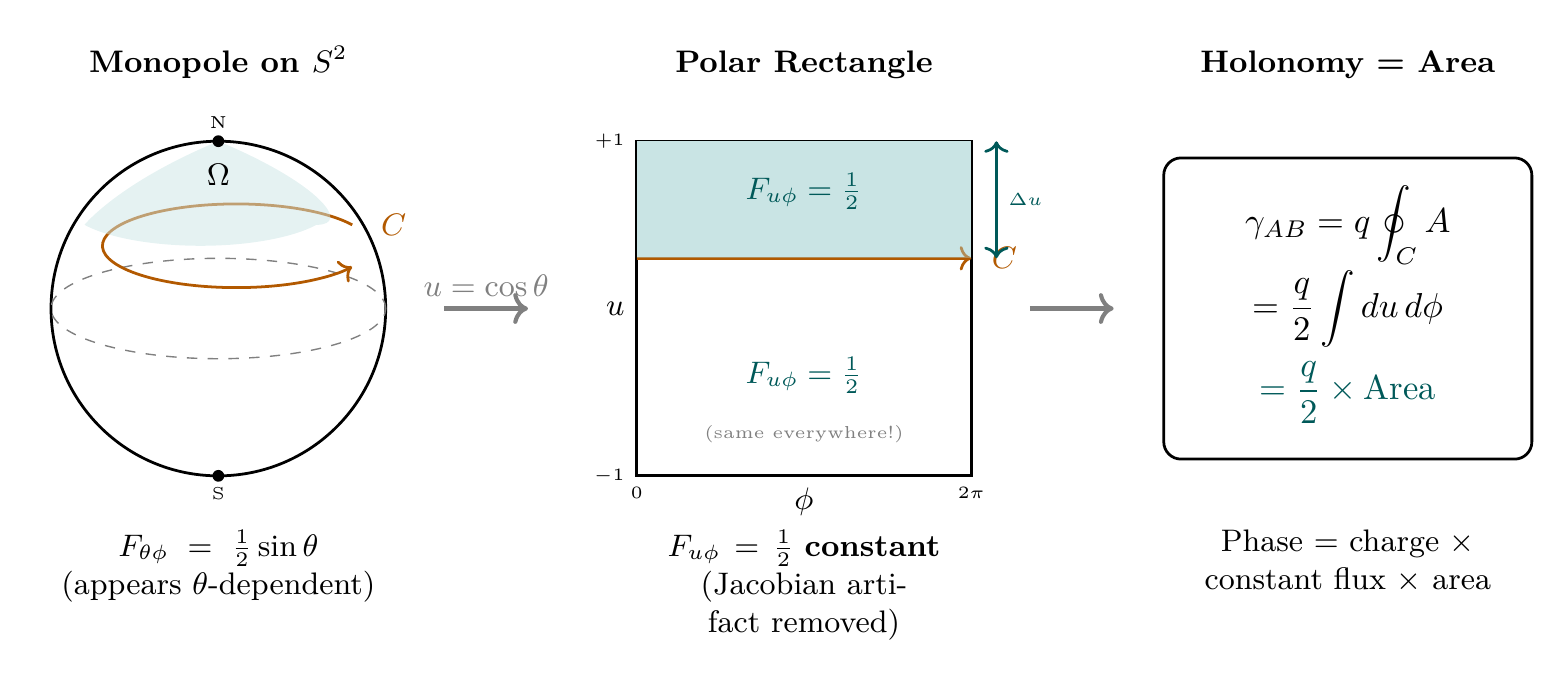
Figure 60b.1: The Aharonov-Bohm effect in polar coordinates. Left: A loop \(C\) on \(S^2\) encloses solid angle \(\Omega\) with \(\theta\)-dependent field strength. Center: The same loop maps to a horizontal line on the polar rectangle \([-1,+1] \times [0,2\pi)\), where the field strength \(F_{u\phi} = 1/2\) is constant everywhere — the \(\sin\theta\) factor was a coordinate artifact. Right: The holonomy reduces to \(\gamma = (q/2) \times \text{rectangle area}\), the simplest possible statement. Colors: {\color{teal!70!black}teal} = THROUGH (\(u\)) direction; {\color{orange!70!black}orange} = AROUND (\(\phi\)) direction.
Polar Field Verification
The polar coordinate representation (\(u = \cos\theta\), \(u \in [-1,+1]\)) provides independent verification across multiple phenomena in this chapter:
| Phenomenon | Polar result | Verification |
|---|---|---|
| Decoherence | \(L_z\) = pure AROUND; \(L_\pm\) = mixed | Channel factorization |
| Tunneling Berry phase | \(\Delta\gamma = qg_m \times\) rectangle area | Flat measure \(du\,d\phi\) |
| Aharonov-Bohm | \(F_{u\phi} = 1/2\) (constant) | \(\sin\theta\) was Jacobian artifact |
| Quantum Zeno | Speed\(^2\) = THROUGH + AROUND | Both channels frozen |
| Contextuality | \(h_{uu} = R^2/(1-u^2)\) non-constant | Metric obstruction to NCHV |
In every case, the polar representation simplifies the geometry: Berry phases become rectangle areas, the monopole field becomes constant, and the AROUND/THROUGH decomposition makes the physical content of each phenomenon manifest.
\hrule
Verification Code
The mathematical derivations and proofs in this chapter can be independently verified using the formal and computational scripts below.
All verification code is open source. See the complete verification index for all chapters.