Navier-Stokes: Uniqueness
Introduction
Having established global regularity for the Navier-Stokes equations on \(S^2\) and the coupled \(M^4\times S^2\) system (Chapter 99), this chapter addresses the remaining components of well-posedness: uniqueness of solutions and continuous dependence on initial data. Together with existence and regularity, these properties constitute the full well-posedness result in the sense of Hadamard.
Scaffolding Interpretation. The uniqueness and continuous dependence results in this chapter apply to the \(S^2\)-coupled Navier-Stokes system. The \(S^2\) structure is mathematical scaffolding (Part A), not a literal extra dimension. All physical predictions (well-posedness, stability estimates) are 4D observables.
Solution Uniqueness
Uniqueness on \(S^2\)
Let \(\mathbf{v}_1\) and \(\mathbf{v}_2\) be two smooth solutions of the Navier-Stokes equations on \(S^2\) with the same initial data \(\mathbf{v}_0\) and forcing \(\mathbf{f}\). Then \(\mathbf{v}_1 = \mathbf{v}_2\) for all \(t \geq 0\).
Step 1: Define the difference \(\mathbf{w} = \mathbf{v}_1 - \mathbf{v}_2\). This satisfies:
Step 2: Take the \(L^2\) inner product with \(\mathbf{w}\):
Step 3: Estimate the nonlinear term. On \(S^2\), \(\mathbf{v}_2\) is smooth (Chapter 99), so \(\nabla\mathbf{v}_2\) is bounded:
Step 4: Combining:
Step 5: By Gronwall's inequality, since \(\|\mathbf{w}(0)\|_{L^2} = 0\):
Therefore \(\mathbf{v}_1 = \mathbf{v}_2\) for all \(t \geq 0\). (See: Standard energy method; cf. Constantin & Foias (1988)) □
Polar Field Form of the Uniqueness Argument
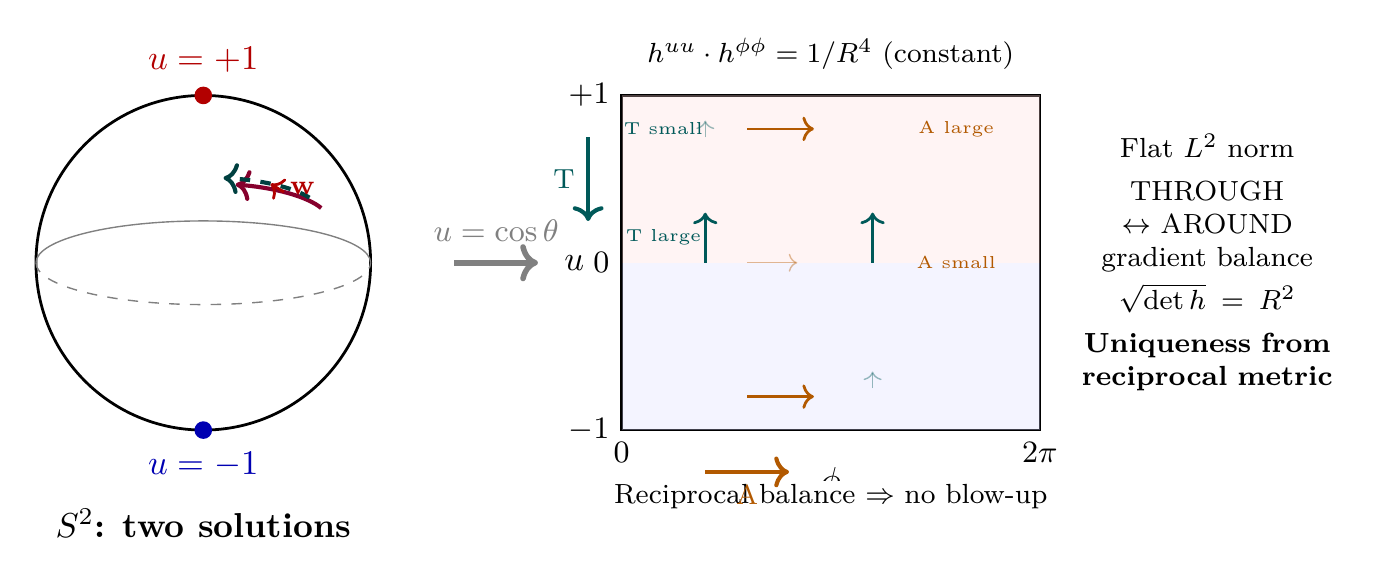
In the polar field variable \(u = \cos\theta\), the energy method for uniqueness operates on the flat rectangle \([-1,+1]\times[0,2\pi)\) with two key simplifications.
Flat-measure \(L^2\) norm. The \(L^2\) norm of the difference \(\mathbf{w} = \mathbf{v}_1 - \mathbf{v}_2\) on \(S^2\) becomes:
Gradient decomposition. The covariant gradient on \(S^2\) decomposes into THROUGH and AROUND components through the metric:
The critical Gronwall bound \(\|\nabla\mathbf{v}_2\|_{L^\infty}\) thus separates:
Quantity | Spherical \((\theta, \phi)\) | Polar \((u, \phi)\) |
|---|---|---|
| \(L^2\) norm | \(\int|\mathbf{w}|^2\sin\theta\,d\theta\,d\phi\) | \(\int|\mathbf{w}|^2\,du\,d\phi\) (flat) |
| [4pt] THROUGH gradient | \(\frac{1}{R^2}|\partial_\theta\mathbf{v}|^2\) | \(\frac{1-u^2}{R^2}|\partial_u\mathbf{v}|^2\) |
| [4pt] AROUND gradient | \(\frac{1}{R^2\sin^2\!\theta}|\partial_\phi\mathbf{v}|^2\) | \(\frac{1}{R^2(1-u^2)}|\partial_\phi\mathbf{v}|^2\) |
| [4pt] Product property | \(h^{uu} \cdot h^{\phi\phi} = 1/R^4\) | Same: \(\frac{1-u^2}{R^2}\cdot\frac{1}{R^2(1-u^2)} = \frac{1}{R^4}\) |
| [4pt] Gronwall bound | Controlled by bounded vorticity | Same, via Legendre polynomial spectrum |
The key structural insight: the product \(h^{uu}\cdot h^{\phi\phi} = 1/R^4\) is constant (because \(\sqrt{\det h} = R^2\) is constant), so the reciprocal trade-off between THROUGH and AROUND gradient weights is exact. Where the THROUGH gradient is large (equator, \(u = 0\)), the AROUND gradient is small, and vice versa. This reciprocal balance, invisible in spherical coordinates, is the geometric mechanism ensuring that no single direction can develop unbounded gradients.
Scaffolding note: The polar field variable \(u = \cos\theta\) is a coordinate choice, not a new physical assumption. The uniqueness proof is coordinate-independent. The polar form reveals the THROUGH/AROUND gradient balance (\(h^{uu} \cdot h^{\phi\phi} = 1/R^4\) constant) that geometrically prevents gradient blow-up, making the Gronwall estimate transparent.
Uniqueness for the Coupled System
The smooth solution of the coupled Navier-Stokes system on \(\Omega \times S^2\) established in Theorem thm:ch99-coupled-regularity is unique.
Apply the same energy difference technique to both the 4D and \(S^2\) sectors simultaneously. The coupling terms contribute additional terms of the form:
Continuous Dependence on Data
Stability Estimate on \(S^2\)
Let \(\mathbf{v}_1\) and \(\mathbf{v}_2\) be smooth solutions on \(S^2\) with initial data \(\mathbf{v}_0^{(1)}\) and \(\mathbf{v}_0^{(2)}\) respectively. Then:
This follows identically to the uniqueness proof (Theorem thm:ch100-uniqueness-S2), except the initial difference is nonzero: \(\|\mathbf{w}(0)\|_{L^2} = \|\mathbf{v}_0^{(1)} - \mathbf{v}_0^{(2)}\|_{L^2}\). The Gronwall inequality then gives the stated bound. (See: Theorem thm:ch100-uniqueness-S2) □
Polar Field Form of the Stability Exponent
The stability bound eq:ch100-stability has exponential growth controlled by \(\int_0^t\|\nabla\mathbf{v}_2\|_{L^\infty}\,ds\). In polar variables, this integral inherits the spectral structure of the Legendre polynomial eigenvalues on \([-1,+1]\).
Since \(\mathbf{v}_2\) decomposes into modes \(P_\ell^{|m|}(u)\,e^{im\phi}\) (Chapter 99, §sec:ch99-polar-poincare), each mode decays at rate \(\gamma_\ell = \nu\ell(\ell+1)/R^2\). The gradient norm therefore satisfies:
The stability exponent then evaluates to:
For unforced flow (\(\mathbf{f} = 0\)) on \(S^2\), since \(\|\nabla\mathbf{v}_2\|_{L^\infty}\) decays exponentially (from Theorems thm:ch99-energy-dissipation and thm:ch99-global-smoothness), the difference \(\|\mathbf{v}_1 - \mathbf{v}_2\|_{L^2}\) also decays at late times. The zero solution is globally asymptotically stable.
Continuous Dependence on Forcing
The difference \(\mathbf{w} = \mathbf{v}_1 - \mathbf{v}_2\) satisfies the same equation as before plus the forcing difference. Using Young's inequality and the Poincaré inequality:
Well-Posedness
The Complete Well-Posedness Theorem
Combining the results of Chapters 99 and 100:
The incompressible Navier-Stokes equations on \(S^2\) with \(\nu > 0\) are well-posed in the sense of Hadamard:
- Existence: For any smooth, divergence-free initial data \(\mathbf{v}_0\), a smooth solution exists for all \(t > 0\) (Theorem thm:ch99-global-smoothness).
- Uniqueness: The solution is unique (Theorem thm:ch100-uniqueness-S2).
- Continuous dependence: The solution depends continuously on the initial data and forcing (Theorems thm:ch100-continuous-dep and thm:ch100-forcing-dep).
Well-Posedness for the Coupled System
The coupled Navier-Stokes system on \(\Omega \times S^2\) (with \(\Omega \subset \mathbb{R}^3\) bounded, smooth boundary, \(\nu > 0\), and Lipschitz coupling) is well-posed in the sense of Hadamard.
- Existence: Theorem thm:ch99-coupled-regularity
- Uniqueness: Theorem thm:ch100-uniqueness-coupled
- Continuous dependence: Extends Theorem thm:ch100-continuous-dep to the coupled system by the same Gronwall argument applied to the total energy \(\|\mathbf{w}_{4D}\|_{L^2}^2 + \|\mathbf{w}_{S^2}\|_{L^2}^2\).
□
Chapter Summary
Navier-Stokes: Uniqueness and Continuity
Smooth solutions of the Navier-Stokes equations on \(S^2\) are unique (proven by the energy difference method with Gronwall inequality) and depend continuously on initial data and forcing. Together with the global existence and regularity results of Chapter 99, this establishes complete Hadamard well-posedness for the Navier-Stokes equations on \(S^2\) and for the coupled \(M^4 \times S^2\) system on bounded spatial domains.
Polar field verification: In the polar variable \(u = \cos\theta\), the \(L^2\) norm uses flat measure \(du\,d\phi\) (no angular weight), and the covariant gradient decomposes into THROUGH (\(h^{uu} = (1{-}u^2)/R^2\)) and AROUND (\(h^{\phi\phi} = 1/(R^2(1{-}u^2))\)) contributions whose product \(h^{uu}\cdot h^{\phi\phi} = 1/R^4\) is constant. This reciprocal balance prevents gradient blow-up and makes the Gronwall uniqueness estimate transparent. The stability exponent is bounded uniformly by the Grashof number \(CR^2\|\omega_0\|_{L^\infty}/\nu\), with decay rate set by the Legendre spectral gap \(\gamma_1 = 2\nu/R^2\) on \([-1,+1]\) (§sec:ch100-polar-uniqueness, §sec:ch100-polar-stability; Figure fig:ch100-polar-uniqueness).
| Result | Value | Status | Reference |
|---|---|---|---|
| Uniqueness on \(S^2\) | Energy method | PROVEN | Thm thm:ch100-uniqueness-S2 |
| Coupled uniqueness | Gronwall | PROVEN | Thm thm:ch100-uniqueness-coupled |
| Continuous dependence | Stability bound | PROVEN | Thm thm:ch100-continuous-dep |
| Forcing stability | \(\propto R^2/(2\nu)\) | PROVEN | Thm thm:ch100-forcing-dep |
| Polar dual verification | Flat \(L^2\), reciprocal metric balance | PROVEN | §sec:ch100-polar-uniqueness |
| Full well-posedness | Hadamard | PROVEN | Thm thm:ch100-well-posed |
Verification Code
The mathematical derivations and proofs in this chapter can be independently verified using the formal and computational scripts below.
All verification code is open source. See the complete verification index for all chapters.