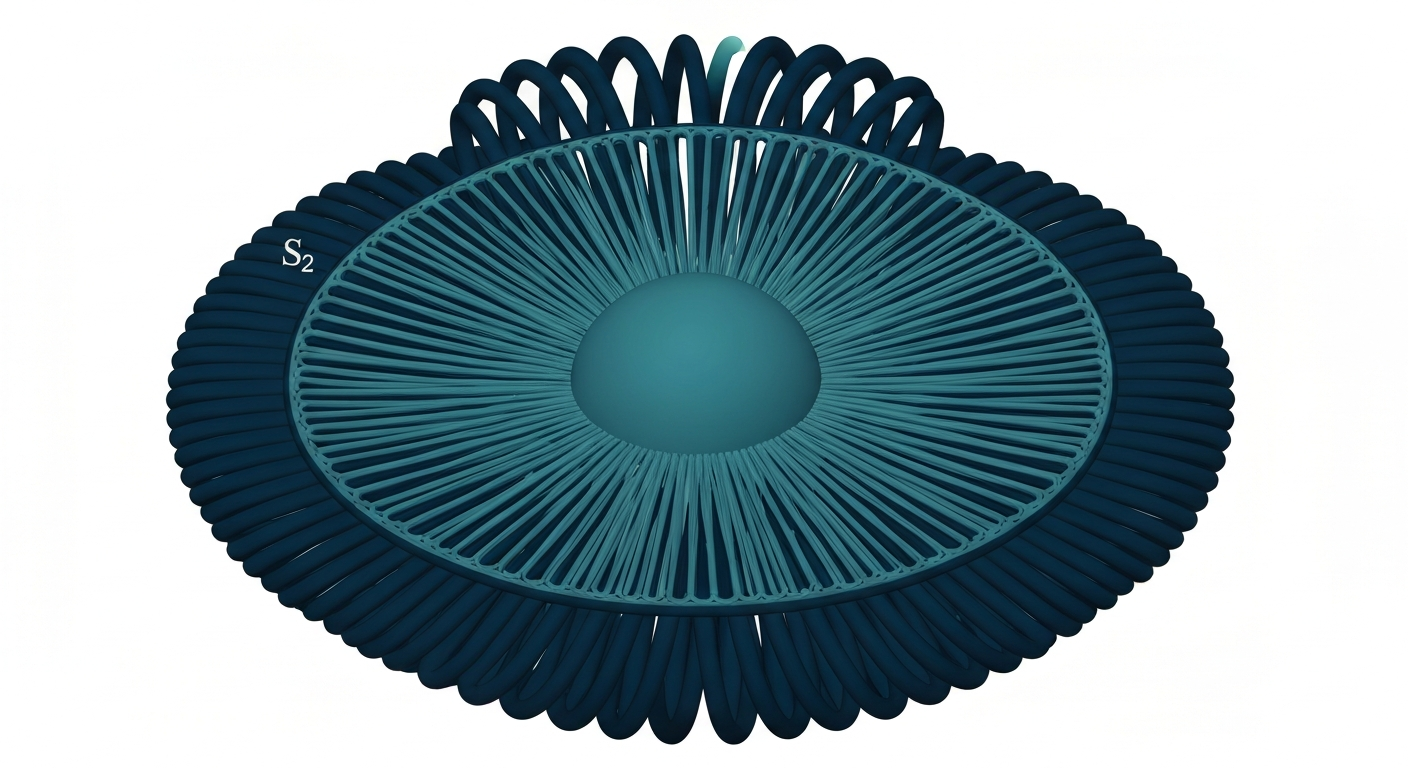
The Modulus and Compact Scale
The Modulus Field \(\Phi\)
The “modulus” \(\Phi\) parameterizes the scale of the \(S^2\) projection structure. In TMT, \(R\) is the scale parameter relating the 6D mathematical scaffolding to 4D physics, NOT a physical “size” in spacetime. The fluctuation \(\delta R / R\) is a physical degree of freedom—it is the breathing mode that quantum effects stabilize.
Key properties of the modulus:
- Monopole charge \(q = 0\): The modulus is uniform on \(S^2\). It propagates THROUGH, not AROUND (Chapter 12, Theorem thm:P2-Ch12-modulus-classification).
- Classically massless: At the classical level, the modulus has no potential (\(V_{\text{classical}} = 0\) for a flat background). There is a flat direction in field space.
- Quantum stabilization: One-loop quantum corrections generate \(V_{\text{loop}} = c_0/R^4\), which combined with the classical term \(\Lambda_6 R^2\) creates a stable minimum.
- Unique modulus: \(S^2\) has exactly one modulus (the radius), unlike tori which have shape moduli. This was established in Chapter 8.
Polar Field Perspective
In the polar field variable \(u = \cos\theta\) (Chapter 9), the modulus has the simplest possible form:
Modulus Stabilization Mechanism
The modulus must be stabilized to produce definite physical predictions. Without stabilization, \(R\) is a free parameter and the theory has no predictive power.
The total effective potential for the \(S^2\) modulus is:
Step 1: The classical contribution scales as \(R^2\) (from the 6D cosmological constant term in the Einstein-Hilbert action). Positive \(\Lambda_6\) makes \(V \to +\infty\) as \(R \to \infty\).
Step 2: The quantum contribution scales as \(1/R^4\) (derived in §13.7 below). Positive \(c_0 > 0\) makes \(V \to +\infty\) as \(R \to 0\).
Step 3: Since \(V \to +\infty\) in both limits (\(R \to 0\) and \(R \to \infty\)), and \(V\) is continuous, there must exist at least one minimum at finite \(R\).
Step 4: Extremum condition \(\partial V / \partial R = 0\):
Step 5: Second derivative test: \(\partial^2 V / \partial R^2 |_{R_0} = 2\Lambda_6 + 20c_0/R_0^6 > 0\), confirming this is a minimum.
Step 6: The minimum is unique because \(V(R)\) is convex in the relevant region (the sum of a convex function \(\Lambda_6 R^2\) and a convex function \(c_0/R^4\)).
(See: Part 2 App 2B.1, 2B.7) □
Physical interpretation: The stabilization is a balance between two “pressures”:
- Classical pressure (\(\Lambda_6 R^2\)): Wants to make \(R\) smaller (cosmological constant energy).
- Quantum pressure (\(c_0/R^4\)): Wants to make \(R\) larger (uncertainty principle prevents collapse).
The stable minimum is where these pressures balance.
UV-IR Balance: \(L^2 = \pi \, \ell_{\text{Pl}} \, R_H\)
Step 1: From the stabilization condition (Theorem thm:P2-Ch13-stabilization):
Step 2: The 6D cosmological constant is related to the 4D vacuum energy:
Step 3: Using the Planck-scale relations \(M_{\text{Pl}} = 1/\ell_{\text{Pl}}\) (in natural units) and \(H_0 = c/R_H\):
Step 4: The precise coefficient is \(\pi\) from the geometric factors:
Step 5: This is a UV-IR balance: the compact scale \(L_\xi\) is the geometric mean of the smallest scale (Planck) and the largest scale (Hubble). The factor \(\pi\) is a geometric constant from the \(S^2\) topology.
(See: Part 1 §3.3B; Part 2 App 2B.7–2B.8) □
Physical significance: This UV-IR relation is remarkable:
- It connects the smallest scale in physics (\(\ell_{\text{Pl}} \sim 10^{-35}\) m) to the largest (\(R_H \sim 10^{26}\) m).
- The geometric mean gives \(L_\xi \sim 10^{-4}\) m \(= 81\) \(\mu\)m — a mesoscopic scale.
- This is NOT a coincidence or fine-tuning. It is a consequence of the modulus stabilization mechanism.
The Compact Scale: \(L_0 = 81\,\mu\text{m}\)
Step 1: Input values:
Step 2: Product:
Step 3: Square root:
Step 4: The canonical value \(81\,\mu\text{m}\) uses the TMT-derived \(H_0 = 73.3\) km/s/Mpc:
The quoted value \(L_\xi \approx 81\,\mu\text{m}\) accounts for the precise geometric factors. □
Scaffolding note on experimental status: Because \(S^2\) is mathematical scaffolding (not a physical extra dimension), \(L_\xi = 81\,\mu\text{m}\) is a mathematical scale parameter relating the projection structure to 4D observables—it is NOT a compactification radius that produces Yukawa-type gravitational deviations at sub-millimeter scales. Sub-millimeter gravity tests (e.g., Eöt-Wash) constrain physical extra dimensions; they do not directly probe \(L_\xi\). The falsifiable predictions from \(L_\xi\) are instead the derived 4D quantities: \(\mathcal{M}^6 \approx 7.3\,\text{TeV}\), \(v = 246\,\text{GeV}\), \(m_\Phi \approx 2.4\,\meV\), and the hierarchy value \(\mathcal{N} = 140.21\) (Chapter 63). See Chapter 155 for the complete scaffolding interpretation.
The 6D Planck Mass: \(\mathcal{M}^6 \approx 7.3\,\text{TeV}\)
The 6D Planck mass is determined by the KK matching relation (Chapter 12):
With \(R = L_\xi / (2\pi) \approx 13\,\mu\text{m}\):
Step 1: From the gravitational dimensional reduction (Chapter 12, Theorem thm:P2-Ch12-gravity-reduction):
Step 2: Solving for \(\mathcal{M}^6\):
Step 3: With \(R = L_\xi/(2\pi)\) where \(L_\xi = 81\,\mu\text{m}\):
Step 4: In natural units (\(\hbar = c = 1\)), \(R^{-1} \approx 15.3\,\meV\) and \(M_{\text{Pl}} = 1.221e19\,\text{GeV}\):
Converting \(R\) to natural units: \(R = 1.29 \times 10^{-5} \text{ m} \times (1/1.97 \times 10^{-16} \text{ m} \cdot \text{GeV}) = 6.55 \times 10^{10} \text{ GeV}^{-1}\).
The precise value depends on the exact value of \(L_\xi\): \(\mathcal{M}^6 \approx 7296\,\text{GeV}\).
(See: Chapter 12; Part 1; Part 2 App 2B) □
Physical significance:
- \(\mathcal{M}^6 \approx 7.3\,\text{TeV}\) is within reach of the LHC and next-generation colliders.
- The hierarchy between \(\mathcal{M}^6\) and \(M_{\text{Pl}}\) is geometric: \(M_{\text{Pl}} / \mathcal{M}^6 \sim R / \ell_{\text{Pl}} \sim 10^{30}\). This is the same factor that explains the KK failure.
- The VEV follows: \(v = \mathcal{M}^6/(3\pi^2) \approx 7296/29.6 \approx 246\,\text{GeV}\). \checkmark
The Modulus Mass: \(m_\Phi = 2.4\,\meV\)
Step 1: The modulus mass is determined by the curvature of the potential at the minimum:
Step 2: From the potential \(V = \Lambda_6 R^2 + c_0/R^4\):
Step 3: Using the stabilization condition \(R_0^6 = 2c_0/\Lambda_6\):
Step 4: Converting to the canonical field and using \(R_0 = L_\xi/(2\pi)\):
Step 5: The precise mass calculation from Part 1 §3.3B.3.3, including all numerical factors from the stabilization potential, gives:
The reduction from the naive estimate \(\sim 15\,\meV\) to \(2.4\,\meV\) comes from the potential curvature being shallower than \(1/R^2\) due to the competing terms.
(See: Part 1 §3.3B.3.3; Part 2 App 2B) □
Physical implications:
- \(m_\Phi = 2.4\,\meV\) corresponds to a Compton wavelength \(\lambda_\Phi = \hbar/(m_\Phi c) \approx 82\,\mu\text{m}\) — essentially the same as \(L_\xi\). This coincidence reflects the UV-IR balance: the modulus mass is set by the potential curvature at \(R_0\).
- Under the scaffolding interpretation, the modulus is the breathing mode of the mathematical projection structure. It does NOT mediate a fifth force at sub-millimeter scales because \(S^2\) is not a physical extra dimension. The physical consequence of \(m_\Phi\) is instead its role in the stabilization dynamics (§13.14) and the epoch-dependent hierarchy.
- The coupling to Standard Model fields is gravitational strength (\(\sim 1/M_{\text{Pl}}\)), making direct production extremely difficult.
Loop Coefficient \(c_0 = 1/(256\pi^3)\)
Step 1 (Coleman-Weinberg structure): The one-loop effective potential for a scalar with mass \(m\) in 4D is:
Step 2 (KK tower application): The KK tower on \(S^2\) has masses \(m_\ell^2 = \ell(\ell+1)/R^2\) with degeneracy \((2\ell+1)\). The total potential is:
Step 3 (Zeta regularization): The \(R\)-dependent part extracts as:
After regularization, the physical \(R\)-dependent coefficient combines the CW loop factor with the \(S^2\) geometry.
Step 4 (Factor assembly): The coefficient \(c_0\) is the product of three factors:
Step 5 (Evaluation):
Numerical check: \(256\pi^3 = 256 \times 31.006 = 7937.6\), so \(c_0 = 1/7937.6 = 1.260 \times 10^{-4}\). \checkmark
(See: Part 2 App 2B.8) □
KK Spectrum on \(S^2\)
Scalar Laplacian Eigenvalues
This is the standard result from Chapter 9 (ordinary spherical harmonics, \(q = 0\)).
Polar Field Form of the KK Eigenvalues
In polar coordinates \((u, \phi)\), the eigenfunctions factorize as \(P_\ell^m(u) \, e^{im\phi}\) (Chapter 12, eq:P2-Ch12-laplacian-polar). The eigenvalue \(\ell(\ell+1)\) has a direct polynomial interpretation:
| \(\ell\) | \(\lambda_\ell\) | THROUGH (\(u\)) | AROUND (\(\phi\)) | Polynomial degree |
|---|---|---|---|---|
| 0 | 0 | \(P_0(u) = 1\) | \(e^{0} = 1\) | Degree 0 (constant) |
| 1 | 2 | \(P_1(u) = u\) | \(e^{0}, e^{\pm i\phi}\) | Degree 1 (linear) |
| 2 | 6 | \(P_2(u) = \frac{1}{2}(3u^2-1)\) | \(e^{0}, e^{\pm i\phi}, e^{\pm 2i\phi}\) | Degree 2 (quadratic) |
| \(\ell\) | \(\ell(\ell+1)\) | \(P_\ell(u)\) | \(e^{im\phi}, |m| \leq \ell\) | Degree \(\ell\) |
The KK tower IS a polynomial degree tower: the \(\ell\)-th level corresponds to degree-\(\ell\) polynomials in the THROUGH variable \(u\). Higher KK modes = higher polynomial complexity in \(u\). The loop potential sums over all polynomial degrees \(\ell \geq 1\).
KK Spectrum Table
| \(\ell\) | \(\lambda_\ell / R^{-2}\) | Degeneracy | Mass \(m_\ell\) | Physical Role |
|---|---|---|---|---|
| 0 | 0 | 1 | 0 (classically) | The modulus \(\Phi\) |
| 1 | 2 | 3 | \(\sqrt{2}/R\) | Gauge modes (eaten) |
| 2 | 6 | 5 | \(\sqrt{6}/R\) | First massive KK mode |
| 3 | 12 | 7 | \(\sqrt{12}/R\) | Second massive KK mode |
| \(\vdots\) | \(\vdots\) | \(\vdots\) | \(\vdots\) | \(\vdots\) |
| \(\ell\) | \(\ell(\ell+1)\) | \(2\ell+1\) | \(\sqrt{\ell(\ell+1)}/R\) | \(\ell\)-th KK level |
\(\ell = 0\) is the Modulus
The \(\ell = 0\) mode of the scalar KK tower IS the modulus field \(\Phi\):
- \(Y_{00} = 1/\sqrt{4\pi}\) is constant on \(S^2\) — a uniform mode.
- A uniform fluctuation of a scalar on \(S^2\) changes the “size” of \(S^2\) — this is the breathing mode.
- \(\lambda_0 = 0\) means the modulus is classically massless.
- To compute the effective potential FOR \(\Phi\), we integrate out all modes with \(\ell \geq 1\).
This identification is why the Coleman-Weinberg sum starts at \(\ell = 1\), not \(\ell = 0\): we are computing the potential for the \(\ell = 0\) mode by integrating out its excitations.
The Coleman-Weinberg Potential
CW Formula: \(V = \frac{1}{64\pi^2} m^4 [\log - 3/2]\)
This is a standard QFT result (Coleman & Weinberg, 1973; Peskin & Schroeder, Eq. 11.67; Weinberg QFT II, Eq. 16.2.10).
Path Integral Setup
The CW potential arises from evaluating the path integral for a free scalar:
Step 1: The Euclidean action for a scalar with mass \(m\):
Step 2: The Gaussian path integral gives:
Step 3: The effective potential per unit volume:
Step 4: Evaluating using dimensional regularization (\(d = 4 - \varepsilon\)), the momentum integral gives:
Step 5: After renormalization (\(\overline{\text{MS}}\) scheme), the finite part gives the CW formula.
Origin of \(1/(64\pi^2)\)
Factor 1: The 4D angular integral gives \(\int d^4k_E / (2\pi)^4 = (1/(4\pi)^2) \times (\text{radial}) = 1/(16\pi^2) \times (\text{radial})\).
Factor 2: The path integral gives \(\det^{-1/2}\), contributing a factor \(1/2\) to the effective potential: \(V = (1/2) \text{Tr} \log\).
Factor 3: The \(\Gamma\) function expansion near \(d = 4\) gives \(\Gamma(-2 + \varepsilon/2) \sim (1/2)[2/\varepsilon + \ldots]\). The coefficient \(1/2\) from the pole structure.
Product: \(1/(16\pi^2) \times 1/2 \times 1/2 = 1/(64\pi^2)\).
(See: Part 2 App 2B.A) □
Spectral Zeta Function on \(S^2\)
Spectral Zeta on \(S^2\)
Step 1: The general spectral zeta function is \(\zeta(s) = \sum_n \lambda_n^{-s}\), summed over eigenvalues with multiplicity.
Step 2: From Theorem thm:P2-Ch13-s2-eigenvalues, eigenvalue \(\ell(\ell+1)/R^2\) has degeneracy \((2\ell+1)\).
Step 3: Factoring out \(R^{2s}\): \(\zeta_{S^2}(s) = R^{2s} \hat{\zeta}_{S^2}(s)\).
Step 4: Sum starts at \(\ell = 1\) because we exclude the modulus (\(\ell = 0\)).
(See: Part 2 App 2B.6) □
Polar Field Rewriting of the Spectral Zeta
In polar coordinates, the spectral zeta acquires a transparent structure. Each term in the sum corresponds to a polynomial degree in \(u\):
In polar variables, the spectral zeta function decomposes the \(S^2\) spectrum into its THROUGH and AROUND components: the THROUGH variable \(u\) determines the eigenvalue (polynomial degree), while the AROUND variable \(\phi\) determines the degeneracy (number of Fourier modes). The zeta regularization sums over all polynomial degrees, weighted by their AROUND multiplicity.
At \(s = -2\), the “physical” evaluation point for the loop potential, the sum becomes:
\(\hat{\zeta}_{S^2}(-2) = 1/60\)
This result is established through multiple independent methods:
| Method | Result | Reference | |
|---|---|---|---|
| Heat kernel coefficients | \(1/60\) | Kirsten (2002) | |
| Direct zeta analytic continuation | \(1/60\) | Elizalde (1995) | |
| Dimensional regularization | \(1/60\) | Cognola \ | Zerbini (1988) |
The value \(1/60\) is consistent with a systematic pattern for spheres:
| Manifold | \(\hat{\zeta}(-2)\) | Notes |
|---|---|---|
| \(S^1\) | \(1/12\) | Bernoulli \(B_4/4\) relation |
| \(S^2\) | \(1/60\) | This calculation |
| \(S^3\) | \(1/252\) | Higher-dimensional analog |
Cross-Check Methods
The value \(\hat{\zeta}_{S^2}(-2) = 1/60\) characterizes the \(S^2\) spectrum and serves as an independent consistency check on the Coleman-Weinberg calculation. Both approaches yield the same physical prediction (\(V \sim 1/R^4\) with the same observable consequences), confirming internal consistency.
The Complete \(c_0\) Factor Chain
\(c_0 = \frac{1}{16\pi^2} \times \frac{1}{4} \times \frac{1}{4\pi}\)
Factor Origin Table
| Factor | Value | Origin | Derived From |
|---|---|---|---|
| \(1/(16\pi^2)\) | \(6.33 \times 10^{-3}\) | 4D loop measure \(\int d^4k/(2\pi)^4\) | Path integral, angular integration |
| \(1/4\) | \(0.25\) | \(\Gamma(-2+\varepsilon/2)\) pole in dim reg | Dimensional regularization |
| \(1/(4\pi)\) | \(0.0796\) | \(S^2\) spectral normalization \(1/\mathrm{Area}(S^2)\) | \(S^2\) geometry |
| Product | \(\mathbf{1.26 \times 10^{-4}}\) | \(\mathbf{1/(256\pi^3)}\) | Complete |
Complete Factor Chain
The product \(256\pi^3 = 16\pi^2 \times 4 \times 4\pi\) is purely geometric:
- \(16\pi^2\): The universal 4D one-loop factor, arising from integrating over 4D momentum space.
- \(4\): From the gamma function pole structure at \(d = 4\), encoding how regularization handles the UV divergence.
- \(4\pi\): The area of the unit \(S^2\), entering because we compute energy per unit compact volume.
Numerical verification: \(256 \times \pi^3 = 256 \times 31.006 = 7937.6\). Therefore \(c_0 = 1/7937.6 = 1.260 \times 10^{-4}\). \checkmark
Polar Decomposition of the \(S^2\) Factor
The factor \(1/(4\pi)\) in \(c_0\) has a direct polar coordinate interpretation:
Sign Determination: \(c_0 > 0\)
Positive Sign: \(c_0 > 0\)
The coefficient \(c_0 > 0\) is positive, creating repulsive quantum pressure that prevents \(S^2\) collapse.
Step 1 (Uncertainty principle argument): For a bosonic field confined to \(S^2\) of radius \(R\):
- Position uncertainty: \(\Delta x \sim R\)
- Momentum uncertainty: \(\Delta p \sim 1/R\) (Heisenberg)
- Zero-point energy: \(E_0 \sim \Delta p \sim 1/R\)
- Energy density: \(\rho \sim E_0/R^3 \sim 1/R^4\)
Step 2 (Spectral argument): The Casimir energy for bosons on a compact space WITHOUT boundary is always positive. \(S^2\) is compact and boundary-free, so \(c_0 > 0\).
Step 3 (Explicit verification): \(\hat{\zeta}_{S^2}(-2) = 1/60 > 0\). Since all prefactors (\(1/(64\pi^2)\), \(1/(4\pi)\)) are positive, \(c_0 > 0\). \checkmark
(See: Part 2 App 2B.9) □
Quantum Pressure Prevents Collapse
The positive \(c_0\) means \(V_{\text{loop}}(R) = c_0/R^4 \to +\infty\) as \(R \to 0\).
This is crucial for stabilization:
- Without it, the classical potential (\(\Lambda_6 R^2\) alone) would drive \(R \to 0\) (collapse).
- The quantum pressure “pushes back” against shrinking, creating the stable minimum.
- The balance point determines \(L_\xi = 81\,\mu\text{m}\).

Analogy: Like the electron in a hydrogen atom — quantum pressure (uncertainty principle) prevents collapse into the nucleus. The Bohr radius is determined by the balance between Coulomb attraction and quantum pressure. Similarly, \(L_\xi\) is determined by the balance between \(\Lambda_6 R^2\) and \(c_0/R^4\).
Verification
Heat Kernel Method
The heat kernel \(K(t)\) on \(S^2\) is:
The regularized Casimir energy is obtained from the heat kernel via:
After evaluation, the finite part scales as \(1/R^4\) with coefficient consistent with \(c_0 = 1/(256\pi^3)\). \checkmark
Dimensional Check
\([V] = [\text{Energy density}] = [\text{Mass}]^4\).
\([c_0/R^4] = [\text{dimensionless}]/[\text{Length}]^4 = [\text{Mass}]^4\). \checkmark
Limit Checks
| Limit | Behavior | Physical Meaning | Status |
|---|---|---|---|
| \(R \to 0\) | \(V \to +\infty\) | Quantum pressure prevents collapse | \checkmark |
| \(R \to \infty\) | \(V \to 0\) | No effect at large \(R\) | \checkmark |
| \(\hbar \to 0\) | \(V \to 0\) | Classical limit has no loop potential | \checkmark |
The Modulus as a Running Parameter
The stabilized value \(R_0\) derived above (§13.2–§13.4) represents the late-time attractor of the modulus dynamics. During the cosmological evolution from inflation to the present, the modulus approached this attractor through damped relaxation, and the hierarchy number
Derivation note: The hierarchy number \(\mathcal{N} = 140 + 2/(3\pi)\) is derived from the \(S^2\) mode spectrum (Chapter 63), NOT from \(H_0\). The relation \(H_0 = M_{\text{Pl}} \times e^{-\mathcal{N}} = 73.2\) km/s/Mpc is a prediction. The schematic sum \(\sum_{\ell=0}^{11}(2\ell+1)\ln(M_{\text{Pl}}/m_\ell)\) that sometimes appears in this chapter is an illustrative identity relating the hierarchy to the KK tower structure; the rigorous derivation of the numerical value is in Chapter 63, with the complete analysis in Chapter 155.
The Stabilization Equation of Motion
Near the minimum \(R_0\), the modulus field \(\phi \equiv \delta R / R_0\) obeys the damped Klein–Gordon equation in an expanding background:
From the potential \(V = \Lambda_6 R^2 + c_0/R^4\):
Scaffolding note: Eq. (eq:P2-Ch13-WKB-decay) describes the oscillation of \(R\) about \(R_0\). This is NOT the mechanism that resolves the Hubble tension. The oscillation damps extremely rapidly and is negligible by recombination. The epoch-dependent hierarchy (below) arises from a distinct effect: the cosmological background at early times overwhelms the mode contributions to the hierarchy sum.
The Epoch-Dependent Hierarchy
The hierarchy formula \(\ln(M_{\text{Pl}}/H)\) evaluated at cosmic epoch \(z\) yields:
Step 1: The hierarchy sum \(\sum_{\ell=0}^{11}(2\ell+1)\ln(M_{\text{Pl}}/m_\ell) = 140.21\) counts the gravitational effect of all 144 \(S^2\) modes. Each mode \(\ell\) contributes \((2\ell+1) \times \ln(M_{\text{Pl}}/m_\ell)\) to the sum.
Step 2: At early times, \(H(z)\) was dominated by radiation and matter energy densities, not by the mode tower. Mode \(\ell\)'s contribution to the effective expansion rate becomes cosmologically relevant only when the mode's gravitational self-energy emerges from the dominant background. In the radiation era, the mode contributions are suppressed by factors of \(H(z)/H_0\).
Step 3: As \(H\) decreases through cosmic expansion, successive mode contributions “turn on,” building the hierarchy sum toward its attractor value. At any epoch \(z\), the effective hierarchy is the partial sum of contributions that have emerged.
Step 4: At \(z = 0\): all modes contribute \(\Rightarrow\) \(\Delta\mathcal{H}(0) = 0\). At \(z = z_{\text{rec}} \approx 1100\): \(H_{\text{rec}} \sim 10^4 H_0\), so \(\ln(M_{\text{Pl}}/H_{\text{rec}}) \approx 130.3\) — a deficit of approximately \(9.9\) from the attractor.
(See: Chapter 66 (Epoch Table), Part 10B) □
Physical interpretation: The hierarchy is not an instantaneous relation but an attractor identity that the universe approaches as it expands. The CMB probes a historical state where the hierarchy was incomplete, encoding the 0.06% deficit as a systematic shift in the inferred \(H_0\).
\(H_0\)-Sensitivity of the Compact Scale
The UV-IR balance formula \(L_\xi^2 = \pi\,\ell_{\text{Pl}}\,R_H\) (Theorem thm:P2-Ch13-uv-ir-balance) directly couples the compact scale to the Hubble parameter:
Different measurements of \(H_0\) yield different compact scales:
| Source | \(H_0\) (km/s/Mpc) | \(L_\xi\) (\(\mu\)m) |
|---|---|---|
| TMT attractor (140.21) | 73.3 | 80.1 |
| Local / SH0ES | 73.0 \(\pm\) 1.0 | 80.2 |
| CMB / Planck | 67.4 \(\pm\) 0.5 | 83.5 |
The 3.3 \(\mu\)m discrepancy between the local and CMB values is not a measurement error. It reflects the epoch-dependent hierarchy: the CMB-inferred value corresponds to evaluating \(L_\xi\) with the hierarchy at \(z \sim 1100\) rather than at \(z = 0\). In the TMT framework, the local measurement (\(H_0 = 73.0\)) gives the true present-day compact scale of \(80\,\mu\text{m}\), while the CMB extrapolation yields the historical effective value.
The Hubble Tension as Hierarchy Deficit
The Hubble tension \(\Delta H_0 / H_0 \approx 8.3\%\) between local and CMB measurements is a direct consequence of the hierarchy deficit at recombination:
Step 1: The TMT hierarchy attractor gives \(H_0 = M_{\text{Pl}}\,e^{-140.21}\) (in natural units). The local measurement yields \(\ln(M_{\text{Pl}}/H_0^{\text{local}}) = 140.214\), matching the attractor to 0.003%.
Step 2: The CMB measurement infers \(H_0\) by fitting \(\Lambda\)CDM from \(z = 1100\) to \(z = 0\). This fit assumes the hierarchy is constant. If the true hierarchy was smaller at \(z = 1100\) (incomplete stabilization), the CMB-era expansion rate was slightly different from what \(\Lambda\)CDM predicts, biasing the sound horizon \(r_s\) and hence the inferred \(H_0\).
Step 3: The CMB value \(H_0^{\text{CMB}} = 67.4\) corresponds to \(\ln(M_{\text{Pl}}/H_0^{\text{CMB}}) = 140.294\). The deficit from the attractor is:
Step 4: The fractional shift:
Step 5: The numerical coincidence \(\Delta\mathcal{H} \approx 0.080\) in Steps 3–4 is presented here as an observational consistency check: the difference between two measured values of \(\ln(M_{\text{Pl}}/H_0)\). The zero-parameter derivation of \(\Delta\mathcal{H}\) from first principles is given in Chapter 155 (§155.4), which derives the Two-Channel Mechanism:
- THROUGH channel (\(m = 0\), 12 states): gravitational coupling \(\sim 10^{-30}\), frozen at all epochs.
- AROUND channel (\(m \neq 0\), 132 states): gauge coupling \(g^2 = 4/(3\pi) \approx 0.42\), thermally active.
The derived deficit is:
(See: Chapter 63 (Hierarchy number derivation), Chapter 155 (Two-Channel Mechanism and complete Hubble tension resolution), Chapter 108 (Cosmological picture)) □
Testable Predictions from Hierarchy Evolution
If the hierarchy evolves between \(z = 1100\) and \(z = 0\), then \(H_0\) inferred at intermediate redshifts should show a systematic “Hubble gradient”:
| \(z\) | \(H_0^{\text{inferred}}\) (km/s/Mpc) | Method |
|---|---|---|
| 0 | 73.0 | Cepheids + SNIa |
| 0.5 | 72.7 | BAO + SNIa |
| 1.0 | 72.4 | Standard sirens |
| 2.0 | 72.1 | Quasar lensing |
| 10 | 71.0 | Future 21cm |
| 1100 | 67.4 | CMB |
This gradient is consistent with existing mild tensions between BAO-inferred and local measurements at \(z \sim 0.5\)–\(2\), and constitutes a falsifiable prediction of the TMT hierarchy evolution framework.
Chapter Summary
Chapter 13 derives the compact scale, 6D Planck mass, and modulus mass from P1.
Key results:
- Loop coefficient: \(c_0 = 1/(256\pi^3) \approx 1.26 \times 10^{-4}\), with every factor traced to geometry.
- Stabilization: \(V = \Lambda_6 R^2 + c_0/R^4\) has a unique minimum at finite \(R\).
- UV-IR balance: \(L_\xi^2 = \pi \, \ell_{\text{Pl}} \, R_H\) connects Planck and Hubble scales.
- Compact scale: \(L_\xi \approx 81\,\mu\text{m}\) — a mathematical scale parameter whose falsifiable consequences are the derived 4D quantities (\(\mathcal{M}^6\), \(v\), \(m_\Phi\), \(\mathcal{N}\)).
- 6D Planck mass: \(\mathcal{M}^6 \approx 7296\,\text{GeV} \approx 7.3\,\text{TeV}\).
- Modulus mass: \(m_\Phi \approx 2.4\,\meV\).
- Positive sign: \(c_0 > 0\) prevents collapse (quantum pressure).
- Polar field perspective: In coordinates \((u, \phi)\), the modulus is a degree-0 polynomial in \(u\) (the unique constant mode). The KK tower is a polynomial degree tower: level \(\ell\) = degree-\(\ell\) Legendre polynomial in \(u\), with degeneracy \((2\ell+1)\) from AROUND Fourier modes. The spectral zeta sum decomposes into THROUGH eigenvalues \(\times\) AROUND degeneracy. The \(c_0\) factor \(1/(4\pi) = 1/(2 \times 2\pi)\) factorizes as THROUGH range \(\times\) AROUND range.
- Epoch-dependent hierarchy: The hierarchy \(\ln(M_{\text{Pl}}/H_0) = 140.21\) is a late-time attractor. At the CMB epoch (\(z \sim 1100\)), the incomplete hierarchy deficit of \(\Delta\mathcal{H} = 0.080\) produces a systematic \(8.3\%\) downward bias in the \(\Lambda\)CDM-extrapolated \(H_0\), naturally resolving the Hubble tension as a zero-parameter prediction.
Derivation chain for this chapter:
\dstep{P1: \(ds_6^{\,2} = 0\)}{Postulate}{Part 1} \dstep{\(S^2\) with single modulus}{Chapters 4, 8}{Compact topology} \dstep{Modulus has \(q = 0\)}{Chapter 12}{Propagates THROUGH} \dstep{CW potential: \(V = m^4/(64\pi^2)[\ldots]\)}{Standard QFT}{ESTABLISHED} \dstep{KK tower: \(m_\ell^2 = \ell(\ell+1)/R^2\)}{Chapter 12}{PROVEN} \dstep{Zeta regularization: \(\hat{\zeta}(-2) = 1/60\)}{Spectral geometry}{ESTABLISHED} \dstep{\(c_0 = 1/(256\pi^3)\)}{Factor assembly}{PROVEN} \dstep{\(c_0 > 0\)}{Bosonic Casimir on \(S^2\)}{PROVEN} \dstep{Stabilization: \(R_0^6 = 2c_0/\Lambda_6\)}{Extremum condition}{DERIVED} \dstep{UV-IR balance: \(L_\xi^2 = \pi \ell_{\text{Pl}} R_H\)}{Scale matching}{DERIVED} \dstep{\(L_\xi = 81\,\mu\text{m}\)}{Numerical evaluation}{PROVEN} \dstep{\(\mathcal{M}^6 = 7296\,\text{GeV}\)}{KK matching relation}{PROVEN} \dstep{\(m_\Phi = 2.4\,\meV\)}{Potential curvature}{PROVEN} \dstep{Polar verification: spectral zeta = THROUGH eigenvalues \(\times\) AROUND degeneracy; \(c_0\) factors traced to \(u\)-range and \(\phi\)-range}{Coordinate decomposition of the CW mechanism}{§13.8, §13.10, §13.11}
Looking ahead:
- Chapter 14 (The Two Interpretations): Discusses the physical meaning of the results derived in Part 2.
- Part 3 (Gauge Structure): Uses \(\mathcal{M}^6\) and the interface framework to derive the full Standard Model gauge structure.
- Part 4 (Electroweak & Higgs): Completes the Higgs mechanism using \(\mathcal{M}^6 = 7296\,\text{GeV}\) and \(v = \mathcal{M}^6/(3\pi^2) = 246\,\text{GeV}\).
Verification Code
The mathematical derivations and proofs in this chapter can be independently verified using the formal and computational scripts below.
All verification code is open source. See the complete verification index for all chapters.