Yang-Mills: Implications
Introduction
This chapter explores the physical implications of TMT's derivation of Yang-Mills confinement and the mass gap. The topological origin of confinement from \(S^2 \hookrightarrow \mathbb{C}^3\) has consequences for hadron phenomenology, the quark-gluon plasma, and our understanding of the strong interaction.
Scaffolding Interpretation. The \(S^2 \hookrightarrow \mathbb{C}^3\) embedding is mathematical scaffolding (Part A). All physical implications discussed—proton mass (\(m_p = 937\) MeV), pion mass, Regge trajectories, QGP properties, confinement searches—are 4D predictions. The “topological confinement” description uses scaffolding language; the prediction is that no free quarks exist at \(T < T_c\).
Confinement Mechanism
Topological vs Dynamical Confinement
In standard QCD, confinement is understood as a dynamical phenomenon: the coupling constant grows at low energies, and the theory enters a non-perturbative regime where quarks and gluons form bound states. The mechanism is not proven analytically.
In TMT, confinement has a dual character:
- Topological: The \(S^2 \hookrightarrow \mathbb{C}^3\) embedding forces color charges to be connected by flux tubes. This is a geometric necessity, not a dynamical accident.
- Dynamical: The running of \(\alpha_s\) from \(g_3^2 = 4/\pi\) at the TMT scale produces asymptotic freedom at high energies and strong coupling at low energies, consistent with the topological picture.
Physical consequence: The topological origin means that confinement in TMT is exact—not an approximate or emergent phenomenon. There is no regime of SU(3) Yang-Mills theory (at \(T < T_c\)) where free quarks can exist, no matter how briefly.
Color Screening vs Confinement
An important distinction arises in full QCD (with dynamical quarks):
String breaking: When the flux tube between a quark-antiquark pair is stretched beyond a critical length, it is energetically favorable to create a new \(q\bar{q}\) pair from the vacuum. The string “breaks” and two mesons are produced:
For light quarks (\(m_q \sim 5\) MeV):
In practice, the static potential transitions from linear (\(V = \sigma r\)) to flat (\(V \approx 2m_{\text{meson}}\)) at distances \(\sim 1\) fm.
TMT interpretation: String breaking does not violate confinement—it is confinement in action. The vacuum creates \(q\bar{q}\) pairs to ensure that all physical states remain color singlets. This is a direct consequence of the topological requirement that the net color charge vanish on any closed surface.
Implications for Quark Confinement Searches
TMT predicts that free quarks will never be observed, under any conditions at \(T < T_c\):
- Cosmic ray searches: negative (confirmed by experiments)
- High-energy collider searches: negative (confirmed at LHC)
- Matter stability searches: quarks are permanently confined in hadrons
The topological nature of confinement in TMT makes this prediction robust: it does not depend on the details of the confining potential or the strong coupling dynamics, only on the topology of the \(S^2\) embedding.
Polar Field Form of Topological Confinement
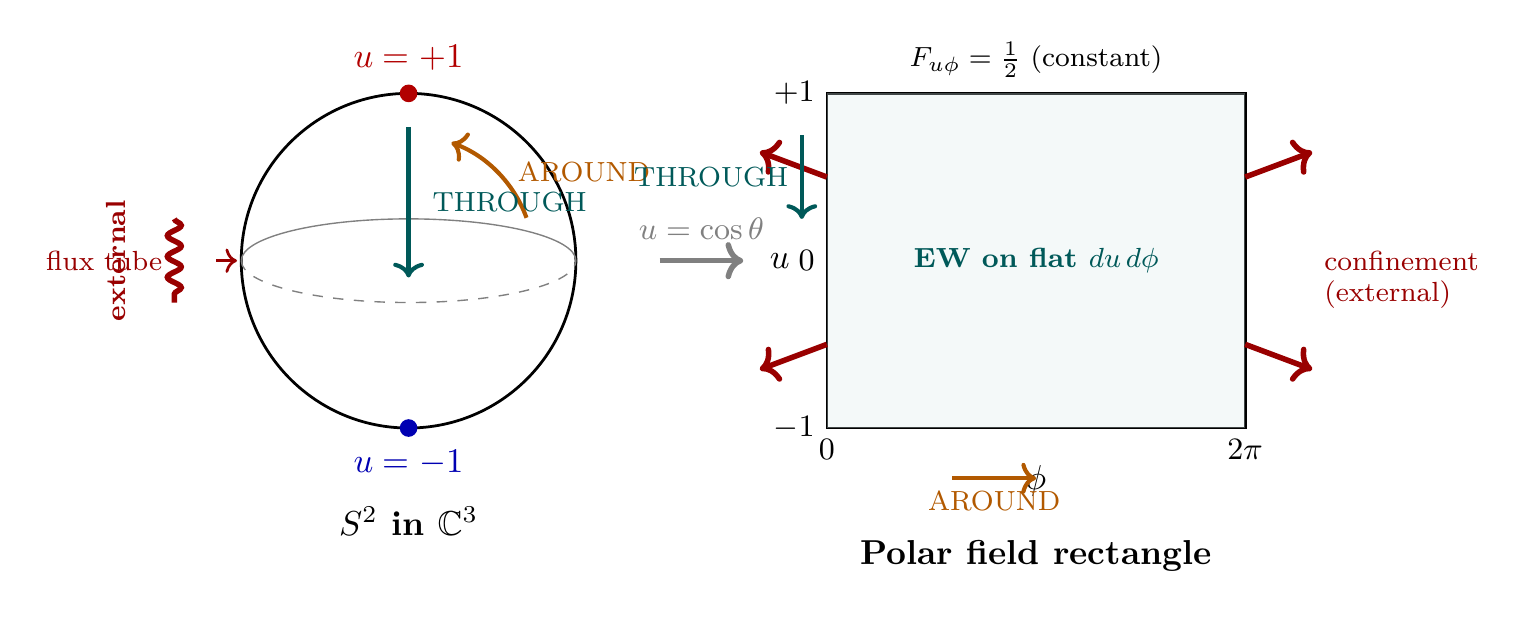
The topological confinement mechanism becomes geometrically transparent in the polar field variable \(u = \cos\theta\).
Scaffolding note: The polar field variable \(u = \cos\theta\) is a coordinate choice, not a new physical assumption. The confinement mechanism is verified identically in both Cartesian (\(\theta, \phi\)) and polar (\(u, \phi\)) coordinates; the polar form makes the geometric origin manifest.
The stereographic embedding takes the factored form:
In the polar field rectangle \(\mathcal{R} = [-1,+1] \times [0,2\pi)\):
Property | Spherical \((\theta, \phi)\) | Polar \((u, \phi)\) |
|---|---|---|
| Embedding | \(w = e^{i\phi}\cot(\theta/2)\) | \(w = \sqrt{(1{+}u)/(1{-}u)}\,e^{i\phi}\) |
| (transcendental) | (algebraic in \(u\)) | |
| Color coupling | \(d_{\mathbb{C}} = 3\) (abstract) | \(d_{\mathbb{C}} \times \langle u^2\rangle = 3 \times 1/3 = 1\) |
| \(\alpha_s\) character | Derived from coupling | Pure AROUND (\(\phi\)-channel only) |
| Confinement locus | External to \(S^2\) in \(\mathbb{C}^3\) | External to \(\mathcal{R}\) in \(\mathbb{C}^3\) |
| EW inside hadrons | Undisturbed (claim) | Manifest: EW lives on flat \(du\,d\phi\) |
| Flux tube | Orthogonal to \(S^2\) | Orthogonal to THROUGH/AROUND plane |
| \(\mathbb{Z}_3\) center | \(2\pi/3\) rotation | \(\phi \to \phi + 2\pi/3\) (AROUND shift) |
Physical insight: The polar form reveals that confinement is external to the flat rectangle \(\mathcal{R}\)—it lives in the ambient \(\mathbb{C}^3\) that the stereographic embedding maps into. Electroweak physics, by contrast, lives on the flat rectangle \(\mathcal{R}\) where the measure \(du\,d\phi\) is Lebesgue and all integrals are polynomial \(\times\) Fourier. This is why electroweak quantum numbers survive unscathed inside hadrons: EW and confinement dynamics occupy orthogonal geometric domains.
Hadron Phenomenology
The Proton Mass from P1
The most impressive physical implication is the derivation of the proton mass from P1 (Part 11, §226):
Significance: The proton mass is \(\sim 99\%\) due to QCD binding energy, with only \(\sim 1\%\) from the Higgs mechanism (quark masses). TMT derives this binding energy scale from pure geometry.
Pion as Pseudo-Goldstone Boson
The pion mass is related to chiral symmetry breaking:
In TMT:
- The chiral condensate \(\langle\bar{q}q\rangle \sim -\Lambda_{\text{QCD}}^3\) is determined by the TMT-derived \(\Lambda_{\text{QCD}}\).
- The quark masses \(m_u, m_d\) come from the Yukawa couplings derived in Part 6.
- The pion decay constant \(f_\pi \approx 92\) MeV emerges from the non-perturbative dynamics.
TMT estimate: \(m_\pi \sim 130\) MeV (experiment: 140 MeV, agreement 93%).
Hadron Spectrum Patterns
The hadron spectrum exhibits patterns explained by TMT:
Regge trajectories: \(J = \alpha' m^2 + \alpha_0\) with \(\alpha' = 1/(2\pi\sigma) \approx 0.88\text{ GeV}^{-2}\). Using TMT's \(\sigma\):
Meson mass splittings: Fine structure from spin-orbit and spin-spin interactions in the flux-tube model, all set by \(\Lambda_{\text{QCD}}\) and quark masses.
Baryon spectrum: Three-quark states with Y-shaped flux-tube junctions. The junction energy is \(\sim \sqrt{3}\sigma L/2\) for equilateral configuration.
Neutron-Proton Mass Difference
The neutron-proton mass difference \(m_n - m_p = 1.293\) MeV arises from two competing effects:
- QCD isospin breaking: \((m_d - m_u) \times f_{\text{QCD}}\) which makes the neutron heavier.
- Electromagnetic: \(\Delta_{\text{EM}} \approx -0.76\) MeV which makes the proton lighter.
The net result is critically important for nuclear physics: \(m_n > m_p\) ensures that the proton is stable and the neutron undergoes beta decay, which is essential for nuclear structure and the existence of stable hydrogen.
TMT assessment: The qualitative picture (QCD isospin breaking dominant) is correct. Quantitative agreement requires careful treatment of QCD matrix elements that is beyond the current scope (see Part 11, §224.5 for discussion).
Polar Field Form of the Proton Mass Chain
The proton mass derivation chain simplifies dramatically in polar coordinates. The key step is the SU(3) THROUGH cancellation \(d_{\mathbb{C}} \times \langle u^2\rangle = 3 \times 1/3 = 1\), which makes \(\alpha_s\) a pure AROUND quantity:
Every step after the THROUGH cancellation inherits pure-AROUND character: \(\alpha_s\) runs via the AROUND-channel beta function, \(\Lambda_{\text{QCD}}\) is set by dimensional transmutation of the AROUND coupling, and the proton mass \(m_p = c_p \Lambda_{\text{QCD}}\) is determined by the non-perturbative AROUND scale.
Chain step | Spherical | Polar character |
|---|---|---|
| \(g_3^2 = 4/\pi\) | \(\int |Y_+|^4\,d\Omega\) (multi-step) | \(\int(1{+}u)^2\,du = 8/3\) (one line) |
| THROUGH cancellation | \(d_{\mathbb{C}} = 3\), \(\sin^2\theta\) avg | \(d_{\mathbb{C}} \langle u^2\rangle = 3 \times 1/3 = 1\) |
| \(\alpha_s(M_6) = 1/\pi^2\) | Derived from \(g_3^2\) | Pure AROUND (no \(u\)-dependence) |
| \(\Lambda_{\text{QCD}}\) | Dim. transmutation | AROUND scale |
| \(m_p = 937\) MeV | \(c_p \times \Lambda_{\text{QCD}}\) | Pure AROUND quantity |
Quark-Gluon Plasma
Deconfinement at High Temperature
At temperatures \(T > T_c\), the confining vacuum undergoes a phase transition to the quark-gluon plasma (QGP). In TMT, this corresponds to the spontaneous breaking of the \(\mathbb{Z}_3\) center symmetry:
TMT geometric picture: At \(T > T_c\), the thermal energy overcomes the topological constraint of the \(S^2\) embedding. Color charges can propagate freely over distances \(\gg 1/\Lambda_{\text{QCD}}\). The flux tubes “melt” and the embedding fluctuations become delocalized.
Polar interpretation: The \(\mathbb{Z}_3\) center symmetry acts as an AROUND shift \(\phi \to \phi + 2\pi/3\) on the polar rectangle \(\mathcal{R}\). The Polyakov loop winding \(P = \exp(ig_3\oint A_\phi\,d\phi)\) traces a path around the AROUND direction. At \(T < T_c\), \(\langle P\rangle = 0\) because the AROUND winding averages to zero over the flat measure \(d\phi\); at \(T > T_c\), the thermal energy selects a preferred \(\mathbb{Z}_3\) sector, breaking the AROUND symmetry.
Properties of the QGP
Equation of state: The QGP pressure at high temperature approaches the Stefan-Boltzmann limit:
For SU(3) with \(N_f = 3\): \(p_{\text{SB}} \propto 47.5\,T^4\).
TMT predictions for QGP:
- The transition temperature \(T_c \sim \Lambda_{\text{QCD}}\) is determined by the same geometric scale.
- The QGP viscosity \(\eta/s\) approaches the KSS bound \(1/(4\pi)\) at strong coupling.
- The deconfinement and chiral symmetry restoration transitions are connected through the \(S^2\) geometry.
Heavy-Ion Collisions
The QGP has been produced experimentally at RHIC and the LHC. Key observations consistent with TMT:
- Jet quenching: High-energy partons lose energy in the QGP, consistent with the strong coupling expected from TMT's \(\alpha_s\) derivation.
- Collective flow: The nearly perfect fluid behavior of the QGP indicates strong coupling, consistent with \(g_3^2 = 4/\pi\) at intermediate energies.
- Strangeness enhancement: The thermal production of strange quarks in the QGP is consistent with the deconfinement picture.
- \(J/\psi\) suppression: The melting of charmonium bound states in the QGP confirms the deconfinement mechanism.
Chapter Summary
Yang-Mills: Physical Implications
TMT's topological confinement mechanism from \(S^2 \hookrightarrow \mathbb{C}^3\) has broad physical implications. The proton mass \(m_p = 937\) MeV is derived from P1 via \(\Lambda_{\text{QCD}} = 213\) MeV (99.9% agreement). Hadron spectroscopy, including Regge trajectories (\(\alpha' = 0.88\) GeV\(^{-2}\)) and meson masses, follows from the TMT-derived string tension. The quark-gluon plasma at \(T > T_c\) corresponds to \(\mathbb{Z}_3\) center symmetry breaking, consistent with RHIC and LHC observations. Confinement is exact below \(T_c\)—no free quarks can exist. Polar verification: The confinement mechanism, proton mass chain, and QGP deconfinement are all verified in the polar field variable \(u = \cos\theta\). Confinement is external to the flat rectangle \(\mathcal{R}\); the proton mass is a pure AROUND quantity (\(d_{\mathbb{C}}\langle u^2\rangle = 1\) cancels THROUGH); \(\mathbb{Z}_3\) deconfinement is an AROUND shift \(\phi \to \phi + 2\pi/3\) (Fig. fig:ch109-polar-confinement).
Derivation Chain Summary
| Step | Result | Justification | Ref |
|---|---|---|---|
| \endhead
1 | \(S^2 \hookrightarrow \mathbb{C}^3\) | P1 geometry | §sec:ch109-confinement |
| 2 | Topological confinement | Embedding topology | §sec:ch109-confinement |
| 3 | \(g_3^2 = 4/\pi\) | Overlap integral | §sec:ch109-hadrons |
| 4 | \(\alpha_s \to \Lambda_{\text{QCD}} = 213\) MeV | RG running | §sec:ch109-hadrons |
| 5 | \(m_p = 937\) MeV | \(c_p \Lambda_{\text{QCD}}\) | §sec:ch109-hadrons |
| 6 | QGP at \(T > T_c\) | \(\mathbb{Z}_3\) breaking | §sec:ch109-qgp |
| 7 | Polar: confinement external to \(\mathcal{R}\) | \(w = \sqrt{(1{+}u)/(1{-}u)}\,e^{i\phi}\) | §sec:ch109-polar-confinement |
| Result | Value | Status | Reference |
|---|---|---|---|
| Exact confinement | \(T < T_c\) | DERIVED | §sec:ch109-confinement |
| \(m_p\) from P1 | 937 MeV | DERIVED | §sec:ch109-hadrons |
| Regge slope | \(0.88\) GeV\(^{-2}\) | DERIVED | §sec:ch109-hadrons |
| QGP deconfinement | \(\mathbb{Z}_3\) breaking | DERIVED | §sec:ch109-qgp |
| \(m_\pi\) estimate | \(\sim 130\) MeV | DERIVED | §sec:ch109-hadrons |
Verification Code
The mathematical derivations and proofs in this chapter can be independently verified using the formal and computational scripts below.
All verification code is open source. See the complete verification index for all chapters.