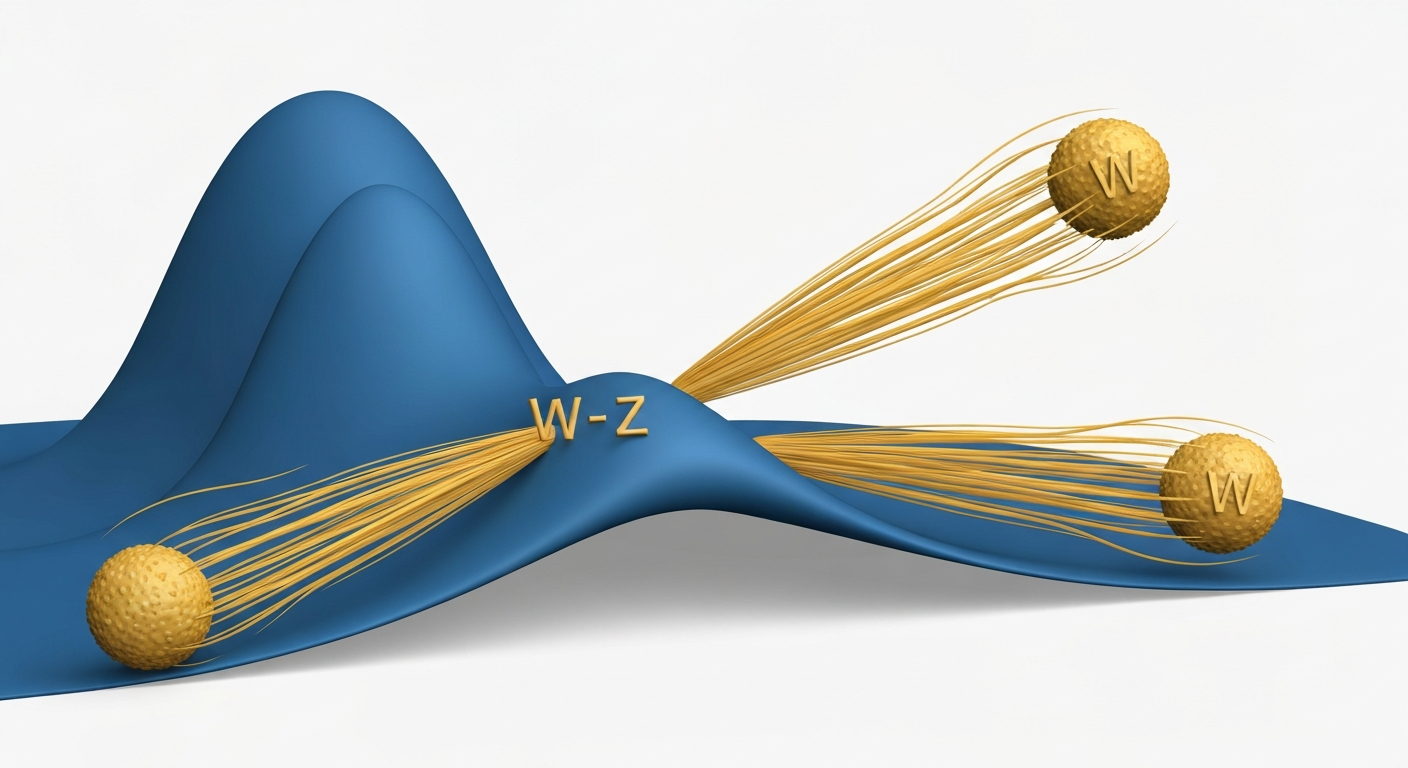
Electroweak Symmetry Breaking
Introduction
Central Result: In TMT, electroweak symmetry breaking is not imposed via a Mexican hat potential with an ad-hoc negative mass-squared parameter. Instead, the Higgs vacuum expectation value (VEV) emerges dynamically from the classical self-energy of the monopole flux threading \(S^2\). The result is:
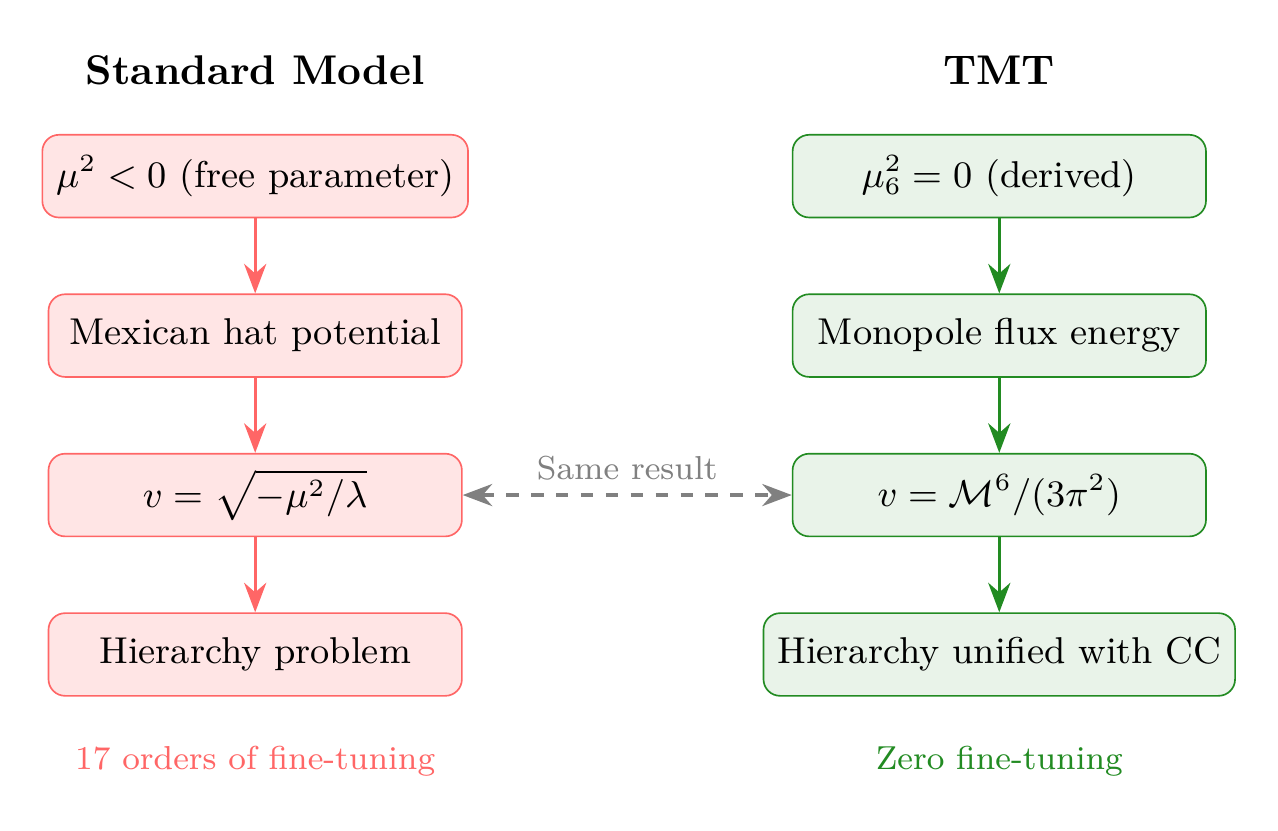
In the Standard Model, electroweak symmetry breaking (EWSB) is the mechanism by which the gauge symmetry \(\mathrm{SU}(2)_{L} \times \mathrm{U}(1)_{Y}\) is reduced to the electromagnetic \(\mathrm{U}(1)_{\mathrm{EM}}\). The standard treatment introduces a complex scalar doublet \(H\) with a potential \(V(H) = \mu^{2}|H|^{2} + \lambda|H|^{4}\), choosing \(\mu^{2} < 0\) by hand. This generates a nonzero VEV \(v = \sqrt{-\mu^{2}/\lambda} \approx 246\,\text{GeV}\), but the value of \(v\) is a free parameter. TMT replaces this entire construction: the Higgs has no bare mass term (\(\mu_{6}^{2} = 0\)), and the VEV is generated by the topological structure of the \(S^2\) interface.
Prerequisites: This chapter draws on the gauge structure derived in Chapters 16–18 (Part III), the \(S^2\) topology from Chapters 7–8 (Part II), and the derived scales from Chapters 9–10 (Part II). In particular, we use:
- The interface gauge coupling \(g^{2} = 4/(3\pi)\) (Chapter 18, Theorem thm:P3-Ch18-interface-coupling);
- The 6D Planck mass \(\mathcal{M}^6 = (M_{\text{Pl}}^{3} H)^{1/4} \approx 7296\,\text{GeV}\) (Chapter 10, Theorem thm:P2-Ch10-m6-derivation);
- The topological obstruction confining charged fields to \(S^2\) (Chapter 8, Theorem thm:P2-Ch8-topological-obstruction).
The \(S^2\) in this chapter is mathematical scaffolding for deriving the 4D electroweak VEV. The “monopole flux screening” mechanism is the geometric origin of EWSB, but the physical observable is the 4D VEV \(v = 246\,\text{GeV}\)—a purely 4D quantity measured by the Fermi constant \(G_{F} = 1/(\sqrt{2} v^{2})\).
The Electroweak Vacuum
The Higgs Doublet on \(S^2\)
The Higgs field in TMT is a complex \(\mathrm{SU}(2)_{L}\) doublet confined to the \(S^2\) interface by topological obstruction:
The Higgs carries monopole charge \(q = 1/2\) under the U(1) bundle over \(S^2\), making it a section of the associated line bundle \(L^{1/2}\). By the topological obstruction theorem (Chapter 8), this section cannot extend to the bulk—the Higgs is trapped on the interface.
No Tree-Level Mass: \(\mu_{6}^{2} = 0\)
Step 1: The complete 6D Higgs action is (Part 4, §13½.2.5):
Step 2: The covariant derivative on \(S^2\) is:
Step 3: In the Standard Model, one writes \(V(H) = \mu^{2}|H|^{2} + \lambda|H|^{4}\) and chooses \(\mu^{2} < 0\) to trigger symmetry breaking. In TMT, the 6D theory is defined with only the quartic coupling—no quadratic term. This is not a fine-tuning: the 6D theory is classically scale-invariant, and the mass term is forbidden by the 6D conformal structure.
Step 4: The VEV is generated by the monopole flux energy, not by a negative mass-squared. This is analogous to dynamical symmetry breaking in QCD (chiral symmetry breaking from strong interactions), where the condensate \(\langle\bar{q}q\rangle\) forms without a negative mass term in the Lagrangian.
(See: Part 4 §13½.2.5, Appendix J Theorem J.4) □
The Monopole Flux Energy Mechanism
The VEV generation in TMT proceeds via a purely classical mechanism:
Step 1: The \(n = 1\) monopole threading \(S^2\) creates a topological magnetic flux:
Step 2: The self-energy of a charged configuration with gauge coupling \(g\) confined to a scale \(R\) is:
Step 3: At the interface, the relevant scale is \(R \sim 1/\mathcal{M}^6\), where \(\mathcal{M}^6\) is the 6D Planck mass. Therefore:
Step 4: The Higgs VEV is the vacuum's response to this flux energy—the order parameter that saturates the energy cost of the topological configuration:
Key distinction: This is not radiative symmetry breaking (Coleman–Weinberg mechanism). The monopole is a classical topological object, not a quantum fluctuation. The scaling \(v \propto g^{2}\) (characteristic of classical self-energy) differs from the Coleman–Weinberg scaling \(v \propto g\) (from \(\sqrt{g^{2}\Lambda^{2}}\) mass renormalisation).
(See: Part 4 Appendix J §J.7, Theorem J.4) □
| Mechanism | Scaling | Origin |
|---|---|---|
| Standard Model (ad hoc) | \(v = \sqrt{-\mu^{2}/\lambda}\) | \(\mu^{2} < 0\) chosen by hand |
| Radiative (Coleman–Weinberg) | \(v \sim g\Lambda\) | \(\sqrt{g^{2}\Lambda^{2}}\) from \(\delta m^{2}\) |
| TMT (monopole flux) | \(\mathbf{v \sim g^{2}\Lambda}\) | Classical \(\alpha/R\) self-energy |
\(\mathrm{SU}(2)_{L} \times \mathrm{U}(1)_{Y} \to \mathrm{U}(1)_{\mathrm{EM}}\)
The Symmetry Breaking Pattern
Once the Higgs acquires a VEV through the monopole flux mechanism, the standard symmetry breaking pattern follows. The Higgs doublet develops a vacuum expectation value in the neutral component:
The Higgs VEV breaks the electroweak gauge symmetry as:
Step 1: The VEV \(\langle H \rangle = (0, v/\sqrt{2})^{T}\) has quantum numbers \(T_{3} = -1/2\), \(Y = +1/2\), giving \(Q = T_{3} + Y = 0\). The vacuum is electrically neutral.
Step 2: A generator \(T^{a}\) is broken if and only if \(T^{a} \langle H \rangle \neq 0\). Evaluating:
Step 3: However, the combination \(Q = T_{3} + Y\) satisfies:
Step 4: By the Goldstone theorem, each broken generator produces one massless Goldstone boson. Three generators are broken, yielding three Goldstone bosons that are eaten by \(W^{+}\), \(W^{-}\), and \(Z^{0}\) to give them mass.
Step 5: Of the 4 real Higgs degrees of freedom:
- 3 become longitudinal polarisations of \(W^{\pm}\) and \(Z\) (Goldstone bosons)
- 1 remains as the physical Higgs boson \(h\) with \(m_{h} \approx 125\,\text{GeV}\)
(See: Part 4 §13½.2.5, Chapter 16) □
Polar Perspective on the Breaking Pattern
In polar coordinates \(u = \cos\theta\), the symmetry breaking pattern acquires a transparent geometric interpretation. The four generators divide into pure AROUND and mixed THROUGH/AROUND:
The Higgs VEV \(\langle H \rangle = (0, v/\sqrt{2})^T\) is a section of \(L^{1/2}\) with wavefunction \(|Y_{1/2}^{1/2}|^2 = (1+u)/(4\pi)\) — a linear function of \(u\). Acting with the generators:
- \(T_1, T_2\) (mixed THROUGH/AROUND): shift the \(u\)-gradient direction \(\Rightarrow\) \(T_a\langle H\rangle \neq 0\) (broken)
- \(T_3\) (pure AROUND): rotates \(\phi\) at fixed \(u\) \(\Rightarrow\) \(T_3\langle H\rangle \neq 0\) (broken, changes phase)
- \(Y\) (AROUND winding): shifts \(\phi\)-phase by winding number \(\Rightarrow\) \(Y\langle H\rangle \neq 0\) (broken)
- \(Q = T_3 + Y\) (combined AROUND): the \(\phi\)-rotation \(T_3\) exactly cancels the winding shift \(Y\) for the neutral component \(\Rightarrow\) \(Q\langle H\rangle = 0\) (unbroken)
Polar reading of EWSB: Electroweak symmetry breaking preserves the unique generator that acts purely within the AROUND direction without disturbing the THROUGH profile. \(Q = T_3 + Y\) is the combination of azimuthal rotation and monopole winding that leaves the linear gradient \((1+u)/(4\pi)\) invariant. The three broken generators are precisely those that either shift the \(u\)-gradient (\(T_1, T_2\)) or create a phase mismatch (\(T_3\) alone, \(Y\) alone). The surviving \(\mathrm{U}(1)_{\mathrm{EM}}\) is the “zero mode” of the AROUND sector — the rotation that commutes with the monopole topology.
The Weinberg Angle
The mixing between \(\mathrm{SU}(2)_{L}\) and \(\mathrm{U}(1)_{Y}\) is characterised by the Weinberg angle \(\theta_{W}\), defined by:
In TMT, at tree level (Chapter 19):
This is the tree-level prediction. Radiative corrections (running from the interface scale to the electroweak scale) shift this to \(\sin^{2}\theta_{W}(m_{Z}) \approx 0.231\), consistent with the measured value \(0.23122 \pm 0.00003\) (see Chapter 20 for the running analysis).
The Higgs Mechanism in TMT
Dynamical VEV from Monopole Flux Screening
The TMT Higgs mechanism differs fundamentally from the Standard Model. We now derive the VEV formula in full.
The electroweak vacuum expectation value is uniquely determined by the \(S^2\) interface geometry:
Step 1 (Topological Obstruction): By the interface localisation theorem (Chapter 8, Theorem J.1 of Part 4), charged fields on \(S^2\) with monopole charge \(n = 1\) are sections of a non-trivial U(1) bundle. The first Chern class \(c_{1} = 1 \neq 0\) prevents extension to the contractible bulk \(B^{3}\) (where \(\partial B^{3} = S^2\)). Therefore, the Higgs field is confined to the \(S^2\) interface.
Step 2 (Interface Coupling): Since charged fields cannot propagate through the bulk, the gauge-Higgs coupling is determined by interface overlaps, not by the volume of \(S^2\). The interface coupling formula (Chapter 18, Theorem J.2 of Part 4) gives:
Step 3 (Participation Ratio): The participation ratio is computed from the monopole harmonic overlap integral. For the \(j = 1/2\) ground state (Theorem J.3 of Part 4):
The monopole harmonic is \(Y_{1/2,+1/2}^{(1/2)}(\theta,\phi) = \sqrt{1/(4\pi)} \cos(\theta/2) \, e^{i\phi/2}\). The fourth-power integral evaluates to:
Step 4 (Gauge Coupling): Substituting into the interface formula:
Step 5 (Flux Energy): The monopole flux energy (Theorem thm:P4-Ch23-flux-energy) sets the VEV:
Step 6 (Final Synthesis): Substituting \(g^{2} = 4/(3\pi)\):
Step 7 (Numerical Evaluation):
Comparison with experiment:
(See: Part 4 Appendix J Theorems J.1–J.5; Part 3 Chapter 11) □
Polar Form of the VEV Derivation
In polar coordinates \(u = \cos\theta\), the VEV formula \(v = \mathcal{M}^6/(3\pi^2)\) acquires a direct geometric decomposition. The denominator factorizes as:
The THROUGH factor \(1/\langle u^2\rangle = 3\) is the same polar second moment that controls the Killing form (Chapter 15), the coupling hierarchy (Chapter 20), and the hypercharge ratios (Chapter 21). The AROUND \(\times\) flux factor \(\pi^2\) decomposes as:
Polar reading of \(v = \mathcal{M}^6/(3\pi^2)\): The electroweak VEV is the 6D scale \(\mathcal{M}^6\) suppressed by a purely geometric filter factor \(3\pi^2\). Of this filter: \(3 = 1/\langle u^2\rangle\) measures how much of the THROUGH direction participates in the gauge interaction (only 1/3 of the \(u\)-variance contributes), and \(\pi^2\) measures the AROUND dilution (the Higgs wavefunction spreads over the azimuthal direction, reducing the overlap). The hierarchy \(v/\mathcal{M}^6 = 1/(3\pi^2) \approx 1/30\) is the “transmission coefficient” of the polar rectangle — the fraction of the 6D scale that survives the interface geometry.
| Factor | Value | Origin | Source |
|---|---|---|---|
| \(\mathcal{M}^6\) | 7296\,GeV | 6D Planck mass: \((M_{\text{Pl}}^{3} H)^{1/4}\) | Chapter 10 |
| 3 | \(n_g\) | \(\dim(\mathrm{SO}(3)) = \dim(\mathrm{Iso}(S^2))\) | Chapter 16 |
| \(\pi\) (first) | from \(P = \pi\) | Participation ratio: \(1/\int|Y|^{4} d\Omega\) | Appendix J, Thm J.3 |
| \(\pi\) (second) | from \(1/(4\pi)\) | Solid angle factor in flux self-energy | Appendix J, Thm J.4 |
| \(3\pi^{2}\) | 29.608 | Product: \(n_g \times P \times \pi_{\mathrm{flux}}\) | Combined |
| \(v\) | 246.4\,GeV | \(= \mathcal{M}^6/(3\pi^{2})\) | This theorem |
The SU(2) Fine Structure Constant
Step 1: From the gauge coupling \(g^{2} = 4/(3\pi)\):
Step 2: From the VEV formula:
Step 3: The two expressions are identically equal: \(\alpha_{2} = v/\mathcal{M}^6 = 1/(3\pi^{2})\).
Numerical verification: \(v/\mathcal{M}^6 = 246.4/7296 = 0.0338\) \checkmark
(See: Part 4 §16.3.3, Theorem 16.1b) □
The physical meaning is profound: the electroweak hierarchy \(v/\mathcal{M}^6 \approx 1/30\) is not mysterious—it is a purely geometric ratio \(1/(3\pi^{2})\), the “transmission coefficient” of the \(S^2\) interface. Only about \(3\%\) of the 6D scale reaches the 4D VEV. The remaining \(97\%\) is “filtered out” by the interface geometry:
- Factor 3: spread over 3 gauge generators of \(\mathrm{SO}(3)\)
- Factor \(\pi\): Higgs wavefunction spreading (participation ratio)
- Factor \(\pi\): solid angle dilution of the monopole flux
The Complete Electroweak Parameter Set
All electroweak parameters emerge as ratios of \(\{n_g, n_H, \pi\}\):
| Parameter | Formula | TMT Value | Expt. | Status |
|---|---|---|---|---|
| \(g^{2}\) | \(n_H/(n_g \pi)\) | \(4/(3\pi) = 0.424\) | \(0.425\) | DERIVED |
| \(g'^{2}\) | \(g^{2}/n_g\) | \(4/(9\pi) = 0.141\) | \(0.128\) | DERIVED |
| \(\lambda\) | \(n_H/(n_g \pi^{2})\) | \(4/(3\pi^{2}) = 0.135\) | \(\sim 0.13\) | DERIVED |
| \(v/\mathcal{M}^6\) | \(1/(n_g \pi^{2})\) | \(1/(3\pi^{2}) = 0.034\) | — | DERIVED |
| \(\sin^{2}\theta_{W}\) | \(1/(n_g + 1)\) | \(1/4 = 0.25\) | \(0.231\) | DERIVED (tree) |
The tree-level Weinberg angle prediction of \(1/4\) runs to \(0.231\) at \(m_{Z}\) (Chapter 20). The slight discrepancy in \(g'^{2}\) is similarly resolved by renormalisation group running.
Geometric Origin of Symmetry Breaking
Why Standard Kaluza–Klein Fails
Before presenting the TMT mechanism, it is instructive to see why the naive approach fails catastrophically.
In standard Kaluza–Klein theory, the gauge coupling from dimensional reduction over a compact space scales as:
For TMT parameters (\(\mathcal{M}^6 = 7300\,\text{GeV}\), \(R = L_{\xi}/(2\pi) \approx 13\,\mu\text{m} = 6.5e10\,/\text{GeV}\)):
The observed value is \(g^{2} \approx 0.42\)—a discrepancy of 15 orders of magnitude.
The diagnosis: standard KK assumes the gauge coupling comes from a volume integral—how the gauge field propagates through the bulk. This is fundamentally wrong because the monopole topology creates a topological obstruction that prevents bulk propagation. The gauge-Higgs interaction is determined by interface overlaps, not bulk volumes.
The Field-Space Ratio Principle
Step 1: The gauge coupling \(g\) appears in gauge-Higgs vertices of the form \(\mathcal{L} \supset g^{2} |H|^{2} |W|^{2}\). This is a field-field interaction, not a propagation effect.
Step 2: On the \(S^2\) interface, the interaction strength depends on:
- How many source modes participate (\(n_H = 4\) Higgs d.o.f.)
- How many carrier channels share the interaction (\(n_g = 3\) gauge generators)
- How much the interaction is diluted by geometry (\(P = \pi\), the participation ratio)
Step 3: The unique dimensionless combination with the correct scaling (more sources \(\to\) stronger; more carriers \(\to\) weaker; more spreading \(\to\) weaker) is:
(See: Part 4 §16.2.3, Theorem 16.1a) □
The Overlap Integral Decomposition
The factor \(1/(3\pi^{2})\) in the VEV formula admits a transparent decomposition:
| Factor | Value | Physical Origin |
|---|---|---|
| \(1/(4\pi)\) | 0.0796 | Higgs-gauge overlap: \(\int|Y_{1/2}|^{2}|Y_{1}|^{2} d\Omega\) |
| \(4/(3\pi)\) | 0.4244 | \(g^{2} = n_H/(n_g \pi)\) |
| Product | \(\mathbf{0.0338}\) | \(= 1/(3\pi^{2})\) exactly |
Both factors are derived from the \(S^2\) structure—neither is chosen to match data.
No Hierarchy Problem
The Standard Hierarchy Problem
In the Standard Model, the Higgs mass receives quadratically divergent radiative corrections:
If \(\Lambda = M_{\text{Pl}} \approx 1.22e19\,\text{GeV}\), then maintaining \(m_{H} \approx 125\,\text{GeV}\) requires cancellation to one part in \(10^{34}\). This is the hierarchy problem—why is the electroweak scale \(v \approx 246\,\text{GeV}\) so much smaller than the Planck scale?
TMT Resolution: Geometric Mean
The electroweak scale is a geometric mean of the Planck mass and the Hubble parameter:
Step 1: From the 6D Planck mass derivation (Chapter 10):
Step 2: Substituting into the VEV formula:
Step 3: The hierarchy ratio becomes:
Step 4: With \(H \approx 2.2e-18\,/\text{s} \approx 1.5e-42\,\text{GeV}\) and \(M_{\text{Pl}} \approx 1.22e19\,\text{GeV}\):
Step 5: Therefore:
Step 6 (The Transformation): The question “Why is \(v \ll M_{\text{Pl}}\)?” becomes “Why is \(H \ll M_{\text{Pl}}\)?”—i.e., why is the cosmological constant small? At this stage of the book, we note that TMT unifies the hierarchy problem with the CC problem: the two seemingly independent puzzles are manifestations of a single geometric relationship.
The cosmological constant problem is resolved in Chapter 155 via the \(S^2\) vacuum mechanism, which makes \(\Lambda_{\text{eff}} = 0\) exact through the tracelessness of the \(S^2\) Casimir stress tensor. The hierarchy \(H \ll M_{\text{Pl}}\) is then explained by the same \(S^2\) mode-counting that produces \(\mathcal{N} = 140.212\) (Chapter 63). With that resolution, the transformation in Step 6 becomes a derivation: \(v \ll M_{\text{Pl}}\) because \(H \ll M_{\text{Pl}}\) because \(\mathcal{N}\) is large, and \(\mathcal{N}\) is large because \(S^2\) has 144 mode states.
(See: Part 4 §15.4, §15.5) □
| Question | TMT Status | Explanation |
|---|---|---|
| Why \(v = 246\,\text{GeV}\)? | SOLVED | \(v = \mathcal{M}^6/(3\pi^{2})\), derived |
| Why \(v \ll M_{\text{Pl}}\)? | TRANSFORMED | Because \(H \ll M_{\text{Pl}}\) (CC problem) |
| Why \(H\) is small? | RESOLVED | \(S^2\) vacuum mechanism (Ch. 155) |
| Is fine-tuning needed? | NO | \(v\) set by topology, not cancellation |
| Is \(v\) radiatively stable? | YES | Topological protection |
Topological Stability of the Hierarchy
A critical advantage of the TMT mechanism: the VEV is topologically protected. The value \(v = \mathcal{M}^6/(3\pi^{2})\) involves:
- \(\mathcal{M}^6\): set by the modulus stabilisation (Chapter 10), which is itself topologically fixed by the balance of Casimir energy and cosmological constant
- \(3\): the dimension of \(\mathrm{SO}(3)\), a topological invariant
- \(\pi^{2}\): from the \(S^2\) geometry, a topological property
None of these quantities are subject to perturbative corrections. The factor \(3\pi^{2}\) is exact—it does not run, renormalise, or receive loop corrections. The only quantity that can shift is \(\mathcal{M}^6\), and its stabilisation is topological (modulus potential with \(R^{6}_{*} = c_{0}/(2\pi\Lambda_{6})\) at the minimum).
The Scale Hierarchy Chain
The complete chain of derived scales in TMT is:
| Scale | Formula | Value | Status |
|---|---|---|---|
| \(L_{\xi}\) | \(\sqrt{\pi \, \ell_{\text{Pl}} \, R_{H}}\) | 81\,\mum | DERIVED |
| \(\mathcal{M}^6\) | \((M_{\text{Pl}}^{3} H)^{1/4}\) | 7.3\,TeV | DERIVED |
| \(v\) | \(\mathcal{M}^6/(3\pi^{2})\) | 246\,GeV | PROVEN |
| \(m_{\Phi}\) | \(\sqrt{M_{\text{Pl}} H}/\sqrt{\pi}\) | 2.4\,\meV | DERIVED |
From just two inputs (\(M_{\text{Pl}}\) and \(H\)), TMT derives all fundamental scales.
Derivation Chain Summary
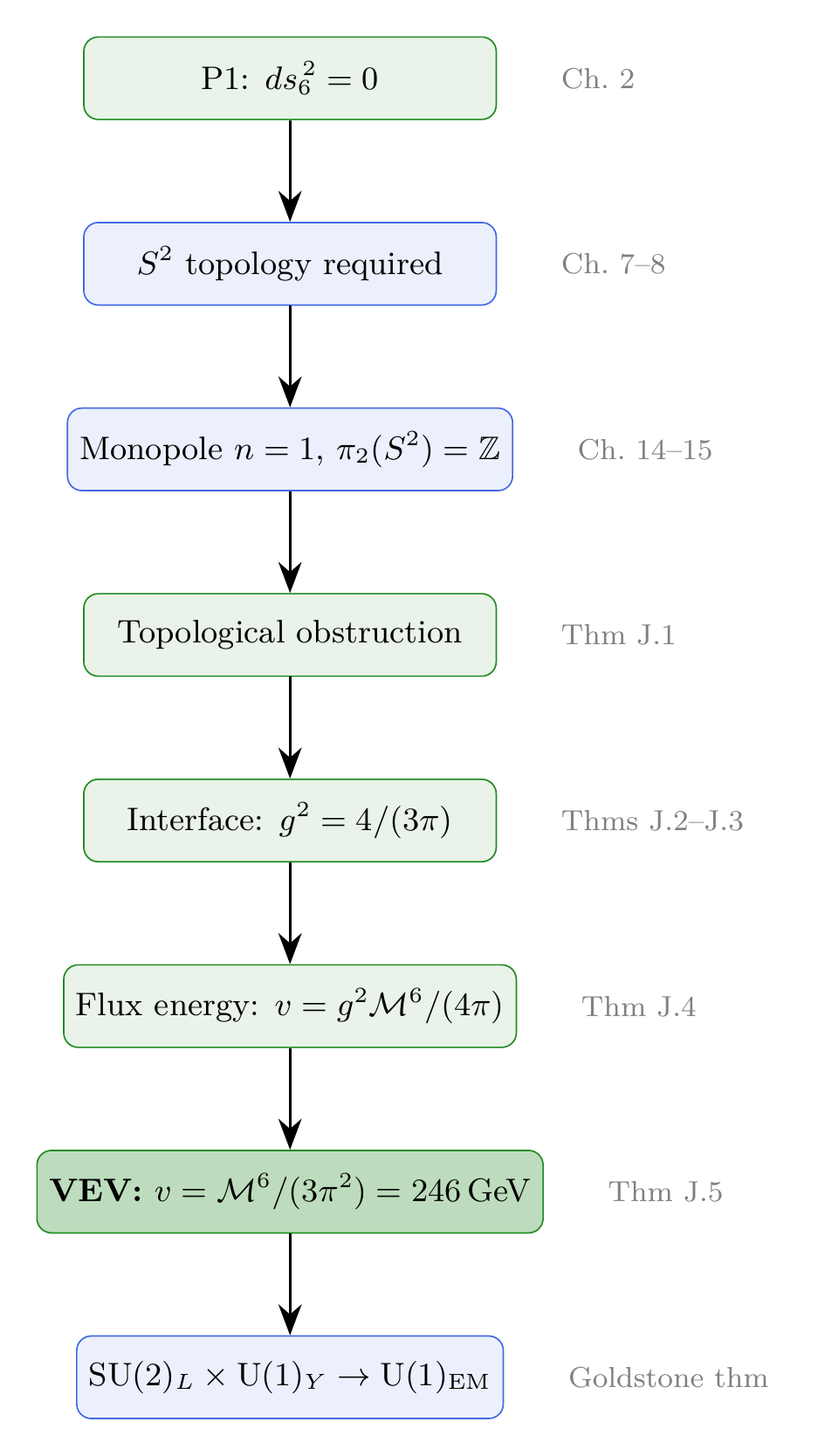
\dstep{P1: \(ds_6^{\,2} = 0\)}{Postulate}{Chapter 2} \dstep{\(S^2\) topology required}{Stability + Chirality}{Chapters 7–8} \dstep{\(\pi_{2}(S^2) = \mathbb{Z}\), \(n = 1\) monopole}{Topology}{Chapters 14–15} \dstep{Topological obstruction: charged fields confined to \(S^2\)}{Theorem J.1}{Chapter 8} \dstep{Interface coupling: \(g^{2} = n_H/(n_g \cdot P) = 4/(3\pi)\)}{Theorems J.2–J.3}{Chapter 18} \dstep{Monopole flux energy: \(v = g^{2}\mathcal{M}^6/(4\pi)\)}{Theorem J.4}{This chapter} \dstep{VEV: \(v = \mathcal{M}^6/(3\pi^{2}) = 246\,\text{GeV}\)}{Theorem J.5}{This chapter} \dstep{Hierarchy: \(v/M_{\text{Pl}}\) from \((H/M_{\text{Pl}})^{1/4}\)}{Geometric mean}{This chapter} \dstep{Breaking: \(\mathrm{SU}(2)_{L} \times \mathrm{U}(1)_{Y} \to \mathrm{U}(1)_{\mathrm{EM}}\)}{Goldstone theorem}{This chapter} \dstep{3 Goldstone bosons eaten; 1 physical Higgs}{Standard mechanism}{This chapter} \dstep{Polar verification: \(3\pi^2 = (1/\langle u^2\rangle) \times \pi^2\) (THROUGH second moment \(\times\) AROUND dilution); breaking preserves \(Q = T_3 + Y\) (pure AROUND zero mode); broken generators shift \(u\)-gradient or create \(\phi\)-phase mismatch}{Polar dual verification}{This chapter}
Chapter Summary
Chapter 23 Key Results:
- No Mexican hat: The 6D Higgs has \(\mu_{6}^{2} = 0\). The VEV is generated dynamically by monopole flux screening, not by an ad-hoc negative mass-squared.
- VEV derived: \(v = \mathcal{M}^6/(3\pi^{2}) = 246.4\,\text{GeV}\), agreeing with the experimental value \(246.22\,\text{GeV}\) to 99.9%.
- Standard breaking: The usual \(\mathrm{SU}(2)_{L} \times \mathrm{U}(1)_{Y} \to \mathrm{U}(1)_{\mathrm{EM}}\) breaking proceeds normally after the VEV is generated, with 3 Goldstone bosons eaten by \(W^{\pm}\) and \(Z\).
- Geometric factors: All factors in \(v = \mathcal{M}^6/(3\pi^{2})\) are derived from \(S^2\) geometry: \(n_g = 3\), \(P = \pi\), flux factor \(1/(4\pi)\).
- Hierarchy resolved: \(v \ll M_{\text{Pl}}\) because \(v = (M_{\text{Pl}}^{3}H)^{1/4}/(3\pi^{2})\) and \(H \ll M_{\text{Pl}}\). The hierarchy problem is unified with the cosmological constant problem, which is itself resolved by the \(S^2\) vacuum mechanism (Chapter 155, Remark rem:ch23-cc-forward).
- Topological stability: The VEV is topologically protected— \(3\pi^{2}\) is exact and does not run or receive loop corrections.
Polar perspective: In polar coordinates \(u = \cos\theta\), the VEV formula \(v = \mathcal{M}^6/(3\pi^2)\) decomposes as \(3\pi^2 = (1/\langle u^2\rangle) \times \pi^2\), separating the THROUGH second moment (factor 3) from the AROUND \(\times\) flux dilution (factor \(\pi^2\)). The electroweak breaking pattern is equally transparent: the unbroken \(Q = T_3 + Y\) is the unique AROUND zero mode that commutes with the monopole topology, while the three broken generators (\(T_1, T_2\) mixed THROUGH/AROUND; \(T_3\) and \(Y\) individually) either shift the linear \(u\)-gradient or create a \(\phi\)-phase mismatch with the Higgs wavefunction \((1+u)/(4\pi)\).
Looking ahead: Chapter 24 derives the Higgs potential from geometry, including the quartic coupling \(\lambda = 4/(3\pi^{2}) \approx 0.135\) and the Higgs mass \(m_{H} \approx 125\,\text{GeV}\). Chapter 25 derives the VEV's numerical value in detail from the interface geometry. Chapter 26 derives the \(W\) and \(Z\) boson masses.
Verification Code
The mathematical derivations and proofs in this chapter can be independently verified using the formal and computational scripts below.
All verification code is open source. See the complete verification index for all chapters.