
The Aggregate Certainty Theorem
Introduction
The Temporal Determination Theorem (Chapter 90) established that probability distributions over future aggregate events are geometric consequences of P1. This chapter proves the complementary result: as the number of particles \(N\) grows, aggregate observables become deterministic—their fluctuations vanish exponentially.
This is the Aggregate Certainty Theorem, which provides the mathematical foundation for why collective properties can be predicted even though individual outcomes cannot. The result follows from concentration of measure on the product space \((S^2)^N\), which is itself a consequence of the positive curvature of \(S^2\) and the derived natural measure of Chapter 88.
The Aggregate Certainty Theorem operates at the interface between \(S^2\) scaffolding and 4D physics. The concentration bound arises from the geometry of \(S^2\) (scaffolding), but its physical consequence—macroscopic determinism—is a 4D observable prediction.
Averaging Over Futures
Concentration of Measure
A probability measure \(\mu\) on a space \(X\) exhibits concentration of measure if, for typical Lipschitz functions \(f : X \to \mathbb{R}\):
The key intuition is that in high-dimensional spaces, “most” of the measure is concentrated near the average value of any sufficiently smooth function. Extreme values become exponentially rare as the dimension grows.
Lévy's Lemma on \(S^2\)
The starting point is a classical result from geometric measure theory, applied to the specific geometry of \(S^2\).
Let \(f : S^2 \to \mathbb{R}\) be a function with Lipschitz constant \(L\):
This is a standard result in geometric measure theory. The derivation proceeds in three steps:
Step 1: The uniform measure on \(S^2\) satisfies a log-Sobolev inequality. For the sphere of radius \(r\), the log-Sobolev constant is \(\rho_{\mathrm{LS}} = 1/(r^2)\), which for the unit sphere gives \(\rho_{\mathrm{LS}} = 1\).
Step 2: By Herbst's argument, the log-Sobolev inequality implies sub-Gaussian concentration. Specifically, for any Lipschitz function \(f\) with constant \(L\):
Step 3: Applying the Chernoff bound (optimizing over \(\lambda\)) yields the stated concentration inequality.
The positive Ricci curvature of \(S^2\) (\(\mathrm{Ric} = 1/r^2\)) is the geometric origin of the concentration phenomenon. (See: Ledoux (2001), Theorem 5.1) □ □
Extension to Product Spaces
For product measures, concentration “tensorizes”: if each factor exhibits concentration with a given parameter, the product exhibits enhanced concentration proportional to \(N\).
Step 1: The product measure on \((S^2)^N\) is:
Step 2: Each \(S^2\) factor satisfies Lévy's lemma (Lemma lem:P12-Ch91-levy) with log-Sobolev constant \(\rho_{\mathrm{LS}} = 1\).
Step 3: By the tensorization property of log-Sobolev inequalities (Ledoux, Theorem 5.7), the product space has log-Sobolev constant:
Step 4: Repeating the Herbst–Chernoff argument with the enhanced log-Sobolev constant gives the stated bound with the factor of \(N\) in the exponent. □ □
The factor of \(N\) in the exponent is the crucial feature: concentration improves exponentially with particle number.
Polar Field Form of Product Concentration
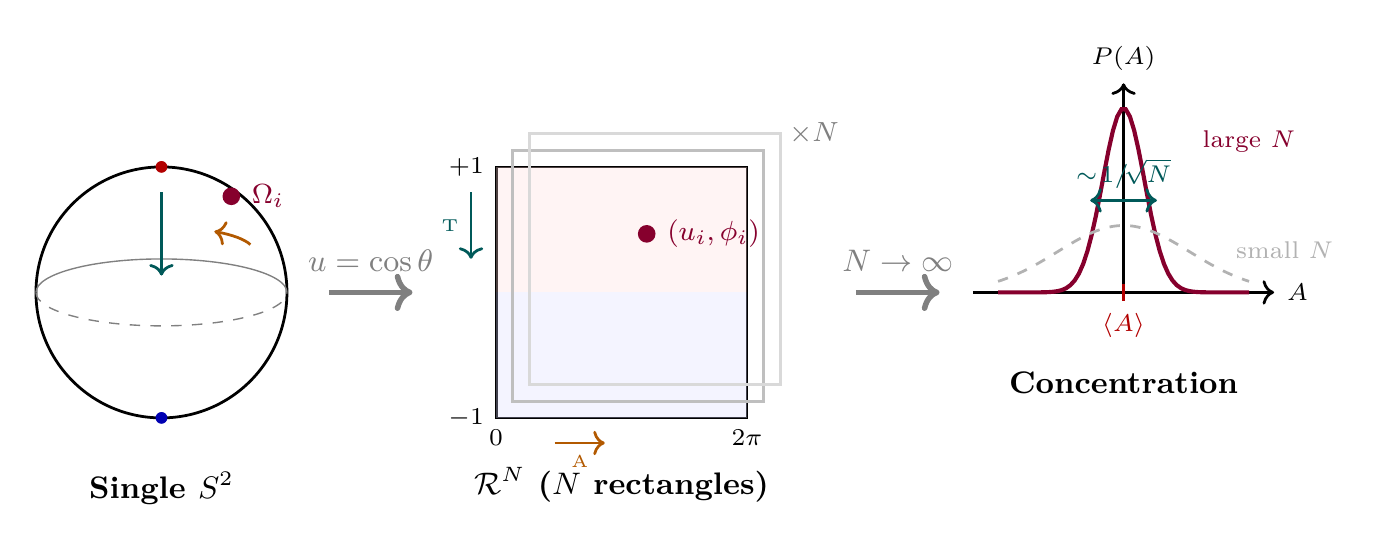
The concentration on \((S^2)^N\) becomes geometrically transparent in the polar field variable \(u = \cos\theta\). Each \(S^2\) factor maps to a flat rectangle \(\mathcal{R} = [-1,+1] \times [0,2\pi)\), so the product space becomes:
The product measure of Eq. eq:ch91-product-measure takes the explicit form:
The tensorization that drives concentration (Eq. eq:ch91-tensorization) is now manifest: flat rectangles tensorize trivially, and the log-Sobolev constant scales as \(N\) because each independent rectangle contributes additively. The concentration bound becomes:
For functions that factorize into THROUGH and AROUND components, \(F(\{u_i,\phi_i\}) = G(\{u_i\}) \cdot H(\\phi_i\)\), the concentration decomposes:
Property | Spherical \((\theta, \phi)\) | Polar \((u, \phi)\) |
|---|---|---|
| Single-particle space | \(S^2\) (curved) | \(\mathcal{R} = [-1,+1] \times [0,2\pi)\) (flat measure) |
| \(N\)-particle space | \((S^2)^N\) | \(\mathcal{R}^N\) (\(N\) independent rectangles) |
| Measure | \(\prod d\Omega_i/(4\pi)\) | \(\prod du_i\,d\phi_i/(4\pi)\) (flat Lebesgue) |
| Area per particle | \(4\pi\) | \(2 \times 2\pi\) (THROUGH \(\times\) AROUND) |
| Determinant | \(\sqrt{\det h} = R^2 \sin\theta\) (variable) | \(\sqrt{\det h} = R^2\) (constant) |
| Tensorization | Abstract (log-Sobolev) | Manifest (flat \(\times\) flat = flat) |
| Concentration source | Positive Ricci curvature | Curvature in \(h_{uu} = R^2/(1-u^2)\) (metric, not measure) |
The polar form reveals a key structural insight: concentration of measure on \((S^2)^N\) is not driven by curvature of the measure (which is flat in polar coordinates) but by curvature of the metric (which determines the Lipschitz condition). The distinction between flat measure and curved distance is invisible in spherical coordinates but transparent in the polar field variable.
Scaffolding note: The polar field variable \(u = \cos\theta\) is a coordinate choice, not a new physical assumption. The product space \(\mathcal{R}^N = [-1,+1]^N \times [0,2\pi)^N\) is the same mathematical object as \((S^2)^N\); the flat-rectangle picture is a representation that makes tensorization manifest. The physical conclusion—aggregate certainty with exponential concentration—follows identically in both coordinate systems.
Certainty from Indeterminacy
Statement of the Aggregate Certainty Theorem
Let \(A : \mathcal{F}_t \to \mathbb{R}\) be an aggregate observable that:
- Is symmetric under particle permutation.
- Has Lipschitz constant \(L\) with respect to the \(S^2\) components.
Then:
Consequently:
Step 1: Decompose the configuration space.
A configuration \(\Sigma \in \mathcal{F}_t\) consists of spatial positions \(\{x_i\}\) and \(S^2\) configurations \(\\Omega_i\). For fixed spatial positions, \(A\) becomes a function on \((S^2)^N\).
Step 2: Apply concentration on \((S^2)^N\).
For fixed \(\{x_i\}\), Theorem thm:P12-Ch91-product-concentration gives:
Step 3: Average over spatial positions.
The bound is independent of \(\{x_i\}\) (it depends only on \(N\), \(\varepsilon\), and \(L\)), so averaging over the spatial measure preserves the bound:
Step 4: The limit.
As \(N \to \infty\), the exponential \(\exp(-N\varepsilon^2/(2L^2)) \to 0\) for any fixed \(\varepsilon > 0\). □ □
Deterministic Aggregates
Relative Fluctuations
For additive observables \(A = \sum_i a_i\) with identical, independent contributions \(a_i\):
Therefore, the relative standard deviation is:
This is the standard \(1/\sqrt{N}\) scaling of statistical mechanics, here derived from the geometric concentration bound. □ □
Derivation Chain Display
\dstep{P1: \(ds_6^{\,2} = 0\) on \(\mathcal{M}^4 \times S^2\)}{Postulate}{Part 1} \dstep{\(S^2\) has positive Ricci curvature}{Geometry of \(S^2\)}{Ch. 87} \dstep{Uniform measure on \(S^2\) satisfies log-Sobolev inequality} {Curvature \(\to\) log-Sobolev}{Ch. 88} \dstep{Lévy's lemma: exponential concentration on \(S^2\)} {Herbst argument}{This chapter} \dstep{Tensorization: concentration on \((S^2)^N\) with factor \(N\)} {Product log-Sobolev}{This chapter} \dstep{Aggregate Certainty Theorem: \(P(|A - \langle A\rangle| > \varepsilon) \leq 2e^{-N\varepsilon^2/(2L^2)}\)} {Spatial averaging}{This chapter} \dstep{Large-\(N\) determinism: aggregates become certain} {\(N \to \infty\) limit}{This chapter} \dstep{Polar verification: \(d\mu_N = \prod du_i\,d\phi_i/(4\pi)\) flat Lebesgue on \(\mathcal{R}^N\); tensorization manifest; concentration from metric curvature \(h_{uu} = R^2/(1-u^2)\), not measure curvature} {Polar coordinate reformulation}{\Ssec:ch91-polar-product}
Macroscopic Determinism
The Psychohistory Threshold
We require:
From the Aggregate Certainty Theorem (Theorem thm:P12-Ch91-aggregate-certainty):
Solving for \(N\):
Numerical Examples
Example 1: Thermodynamic prediction. For a gas with normalized Lipschitz constant \(L = 1\), requiring 1% accuracy (\(\varepsilon = 0.01\)) at 99% confidence (\(\delta = 0.01\)):
Systems with \(N > 10^5\) particles are predictable to 1% with 99% confidence.
Example 2: High-precision prediction. For 0.1% accuracy (\(\varepsilon = 0.001\)) at 99.9% confidence (\(\delta = 0.001\)):
High-precision prediction requires \(N > 10^7\) particles.
Example 3: Macroscopic systems. For a mole of gas (\(N \approx 6 \times 10^{23}\)) with \(L = 1\):
Macroscopic systems are deterministic to extraordinary precision. The probability of a part-per-ten-billion deviation from the mean is less than \(2e^{-3000}\), a number with over 1300 zeros after the decimal point.
(\(L = 1\))
| Accuracy \(\varepsilon\) | Confidence \(1-\delta\) | \(N_{\min}\) | Physical system |
|---|---|---|---|
| 10% | 95% | \(\sim 1{,}200\) | Small cluster |
| 1% | 99% | \(\sim 10^5\) | Mesoscopic |
| 0.1% | 99.9% | \(\sim 10^7\) | Microscale gas |
| \(10^{-6}\) | \(1 - 10^{-6}\) | \(\sim 10^{13}\) | Macroscopic grain |
| \(10^{-10}\) | \(1 - 10^{-10}\) | \(\sim 10^{21}\) | Macroscopic solid |
Factor Origin Table
| Factor | Value | Origin | Source |
|---|---|---|---|
| \(N\) | Particle number | Number of \(S^2\) factors
in product | Ch. 87 |
| \(\varepsilon\) | Deviation tolerance | Observable-dependent | Input |
| \(L\) | Lipschitz constant | Smoothness of observable on \(S^2\) | Observable |
| \(2\) (prefactor) | Tail bound | Two-sided Chernoff bound | Standard |
| \(2\) (denominator) | \(2L^2\) | Log-Sobolev constant normalization | Geometry of \(S^2\) |
Quantum-Classical Correspondence
Individual Outcomes Remain Unpredictable
Individual observables violate the conditions of the Aggregate Certainty Theorem:
- They are not symmetric under permutation (they single out particle \(i\)).
- They depend on a single \(S^2\) configuration, not on averages over \(N\) configurations.
- No factor of \(N\) appears in the concentration bound: the relevant space is \(S^2\), not \((S^2)^N\).
The variance \(\mathrm{Var}(a_i)\) is determined by the single-sphere integral \(\int_{S^2} a_i^2 \, d\Omega/(4\pi)\), which is independent of \(N\). □ □
This theorem establishes the quantum-classical correspondence within TMT: individual \(S^2\) configurations are fundamentally unpredictable (quantum indeterminacy), while aggregate properties become deterministic in the large-\(N\) limit (classical certainty).
Polar Field Form of Individual Variance
In the polar field variable \(u = \cos\theta\), the single-particle variance takes the explicit form:
For observables that factorize as \(a_i(u_i,\phi_i) = f(u_i)\,g(\phi_i)\), the variance decomposes:
The contrast with the Aggregate Certainty Theorem is now geometrically sharp:
- Individual: sample one rectangle \(\mathcal{R}\)—variance \(O(1)\).
- Aggregate: average over \(N\) independent rectangles \(\mathcal{R}^N\)—variance \(O(1/N)\), concentration exponential in \(N\).
Non-Aggregate Observables
A non-aggregate observable is one that:
- Depends on specific particle identities.
- Is not symmetric under permutation.
- Cannot be written as a function of collective variables.
Examples: “What is the position of particle #17?” “Did the first particle go left or right?” “What is the precise timing of a specific radioactive decay?”
Non-aggregate observables cannot be predicted by TDF with improving accuracy as \(N\) increases.
Concentration of measure applies only to functions that “average out” individual fluctuations. Non-aggregate observables expose individual fluctuations directly. Since individual \(S^2\) fluctuations have \(\mathrm{Var} = O(1)\) (Theorem thm:P12-Ch91-individual), non-aggregate observables maintain \(O(1)\) variance regardless of \(N\). □ □
Critical Fluctuations
A critical fluctuation is an event where a small-\(N\) fluctuation (unpredictable by TDF) triggers a large-scale consequence through amplification.
Physical examples of divergent \(L\):
| System | Mechanism | Why \(L \to \infty\) |
|---|---|---|
| Phase transitions | Critical point | Correlation length diverges |
| Chaotic systems | Lyapunov instability | Exponential sensitivity |
| Nucleation | Single-particle trigger | Phase change from one event |
| Tipping points | Bifurcation | Vanishing restoring force |
This establishes clear boundaries on TDF predictability: the framework predicts aggregate properties of stable systems but not individual outcomes, non-aggregate observables, or systems near critical instabilities.
The Quantum-Classical Bridge
| Property | Quantum (small \(N\)) | Classical (large \(N\)) |
|---|---|---|
| Individual outcomes | Probabilistic (\(\mathrm{Var} = O(1)\)) | Still probabilistic |
| Aggregate observables | Fluctuating (\(\mathrm{Var} = O(1/N)\)) | Deterministic |
| \(S^2\) configurations | Hidden, unpredictable | Averaged out |
| Prediction accuracy | \(\sim 1/\sqrt{N}\) | Exponentially precise |
| Mathematical basis | Natural measure on \(S^2\) | Concentration of measure |
The Aggregate Certainty Theorem thus provides the mathematical mechanism by which quantum indeterminacy at the individual level gives rise to classical determinism at the aggregate level. This is not a postulate or an approximation—it is a theorem about the geometric measure on \((S^2)^N\).
Chapter Summary
The Aggregate Certainty Theorem
For aggregate observables with bounded Lipschitz constant:
Consequences:
- Aggregates become deterministic as \(N \to \infty\).
- Relative fluctuations scale as \(1/\sqrt{N}\).
- Psychohistory threshold: \(N_{\min} = (2L^2/\varepsilon^2)\ln(2/\delta)\).
- Macroscopic systems are deterministic to extreme precision.
What remains unpredictable: Individual particle outcomes, non-aggregate observables, critical fluctuations (divergent \(L\)), and systems near phase transitions.
Polar verification: In the polar field variable \(u = \cos\theta\), the product space \((S^2)^N\) becomes \(N\) independent flat rectangles \(\mathcal{R}^N\) with flat Lebesgue measure \(\prod du_i\,d\phi_i/(4\pi)\). Tensorization is manifest, and concentration arises from metric curvature (not measure curvature). Individual unpredictability = sampling one rectangle; aggregate certainty = averaging over \(N\) rectangles.
| Result | Value | Status | Reference |
|---|---|---|---|
| Lévy's lemma for \(S^2\) | \(P \leq 2e^{-\varepsilon^2/(2L^2)}\) | ESTABLISHED | Lem. lem:P12-Ch91-levy |
| Product concentration | Factor \(N\) in exponent | PROVEN | Thm. thm:P12-Ch91-product-concentration |
| Aggregate Certainty Theorem | \(P \leq 2e^{-N\varepsilon^2/(2L^2)}\) | PROVEN | Thm. thm:P12-Ch91-aggregate-certainty |
| Deterministic aggregates | \(A \to \langle A \rangle\) as \(N \to \infty\) | PROVEN | Cor. cor:P12-Ch91-deterministic |
| \(1/\sqrt{N}\) fluctuations | \(\mathrm{Std}/\langle A \rangle \sim 1/\sqrt{N}\) | PROVEN | Cor. cor:P12-Ch91-fluctuations |
| Psychohistory threshold | \(N_{\min} = (2L^2/\varepsilon^2)\ln(2/\delta)\) | PROVEN | Thm. thm:P12-Ch91-threshold |
| Individual unpredictability | \(\mathrm{Var}(a_i) = O(1)\) | PROVEN | Thm. thm:P12-Ch91-individual |
| Non-aggregate unpredictability | No \(N\)-improvement | PROVEN | Thm. thm:P12-Ch91-non-aggregate |
| Critical fluctuation limit | \(L \to \infty \Rightarrow N_{\min} \to \infty\) | PROVEN | Thm. thm:P12-Ch91-critical |
Verification Code
The mathematical derivations and proofs in this chapter can be independently verified using the formal and computational scripts below.
All verification code is open source. See the complete verification index for all chapters.