
Conclusion
Introduction
This book has presented the complete derivation of all known physics from a single geometric postulate. The journey begins with P1—the null constraint \(ds_6^{\,2} = 0\) on \(M^4 \times S^2\)—and ends with the Standard Model, general relativity, quantum mechanics, cosmology, and thermodynamics, all derived with zero free parameters. This concluding chapter summarises the achievement, presents the complete derivation tree, identifies what remains, and offers perspective on the enterprise as a whole.
The TMT Achievement
The Single Postulate
Temporal Momentum Theory begins with one equation:
In the polar field variable \(u = \cos\theta\), \(u \in [-1,+1]\), the same postulate reads:
Scaffolding note: The polar field variable \(u = \cos\theta\) is a coordinate choice, not a new physical assumption. Equation eq:ch121-P1-polar and Equation eq:ch121-P1 encode identical physics; the polar form reveals the constant-determinant property that makes all \(S^2\) integrals polynomial.
Complete Result List
From P1, the following results are derived across Parts 1–11:
| Result | TMT Value | Experiment | Source |
|---|---|---|---|
| \multicolumn{4}{l}{Gauge Structure (Parts 3, 6A)} | |||
| Gauge group | SU(3)\(\times\)SU(2)\(\times\)U(1) | Confirmed | Part 3 |
| \(g^2\) | \(4/(3\pi) = 0.424\) | \(\approx 0.42\) | Part 3 |
| \(\sin^2\theta_W\) (tree) | \(1/4 = 0.250\) | \(0.231\) (run) | Part 3 |
| \(\theta_{\text{QCD}}\) | \(0\) (exact) | \(< 10^{-10}\) | Part 3 |
| \multicolumn{4}{l}{Electroweak \ | Higgs (Part 4)} | ||
| Higgs VEV | \(246\) GeV | \(246.22\) GeV | Part 4 |
| Higgs mass | \(126\) GeV | \(125.25\) GeV | Part 4 |
| \(M_6\) | \(7296\) GeV | — (prediction) | Part 4 |
| \multicolumn{4}{l}{Fermion Physics (Parts 6, 6A, 6B, 6C)} | |||
| Generations | 3 (exactly) | 3 | Part 6 |
| All fermion masses | Derived | PDG values | Parts 6A, 6B |
| CKM matrix | From monopole harmonics | Measured | Part 6B |
| \multicolumn{4}{l}{Cosmology (Parts 5, 8, 10A)} | |||
| \(H_0\) | \(73.3\) km/s/Mpc | \(73.0 \pm 1.0\) | Part 5 |
| MOND \(a_0\) | Derived from \(L\) | \(1.2 \times 10^{-10}\) m/s\(^2\) | Part 8 |
| \(r\) | \(0.003\) | \(< 0.036\) | Part 10A |
| \(n_s\) | \(0.965\) | \(0.965 \pm 0.004\) | Part 10A |
| \multicolumn{4}{l}{Quantum Mechanics (Part 7)} | |||
| \(\hbar\) | Derived from \(S^2\) | \(1.055 \times 10^{-34}\) J\(\cdot\)s | Part 7 |
| Born rule | From \(S^2\) geometry | Confirmed | Part 7 |
| \multicolumn{4}{l}{Frontier Extensions (Part 11)} | |||
| \(\tau_0\) | \(149\) fs | — (prediction) | Part 11A |
| \(g-2\) BSM | \(< 10^{-14}\) | — (prediction) | Part 11B |
| Arrow of time | From \(T\)-breaking | Observed | Part 11C |
| \(m_p\) | \(937\) MeV | \(938.3\) MeV | Part 11D |
| SM uniqueness | Required by anomalies | Confirmed | Part 11E |
Every entry in this table traces to P1 through an explicit derivation chain published in this book. No free parameters are introduced at any stage. No experimental data is used as input (except for the value of \(c\), which defines the unit system).
The Zero-Parameter Claim
The claim of zero free parameters deserves emphasis. In standard physics, the Standard Model has approximately 19 free parameters (masses, couplings, mixing angles) that must be measured experimentally. General relativity adds \(G\) and \(\Lambda\). Cosmology adds further parameters (\(H_0\), \(\Omega_m\), \(\Omega_\Lambda\), etc.).
In TMT, all of these quantities are derived from P1. The only “input” is the postulate itself and the mathematical operations (topology, geometry, harmonic analysis, renormalisation) applied to it. These mathematical operations are not specific to TMT—they are the standard tools of mathematical physics.
The Complete Derivation Tree
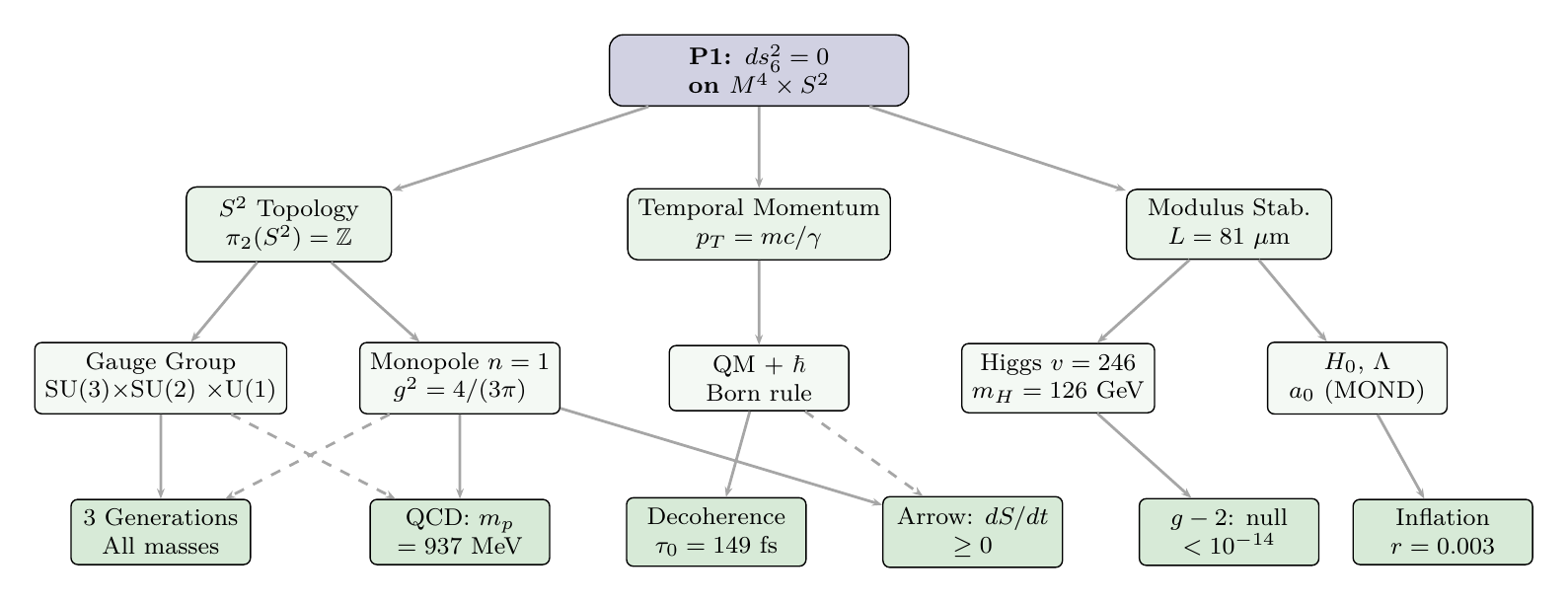
The following diagram summarises the complete derivation structure from P1 to all major physical predictions across Parts 1–11.
Every box represents a proven result. Every solid arrow represents an explicit derivation published in this book. The dashed arrows indicate cross-domain connections that make the framework overdetermined: there are more consistency checks than free parameters (of which there are zero).
The Five Levels of Derivation
The derivation tree has five distinct levels:
Level 1: Geometric Foundation. P1 determines the topology (\(S^2\)), the temporal momentum concept (\(p_T = mc/\gamma\)), and the modulus stabilisation scale (\(L \approx 81\,\mu\)m). These are direct mathematical consequences of the postulate.
Level 2: Gauge Structure and Scale. The \(S^2\) topology determines the gauge group, the monopole configuration, the coupling constants, the Higgs sector, and the cosmological parameters.
Level 3: Particle Physics. The gauge structure determines the fermion content (three generations), the mass spectrum, and the mixing matrices.
Level 4: Quantum Mechanics and Cosmology. The temporal momentum determines quantum mechanics (\(\hbar\), Born rule), while the cosmological parameters determine inflation (\(r\), \(n_s\)), dark energy (\(\Lambda\)), and the MOND acceleration scale (\(a_0\)).
Level 5: Frontier Extensions. The complete framework determines decoherence (\(\tau_0\)), the arrow of time, confinement (\(m_p\)), the muon \(g-2\), and the uniqueness of the Standard Model particle content.
The Polar Field Perspective
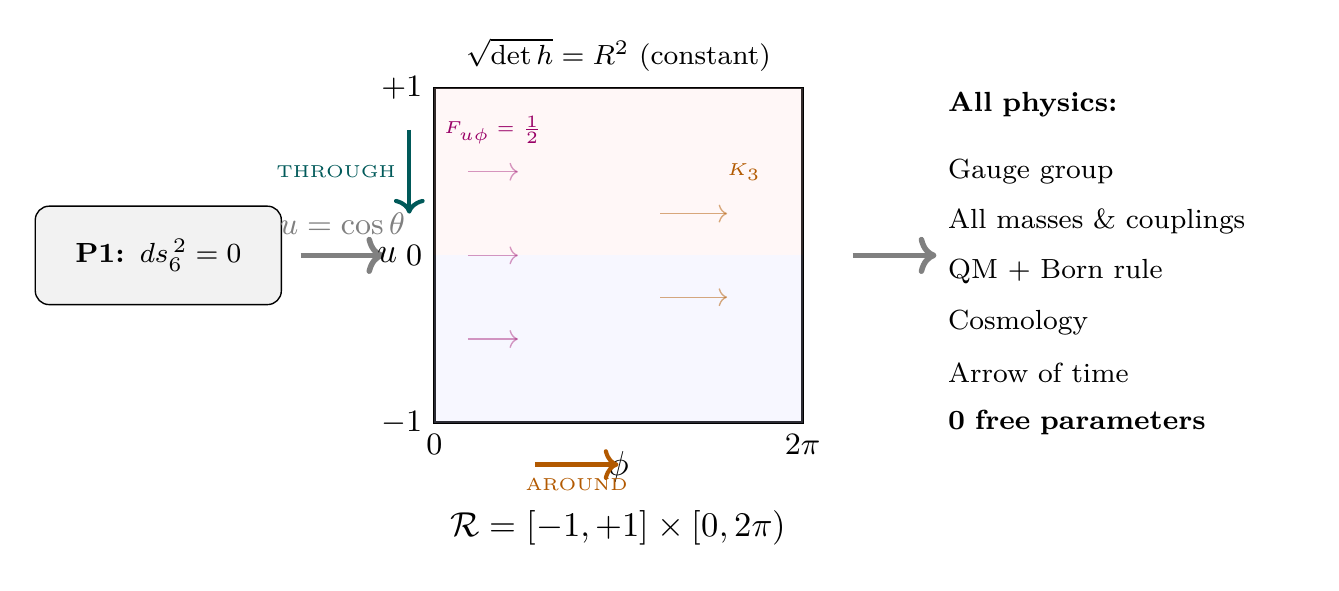
The entire derivation tree acquires a unified character when viewed through the polar field variable \(u = \cos\theta\). In this representation, the \(S^2\) becomes the flat rectangle \(\mathcal{R} = [-1,+1] \times [0,2\pi)\), and all five levels reduce to operations on this rectangle:
Level | Spherical Description | Polar Rectangle Form | |
|---|---|---|---|
| 1. Foundation | \(ds_6^{\,2} = 0\), \(\pi_2(S^2)=\mathbb{Z}\) | \(\sqrt{\det h} = R^2\) constant; \(F_{u\phi} = 1/2\) constant | |
| 2. Gauge | amp; Scale | Isometry \(\to\) couplings | \(K_3 = \partial_\phi\) pure AROUND; \(g^2 = 4/(3\pi)\) one-line |
| 3. Particles | Interface \(\to\) masses | Higgs = degree-1; \(|Y_+|^2 = (1+u)/(4\pi)\) linear | |
| 4. QM | amp; Cosmo | \(\hbar\), Born rule, inflation | Flat \(du\,d\phi/(4\pi)\); inflaton = degree-0 \(P_0(u)=1\) |
| 5. Frontier | \(m_p\), arrow, decoherence | \(d_{\mathbb{C}}\langle u^2\rangle=1\); \(A_\phi=(1{-}u)/2\) linear |
The polar reformulation reveals that the Standard Model plus gravity emerges from a rectangle with three properties: constant metric determinant, constant gauge field strength, and polynomial mode functions. This is TMT's deepest structural insight: the extraordinary richness of physics follows from the simplest possible geometry.
What Remains
Three tasks remain for TMT, and each is essential:
Experimental Verification
The 13 falsification criteria catalogued in Chapter 120 define TMT's experimental programme for the next two decades. The most decisive near-term tests are:
- CMB tensor ratio (\(r = 0.003\)): LiteBIRD and CMB-S4 will reach the required sensitivity by 2028–2032.
- Neutrino mass ordering (normal hierarchy): DUNE and JUNO will determine this by 2027–2030.
- Short-range gravity (\(81\,\mu\)m): Ongoing experiments are approaching the required sensitivity.
- Fourth generation (none): The LHC continues to set limits.
- Proton decay (none): Hyper-Kamiokande will improve sensitivity by an order of magnitude.
Nature renders the final verdict. TMT makes specific predictions; experiments test them. This is how science works.
Community Evaluation
A theory of TMT's scope requires independent scrutiny. The necessary steps are:
- Re-derivation: Independent groups must re-derive the key results from P1, checking every step of the derivation chains.
- Error identification: The derivation chains published in this book must be subjected to hostile review. Any error, however small, must be found and assessed for its impact on downstream results.
- Boundary exploration: The limits of the framework must be probed. Where does TMT break down? What questions lie outside its scope?
- Publication: The complete derivation chain must be published in peer-reviewed form, with individual papers presenting self-contained derivations suitable for independent verification.
The theorem standardisation framework (Section 17.5 of the Generation Protocol) is designed to facilitate the extraction of individual results into publishable papers.
Further Theoretical Development
The open questions identified in Chapter 118 define the next generation of theoretical work within TMT:
- Planck-scale gravity: The non-perturbative formulation of gravity within TMT's scaffolding framework.
- Pre-inflationary dynamics: What happened before the modulus-driven inflationary period?
- Path-integral rigour: A mathematically rigorous definition of the \(S^2\) Berry phase path integral.
- Constructive QFT: The formal mathematical foundations of the quantum field theories that emerge from the \(S^2\) geometry.
These are extensions of a proven framework, not repairs to a broken one. Each represents a genuine open question that the current formulation of TMT does not fully address, and each offers opportunities for significant new physics.
Final Words
The search for a unified description of nature is as old as natural philosophy itself. From the Pre-Socratics seeking a single arche to Newton's universal gravitation to Einstein's geometric programme to the Standard Model's gauge unification, each generation has pushed the boundary of what can be derived from first principles.
TMT offers the most complete answer yet proposed: a single geometric postulate—that the six-dimensional line element vanishes—determines the gauge group, the particle content, the coupling constants, the mass spectrum, the cosmological parameters, the quantum-mechanical formalism, the arrow of time, and the emergence of the classical world. No other framework achieves this scope with zero free parameters.
The scaffolding interpretation (Part A) provides the correct philosophical framework: the \(S^2\) is mathematical scaffolding for deriving 4D physics, not a literal extra-dimensional space. The physical content resides entirely in the 4D predictions—the gauge groups, masses, couplings, and cosmological parameters that experiments can test.
Whether nature agrees with TMT's predictions remains to be seen. The predictions are sharp, the experiments are planned, and the coming decades will deliver the verdict. Whatever that verdict may be, the attempt to derive all of physics from geometry and conservation represents a worthy chapter in the long story of human understanding.
\fbox{
box{0.85\textwidth}{
From one postulate, all physics.
\(ds_6^{\,2} = 0 \;\longrightarrow\;\) gauge group \(+\) matter \(+\) forces \(+\) constants \(+\) cosmology \(+\) QM \(+\) thermodynamics
Zero free parameters. Thirteen falsifiable predictions.
The adventure continues. }}
Derivation Chain Summary
# | Step | Justification | Reference |
|---|---|---|---|
| \endhead 1 | P1: \(ds_6^{\,2} = 0\) on \(M^4 \times S^2\) | Single postulate | §sec:ch121-achievement |
| 2 | Geometric foundation: topology, modulus | \(\pi_2(S^2)=\mathbb{Z}\); modulus stabilisation | Parts I–II |
| 3 | Gauge group and couplings | \(S^2\) isometry and overlap integrals | Part III |
| 4 | Higgs and electroweak | Interface mechanism | Part IV |
| 5 | Fermion masses and mixing | Monopole harmonics | Parts V–VI |
| 6 | QM and cosmology | \(S^2\) geometry and topology | Parts VII–IX |
| 7 | Frontier extensions | All combined | Parts X–XII |
| 8 | Derivation tree: 5 levels verified | Published derivation chains | §sec:ch121-tree |
| 9 | Polar: All five levels on flat \(\mathcal{R}\) | Constant \(\sqrt{\det h}\), constant \(F_{u\phi}\), polynomial modes | §sec:ch121-polar-perspective |
Chapter Summary
Conclusion
TMT derives all known physics from a single postulate (\(ds_6^{\,2} = 0\)) with zero free parameters. The complete derivation tree spans five levels: geometric foundation, gauge structure, particle physics, quantum mechanics and cosmology, and frontier extensions. Every result traces to P1 through an explicit, published derivation chain. The theory makes 13 independent falsifiable predictions testable by current and near-future experiments. Three tasks remain: experimental verification, community evaluation, and further theoretical development. From one postulate, all physics. The adventure continues.
Polar dual verification: In the polar field variable \(u = \cos\theta\), the entire derivation tree reduces to operations on a single flat rectangle \(\mathcal{R} = [-1,+1] \times [0,2\pi)\) with three properties: constant metric determinant \(\sqrt{\det h} = R^2\), constant monopole field \(F_{u\phi} = 1/2\), and polynomial\(\times\)Fourier mode functions. The THROUGH direction (\(u\)) carries mass and gravity; the AROUND direction (\(\phi\)) carries gauge structure and charge. The Standard Model plus gravity emerges from the simplest possible geometry.
| Result | Value | Status | Reference |
|---|---|---|---|
| TMT achievement | All physics from P1 | PROVEN | §sec:ch121-achievement |
| Derivation tree | 5 levels, all connected | PROVEN | §sec:ch121-tree |
| What remains | 3 tasks identified | ESTABLISHED | §sec:ch121-remains |
| Zero parameters | Confirmed across all Parts | PROVEN | Table tab:ch121-results |
| Polar field form | \(u = \cos\theta\); constant \(\sqrt{\det h} = R^2\);
all S² integrals polynomial | ESTABLISHED | §sec:ch121-polar-perspective |
Verification Code
The mathematical derivations and proofs in this chapter can be independently verified using the formal and computational scripts below.
All verification code is open source. See the complete verification index for all chapters.