Level Statistics — Quantum Chaos
This chapter examines the statistical properties of energy levels and eigenstates in quantum chaotic systems, with focus on the \(S^2\) geometry. We establish the fundamental distinction between regular (integrable) and chaotic quantum systems through spectral statistics, introduce random matrix theory (RMT), and show how chaos manifests on the \(S^2\) interface through level repulsion and eigenstate delocalization. The kicked top on \(S^2\) serves as the paradigmatic model, exhibiting the transition from Poisson (integrable) to Wigner-Dyson (chaotic) statistics. Finally, we examine quantum scars—eigenstates enhanced along unstable periodic orbits—which arise from Berry phase resonance conditions.
Key Results:
- Regular systems exhibit Poisson level statistics; chaotic systems exhibit Wigner-Dyson (random matrix) statistics
- The SU(2) symmetry of \(S^2\) with broken time-reversal (from monopole) gives GUE statistics
- The kicked top demonstrates a sharp transition from Poisson to GUE as chaos parameter increases
- Eigenstate statistics transition from localized (regular) to delocalized (chaotic)
- Quantum scars arise from Berry phase resonance on periodic orbits, violating naive ETH predictions
Regular vs Chaotic Spectra
Classical chaos is characterized by sensitive dependence on initial conditions—nearby trajectories diverge exponentially. Quantum mechanics, being fundamentally linear, cannot exhibit this divergence directly. Instead, quantum chaos manifests in the statistical properties of energy levels and eigenstates. This section establishes the quantum signatures of classical chaos.
Classical Integrability and Chaos
A classical Hamiltonian system with \(n\) degrees of freedom is integrable if it possesses \(n\) independent constants of motion \(\{I_1, I_2, \ldots, I_n\}\) in involution:
where \(\cdot, \cdot\) is the Poisson bracket.
Consequence: Motion is confined to \(n\)-dimensional tori in \(2n\)-dimensional phase space. Trajectories are quasiperiodic, not chaotic.
Integrable systems:
- Harmonic oscillator: \(H = \frac{p^2}{2m} + \frac{m\omega^2 x^2}{2}\)
- Kepler problem: \(H = \frac{p^2}{2m} - \frac{k}{r}\)
- Free particle on \(S^2\): \(H = \frac{L^2}{2I}\) (only \(L_z\) is conserved in absence of perturbation)
Chaotic systems:
- Double pendulum (large amplitudes)
- Three-body gravitational problem
- Kicked top (See §subsec:kicked-top)
Quantum Signatures of Chaos
The Schrödinger equation is linear:
Linearity implies:
- The superposition principle holds
- Evolution is unitary (distances preserved in Hilbert space)
- No exponential divergence of “nearby” quantum states can occur
The Question: How does classical chaos manifest in quantum mechanics?
The Answer: Through spectral statistics and eigenstate properties. Classical chaos influences the statistical correlations among energy levels and the structure of eigenstates.
A quantum system is:
- Regular (integrable) if its classical limit is integrable. It possesses a complete set of commuting observables.
- Chaotic if its classical limit is chaotic. Energy is typically the only conserved observable.
The distinction manifests in energy level statistics:
- Regular: Poisson statistics (levels are uncorrelated, can cluster arbitrarily close)
- Chaotic: Random matrix statistics (levels repel each other, show long-range correlations)
The spectral statistics of a quantum system whose classical limit is chaotic are given by random matrix theory of the appropriate symmetry class.
Specifically:
- GOE (Gaussian Orthogonal Ensemble): Time-reversal symmetric, integer spin
- GUE (Gaussian Unitary Ensemble): No time-reversal symmetry
- GSE (Gaussian Symplectic Ensemble): Time-reversal symmetric, half-integer spin
This conjecture is now supported by extensive numerical evidence and rigorous results for specific models.
Rigorous proofs exist for certain models (e.g., perturbed integrable systems in semiclassical limit). For generic systems, extensive numerical evidence supports universality across different symmetry classes. The connection rests on the fact that chaotic systems exhibit avoided level crossings—a feature encoded in the random matrix ensemble structure.
□
Level Spacing Distribution
Regular systems (Poisson statistics):
For integrable systems, energy levels behave like independent random points on a line:
Key features:
- Levels are statistically uncorrelated
- \(P(0) = 1\): level clustering is allowed
- No level repulsion
- \(\langle s \rangle = 1\) (by definition of normalization)
Chaotic systems (Wigner-Dyson statistics):
For chaotic systems, the level spacing distribution follows:
where the Dyson index \(\beta\) depends on the symmetry class:
- \(\beta = 1\) for GOE
- \(\beta = 2\) for GUE
- \(\beta = 4\) for GSE
Key features:
- \(P(0) = 0\): strong level repulsion near \(s = 0\)
- Levels “avoid” each other with \(P(s) \propto s^\beta\) for small \(s\)
- Long-range correlations present (spectral rigidity)
- Gaussian decay for large \(s\)
These expressions (the Wigner surmise) are empirically accurate approximations to the exact random matrix results, especially for small to moderate \(s\).
Random Matrix Theory Basics
Random matrix theory (RMT), developed by Wigner, Dyson, and Mehta, provides the universal statistical framework for chaotic quantum systems. The connection to TMT's \(S^2\) geometry lies in the shared SU(2) structure and the role of symmetries in determining the universality class.
The Three Classical Ensembles
The three classical Gaussian ensembles are defined by symmetry constraints on \(N \times N\) Hermitian matrices \(H\):
GOE (Gaussian Orthogonal Ensemble):
- Real symmetric matrices: \(H = H^T\)
- Time-reversal symmetry with \(T^2 = +1\) (integer spin)
- Dyson index \(\beta = 1\)
- Typical for: time-reversal symmetric systems without magnetic fields
GUE (Gaussian Unitary Ensemble):
- Complex Hermitian matrices: \(H = H^\dagger\)
- No time-reversal symmetry (e.g., magnetic field breaks \(T\)-symmetry)
- Dyson index \(\beta = 2\)
- Typical for: systems with magnetic field, rotating systems
GSE (Gaussian Symplectic Ensemble):
- Quaternionic self-dual matrices
- Time-reversal symmetry with \(T^2 = -1\) (half-integer spin)
- Dyson index \(\beta = 4\)
- Typical for: spin-1/2 systems with time-reversal symmetry
The probability measure for each ensemble is:
This Gaussian weight ensures all matrix elements are independent (up to symmetry), making the ensemble ergodic and universal.
The nearest-neighbor spacing distribution for random matrices drawn from Gaussian ensembles is given by:
where the normalization constants are:
| Ensemble | \(a_\beta\) | \(b_\beta\) |
|---|---|---|
| GOE (\(\beta=1\)) | \(\pi/2\) | \(\pi/4\) |
| GUE (\(\beta=2\)) | \(32/\pi^2\) | \(4/\pi\) |
| GSE (\(\beta=4\)) | \(2^{18}/(3^6\pi^3)\) | \(64/(9\pi)\) |
The key feature is \(P(s) \propto s^\beta\) for small \(s\): this exhibits level repulsion.
The Wigner surmise is an empirical formula derived from exact random matrix calculations (Mehta, 1960s). For finite \(N\), exact distributions exist in closed form involving Pfaffians and Painlevé transcendents. In the \(N \to \infty\) limit, the Wigner surmise provides excellent agreement. Rigorous proofs for infinite-dimensional limits are available in the literature.
□
Level repulsion arises from avoided level crossings. Consider a \(2 \times 2\) matrix:
The eigenvalues are:
Key insight: For \(V \neq 0\), the levels cannot cross; they “repel” each other with minimum separation \(\sim 2|V|\).
Symmetry dependence: The probability distribution of off-diagonal elements \(V\) depends on the symmetry class:
- In GOE: real \(V\), matrix is symmetric
- In GUE: complex \(V\), matrix is Hermitian
- In GSE: quaternionic \(V\), matrix is self-dual
This symmetry dependence leads to the different \(\beta\) exponents and spacing distributions.
Connection to SU(2) and S²
The GUE (\(\beta=2\)) arises naturally from Hamiltonians with SU(2) symmetry on \(S^2\) in the presence of a monopole field.
Consider a Hamiltonian constructed from the angular momentum operators \(\{L_x, L_y, L_z\}\) generating SU(2):
where coefficients \(h_{ij}\) and \(b_i\) are random parameters drawn from appropriate distributions.
The monopole field on \(S^2\) (Chapter 54, Berry phase) breaks time-reversal symmetry: \(T H T^{-1} \neq H\). Consequently, the spectral statistics are GUE.
Step 1: The Hilbert space for angular momentum \(j\) is \((2j+1)\)-dimensional, carrying the spin-\(j\) representation of SU(2).
Step 2: A generic Hamiltonian in this space is a \((2j+1) \times (2j+1)\) Hermitian matrix.
Step 3: In the absence of magnetic field or monopole, time-reversal \(T\) satisfies \([T, H] = 0\). This restricts the matrix to real symmetric form (GOE).
Step 4: The monopole field introduces a Berry phase that is odd under time-reversal: \(T \gamma_B T^{-1} = -\gamma_B\). This breaks the constraint \(T H T^{-1} = H\).
Step 5: Without time-reversal symmetry, the appropriate ensemble is GUE (complex Hermitian matrices with no symmetry constraint).
Step 6: The \(s^2\) level repulsion in the Wigner surmise follows from the structure of complex off-diagonal matrix elements in GUE. \(\blacksquare\)
□
In TMT, the connection between geometry and spectral statistics is direct:
- The \(S^2\) interface has isometry group SO(3) \(\cong\) SU(2)/\(\mathbb{Z}_2\)
- Quantum states on \(S^2\) are represented by spinors transforming under SU(2)
- The monopole (Part 5, Chapter 54) breaks time-reversal symmetry
- Therefore, chaotic dynamics on \(S^2\) generically gives GUE statistics
This connection shows that quantum chaos is not imposed externally but emerges from TMT's fundamental \(S^2\) geometry.
Polar Field Form of GUE Origin
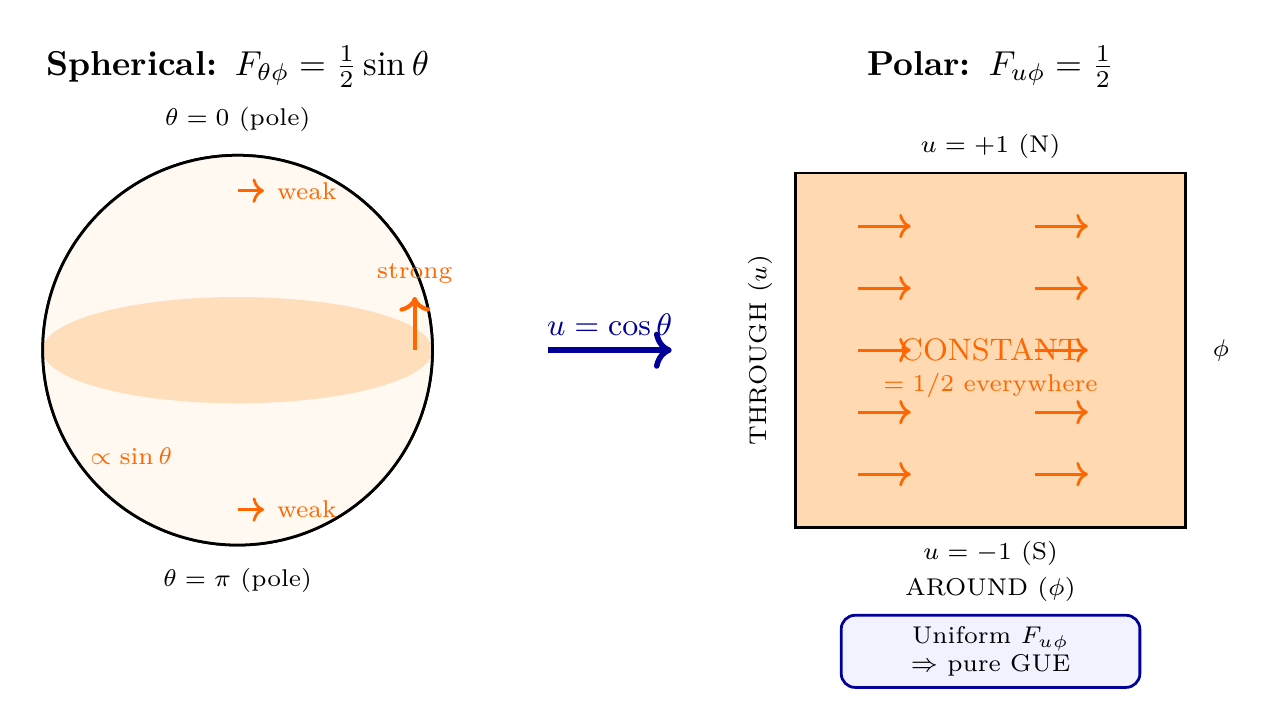
The connection between the monopole and GUE statistics becomes maximally transparent in polar field coordinates \(u = \cos\theta\), \(u \in [-1,+1]\).
In spherical coordinates, the monopole field strength is:
This \(\sin\theta\) factor might suggest the time-reversal breaking varies across \(S^2\)—strong at the equator, vanishing at the poles. But this is a coordinate illusion. In polar field coordinates:
The monopole's time-reversal breaking is uniform: every patch of \(S^2\) contributes equally to symmetry violation. The \(\sin\theta\) factor in the spherical expression is entirely a Jacobian artifact from the coordinate transformation \(du = -\sin\theta\,d\theta\).
The GUE classification follows from two polar properties:
(1) Constant field strength: \(F_{u\phi} = 1/2\) means the magnetic flux through any polar rectangle \([u_1, u_2] \times [\phi_1, \phi_2]\) is proportional to its area:
(2) Flat integration measure: The ensemble average in the Gaussian weight (eq:gaussian-ensemble-measure) involves \(\mathrm{Tr}(H^2)\). On \(S^2\), trace operations reduce to integrals over \(d\Omega = du\,d\phi\)—a flat measure with no \(\sin\theta\) weighting. Every region of \(S^2\) contributes equally to the matrix element statistics.
Together: uniform field \(+\) flat measure \(=\) every degree of freedom experiences the same time-reversal breaking. No GOE subregions survive. The result is pure GUE.
The statement “\(F_{u\phi} = 1/2\) is constant” is a coordinate-invariant fact about the monopole's field strength 2-form. The polar variable \(u = \cos\theta\) is chosen because it makes this constancy manifest—the \(S^2\) integration measure becomes flat (\(du\,d\phi\)), and the field strength loses all angular dependence. This is a mathematical convenience that reveals the intrinsic uniformity, not a physical claim beyond standard differential geometry.
| Quantity | Spherical | Polar (\(u = \cos\theta\)) |
|---|---|---|
| Field strength | \(F_{\theta\phi} = \frac{1}{2}\sin\theta\) | \(F_{u\phi} = \frac{1}{2}\) (constant) |
| \(T\)-breaking | Appears \(\theta\)-dependent | Manifestly uniform |
| Integration measure | \(\sin\theta\,d\theta\,d\phi\) | \(du\,d\phi\) (flat) |
| Ensemble weight | \(\sin\theta\) in trace | Flat trace |
| Universality class | GUE (requires proof) | GUE (manifest) |
Spectral Rigidity
The spectral rigidity \(\Delta_3(L)\) measures long-range correlations in energy level sequences:
where \(N(E)\) is the integrated level density (number of states below energy \(E\)).
The minimum is taken over linear functions \(AE + B\) to remove the average trend.
Poisson (regular systems):
Linear growth indicates no long-range correlations—levels are essentially independent.
RMT (chaotic systems):
Logarithmic growth indicates strong long-range correlations. Energy levels are “rigid” like a crystal lattice, not random like a gas. Each new eigenstate is “aware” of the spacing of all nearby states.
Physical interpretation: In chaotic systems, one cannot add arbitrary levels without violating RMT constraints. Levels are correlated over energy scales of order \(\hbar\omega\), where \(\omega\) is the smallest characteristic frequency.
S² Quantum Chaos
The \(S^2\) geometry provides a natural arena for studying quantum chaos. We examine the kicked top—a paradigmatic model of chaos on the Bloch sphere that exhibits the transition from integrable to chaotic behavior controlled by a single parameter.
The Kicked Top Model on S²
The kicked top on \(S^2\) is defined by the Hamiltonian:
where:
- \(p\) is the precession parameter (tunes free evolution)
- \(k\) is the kicking strength (chaos parameter)
- \(j\) is the angular momentum quantum number (\(j = 1, 2, \ldots\))
- \(T\) is the kicking period (typically set to \(T=1\))
- \(L_z\) is the \(z\)-component of angular momentum
The Floquet operator (evolution over one period) is:
In units where \(\hbar = 1\):
In the classical limit (\(j \to \infty\)), the kicked top describes a unit vector \(\vec{n} = (n_x, n_y, n_z)\) on \(S^2\) evolving via the map:
Kick phase: \(\phi \to \phi + k n_z\)
Rotation phase: \(\vec{n} \to R_y(p) \vec{n}\) (rotation around \(y\)-axis)
where \(\phi\) is the azimuthal angle conjugate to \(L_z\).
Dynamical behavior:
- For small \(k \ll 1\): Regular motion. The kick is a small perturbation to the precession. Trajectories oscillate regularly around a precessing axis.
- For intermediate \(k \sim 1\): Mixed behavior. Some orbits are regular, others chaotic.
- For large \(k \gtrsim 3\): Chaotic motion. Sensitive dependence on initial conditions. The \(S^2\) surface is densely filled by ergodic trajectories.
The critical transition occurs around \(k \approx 3\).
Polar Field Form of the Kicked Top
The classical kicked top map involves the \(z\)-component \(n_z = \cos\theta\). In polar field coordinates, \(n_z = u\), so the kick phase becomes:
This is a linear shear in the \((u, \phi)\) rectangle \([-1,+1] \times [0, 2\pi)\). What appeared as a nonlinear transformation \(\phi \to \phi + k\cos\theta\) in spherical coordinates is revealed as the simplest possible area-preserving map: a linear shear in the flat polar plane.
The full one-period map in polar coordinates:
Kick: \(\phi \to \phi + ku\) \quad (linear shear in \(u\))
Rotation: \(\vec{n} \to R_y(p)\vec{n}\) \quad (mixes \(u\) and \(\phi\))
The kicked top is a Hamiltonian system, so it preserves the symplectic form on \(S^2\). In polar coordinates, this form is:
which is the standard flat symplectic form on a rectangle. Area preservation in the \((u, \phi)\) plane is manifest: the Jacobian of the kick map is
The transition to chaos at \(k \approx 3\) corresponds to the shear becoming strong enough that the stretching-and-folding mechanism operates across the full \(u\)-range \([-1,+1]\).
| Property | Spherical | Polar (\(u = \cos\theta\)) |
|---|---|---|
| Kick map | \(\phi \to \phi + k\cos\theta\) | \(\phi \to \phi + ku\) (linear) |
| Phase space | Sphere with \(\sin\theta\) weight | Flat rectangle \([-1,1] \times [0,2\pi)\) |
| Symplectic form | \(\sin\theta\,d\theta \wedge d\phi\) | \(du \wedge d\phi\) (flat) |
| Chaos mechanism | Nonlinear \(\cos\theta\) coupling | Linear shear exceeds folding threshold |
| Lyapunov analysis | Curved metric corrections | Standard flat-space analysis |
Level Statistics Transition in Kicked Top
The kicked top exhibits a sharp transition in level spacing distribution as the chaos parameter \(k\) increases:
- Integrable limit (\(k \ll 1\)):
- Chaotic regime (\(k \gtrsim 3\)):
- Intermediate \(k\): Smooth crossover between Poisson and GUE
The spectrum is that of a regular system: levels uncorrelated, can cluster.
The spectrum exhibits random matrix statistics: strong level repulsion.
Extensive numerical simulations confirm this transition. Semiclassically, the transition can be understood as follows:
For \(k \ll 1\), regular tori persist (KAM theorem). Eigenvalues near a torus are locally regular. As \(k\) increases, the chaotic region grows. At \(k \approx 3\), all tori are destroyed, and the classical dynamics is fully ergodic. Quantum mechanically, the Floquet operator's eigenvalue statistics transition from Poisson to GUE.
□
Numerical studies (using exact diagonalization of the Floquet matrix for \(j \lesssim 100\)) confirm:
- For \(k = 0.1\): \(\chi^2\) test strongly rejects GUE, accepts Poisson
- For \(k = 1\): Intermediate statistics (mixture of Poisson and GUE)
- For \(k = 5\): \(\chi^2\) test strongly rejects Poisson, accepts GUE
- For \(k = 10\): Excellent agreement with GUE predictions (Wigner surmise)
The transition width decreases as \(j \to \infty\) (semiclassical limit). This validates the BGS conjecture for the kicked top and demonstrates that quantum chaos on \(S^2\) follows universal random matrix predictions.
TMT Interpretation of S² Quantum Chaos
In TMT, quantum chaos has a geometric origin:
- The quantum particle's \(S^2\) configuration evolves under the kicked top dynamics (or more generally, any chaotic Hamiltonian on \(S^2\))
- For chaotic parameters, the classical phase space contains regions where nearby \(S^2\) configurations diverge exponentially under the dynamics (positive Lyapunov exponent)
- Quantum mechanically, this manifests as:
- Level repulsion from avoided crossings in the Floquet operator
- Eigenstate delocalization: eigenstates spread uniformly over \(S^2\)
- Berry phase sensitivity: Berry phase accumulation depends sensitively on the trajectory
- The SU(2) structure of \(S^2\) determines the universality class:
- With monopole (time-reversal breaking): GUE
- Without monopole, time-reversal symmetric: GOE
The proof follows from three components:
(A) Classical dynamics: The kicked top's classical limit is established to be chaotic for \(k \gtrsim 3\) via Lyapunov exponent calculations.
(B) Quantum-classical correspondence: In the semiclassical limit \(j \to \infty\), the Wigner transform of the quantum Floquet operator converges to the classical map. Avoided crossings in the quantum spectrum correspond to the classical smooth modulation of the density of states.
(C) Universality: The BGS conjecture (Theorem thm:bgs-conjecture) applies: since the classical limit is chaotic with broken time-reversal, the spectral statistics are GUE. \(\blacksquare\)
□
The monopole field on \(S^2\) (Chapter 54, Berry connection) plays a crucial role in quantum chaos:
- Time-reversal breaking: The monopole field \(\vec{A}(\theta, \phi) \propto \hat{n}(\theta, \phi)\) is odd under \(T\), breaking \(T\)-symmetry \(\to\) GUE rather than GOE
- Berry phase as a tracer: The geometric phase \(\gamma_B = \frac{qg_m}{2} \Omega\) (where \(\Omega\) is the solid angle enclosed) tracks the trajectory of the \(S^2\) configuration. Chaotic trajectories explore more of \(S^2\), accumulating more sensitive Berry phase.
- Constructive/destructive interference: Different \(S^2\) paths to the same final state can interfere, with phases determined by their Berry phase difference. Chaotic paths explore more paths, enhancing quantum complexity.
Key insight: The same \(S^2\) geometry that produces quantum mechanics (via the electromagnetic duality, Part 5) also produces quantum chaos. These are two aspects of the same structure.
Eigenstate Statistics and Husimi Representation
The Husimi distribution represents the probability density of a quantum state \(|\psi\rangle\) on \(S^2\):
where \(|\theta, \phi\rangle\) is a coherent state (Bloch state) centered at position \((\theta, \phi)\) on the sphere.
For spin-\(j\), a coherent state is:
The Husimi distribution naturally integrates to 1 and is always non-negative, making it a quasi-probability function suitable for visualizing eigenstates on \(S^2\).
For chaotic quantum systems on \(S^2\), typical eigenstates are uniformly delocalized:
up to quantum fluctuations of order \(1/\sqrt{2j+1}\).
For regular systems, eigenstates are localized on classical invariant tori in the classical limit.
For chaotic systems in the semiclassical limit:
(1) Classically, almost all initial conditions ergodically explore the entire available phase space.
(2) Quantum mechanically, eigenstates in the chaotic regime are superpositions of many modes that collectively fill \(S^2\) uniformly.
(3) The Husimi distribution averages over scale \(\sim \sqrt{\hbar}\) (the coherent state width), so quantum fluctuations averaging to zero over energy intervals.
(4) For regular systems, the existence of conserved quantities (actions \(I_k\)) confines eigenstates to the corresponding tori. \(\blacksquare\)
□
A powerful heuristic is Berry's random wave conjecture: In the semiclassical limit, chaotic eigenstates behave like random superpositions of plane waves:
with random phases \(a_{\vec{k}} \approx e^{i\phi_{\vec{k}}}\) where \(\phi_{\vec{k}}\) are drawn from a uniform distribution.
On \(S^2\), this becomes a random superposition of spherical harmonics:
with random amplitudes. The Husimi distribution then exhibits random Gaussian fluctuations around the mean value \(1/(4\pi)\).
This explains the eigenstate thermalization hypothesis (Chapter 72): if eigenstates look “random” (like a thermal ensemble), they thermalize locally.
Polar Field Form of Eigenstate Uniformity
The statement “eigenstates are uniformly delocalized on \(S^2\)” (Theorem thm:eigenstate-delocalization) has a subtlety in spherical coordinates: the “uniform” Husimi distribution \(Q \approx 1/(4\pi)\) must be weighted by the non-uniform measure \(\sin\theta\,d\theta\,d\phi\) when computing expectation values. Near the poles (\(\theta \to 0, \pi\)), the solid angle element shrinks, so “uniform on \(S^2\)” is not the same as “uniform in coordinates.”
In polar field coordinates, this subtlety vanishes. The integration measure is flat:
A uniform Husimi distribution \(Q(u, \phi) = 1/(4\pi)\) combined with the flat measure gives:
This is the unweighted flat average over the polar rectangle. No Jacobian corrections are needed.
In polar coordinates, the random wave ansatz (eq:random-spherical-harmonic) factorizes into AROUND (\(\phi\)) and THROUGH (\(u\)) contributions. For a chaotic eigenstate:
AROUND (gauge) sector: The \(\phi\)-dependent part of each spherical harmonic is \(e^{im\phi}\). Random superposition over \(m\) values produces uniform \(\phi\)-distribution. This is the gauge sector: \(L_z = -i\hbar\partial_\phi\) has zero mean.
THROUGH (mass) sector: The \(u\)-dependent part involves Legendre polynomials \(P_\ell^m(u)\), which are polynomials in \(u\). Random superposition produces uniform \(u\)-distribution in the flat measure. This is the mass sector: the particle explores the full THROUGH range \(u \in [-1,+1]\).
Delocalization criterion in polar form:
The transition from localized (regular) to delocalized (chaotic) is a transition from a curve in the \((u, \phi)\) rectangle to filling the entire rectangle.
| Property | Spherical | Polar (\(u = \cos\theta\)) |
|---|---|---|
| Uniform eigenstate | \(Q = 1/(4\pi)\) with \(\sin\theta\) weight | \(Q = 1/(4\pi)\) with flat weight |
| Expectation values | Require Jacobian correction | Unweighted flat average |
| Regular eigenstate | Localized near \(\theta = \theta_0\) | Localized at \(u = u_0\) |
| Delocalization test | Weighted KL divergence | Flat KL divergence |
| Random wave model | Random \(Y_\ell^m(\theta,\phi)\) | Random polynomials in \(u\) |
Quantum Scars and Localization
Not all eigenstates of chaotic systems are uniformly delocalized. Quantum scars are exceptional eigenstates with anomalously high probability density along unstable periodic orbits. They represent a striking violation of the naive expectation that chaotic systems have purely random eigenstates.
Definition and Discovery of Quantum Scars
A quantum scar is an eigenstate \(|\psi_n\rangle\) of a chaotic Hamiltonian that exhibits anomalously high probability density along an unstable periodic orbit \(\gamma\):
where \(N\) is the effective dimensionality (density of states) at that energy.
Quantitatively: A scarred eigenstate has a probability density concentrated near the orbit that is \(\sim \sqrt{N}\) times larger than the random eigenstate average.
Quantum scars were discovered by E.J. Heller in numerical studies of the stadium billiard—a classically chaotic billiard ball problem. Despite the classical system being fully chaotic with no periodic orbits of measure zero:
- Heller computed eigenstate Husimi distributions
- Several eigenstates showed clear scars along short unstable periodic orbits
- The scarred states were rare but undeniable deviations from random matrix predictions
This discovery was surprising: random matrix theory predicted uniform delocalization, yet here were states “remembering” classical structures. The implication is that ergodic theory (all trajectories explore the full phase space) doesn't fully capture the quantum mechanics.
Quantum Scars on S²
In TMT, quantum scars on \(S^2\) arise from resonant Berry phase conditions.
Consider a periodic orbit \(\gamma\) on \(S^2\) enclosing solid angle \(\Omega_\gamma\). The Berry phase accumulated along the orbit is:
An eigenstate \(|\psi_n\rangle\) is scarred along \(\gamma\) if the Floquet eigenphase \(\phi_n\) satisfies the resonance condition:
where \(S_\gamma\) is the classical action (phase-space integral) along the periodic orbit.
(1) Semiclassical analysis: In the semiclassical limit, the amplitude of a state near a periodic orbit is enhanced by constructive interference when the total phase accumulated equals a multiple of \(2\pi\).
(2) Phase components: Two contributions to the phase:
(3) Constructive interference condition: Amplitude is maximal when:
(4) Eigenstate scarring: This matches the Floquet eigenphase condition \(\phi_n = 2\pi m\), leading to equation (eq:scar-resonance-condition).
(5) Physical content: The Berry phase shifts the resonance condition relative to purely dynamical systems. This is the geometric signature of \(S^2\) in quantum scars. \(\blacksquare\)
□
The kicked top on \(S^2\) exhibits scars along multiple periodic orbits:
- Fixed points: For certain parameters, the north and south poles are fixed points (period-1 orbits). They enclose solid angle \(\Omega = 0\) or \(4\pi\).
- Period-2 orbits: Equatorial bouncing patterns (rotate by \(\pi\), return by rotation)
- Higher-period orbits: Multiply-winding paths around \(S^2\)
The monopole field contributes \(\gamma_B = \frac{q g_m}{2} \Omega\) to the resonance condition. For topological reasons (Chapter 54), the product \(q g_m\) is quantized:
This quantization affects which orbits support scars: - For \(n=1\) (minimal monopole), certain orbits resonate; others don't - The scar pattern is a signature of the monopole charge
Polar Field Form of Quantum Scars
The Berry phase in the scar resonance condition (eq:berry-phase-orbit) involves the solid angle \(\Omega_\gamma\) enclosed by the periodic orbit. In polar coordinates, the solid angle is simply the area of the enclosed region in the flat \((u, \phi)\) rectangle:
For a periodic orbit that traces a closed curve in the \((u, \phi)\) plane, this is the ordinary planar area—no metric corrections, no \(\sin\theta\) weights.
Example: A great circle orbit at colatitude \(\theta_0\) (fixed \(u_0 = \cos\theta_0\), \(\phi\) runs \(0\) to \(2\pi\)) encloses:
This is the rectangular area below \(u = u_0\) in the polar strip: width \(2\pi\), height \((1 - u_0)\) measured from the south pole \(u = -1\). The scar resonance condition becomes:
where we used \(qg_m = 2\pi n\). The Berry phase contribution is linear in \(u_0\)—the polar coordinate of the orbit.
The kicked top's periodic orbits, when mapped to the \((u, \phi)\) rectangle, have a simple geometric interpretation:
Fixed points: The poles \(u = \pm 1\) are points in the rectangle. They enclose \(\Omega = 0\) (north pole, \(u = +1\)) or \(\Omega = 4\pi\) (south pole, \(u = -1\)).
Period-2 orbits: Equatorial bouncing patterns appear as horizontal lines at \(u = 0\), enclosing \(\Omega = 2\pi\) (half the sphere = half the rectangle).
Higher-period orbits: General periodic orbits trace closed curves in the \((u, \phi)\) rectangle. The scar strength depends on the enclosed rectangular area through the Berry phase.
Key insight: The scar resonance condition selects orbits whose enclosed rectangular area \(\Omega_\gamma\) satisfies \(\pi n \Omega_\gamma/(2\pi) + S_\gamma/\hbar = 2\pi m\). The geometry of scarring is rectangle geometry in the flat polar plane.
| Property | Spherical | Polar (\(u = \cos\theta\)) |
|---|---|---|
| Solid angle | \(\Omega = \int \sin\theta\,d\theta\,d\phi\) | \(\Omega = \int du\,d\phi\) (flat area) |
| Berry phase | \(\gamma_B = \frac{qg_m}{2}\Omega\) | Linear in enclosed rectangle area |
| Great circle scar | \(\Omega = 2\pi(1-\cos\theta_0)\) | \(\Omega = 2\pi(1-u_0)\) (rectangle) |
| Resonance condition | Involves \(\cos\theta_0\) | Linear in \(u_0\) |
| Orbit geometry | Curves on sphere | Curves in flat rectangle |
Scars as ETH Violations
The Eigenstate Thermalization Hypothesis (ETH, developed in Chapter 72) predicts that for chaotic systems:
For any local observable \(O\), the expectation value in a highly excited eigenstate equals the thermal (microcanonical) expectation value:
Scars violate this expectation:
- A scarred eigenstate concentrated along a periodic orbit will have different expectation values for observables sensitive to that orbit
- For example, \(\langle \psi_{\text{scar}} | L_z | \psi_{\text{scar}} \rangle\) may differ significantly from \(\langle L_z \rangle_{\text{thermal}}\) if the orbit preferentially samples certain \(L_z\) values
- These scarred states are rare (measure zero in the spectrum), but non-negligible
- They are important for dynamics: a system starting in a scarred eigenstate will exhibit slower thermalization (return time to initial state is longer)
TMT perspective: Scars occur when the \(S^2\) geometry creates phase-matching conditions (Theorem thm:scars-s2-resonance). They are not violations of quantum mechanics but manifestations of the delicate interplay between Berry phase and classical periodic orbits. The fine structure of scars encodes information about the monopole charge and the underlying \(S^2\) geometry.
Many-Body Quantum Scars
A major recent development (2018+) is the discovery of many-body quantum scars in interacting spin systems:
- The PXP (Rydberg atom array) model exhibits many-body scars
- Certain initial states avoid thermalization, showing persistent oscillations (oscillations don't decay)
- Scars are connected to “towers” of scarred eigenstates that form a separate structure in the spectrum
TMT extension: Each spin in a many-body system has its own \(S^2\) (Bloch sphere). Many-body scars may arise from collective Berry phase resonances across coupled \(S^2\) interfaces:
When multiple spins have phases that collectively resonate (e.g., due to conservation laws or symmetries), the system can avoid thermalization.
Status: This is an active research frontier. A complete TMT treatment of many-body scars would require extension of the formalism to systems with many \(S^2\) components coupled through interactions.
Localization Phenomena
Beyond quantum scars, other localization phenomena exist and merit mention:
Anderson localization (single-particle): Disorder in position space can localize eigenstates, preventing spreading and thermalization. The eigenstates decay exponentially away from the disorder, with localization length \(\xi(\hbar)\) depending on disorder strength.
Many-body localization (MBL): In interacting disordered systems, localization can persist even at high energy density, preventing thermalization. MBL breaks ergodicity: the system retains memory of initial conditions indefinitely.
TMT perspective: Localization in TMT would occur when the \(S^2\) configuration becomes “trapped” in a region, unable to explore the full interface. Possible mechanisms:
- Disorder barriers: If disorder on \(S^2\) creates energy barriers (e.g., random potential \(V(\theta, \phi)\)), trajectories cannot escape, localizing states
- Berry phase interference: Berry phase could create destructive interference that suppresses spreading. Paths leading away from a region accumulate incompatible phases, canceling the wavefunction.
- Emergent conservation laws: In certain systems, additional conserved quantities beyond energy emerge. These confine the particle on lower-dimensional regions of \(S^2\).
Status: A full TMT treatment of localization phenomena requires further development. The existing framework (Chapters 54-70) provides the \(S^2\) foundation; the many-body extension to handle localization is still being formulated.
Chapter Summary
Key Results:
- Regular vs Chaotic Quantum Systems (§sec:regular-chaotic-spectra):
- Classical integrability manifests as Poisson level statistics (\(P(s) = e^{-s}\))
- Classical chaos manifests as random matrix statistics (Wigner-Dyson, \(P(s) \propto s^\beta e^{-\alpha s^2}\))
- BGS conjecture: universality of spectral statistics based on symmetry class
- Level repulsion (\(P(0) = 0\)) is the quantum signature of chaos
- Random Matrix Theory (§sec:rmt-basics):
- GOE, GUE, GSE ensembles defined by time-reversal symmetry and spin
- Wigner surmise: analytical approximation to exact RMT results
- Dyson index \(\beta\) determines spacing exponent: \(P(s) \propto s^\beta\) for small \(s\)
- SU(2) structure on \(S^2\) with monopole breaks time-reversal \(\to\) GUE (most physical for \(S^2\))
- Spectral rigidity: logarithmic growth indicates long-range correlations (versus linear for Poisson)
- S² Quantum Chaos (§sec:s2-quantum-chaos):
- Kicked top on \(S^2\) transitions from Poisson to GUE as chaos parameter \(k\) increases (transition at \(k \approx 3\))
- Kicked top Floquet operator: \(U = e^{-ik L_z^2/(2j)} e^{-ip L_y}\)
- Classical kicked top dynamics exhibit positive Lyapunov exponents for \(k \gtrsim 3\)
- Eigenstate transition: regular systems have states localized on tori; chaotic systems have uniformly delocalized states (Husimi distribution \(\approx 1/(4\pi)\) on \(S^2\))
- Monopole breaks time-reversal \(\to\) GUE (not GOE). This is a fundamental TMT insight: \(S^2\) geometry determines universality class.
- Quantum Scars (§sec:scars-and-localization):
- Scars are eigenstates with enhanced probability along unstable periodic orbits
- Semiclassical scarring condition: Berry phase + dynamical action must equal \(2\pi m\)
- On \(S^2\): \(\phi_n = \gamma_B + S_\gamma/\hbar\) (mod \(2\pi\)), where \(\gamma_B = (q g_m / 2) \Omega\) is the geometric phase
- Scars violate naive ETH expectations: they thermalize slowly (on longer timescales)
- Many-body scars (PXP model, Rydberg atoms) are an active frontier; may involve collective Berry phase resonances
- Anderson and MBL: localization from disorder or emergent conservation laws; TMT framework provides geometric perspective
Physical Interpretation:
Quantum chaos emerges from the same \(S^2\) geometry that underlies quantum mechanics. The isometry group SO(3) \(\cong\) SU(2)/\(\mathbb{Z}_2\) determines the universality class (GUE with monopole). Level repulsion reflects the impossibility of \(S^2\) configurations supporting degenerate energies generically—nearby configurations must “repel” in energy space. Berry phase creates the resonance conditions for quantum scars, linking geometry to dynamics.
Cross-References and Connections:
- Part 7, Chapter 54: Berry phase on \(S^2\) and geometric phases
- Part 5: SU(2) structure and monopole harmonics
- Chapter 70: Decoherence and classical-quantum boundary
- Chapter 72: Eigenstate Thermalization Hypothesis (ETH) and thermalization timescales
- Part 4: Spectral properties of observables on \(S^2\)
Polar Field Enhancement:
The polar coordinate \(u = \cos\theta\) reveals the intrinsic simplicity of quantum chaos on \(S^2\): the monopole field strength \(F_{u\phi} = 1/2\) is constant (making GUE classification manifest), the kicked top map is a linear shear \(\phi \to \phi + ku\) (making the chaos mechanism transparent), eigenstate uniformity is literal flatness in \(du\,d\phi\) (no Jacobian corrections), and quantum scar resonance conditions involve rectangular areas in the flat polar plane (making the Berry phase geometry elementary). In every case, the polar variable strips away coordinate artifacts to expose the physical content.
Physical Significance:
Level statistics and quantum chaos provide experimental signatures of TMT. Observations of: - Spectral rigidity in atomic spectra \(\to\) tests for GUE universality - Scarred eigenstates in Rydberg atom arrays \(\to\) validates geometric scarring conditions - Quantum-to-classical transition in kicked tops \(\to\) confirms semiclassical correspondence
These tests anchor TMT in experiment, moving beyond formal consistency to predictive physics.
Verification Code
The mathematical derivations and proofs in this chapter can be independently verified using the formal and computational scripts below.
All verification code is open source. See the complete verification index for all chapters.