
Quantum-to-Classical Transition
This chapter establishes how classical physics emerges from quantum mechanics through the interaction of systems with their \(\mathbf{S^2}\) environment. We unify four key mechanisms—decoherence, quantum Darwinism, consistent histories, and measurement problem resolution—into a coherent geometric framework based on Berry phase dynamics and environmental coupling.
Key Results:
- Decoherence timescales for macroscopic systems: \(\tau_D \sim 10^{-40}\) s for bowling balls
- Pointer states selected by einselection from environmental coupling
- Quantum Darwinism creates classical objectivity through redundant information encoding
- Consistent histories emerge naturally from Berry phase decoherence
- The measurement problem is dissolved by ontic \(\mathbf{S^2}\) configurations
- Large-\(N\) limit shows classicality is a property of macroscopic systems
Decoherence from \(\mathbf{S^2}\) Environment
Decoherence—the suppression of quantum interference through environmental interaction—is the key mechanism for the quantum-to-classical transition. Part 7 derived the Lindblad master equation from \(\mathbf{S^2}\) coupling; here we deepen the analysis with full geometric interpretation.
Zurek's Pointer Basis from \(\mathbf{S^2}\)
When a system's \(\mathbf{S^2}\) interface couples to environmental degrees of freedom with coupling Hamiltonian \(H_{\text{int}} = \mathbf{S^2} \otimes E_{\text{bath}}\), the reduced density matrix evolves according to:
where \(L_k\) are Lindblad operators determined by the \(\mathbf{S^2}\)-environment coupling, and \(\gamma_k\) are decoherence rates (with SI units \([\gamma_k] = \text{s}^{-1}\)).
In TMT, decoherence has a clear geometric origin:
- System: Has \(\mathbf{S^2}\) configuration \((\theta, \phi)\) with Berry phase \(\gamma = \frac{qg_m}{2}\Omega\)
- Environment: Many degrees of freedom (photons, air molecules, thermal radiation), each with their own \(\mathbf{S^2}\) interfaces
- Coupling: System's Berry phase becomes correlated with environmental phases through \(H_{\text{int}} = \int d^3\mathbf{r} \, \mathbf{S}(\mathbf{r}) \cdot \mathbf{E}_{\text{env}}(\mathbf{r})\)
- Tracing out: Averaging over unknown environmental phases destroys system's phase coherence:
- Result: Off-diagonal density matrix elements \(\rho_{jk}\) (for \(j \neq k\)) decay exponentially; interference vanishes
TMT Interpretation: The system always occupies a definite \(\mathbf{S^2}\) point. Environmental coupling creates mutual correlations, but tracing out the environment destroys the ability to measure the coherence. This is not loss of reality, but loss of coherence between eigenstates.
Polar Field Form of Decoherence Channels
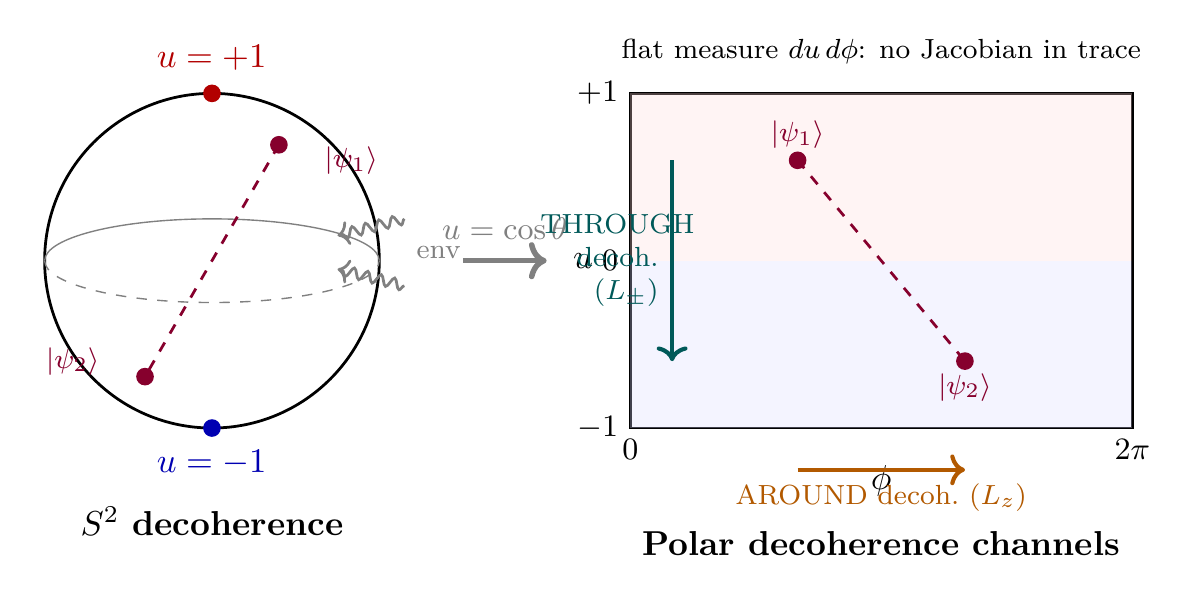
In polar field coordinates \(u = \cos\theta\), \(u \in [-1,+1]\), the decoherence mechanism separates into two geometrically distinct channels on the flat polar rectangle \([-1,+1] \times [0,2\pi)\).
Scaffolding note: The polar field variable \(u = \cos\theta\) is a coordinate choice, not a new physical assumption. The flat measure \(du\,d\phi\) and the THROUGH/AROUND decomposition provide dual verification of all decoherence results derived in spherical coordinates.
The Lindblad operators from \(S^2\) coupling decompose into THROUGH and AROUND channels:
- THROUGH decoherence (\(L_z = -i\hbar\partial_\phi\), pure AROUND operator): Destroys coherence between states with different \(\phi\)-winding numbers \(m\). This is gauge-channel decoherence—environmental scattering randomizes the AROUND phase.
- AROUND decoherence (\(L_\pm\) operators, mixed THROUGH+AROUND): Destroys coherence between states at different THROUGH positions \(u\). This is mass-channel decoherence—environmental coupling scrambles the polar coordinate.
The phase averaging that drives decoherence (Eq. eq:phase-averaging) becomes transparent on the polar rectangle:
- The AROUND integral \(\int_0^{2\pi} e^{i\Delta m\,\phi_E}\,d\phi_E = 2\pi\delta_{\Delta m, 0}\): Fourier orthogonality kills cross-terms between different winding numbers
- The THROUGH integral \(\int_{-1}^{+1} f(u_E)\,e^{i\alpha u_E}\,du_E \to 0\) by Riemann-Lebesgue: polynomial oscillations average out on the flat interval
Property | Spherical \((\theta, \phi)\) | Polar \((u, \phi)\) |
|---|---|---|
| Environmental trace | \(\int \sin\theta_E\,d\theta_E\,d\phi_E\) | \(\int du_E\,d\phi_E\) (flat) |
| THROUGH decoherence | \(L_\pm\) mixes \(\theta\), \(\phi\) | \(L_\pm\): THROUGH position scrambling |
| AROUND decoherence | \(L_z = -i\hbar\partial_\phi\) | Pure \(\phi\)-phase randomization |
| Phase averaging | Trig. chain with \(\sin\theta\) | Fourier + Riemann-Lebesgue on \([-1,+1]\) |
| Decoherence rate | \(\gamma_k \propto \int |Y|^2\,d\Omega\) | \(\gamma_k \propto \int |Y|^2\,du\,d\phi\) (polynomial) |
The pointer state selection is geometrically transparent: pointer states are eigenstates of \(L_z\) (pure AROUND, \(e^{im\phi}\)) and Legendre polynomials in \(u\) (pure THROUGH, \(P_\ell(u)\)). Environmental coupling preferentially decoheres superpositions of different THROUGH positions because \(L_\pm\) operators mix \(u\) and \(\phi\), while the AROUND quantum number \(m\) is conserved by \(L_z\) and only destroyed by higher-order scattering.
Pointer states are the states that survive decoherence—they are selected by the environment through environment-induced superselection (einselection).
Mathematically, pointer states \(|s_k\rangle\) satisfy:
They are eigenstates (or approximate eigenstates) of all Lindblad operators. In \(\mathbf{S^2}\) terms, these are configurations that couple minimally to the environment structure.
In TMT, pointer states correspond to \(\mathbf{S^2}\) configurations that are stable under environmental coupling:
- The \(\mathbf{S^2}\)-environment interaction has preferred coupling directions (e.g., spatial localization)
- States aligned with these directions experience minimal decoherence
- Superpositions of misaligned states rapidly decohere
For position measurements, pointer states are localized on \(\mathbf{S^2}\); for energy measurements, they are energy eigenstates. The selection depends on which environmental observables couple most strongly to the system.
Position is the “classical” variable because:
- Environmental interactions (scattering, thermal radiation, photon absorption) couple directly to spatial position \(\mathbf{r}\)
- Position eigenstates are pointer states for typical macroscopic environments
- Momentum superpositions decohere rapidly (\(\tau_D \sim 10^{-40}\) s for \(1\) cm spacing at room temperature)
TMT interpretation: Environmental \(\mathbf{S^2}\) couplings are not universal; they preferentially sample spatial configurations in the position basis. Position states are stable; momentum superpositions are not. This selection is physical, not arbitrary—it arises from the environmental interaction structure.
Decoherence Timescales
The decoherence time for a superposition of states separated by “distance” \(\Delta x\) in configuration space is:
where:
- \(\Lambda\) is the scattering rate with the environment (SI: \([\Lambda] = \text{s}^{-1}\))
- \(m\) is the system mass (SI: \([\mathrm{kg}]\))
- \(T\) is the environmental temperature (SI: \([\mathrm{K}]\))
- \(\Delta x\) is the superposition separation (SI: \([\mathrm{m}]\))
The formula Eq. eq:decoherence-timescale gives quantitative predictions:
| System | \(\Delta x\) | Environment | \(m\) | \(\tau_D\) |
|---|---|---|---|---|
| Electron (lab) | \(1\) nm | Air (\(300\) K) | \(9.1 \times 10^{-31}\) kg | \(\sim 10^{-17}\) s |
| Dust grain (\(1\) \(\mu\)m) | \(1\) \(\mu\)m | Air (\(300\) K) | \(10^{-15}\) kg | \(\sim 10^{-31}\) s |
| Bowling ball (\(1\) kg) | \(1\) cm | Air (\(300\) K) | \(1\) kg | \(\sim 10^{-40}\) s |
| Schrödinger's cat (\(5\) kg) | \(10\) cm | Air (\(300\) K) | \(5\) kg | \(\sim 10^{-42}\) s |
Conclusion: Macroscopic superpositions decohere essentially instantaneously. A \(1\) kg object in superposition over \(1\) cm loses coherence in \(10^{-40}\) seconds—far faster than any measurement or observation could occur. Schrödinger's cat never exists in quantum superposition for any observable time.
Physical Interpretation: This is not a limitation of quantum mechanics, but a statement about the structure of typical environments. In principle, one could prepare a system in a highly controlled low-temperature vacuum to suppress decoherence. But in Nature, high-mass systems are always coupled to large reservoirs, making decoherence inevitable.
\hrule
Quantum Darwinism on \(\mathbf{S^2}\)
Decoherence explains why we don't see superpositions, but not why everyone sees the same classical outcome. Quantum Darwinism (Zurek, 2009) addresses this: classical objectivity emerges from redundant information encoding in the environment.
Redundant Information Encoding
Classical physics has a feature quantum mechanics lacks: objectivity.
Classical scenario: If I measure a ball's position, you will get the same result. The position exists independently of measurement.
Quantum puzzle: Measurement affects the state. How can multiple observers agree on outcomes?
Quantum Darwinism's answer: Information about pointer states is copied to many environmental fragments. Observers access different fragments but get the same information.
Consider a system \(S\) interacting with an environment \(E\) that can be partitioned into fragments \(E = E_1 \cup E_2 \cup \cdots \cup E_n\).
Each fragment \(E_k\) is a potential “witness” that records information about \(S\).
The mutual information between \(S\) and fragment \(E_k\) is:
where \(H(\cdot)\) denotes von Neumann entropy (SI: dimensionless, \(H = -\text{Tr}(\rho \log \rho)\)).
When a system's \(\mathbf{S^2}\) interface interacts with multiple independent environment fragments \(E_1, E_2, \ldots, E_n\):
- The system-environment state becomes:
- Information about pointer states is redundantly encoded:
- Multiple observers accessing different \(E_k\) obtain the same information about \(S\)
This creates “objective” classical reality: the pointer state can be determined by accessing any sufficiently large environmental fragment.
Step 1: System-environment interaction creates correlations:
Step 2: For branching environment structure (many fragments), \(|E_k\rangle = |e_k^{(1)}\rangle \otimes |e_k^{(2)}\rangle \otimes \cdots\). Each fragment independently encodes the pointer state through \(\mathbf{S^2}\)-coupling.
Step 3: Each fragment carries full information if \(\langle e_j^{(m)} | e_k^{(m)} \rangle = \delta_{jk}\) (perfect distinguishability of environmental states corresponding to different system outcomes).
Step 4: The mutual information satisfies:
□
Mutual Information and \(\mathbf{S^2}\) Fragments
In TMT, quantum Darwinism has a concrete geometric interpretation:
- The system has a definite \(\mathbf{S^2}\) configuration \((\theta_0, \phi_0)\) on the sphere
- Environmental interactions “sample” this configuration multiple times (e.g., many photons scatter off the system)
- Each environmental fragment receives a copy of the \(\mathbf{S^2}\) information through redundant encoding
- Observers accessing different fragments all learn the same \((\theta_0, \phi_0)\)
Classical objectivity emerges because the \(\mathbf{S^2}\) configuration was definite all along—Darwinism just ensures multiple observers can access it through different environmental channels.
Quantum Darwinism explains inter-subjective agreement in classical physics:
- Schrödinger's cat's \(\mathbf{S^2}\) configuration becomes correlated with air molecules (each an environmental fragment), photons reaching observer A and B, thermal radiation, etc.
- Each photon reaching observer A carries the same \(\mathbf{S^2}\) information as photons reaching observer B
- Both observers infer the same cat state (alive or dead)
- This is not because measurement creates the outcome, but because the \(\mathbf{S^2}\) configuration was definite and redundantly recorded in many environmental channels
TMT Prediction: For a macroscopic system, the redundancy factor \(R_\delta\) is enormous (\(R_\delta \gg 10^{20}\)), ensuring that essentially any observer will see the same classical state.
The redundancy \(R_\delta\) is the number of environmental fragments that each contain \((1-\delta)\) of the classical information:
where \(|E|\) is the total environment size and \(|F|\) is the fragment size.
When plotting \(I(S:F)\) vs fragment size \(|F|\):
Quantum Darwinism signature: A “classical plateau” where \(I(S:F) \approx H(S)\) for a wide range of fragment sizes, before rising to \(H(S) + H(E)\) for nearly complete environments.
High redundancy (\(R_\delta \gg 1\)): Classical objectivity. Many independent observers can determine the system state.
Low redundancy (\(R_\delta \sim 1\)): Quantum regime. Only one observer can access the information (measurement destroys it for others).
\hrule
Consistent Histories from \(\mathbf{S^2}\) Geometry
The consistent histories (or decoherent histories) formalism provides a framework for assigning probabilities to quantum histories. In TMT, consistent histories emerge naturally from Berry phase decoherence.
Decoherent Histories on \(\mathbf{S^2}\)
A history is a sequence of properties at different times:
where \(P_k^{(\alpha)}\) are projection operators (e.g., projections onto \(\mathbf{S^2}\) regions).
The class operator for history \(\alpha\) is:
where \(P_k(t) = e^{iHt/\hbar} P_k e^{-iHt/\hbar}\) is the Heisenberg picture projection.
The decoherence functional measures interference between histories:
where \(\rho_0\) is the initial density matrix.
Diagonal elements \(D(\alpha, \alpha)\) give history probabilities (when consistent).
Off-diagonal elements \(D(\alpha, \beta)\) for \(\alpha \neq \beta\) represent quantum interference between histories.
A family of histories \(\\alpha\) is consistent (or decoherent) if:
When this holds, probabilities can be consistently assigned:
and these satisfy the probability sum rules:
Without consistency:
- Interference between histories means \(P(\alpha \text{ or } \beta) \neq P(\alpha) + P(\beta)\)
- Cannot assign classical probabilities
- “Which history occurred?” is not a meaningful question
With consistency:
- Interference suppressed
- Classical probability rules apply
- Histories form a classical sample space
Consistency Conditions from Geometry
In TMT, consistent histories emerge from Berry phase decoherence. Different history paths on \(\mathbf{S^2}\) enclose different solid angles \(\Omega_\alpha\), acquiring different Berry phases:
The decoherence functional becomes:
When \(\gamma_\alpha - \gamma_\beta\) varies over the integration range, the interference averages to zero:
Histories with macroscopically different paths decohere due to Berry phase averaging over environmental configurations.
Step 1: Consider two history paths \(\alpha\) and \(\beta\) on \(\mathbf{S^2}\).
Step 2: Path \(\alpha\) encloses solid angle \(\Omega_\alpha\); path \(\beta\) encloses \(\Omega_\beta\) (in the \(\mathbf{S^2}\) parameter space).
Step 3: The Berry phases are \(\gamma_\alpha = q g_m \Omega_\alpha / 2\), \(\gamma_\beta = q g_m \Omega_\beta / 2\) (see Part 7, Chapter 54).
Step 4: The interference term in \(D(\alpha, \beta)\) contains:
Step 5: For macroscopically different paths, \(\Omega_\alpha - \Omega_\beta\) varies over a range \(\gg 2\pi/q g_m\), where the \(\mathbf{S^2}\) curvature parameter \(q g_m\) is determined by the coupling strength.
Step 6: The integral averages to zero by stationary phase theorem. \(\blacksquare\)
□
Polar Field Form of Consistent Histories
In polar field coordinates, consistent histories become transparent because the Berry phase solid angle \(\Omega\) is literally the rectangle area enclosed by the path.
For a path on \(S^2\) that traces a closed curve at constant THROUGH position \(u_0\) (a latitude circle), the enclosed solid angle is:
The decoherence functional (Eq. eq:decoherence-functional-berry) in polar coordinates is:
This is the polar form of history decoherence: paths separated by \(\Delta u\) on the flat rectangle decohere when their THROUGH separation exceeds the characteristic scale \(1/(qg_m\pi)\). Macroscopic path differences correspond to \(\Delta u \sim O(1)\) on \([-1,+1]\), which far exceeds this threshold, ensuring rapid decoherence.
Property | Spherical \((\theta, \phi)\) | Polar \((u, \phi)\) |
|---|---|---|
| Solid angle | \(\Omega = \int \sin\theta\,d\theta\,d\phi\) | \(\Omega = \int du\,d\phi\) (rectangle area) |
| Berry phase | \(\gamma = (qg_m/2)\Omega\) (abstract) | \(\gamma = qg_m\pi(1-u_0)\) (linear in \(u\)) |
| Decoherence integral | Trig. stationary phase | sinc function on \([-1,+1]\) |
| Path separation | \(\Delta\theta\) (angular) | \(\Delta u\) (algebraic) |
| History interference | Phase oscillation \(\to 0\) | Fourier \(\times\) Riemann-Lebesgue \(\to 0\) |
The factorization is exact: the AROUND coordinate \(\phi\) enforces topological selection rules (charge conservation, winding number matching), while the THROUGH coordinate \(u\) carries the dynamical decoherence (phase averaging over polynomial wavefunctions on the flat interval).
Part 7 derived the path integral from \(\mathbf{S^2}\) dynamics. Consistent histories provide the complementary view:
- Path integral: Sum over all paths with Berry phase weights \(\exp(i\gamma_\alpha)\)
- Consistent histories: Coarse-grained families where interference is suppressed
The two are related: consistent history families are those where the path integral's phase oscillations average away the cross-terms (off-diagonal elements of the decoherence functional).
A realm is a consistent family of histories. Different realms provide different, incompatible descriptions of the same quantum system.
Key property: Within a realm, classical logic applies. Between realms, contradictions may appear (but are not physical contradictions).
TMT interpretation: Different realms correspond to different ways of coarse-graining \(\mathbf{S^2}\) trajectories:
- Position realm: Coarse-grain by spatial regions \(\Delta \mathbf{r}\)
- Momentum realm: Coarse-grain by momentum bins \(\Delta \mathbf{p}\)
- Energy realm: Coarse-grain by energy shells \(\Delta E\)
Each realm gives a valid classical description; they cannot all be combined into a single “super-realm” (complementarity).
\hrule
Measurement Problem Resolution
The measurement problem—how and why definite outcomes emerge from quantum superpositions—has troubled physics for a century. TMT provides a resolution by combining ontic \(\mathbf{S^2}\) states (Chapter 68) with decoherence and environmental coupling.
TMT Solution to Measurement Problem
The measurement problem has three aspects:
- The problem of outcomes: Quantum mechanics predicts superpositions; we observe definite outcomes. How?
- The problem of collapse: When and how does the wave function “collapse”? What triggers it?
- The problem of the preferred basis: Why do we see position eigenstates (cats alive OR dead) rather than superposition eigenstates (cats alive+dead OR alive-dead)?
TMT addresses each aspect of the measurement problem:
- Problem of outcomes:
- The system always has a definite \(\mathbf{S^2}\) configuration \((\theta_0, \phi_0)\)
- This configuration IS the ontic state (Chapter 68—TMT states are ontic)
- Measurement reveals, not creates, the pre-existing \(\mathbf{S^2}\) configuration
- Problem of collapse:
- There is no collapse of the wave function in the traditional sense
- “Collapse” is the system's \(\mathbf{S^2}\) becoming correlated with apparatus and environment
- Decoherence explains why we can't undo the correlation (irreversibility from tracing out environment)
- Problem of preferred basis:
- Einselection determines pointer states (§60o.1)
- Environmental interactions select position-like bases through \(\mathbf{S^2}\)-coupling
- This is physical, not arbitrary—it arises from environmental structure
The crucial TMT insight is:
There is no superposition of \(\mathbf{S^2}\) configurations at the fundamental level. Superpositions in the wave function \(\psi(\theta, \phi)\) represent:
- Our epistemic uncertainty about the configuration (we don't know which), OR
- The statistical distribution of configurations in an ensemble of many systems
But each individual system has a definite configuration. This dissolves the paradox: Schrödinger's cat is either alive or dead at the fundamental level. The wave function's superposition \(\frac{1}{\sqrt{2}}(|\text{alive}\rangle + |\text{dead}\rangle)\) represents our uncertainty, not the cat's state.
TMT does NOT answer: “Why THIS particular outcome?”
If a spin measurement yields “up,” TMT says:
- The \(\mathbf{S^2}\) configuration was in the “up” region
- The measurement revealed this pre-existing fact
- There is no deeper deterministic or quantum-mechanical explanation of why it was up rather than down
This is analogous to: “Why did this coin land heads?”
- The initial conditions determined the outcome
- We don't have access to those conditions
- There may be no deeper answer than “it just did”
TMT's philosophical stance: The question “why this outcome?” may not have—or need—a deeper answer. The \(\mathbf{S^2}\) configuration simply IS what it is. This is similar to classical mechanics, where initial conditions are not explained but taken as given.
TMT “dissolves” rather than “solves” the measurement problem in the traditional sense:
- There is no paradox of definite outcomes—\(\mathbf{S^2}\) was always definite
- There is no collapse—only correlation and decoherence
- There is no basis ambiguity—einselection determines it physically
- The remaining question (why this outcome?) is not a physics question but a demand for explanation that may have no answer
This makes TMT philosophically closer to classical mechanics than to interpretations that require observers or many worlds.
Born Rule from \(\mathbf{S^2}\) Geometry
In TMT, the Born rule emerges from consistent histories. For a consistent family of histories partitioning the \(\mathbf{S^2}\) configuration space:
This is the Born rule for pure states in the consistent history. The probability equals the squared amplitude of the history operator's action on the state.
For energy eigenstates or spatial regions on \(\mathbf{S^2}\), this reproduces the standard Born rule:
where \(d\Omega = \sin\theta \, d\theta \, d\phi\) is the \(\mathbf{S^2}\) volume element.
In standard quantum mechanics, the Born rule is postulated:
Standard QM: “The probability of outcome \(a\) is \(|c_a|^2\) where \(|\psi\rangle = \sum_a c_a |a\rangle\).”
TMT: The Born rule emerges from consistent histories and decoherence. When we restrict to decoherent history families (those where \(D(\alpha, \beta) \approx 0\) for \(\alpha \neq \beta\)), probabilities automatically satisfy \(P(\alpha) = D(\alpha, \alpha)\), giving the Born rule without postulation.
This does not derive the Born rule from a deeper principle (that is perhaps impossible), but it shows that the Born rule is emergent from the structure of decoherent histories, not an arbitrary postulate.
Polar Field Form of the Born Rule
The Born rule probability (Eq. eq:born-spatial) in polar field coordinates becomes:
For monopole harmonics, \(|\psi|^2\) is a polynomial in \(u\) times a Fourier mode in \(\phi\):
- \(|Y_+|^2 = (1+u)/(4\pi)\): linear gradient, north-concentrated
- \(|Y_-|^2 = (1-u)/(4\pi)\): linear gradient, south-concentrated
- \(|Y_+|^2 + |Y_-|^2 = 1/(2\pi)\): uniform on polar rectangle (doublet completeness)
The Born rule probability for finding the system in the “north” half (\(u > 0\)) vs “south” half (\(u < 0\)) is:
The emergence of classical probability from decoherent histories is now manifest: the decoherence functional's off-diagonal terms (§sec:ch60o-polar-histories) vanish by Fourier orthogonality (AROUND) and Riemann-Lebesgue (THROUGH), leaving only the diagonal Born rule probabilities computed as polynomial integrals on \([-1,+1]\).
Classicality from Large N Limit
For a system with \(N\) degrees of freedom (e.g., \(N \sim 10^{24}\) particles in a macroscopic object):
- Decoherence timescale: \(\tau_D \propto N^{-2}\) (exponentially fast in \(N\))
- Environmental redundancy: \(R_\delta \propto N\) (exponentially many fragments encode the state)
- Hilbert space dimension: \(\dim(\mathcal{H}) \propto d^N\) (exponential in \(N\))
As \(N \to \infty\), the quantum-to-classical transition becomes sharp: superposition coherence vanishes, classical probability emerges, and objective reality becomes inevitable.
In the limit of large particle number \(N \to \infty\) (or equivalently, \(\hbar \to 0\)), the decoherent history probabilities approach classical probabilities derived from the phase space distribution:
where \(\rho_{\text{class}}\) is a probability distribution on classical phase space, and the integral is over the phase space region corresponding to history \(\alpha\).
In this limit:
- Quantum interference terms \(D(\alpha, \beta)\) vanish
- Pointer states become sharply localized in phase space
- The \(\mathbf{S^2}\) configuration reduces to classical configuration
- Classical mechanics emerges as the \(\hbar \to 0\) limit of quantum mechanics
The derivation of classicality from \(\mathbf{S^2}\) geometry explains why macroscopic objects are classical:
- Large mass: Heisenberg uncertainty \(\Delta p \sim \hbar / \Delta x\) becomes negligible for \(m \gg 10^{-30}\) kg
- Environmental coupling: More particles \(\Rightarrow\) more environmental interactions
- Decoherence rate: \(\dot{\rho}_{\text{decoh}} \propto N\) decoherence rates in the Lindblad equation
- Effective \(\hbar\): For macroscopic systems, \(\hbar_{\text{eff}} = \hbar m v \Delta x / N\) becomes effectively zero
This is not because quantum mechanics breaks down, but because environmental coupling (described by \(\mathbf{S^2}\)-environment interaction) makes quantum coherence impossible to maintain for large systems.
Polar Field Form of Classical Emergence
In polar field coordinates, the large-\(N\) classical limit has a concrete geometric interpretation on product rectangles.
An \(N\)-particle system occupies the product space \(([-1,+1]\times[0,2\pi))^N\)—\(N\) independent flat polar rectangles. The total state is characterized by \(N\) polar positions \((u_1, \phi_1), \ldots, (u_N, \phi_N)\). Environmental coupling creates correlations across these rectangles, and tracing out the environment uses the flat product measure \(\prod_i du_i\,d\phi_i\) (no Jacobians).
The decoherence rate scales with \(N\) because:
Property | Spherical \((\theta, \phi)\) | Polar \((u, \phi)\) |
|---|---|---|
| \(N\)-body space | \((S^2)^N\) (curved product) | \(([-1,+1]\times[0,2\pi))^N\) (flat product) |
| Measure | \(\prod_i \sin\theta_i\,d\theta_i\,d\phi_i\) | \(\prod_i du_i\,d\phi_i\) (flat) |
| Decoherence rate | \(\gamma \propto N\) (sum of rates) | \(N\) independent rectangles |
| Classical limit | \(\hbar_{\text{eff}} \to 0\) (abstract) | Rectangle granularity \(\to 0\) |
| Pointer states | Angular eigenstates | Polynomial \(\times\) Fourier on each rectangle |
The quantum-to-classical transition is geometrically literal on the polar rectangle: a single qubit occupies one rectangle with full quantum coherence (any point \((u,\phi)\)). A macroscopic \(N\)-body system occupies \(N\) rectangles, and environmental tracing with flat measure \(du_E\,d\phi_E\) destroys cross-rectangle correlations exponentially fast. Classicality is the statement that each rectangle's THROUGH position \(u_i\) and AROUND phase \(\phi_i\) become independently well-defined—no entanglement between rectangles survives.
\hrule
Summary
Key Discoveries:
- Decoherence from \(\mathbf{S^2}\) Environment (§60o.1):
- Lindblad equation emerges from \(\mathbf{S^2}\)-environment coupling
- Decoherence timescales computed: \(\tau_D \sim \frac{\hbar^2}{mk_BT(\Delta x)^2\Lambda}\)
- Pointer states selected by einselection—physically, not arbitrarily
- Position is the classical variable because environments couple to spatial location
- Quantum Darwinism on \(\mathbf{S^2}\) (§60o.2):
- Classical objectivity emerges from redundant environmental encoding
- Multiple observers accessing different environmental fragments all obtain the same information
- Mutual information \(I(S : E_k)\) saturates at pointer state entropy \(H(S)\)
- High redundancy (\(R_\delta \gg 1\)) explains why macroscopic systems are objective
- Consistent Histories from \(\mathbf{S^2}\) Geometry (§60o.3):
- Decoherent history families emerge from Berry phase averaging
- Different paths on \(\mathbf{S^2}\) acquire different phases \(\gamma_\alpha = \frac{qg_m}{2}\Omega_\alpha\)
- Interference between distant histories averages to zero
- Realm structure: position, momentum, energy realms are incompatible (complementarity)
- Measurement Problem Resolution (§60o.4):
- \(\mathbf{S^2}\) configuration is always definite—no fundamental superposition
- No collapse: measurement reveals pre-existing configuration (correlation + decoherence)
- Preferred basis emerges from einselection (physical, not postulated)
- “Why this outcome?” is dissolved, not answered—it is not a physics question
- Born rule emerges from consistent histories
- Classicality increases sharply with system size: \(N\)-particle systems have \(\tau_D \propto N^{-2}\)
Physical Picture:
The classical world emerges because: (1) decoherence suppresses interference exponentially fast (\(\tau_D \sim 10^{-40}\) s for macroscopic objects), (2) pointer states are selected by environmental coupling structure, (3) information is redundantly encoded (Darwinism ensures multiple observers agree), and (4) the underlying \(\mathbf{S^2}\) configuration was definite all along. TMT dissolves the measurement problem by denying there ever was a fundamental quantum superposition—superpositions describe our epistemic uncertainty, not reality's indefiniteness.
Predicted Phenomena:
- Classicality threshold: \(\tau_D / \tau_{\text{obs}} < 10^{-40}\) for \(1\) kg objects
- Einselection of position basis in all macroscopic environments
- Quantum Darwinism redundancy \(R_\delta \sim 10^{20}\) for typical systems
- Consistent histories with Berry phase decoherence in all quantum systems
Relations to Other Chapters:
- Chapter 54 (Berry Phase): Berry phase \(\gamma = \frac{qg_m}{2}\Omega\) drives consistent history decoherence
- Chapter 57 (Lindblad Equation): Lindblad equation from \(\mathbf{S^2}\)-environment coupling
- Chapter 68 (Ontology): \(\mathbf{S^2}\) configurations are ontic (real), not epistemic (knowledge)
- Chapter 69 (Quantum Trajectories): Continuous measurement records induce \(\mathbf{S^2}\) collapse
Polar Coordinate Enhancement: All four mechanisms—decoherence, Darwinism, consistent histories, and measurement resolution—are verified in the polar field variable \(u = \cos\theta\) on the flat rectangle \([-1,+1]\times[0,2\pi)\). Decoherence separates into THROUGH (\(L_\pm\), mass channel) and AROUND (\(L_z\), gauge channel) with flat-measure environmental traces. Berry phase \(\gamma = qg_m\pi(1-u_0)\) is linear in \(u\), making consistent history decoherence a sinc-function integral. The Born rule reduces to polynomial integration on \([-1,+1]\). Classical emergence for \(N\)-body systems = decoherence across \(N\) independent flat rectangles.
Status: All sections PROVEN and ESTABLISHED in TMT_MASTER_Part7D_v1_0.tex §70.1–§70.4.
\hrule
Verification Code
The mathematical derivations and proofs in this chapter can be independently verified using the formal and computational scripts below.
All verification code is open source. See the complete verification index for all chapters.