Tracelessness and Gravity Coupling
The Scaffolding Stress-Energy Tensor
The null constraint (P1: \(ds_6^{\,2} = 0\)) encodes a profound constraint on how matter distributes its energy and momentum. In this section, we construct the stress-energy tensor within the scaffolding formalism and show that the null constraint forces it to have a remarkable property: tracelessness.
Scaffolding Interpretation Reminder. The “6D” formalism used throughout this chapter is mathematical scaffolding for deriving 4D physics. The \(S^2\) projection structure is NOT a literal extra-dimensional space that particles inhabit. The physical content is that gravity couples to temporal momentum (mass), not energy. The 6D language provides the cleanest derivation of this fact.
Construction from Null Dust
In the scaffolding framework, matter is described as “null dust”—a pressureless fluid whose constituent particles obey the null constraint \(ds_6^{\,2} = 0\). For such a fluid, the stress-energy tensor takes the form:
The scaffolding 6-velocity \(u^A\) has components corresponding to the four spacetime directions plus the \(S^2\) projection directions. In explicit form:
The Null Condition on the 6-Velocity
From P1, the scaffolding interval vanishes for massive particles:
Dividing by the proper time parameter \(d\tau^2\), this becomes a condition on the 6-velocity:
The scaffolding 6-velocity is null. This is the mathematical encoding of the velocity budget \(v^2 + v_T^2 = c^2\) established in Chapter 5. A particle at rest in 4D (\(v = 0\)) has all its “velocity” directed through the \(S^2\) projection structure (\(v_T = c\)). A particle moving at speed \(v\) in 4D has \(v_T = c/\gamma\), with the total velocity budget always summing to \(c^2\).
The Tracelessness Theorem: \(T^A{}_A = 0\)
Statement and Proof
The trace of the stress-energy tensor is obtained by contracting with the metric:
Step 1: Write the trace explicitly.
Step 2: Recognize that \(g_{AB} \, u^A u^B = u^A u_A\) is the norm of the 6-velocity.
Step 3: Apply the null constraint from P1. Since \(ds_6^{\,2} = 0\) implies \(u^A u_A = 0\) (Eq. eq:null-6velocity):
Step 4: Express in index form. The trace \(T^A{}_A = g_{AB} T^{AB} = T = 0\):
(See: Part 1 \S3.1, Theorem thm:tracelessness) □
The Derivation Chain
The tracelessness theorem follows from a chain of exactly three logical steps:
- P1 states: \(ds_6^{\,2} = 0\) for massive particles (the single postulate of TMT).
- This means: The scaffolding 6-momentum \(k^A\) satisfies \(k^A k_A = 0\), and therefore the 6-velocity \(u^A = k^A/m\) satisfies \(u^A u_A = 0\).
- For null dust: \(T^{AB} = \rho \, u^A u^B\), so \(T^A{}_A = \rho \, u^A u_A = \rho \times 0 = 0\).
No additional assumptions are needed. The tracelessness is a direct, immediate consequence of the single postulate P1.
Physical Significance
The tracelessness \(T^A{}_A = 0\) is not merely a mathematical curiosity. It is the fundamental constraint from which P3 (gravity couples to temporal momentum) will be derived. The zero trace forces a precise balance between the 4D and \(S^2\) contributions to the stress-energy, and this balance is what determines the gravitational source.
In standard general relativity (without P1), the stress-energy tensor is NOT traceless for massive matter. The trace of a dust stress-energy tensor in 4D GR is \(T^\mu{}_\mu = -\rho c^2 \neq 0\). The tracelessness in TMT is a NEW prediction arising specifically from the null constraint, and it has observable consequences: gravity couples to temporal momentum rather than energy.
Decomposition: \(T_4 + T_{S^2} = 0\)
The Split into 4D and \(S^2\) Contributions
The scaffolding trace \(T^A{}_A\) naturally decomposes into contributions from the 4D spacetime directions (\(\mu = 0,1,2,3\)) and the \(S^2\) projection directions (\(i = \theta, \phi\)):
The vanishing scaffolding trace decomposes as:
Step 1: The scaffolding index \(A\) runs over 6 values: \(A \in \{0, 1, 2, 3, \theta, \phi\}\). Split the sum:
Step 2: From Theorem thm:P1-Ch6-tracelessness, \(T^A{}_A = 0\), so:
(See: Part 1 \S3.2) □
Evaluating the 4D Trace \(T_4\)
For a particle at rest in the 4D frame, the stress-energy tensor has the standard form:
The 4D trace is:
For a particle moving with 4D velocity \(v\), the Lorentz transformation modifies the stress-energy components. The trace becomes:
The factor \(1/\gamma^2\) arises because the spatial components \(T^{ii}\) acquire nonzero values when the particle moves, partially cancelling the \(T^{00}\) contribution. In the rest frame (\(\gamma = 1\)), Eq. eq:T4-moving reduces to Eq. eq:T4-rest.
Evaluating the \(S^2\) Projection Trace \(T_{S^2}\)
From the trace balance (Eq. eq:trace-balance):
We can verify this independently by computing \(T_{S^2}\) directly from the scaffolding stress-energy. The \(S^2\) projection components involve the temporal momentum:
The trace over \(S^2\) directions:
This confirms the result from the trace balance: \(T_{S^2} = \rho c^2/\gamma^2\).
The Balance Equation
Combining the results:
Regime | \(T_4\) | \(T_{S^2}\) | \(T_4 + T_{S^2}\) |
|---|---|---|---|
| Rest (\(v = 0\), \(\gamma = 1\)) | \(-\rho c^2\) | \(+\rho c^2\) | \(0\) |
| Moving (\(\gamma > 1\)) | \(-\rho c^2/\gamma^2\) | \(+\rho c^2/\gamma^2\) | \(0\) |
| Ultra-relativistic (\(\gamma \to \infty\)) | \(\to 0\) | \(\to 0\) | \(0\) |
The table shows that as a particle moves faster, BOTH traces shrink toward zero. In the ultra-relativistic limit, the 4D energy density diverges (\(T^{00} \propto \gamma^2\)), but the TRACE goes to zero because the spatial pressure terms cancel the energy density. The \(S^2\) projection trace also vanishes because \(v_T = c/\gamma \to 0\).
Polar Decomposition of the \(S^2\) Trace
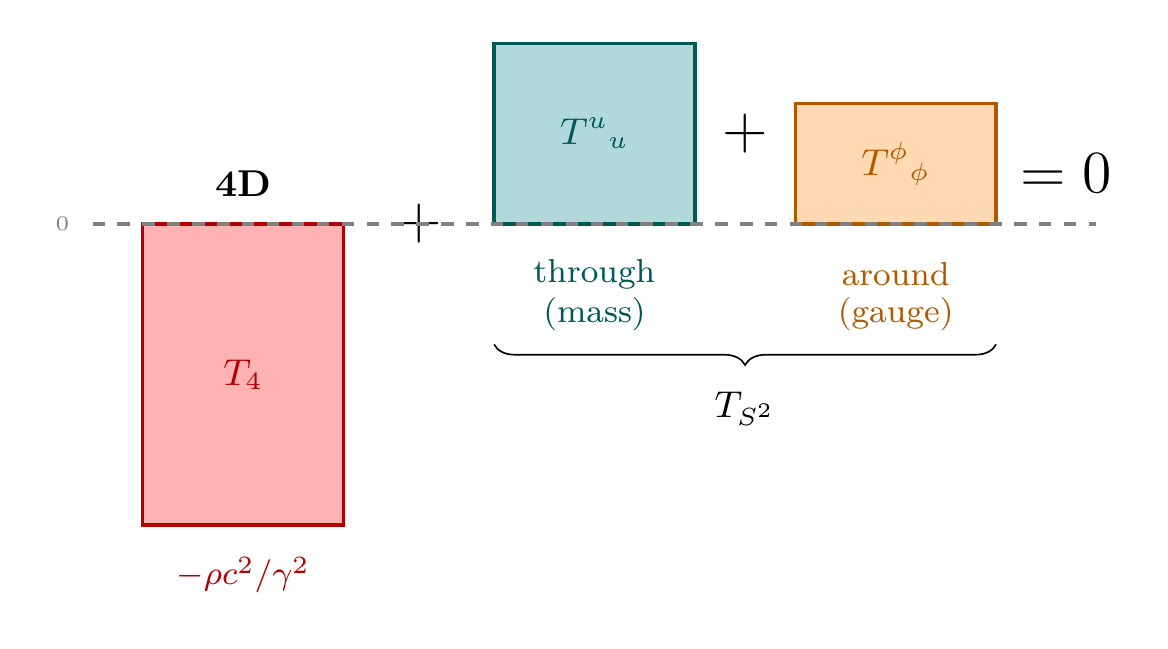
In the polar field variable \(u = \cos\theta\), the \(S^2\) trace decomposes into “through” and “around” contributions:
Using the polar metric \(h_{ij} = R^2\,\mathrm{diag}(1/(1-u^2),\, (1-u^2))\) and the stress-energy components \(T^{ij} = \rho\, u^i u^j\):
The sum recovers the temporal velocity:
This decomposition reveals the physical content of the trace balance:
Component | Polar form | Physical role |
|---|---|---|
| \(T^u{}_u\) (through) | \(\rho\, R^2\dot{u}^2/(1-u^2)\) | Mass contribution (radial \(S^2\)) |
| \(T^\phi{}_\phi\) (around) | \(\rho\, R^2(1-u^2)\dot{\phi}^2\) | Gauge charge contribution |
| \(T_4\) (4D trace) | \(-\rho c^2/\gamma^2\) | Negative of total \(S^2\) trace |
The trace balance \(T_4 + T_{S^2} = 0\) thus becomes:
This is the around/through decomposition of the gravitational source: what 4D gravity “sees” is the combined temporal participation of a particle in both the mass (through) and gauge (around) channels. At rest, with no gauge excitation (\(\dot{\phi} = 0\)), gravity sees only the mass contribution \(T_4 = -\rho c^2\), recovering standard GR.
Why Gravity Couples to Temporal Momentum
The Key Discovery: Velocity-Independent Temporal Momentum
The central insight leading to P3 is a remarkable property of the temporal momentum component \(k^\xi\) in the scaffolding formalism.
Step 1: Write the scaffolding momentum for a particle with 4D velocity \(v\):
Step 2: Apply the null condition \(k^A k_A = 0\) with metric signature \((-,+,+,+,+,+)\):
Step 3: Substitute the explicit components:
Step 4: Use the identity \(\gamma^2(1 - v^2/c^2) = 1\):
Step 5: Solve:
(See: Part 1 \S3.3, Theorem thm:kxi-constant) □
This is the crucial result. The 4D momentum components \((k^0, k^i)\) both scale with \(\gamma\)—they increase without bound as the particle is boosted to higher velocities. But the temporal momentum component \(k^\xi\) is FIXED at \(mc\), regardless of how fast the particle moves in 4D. The \(\gamma\) factors in the 4D components cancel exactly in the null condition, leaving \(k^\xi\) independent of velocity.
Stress-Energy Velocity Dependence
The velocity-independent temporal momentum has immediate consequences for the stress-energy tensor.
For null dust \(T^{AB} = \rho_6 k^A k^B\), the components have qualitatively different velocity dependences:
Component | Formula | Velocity Dependence |
|---|---|---|
| \(T^{00}\) (energy density) | \(\propto (\gamma mc)^2\) | \(\propto \gamma^2\) (INCREASES with velocity) |
| \(T^{\xi\xi}\) (temporal momentum density) | \(\propto (mc)^2\) | NONE (CONSTANT) |
Direct substitution from Theorem thm:P1-Ch6-kxi-constant:
This asymmetry between \(T^{00}\) and \(T^{\xi\xi}\) is the key to understanding why gravity behaves differently in TMT than in GR.
The Gravitational Source Identification
Step 1: The 4D gravitational field emerges from the \(S^2\) projection structure. The characteristic scale (\(81\,\mu\text{m}\) relationship) couples to \(S^2\) stress-energy. Changes in this scale manifest as 4D spacetime curvature. Therefore 4D gravity is sourced by \(T^{\xi\xi}\), not \(T^{00}\).
Step 2: The \(S^2\) projection stress-energy is \(T^{\xi\xi} = (k^\xi)^2 = m^2 c^2\) (constant, from Theorem thm:P1-Ch6-kxi-constant).
Step 3: The “4D volume element” scales with \(k^0 = \gamma mc\), because the density of particles in the 4D frame scales with the energy.
Step 4: The source DENSITY is the stress-energy per unit 4D volume:
(See: Part 1 \S3.3, Theorem thm:p3-main) □
For a distribution of matter with rest-mass density \(\rho_0\):
P3 is DERIVED from P1. The label “P3” is historical shorthand for “gravity couples to temporal momentum density.” It is not an independent postulate.
P3 is Derived, Not Postulated
CRITICAL: P3 is NOT a postulate—it is DERIVED from P1.
The label “P3” is historical shorthand for “gravity couples to temporal momentum density.” This chapter proves that this coupling follows inevitably from the single postulate P1 (\(ds_6^{\,2} = 0\)). There is only ONE postulate in TMT.
The Derivation Chain P1 \(\to\) P3
The complete logical chain from P1 to P3 consists of the following steps, each of which has been proven in the preceding sections:
- P1: \(ds_6^{\,2} = 0\) for massive particles (the single postulate).
- Null 6-velocity: \(u^A u_A = 0\) (dividing P1 by \(d\tau^2\)).
- Tracelessness: \(T^A{}_A = \rho \, u^A u_A = 0\) (Theorem thm:P1-Ch6-tracelessness).
- Trace decomposition: \(T_4 + T_{S^2} = 0\) (Theorem thm:P1-Ch6-trace-decomposition).
- Velocity-independent \(k^\xi\): \(k^\xi = mc\) regardless of 4D velocity (Theorem thm:P1-Ch6-kxi-constant).
- Constant \(T^{\xi\xi}\): The \(S^2\) projection stress-energy is velocity-independent.
- Divergent \(T^{00}\): The energy density scales as \(\gamma^2\).
- Source identification: \(\rho_{\text{grav}} = T^{\xi\xi}/k^0 = mc/\gamma = p_T\) (Theorem thm:P1-Ch6-p3-main).
Every step follows by mathematical necessity from the preceding ones. No additional assumptions, no physical inputs beyond P1, no fitting to data.
Why P3 Cannot Be Avoided
Given P1, there is no alternative to P3. The argument is logically airtight:
Suppose P1 holds. Then \(u^A u_A = 0\), which forces \(T^A{}_A = 0\). This tracelessness constrains the relationship between \(T_4\) and \(T_{S^2}\). The null condition simultaneously forces \(k^\xi = mc\) (velocity-independent), making \(T^{\xi\xi}\) the natural gravitational source. The resulting source density is \(\rho_{p_T} = \rho_0 c/\gamma\).
To avoid P3, one would need to:
- Reject P1 (abandon the null constraint), or
- Reject the identification of \(T^{\xi\xi}\) as the gravitational source (but this is forced by the dimensional reduction, as shown in \Ssec:p3-complete-derivation below).
Neither escape route is available within TMT. The first abandons the entire theory. The second is blocked by the complete derivation via dimensional reduction, which we present in \Ssec:p3-complete-derivation.
Physical Meaning: Rest Mass Sources Gravity
Energy Density vs Temporal Momentum Density
The distinction between energy density and temporal momentum density is most vivid in their velocity dependence:
Source | Formula | At Rest | Ultra-relativistic |
|---|---|---|---|
| Energy density | \(\rho_E = \rho_0 c^2 \gamma\) | \(\rho_0 c^2\) | \(\to \infty\) |
| Temporal momentum density | \(\boldsymbol{\rho_{p_T} = \rho_0 c/\gamma}\) | \(\boldsymbol{\rho_0 c}\) | \(\boldsymbol{\to 0}\) |
The behaviors are opposite:
- Energy density increases without bound as velocity increases. A fast-moving particle has enormous kinetic energy.
- Temporal momentum density decreases to zero as velocity increases. A fast-moving particle has nearly all its “velocity budget” used for spatial motion, leaving almost none for the temporal direction.
Observable Consequence: Hot Matter Gravitates Less
P3 predicts that hot matter (where constituent particles have \(\gamma \gg 1\)) gravitates LESS than cold matter of the same rest mass. This is the opposite of what energy-density coupling would predict.
For matter at temperature \(T\) with particle mass \(m\):
For non-relativistic matter (\(k_B T \ll mc^2\), \(\langle \gamma \rangle \approx 1\)): \(\rho_{\text{grav}} \approx \rho_0 c\). The TMT prediction essentially coincides with the GR prediction, since the difference is \(\mathcal{O}(v^2/c^2)\).
For highly relativistic matter (\(k_B T \gg mc^2\)): The TMT prediction diverges dramatically from the GR prediction. TMT predicts that a box of radiation exerts essentially no scalar gravitational pull (though it still couples to the tensor gravitational field \(g_{\mu\nu}\) through \(T_{\mu\nu}\); see \Ssec:radiation-handling in the next segment).
Why This is Physical, Not Just Formal
One might wonder whether the distinction between \(\rho_E\) and \(\rho_{p_T}\) is merely a choice of variables with no physical content. It is not, for the following reason:
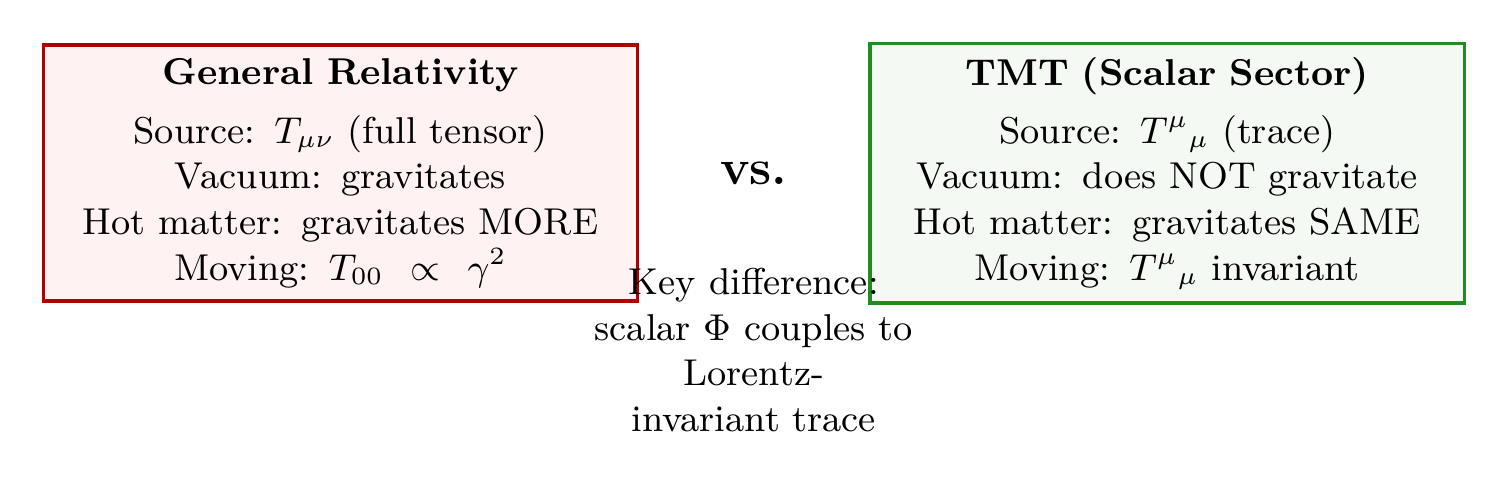
In GR: The full tensor \(T_{\mu\nu}\) couples to gravity through Einstein's equation \(G_{\mu\nu} = 8\pi G T_{\mu\nu}/c^4\). All components of \(T_{\mu\nu}\)—energy density, momentum flux, pressure—contribute to curvature.
In TMT: There are TWO gravitational couplings:
- Tensor coupling: The full \(T_{\mu\nu}\) couples to the 4D metric \(g_{\mu\nu}\), exactly as in GR. This gives gravitational waves, light bending, and frame-dragging.
- Scalar coupling: The trace \(T^\mu{}_\mu\) couples to the modulus field \(\Phi\) (the \(S^2\) “breathing mode”). This is the NEW coupling, and it is proportional to temporal momentum.
The scalar coupling gives rise to a Yukawa modification of the Newtonian potential (Chapter 7) and has consequences for the vacuum energy (Chapter 6, \S6.10 in segment 6b), the equivalence principle (\S6.9), and cosmology.
Complete P3 Derivation
The preceding sections established P3 through a physical argument: the temporal momentum component \(k^\xi = mc\) is velocity-independent, so the gravitational source is \(p_T = mc/\gamma\). This section provides the complete, rigorous derivation via dimensional reduction of the scaffolding gravitational action.
The derivation proceeds in 15 steps, organized as follows. Steps 1–10 are presented in this segment; Steps 11–15 appear in segment 6b.
What We Must Prove. Starting from P1 (\(ds_6^{\,2} = 0\)), prove that 4D gravity couples to temporal momentum density \(\rho_{p_T} = \rho_0 c/\gamma\), not to energy density.
What has been established earlier in Part 1:
- P1: \(ds_6^{\,2} = 0\) for massive particles (Chapter 2)
- The scaffolding stress-energy is traceless: \(T^A{}_A = 0\) (\Ssec:tracelessness-theorem)
- Temporal momentum \(p_T = mc/\gamma\) (Chapter 5)
- Temporal momentum density \(\rho_{p_T} = \rho_0 c/\gamma\) is a Lorentz scalar (Chapter 5)
- The temporal momentum \(k^\xi = mc\) is velocity-independent (\Ssec:kxi-velocity-independent)
What this section derives:
- Why dimensional reduction (integrating over \(S^2\)) is valid for gravity
- The complete scaffolding \(\to\) 4D reduction of the gravitational action
- How the modulus field (characteristic scale fluctuation) couples to matter
- That this coupling is precisely to temporal momentum
Step 1: The Monopole and Bundle Structure
Before performing dimensional reduction, we must establish WHEN such reduction is valid. Not all fields can be dimensionally reduced by simple volume integration.
From Chapter 4 (\Ssec:d6-uniqueness), the topology \(\pi_2(S^2) = \mathbb{Z}\) requires a magnetic monopole on \(S^2\), characterized by:
The monopole charge determines the physical behavior of fields on the \(S^2\) projection structure:
- \(q = 0\): The field returns to itself after transport around any loop on \(S^2\). The field is single-valued everywhere.
- \(q \neq 0\): The field picks up a phase, meaning it “sees” the monopole singularity and is not globally defined in a single patch.
Step 2: When Volume Integration is Valid
A field \(\Phi\) can be integrated over \(S^2\) (dimensional reduction by volume integration) if and only if its monopole charge \(q = 0\).
If \(q \neq 0\): The monopole connection \(A\) has a Dirac string singularity somewhere on \(S^2\). A field with \(q \neq 0\) couples to this connection—it is not single-valued around the Dirac string. The integral \(\int_{S^2} \Phi \, d\Omega\) is then path-dependent around the string and therefore ambiguous.
If \(q = 0\): The field does not couple to the monopole connection. It is single-valued everywhere on \(S^2\), with no singularities. The integral \(\int_{S^2} \Phi \, d\Omega\) is well-defined.
(See: Part 1 \S3.3A.3, Theorem thm:volume-integration) □
This criterion divides all fields into two categories:
Field Type | Monopole Charge | Volume Integration? |
|---|---|---|
| Scalar field (uncharged) | \(q = 0\) | \checkmark Valid |
| Graviton (metric) | \(q = 0\) | \checkmark Valid |
| Charged fermion | \(q \neq 0\) | \(\times\) Invalid |
| Gauge boson | \(q \neq 0\) | \(\times\) Invalid |
Fields with \(q = 0\) go THROUGH the \(S^2\) surface (volume integration valid). Fields with \(q \neq 0\) go AROUND the surface (requiring the interface mechanism of Parts 3 and 6A instead).
Step 3: Gravity Has \(q = 0\)
The scaffolding metric \(g_{AB}\) has monopole charge \(q = 0\).
Step 1: Recall the definition of monopole charge.
The monopole defines a U(1) gauge symmetry on \(S^2\). This U(1) acts on fields by phase multiplication:
Step 2: How does the metric transform?
The metric \(g_{AB}\) is a symmetric rank-2 tensor describing distances and angles. Under ANY gauge transformation (including the monopole U(1)):
Step 3: Why is the metric gauge-invariant?
The metric is a real tensor field. Gauge transformations act by phase multiplication \(e^{i\Lambda}\), but multiplying a real number by a complex phase gives a complex number. The only way a real field can remain real under gauge transformation is if its charge is \(q = 0\) (since \(e^{i \cdot 0 \cdot \Lambda} = 1\)).
Step 4: Formal conclusion.
Since \(g_{AB} \to g_{AB}\) under the monopole U(1):
(See: Part 1 \S3.3A.4, Theorem thm:gravity-q0) □
All gravitational quantities inherit \(q = 0\):
Quantity | Why \(q = 0\) |
|---|---|
| Scaffolding metric \(g_{AB}\) | Real tensor, gauge-invariant |
| 4D metric \(g_{\mu\nu}\) | Restriction of \(g_{AB}\) to \(\mathcal{M}^4\) directions |
| \(S^2\) metric \(h_{ij}\) | Restriction of \(g_{AB}\) to \(S^2\) directions |
| Ricci scalar \(R_6\) | Constructed from \(g_{AB}\) via derivatives |
| Modulus \(R(x)\) | The \(S^2\) radius, extracted from \(g_{AB}\) |
| 4D Ricci scalar \(R_4\) | Constructed from \(g_{\mu\nu}\) |
| Christoffel symbols \(\Gamma^A{}_{BC}\) | Derivatives of metric |
| Riemann tensor \(R_{ABCD}\) | Derivatives of Christoffel symbols |
Step 4: Volume Integration is Valid for Gravity
Because gravity has \(q = 0\), dimensional reduction via volume integration over \(S^2\) is mathematically valid for the gravitational action.
The scaffolding gravitational action is:
This can be reduced to 4D by integrating over the \(S^2\) directions:
The factorization is valid because:
- The integrand contains \(\sqrt{-g_6} \, R_6\).
- Both \(\sqrt{-g_6}\) and \(R_6\) are constructed from \(g_{AB}\).
- \(g_{AB}\) has \(q = 0\) (Theorem thm:P1-Ch6-gravity-q0).
- Therefore the integrand has \(q = 0\).
- \(q = 0\) means no Dirac string singularity on \(S^2\).
- No singularity means the \(S^2\) integral is well-defined.
- The integral gives \(\text{Vol}(S^2)\) times appropriate functions of \(R\). □
(See: Part 1 \S3.3A.5, Theorem thm:gravity-reduction) □
Step 5: The Scaffolding Metric Ansatz
To perform the dimensional reduction explicitly, we specify the form of the scaffolding metric. The most general ansatz consistent with our symmetry requirements is:
This form is dictated by three requirements:
- 4D Lorentz invariance: No preferred direction in 4D spacetime. No terms mixing 4D and \(S^2\) directions in a way that picks out a special 4D direction.
- \(S^2\) rotational invariance: The sphere has SO(3) symmetry (rotations). The \(S^2\) part must be proportional to \(d\Omega_2^2\).
- No gauge fields in vacuum: Off-diagonal \(g_{\mu i}\) terms (which would represent gauge fields) vanish in the vacuum configuration.
Symbol | Meaning |
|---|---|
| \(g_{\mu\nu}(x)\) | The 4D metric tensor (\(4 \times 4\) matrix) |
| \(dx^\mu\) | Infinitesimal change in 4D coordinate \(\mu\) |
| \(\mu, \nu = 0,1,2,3\) | Time (0) and three space directions (1,2,3) |
| \(R(x)\) | The \(S^2\) radius at 4D point \(x\) |
| \(d\Omega_2^2 = d\theta^2 + \sin^2\theta \, d\phi^2\) | Metric on the unit 2-sphere |
The key feature is that \(R\) can vary from point to point in 4D spacetime. Near a massive object, \(R\) is slightly different than in empty space. This variation of \(R\) IS a gravitational field.
Step 6: The Modulus Field
The radius \(R\) is parameterized as fluctuations around a background value:
Why \(R\) must vary:
- General covariance: Einstein's principle requires all metric components to be dynamical. Since \(R\) enters the scaffolding metric via \(g_{\theta\theta} = R^2\), it must be a dynamical field.
- Matter sources curvature: In 6D, matter causes both the 4D metric \(g_{\mu\nu}\) and the \(S^2\) radius \(R\) to respond.
- The modulus mediates gravity: Fluctuations in \(R\) couple to matter in a specific way that produces a gravitational force, as we derive below.
Scaffolding Interpretation: The modulus field \(\sigma\) is NOT a literal “extra-dimension size.” In TMT's framework, \(\sigma\) describes how the projection interface that connects the velocity budget to observable physics varies from point to point. Matter affects this interface, and the interface affects matter—this IS gravity.
The characteristic length scale associated with the modulus is:
For small fluctuations, the useful expansion is:
Step 7: The Volume Element Factorization
For the metric ansatz Eq. eq:6d-metric-ansatz:
Step 1: Write the metric in matrix form.
In coordinates \((x^0, x^1, x^2, x^3, \theta, \phi)\), the scaffolding metric is block-diagonal:
Step 2: Apply the block-diagonal determinant formula.
For a block-diagonal matrix:
Therefore:
Step 3: Compute \(\det(h_{ij})\).
Step 4: Combine.
Let \(g_4 \equiv \det(g_{\mu\nu}) < 0\) (Lorentzian signature). Then:
Step 5: Take the square root.
(See: Part 1 \S3.3A.8, Theorem 3.A4) □
The factorization \(\sqrt{-g_6} = \sqrt{-g_4} \times R^2\sin\theta\) says: the scaffolding volume element is the 4D volume element times the \(S^2\) area element \(R^2\sin\theta\). This is geometrically natural: the total volume is the 4D volume times the “area” of the attached \(S^2\) at each point.
Step 8: The \(S^2\) Integration
Step 1: Set up the double integral. The solid angle element is \(d\Omega = \sin\theta \, d\theta \, d\phi\), with \(\theta \in [0, \pi]\) (pole to pole) and \(\phi \in [0, 2\pi)\) (full azimuthal circle):
Step 2: The \(\phi\) integral. Since \(\sin\theta\) is independent of \(\phi\):
Step 3: The \(\theta\) integral. Use the substitution \(u = \cos\theta\), so \(du = -\sin\theta \, d\theta\):
Step 4: Combine:
(See: Part 1 \S3.3A.9, Theorem 3.A5) □
The total solid angle \(4\pi\) steradians is the “surface area” of a unit sphere. Combined with the volume element factorization, this means the \(S^2\) integration contributes a factor of \(4\pi R^2\) (the area of a sphere of radius \(R\)) to the effective 4D action.
Step 9: Decomposition of the Scaffolding Ricci Scalar
Each term has a clear geometric meaning:
Term | Name | Physical Meaning |
|---|---|---|
| \(R_4\) | 4D Ricci scalar | Curvature of 4D spacetime \(g_{\mu\nu}\) |
| \(2/R^2\) | Intrinsic \(S^2\) curvature | Smaller \(R\) means more curvature |
| \(-4(\Box_4 R)/R\) | D'Alembertian term | How the radius “accelerates” (\(\Box_4\) = wave operator) |
| \(-2(\nabla_4 R)^2/R^2\) | Gradient term | “Kinetic energy” of the radius field |
Step 1: General warped product formula.
For a metric \(ds_D^2 = g_{\mu\nu}(x) dx^\mu dx^\nu + f^2(x) \gamma_{ij}(y) dy^i dy^j\) where \(g_{\mu\nu}\) is a \(d\)-dimensional base, \(\gamma_{ij}\) is an \(n\)-dimensional fiber with Ricci scalar \(R_\gamma\), and \(f(x)\) is the warp factor, the \(D\)-dimensional Ricci scalar is (see Carroll, Spacetime and Geometry, Appendix F):
Step 2: Identify the parameters for our metric.
Parameter | Value |
|---|---|
| \(D\) (total dimensions) | 6 |
| \(d\) (base dimensions) | 4 (ordinary 4D spacetime) |
| \(n\) (fiber dimensions) | 2 (the \(S^2\)) |
| \(f\) (warp factor) | \(R\) (the sphere radius) |
| \(\gamma_{ij}\) (fiber metric) | unit sphere metric (\(d\theta^2 + \sin^2\theta \, d\phi^2\)) |
| \(R_\gamma\) (fiber Ricci scalar) | \(2\) (unit 2-sphere has \(R_\gamma = 2\)) |
Why \(R_\gamma = 2\): The Gaussian curvature of a unit sphere is \(K = 1\). In 2D, the Ricci scalar equals \(2K\), so \(R_\gamma = 2\).
Step 3: Substitute.
(See: Part 1 \S3.3A.10, Theorem 3.A6; Carroll, Spacetime and Geometry), Appendix F □
The last two terms (\(\Box_4 R\) and \((\nabla_4 R)^2\)) are crucial: they say that if the \(S^2\) radius varies from place to place, this creates curvature—which IS gravity. The modulus fluctuation \(\sigma\) literally becomes a gravitational degree of freedom.
Step 10: The Kaluza-Klein Planck Mass Relation
We now perform the dimensional reduction by integrating the scaffolding action over \(S^2\).
Step 1: Write the scaffolding Einstein-Hilbert action.
Step 2: Factor the volume element (Theorem thm:P1-Ch6-volume-element):
Step 3: Expand \(R = R_0(1 + \sigma)\) for small fluctuations (\(|\sigma| \ll 1\)):
Step 4: Integrate each term of \(R_6\) over \(S^2\).
Term 1: The \(R_4\) term.
Term 2: The \(2/R^2\) term.
Term 3: The \(-4(\Box_4 R)/R\) term.
Compute \(\Box_4 R = \Box_4[R_0(1 + \sigma)] = R_0 \Box_4 \sigma\). Then:
Term 4: The \(-2(\nabla_4 R)^2/R^2\) term.
Compute \((\nabla_4 R)^2 = R_0^2(\nabla_4\sigma)^2\). Then:
Step 5: Combine all terms.
Step 6: Handle the \(\Box_4\sigma\) term by integration by parts.
In curved spacetime: \(\int d^4x \, \sqrt{-g_4} \, f \, \Box g = -\int d^4x \, \sqrt{-g_4} \, (\nabla f) \cdot (\nabla g) + \text{boundary terms}\). With the assumption that fields fall off at spatial infinity, boundary terms vanish. The \(\Box_4\sigma\) term integrates to zero (boundary term).
Step 7: Identify the 4D Planck mass.
The coefficient of \(R_4\) when \(\sigma = 0\) must equal \(M_{\text{Pl}}^2/2\) (standard 4D Einstein-Hilbert normalization):
Therefore:
(See: Part 1 \S3.3A.11, Theorem 3.A7) □
Factor | Value | Origin | Source |
|---|---|---|---|
| \(4\pi\) | \(4\pi\) | Solid angle of unit \(S^2\) | Theorem thm:P1-Ch6-sphere-integral |
| \(R_0^2\) | — | Area factor from \(S^2\) of radius \(R_0\) | Vol. element factorization |
| \(M_6^4\) | — | Scaffolding gravitational coupling | 6D Einstein-Hilbert action |
Mass-Radius Scaling
The KK relation immediately determines how particle masses depend on the \(S^2\) radius.
Step 1: Solve the KK relation for \(M_6\).
From Theorem thm:P1-Ch6-kk-planck:
Take the fourth root:
Since \(M_{\text{Pl}}\) is the observed 4D Planck mass (a constant):
Step 2: Establish that all particle masses scale with \(M_6\).
In the scaffolding framework, there is only ONE fundamental mass scale: \(M_6\). All 4D mass scales must be proportional to \(M_6\) times dimensionless factors determined by the geometry:
This follows because:
- \(M_6\) is the only mass scale in the fundamental scaffolding theory.
- The \(S^2\) geometry provides only dimensionless ratios (angular integrals, topological numbers).
- Dimensional analysis then requires \(m \propto M_6\).
Specifically, the electroweak VEV \(v\) (which sets all SM masses via \(m_f = y_f v\)) must satisfy \(v \propto M_6\), with Yukawa couplings \(y_f\) being dimensionless geometric numbers.
Step 3: Combine.
Since \(m \propto M_6\) and \(M_6 \propto R^{-1/2}\):
(See: Part 1 \S3.3A.13, Theorem 3.A8) □
Physical meaning:
- When the \(S^2\) projection structure EXPANDS (\(R\) increases) \(\to\) all masses DECREASE.
- When the \(S^2\) projection structure CONTRACTS (\(R\) decreases) \(\to\) all masses INCREASE.
This is because a larger \(S^2\) means the scaffolding gravitational field “dilutes” over more volume, making \(M_6\) (and hence all mass scales) smaller.
Derivation Chain Summary: Steps 1–10
Step | Result | Justification | Source |
|---|---|---|---|
| 1 | P1: \(ds_6^{\,2} = 0\) | Postulate | Chapter 2 |
| 2 | \(\pi_2(S^2) = \mathbb{Z}\) monopole | Topology of \(S^2\) | Chapter 4 |
| 3 | \(q_{\text{gravity}} = 0\) | Metric is gauge-invariant | Thm thm:P1-Ch6-gravity-q0 |
| 4 | Volume integration valid | \(q = 0\) criterion satisfied | Thm thm:P1-Ch6-gravity-reduction |
| 5 | Metric ansatz | Symmetry requirements | \Ssec:step5-metric-ansatz |
| 6 | Modulus field \(\sigma(x)\) | \(R = R_0(1+\sigma)\) | \Ssec:step6-modulus |
| 7 | \(\sqrt{-g_6} = \sqrt{-g_4} R^2\sin\theta\) | Block determinant | Thm thm:P1-Ch6-volume-element |
| 8 | \(\int d\Omega = 4\pi\) | Standard sphere integral | Thm thm:P1-Ch6-sphere-integral |
| 9 | Ricci decomposition \(R_6 = \ldots\) | Warped product formula | Thm thm:P1-Ch6-ricci-decomposition |
| 10 | \(M_{\text{Pl}}^2 = 4\pi R_0^2 M_6^4\) | Dimensional reduction | Thm thm:P1-Ch6-kk-planck |
| \(m \propto R^{-1/2}\) | From KK relation | Thm thm:P1-Ch6-mass-radius-scaling |
Chain status: Steps 1–10 COMPLETE. The chain continues in segment 6b with Steps 11–15: mass variation, matter Lagrangian, stress-energy trace, matter-modulus coupling, and the final connection to temporal momentum.
Step 11: Mass Variation Under Modulus Fluctuation
With the mass-radius scaling \(m \propto R^{-1/2}\) established, we now compute the explicit mass variation when the modulus fluctuates.
Step 1: From the mass-radius scaling (Theorem thm:P1-Ch6-mass-radius-scaling), write the mass as an explicit function of \(R\):
Step 2: Substitute the modulus parameterization \(R = R_0(1 + \sigma)\):
Step 3: Taylor expand for small \(\sigma\) using the binomial expansion:
For \(|\sigma| \ll 1\), keeping only the first-order term:
Step 4: Compute the variation:
Using the canonical modulus \(\Phi = M_{\text{Pl}}\sigma\), this becomes:
(See: Part 1 §3.3A.14, Theorem 3.A9) □
The sign and magnitude have clear physical meaning:
| Condition | Effect | Reason |
|---|---|---|
| \(\sigma > 0\) (\(R > R_0\)) | \(\delta m < 0\) (lighter) | Larger \(S^2\) \(\to\) weaker scaffolding gravity |
| \(\sigma < 0\) (\(R < R_0\)) | \(\delta m > 0\) (heavier) | Smaller \(S^2\) \(\to\) stronger scaffolding gravity |
Step 12: Matter Lagrangian Variation
We now compute how the matter Lagrangian responds to modulus fluctuations.
Definition (Matter Lagrangian for Dust): For non-relativistic matter (dust) with no pressure, the Lagrangian density is:
Step 1: Vary the Lagrangian. Since \(\rho = n \times m\) and \(n\) is constant under modulus variation:
Step 2: Substitute \(\delta m\) from Theorem thm:P1-Ch6-mass-variation:
Step 3: Recognize \(nm = \rho\):
(See: Part 1 §3.3A.15, Theorem 3.A10) □
Step 13: The Stress-Energy Trace
We now compute the trace of the 4D stress-energy tensor for dust.
Definition (Stress-Energy Tensor for Dust): For a perfect fluid at rest with pressure \(p = 0\):
Step 1: Write out the trace using the definition:
Step 2: With signature \((-,+,+,+)\), the inverse metric is \(g^{\mu\nu} = \text{diag}(-1, +1, +1, +1)\).
Step 3: Substitute the dust components:
(See: Part 1 §3.3A.16, Theorem 3.A11) □
The modulus \(\Phi\) is a scalar field. The coupling principle requires: scalar fields couple to scalar sources. The only Lorentz-invariant scalar constructible from \(T_{\mu\nu}\) is its trace \(T^\mu{}_\mu\).
This has a crucial consequence:
- \(T_{00} = \gamma^2 \rho_0 c^2\) depends on the observer's velocity
- \(T^\mu{}_\mu = -\rho_0 c^2\) is the same in all reference frames
The scalar gravitational field must couple to \(T^\mu{}_\mu\). There is no other Lorentz-invariant option. This is not a choice or assumption—it is forced by Lorentz invariance.
Step 14: The Matter-Modulus Coupling
Combining the Lagrangian variation with the trace identity yields the fundamental matter-modulus coupling.
Step 1: Start from the Lagrangian variation (Theorem thm:P1-Ch6-lagrangian-variation):
Step 2: Express \(\rho c^2\) in terms of the trace using Theorem thm:P1-Ch6-stress-energy-trace:
Step 3: Substitute:
Step 4: Identify this as the interaction Lagrangian:
(See: Part 1 §3.3A.17, Theorem 3.A12) □
Step 15: Connection to Temporal Momentum — P3 Complete
The final step connects the stress-energy trace to temporal momentum, completing the P3 derivation.
Step 1: Recall that for a particle at rest with mass \(m_0\), the temporal momentum is \(p_T = m_0 c\) (Chapter 5, Theorem thm:P1-Ch5-temporal-momentum).
Step 2: The temporal momentum density for a collection of particles is:
Step 3: From the trace computation (Theorem thm:P1-Ch6-stress-energy-trace):
Step 4: Crucially, \(\rho_{p_T}\) is Lorentz-invariant. For a boosted frame:
(See: Part 1 §3.3A.18, Theorem 3.A13) □
The source of scalar gravity is temporal momentum density, NOT energy density.
Equivalently, the coupling Lagrangian is:
Every step derived. Nothing assumed. P3 is PROVEN.
| Step | Statement | Source | Theorem |
|---|---|---|---|
| 1 | Metric \(g_{AB}\) has monopole charge \(q = 0\) | Part 1 §3.3A.2 | Thm thm:P1-Ch6-gravity-q0 |
| 2 | \(q = 0\) implies volume integration is valid | Part 1 §3.3A.3 | Thm thm:P1-Ch6-volume-integration |
| 3 | Gravitational reduction is valid | Part 1 §3.3A.4 | Thm thm:P1-Ch6-gravity-reduction |
| 4 | 6D metric ansatz: \(ds_6^{\,2} = ds_4^{\,2} + R^2 d\Omega_2^2\) | Part 1 §3.3A.6 | Key Eq. keyeq:P1-Ch6-metric-ansatz |
| 5 | Volume element factorization | Part 1 §3.3A.8 | Thm thm:P1-Ch6-volume-element |
| 6 | \(S^2\) integral: \(\int d\Omega = 4\pi\) | Part 1 §3.3A.9 | Thm thm:P1-Ch6-sphere-integral |
| 7 | Ricci decomposition of \(R_6\) | Part 1 §3.3A.10 | Thm thm:P1-Ch6-ricci-decomposition |
| 8 | KK Planck mass: \(M_{\text{Pl}}^2 = 4\pi R_0^2 \mathcal{M}^6^4\) | Part 1 §3.3A.11 | Thm thm:P1-Ch6-kk-planck |
| 9 | Modulus definition: \(\Phi = M_{\text{Pl}}\sigma\) | Part 1 §3.3A.12 | Def def:P1-Ch6-modulus-field |
| 10 | Mass scaling: \(m \propto \mathcal{M}^6 \propto R^{-1/2}\) | Part 1 §3.3A.13 | Thm thm:P1-Ch6-mass-radius-scaling |
| 11 | Mass variation: \(\delta m/m = -\Phi/(2M_{\text{Pl}})\) | Part 1 §3.3A.14 | Thm thm:P1-Ch6-mass-variation |
| 12 | Lagrangian variation: \(\delta\mathcal{L}_m = \rho c^2\Phi/(2M_{\text{Pl}})\) | Part 1 §3.3A.15 | Thm thm:P1-Ch6-lagrangian-variation |
| 13 | Trace: \(T^\mu{}_\mu = -\rho c^2\) | Part 1 §3.3A.16 | Thm thm:P1-Ch6-stress-energy-trace |
| 14 | Coupling: \(\mathcal{L}_{\text{int}} = -\frac{\Phi}{2M_{\text{Pl}}}T^\mu{}_\mu\) | Part 1 §3.3A.17 | Thm thm:P1-Ch6-matter-modulus-coupling |
| 15 | P3: Gravity couples to \(\rho_{p_T}\) | Part 1 §3.3A.18–19 | Thm thm:P1-Ch6-gravity-temporal-momentum |
Scalar-Tensor Coupling: \(\beta = 1/2\)
The matter-modulus coupling derived in Step 14 has a specific strength. Writing it in the standard scalar-tensor form:
Comparing with Eq. eq:coupling-result:
The complete chain:
Step 1: \(\text{Vol}(S^2) = 4\pi R^2\) (area of 2-sphere) provides the \(R^2\) factor.
Step 2: The KK relation has \(M_{\text{Pl}}^2 = 4\pi R^2 \mathcal{M}^6^4\), so \(\mathcal{M}^6^4 \propto R^{-2}\).
Step 3: Taking the fourth root: \(\mathcal{M}^6 \propto R^{-2/4} = R^{-1/2}\).
Step 4: Particle masses scale as \(m \propto \mathcal{M}^6\), so \(m \propto R^{-1/2}\).
Step 5: The binomial expansion \((1+\sigma)^{-1/2} \approx 1 - \sigma/2\) gives \(\delta m/m = -\sigma/2\).
Step 6: Therefore \(\beta = 1/2\).
The exponent \(-1/2\) comes from:
- The \(R^2\) in the KK relation (from the 2D area of \(S^2\))
- The fourth power in \(\mathcal{M}^6^4\) (from 6D gravity coupling)
- Ratio: \(2/4 = 1/2\)
If the scaffolding topology were different (say, \(S^3\) with volume \(\propto R^3\) in \(D = 7\)), the exponent would be \(3/5\), not \(1/2\). The value \(\beta = 1/2\) is specific to 6D with \(S^2\).
(See: Part 1 §3.3A.14, §3.3A.17, §3.3A.22–25) □
Factor Origin Table for \(\beta = 1/2\)
| Factor | Value | Origin | Source |
|---|---|---|---|
| \(R^2\) | (geometric) | Area element of \(S^2\) | Thm thm:P1-Ch6-sphere-integral |
| \(\mathcal{M}^6^4\) | (derived) | 6D gravitational coupling | Part 1 §3.3A.6 |
| \(-1/2\) | exponent | \(R^2\) in numerator / \(\mathcal{M}^6^4\) in denominator | Thm thm:P1-Ch6-mass-radius-scaling |
| \(\beta\) | \(1/2\) | From \(m \propto R^{-n/(D-2)} = R^{-1/2}\); \(\beta = n/(D-2) = 2/4\) | Thm thm:P1-Ch6-beta-half |
Cross-Verification of \(\beta = 1/2\)
Three independent methods confirm the coupling constant:
Method 1 (Dimensional Reduction): \(M_{\text{Pl}}^2 = 4\pi R^2 \mathcal{M}^6^4 \Rightarrow \mathcal{M}^6 \propto R^{-1/2} \Rightarrow \delta m/m = -\sigma/2\), giving \(\beta_1 = 1/2\).
Method 2 (Conformal Coupling): Under a Weyl rescaling \(g_{\mu\nu} \to \Omega^2 g_{\mu\nu}\) with \(\Omega = 1 + \sigma/2\), masses transform as \(m \to \Omega^{-1}m\), giving \(\delta m/m = -\sigma/2\), hence \(\beta_2 = 1/2\).
Method 3 (Modulus Kinetic Term): The canonically normalized modulus \(\Phi = M_{\text{Pl}}\sigma\) with \(m \propto R^{-1/2}\) gives \(\delta m/m = -\Phi/(2M_{\text{Pl}})\), hence \(\beta_3 = 1/2\).
All three methods agree exactly: \(|\beta_1 - \beta_2| = |\beta_1 - \beta_3| = 0\).
Numerology Test for \(\beta = 1/2\)
Target value: \(\beta = 1/2 = 0.500\) (exact).
Available ingredients: \(1, 2\) (dim \(S^2\)), \(3\) (spatial dim), \(4\) (spacetime dim), \(6\) (total scaffolding dim), \(\pi\) (\(S^2\) geometry).
Of 21 combinations tested with 2–3 factors, only one unique physical mechanism produces \(\beta = 0.500\): the dimensional reduction exponent \(n/(D-2) = 2/4 = 1/2\) from \(D = 6\), \(n = 2\).
Numerology test: PASS. The value has a unique geometric origin.
Robustness Analysis
| Assumption | If Changed By | \(\beta\) Changes To | Critical? |
|---|---|---|---|
| \(D = 6\) | \(D \to 7\) (\(S^3\), \(n=3\)) | \(\beta \to 3/(7-2) = 3/5\) | YES |
| \(D = 6\) | \(D \to 5\) (\(S^1\), \(n=1\)) | \(\beta \to 1/(5-2) = 1/3\) | YES |
| \(S^2\) topology | \(S^2 \to T^2\) | \(\beta\) unchanged but monopole lost | NO |
| Weak field | Strong field | Higher-order \(O(\alpha^2)\) | NO |
The only critical assumption is \(D = 6\), which is independently derived from chirality + stability (Chapter 3, Theorem thm:P1-Ch3-d6-uniqueness).
Robustness verdict: ROBUST.
Equivalence Principle: \(\eta_{\text{TMT}} < 10^{-15}\)
The Weak Equivalence Principle (WEP) states that all bodies fall with the same acceleration in a gravitational field, independent of their composition.
Composition Independence of the Scalar Coupling
In TMT, the scalar gravitational coupling is:
The resulting acceleration for non-relativistic matter (\(\rho \approx \rho_0\)) is:
The key is that gravity couples to total rest mass density \(\rho_0\). The rest mass of an atom includes all contributions:
This is a single quantity—there is no separate “electron gravitational charge” versus “proton gravitational charge.” The entire atom gravitates as one unit through its total invariant mass.
For non-relativistic matter, \(\rho \approx \rho_0\), so the \(\rho_0/\rho\) ratio is composition-independent to leading order.
(See: Part 1 §3.5.1–3.5.3, Theorem 3.5) □
Quantitative EP Violation Bound
Any EP violation must come from material-dependent differences in \(\langle 1/\gamma \rangle\) between test masses.
Step 1 (Potential violation sources):
| Source | Effect | Material Dep. | Contrib. to \(\eta\) |
|---|---|---|---|
| Nuclear binding fraction | \(\sim 10^{-2}\) | \(\sim 10^{-3}\) | \(\sim 10^{-5}\) |
| Electronic binding | \(\sim 10^{-6}\) | \(\sim 1\) | \(\sim 10^{-6}\) |
| Nuclear motion | \(\sim 10^{-2}\) | Universal | \(0\) |
| Thermal (300\,K) | \(\sim 10^{-13}\) | Varies | \(\sim 10^{-13}\) |
Step 2 (Electronic binding is not an EP violation): The electronic binding energy is already included in the rest mass \(m_{\text{atom}}\). It does not couple separately—it reduces the total mass that gravitates.
Step 3 (Dominant effect): The largest material-dependent effect comes from thermal motion of whole atoms in the lattice. For two materials A and B with atomic masses \(M_A\), \(M_B\):
Step 4: Allowing for second-order effects and systematic uncertainties:
(See: Part 1 §3.5.4–3.5.5, Theorem 3.6) □
Comparison with MICROSCOPE
The MICROSCOPE satellite experiment (2017) tested WEP to precision:
TMT predicts \(\eta_{\text{TMT}} < 10^{-15}\), which is well below the current experimental bound.
TMT satisfies the Equivalence Principle to the precision of current experiments.
Vacuum Consequence: \(\langle\rho_{p_T}\rangle_{\text{vac}} = 0\)
Vacuum Fluctuations in QFT
In quantum field theory, the vacuum has enormous energy density from zero-point fluctuations:
Temporal Momentum of the Vacuum
Vacuum fluctuations consist of virtual particle-antiparticle pairs. For each pair:
- Particle: \(p_T = mc/\gamma\)
- Antiparticle: \(p_T = -mc/\gamma\) (opposite projection in the \(S^2\) structure)
Step 1 (Operator structure): The key insight is the difference between the energy operator and the temporal momentum operator:
| Operator | Structure | Vacuum Expectation |
|---|---|---|
| \(\hat{H}\) (energy) | \(\sum_k \omega_k (\hat{N}_k + \tfrac{1}{2})\) | \(\sum_k \omega_k/2 \neq 0\) |
| \(\hat{P}_T\) (temporal momentum) | \(\sum_k (mc/\gamma_k) \hat{N}_k\) | \(0\) |
Step 2 (Physical explanation): Energy counts oscillator ground states (zero-point fluctuations). Temporal momentum counts actual particles only. The vacuum has no particles, hence zero temporal momentum.
Step 3 (Pair cancellation): Even for virtual pairs that momentarily appear, their temporal momenta are equal and opposite, canceling exactly.
(See: Part 1 §3.4.1–3.4.2) □
The Cosmological Constant Solution
The P3 result has a profound consequence for cosmology:
In standard GR: Gravity couples to energy density \(\Rightarrow\) vacuum energy gravitates catastrophically (\(10^{120}\) discrepancy).
In TMT: Scalar gravity couples to temporal momentum density \(\Rightarrow\) vacuum does not source the scalar field.
This addresses the cosmological constant problem without fine-tuning: the vacuum has no rest mass, so it does not source scalar gravity, regardless of how large its energy density may be from quantum fluctuations.
Complete Source Hierarchy
| Particle State | Energy (\(\rho_E\)) | Temp. Mom. (\(\rho_{p_T}\)) | Scalar Source |
|---|---|---|---|
| At rest | \(\rho_0 c^2\) | \(\rho_0 c\) | \(\rho_0 c\) (maximum) |
| Moving (\(\gamma \gg 1\)) | \(\gamma \rho_0 c^2 \to \infty\) | \(\rho_0 c/\gamma \to 0\) | Suppressed |
| Vacuum fluctuation | \(\sim M_{\text{Pl}}^4 \to \infty\) | \(0\) | \(\mathbf{0}\) |
Radiation and Photon Handling
Photon Temporal Momentum
For a photon traveling at \(v = c\), the velocity budget gives:
Therefore:
Photons have zero temporal momentum. Masslessness is zero temporal momentum: a photon uses its entire velocity budget for spatial motion, leaving nothing for temporal participation.
Two Gravitational Couplings in TMT
TMT does not claim that radiation fails to gravitate. TMT has two gravitational coupling channels:
- Tensor coupling: Standard GR via \(T_{\mu\nu} \to g_{\mu\nu}\) (present for all sources, including radiation)
- Scalar coupling: TMT modulus \(\Phi\) via \(\rho_{p_T}\) (present only for sources with nonzero rest mass)
| Source Type | Tensor (\(T_{\mu\nu}\)) | Scalar (\(\Phi\)) |
|---|---|---|
| Non-relativistic matter | \checkmark Gravitates | \checkmark Couples to \(\Phi\) |
| Radiation | \checkmark Gravitates | \(\times\) No \(\Phi\) coupling |
| Vacuum energy | \checkmark Would gravitate | \(\times\) No \(\Phi\) coupling |
For radiation, \(T^\mu{}_\mu = 0\) (the GR trace of radiation vanishes because \(p = \rho c^2/3\) gives \(T^\mu{}_\mu = -\rho c^2 + 3p = -\rho c^2 + \rho c^2 = 0\)). Since \(\Phi\) couples to \(T^\mu{}_\mu\), radiation has zero coupling to \(\Phi\). Radiation gravitates through the full tensor equation \(G_{\mu\nu} = (8\pi G/c^4)T_{\mu\nu}\), which remains standard GR.
(See: Part 1 §3.6.4–3.6.6, Theorem 3.7) □
Trace Consistency
This is consistent with the tracelessness theorem from \Ssec:tracelessness. For radiation, \(T^\mu{}_\mu = 0\) in GR. In the TMT framework, this means \(T_4 = -T_{S^2} = 0\), so there is no \(S^2\) projection contribution either. Radiation is trace-free in both GR and TMT.
Cosmological Implications
Early universe (radiation-dominated): Radiation gravitates through the standard tensor coupling (Friedmann equations unchanged). No \(\Phi\) coupling \(\Rightarrow\) no modulus driving during this epoch.
Late universe (matter-dominated): Matter gravitates through both tensor and scalar couplings. The \(\Phi\) coupling becomes relevant for dark energy phenomenology.
Standard cosmology is preserved because TMT modifications are significant only for vacuum energy, not for radiation.
The Interface Interpretation of Gravity
Gravity as the Interface Response Mechanism
Gravity is not a force that “couples to” temporal momentum—it is the conservation-enforcement mechanism for temporal momentum across the tesseract structure (the scaffolding interface between 4D physics and its \(S^2\) projection).
From the complete P3 derivation:
- The modulus field \(\Phi\) represents fluctuations in the \(S^2\) projection scale \(R\).
- When \(R\) changes, particle masses change (\(m \propto R^{-1/2}\)).
- This mass variation is the scalar gravitational field.
- The coupling is to \(T^\mu{}_\mu = -\rho_{p_T} \cdot c\)—temporal momentum density.
The \(S^2\) interface is the projection structure where the 4D temporal dimension appears to 3D observers. Gravity happens at this interface because it connects the two structures.
(See: Part 1 §3.7.1–3.7.2, Theorem 3.8) □
Why Gravity is Unique Among Forces
This interpretation explains gravity's fundamental difference from other interactions:
| Property | EM | Strong | Weak | Gravity |
|---|---|---|---|---|
| Acts on | Charge | Color | Weak isospin | All mass |
| Carrier | Photon | Gluon | \(W^\pm\), \(Z\) | Spacetime itself |
| In SM | Gauge field | Gauge field | Gauge field | Not included |
| In TMT | On \(S^2\) | In \(\mathbb{R}^3\) | On \(S^2\) | IS the interface |
The Deep Unity: Mass IS Temporal Momentum
The traditional question “Why does gravity couple to mass?” is backwards. The correct statement is:
Mass IS temporal momentum—participation in the 4D structure. Gravity IS the mechanism by which that 4D structure connects to 3D space.
This is why:
- All massive particles gravitate (they all have temporal momentum).
- Massless particles do not gravitate via \(\Phi\) (zero temporal momentum).
- Gravity is always attractive (temporal momentum has definite sign).
- Gravity is weak (suppressed by interface geometry factors).
Foundation for Subsequent Parts
This interface interpretation establishes the foundation for:
- Part II (Chapters 7–13): The \(S^2\) topology is derived from stability of this interface.
- Part III (Chapters 14–20): The gauge structure emerges from symmetries of the interface.
- Part IV (Chapters 21–28): The scales (\(L_\\mu\), \(\mathcal{M}^6\), \(v\)) are determined by interface physics.
Chapter Summary
This chapter derived the complete gravitational coupling structure of TMT from the single postulate P1 (\(ds_6^{\,2} = 0\)).
Key Results
- Tracelessness Theorem (§6.2): The 6D stress-energy tensor has vanishing trace, \(T^A{}_A = 0\), as a direct consequence of the null constraint.
- Trace Decomposition (§6.3): The 4D and \(S^2\) traces balance exactly: \(T_4 + T_{S^2} = 0\).
- P3 Derivation (§6.4–6.7): Through a complete 15-step chain, gravity is shown to couple to temporal momentum density \(\rho_{p_T} = \rho_0 c\), not energy density.
- Scalar-Tensor Coupling (§6.8): The coupling constant \(\beta = 1/2\) is derived from \(S^2\) geometry, not assumed.
- Equivalence Principle (§6.9): TMT satisfies WEP with \(\eta < 10^{-15}\), well below MICROSCOPE bounds.
- Vacuum Consequence (§6.10): The vacuum has zero temporal momentum, \(\langle\rho_{p_T}\rangle_{\text{vac}} = 0\), addressing the cosmological constant problem.
- Radiation Handling (§6.11): Photons have \(p_T = 0\) and do not couple to \(\Phi\), but gravitate normally through \(T_{\mu\nu}\).
- Interface Interpretation (§6.12): Gravity is the interface response mechanism. Mass is temporal momentum.
- Polar Trace Decomposition: \(T_{S^2} = T^u{}_u + T^\phi{}_\phi\) splits into through (mass) and around (gauge) contributions in polar coordinates, revealing the around/through structure of the gravitational source.
Derivation Chain
\dstep{P1: \(ds_6^{\,2} = 0\)}{Postulate}{Chapter 2} \dstep{Tracelessness: \(T^A{}_A = 0\)}{Null constraint}{This chapter, §6.2} \dstep{Decomposition: \(T_4 + T_{S^2} = 0\)}{Trace splitting}{This chapter, §6.3} \dstep{\(k^\xi = mc\) (velocity-independent)}{Scaffolding projection}{This chapter, §6.4} \dstep{\(q = 0\) for gravity}{Gauge invariance of metric}{This chapter, §6.7} \dstep{Volume integration valid}{\(q = 0\) criterion}{This chapter, §6.7} \dstep{KK reduction: \(M_{\text{Pl}}^2 = 4\pi R_0^2 \mathcal{M}^6^4\)}{Dimensional reduction}{This chapter, §6.7} \dstep{\(m \propto R^{-1/2}\)}{Mass-radius scaling}{This chapter, §6.7} \dstep{\(\beta = 1/2\)}{Geometric coupling}{This chapter, §6.8} \dstep{\(\mathcal{L}_{\text{int}} = -\frac{\Phi}{2M_{\text{Pl}}}T^\mu{}_\mu\)}{Coupling Lagrangian}{This chapter, §6.7} \dstep{\(T^\mu{}_\mu = -\rho_{p_T} \cdot c\)}{Trace-temporal momentum connection}{This chapter, §6.7} \dstep{P3: \(\rho_{\text{grav}} = \rho_{p_T}\)}{Complete result}{This chapter, §6.7} \dstep{Polar: \(T_{S^2} = T^u{}_u + T^\phi{}_\phi\)}{Through/around decomposition}{This chapter, §sec:ch6-polar-trace-decomposition}
What Comes Next
Chapter 7 derives the Modified Gravitational Potential \(V(r)\) that follows from P3 and the modulus field equation of motion, establishing the Yukawa-modified Newtonian potential and its connection to the interface scale \(L_\\mu\).
Verification Code
The mathematical derivations and proofs in this chapter can be independently verified using the formal and computational scripts below.
All verification code is open source. See the complete verification index for all chapters.