
The Configuration Space of Futures
Introduction
Chapter 86 established the philosophical foundations of Temporal Determination: the future is ontically determined by S\(^2\) configurations but epistemically inaccessible, giving the appearance of probability. This chapter makes the framework mathematically precise by constructing the configuration space of futures \(\mathcal{F}_t\)—the space of all possible states of the universe at a given time \(t\).
The construction proceeds in four stages. First, the single-particle configuration space \(\mathcal{C}_1 = M^4 \times S^2\) is defined, inheriting its structure directly from P1. Second, the \(N\)-particle space \(\mathcal{C}_N = (\mathcal{C}_1)^N\) is built as a product. Third, the physical configuration space \(\mathcal{F}_N = \mathcal{C}_N / S_N\) is obtained by quotienting by the symmetric group (identical particles). Fourth, the time-sliced future space \(\mathcal{F}_t\) is defined and equipped with a natural measure derived from TMT's geometric probability.
The central result is that \(\mathcal{F}_t\) is a well-defined smooth manifold (away from coincidence loci) with a unique, geometrically determined probability measure. This measure—not postulated but derived from the uniform distribution on \(S^2\) (Chapter 86, Theorem thm:P12-Ch86-geometric-probability)—is the foundation for all statistical predictions in the Temporal Determination Framework.
Space of Possible Futures
The Single-Particle Configuration Space
The configuration space for a single particle in TMT is:
- \(M^4\) is 4-dimensional Minkowski spacetime (or, more generally, a Lorentzian manifold),
- \(S^2\) is the 2-sphere representing the temporal momentum interface.
A point \(\omega \in \mathcal{C}_1\) is written \(\omega = (x^\mu, \Omega)\) where \(x^\mu \in M^4\) and \(\Omega = (\theta,\phi) \in S^2\).
The product \(M^4 \times S^2\) is the mathematical scaffolding of TMT (Part A). The \(S^2\) factor is not a physical “extra dimension” but rather the projection structure from which internal quantum numbers derive. The 6-dimensional metric \(ds^2_{\mathcal{C}_1} = g_{\mu\nu}\,dx^\mu dx^\nu + R_0^2(d\theta^2 + \sin^2\theta\,d\phi^2)\) has signature \((-,+,+,+,+,+)\): one timelike and five spacelike directions.
Polar Field Form of the Configuration Space
The interface coordinates \(\Omega = (\theta, \phi)\) can be expressed in the polar field variable \(u = \cos\theta\), \(u \in [-1, +1]\), so that a single-particle state becomes \(\omega = (x^\mu, u, \phi)\). In these coordinates the 6D metric takes the form:
Property | Spherical \((\theta, \phi)\) | Polar \((u, \phi)\) |
|---|---|---|
| Coordinates | \((\theta, \phi) \in [0,\pi]\times[0,2\pi)\) | \((u, \phi) \in [-1,+1]\times[0,2\pi)\) |
| \(S^2\) metric | \(R_0^2(d\theta^2 + \sin^2\!\theta\,d\phi^2)\) | \(R_0^2\!\left(\tfrac{du^2}{1-u^2} + (1{-}u^2)\,d\phi^2\right)\) |
| Measure | \(\sin\theta\,d\theta\,d\phi\) | \(du\,d\phi\) (flat) |
| \(\sqrt{\det h}\) | \(R_0^2\sin\theta\) (variable) | \(R_0^2\) (constant) |
| North pole | \(\theta = 0\) | \(u = +1\) |
| South pole | \(\theta = \pi\) | \(u = -1\) |
The polar representation reveals that \(S^2\), when viewed through the variable \(u = \cos\theta\), is metrically a flat rectangle \(\mathcal{R} = [-1,+1] \times [0,2\pi)\) with constant area element. The configuration space \(\mathcal{C}_1 = M^4 \times \mathcal{R}\) is thus a product of Minkowski spacetime with a flat domain—the “hidden” degrees of freedom live on the simplest possible compact geometry.
Scaffolding note: The polar field variable \(u = \cos\theta\) is a coordinate choice, not a new physical assumption. All physical predictions are identical in \((\theta, \phi)\) and \((u, \phi)\) coordinates. The advantage of the polar form is that the flat measure \(du\,d\phi\) makes the uniform geometric probability \(\rho = 1/(4\pi)\) manifestly constant—no \(\sin\theta\) weighting obscures the uniformity.
The product \(M^4 \times S^2\) is by definition a trivial bundle over \(M^4\) with fiber \(S^2\). The projection \(\pi_1\) is the standard projection onto the first factor. Local triviality is automatic for product spaces. □
(See: Part 12 §141.1) □
The \(N\)-Particle Configuration Space
For \(N\) distinguishable particles, the configuration space is the Cartesian product:
The spacetime coincidence locus is:
The Physical Configuration Space
For identical particles, configurations that differ only by relabeling must be identified. This is accomplished by quotienting by the symmetric group.
If \(\sigma \cdot \Sigma = \Sigma\), then \(\omega_{\sigma^{-1}(i)} = \omega_i\) for all \(i\). If \(\sigma \neq \mathrm{id}\), there exists \(i\) with \(\sigma^{-1}(i) \neq i\), so two distinct particles have identical configurations, meaning \(\Sigma \in \Delta\). Contrapositive: \(\Sigma \notin \Delta\) implies \(\sigma = \mathrm{id}\). □
(See: Part 12 §141.3) □
The physical configuration space \(\mathcal{F}_N\) is:
- A smooth manifold on \((\mathcal{C}_N \setminus \Delta) / S_N\),
- An orbifold with singularities along \(\Delta / S_N\).
Its dimension is:
Part (1): On \(\mathcal{C}_N \setminus \Delta\), the \(S_N\) action is free (Theorem thm:P12-Ch87-free-action). A free action of a finite group on a smooth manifold yields a smooth manifold quotient. The quotient inherits a smooth structure from the covering space.
Part (2): On the diagonal \(\Delta\), points have non-trivial stabilizers (subgroups of \(S_N\) that fix them). The quotient at such points has orbifold singularities: the local model is \(\mathbb{R}^{6N} / \Gamma\) where \(\Gamma\) is the stabilizer subgroup.
Dimension: Taking a quotient by a finite group identifies a finite number of points in each fiber but does not change the local dimension: \(\dim(\mathcal{C}_N / S_N) = \dim(\mathcal{C}_N) = 6N\). □
(See: Part 12 §141.3) □
Measure on Configuration Space
The Fiber Bundle Structure of \(\mathcal{F}_N\)
The physical configuration space has a natural decomposition into observable and hidden components:
The projection is well-defined: if \(\Sigma' = \sigma \cdot \Sigma\) for some \(\sigma \in S_N\), then the spacetime components are also permuted by \(\sigma\), giving the same equivalence class in \(\mathcal{B}_N\). Local triviality follows from the product structure of \(\mathcal{C}_N\) restricted to generic (non-coincident) base points. □
(See: Part 12 §141.4) □
If all spacetime positions are distinct, no permutation \(\sigma \neq \mathrm{id}\) fixes the spacetime configuration. Therefore \(\mathrm{Stab}([x]) = \mathrm{id}\), and the fiber is the full product \((S^2)^N\) with no identifications. □
(See: Part 12 §141.4) □
The \(6N\) total degrees of freedom split as:
\(\mathcal{F}_N\)
| Component | Degrees of Freedom | Accessibility |
|---|---|---|
| Spacetime positions \((x_i^\mu)\) | \(4N\) | Observable |
| Interface configurations \((\Omega_i)\) | \(2N\) | Hidden |
| Total | \(6N\) |
This is the precise sense in which \(S^2\) provides “hidden variables”: 2 out of every 6 degrees of freedom per particle are epistemically inaccessible (Chapter 86), creating the appearance of probability from an underlying deterministic evolution.
Construction of the Natural Measure
The natural measure on \(\mathcal{C}_N\) is the product of single-particle measures:
Step 1: From Chapter 86 (Theorem thm:P12-Ch86-geometric-probability), the natural measure on a single \(S^2\) is the uniform measure \(d\Omega/(4\pi)\), derived from P1 through ergodicity of the deterministic \(S^2\) dynamics.
Step 2: For particles interacting only through conservation laws (the generic case), the single-particle measures factorize by independence.
Step 3: The spacetime measure \(d^4x / V\) is the natural Lebesgue measure on \(M^4\), normalized to the spacetime volume \(V\).
Step 4: The product measure is the unique measure compatible with three properties:
- Independence of non-interacting particles,
- TMT's geometric probability \(\rho_{S^2} = 1/(4\pi)\) on each \(S^2\),
- Spatial homogeneity (Lebesgue measure on \(M^4\)).
These are not assumptions but consequences of P1: independence from the product structure of \(\mathcal{C}_N\), geometric probability from ergodicity (Chapter 86), and homogeneity from translation invariance of \(M^4\). □
(See: Part 12 §141.6; Part 7 Theorem 52.3) □
Polar Field Form of the Product Measure
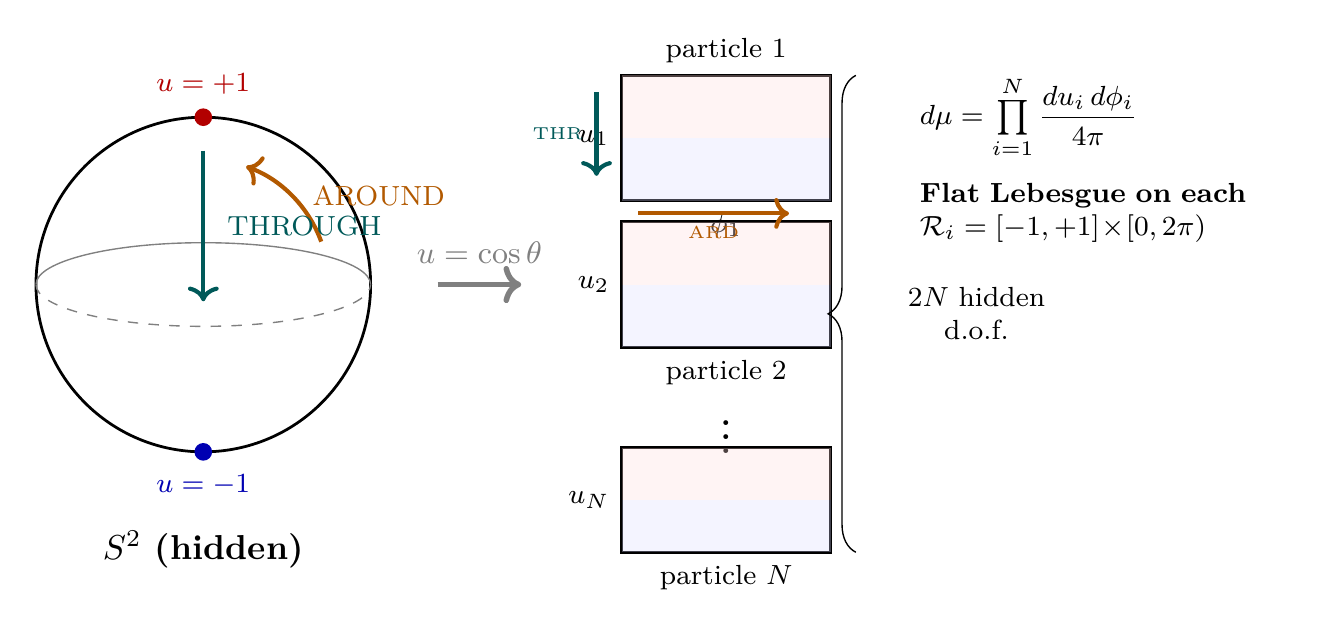
In the polar field variable \(u_i = \cos\theta_i\), the product measure takes a particularly transparent form. Since \(d\Omega_i = du_i\,d\phi_i\) (flat, no Jacobian), the natural measure on \(\mathcal{C}_N\) becomes:
The polar form eliminates all trigonometric weight factors. Compare:
Property | Spherical \((\theta_i, \phi_i)\) | Polar \((u_i, \phi_i)\) |
|---|---|---|
| \(S^2\) measure | \(\sin\theta_i\,d\theta_i\,d\phi_i/(4\pi)\) | \(du_i\,d\phi_i/(4\pi)\) |
| Jacobian factor | \(\sin\theta_i\) (position-dependent) | \(1\) (constant) |
| \(N\)-particle measure | \(\prod_i \sin\theta_i\,d\theta_i\,d\phi_i/(4\pi)\) | \(\prod_i du_i\,d\phi_i/(4\pi)\) |
| Integration domain | \([0,\pi]^N \times [0,2\pi)^N\) | \([-1,+1]^N \times [0,2\pi)^N\) |
| Uniform density | \(\rho = 1/(4\pi)\) (obscured by \(\sin\theta\)) | \(\rho = 1/(4\pi)\) (manifestly constant) |
The physical content is identical in both coordinates, but the polar form makes the uniformity of the geometric probability manifest: the density \(\rho = 1/(4\pi)\) is literally a constant function on the flat rectangle \(\mathcal{R} = [-1,+1] \times [0,2\pi)\). No hidden weighting of polar vs. equatorial regions appears.
For the \(N\)-particle system, the hidden degrees of freedom span the product rectangle \(\mathcal{R}^N = [-1,+1]^N \times [0,2\pi)^N\) with flat product measure \(\prod_i du_i\,d\phi_i\). The total hidden volume is \((4\pi)^N\), factorizing as:
Descent to the Quotient
Permuting particle labels permutes the factors in the product measure but does not change the product:
(See: Part 12 §141.6) □
The \(S_N\)-invariant measure \(d\mu_{\mathcal{C}_N}\) descends to a well-defined measure on the physical configuration space:
An \(S_N\)-invariant measure on the covering space \(\mathcal{C}_N\) induces a measure on the quotient \(\mathcal{F}_N\) by the standard construction: for any measurable set \(A \subseteq \mathcal{F}_N\), its preimage \(\pi^{-1}(A)\) consists of \(N!\) copies (at generic points), so dividing by \(N!\) gives a normalized measure on the quotient. At orbifold points (the diagonal \(\Delta\)), the measure is zero (these form a set of measure zero in \(\mathcal{C}_N\)). □
(See: Part 12 §141.6) □
Probability Structures
The Time-Sliced Future Space
The time-sliced future space has the structure:
Step 1: Fixing \(x^0 = t\) for all particles removes one degree of freedom per particle (the time coordinate). The remaining spatial positions span \((\mathbb{R}^3)^N\), and the \(S^2\) configurations span \((S^2)^N\).
Step 2: The quotient by \(S_N\) accounts for identical particles.
Step 3: The dimension count is immediate: \(\dim(\mathcal{F}_t) = N \cdot \dim(\mathbb{R}^3) + N \cdot \dim(S^2) = 3N + 2N = 5N\).
Step 4: The fiber bundle structure is inherited from the bundle \(\pi: \mathcal{F}_N \to \mathcal{B}_N\) by restriction to the time slice \(t\). □
(See: Part 12 §141.5) □
The Natural Measure on \(\mathcal{F}_t\)
Step 1: Restricting the product measure (Theorem thm:P12-Ch87-product-measure) to the simultaneity surface \(x^0 = t\) replaces \(d^4x_i/V\) with \(d^3x_i/V_3\), where \(V_3\) is the spatial volume at time \(t\).
Step 2: The \(S^2\) factor \(d\Omega_i/(4\pi)\) is unchanged by the time restriction.
Step 3: The \(1/N!\) factor accounts for the quotient by \(S_N\) (Corollary cor:ch87-quotient-measure).
Step 4: Normalization:
(See: Part 12 §141.6) □
This measure is the central object of the Temporal Determination Framework: a geometrically determined probability distribution on the space of possible futures. It is not postulated but derived from P1 through the chain:
The Space of Possible Futures
Given the present configuration \(\Sigma_{\mathrm{now}} \in \mathcal{F}_{t_0}\), the space of possible futures at time \(t > t_0\) is:
The key insight is that the “possible futures” are not truly uncertain at the ontic level—the evolution \(\Sigma_t = \Phi_{t-t_0}(\Sigma_{\mathrm{now}})\) is deterministic given the full state including \(S^2\) configurations. The uncertainty arises entirely because the observer cannot measure the \(\Omega_i\) components. Thus, the space of possible futures is really the space of futures compatible with the observer's partial information about the present.
\(d\mu_{\mathcal{F}_t}\)
| Factor | Value | Origin | Source |
|---|---|---|---|
| \(d^3x_i/V_3\) | Spatial Lebesgue | Translation invariance of \(M^4\) | P1 |
| \(d\Omega_i/(4\pi)\) | Uniform on \(S^2\) | Ergodicity of \(S^2\) dynamics | Ch. 86 |
| \(1/N!\) | Combinatorial | Quotient by \(S_N\)
(identical particles) | §sec:ch87-space-futures |
| \(4\pi\) | Area of \(S^2\) | \(\int_{S^2} \sin\theta\,d\theta\,d\phi = 4\pi\) | Geometry |
In polar field coordinates, the \(4\pi\) factor in the denominator admits a transparent geometric decomposition: \(4\pi = \int_{-1}^{+1} du \times \int_0^{2\pi} d\phi = 2 \times 2\pi\). The factor of 2 is the THROUGH extent (range of \(u = \cos\theta\) from south pole to north pole), and \(2\pi\) is the AROUND circumference. Every factor of \(4\pi\) appearing in the configuration space measure traces to this product of flat integrals on the polar rectangle \(\mathcal{R} = [-1,+1] \times [0,2\pi)\).
Emergence of Time Direction
Fibration Over Time
The full configuration space \(\mathcal{F}_N\) can be fibered over the time parameter, providing a natural framework for discussing temporal evolution:
The physical configuration space admits a fibration over time:
The fibration follows from the foliation of Minkowski space by constant-time hypersurfaces \(\Sigma_t\). Each configuration \(\Sigma \in \mathcal{F}_N\) lies on exactly one such hypersurface (given that all particles are simultaneous in the chosen frame). The evolution operator is the restriction of the full dynamical evolution (from P1's equations of motion) to the time-sliced spaces. □
(See: Part 12 §141.5) □
Time Direction from Measure Dynamics
The arrow of time, established philosophically in Chapter 86, receives a precise mathematical formulation in the configuration space framework:
Given an initial configuration at time \(t_0\) with low entropy (concentrated \(S^2\) configurations), the deterministic evolution spreads the configuration across \((S^2)^N\) by ergodic dynamics. The natural measure on \(\mathcal{F}_t\) captures this spreading: the entropy functional
This entropy increase is not a statistical tendency but a consequence of the ergodic dynamics on each \(S^2\): the deterministic evolution generically spreads initial concentration toward uniformity on the compact manifold \(S^2\). The direction of increasing entropy defines the forward direction of time within the Temporal Determination Framework, connecting the mathematical structure of \(\mathcal{F}_t\) to the experienced arrow of time.
Polar Field Form of the Entropy Functional
In the polar field variable \(u_i = \cos\theta_i\), the entropy functional takes the form:
The equilibrium maximum \(S_{\max} = N\ln(4\pi)\) corresponds to each \(\rho_i = 1/(4\pi)\): the constant function on the flat rectangle. In spherical coordinates, this same constant density \(1/(4\pi)\) is obscured by the \(\sin\theta\) measure, making it less obvious that the equilibrium is uniform. In polar coordinates, the uniformity of the maximum-entropy state is visually and algebraically manifest.
Dimensional Summary
| Space | Dimension | Structure | Role |
|---|---|---|---|
| \(\mathcal{C}_1 = M^4 \times S^2\) | 6 | Trivial bundle | Single particle |
| \(\mathcal{C}_N = (\mathcal{C}_1)^N\) | \(6N\) | Product | \(N\) distinguishable |
| \(\mathcal{F}_N = \mathcal{C}_N / S_N\) | \(6N\) | Orbifold | \(N\) identical |
| \(\mathcal{F}_t\) | \(5N\) | Fiber bundle | Time-sliced futures |
| \(\mathcal{B}_t = (\mathbb{R}^3)^N / S_N\) | \(3N\) | Base | Observable positions |
| \((S^2)^N\) | \(2N\) | Fiber | Hidden configurations |
Derivation Chain Summary
| Step | Result | Justification | Reference |
|---|---|---|---|
| \endhead
1 | \(\mathcal{C}_1 = M^4 \times S^2\) | P1 product structure | Def. def:ch87-single-particle |
| 2 | Fiber bundle \(\pi_1: \mathcal{C}_1 \to M^4\) | Trivial bundle | Thm. thm:P12-Ch87-fiber-bundle-C1 |
| 3 | \(\mathcal{C}_N = (\mathcal{C}_1)^N\), \(\dim = 6N\) | Product | Def. def:ch87-CN |
| 4 | \(\mathcal{F}_N = \mathcal{C}_N / S_N\) orbifold | Free action off \(\Delta\) | Thm. thm:P12-Ch87-orbifold |
| 5 | \(d\mu = \prod [d^3x_i/V_3 \cdot d\Omega_i/(4\pi)]\) | Independence + ergodicity | Thm. thm:P12-Ch87-product-measure |
| 6 | \(\mathcal{F}_t\), \(\dim = 5N\) | Time slice | Thm. thm:P12-Ch87-structure-Ft |
| 7 | Temporal fibration \(\mathcal{F}_N = \bigsqcup_t \mathcal{F}_t\) | Foliation | Thm. thm:P12-Ch87-temporal-fibration |
| 8 | Polar: \(d\mu = \prod du_i\,d\phi_i/(4\pi)\) (flat) | \(u = \cos\theta\); \(\sqrt{\det h} = R_0^2\) | §sec:ch87-polar-measure |
Chapter Summary
The Configuration Space of Futures
The Temporal Determination Framework is built on a rigorously constructed configuration space. Starting from P1's product structure \(M^4 \times S^2\), the single-particle space \(\mathcal{C}_1\) extends to the \(N\)-particle space \(\mathcal{C}_N = (M^4 \times S^2)^N\), and the physical space \(\mathcal{F}_N = \mathcal{C}_N / S_N\) is obtained by quotienting by particle permutations. The time-sliced future space \(\mathcal{F}_t\) has dimension \(5N\) and the structure of a fiber bundle with \(3N\) observable spatial degrees of freedom and \(2N\) hidden \(S^2\) degrees of freedom.
The natural measure \(d\mu_{\mathcal{F}_t} = (1/N!) \prod_i [d^3x_i/V_3 \cdot d\Omega_i/(4\pi)]\) is derived (not postulated) from TMT's geometric probability on \(S^2\) and the factorization of independent particle measures. This measure is the foundation for all probability calculations in the Temporal Determination Framework.
In polar field coordinates (\(u_i = \cos\theta_i\)), the measure becomes \(\prod_i du_i\,d\phi_i/(4\pi)\)—flat Lebesgue on \(N\) independent rectangles \(\mathcal{R}_i = [-1,+1] \times [0,2\pi)\). The uniform geometric probability \(\rho = 1/(4\pi)\) is manifestly constant with no hidden \(\sin\theta\) weighting, and the factor \(4\pi = 2 \times 2\pi\) decomposes into THROUGH (range of \(u\)) \(\times\) AROUND (circumference).
| Result | Value | Status | Reference |
|---|---|---|---|
| \(\mathcal{C}_1 = M^4 \times S^2\) | \(\dim = 6\) | PROVEN | Def. def:ch87-single-particle |
| \(\mathcal{F}_N\) orbifold structure | smooth away from \(\Delta\) | PROVEN | Thm. thm:P12-Ch87-orbifold |
| Fiber bundle projection | \(\pi: \mathcal{F}_N \to \mathcal{B}_N\) | PROVEN | Thm. thm:P12-Ch87-fiber-projection |
| \(\mathcal{F}_t\) structure | \(\dim = 5N\) | PROVEN | Thm. thm:P12-Ch87-structure-Ft |
| Natural measure | \((1/N!) \prod [d^3x/V_3 \cdot d\Omega/(4\pi)]\) | PROVEN | Thm. thm:P12-Ch87-natural-measure |
| \(S_N\)-invariance of measure | \(d\mu(\sigma \cdot \Sigma) = d\mu(\Sigma)\) | PROVEN | Thm. thm:P12-Ch87-invariant-measure |
| Polar: flat product measure | \(\prod du_i\,d\phi_i/(4\pi)\) | PROVEN | §sec:ch87-polar-measure |
Verification Code
The mathematical derivations and proofs in this chapter can be independently verified using the formal and computational scripts below.
All verification code is open source. See the complete verification index for all chapters.