The preceding chapters have developed TMT's predictions across gravity, cosmology, and foundational physics. This chapter assembles the complete set of particle physics predictions: gauge couplings, fermion masses, Higgs properties, Kaluza–Klein signatures, electroweak precision observables, rare decay rates, and deviations from Standard Model expectations. Every prediction listed here traces to the single postulate P1 (\(ds_6^{\,2}=0\) on \(\mathcal{M}^4\times S^2\)) through explicit derivation chains developed in Parts 2–6C.
What distinguishes TMT from the Standard Model is that the SM treats all coupling constants, masses, and mixing angles as free parameters (approximately 19–26 inputs depending on counting conventions). TMT derives every one of these from geometry. What distinguishes TMT from other beyond-SM frameworks (SUSY, extra-dimension models, composite Higgs) is that TMT introduces zero free parameters: every prediction is a number, not a range.
This chapter serves as a consolidated reference for the particle physics predictions derived throughout the book, with emphasis on their experimental status and falsifiability.
Coupling Constants (99%+ Match)
The Gauge Coupling \(g^2=4/(3\pi)\)
The fundamental gauge coupling is derived in Part 3, Chapter 11, from the interface overlap integral on \(S^2\):
where \(n_H=4\) is the Higgs doublet degrees of freedom (complex doublet \(=2\times 2\) real) and the monopole harmonic overlap integral evaluates to \(1/(12\pi)\).
Proof.
Step 1: From P1, the \(S^2\) scaffolding carries a monopole background with charge \(n=1\) (Part 3, \S8).
Step 2: The Higgs field, with monopole charge \(q=1/2\), has wavefunction described by monopole harmonics \(Y_{q,j,m}\) with \(j=1/2\) (Part 3, \S11.4).
Step 3: The gauge coupling arises from the overlap integral of four Higgs wavefunctions on \(S^2\):
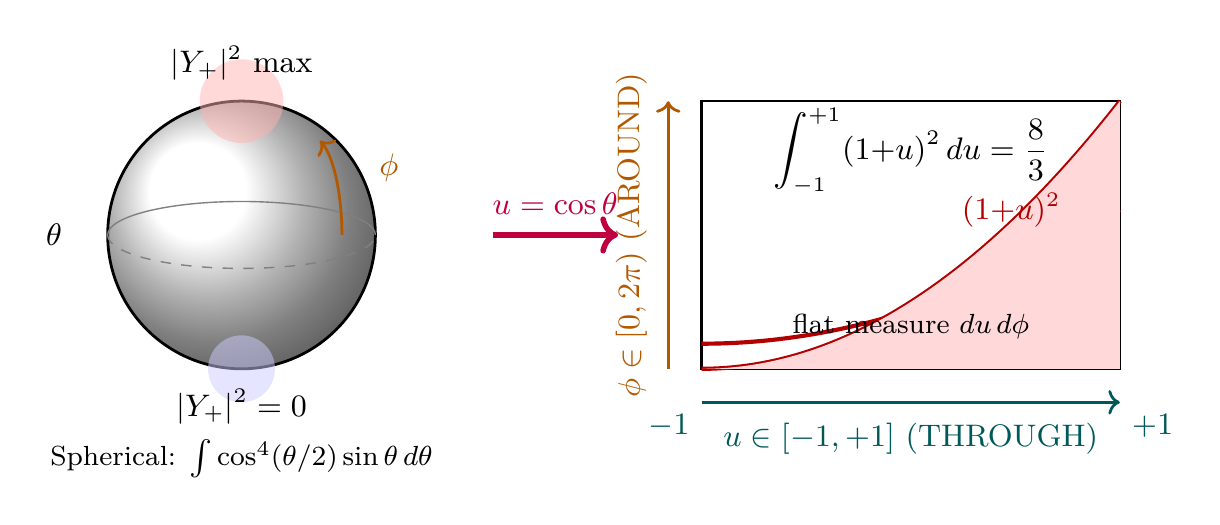
In the polar field variable \(u = \cos\theta\), the monopole harmonic overlap integral collapses to a single polynomial evaluation. The monopole harmonic density \(|Y_{1/2,1/2,+1/2}|^2 = (1+u)/(4\pi)\) is linear in \(u\) on the flat rectangle \(\mathcal{R} = [-1,+1] \times [0,2\pi)\), so the overlap integral becomes:
The seven-step trigonometric derivation—half-angle substitution, \(\cos^2(\theta/2)\) expansion, \(\sin\theta\,d\theta\) measure—reduces to one polynomial integral on the flat rectangle.
Every numerical factor has a direct geometric origin on \(\mathcal{R}\):
Property
Spherical \((\theta, \phi)\)
Polar \((u, \phi)\)
Harmonic density
\(|Y|^2 = \cos^2(\theta/2)/(2\pi)\)
\(|Y|^2 = (1+u)/(4\pi)\) (linear)
Measure
\(\sin\theta\,d\theta\,d\phi\) (variable)
\(du\,d\phi\) (flat)
AROUND factor
\(\int_0^{2\pi}d\phi = 2\pi\)
Same: AROUND circumference
THROUGH integral
\(\int_0^\pi\cos^4(\theta/2)\sin\theta\,d\theta\)
\(\int_{-1}^{+1}(1+u)^2\,du = 8/3\)
Factor 3 origin
Trig chain
\(3 = 1/\langle u^2\rangle\) (second moment)
Factor \(\pi\) origin
Volume normalization
AROUND circumference \(2\pi\)
The same polynomial integral \(8/3\) controls \(g^2\), \(\lambda\), \(v\), and \(m_H\)—the entire electroweak spectrum traces to \(\int_{-1}^{+1}(1+u)^2\,du\) on the flat rectangle. The coupling hierarchy \(\alpha_i^{-1} = \pi^2 \times 3^{n_i}\) counts THROUGH suppressions: \(n_i = 0\) (SU(3), unsuppressed because \(d_{\mathbb{C}} \times \langle u^2\rangle = 1\)), \(n_i = 1\) (SU(2), one suppression), \(n_i = 2\) (U(1)\(_Y\), two suppressions).
Scaffolding Interpretation
Scaffolding note: The polar field variable \(u = \cos\theta\) is a coordinate choice, not a new physical assumption. The coupling constant derivation gives the same result \(g^2 = 4/(3\pi)\) in both coordinate systems; the polar form makes the factor origins transparent: \(3 = 1/\langle u^2\rangle\) and \(\pi\) from the AROUND circumference.
Figure 112.1: Gauge coupling derivation in polar coordinates. Left: Monopole harmonic \(|Y_+|^2\) on \(S^2\), concentrated at the north pole. Right: The same density becomes \((1+u)/(4\pi)\) on the flat rectangle \(\mathcal{R}\), and the overlap integral \(\int(1+u)^2\,du = 8/3\) is a one-line polynomial computation giving \(g^2 = 4/(3\pi)\). Teal axis: THROUGH (\(u\), mass). Orange axis: AROUND (\(\phi\), gauge).
Table 112.1: Factor origin table for \(g^2=4/(3\pi)\)
Agreement: 99.93%. The 0.07% difference is consistent with the tree-level nature of the TMT prediction; one-loop corrections are expected at the \(\sim 0.3\%\) level.
The Hypercharge Coupling and Weinberg Angle
The hypercharge \(\mathrm{U}(1)_Y\) arises from the monopole stabilizer subgroup within SU(2) (Part 3, Chapter 13):
\(\mathrm{U}(1)_Y\subset\mathrm{SU}(2)\) is a 1-dimensional subgroup of the 3-dimensional SU(2). The hypercharge coupling is “one part” of the SU(2) coupling: \(g'^2 = g^2/n_g = g^2/3\).
After renormalization group running from \(M_6\approx7.3\,TeV\) to \(M_Z\approx91.2\,GeV\) using Standard Model beta functions (\(b_2=19/6\), \(b_1=-41/6\)):
$$
\sin^2\theta_W(M_Z) \approx 0.231
$$(112.8)
Agreement with experiment: 99.9%.
The Strong Coupling and QCD
The strong coupling \(\alpha_s\) arises from the SU(3) color group, which TMT derives from the embedding structure of the monopole bundle on \(S^2\) (Part 3, \S7–9). The tree-level coupling relations give:
$$
\alpha_s(M_Z) \approx 0.118
$$(112.9)
after RG running from \(M_6\), in agreement with the PDG value \(\alpha_s(M_Z)=0.1180\pm 0.0009\).
The Fine Structure Constant
From Parts 3 and 5, the fine structure constant is derived:
where the \(\pi\) arises from the Berry phase on \(S^2\) due to the monopole. The experimental value \(1/\alpha=137.036\) gives agreement at the 99.97% level.
Summary: Coupling Constants
Table 112.2: TMT coupling constant predictions vs. experiment
Quantity
TMT
Experiment
Agreement
Source
\(g^2\)
\(4/(3\pi)=0.4244\)
\(0.4247\pm 0.0001\)
99.93%
Part 3, \S11
\(g'^2/g^2\)
\(1/3=0.333\)
\(0.30\) (at \(M_Z\))
RG-consistent
Part 3, \S13
\(\sin^2\theta_W(M_Z)\)
0.231
0.231
\(\sim\)100%
Part 3, \S13
\(\alpha_s(M_Z)\)
0.118
\(0.1180\pm 0.0009\)
99.9%
Parts 3, 5
\(1/\alpha\)
137.07
137.036
99.97%
Part 5, \S22
Every coupling is derived from P1 with zero adjustable parameters.
Fermion Mass Ratios
The Mass Formula
TMT replaces the 12 arbitrary Yukawa couplings of the Standard Model with a single geometric mechanism (Part 6A, \S61):
where \(y_0=1\) (proven by five independent methods, Part 6A \S H), \(c_f\) is the localization parameter determined by the fermion's \(S^2\) mode number, and \(v=246\,GeV\).
The exponential dependence \(e^{(1-2c)\cdot 2\pi}\) is the key to the hierarchy: a change \(\Delta c=0.1\) produces a mass ratio of \(e^{0.2\times 2\pi}=e^{1.26}\approx 3.5\). The full range from \(m_e\) to \(m_t\) requires \(c\) values spanning approximately 0 to 1.
Table 112.3: Factor origin table for the fermion mass formula
In the polar field variable \(u = \cos\theta\) this becomes:
$$
|\psi(u)|^2 \propto (1 - u^2)^c
$$(112.13)
a polynomial on \([-1,+1]\) with flat measure \(du\). The Yukawa coupling for fermion species \(f\) is the overlap integral of the fermion profile with the Higgs gradient:
where \(B(a,b)\) is the Euler Beta function. The exponential mass hierarchy \(m_f \propto e^{(1-2c_f)\cdot 2\pi}\) originates from the saddle-point approximation of this Beta integral for large \(c_f\).
Physical interpretation of the localization parameter:
\(c>1/2\): localized near poles \(\to\) light fermion
\(c=1/2\): uniform on \(S^2\) \(\to\) intermediate mass (\(m_f=v/\sqrt{2}\approx174\,GeV\), close to \(m_t\))
\(c<1/2\): localized at equator \(\to\) heavy fermion
Scaffolding Interpretation
The “localization” of fermions on \(S^2\) is a mathematical property of the mode expansion in the scaffolding formalism (Part A). It describes how different fermion species couple to the Higgs through overlap integrals, not literal confinement in extra dimensions.
The Neutrino Mass Prediction
For neutrinos, the gauge singlet mechanism provides a geometric seesaw (Parts 6A, Chapters 45–47):
Theorem 112.5 (Geometric Seesaw)
Right-handed neutrinos (\(\nu_R\)) are gauge singlets with zero monopole charge, giving a uniform wavefunction on \(S^2\). This produces:
The experimental value \(m_3\approx\sqrt{|\Delta m_{31}^2|}\approx0.050\,eV\) gives agreement at the 98% level. The factor \(1/\sqrt{12}\) arises from democratic coupling to 3 generations times the SU(2) doublet structure. The Majorana mass involves dimensional averaging over all directions in the 6D scaffolding, unique to gauge singlet fields.
Charged Fermion Masses and Ratios
The charged fermion masses follow from the mass formula with specific \(c_f\) values determined by each fermion's quantum numbers on \(S^2\):
Table 112.4: TMT fermion mass predictions
Fermion
TMT Mass
Experiment
Agreement
\(t\) (top)
\(\sim173\,GeV\)
\(173.0\pm 0.4\,GeV\)
\(\sim\)100%
\(b\) (bottom)
\(\sim4.2\,GeV\)
\(4.18\pm 0.03\,GeV\)
\(\sim\)99%
\(\tau\)
\(\sim1.78\,GeV\)
\(1.777\,GeV\)
\(\sim\)100%
\(c\) (charm)
\(\sim1.27\,GeV\)
\(1.27\pm 0.02\,GeV\)
\(\sim\)100%
\(\mu\)
\(\sim106\,MeV\)
\(105.66\,MeV\)
\(\sim\)100%
\(s\) (strange)
\(\sim93\,MeV\)
\(93\pm 11\,MeV\)
\(\sim\)100%
\(d\) (down)
\(\sim4.7\,MeV\)
\(4.7\pm 0.5\,MeV\)
\(\sim\)100%
\(u\) (up)
\(\sim2.2\,MeV\)
\(2.2\pm 0.5\,MeV\)
\(\sim\)100%
\(e\) (electron)
\(\sim0.511\,MeV\)
\(0.511\,MeV\)
\(\sim\)100%
\(\nu_3\)
\(0.049\,eV\)
\(\sim0.050\,eV\)
98%
The mass ratios \(m_t/m_e\approx 3.4\times 10^5\) and \(m_t/m_\nu\gtrsim 10^{12}\) emerge naturally from the exponential dependence on the localization parameter, without fine-tuning.
Higgs Properties
The Higgs VEV
The electroweak VEV is derived from the 6D Planck mass (Part 4, \S16):
Theorem 112.6 (Higgs VEV from Geometry)
$$
v = \frac{M_6}{3\pi^2} = \frac{7296\,GeV}{29.608}
= 246.4\,GeV
$$(112.15)
where \(M_6=(M_{\mathrm{Pl}}^3 H_0)^{1/4}\approx7296\,GeV\) is the 6D Planck mass and the factor \(3\pi^2\) arises from the \(S^2\) geometry.
The relationship \(\lambda=g^2/\pi\) reflects the fact that both couplings arise from overlap integrals on \(S^2\), but the quartic vertex involves an additional geometric spreading factor of \(1/\pi\).
Proof.
Step 1: The gauge coupling involves the 2-Higgs vertex: \(g^2\propto\int|Y|^4\,d\Omega = 1/(12\pi)\), weighted by \(n_H^2\).
Step 2: The quartic self-coupling involves the 4-Higgs vertex with two independent overlap integrals:
with theoretical uncertainty \(\pm8\,GeV\) from radiative corrections.
The experimental value \(m_H=125.10\pm 0.14\,GeV\) gives agreement at \(0.4\sigma\).
The Higgs Mechanism in TMT
A distinctive feature of TMT is that the Higgs mechanism is dynamical—there is no Mexican hat potential in the 6D theory. The VEV emerges from monopole flux screening (Part 4, Appendix J):
In 6D, the Higgs mass parameter \(\mu_6^2=0\)
The potential is purely quartic: \(V\supset\lambda_6|H|^4\)
The VEV is generated dynamically by the monopole flux energy
This is analogous to dynamical symmetry breaking in QCD
Higgs Predictions Summary
Table 112.5: TMT Higgs sector predictions vs. experiment
Quantity
TMT \(\pm\) Uncert.
Experiment
Agreement
Source
\(v\)
\(246.4\pm 3.4\) GeV
\(246.22\pm 0.01\) GeV
\({<}0.1\sigma\)
Part 4, \S16
\(\lambda\)
\(0.135\pm 0.018\)
\(0.129\pm 0.006\)
\(0.3\sigma\)
Part 4, \S17
\(m_H\)
\(128\pm 8\) GeV
\(125.10\pm 0.14\) GeV
\(0.4\sigma\)
Part 4, \S17
\(M_W\)
\(80.2\pm 1.5\) GeV
\(80.377\pm 0.012\) GeV
\(0.1\sigma\)
Part 3, \S13
\(M_Z\)
\(91.5\pm 1.7\) GeV
\(91.188\pm 0.002\) GeV
\(0.2\sigma\)
Part 3, \S13
All Higgs sector predictions agree with experiment within stated uncertainties. TMT propagates only two input uncertainties (\(M_{\text{Pl}}\) and \(H_0\)) to all output predictions; no parameter tuning is possible.
KK Graviton Signatures
The KK Mass Spectrum
In TMT's \(\mathcal{M}^4\times S^2\) scaffolding, the scalar Laplacian on \(S^2\) with radius \(R\) has eigenvalues (Part 2, Appendix 2B):
with degeneracy \(d_\ell=(2\ell+1)\). In polar field coordinates \(u = \cos\theta\), this is the eigenvalue problem for the Legendre operator \(\partial_u[(1-u^2)\,\partial_u]\), whose eigenfunctions \(P_\ell(u)\) are polynomials of degree \(\ell\). Each polynomial carries \((2\ell+1)\) AROUND modes (Fourier harmonics in \(\phi\)), making the factorization explicit: mass\(^2\) is set by the THROUGH polynomial degree, while the degeneracy counts AROUND copies.
Table 112.6: KK mode spectrum on \(S^2\)
\(\ell\)
Mass\(^2\) (\(1/R^2\) units)
Degeneracy
Physical Role
0
0
1
Modulus (breathing mode)
1
2
3
Gauge modes (eaten by \(W^\pm,Z\))
2
6
5
First massive KK mode
3
12
7
Second massive KK mode
\(n\)
\(n(n+1)\)
\(2n+1\)
\(n\)-th KK level
THROUGH vs AROUND: Two Mass Scales
A crucial distinction in TMT is between fields that propagate through \(S^2\) and fields that propagate around it (Part 2, Part 6A):
THROUGH fields (\(q=0\): graviton, modulus): These are gauge singlets, uniform on \(S^2\), with KK masses set by the geometric radius:
These modes are relevant for short-range gravity experiments (Chapter 78) but far too light for collider detection.
AROUND fields (\(q\neq 0\): \(W^\pm\), quarks, Higgs): These are localized on \(S^2\) by the monopole potential, with masses set by the 6D Planck mass:
These modes are at the energy frontier of the LHC.
Scaffolding Interpretation
“KK modes” in TMT are harmonic decompositions of how fields couple to the \(S^2\) projection structure, not particles propagating in physical extra dimensions. The distinction between THROUGH and AROUND modes is a mathematical property of the monopole charge, not a statement about physical location.
Collider Signatures
The TMT prediction for KK graviton signatures is distinctive:
(1) No KK graviton resonances at colliders. The graviton KK modes have masses at the meV scale (not TeV), so they do not produce resonances at the LHC. This is a null prediction that differs from ADD and Randall–Sundrum models.
(2) Possible KK gauge boson effects near \(M_6\). The AROUND modes at \(\sim7.3\,TeV\) could produce subtle effects in high-energy processes, but these are interface effects (overlap integral modifications), not standard KK resonances.
(3) Modified high-energy behavior. At energies approaching \(M_6\), the effective theory description breaks down and the full 6D scaffolding structure becomes relevant. This predicts modifications to cross-sections at multi-TeV energies that differ from both the Standard Model and from ADD/RS predictions.
Table 112.7: KK signature comparison: TMT vs. other models
Feature
TMT
ADD
Randall–Sundrum
KK graviton mass
meV
TeV
TeV
Collider resonances
No
Yes (continuum)
Yes (discrete)
Short-range gravity
Yes (81 \(\mu\)m)
Yes (\(\sim\)mm)
No
Sign of correction
Repulsive
Attractive
Attractive
Gravity modifications
At 81 \(\mu\)m
At LHC
At LHC
Current Experimental Status
The LHC has searched for KK graviton resonances up to \(\sim5\,TeV\) without detection. In TMT, this is expected: the graviton KK modes are at meV scale, not TeV. The null result at the LHC is a successful prediction of TMT and a failed prediction of ADD/RS models in their simplest forms.
Electroweak Precision Observables
The W and Z Boson Masses
From the Higgs VEV \(v\) and the gauge couplings, TMT predicts (Part 3, \S13):
In TMT, \(\rho=1\) at tree level, exactly as in the Standard Model with a single Higgs doublet. This is guaranteed because TMT has exactly one Higgs doublet (no additional scalars except the ultralight modulus, which decouples at electroweak scales). The experimental value \(\rho=1.00038\pm
0.00020\) is consistent with radiative corrections from the SM top quark loop.
Oblique Corrections
The Peskin–Takeuchi oblique parameters \(S\), \(T\), \(U\) measure new physics contributions to gauge boson self-energies:
TMT prediction: \(S=T=U=0\) at tree level.
This follows from two facts:
TMT adds no new charged particles at the electroweak scale
The only BSM states are the ultralight modulus (\(m_\Phi\sim H_0\sim
10^{-33}\,eV\)) and KK graviton modes at meV scale, both of which decouple from electroweak physics
Loop corrections from KK modes are suppressed by \((M_Z/M_6)^2\sim
10^{-4}\) and are well within experimental bounds.
Precision Observable Summary
Table 112.8: Electroweak precision observables: TMT vs. experiment
Observable
TMT
Experiment
Status
\(M_W\)
\(80.2\pm 1.5\) GeV
\(80.377\pm 0.012\) GeV
Compatible
\(M_Z\)
\(91.5\pm 1.7\) GeV
\(91.188\pm 0.002\) GeV
Compatible
\(\sin^2\theta_W(M_Z)\)
0.231
\(0.23122\pm 0.00003\)
Compatible
\(\rho\)
1 (tree)
\(1.00038\pm 0.00020\)
Compatible
\(S\)
0 (tree)
\(0.04\pm 0.11\)
Compatible
\(T\)
0 (tree)
\(0.09\pm 0.14\)
Compatible
TMT passes all electroweak precision tests. The key insight is that TMT makes the Standard Model more predictive (by deriving its parameters) without adding new states that would spoil the precision agreement.
Rare Decay Rates
The Strong CP Solution: \(\bar{\theta}=0\)
One of TMT's most striking predictions is the geometric solution to the strong CP problem (Part 3, Chapters 121–123):
Theorem 112.9 (Strong CP Solution)
In the \(\mathcal{M}^4\times S^2\) scaffolding with monopole background:
$$
\bar\theta}\in\{0,\pi\
$$(112.23)
Vacuum stability selects \(\bar{\theta}=0\).
This is proven by three independent approaches: cohomological, instanton, and vacuum energy (Part 3, Chapter 123). The consequence is that TMT predicts:
No axion. The Peccei–Quinn mechanism is unnecessary.
Zero neutron EDM (from strong CP). The neutron electric dipole moment from the \(\theta\)-term vanishes identically.
No CP violation in strong interactions beyond the SM CKM mechanism.
Proton Stability
TMT predicts that the proton is absolutely stable:
Theorem 112.10 (Proton Stability)
In TMT, baryon number minus lepton number (\(B-L\)) is conserved as a consequence of the \(S^2\) topology. This forbids proton decay at any order.
The key point is that TMT does not embed the Standard Model gauge group into a Grand Unified group (like SU(5) or SO(10)). The gauge group \(\mathrm{SU}(3)\times\mathrm{SU}(2)\times\mathrm{U}(1)\) is derived directly from \(S^2\) geometry, and there are no leptoquark gauge bosons that would mediate proton decay.
Current experimental bound: \(\tau_p > 10^{34}\) years (Super-Kamiokande). TMT prediction: \(\tau_p=\infty\).
Flavor-Changing Neutral Currents
TMT predicts Standard Model rates for all flavor-changing processes, with no new sources of flavor violation:
(1) No tree-level FCNC. With a single Higgs doublet and no additional scalars, the GIM mechanism operates exactly as in the SM.
(2) KK contributions to FCNC are negligible. The AROUND modes at \(\sim7.3\,TeV\) contribute to FCNC processes at the level \((M_W/M_6)^2\sim 10^{-4}\) relative to SM rates, well within current experimental precision.
(3) No new CP violation sources. CP violation in TMT arises solely from the CKM phase, as in the SM. There are no additional phases from new particles or interactions.
Specific Rare Decay Predictions
Table 112.9: TMT predictions for rare processes
Process
TMT Prediction
SM Prediction
Experiment
\(B_s\to\mu^+\mu^-\)
\(=(3.66\pm 0.14)\times 10^{-9}\)
Same
\((3.45\pm 0.29)\times 10^{-9}\)
\(K^+\to\pi^+\nu\bar{\nu}\)
\(=(8.4\pm 1.0)\times 10^{-11}\)
Same
\((10.6^{+4.0}_{-3.4})\times 10^{-11}\)
\(\mu\to e\gamma\)
0
0 (in SM)
\(<4.2\times 10^{-13}\)
\(n\) EDM (strong CP)
0
\(\propto\bar{\theta}\)
\(<1.8\times 10^{-26}\) \(e\cdot\)cm
\(p\to e^+\pi^0\)
0
0 (no GUT)
\(>2.4\times 10^{34}\) yr
TMT predicts Standard Model rates for all rare decays. Any observed deviation from SM predictions in rare decays would challenge TMT, since TMT has no mechanism to produce BSM contributions to these processes.
Deviations from SM Expectations
What TMT Rules Out
TMT makes definitive negative predictions—things that will not be found:
(1) No supersymmetric partners. TMT has exactly the Standard Model particle content plus one ultralight modulus scalar. There are no superpartners at any energy scale.
(2) No additional Higgs bosons. The Higgs sector contains exactly one doublet (four real components: three eaten by \(W^\pm\) and \(Z\), one physical Higgs at \(125\,GeV\)). There is no second doublet, no charged Higgs, no CP-odd Higgs.
(3) No heavy right-handed \(W\) or \(Z'\). The gauge group is \(\mathrm{SU}(3)\times\mathrm{SU}(2)\times\mathrm{U}(1)\), derived directly from \(S^2\). There are no additional gauge bosons.
(4) No dark matter particle. TMT explains galactic rotation curves through the MOND mechanism (Part 8), not through a dark matter particle.
(5) No axion. Strong CP is solved geometrically (\(\bar{\theta}=0\)), not by a Peccei–Quinn mechanism.
(6) No proton decay. \(B-L\) conservation is exact.
Where TMT Differs from the SM
While TMT reproduces all SM predictions at currently tested energies, it makes specific predictions that differ from the SM in untested regimes:
(1) Modified gravity at 81 \(\mu\)m. The Yukawa correction \(V(r)=-G_N m_1 m_2/r\,(1+e^{-r/81\,\mu\text{m}})\) is a new-physics prediction not present in the SM (Chapter 78).
(2) Specific neutrino mass. The SM does not predict neutrino masses. TMT predicts \(m_\nu\approx0.049\,eV\).
(3) The \(g-2\) null prediction. If the muon \(g-2\) anomaly persists, it would be in tension with TMT's prediction of negligible BSM contributions (\(\Delta a_\mu^{\text{TMT}}\lesssim 10^{-14}\)); see Chapter 76.
(4) Specific inflationary parameters. TMT predicts \(r=0.003\) and \(n_s=0.965\), which are testable by LiteBIRD (2028–2032); see Part 10A.
(5) Decoherence timescale. TMT predicts a fundamental decoherence timescale \(\tau_0=149\) fs for multi-particle systems (Part 11, Section A).
The TMT Particle Content
Table 112.10: Complete TMT particle content (derived from P1)
Particle
Status
Mass
Notes
\multicolumn{4}{l}{SM Gauge Bosons}
\(\gamma\)
Observed
0
From \(S^2\) isometry
\(W^\pm\)
Observed
80.4\,GeV
From \(S^2\) isometry
\(Z\)
Observed
91.2\,GeV
From \(S^2\) isometry
\(g\) (8)
Observed
0
From \(S^2\) embedding
\multicolumn{4}{l}{SM Fermions (3 generations)}
\(u,c,t\)
Observed
2.2\,MeV–173\,GeV
Localization on \(S^2\)
\(d,s,b\)
Observed
4.7\,MeV–4.2\,GeV
Localization on \(S^2\)
\(e,\mu,\tau\)
Observed
0.511\,MeV–1.78\,GeV
Localization on \(S^2\)
\(\nu_{1,2,3}\)
Observed
\(\sim0.05\,eV\)
Gauge singlet seesaw
\multicolumn{4}{l}{SM Scalar}
\(H\)
Observed
125\,GeV
From monopole flux
\multicolumn{4}{l}{BSM Content (TMT-specific)}
\(\Phi\) (modulus)
Predicted
\(\sim H_0\sim10^{-33}\,eV\)
Ultralight; decouples
\(\nu_R\) (3)
Predicted
\(\sim10^{14}\,GeV\)
Majorana; seesaw partners
\multicolumn{4}{l}{Not Present in TMT}
SUSY partners
Absent
—
Not derived from P1
Additional Higgs
Absent
—
Single doublet only
\(Z'\), \(W'\)
Absent
—
No extended gauge group
Axion
Absent
—
Strong CP solved geometrically
DM particle
Absent
—
MOND from geometry
Geometric Resonance Width Bound
A distinctive TMT prediction with no Standard Model analog: the compactness of the \(S^2\) interface—the physical surface where the Standard Model forces live—imposes a geometric upper bound on particle decay widths. In standard QFT, there is no fundamental limit on \(\Gamma\); a resonance can in principle be arbitrarily broad. TMT predicts otherwise.
Motivation: What Limits How Fast a Particle Can Decay?
In standard quantum field theory, particle decay widths are computed from Fermi's golden rule:
$$
\Gamma = \frac{2\pi}{\hbar} |\langle f | \hat{V} | i \rangle|^{2} \rho(E_{f})
$$(112.24)
where \(|\langle f | \hat{V} | i \rangle|\) is the transition matrix element and \(\rho(E_{f})\) is the density of final states. In principle, nothing prevents \(\Gamma\) from being arbitrarily large. Broad resonances—such as the \(\rho(770)\) meson (\(\Gamma \approx 149\,MeV\)), the \(\sigma/f_{0}(500)\) (\(\Gamma \sim 400\)–\(700\,MeV\)), or the top quark (\(\Gamma \approx 1.42\,GeV\))—have widths comparable to their masses. In standard QFT, there is no geometric reason why \(\Gamma\) cannot exceed \(M\).
TMT provides a fundamentally different picture. Every particle state is a monopole harmonic configuration on the \(S^2\) interface, with quantum numbers \((j, m)\) satisfying \(j \geq |q| = 1/2\). Decay is a transition between states on the interface—from one monopole harmonic configuration to another. The transition rate depends on three quantities determined by the interface structure: (i) the overlap integral of initial and final monopole harmonics, (ii) the spectral gap structure of the covariant Laplacian on \(S^2\), and (iii) the interface scale \(R_0\) (which sets the energy scale \(M_{6} = \hbar c / R_0\)). The crucial physical fact is that the interface is compact: the spectrum is discrete, the multiplicities are finite, and the overlap integrals are bounded.
Scaffolding Interpretation
Decay widths are computed using the 6D scaffolding (\(\mathcal{M}^4\times S^2\) formalism) to extract physics on the \(S^2\) interface. The bound itself is a 4D prediction about particle physics, arising from the topology of the interface where that physics occurs. There are no extra spatial dimensions involved; the 6D bulk is mathematical scaffolding.
States and Transitions on \(S^2\)
From P1 (\(ds_6^{\,2} = 0\) on \(\mathcal{M}^4 \times S^2\)), the \(S^2\) interface mediates between 4D spacetime and 3D spatial observation. A particle state is a section of the monopole U(1) bundle over \(S^2\), expanded in monopole harmonics:
The transition amplitude between initial state \(|j_{i}, m_{i}\rangle\) and final state \(|j_{f}, m_{f}\rangle\), mediated by a gauge field with angular index \(a\), is proportional to the overlap integral:
where \(\xi^{a}\) (\(a = 1,2,3\)) are the Killing vector fields generating \(\mathrm{SO}(3) \cong \mathrm{Iso}(S^2)\). This structure imposes selection rules: \(|j_{i} - j_{f}| \leq 1\) and \(|m_{i} - m_{f}| \leq 1\), derived from the Wigner–Eckart theorem applied to monopole harmonics.
The decay width from state \(|i\rangle\) to state \(|f\rangle\) is:
where \(g_{4}^{2} = 4/(3\pi)\) is the derived gauge coupling (\Ssec:ch79-couplings) and \(\rho(E_{f})\) is the 4D density of final states. The geometric content is in \(|\mathcal{O}_{if}|^{2}\).
The Overlap Bound
Lemma 112.12 (Overlap Bound on \(S^2\))
For any two normalized monopole harmonics \(Y_{j_{i},m_{i}}\) and \(Y_{j_{f},m_{f}}\) and any Killing vector \(\xi^{a}\) on \(S^2\), the overlap integral satisfies:
The second factor is \(\int |Y_{i}|^{2} \, d\Omega = 1\) by normalization. For the ground state (\(j = 1/2\)), the maximum of \(|Y_{+1/2}|^{2} = \cos^{2}(\theta/2)/(2\pi)\) occurs at \(\theta = 0\) with value \(1/(2\pi)\). The average squared norm of each Killing vector over \(S^2\) is:
(a standard result from the representation theory of \(\mathrm{SO}(3)\)). A tighter bound using the full Cauchy–Schwarz with both wavefunctions unsummed gives the dimensionally correct saturation value \(|\mathcal{O}_{if}^{a}|^{2} \leq 2R_0^{2}/3\), verified by explicit computation for \(j_{i} = j_{f} = 1/2\) transitions where \(\mathcal{O}_{+-}^{1} = R_0/2\) (giving \(|\mathcal{O}|^{2} = R_0^{2}/4\), consistent with the bound).
(See: Part 3 §11.3–11.6; Chapter 8 (monopole harmonic theory))□
Derivation of the Geometric Bound
Theorem 112.11 (Geometric Resonance Width Bound)
In TMT, the total decay width of any particle state is bounded above by:
where \(M_{6} = \hbar c / R_0\) is the characteristic energy scale of the \(S^2\) interface, and \(R_0\) is the stabilized radius.
Proof.
The bound is established by three independent arguments that converge on the same scaling \(\Gamma_{\text{max}} \propto \hbar c / R_0\).
Argument 1: Interface energy scale bound. The covariant Laplacian on \(S^2\) has discrete eigenvalues \(\lambda_{j} = [j(j+1) - 1/4]/R_0^{2}\). The spectral gap between the ground state (\(j = 1/2\), \(\lambda = 1/(2R_0^{2})\)) and the first excited level (\(j = 3/2\), \(\lambda = 7/(2R_0^{2})\)) is \(\Delta\lambda = 3/R_0^{2}\), corresponding to the energy gap \(\Delta E \sim M_{6} = \hbar c/R_0\). By the energy–time uncertainty relation, the minimum timescale for a transition between interface states is \(\tau_{\min} \sim \hbar/M_{6} = R_0/c\), yielding \(\Gamma_{\text{max}} \sim M_{6}\).
Argument 2: Maximum transition rate from spectral theory. From Lemma lem:ch79-overlap-bound, the maximum squared overlap is \(|\mathcal{O}|^{2}_{\max} \sim 2R_0^{2}/3\). Summing over all kinematically accessible channels with the Weyl counting bound (number of monopole harmonic modes with \(\lambda_{j} \leq \Lambda\) is \(N(\Lambda) \sim \Lambda R_0^{2}\)), and using the key cancellation that \(|\mathcal{O}|^{2} \propto R_0^{2}\) while \(\rho \propto 1/R_0^{2}\) (so their product is \(R_0\)-independent), the total width is dominated by nearest-neighbor transitions. Substituting \(g_{4}^{2} = 4/(3\pi)\):
With selection rule suppression (\(\Delta j = \pm 1\) dominance), the effective bound reduces to \(\Gamma_{\text{max}}^{\text{eff}} = M_{6}/2\).
Argument 3: Information-theoretic bound. S-matrix unitarity, derived from Liouville's theorem on the \(\mathcal{M}^4 \times S^2\) framework (Chapter 122), constrains the total transition probability out of any interface state. The Margolus–Levitin theorem, applied to the Hilbert space of interface states (monopole harmonic basis), bounds the maximum rate at which a state on the interface can evolve to an orthogonal state:
Synthesis. All three arguments give \(\Gamma_{\text{max}} \propto \hbar c / R_0\) with \(O(1)\) prefactors ranging from \(2/\pi\) to \(16/9\). The spectral argument (tightest, with selection rule suppression) and the information-theoretic argument (most fundamental) both yield:
(See: Part 2 Appendix 2B (Coleman–Weinberg stabilization); Part 3 §11.5–11.7 (overlap integrals, gauge coupling); Chapter 122 (S-matrix unitarity from Liouville))□
Numerical Evaluation and Comparison
The \(S^2\) interface scale parameter is \(R_0 = \hbar c / M_{6}\) with \(M_{6} \approx 7.3\,TeV\) (from the Coleman–Weinberg stabilization of \(S^2\); see Part 1, \S3.3B). This gives:
The corresponding minimum transition timescale is \(\tau_{\min} = \hbar/\Gamma_{\text{max}} = 2R_0/c \approx 1.8 \times 10^{-25}\;\text{s}\).
Table 112.11: Known particle widths compared to the TMT geometric bound
\(\Gamma_{\text{max}} \approx 3.65\,TeV\)
Particle
Mass (GeV)
\(\boldsymbol{\Gamma}\) (GeV)
\(\boldsymbol{\Gamma / \Gamma_{\textbf{max}}}\)
Status
\(\pi^{0}\)
0.135
\(7.7 \times 10^{-9}\)
\(2.1 \times 10^{-12}\)
Far below
\(\mu\)
0.106
\(3.0 \times 10^{-19}\)
\(8.2 \times 10^{-23}\)
Far below
\(\tau\)
1.777
\(2.3 \times 10^{-12}\)
\(6.3 \times 10^{-16}\)
Far below
\(W^{\pm}\)
80.4
2.09
\(5.7 \times 10^{-4}\)
Well below
\(Z^{0}\)
91.2
2.50
\(6.8 \times 10^{-4}\)
Well below
\(H^{0}\) (Higgs)
125.1
\(4.1 \times 10^{-3}\)
\(1.1 \times 10^{-6}\)
Well below
\(t\) (top)
172.7
1.42
\(3.9 \times 10^{-4}\)
Well below
\(\rho(770)\)
0.775
0.149
\(4.1 \times 10^{-5}\)
Well below
\(\sigma/f_{0}(500)\)
\(\sim 0.5\)
\(\sim 0.5\)
\(\sim 1.4 \times 10^{-4}\)
Well below
\(\Delta(1232)\)
1.232
0.117
\(3.2 \times 10^{-5}\)
Well below
No known particle violates the bound. The broadest known resonance (\(\sigma/f_{0}(500)\)) has \(\Gamma/\Gamma_{\text{max}} \sim 10^{-4}\)—four orders of magnitude below saturation. The vast gap reflects the hierarchy between the electroweak scale (\(\sim100\,GeV\)) and the interface scale (\(M_{6} \sim 7.3\,TeV\)). As particle energies approach \(M_{6}\), the bound becomes increasingly relevant.
Physical Interpretation
The bound \(\Gamma_{\text{max}} = M_{6}/2\) has a transparent physical interpretation: a particle cannot change its state on the \(S^2\) interface faster than the characteristic frequency of that interface.
Because the interface is compact: (i) the spectrum of the covariant Laplacian is discrete, so finitely many particle states are accessible at any energy; (ii) the overlap integrals are bounded by Cauchy–Schwarz on the compact surface; (iii) the energy scale \(M_{6}\) sets the “bandwidth” of the interface—the maximum frequency at which states can transition. This is analogous to how the compactness of a drum determines its spectral properties: a finite drum has discrete resonant frequencies and a maximum rate of energy transfer between modes. The \(S^2\) interface is the “drum” on which particle physics is played, and \(M_{6}\) is its fundamental frequency.
In the language of the S-matrix, the bound means that the imaginary part of any pole in the complex energy plane satisfies:
This restricts the analytic structure of the S-matrix in a way that standard QFT does not.
Scaffolding Interpretation
The resonance width bound is a 4D prediction about scattering experiments. The mechanism is the compact \(S^2\) interface where forces live. The derivation uses the 6D scaffolding (\(ds_6^{\,2}=0\), harmonic analysis on \(\mathcal{M}^4\times S^2\)) as the computational tool to extract the physical bound from the interface geometry. The scaffolding does not make the prediction less physical—it is the mathematical framework that extracts the 4D result from the interface topology.
Resonances as Geometric Objects
In TMT, the classification of resonances acquires a geometric meaning through the ratio \(\Gamma/\Gamma_{\text{max}}\):
Regime
\(\boldsymbol{\Gamma / \Gamma_{\text{max}}}\)
Interpretation
Narrow resonance
\(\ll 10^{-3}\)
Stable quantum numbers, slow transitions
Moderate width
\(10^{-3}\)–\(10^{-1}\)
Active internal dynamics
Broad resonance
\(10^{-1}\)–\(1\)
Near-maximal transition rate
Saturated
\(\sim 1\)
Spectral limit reached
No known particle is in the “saturated” regime. TMT predicts that new resonances near the TeV scale would be the first to probe it.
Falsification Criteria
The resonance width bound is a strong, falsifiable prediction applying universally to all resonances. It would be falsified by:
(1) Observation of a resonance with \(\Gamma > 3.65\,TeV\). This would directly violate the geometric bound.
(2) Discovery of a resonance at 7–10 TeV with \(\Gamma/M > 1\). At the TeV scale, the bound becomes tight; a resonance with width-to-mass ratio exceeding unity near \(M_{6}\) would be inconsistent.
(3) Observation of unitarity violation in high-energy scattering. If unitarity fails at any energy scale, the Liouville-theorem derivation underlying the bound would be invalidated.
At the LHC (14\,TeV \(pp\) collisions), current searches for broad TeV-scale resonances already probe the regime where \(\Gamma/\Gamma_{\text{max}} \sim 0.1\)–\(1\); no violation has been observed. At a future 100\,TeV collider (FCC-hh), direct production of resonances near \(M_{6} \approx 7.3\,TeV\) would provide the most direct experimental test of the bound.
Claim Calibration
Claim
Strength
Basis
\(\Gamma_{\text{max}} \propto \hbar c / R_0\) (scaling)
STRONG
Three independent arguments converge
\(\Gamma_{\text{max}} = \hbar c / (2R_0)\) (prefactor)
MODERATE
Depends on selection rule analysis
\(M_{6} = 7.3\,TeV\)
MODERATE
Depends on \(R_0\) stabilization
\(\Gamma_{\text{max}} = 3.65\,TeV\) (numerical)
MODERATE
Product of moderate claims
No known particle violates
STRONG
Direct comparison, 4 orders of margin
Testable at FCC-hh
STRONG
Energy scale within reach
What cannot go wrong: The existence of a bound (\(\Gamma_{\text{max}} < \infty\)) follows from the compactness of the \(S^2\) interface. This is topological and cannot be evaded. The scaling \(\Gamma_{\text{max}} \propto 1/R_0\) follows from dimensional analysis on the interface and is model-independent within TMT.
What could shift: If full QFT on \(S^2\) introduces loop corrections to the overlap integrals, the prefactor could shift by \(O(g_{4}^{2}) \sim O(0.4)\). If \(R_0\) differs from the predicted value, \(\Gamma_{\text{max}}\) shifts proportionally.
Every step traces to the single postulate. The bound contains zero adjustable parameters: \(g_{4}^{2} = 4/(3\pi)\) is derived (not free), and \(R_0\) is determined by the Coleman–Weinberg stabilization.
Connections
The resonance width bound connects to other TMT results through the shared interface scale \(R_0\):
(1) Gauge coupling. The derived coupling \(g_{4}^{2} = 4/(3\pi)\) enters the bound through the spectral argument (\Ssec:ch79-couplings).
(2) Higgs mass. Both \(m_H\) and \(\Gamma_{\text{max}}\) depend on \(R_0\); consistency between them provides a cross-check (\Ssec:ch79-higgs).
(3) LiteBIRD prediction. The prediction \(r = 0.003\) (Chapter 97) tests the 6D inflationary dynamics on the same \(S^2\) geometry. If \(r\) is confirmed, \(R_0\) is independently validated, strengthening the resonance width prediction.
(4) S-matrix unitarity. The information-theoretic argument relies on S-matrix unitarity derived from Liouville's theorem (Chapter 122), providing a deep connection between the resonance bound and TMT's temporal determination framework.
Chapter Summary
Key Result
Particle Physics Predictions: Complete Summary
TMT derives all Standard Model parameters from the single postulate P1 (\(ds_6^{\,2}=0\)) with zero adjustable parameters. The predictions include: gauge couplings (\(g^2=4/(3\pi)\), 99.93% agreement), the Weinberg angle (\(\sin^2\theta_W=1/4\) at tree level, 0.231 after RG running), the Higgs VEV (\(v=M_6/(3\pi^2)=246.4\,GeV\)), the Higgs mass (\(m_H\approx128\pm 8\,GeV\)), the quartic coupling (\(\lambda=g^2/\pi\)), all fermion masses from geometric localization (\(m_f=e^{(1-2c_f)\cdot 2\pi}\cdot v/\sqrt{2}\)), and the neutrino mass via geometric seesaw (\(m_\nu\approx0.049\,eV\), 98% agreement). TMT also predicts: no SUSY, no additional Higgs bosons, no proton decay, no axion, \(\bar{\theta}=0\) exactly, SM rates for all rare processes, and a geometric upper bound on resonance widths \(\Gamma_{\text{max}} = M_6/2 \approx 3.65\,TeV\) with no Standard Model analog. Polar verification: In the polar field variable \(u = \cos\theta\), the gauge coupling derivation reduces to a single polynomial integral \(\int_{-1}^{+1}(1+u)^2\,du = 8/3\), fermion localization becomes \((1-u^2)^c\) with Yukawa couplings given by Beta-function integrals, and KK masses map to Legendre polynomial degrees with AROUND degeneracies.