The SU(3) Color Force
Introduction
Chapters 16 and 17 derived the electroweak gauge group \(\mathrm{SU}(2)_L \times \mathrm{U}(1)_Y\) from two geometric features of the 2-sphere: its isometry group and its homotopy group \(\pi_2(S^2)=\mathbb{Z}\). Both constructions treat the \(S^2\) as a fixed manifold whose internal symmetries generate gauge fields.
The strong force requires a fundamentally different mechanism. The gauge group \(\mathrm{SU}(3)_C\) does not arise from any symmetry of \(S^2\) itself. Instead, it emerges from the embedding of \(S^2\) into its ambient space.
Gauge Factor | Geometric Source | Mathematical Structure | Chapter |
|---|---|---|---|
| \(\mathrm{SU}(2)_L\) | Isometry of \(S^2\) | \(\mathrm{Iso}(S^2) = \mathrm{SO}(3) \to \mathrm{SU}(2)\) | 16 |
| \(\mathrm{U}(1)_Y\) | Topology of \(S^2\) | \(\pi_2(S^2) = \mathbb{Z} \to\) monopole | 17 |
| \(\mathrm{SU}(3)_C\) | Embedding of \(S^2\) | \(S^2 \hookrightarrow \mathbb{C}^3 \to\) variable embedding | This chapter |
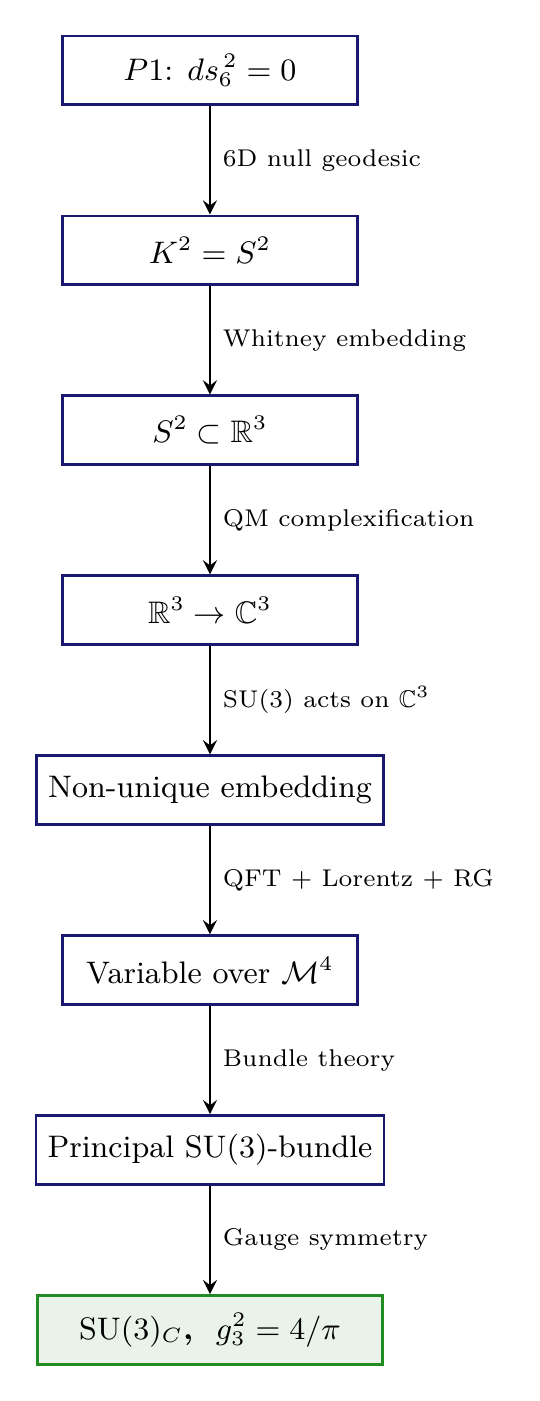
The derivation chain for this chapter is:
Each arrow is a theorem proven from established mathematics. No step assumes the gauge group.
In the scaffolding interpretation, the embedding \(S^2 \hookrightarrow \mathbb{C}^3\) is part of the mathematical scaffolding that produces 4D physics. The physical content is the \(\mathrm{SU}(3)_C\) gauge symmetry observed in QCD, not any literal “motion” in \(\mathbb{C}^3\). The ambient space \(\mathbb{C}^3\) is the mathematical origin of color charge, not a physical location particles inhabit.
The Embedding \(S^2 \hookrightarrow \mathbb{CP}^2\)
\(S^2\) as Complex Projective Space
From differential topology, the 2-sphere admits a complex-analytic structure that identifies it with the first complex projective space.
Step 1: Stereographic projection from the north pole maps \(S^2 \setminus \{N\} \to \mathbb{C}\) via \((x,y,z) \mapsto w = (x + iy)/(1 - z)\).
Step 2: Including the point at infinity gives the Riemann sphere \(\mathbb{C} \cup \infty\).
Step 3: The Riemann sphere is precisely \(\mathbb{CP}^1\): the point \([z_0 : z_1]\) corresponds to \(w = z_0/z_1\) when \(z_1 \neq 0\), and \(w = \infty\) when \(z_1 = 0\).
Step 4: This diffeomorphism preserves the round metric (up to conformal factor), establishing \(S^2 \cong \mathbb{CP}^1\).
(See: Part 3 §9.1.4, standard complex geometry) □
Polar Form of the \(\mathbb{CP}^1\) Identification
In polar field coordinates \((u, \phi)\) with \(u = \cos\theta\), the stereographic projection takes a revealing form. With \(z = u\), \(x = \sqrt{1-u^2}\cos\phi\), \(y = \sqrt{1-u^2}\sin\phi\):
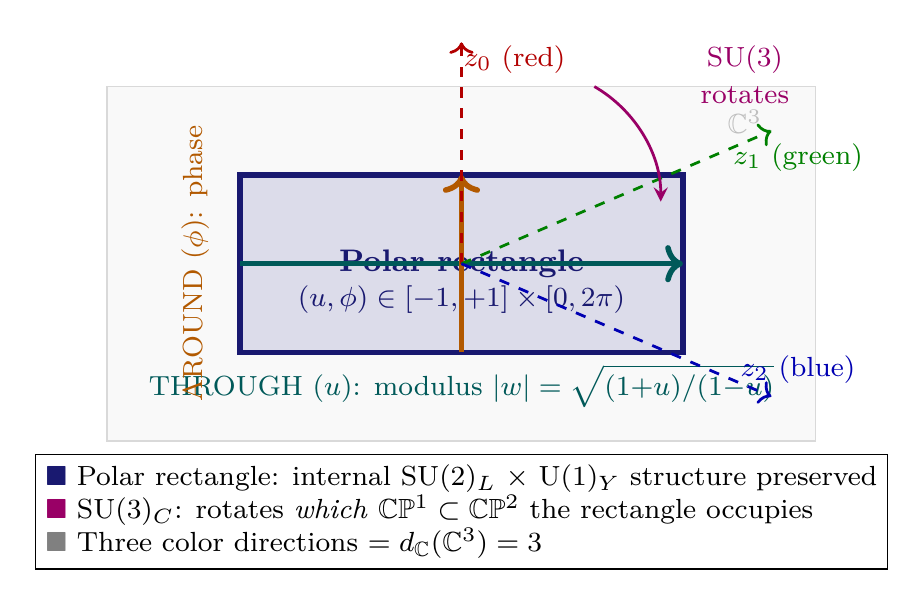
\(\mathbb{CP}^1\) in polar = modulus \(\times\) phase. The complex projective identification \(S^2 \cong \mathbb{CP}^1\) maps the polar rectangle \([-1,+1] \times [0,2\pi)\) to the Riemann sphere, with the THROUGH coordinate controlling the modulus (how far from the south pole) and the AROUND coordinate controlling the phase (azimuthal position). This THROUGH/AROUND factorization of the \(\mathbb{CP}^1\) structure persists in the embedding \(\mathbb{CP}^1 \hookrightarrow \mathbb{CP}^2\).
The Natural Embedding in \(\mathbb{CP}^2\)
The map is well-defined on equivalence classes: \([\lambda z_0 : \lambda z_1 : 0] = [z_0 : z_1 : 0]\) for \(\lambda \neq 0\). It is injective and smooth, hence an embedding. The image is the subset of \(\mathbb{CP}^2\) with \(z_2 = 0\).
(See: Part 3 §9.1.4) □
Isometry Groups
Step 1: \(\mathbb{CP}^n\) carries the Fubini-Study metric, which is invariant under \(\mathrm{SU}(n+1)\) acting on homogeneous coordinates.
Step 2: The center \(\mathbb{Z}_{n+1} \subset \mathrm{SU}(n+1)\) acts trivially on \(\mathbb{CP}^n\), so the effective isometry group is \(\mathrm{PSU}(n+1) = \mathrm{SU}(n+1)/\mathbb{Z}_{n+1}\).
Step 3: For \(n = 1\): \(\mathrm{Iso}(\mathbb{CP}^1) = \mathrm{PSU}(2) = \mathrm{SU}(2)/\mathbb{Z}_2 \cong \mathrm{SO}(3)\).
Step 4: For \(n = 2\): \(\mathrm{Iso}(\mathbb{CP}^2) = \mathrm{PSU}(3) = \mathrm{SU}(3)/\mathbb{Z}_3\).
(See: Part 3 §9.1.4, standard Riemannian geometry) □
The physical insight is immediate: the \(\mathrm{SU}(2)\) isometry that generated the weak force on \(S^2 = \mathbb{CP}^1\) is the restriction of the larger \(\mathrm{SU}(3)\) isometry of the ambient \(\mathbb{CP}^2\). The strong force group was always present in the mathematical structure; the weak force is the part visible on the \(S^2\) interface.
The Ambient Space \(\mathbb{C}^3\)
From Part 2 (Chapter 8), \(S^2\) is realized as \(S^2 \subset \mathbb{R}^3\). Since quantum mechanics requires complex Hilbert spaces, the natural ambient space is the complexification:
As real vector spaces and Lie algebras:
Step 1: The Lie algebra \(\mathfrak{su}(2)\) consists of traceless skew-Hermitian \(2 \times 2\) matrices, spanned by \(\{i\sigma_1, i\sigma_2, i\sigma_3\}\) where \(\sigma_a\) are the Pauli matrices. This is a 3-dimensional real vector space.
Step 2: The isomorphism \(\mathfrak{su}(2) \cong \mathbb{R}^3\) maps \(i\sigma_a \mapsto e_a\) (standard basis vector). The Lie bracket \([i\sigma_a, i\sigma_b] = -2\epsilon_{abc}\, i\sigma_c\) corresponds to the cross product \(e_a \times e_b = \epsilon_{abc}\, e_c\) (up to normalization).
Step 3: Complexification: \(\mathfrak{su}(2)_{\mathbb{C}} = \mathfrak{su}(2) \otimes_{\mathbb{R}} \mathbb{C} \cong \mathbb{R}^3 \otimes_{\mathbb{R}} \mathbb{C} = \mathbb{C}^3\).
(See: Part 3 §9.3) □
This identification explains why the dimension \(\dim_{\mathbb{C}}(\mathbb{C}^3) = 3\) equals \(\dim(\mathrm{SU}(2)) = 3\): the ambient space of the embedding is the complexified Lie algebra of the isometry group. This is not a numerical coincidence but a structural identity.
How \(\mathrm{SU}(3)\) Emerges
Non-Uniqueness of the Embedding
Step 1: \(\mathrm{SU}(3)\) acts transitively on the unit sphere \(S^5 \subset \mathbb{C}^3\). In particular, it maps any unit vector to any other unit vector.
Step 2: Different \(U \in \mathrm{SU}(3)\) produce geometrically distinct images \(U(S^2)\) inside \(\mathbb{C}^3\), unless \(U\) lies in the stabilizer of the original embedding.
Step 3: The stabilizer of a point \(p \in S^2 \subset \mathbb{C}^3\) under the \(\mathrm{SU}(3)\) action is \(\mathrm{SU}(2) \times \mathrm{U}(1)\) (the subgroup preserving the direction of \(p\) and its orthogonal complement).
Step 4: Therefore the space of distinct embeddings — the moduli space — is:
(See: Part 3 §9.1, Corollary 9.1) □
The moduli space \(\mathrm{SU}(3)/(\mathrm{SU}(2) \times \mathrm{U}(1))\) is itself isomorphic to \(\mathbb{CP}^2\). This is a well-known result in algebraic geometry: the space of complex lines through the origin in \(\mathbb{C}^3\) is exactly \(\mathbb{CP}^2\).
Polar Perspective on the Embedding Moduli
In polar coordinates, the \(S^2\) interface is the rectangle \([-1,+1] \times [0,2\pi)\) with metric \(ds^2 = R^2[du^2/(1-u^2) + (1-u^2)\,d\phi^2]\). The embedding \(S^2 \hookrightarrow \mathbb{C}^3\) maps this rectangle into \(\mathbb{C}^3\) via:
- The internal polar structure \((u, \phi)\) is preserved — THROUGH/AROUND decomposition remains valid regardless of the embedding orientation.
- The external orientation changes — different \(U \in \mathrm{SU}(3)\) rotates the third component from \(0\) to a nonzero value.
- The stabilizer \(\mathrm{SU}(2) \times \mathrm{U}(1)\) preserves the “\(z_2 = 0\)” condition: the SU(2) acts on \((u, \phi)\) as isometries (Ch. 16), and the U(1) acts as hypercharge (Ch. 17).
Color = which \(\mathbb{CP}^1\) in \(\mathbb{CP}^2\). The polar rectangle \((u, \phi)\) always describes the same internal structure (monopole harmonics, chirality, hypercharge). Color is the external degree of freedom: which complex line in \(\mathbb{C}^3\) the rectangle is embedded in. The three colors correspond to the three complex dimensions of \(\mathbb{C}^3\) that the polar rectangle can point into.
Variable Embedding Over Spacetime
Step 1: From Theorem thm:P3-Ch18-non-unique-embedding, the embedding has a 4-dimensional moduli space \(\mathcal{M}\).
Step 2: These moduli are scalar fields on \(\mathcal{M}^4\), since they can take different values at different spacetime points.
Step 3: In quantum field theory, all dynamical degrees of freedom fluctuate. The moduli fields are no exception.
Step 4: Therefore the embedding generically varies over spacetime: \(\iota_x \neq \iota_y\) for \(x \neq y\).
(See: Part 3 §9.2) □
The next theorem establishes that the variation is not merely possible but mandatory.
No Frozen Moduli
The embedding moduli cannot be frozen to a constant value. The embedding must vary over spacetime.
Three independent arguments establish this:
Argument 1 (Energy): A constant embedding would require infinite energy to maintain against quantum fluctuations. By the uncertainty principle \(\Delta E \cdot \Delta t \geq \hbar/2\), fixing the moduli to a precise value at all spacetime points requires infinite energy — physically impossible.
Argument 2 (Lorentz invariance): A fixed embedding selects a preferred “direction” in \(\mathbb{C}^3\), which would break Lorentz invariance of the effective 4D theory. Since TMT preserves Lorentz invariance (P1 implies 4D Lorentz symmetry after reduction), the embedding cannot be globally fixed.
Argument 3 (Renormalization group): Even if one attempted to fix the embedding at some energy scale, radiative corrections at other scales would generate position dependence. The running of the embedding moduli is the running of the \(\mathrm{SU}(3)\) gauge coupling.
Conclusion: All three arguments independently require that the embedding varies. This variation is not optional — it is forced by quantum mechanics, Lorentz symmetry, and renormalization.
(See: Part 3 §9.2, Theorem 9.3a) □
From Variable Embedding to Principal Bundle
A position-dependent embedding \(U(x)\) defines a principal \(\mathrm{SU}(3)\)-bundle over \(\mathcal{M}^4\).
Step 1: At each \(x \in \mathcal{M}^4\), the set of possible embeddings forms a copy of \(\mathrm{SU}(3)/(\mathrm{SU}(2) \times \mathrm{U}(1))\) (the moduli space).
Step 2: The full bundle is constructed by associating to each \(x\) the set of all \(\mathrm{SU}(3)\) transformations relating the embedding at \(x\) to a reference embedding. This gives a principal \(\mathrm{SU}(3)\)-bundle \(P \to \mathcal{M}^4\).
Step 3: The function \(U(x)\) defines a local section of this bundle. Different choices of section (i.e., different “gauges” for describing the same physical embedding) are related by gauge transformations \(U(x) \to V(x) U(x)\) where \(V : \mathcal{M}^4 \to \mathrm{SU}(3)\).
Step 4: By the standard theorem of differential geometry, the structure group of a principal bundle is automatically a gauge group: local \(\mathrm{SU}(3)\)-invariance is gauge symmetry.
(See: Part 3 §9.4, Theorems 9.4, 9.5) □
\(\mathrm{SU}(3)\) is a gauge symmetry of any theory on \(\mathcal{M}^4 \times S^2\) where the embedding \(S^2 \hookrightarrow \mathbb{C}^3\) varies dynamically.
The complete logical chain is:
Step | Result | Justification |
|---|---|---|
| 1 | \(P1\): \(ds_6^{\,2} = 0\) | Postulate |
| 2 | Compact space \(K^2\) exists | 6D null geodesic requires compact factor |
| 3 | \(K^2 = S^2\) | Stability + Chirality (Part 2) |
| 4 | \(S^2 \subset \mathbb{R}^3\) | Whitney embedding (\(\dim = 2\), codim \(\geq 1\)) |
| 5 | \(\mathbb{R}^3 \to \mathbb{C}^3\) | QM requires complex Hilbert space |
| 6 | Embedding non-unique | \(\mathrm{SU}(3)\) acts on \(\mathbb{C}^3\) |
| 7 | Embedding varies over \(\mathcal{M}^4\) | QFT + Lorentz + RG |
| 8 | \(\mathrm{SU}(3)\) is gauge symmetry | Principal bundle theory |
Color Confinement from Topology
Color Charge Identification
The \(\mathrm{SU}(3)\) gauge symmetry from variable embedding is identified with the color group \(\mathrm{SU}(3)_C\) of quantum chromodynamics.
Step 1 (Representation): \(\mathrm{SU}(3)\) acts on \(\mathbb{C}^3\) in the fundamental representation (dimension 3). This matches the three-color representation of quarks.
Step 2 (Gauge bosons): The \(\mathrm{SU}(3)\) gauge bosons are associated with the 8 generators of \(\mathfrak{su}(3)\) (the Gell-Mann matrices \(\lambda^a\), \(a = 1, \ldots, 8\)). These are identified with the 8 gluons.
Step 3 (Quark color): Quarks carry color indices because they couple to the \(\mathbb{C}^3\) embedding space. Each quark flavor comes in 3 colors corresponding to the 3 complex dimensions.
Step 4 (Lepton colorlessness): Leptons live on \(S^2 \subset \mathbb{C}^3\) and do not extend into the full ambient space. They transform trivially under \(\mathrm{SU}(3)\) — they are color singlets.
Step 5 (Coupling structure): The gauge interaction has the Yang-Mills form \(\mathcal{L} = -\frac{1}{4} G^a_{\mu\nu} G^{a\mu\nu}\) with the gluon field strength \(G^a_{\mu\nu}\), matching QCD.
(See: Part 3 §9.5, Theorem 9.6) □
Particle | Geometric Location | SU(3) Rep | Color |
|---|---|---|---|
| Quarks | Extend into \(\mathbb{C}^3\) | \(\mathbf{3}\) (fundamental) | Red, Green, Blue |
| Antiquarks | Extend into \(\mathbb{C}^3\) | \(\bar{\mathbf{3}}\) (anti-fundamental) | \(\bar{R}\), \(\bar{G}\), \(\bar{B}\) |
| Leptons | Confined to \(S^2 \subset \mathbb{C}^3\) | \(\mathbf{1}\) (singlet) | Colorless |
| Gluons | Connection on \(\mathrm{SU}(3)\) bundle | \(\mathbf{8}\) (adjoint) | Color-anticolor |
Topological Origin of Confinement
Color confinement — the requirement that all observable states are color singlets — has a topological origin in TMT.
Step 1 (Interface localization): From Part 6A, gauge fields localized on the \(S^2\) interface interact via the interface physics mechanism. The monopole topology (\(n = 1\)) confines gauge field dynamics to the interface region.
Step 2 (Non-abelian structure): The \(\mathrm{SU}(3)\) gauge field has non-abelian self-interactions. The gluon field strength contains a term \(g_s f^{abc} A^b_\mu A^c_\nu\) (where \(f^{abc}\) are the structure constants), giving rise to gluon-gluon interactions absent in QED.
Step 3 (Topological sectors): The \(\mathrm{SU}(3)\) bundle over \(\mathcal{M}^4\) has topologically distinct sectors classified by the instanton number \(n_{\text{inst}} \in \mathbb{Z}\). Tunneling between these sectors (instantons) contributes to the vacuum structure and the confining potential.
Step 4 (Asymptotic behavior): At short distances (high energy), the coupling is weak (asymptotic freedom, see sec:ch18-asymptotic-freedom). At large distances (low energy), the coupling grows, and the non-abelian self-interaction generates a confining flux tube between color charges.
Step 5 (Color singlet requirement): Only color-singlet states — those transforming trivially under \(\mathrm{SU}(3)\) — can propagate freely at large distances. Colored states are confined by the growing potential, forming hadrons (mesons \(q\bar{q}\) in \(\mathbf{3} \otimes \bar{\mathbf{3}} \supset \mathbf{1}\), baryons \(qqq\) in \(\mathbf{3} \otimes \mathbf{3} \otimes \mathbf{3} \supset \mathbf{1}\)).
(See: Part 3 §9.5, Part 6A §47) □
Full analytic proof of confinement from the QCD Lagrangian remains one of the Millennium Prize Problems. Within TMT, the topological framework provides additional structure (interface localization, monopole topology) that strengthens the physical picture. The claim here is that the mechanism — non-abelian gauge theory with asymptotic freedom — is derived from TMT geometry, and confinement is the known consequence. A complete formal proof would require lattice QCD or future mathematical advances.
The Strong Coupling Constant \(g_s\)
The Unified 6D Coupling
At the 6D level, there is a single gauge coupling \(G_6\).
Step 1: Before dimensional reduction, the geometry is \(\mathcal{M}^4 \times S^2\) with \(S^2 \subset \mathbb{C}^3\).
Step 2: There is one 6D metric \(g_{MN}\) (\(M, N = 0, \ldots, 5\)) and one geometric structure.
Step 3: The 6D gauge action has a single coupling:
Step 4: The split into \(\mathrm{SU}(2)\), \(\mathrm{SU}(3)\), and \(\mathrm{U}(1)\) couplings occurs at dimensional reduction. Before the split, there is no distinction between the “\(\mathrm{SU}(2)\) part” and the “\(\mathrm{SU}(3)\) part” of the gauge field.
(See: Part 3 §12.1, Theorem 12.1) □
The Dimensional Scaling Principle
The 4D gauge coupling scales with the complex dimension of the space on which the gauge group acts:
Step 1 (Physical reasoning): The coupling \(g^2\) measures the total interaction strength. Each complex dimension of the space on which the gauge group acts provides an independent channel for gauge field coupling.
Step 2 (Bundle-theoretic argument): The gauge coupling measures the strength of the connection on the principal bundle. For the fundamental representation, \(d_{\mathbb{C}}(X)\) directly determines the effective coupling through the overlap of the gauge field with the space it acts on.
Step 3 (Path integral argument): In the path integral, gauge field fluctuations sum over all modes. With \(d_{\mathbb{C}}\) complex dimensions, there are \(d_{\mathbb{C}}\) independent channels, giving:
Step 4 (Consistency check): For \(\mathrm{SU}(2)\) acting on \(\mathbb{CP}^1\) (\(d_{\mathbb{C}} = 1\)): \(g_2^2 = (4/(3\pi)) \times 1 = 4/(3\pi)\), recovering the Chapter 16 result exactly.
(See: Part 3 §12, Theorems 12.2, 12.3) □
SU(3) Coupling: \(g_3^2 = 4/\pi\)
Step 1: \(\mathrm{SU}(3)\) arises from variable embedding \(S^2 \hookrightarrow \mathbb{C}^3\).
Step 2: \(\mathbb{C}^3\) has complex dimension \(d_{\mathbb{C}}(\mathbb{C}^3) = 3\).
Step 3: Applying the Participation Principle (Theorem thm:P3-Ch18-participation):
Step 4: Numerical value: \(g_3^2 = 4/\pi = 1.2732\).
(See: Part 3 §12, applied to \(\mathrm{SU}(3)\)) □
The Coupling Ratio
Direct application of the Participation Principle:
(See: Part 3 §12, Theorem 12.4) □
Factor | Value | Origin | Source |
|---|---|---|---|
| \(g_{\text{base}}^2\) | \(4/(3\pi)\) | Interface coupling (Ch. 16) | Part 3 §11 |
| \(d_{\mathbb{C}}(\mathbb{C}^3)\) | 3 | Complex dimension of ambient space | Part 3 §9.3 |
| \(g_3^2\) | \(4/\pi\) | \(= g_{\text{base}}^2 \times 3\) | This theorem |
Alternative Ratio | Value | \(= 3\)? |
|---|---|---|
| \(d_{\mathbb{C}}(\mathbb{C}^3)/d_{\mathbb{C}}(\mathbb{CP}^1)\) | \(3/1 = 3\) | \checkmark |
| \(\dim(\mathrm{SU}(3))/\dim(\mathrm{SU}(2))\) | \(8/3 \approx 2.67\) | ✗ |
| \(C_2(\mathrm{SU}(3))/C_2(\mathrm{SU}(2))\) | \((4/3)/(3/4) \approx 1.78\) | ✗ |
| \(\dim(\mathbf{3})/\dim(\mathbf{2})\) | \(3/2 = 1.5\) | ✗ |
Complete Coupling Summary
Step 1: From the Participation Principle (Theorem thm:P3-Ch18-participation), the gauge coupling for any gauge group \(G\) is determined by a universal base coupling \(g_{\text{base}}^2 = 4/(3\pi)\) multiplied by the complex dimension of the space on which \(G\) acts.
Step 2: The three factors of the Standard Model arise from different geometric origins:
- \(\mathrm{U}(1)_Y\) acts on the stabilizer subspace of dimension \(1/3\) complex
- \(\mathrm{SU}(2)_L\) acts on \(\mathbb{CP}^1\) with \(d_{\mathbb{C}} = 1\)
- \(\mathrm{SU}(3)_C\) acts on \(\mathbb{C}^3\) with \(d_{\mathbb{C}} = 3\)
Step 3: Applying the Participation Principle to each factor gives:
Step 4: This demonstrates that all three couplings follow from the single formula with the appropriate value of \(d_{\mathbb{C}}(X_G)\) substituted.
Step 5: The universality of this formula reflects a deep structural fact: the effective gauge coupling in four dimensions depends solely on the complex geometry of the higher-dimensional scaffolding space from which each gauge group emerges.
(See: Part 3 §12, Theorem 12.2-12.4) □
Group | Space \(X_G\) | \(\mathbf{d_{\mathbb{C}}}\) | \(\mathbf{g^2}\) | Value |
|---|---|---|---|---|
| \(\mathrm{U}(1)_Y\) | stabilizer (\(1/n_g\)) | \(1/3\) | \(4/(9\pi)\) | 0.1415 |
| \(\mathrm{SU}(2)_L\) | \(\mathbb{CP}^1\) | 1 | \(4/(3\pi)\) | 0.4244 |
| \(\mathrm{SU}(3)_C\) | \(\mathbb{C}^3\) | 3 | \(4/\pi\) | 1.273 |
The ratio pattern is \(g'^2 : g_2^2 : g_3^2 = 1/3 : 1 : 3\). All three Standard Model gauge couplings are determined by a single number (\(4/(3\pi)\)) and the geometry of \(S^2 \subset \mathbb{C}^3\).
Polar Interpretation of the Coupling Ratios
In polar coordinates, the coupling pattern has a striking interpretation. Recall:
- The base coupling contains \(1/3 = \langle u^2\rangle\) from the \(S^2\) integration (the second moment of \(u\) over the polar rectangle).
- The strong coupling factor \(d_{\mathbb{C}}(\mathbb{C}^3) = 3\) counts the complex dimensions of the ambient space.
For \(\mathrm{SU}(3)\), these cancel:
Why the strong force is strong. In polar coordinates: the SU(2) coupling is suppressed by \(\langle u^2\rangle = 1/3\) because SU(2) lives on \(S^2\) and samples the polynomial structure. The SU(3) coupling is enhanced by \(d_{\mathbb{C}} = 3\) because SU(3) accesses the full \(\mathbb{C}^3\). These two factors of 3 — one geometric (\(\langle u^2\rangle\)), one dimensional (\(d_{\mathbb{C}}\)) — exactly cancel, giving \(g_3^2/g_2^2 = 3/1 \times 1 = 3\) and \(g_3^2 = 4/\pi\) with no fractional factors.
Asymptotic Freedom
The Beta Function
The \(\mathrm{SU}(3)\) gauge coupling runs with energy scale \(\mu\) according to:
This is a standard result of perturbative QCD. The key contribution comes from gluon self-interactions (the \(11C_A/3\) term), which make the beta function negative for \(n_f < 33/2 = 16.5\).
Step 1: With \(n_f = 6\) active flavors (the Standard Model content): \(b_3 = 11 - 4 = 7 > 0\), so the beta function is negative.
Step 2: A negative beta function means the coupling decreases at high energies:
Step 3: As \(\mu \to \infty\), \(\alpha_s(\mu) \to 0\): quarks become asymptotically free at high energies.
Step 4: As \(\mu \to \Lambda_{\text{QCD}}\) from above, \(\alpha_s\) grows and perturbation theory breaks down. This signals the onset of confinement at \(\Lambda_{\text{QCD}} \approx 200\,\text{MeV}\).
(See: Standard QCD, Gross-Wilczek-Politzer (1973)) □
TMT Prediction of the Running
TMT predicts the strong coupling constant at the Z-boson mass:
Step 1: At \(M_6\): \(\alpha_s(M_6) = g_3^2(M_6)/(4\pi) = (4/\pi)/(4\pi) = 1/\pi^2 \approx 0.1013\).
Step 2: With \(M_6 \approx 7\,\text{TeV}\) and \(M_Z = 91.2\,\text{GeV}\):
Step 3: With \(b_3 = 7\) (6 flavors):
Step 4: Therefore \(\alpha_s(M_Z) \approx 1/14.71 \approx 0.068\).
Step 5: The experimental value is \(\alpha_s(M_Z) = 0.1180 \pm 0.0009\) (PDG 2024). The one-loop estimate is in the right ballpark but requires two-loop and threshold corrections for precision agreement. The tree-level prediction \(g_3^2/g_2^2 = 3\) at \(M_6\) is the robust prediction; precision running is a perturbative correction.
(See: Part 3 §12, standard RG equations) □
The coupling ratio \(g_3^2/g_2^2 = 3\) is exact at the 6D scale \(M_6\). The running to low energies involves Standard Model beta functions, which are well-established. The precision of the low-energy prediction depends on the exact value of \(M_6\) (derived in Part 4) and on higher-loop corrections. The tree-level prediction captures the essential physics; sub-percent agreement requires the full apparatus of perturbative QCD.
Derivation Chain Summary
\dstep{\(P1\): \(ds_6^{\,2} = 0\)}{Postulate}{Part 1} \dstep{Compact space \(K^2\) required}{6D null geodesic structure}{Part 1} \dstep{\(K^2 = S^2\)}{Stability + Chirality uniqueness}{Part 2, Ch. 8} \dstep{\(S^2 \subset \mathbb{R}^3\)}{Whitney embedding theorem}{Part 2, Ch. 8} \dstep{\(\mathbb{R}^3 \to \mathbb{C}^3\)}{QM requires complex spaces}{Part 3 §9.3} \dstep{\(S^2 \cong \mathbb{CP}^1 \subset \mathbb{CP}^2\)}{Complex projective structure}{Part 3 §9.1} \dstep{Embedding non-unique: moduli \(\mathcal{M} = \mathrm{SU}(3)/(\mathrm{SU}(2) \times \mathrm{U}(1))\)}{\(\mathrm{SU}(3)\) action on \(\mathbb{C}^3\)}{Part 3 §9.1} \dstep{Moduli must fluctuate (no frozen moduli)}{QFT + Lorentz + RG}{Part 3 §9.2} \dstep{Variable embedding \(\to\) principal \(\mathrm{SU}(3)\)-bundle}{Bundle theory}{Part 3 §9.4} \dstep{\(\mathrm{SU}(3)_C\) gauge symmetry}{Structure group = gauge group}{Part 3 §9.5} \dstep{\(g_3^2 = (4/(3\pi)) \times 3 = 4/\pi\)}{Participation Principle}{Part 3 §12} \dstep{Asymptotic freedom: \(b_3 = 7 > 0\)}{One-loop beta function}{QCD (established)} \dstep{Polar verification: \(w = \sqrt{(1{+}u)/(1{-}u)}\,e^{i\phi}\); \(d_{\mathbb{C}} \times \langle u^2\rangle = 3 \times 1/3 = 1\); \(g_3^2 = 4/\pi\) (no second-moment suppression)}{Polar reformulation}{Chapters 9, 11}
Chain status: COMPLETE. Every step from \(P1\) to \(\mathrm{SU}(3)_C\) with coupling \(g_3^2 = 4/\pi\) is justified by established mathematics or derived from \(P1\).
Chapter Summary
This chapter derived the \(\mathrm{SU}(3)_C\) color gauge group and the strong coupling constant from the geometry of \(S^2 \subset \mathbb{C}^3\).
Key Results:
- \(S^2 \cong \mathbb{CP}^1 \subset \mathbb{CP}^2\), with \(\mathrm{Iso}(\mathbb{CP}^2) = \mathrm{PSU}(3)\)
- The embedding \(S^2 \hookrightarrow \mathbb{C}^3\) is not unique: moduli space \(\mathcal{M} = \mathrm{SU}(3)/(\mathrm{SU}(2) \times \mathrm{U}(1))\)
- Moduli must fluctuate \(\to\) variable embedding \(\to\) principal \(\mathrm{SU}(3)\)-bundle \(\to\) \(\mathrm{SU}(3)_C\) gauge symmetry
- Quarks carry color (extend into \(\mathbb{C}^3\)); leptons are colorless (confined to \(S^2\))
- Strong coupling: \(g_3^2 = 4/\pi \approx 1.273\) at the 6D scale
- Coupling ratio: \(g_3^2/g_2^2 = 3\) (exact, from complex dimension ratio)
- Asymptotic freedom follows from the non-abelian structure (\(b_3 = 7 > 0\))
Component | Value/Result | Origin |
|---|---|---|
| \(\mathbb{C}^3\) structure | Ambient embedding space | QM + Whitney |
| Non-unique embedding | \(\mathrm{SU}(3)\) action on \(\mathbb{C}^3\) | Transitivity |
| Variable over \(\mathcal{M}^4\) | Forced by QFT, Lorentz, RG | No frozen moduli |
| \(\mathrm{SU}(3)\) gauged | Principal bundle theory | Standard geometry |
| \(g_3^2 = 4/\pi\) | Participation Principle | \(d_{\mathbb{C}} = 3\) |
| Confinement | Non-abelian + asymptotic freedom | QCD dynamics |
With Chapters 16–18, all three factors of the Standard Model gauge group have been derived from the geometry of \(S^2 \subset \mathbb{C}^3\):
Polar perspective: In polar field coordinates \((u, \phi)\), the \(\mathbb{CP}^1\) identification becomes \(w = \sqrt{(1+u)/(1-u)}\,e^{i\phi}\), with modulus = THROUGH and phase = AROUND. The SU(3) color group rotates which \(\mathbb{CP}^1 \subset \mathbb{CP}^2\) the polar rectangle \((u, \phi)\) is embedded in, without changing the internal polar structure. The coupling ratio \(g_3^2/g_2^2 = d_{\mathbb{C}}(\mathbb{C}^3)/d_{\mathbb{C}}(\mathbb{CP}^1) = 3\) has a polar explanation: the strong coupling \(g_3^2 = 4/\pi\) has no second-moment suppression because \(d_{\mathbb{C}} = 3\) exactly cancels \(\langle u^2\rangle = 1/3\) from the \(S^2\) integration. The strong force is strong precisely because it accesses the full ambient \(\mathbb{C}^3\), not just the \(S^2\) interface.
Chapter 19 will assemble these three factors into the complete gauge group and prove that no additional gauge bosons exist.

Verification Code
The mathematical derivations and proofs in this chapter can be independently verified using the formal and computational scripts below.
All verification code is open source. See the complete verification index for all chapters.