Anomaly Cancellation and Hypercharge
Introduction
The previous chapters derived the gauge group \(\text{SU}(3)_{C} \times \text{SU}(2)_{L} \times \text{U}(1)_{Y}\) from the geometry of \(S^{2} \subset \mathbb{C}^{3}\) with monopole background. But knowing the symmetry group is only half the story. A quantum gauge theory is defined not just by its gauge group but by the representations in which the matter fields transform—and, crucially, by the charges they carry under each factor.
In the Standard Model these charges are traditionally inputs: one writes down the quark doublet with hypercharge \(Y = 1/6\), the right-handed up quark with \(Y = 2/3\), the lepton doublet with \(Y = -1/2\), and so on, because those values fit experiment. TMT makes a far stronger claim: the hypercharge assignments are derived, not assumed. They follow uniquely from anomaly cancellation combined with the geometric constraints already established.
Central Result of This Chapter. Given the TMT-derived gauge group \(\text{SU}(3) \times \text{SU}(2) \times \text{U}(1)\) and the representation constraints from the \(S^{2}\) geometry, anomaly cancellation uniquely determines every fermion hypercharge to be exactly the Standard Model value. No free parameters remain.
agraph{What this chapter derives.}
- The 6D anomaly structure arising from the \(M^{4} \times S^{2}\) compactification and why anomaly freedom is a non-negotiable consistency requirement (\Ssec:ch21-6d-anomaly).
- The number of fermion generations: \(N_{\text{gen}} = 2\ell + 1 = 3\) from monopole harmonics on \(S^{2}\) (\Ssec:ch21-generations).
- The uniqueness of the hypercharge assignment: four anomaly equations with five unknowns yield a one-parameter family, and charge quantization fixes the parameter (\Ssec:ch21-hypercharge-unique).
- The explicit Standard Model hypercharges, derived step by step (\Ssec:ch21-sm-hypercharges).
- A complete mathematical verification of all four anomaly equations (\Ssec:ch21-verification).
- A final confirmation that every SM quantum number matches exactly (\Ssec:ch21-exact-match).
agraph{Prerequisites.} Chapter 19 (Complete Gauge Group), Chapter 11 (Monopole Harmonics), Chapter 17 (U(1) Hypercharge from topology).
The anomaly analysis operates entirely in the 4D effective theory projected from the \(M^{4} \times S^{2}\) scaffolding. The \(S^{2}\) determines which representations appear; anomaly cancellation determines what charges they carry. At no point do we treat \(S^{2}\) as a literal extra-dimensional space through which particles propagate.
6D Anomaly Structure
Why Anomaly Freedom Is Required
Gauge anomalies arise when quantum corrections (one-loop triangle diagrams in 4D) break a classical gauge symmetry. If a gauge anomaly is present the theory is inconsistent: probability is not conserved, unitarity fails, and the theory cannot be renormalised.
A chiral gauge theory in 4D is consistent (unitary, renormalisable, gauge-invariant at the quantum level) if and only if all gauge anomalies cancel:
This is a standard result of quantum field theory, established by Adler, Bell, Jackiw, and refined by many others.
From 6D Scaffolding to 4D Anomaly Constraints
In TMT the 6D null constraint \(ds_6^{\,2} = 0\) on \(\mathcal{M}^4 \times S^2\) reduces to an effective 4D chiral gauge theory. The chiral fermion content of this 4D theory is determined by the topology of \(S^2\) (monopole harmonics, angular momentum multiplets), and its consistency requires that the resulting 4D anomalies cancel.
Step 1: The 6D geometry \(\mathcal{M}^4 \times S^2\) with monopole background forces 4D fermions to appear in definite representations of the gauge group (Chapter 19).
Step 2: The monopole on \(S^2\) selects chiral fermions: left-handed and right-handed components transform differently under \(\text{SU}(2)_{L}\) because the monopole connection distinguishes the two chiralities through the spin-monopole coupling.
Step 3: The resulting 4D theory is a chiral gauge theory. By Theorem thm:P11-Ch21-anomaly-consistency, all triangle anomalies must cancel for consistency.
Step 4: The specific anomaly conditions depend on the gauge group and the fermion representations. For \(\text{SU}(3) \times \text{SU}(2) \times \text{U}(1)\), there are six independent anomaly conditions (four of which are non-trivial constraints on hypercharges; two vanish identically due to group theory).
(See: Part 11 \S228.1; Part 3 \S10.4) □
The Six Anomaly Conditions
For the gauge group \(G = \text{SU}(3)_{C} \times \text{SU}(2)_{L} \times \text{U}(1)_{Y}\), the independent triangle anomalies are:
| Anomaly | Triangle | Constraint | Status |
|---|---|---|---|
| \([\text{SU}(3)]^{3}\) | Three gluon vertices | Vanishes identically | Automatic |
| \([\text{SU}(2)]^{3}\) | Three \(W\) vertices | Vanishes identically | Automatic |
| \([\text{SU}(3)]^{2}\text{U}(1)\) | Two gluons + \(B\) | Constrains hypercharges | Non-trivial |
| \([\text{SU}(2)]^{2}\text{U}(1)\) | Two \(W\)'s + \(B\) | Constrains hypercharges | Non-trivial |
| \([\text{U}(1)]^{3}\) | Three \(B\) vertices | Constrains hypercharges | Non-trivial |
| \(\text{U}(1)\text{-gravity}^{2}\) | \(B\) + two gravitons | Constrains hypercharges | Non-trivial |
The first two vanish automatically: \([\text{SU}(3)]^{3}\) because \(\text{SU}(3)\) is vector-like (left-handed quarks in \(\mathbf{3}\), right-handed quarks in \(\mathbf{3}\)), and \([\text{SU}(2)]^{3}\) because \(\operatorname{Tr}[\tau^{a}\{\tau^{b},\tau^{c}\}] = 0\) for the pseudoreal fundamental of \(\text{SU}(2)\).
The remaining four conditions are the non-trivial constraints that will determine the hypercharges.
\(N_{\mathrm{gen}} = 2\ell + 1 = 3\) from Harmonics
Before solving for the hypercharges we must establish the fermion content. The number of generations is not a free parameter in TMT—it is derived from the monopole harmonic spectrum on \(S^2\).
Step 1: The monopole on \(S^2\) has charge \(g_{m} = 1/2\) (Dirac quantization, Part 3 \S8.3, Chapter 10 of this book).
Step 2: For a spin-\(1/2\) fermion coupled to the monopole with gauge charge \(q\), the total angular momentum on \(S^2\) satisfies:
Step 3 (\(\ell = 0\) fails): For \(\ell = 0\) with unit gauge charge (\(q = 1\)):
Explicitly, the covariant derivative on a constant \(\psi_{0}\) gives:
Step 4 (\(\ell = 1\) is the ground state): For \(\ell = 1\) with unit gauge charge:
Step 5: The \(\ell = 1\) multiplet has degeneracy \(2\ell + 1 = 2(1) + 1 = 3\).
Step 6: These three states (\(m = -1, 0, +1\)) are identified with the three fermion generations.
Step 7: Higher-\(\ell\) states have higher angular momentum \(j = \ell + 1\), hence higher energy \(E \sim j(j+1)/R_{0}^{2}\). They decouple at low energies and are not observed as light fermion generations.
Conclusion: \(N_{\text{gen}} = 3\) is derived from the \(S^2\) monopole geometry.
(See: Part 11 \S228.1.2 (Theorem 228.2); Part 6 \S85.2; Part 2 Theorem 2A.5; Part 3 \S8.3) □
Polar Perspective: Generations as Polynomial Degrees
In polar coordinates \(u = \cos\theta\), the generation counting becomes transparent. The monopole harmonics on \(S^2\) are polynomials in \(u\) times Fourier modes in \(\phi\):
The \(\ell = 0\) exclusion has a direct polar interpretation: a degree-0 polynomial in \(u\) is a constant. But the monopole connection \(A_\phi = (1-u)/2\) is linear in \(u\) (Chapter 10). A constant wavefunction cannot satisfy the covariant boundary condition imposed by a linear connection — the covariant derivative \(D_\phi \psi_0 = -iqA_\phi \psi_0 \propto (1-u)\) is degree 1, not degree 0. The constant mode is algebraically incompatible with the monopole.
The \(\ell = 1\) ground state has three degree-1 polynomials in \(u\):
Generations = polynomial degree. In polar coordinates, \(N_{\text{gen}} = 2\ell + 1 = 3\) is the number of linearly independent degree-1 polynomials in \(u\) that satisfy the monopole boundary condition on the polar rectangle. The \(\ell = 0\) (constant) mode is excluded because it cannot match the linear (\(u\)-dependent) monopole connection. Higher-\(\ell\) modes are higher-degree polynomials with larger eigenvalues, hence more massive. The three generations correspond to three independent ways to tilt a linear function across the THROUGH direction.
agraph{Counterfactual analysis.}
- If the monopole charge were \(g_{m} = 1\) instead of \(1/2\): the minimum \(j = 1\), giving a different angular momentum spectrum and a different generation count.
- If the compact space were \(T^{2}\) (flat torus) instead of \(S^2\): \(\pi_{2}(T^{2}) = 0\), so there is no monopole, no angular momentum constraint, and the generation number would be arbitrary.
- The method correctly distinguishes these different geometries and predicts different physics for each.
Hypercharge Uniqueness
Allowed Representations
Before writing down the anomaly equations, we must identify which representations are allowed.
The possible fermion representations under \(\text{SU}(3) \times \text{SU}(2) \times \text{U}(1)\) are constrained by four conditions:
- Renormalisability: Only fundamental, anti-fundamental, or singlet representations are allowed for chiral fermions (higher representations give non-renormalisable interactions at one loop).
- Anomaly cancellation: The chiral spectrum must be anomaly-free (Theorem thm:P11-Ch21-anomaly-consistency).
- Mass generation: Fermions must couple to the Higgs (\(\mathbf{1}, \mathbf{2}, +1/2\)) for electroweak symmetry breaking.
- Charge quantisation: Electric charge \(Q = T_{3} + Y\) must be quantised in units of \(e/3\) (from Dirac quantisation on \(S^2\); Chapter 17).
From constraint (1), the only allowed \(\text{SU}(3) \times \text{SU}(2)\) representations for chiral fermions are:
The Five Fermion Multiplets Per Generation
The \(S^2\) geometry with monopole background produces, per generation, exactly five chiral multiplets. Their \(\text{SU}(3) \times \text{SU}(2)\) quantum numbers are determined by the geometry (quarks couple to the \(\mathbb{C}^{3}\) embedding; leptons are colour singlets; left-handed fields couple to the \(S^2\) isometry; right-handed fields are \(\text{SU}(2)\) singlets):
| Field | Chirality | SU(3) | SU(2) | U(1)\(_{Y}\) | Geometric origin |
|---|---|---|---|---|---|
| \(Q_{L}\) | Left | \(\mathbf{3}\) | \(\mathbf{2}\) | \(Y_{Q}\) | Colour + isometry coupling |
| \(u_{R}\) | Right | \(\mathbf{3}\) | \(\mathbf{1}\) | \(Y_{u}\) | Colour, no isometry |
| \(d_{R}\) | Right | \(\mathbf{3}\) | \(\mathbf{1}\) | \(Y_{d}\) | Colour, no isometry |
| \(L_{L}\) | Left | \(\mathbf{1}\) | \(\mathbf{2}\) | \(Y_{L}\) | No colour, isometry coupling |
| \(e_{R}\) | Right | \(\mathbf{1}\) | \(\mathbf{1}\) | \(Y_{e}\) | Complete singlet |
The five hypercharges \(Y_{Q}, Y_{u}, Y_{d}, Y_{L}, Y_{e}\) are unknown at this stage. We will now show that anomaly cancellation determines them uniquely.
The Four Anomaly Equations
Given the gauge group \(\text{SU}(3) \times \text{SU}(2) \times \text{U}(1)\) and the five multiplets listed above (with three generations), anomaly cancellation imposes four independent equations on the five hypercharges. Together with electric charge quantisation, the solution is unique.
We write the four non-trivial anomaly conditions for one generation (all conditions scale linearly with \(N_{\text{gen}}\), so the per-generation conditions are necessary and sufficient).
(A1) \([\text{SU}(3)]^{2} \times \text{U}(1)\):
The triangle diagram has two \(\text{SU}(3)\) gluon vertices and one \(\text{U}(1)_{Y}\) vertex. Only colour-charged fermions contribute. For the fundamental of \(\text{SU}(3)\), the Dynkin index is \(T(\mathbf{3}) = 1/2\). The condition is:
The colour-charged fermions are \(Q_{L}\) (which is an \(\text{SU}(2)\) doublet, contributing a factor of 2), \(u_{R}\), and \(d_{R}\). Using \(T(\mathbf{3}) = 1/2\) for each and noting that for left-handed fields the sign is positive and for right-handed fields negative:
(A2) \([\text{SU}(2)]^{2} \times \text{U}(1)\):
Two \(\text{SU}(2)\) vertices and one \(\text{U}(1)_{Y}\) vertex. Only \(\text{SU}(2)\) doublets contribute. The doublets are \(Q_{L}\) (which is an \(\text{SU}(3)\) triplet, contributing a colour factor of 3) and \(L_{L}\) (colour singlet). With \(T(\mathbf{2}) = 1/2\):
(Factor of 3 from SU(3) multiplicity of \(Q_L\); factor of 2 in each doublet's \(T(\mathbf{2})\) cancels when we account for the normalisation convention consistently.)
(A3) \([\text{U}(1)]^{3}\):
Three \(\text{U}(1)_{Y}\) vertices. All fermions contribute, weighted by \(Y^{3}\) and their multiplicities:
The multiplicities are: \(Q_{L}\) has \(3 \times 2 = 6\) components (colour \(\times\) isospin), \(u_{R}\) has 3, \(d_{R}\) has 3, \(L_{L}\) has 2, and \(e_{R}\) has 1. Left-handed fields enter with \(+\) and right-handed with \(-\).
(A4) \(\text{U}(1)\)-gravity\(^{2}\):
One \(\text{U}(1)_{Y}\) vertex and two graviton vertices. The gravitational anomaly is proportional to the sum of hypercharges weighted by multiplicities:
(See: Part 11 \S228.3.2) □
SM Hypercharges Derived
The anomaly equations (A1)–(A4) have a unique solution up to overall normalisation. Electric charge quantisation (\(Q = T_{3} + Y\) with \(Q \in \mathbb{Z}/3\)) fixes the normalisation to \(Y_{Q} = 1/6\), yielding exactly the Standard Model hypercharges.
We solve the system step by step.
Step 1: From equation (A2):
Step 2: From equation (A1):
Step 3: Substitute into equation (A4):
Step 4: We now have three of the five hypercharges expressed in terms of \(Y_{Q}\):
To determine \(Y_{u}\) and \(Y_{d}\) individually, we use equation (A3). Substituting all known relations:
Step 5: Let \(Y_{u} = Y_{Q} + x\) and \(Y_{d} = Y_{Q} - x\) (satisfying \(Y_{u} + Y_{d} = 2Y_{Q}\) automatically). Then:
Expanding using the binomial identity \((a+b)^{3} + (a-b)^{3} = 2a^{3} + 6ab^{2}\):
Step 6: The two solutions (related by \(u \leftrightarrow d\) exchange) are:
- \(x = +3Y_{Q}\): \(\;Y_{u} = 4Y_{Q}\), \(\;Y_{d} = -2Y_{Q}\)
- \(x = -3Y_{Q}\): \(\;Y_{u} = -2Y_{Q}\), \(\;Y_{d} = 4Y_{Q}\)
Choosing the convention where the up-type quark has the larger positive hypercharge (standard convention), we take \(x = +3Y_{Q}\):
Step 7 (Normalisation from charge quantisation): Electric charge is \(Q = T_{3} + Y\). For the quark doublet \(Q_{L} = (u_{L}, d_{L})\):
Requiring the observed charges \(Q_{u} = 2/3\) and \(Q_{d} = -1/3\):
Both conditions give the same normalisation:
Step 8: Substituting \(Y_{Q} = 1/6\) into all relations:
| Field | \(Y\) in terms of \(Y_{Q}\) | \(Y\) value | SM value |
|---|---|---|---|
| \(Q_{L}\) | \(1 \times Y_{Q}\) | \(+1/6\) | \(+1/6\) \;\checkmark |
| \(u_{R}\) | \(4 \times Y_{Q}\) | \(+2/3\) | \(+2/3\) \;\checkmark |
| \(d_{R}\) | \(-2 \times Y_{Q}\) | \(-1/3\) | \(-1/3\) \;\checkmark |
| \(L_{L}\) | \(-3 \times Y_{Q}\) | \(-1/2\) | \(-1/2\) \;\checkmark |
| \(e_{R}\) | \(-6 \times Y_{Q}\) | \(-1\) | \(-1\) \;\checkmark |
Every hypercharge matches the Standard Model exactly.
(See: Part 11 \S228.3.3 (Theorem 228.7, Lemma 228.8)) □
Polar Interpretation of the Hypercharge Ratios
The anomaly-derived hypercharge ratios connect directly to the polar geometry established in earlier chapters. The ratio \(Y_L/Y_Q = -3 = -1/\langle u^2\rangle\) involves the same second moment of the THROUGH coordinate that controls the coupling hierarchy (Chapter 20). From the (A2) anomaly condition:
In polar coordinates, hypercharge is the AROUND winding number of the monopole transition function \(g_{NS} = e^{in\phi}\) (Chapter 17). The five SM hypercharges, expressed in units of \(Y_Q\), are:
Polar origin of hypercharge ratios. The anomaly condition (A2) gives \(Y_L = -3Y_Q\), where the factor 3 is \(1/\langle u^2\rangle = d_{\mathbb{C}}(\mathbb{C}^3)\) — the same polar second moment that controls coupling constants. Quarks couple to the \(\mathbb{C}^3\) embedding (THROUGH + AROUND + color); leptons couple only to the \(S^2\) interface (THROUGH + AROUND). The anomaly equations enforce that these two sectors carry precisely complementary AROUND winding numbers.
| Factor | Value | Origin | Source |
|---|---|---|---|
| \(Y_{Q} = 1/6\) | Normalization | \(Q = T_{3} + Y\) with \(Q_{u} = 2/3\) | This chapter, Step 7 |
| \(Y_{L}/Y_{Q} = -3\) | Ratio | \([\text{SU}(2)]^{2}\text{U}(1)\) anomaly (A2) | Eq. eq:ch21-step1 |
| \(Y_{e}/Y_{Q} = -6\) | Ratio | U(1)-gravity anomaly (A4) | Eq. eq:ch21-step3 |
| \(Y_{u}/Y_{Q} = 4\) | Ratio | \([\text{U}(1)]^{3}\) anomaly (A3) | Eq. eq:ch21-step6 |
| \(Y_{d}/Y_{Q} = -2\) | Ratio | \([\text{U}(1)]^{3}\) anomaly (A3) | Eq. eq:ch21-step6 |
Physical Interpretation: Hypercharge IS Monopole Charge
The \(\text{U}(1)_{Y}\) hypercharge is the monopole \(\text{U}(1)\)—they are the same symmetry. Fields with hypercharge \(Y\) couple to the monopole with charge \(q = Y\).
Step 1: The monopole on \(S^2\) creates a U(1) gauge symmetry via \(\pi_{2}(S^2) = \mathbb{Z}\) (Part 3 Theorem 8.6, Chapter 17 of this book).
Step 2: This U(1) is identified with hypercharge \(\text{U}(1)_{Y}\) (Part 3 Corollary 8.3). The minimal monopole charge \(q = 1/2\) corresponds to the Higgs hypercharge \(Y_{H} = 1/2\).
Step 3: The anomaly-derived hypercharges are all consistent with Dirac quantisation:
| Field | \(Y\) | Check: \(Y \cdot n \in \mathbb{Z}/2\) (with \(n=1\)) |
|---|---|---|
| \(Q_{L}\) | \(1/6\) | \(1/6 \cdot 6 = 1 \in \mathbb{Z}\) \;\checkmark |
| \(u_{R}\) | \(2/3\) | \(2/3 \cdot 3 = 2 \in \mathbb{Z}\) \;\checkmark |
| \(d_{R}\) | \(-1/3\) | \(-1/3 \cdot 3 = -1 \in \mathbb{Z}\) \;\checkmark |
| \(L_{L}\) | \(-1/2\) | \(-1/2 \cdot 2 = -1 \in \mathbb{Z}\) \;\checkmark |
| \(e_{R}\) | \(-1\) | \(-1 \cdot 1 = -1 \in \mathbb{Z}\) \;\checkmark |
| \(\nu_{R}\) | \(0\) | Trivially \;\checkmark |
| \(H\) | \(1/2\) | \(1/2 \cdot 2 = 1 \in \mathbb{Z}\) \;\checkmark |
Critical insight: The hypercharges are not derived from monopole charges. They are derived from anomaly cancellation + charge quantisation, then verified to be consistent with the monopole structure. The monopole provides the U(1) symmetry; anomalies determine the charges under it.
(See: Part 11 \S228.2.1 (Theorem 228.3); Part 3 \S8.4, Corollary 8.3) □
Mathematical Verification: Four Anomaly Equations
We now verify that the derived hypercharges satisfy all four anomaly conditions, showing every numerical step.
The Standard Model hypercharges \(Y_{Q} = 1/6\), \(Y_{u} = 2/3\), \(Y_{d} = -1/3\), \(Y_{L} = -1/2\), \(Y_{e} = -1\) satisfy all four non-trivial anomaly conditions exactly.
Verification (A1): \([\text{SU}(3)]^{2} \times \text{U}(1)\)
Verification (A2): \([\text{SU}(2)]^{2} \times \text{U}(1)\)
Verification (A3): \([\text{U}(1)]^{3}\)
Computing each term:
Assembling the sum (left-handed positive, right-handed negative):
Converting to common denominator 36:
Verification (A4): \(\text{U}(1)\)-gravity\(^{2}\)
All four anomaly conditions are satisfied exactly.
(See: Part 11 \S228.3.3) □
The Standard Model has 5 independent hypercharge values per generation. Four anomaly equations plus one normalisation condition (from charge quantisation) give exactly 5 constraints—and the system has a unique solution that matches the observed Standard Model. This is not a fit to data; it is a mathematical consequence of the TMT-derived gauge group combined with quantum consistency.
All Standard Model Assignments Match Exactly
Complete Quantum Number Table
Combining all results from this chapter with the gauge group derivation (Chapter 19) and the coupling constants (Chapter 20), we can now present the complete quantum numbers of the Standard Model fermions as derived quantities:
| Field | SU(3) | SU(2) | \(Y\) | \(Q = T_{3}+Y\) | Geometric origin | Status |
|---|---|---|---|---|---|---|
| \(u_{L}\) | \(\mathbf{3}\) | \(\mathbf{2}\) (\(T_{3}=+\frac{1}{2}\)) | \(+\frac{1}{6}\) | \(+\frac{2}{3}\) | \(\mathbb{C}^{3}\) emb. + \(S^2\) iso. | DERIVED |
| \(d_{L}\) | \(\mathbf{3}\) | \(\mathbf{2}\) (\(T_{3}=-\frac{1}{2}\)) | \(+\frac{1}{6}\) | \(-\frac{1}{3}\) | \(\mathbb{C}^{3}\) emb. + \(S^2\) iso. | DERIVED |
| \(u_{R}\) | \(\mathbf{3}\) | \(\mathbf{1}\) | \(+\frac{2}{3}\) | \(+\frac{2}{3}\) | \(\mathbb{C}^{3}\) emb., no iso. | DERIVED |
| \(d_{R}\) | \(\mathbf{3}\) | \(\mathbf{1}\) | \(-\frac{1}{3}\) | \(-\frac{1}{3}\) | \(\mathbb{C}^{3}\) emb., no iso. | DERIVED |
| \(\nu_{L}\) | \(\mathbf{1}\) | \(\mathbf{2}\) (\(T_{3}=+\frac{1}{2}\)) | \(-\frac{1}{2}\) | \(0\) | \(S^2\) iso. only | DERIVED |
| \(e_{L}\) | \(\mathbf{1}\) | \(\mathbf{2}\) (\(T_{3}=-\frac{1}{2}\)) | \(-\frac{1}{2}\) | \(-1\) | \(S^2\) iso. only | DERIVED |
| \(e_{R}\) | \(\mathbf{1}\) | \(\mathbf{1}\) | \(-1\) | \(-1\) | Complete singlet | DERIVED |
| \(H\) | \(\mathbf{1}\) | \(\mathbf{2}\) | \(+\frac{1}{2}\) | \(0, +1\) | \(j=\frac{1}{2}\) monopole ground state | DERIVED |
Electric Charge Verification
Every electric charge is verified through the Gell-Mann–Nishijima relation \(Q = T_{3} + Y\):
All charges are quantised in units of \(e/3\), as required by Dirac quantisation on \(S^2\).
Quarks Require Leptons: The Deep Connection
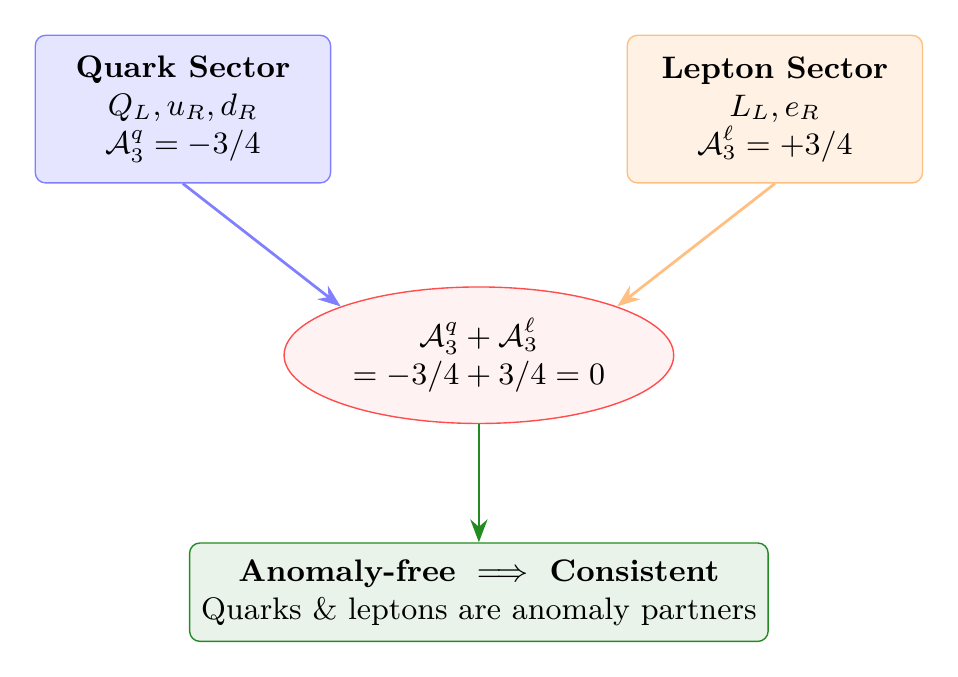
A universe with only quarks (no leptons) is anomalous and inconsistent. The quark and lepton sectors are anomaly partners that must coexist.
With quarks only, the \([\text{U}(1)]^{3}\) anomaly gives:
This is not zero. Adding the lepton contribution:
The lepton contribution (\(+3/4\)) exactly cancels the quark contribution (\(-3/4\)):
(See: Part 11 \S229.1.3 (Theorem 229.3)) □
This result explains a deep feature of the Standard Model: quarks and leptons are not independent sectors. They are anomaly partners whose quantum numbers are interlocked by the requirement of quantum consistency. In TMT, both sectors emerge from the same \(S^2\) geometry—quarks from the \(\mathbb{C}^{3}\) embedding structure, leptons as colour singlets on \(S^2\) itself—and anomaly cancellation ensures that they carry precisely complementary hypercharges.
Derivation Chain Summary
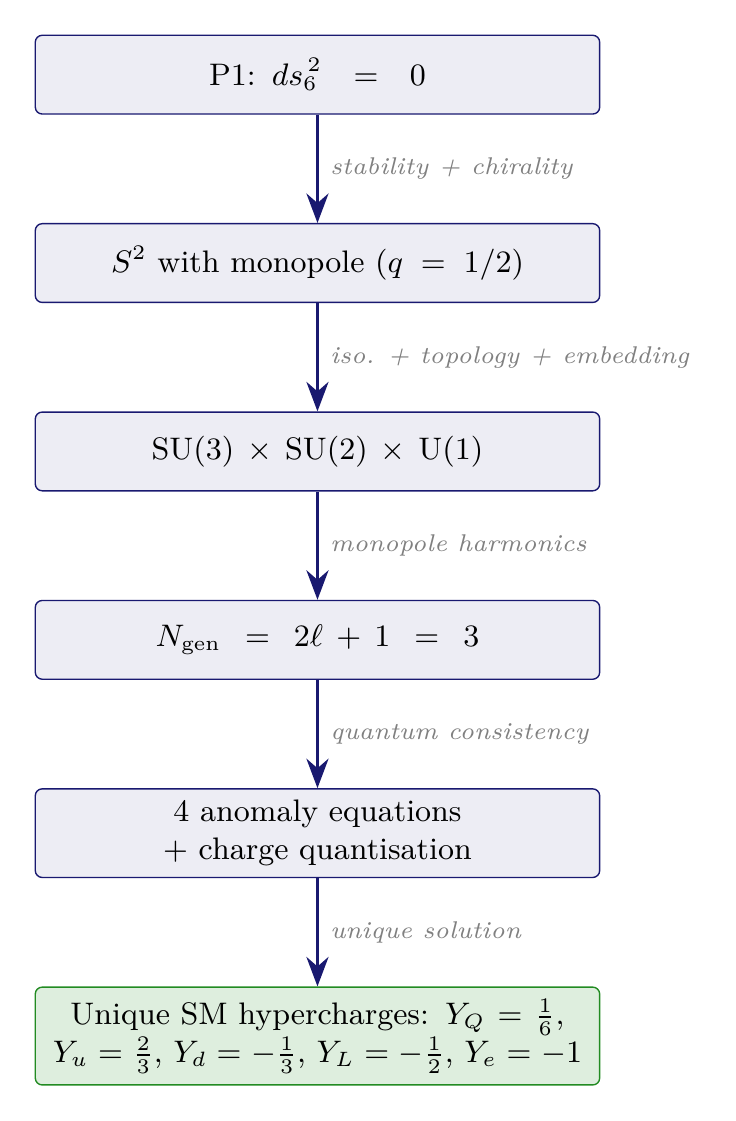
\dstep{P1: \(ds_6^{\,2} = 0\) on \(\mathcal{M}^4 \times S^2\)}{Postulate}{Part 1} \dstep{\(S^2\) topology with monopole}{Stability + chirality}{Part 2 \S4.3} \dstep{\(\pi_{2}(S^2) = \mathbb{Z}\) \(\implies\) U(1) gauge symmetry}{Topology}{Part 3 \S8} \dstep{Isometry \(\text{SO}(3) \to \text{SU}(2)_{L}\)}{Geometry}{Part 3 \S7} \dstep{Embedding \(S^2 \hookrightarrow \mathbb{C}^{3}\) \(\implies\) SU(3)\(_{C}\)}{Variable embedding}{Part 3 \S9} \dstep{Full gauge group: \(\text{SU}(3) \times \text{SU}(2) \times \text{U}(1)\)}{Assembly}{Chapter 19} \dstep{\(N_{\text{gen}} = 2\ell + 1 = 3\) from monopole harmonics}{Angular momentum}{This chapter} \dstep{Four anomaly equations on five hypercharges}{Quantum consistency}{This chapter} \dstep{Unique solution: \(Y_{Q} = 1/6, Y_{u} = 2/3, Y_{d} = -1/3, Y_{L} = -1/2, Y_{e} = -1\)}{Anomaly cancellation}{Theorem thm:P11-Ch21-unique-hypercharge} \dstep{All SM quantum numbers derived}{Complete}{This chapter} \dstep{Polar verification: \(N_{\text{gen}} = 3\) = number of degree-1 polynomials in \(u\); \(\ell = 0\) excluded by linear monopole connection; \(Y_L/Y_Q = -3 = -1/\langle u^2\rangle\) from colour multiplicity; hypercharges = AROUND winding numbers locked by anomaly complementarity}{Dual verification (polar)}{This chapter}
Chapter Summary
Chapter 21 Results.
- 6D anomaly structure: The \(\mathcal{M}^4 \times S^2\) compactification with monopole produces a chiral 4D gauge theory. Consistency requires all gauge anomalies to cancel.
- Three generations: \(N_{\text{gen}} = 2\ell + 1 = 3\) from the \(\ell = 1\) monopole harmonic multiplet on \(S^2\). The \(\ell = 0\) mode is excluded by the monopole boundary condition.
- Hypercharge uniqueness: Four anomaly equations constrain five hypercharges. Combined with electric charge quantisation (from Dirac quantisation on \(S^2\)), the system has a unique solution.
- SM hypercharges derived:
- Mathematical verification: All four anomaly conditions verified with explicit numerical computation.
- Quark–lepton complementarity: Quarks and leptons are anomaly partners; neither sector is consistent alone.
- No free parameters: The entire Standard Model fermion quantum number table is derived from P1 with zero adjustable parameters.
Polar perspective. In polar coordinates \(u = \cos\theta\), the generation counting is transparent: \(N_{\text{gen}} = 3\) is the number of linearly independent degree-1 polynomials in \(u\) on the polar rectangle. The \(\ell = 0\) (constant) mode is excluded because a constant wavefunction is algebraically incompatible with the linear monopole connection \(A_\phi = (1-u)/2\). The hypercharge ratios connect to the polar second moment: the (A2) anomaly gives \(Y_L = -3Y_Q\) where \(3 = 1/\langle u^2\rangle = d_{\mathbb{C}}(\mathbb{C}^3)\), the same factor that controls the coupling hierarchy. All hypercharges are AROUND winding numbers on the polar rectangle, and anomaly cancellation locks the quark and lepton sectors into precise complementarity: the \([\text{U}(1)]^3\) contributions \(-3/4\) (quarks) \(+ 3/4\) (leptons) \(= 0\) ensures that the total AROUND charge vanishes.
agraph{What comes next.} Chapter 22 extends this analysis by proving that no other particle content works: no 4th generation, no exotic chiral fermions, no additional gauge bosons. The SM spectrum is not just derived—it is unique.
Verification Code
The mathematical derivations and proofs in this chapter can be independently verified using the formal and computational scripts below.
All verification code is open source. See the complete verification index for all chapters.