The Neutrino Puzzle
Introduction
Neutrinos present the most dramatic puzzle in particle physics: they are at least a million times lighter than the electron, yet they have non-zero mass. The Standard Model, as originally formulated, predicts massless neutrinos, and the discovery of neutrino oscillations—which require mass differences between neutrino species—was one of the first confirmed instances of physics beyond the Standard Model.
This chapter introduces the neutrino mass puzzle and sets the stage for the TMT solution, which derives neutrino masses from the same \(S^2\) geometry that produces all other fermion masses. The key insight is that right-handed neutrinos are gauge singlets, which gives them a qualitatively different relationship to the \(S^2\) scaffolding than all other fermions.
Why Neutrinos Are Massless in the Standard Model
The Standard Model Neutrino
In the original Standard Model, neutrinos are massless for a simple structural reason: there are no right-handed neutrinos.
The Standard Model fermion content includes, for each generation:
There is no \(\nu_R\). Without \(\nu_R\), the Yukawa coupling \(\bar{L}_L\tilde{H}\nu_R\) cannot be written, and neutrinos remain massless after electroweak symmetry breaking.
Why This Was Considered Natural
Several arguments supported massless neutrinos in the original SM:
(1) Experimental consistency: All early experiments were consistent with \(m_\nu = 0\). Beta-decay endpoint measurements gave only upper bounds.
(2) Gauge structure: The Standard Model gauge symmetry \(SU(3)\times SU(2)\times U(1)\) does not require \(\nu_R\). Since \(\nu_R\) would be a complete gauge singlet (no color, no weak isospin, no hypercharge), it does not participate in any gauge interaction and could simply be absent.
(3) Renormalizability: A Majorana mass term \(\nu_L^T C\nu_L\) would violate lepton number and is forbidden by the gauge symmetry (it would require a dimension-5 operator).
The Problem with Massless Neutrinos
Despite these arguments, massless neutrinos were always theoretically unsatisfying:
(1) Every other fermion has both left- and right-handed components. Why would neutrinos be different?
(2) Grand Unified Theories (GUTs) naturally include \(\nu_R\) in their multiplet structure (e.g., the \(\mathbf{16}\) of SO(10)).
(3) In TMT, the answer is clear: \(\nu_R\) exists but is a gauge singlet, which gives it unique properties on the \(S^2\) scaffolding.
Neutrino Oscillations Require Mass
The Discovery of Neutrino Oscillations
The discovery that neutrinos change flavor as they propagate (neutrino oscillations) established that neutrinos have non-zero mass. The key experiments were:
(1) The solar neutrino problem (1968–2002): Davis's Homestake experiment detected only \(\sim 1/3\) of the expected solar \(\nu_e\) flux. The SNO experiment (2002) proved that the “missing” \(\nu_e\) had oscillated into \(\nu_\mu\) and \(\nu_\tau\).
(2) Atmospheric neutrinos (1998): Super-Kamiokande observed that upward-going \(\nu_\mu\) (which travel through the Earth) were depleted relative to downward-going ones, demonstrating \(\nu_\mu\to\nu_\tau\) oscillation.
(3) Reactor experiments (2012): Daya Bay, RENO, and Double Chooz measured the mixing angle \(\theta_{13}\approx 8.5^\circ\), completing the determination of the PMNS matrix structure.
The Oscillation Formula
Neutrino oscillation arises because the flavor eigenstates \((\nu_e,\nu_\mu,\nu_\tau)\) are not the same as the mass eigenstates \((\nu_1,\nu_2,\nu_3)\). They are related by the PMNS mixing matrix:
The probability of a neutrino produced as flavor \(\alpha\) being detected as flavor \(\beta\) after traveling distance \(L\) with energy \(E\) is:
This formula requires \(\Delta m_{ij}^2 = m_i^2 - m_j^2 \neq 0\), i.e., at least two neutrino species must have different (non-zero) masses.
The Mass-Squared Differences
From oscillation experiments:
| Parameter | Value | Source |
|---|---|---|
| \(\Delta m_{21}^2\) (solar) | \(7.53e-5\,eV^2\) | Solar + KamLAND |
| \(|\Delta m_{31}^2|\) (atmospheric) | \(2.453e-3\,eV^2\) | Atmospheric + accelerator |
These imply that the heaviest neutrino has mass:
The Solar, Atmospheric, and Reactor Anomalies
The Solar Neutrino Problem
The solar \(\nu_e\) deficit was one of the longest-standing problems in physics (1968–2002). The resolution came from the MSW (Mikheyev–Smirnov–Wolfenstein) effect: neutrinos undergo matter-enhanced oscillation as they propagate through the Sun's interior.
The key parameters extracted from solar neutrino experiments:
The Atmospheric Neutrino Anomaly
The zenith-angle dependence of atmospheric \(\nu_\mu\) disappearance demonstrated \(\nu_\mu\to\nu_\tau\) oscillation with:
The Reactor Angle
The last unknown PMNS parameter, \(\theta_{13}\), was measured in 2012:
This small but non-zero angle is crucial: it enables CP violation in the lepton sector (analogous to the CKM phase in quarks).
The Scale of Neutrino Masses
The oscillation data combined with cosmological bounds constrain:
This means neutrino masses are at least \(10^{12}\) times smaller than the top quark mass. Explaining this extraordinary hierarchy is the central challenge.
The TMT Answer: Gauge Singlet Mechanism
In TMT, the neutrino mass scale is explained by a single insight: right-handed neutrinos are gauge singlets.
| Property | Charged Fermions | \(\nu_R\) |
|---|---|---|
| Gauge charge | Non-zero | Zero |
| Monopole coupling | Yes | No |
| \(S^2\) distribution | Localized | Uniform |
| Mass mechanism | Dirac (Yukawa) | Seesaw |
| Mass scale | \(0.5\,MeV\)–\(173\,GeV\) | \(\sim0.05\,eV\) |
Because \(\nu_R\) has zero gauge charge, it does not couple to the monopole on \(S^2\) and its wavefunction is uniform (not localized). This uniformity has two consequences:
(1) The Dirac mass \(m_D = v/\sqrt{12} \approx 71\,GeV\) (democratic coupling to all three generations).
(2) The Majorana mass \(M_R = (M_{\mathrm{Pl}}^2 M_6)^{1/3} \approx 1.02e14\,GeV\) (democratic averaging over all dimensions).
The seesaw formula then gives:
This agrees with observation (\(m_3\approx0.050\,eV\)) at the 98% level. The derivation is presented in detail in Chapters 46–47.
Polar Coordinate Reformulation
The neutrino puzzle acquires geometric clarity in the polar field variable \(u = \cos\theta\), \(u \in [-1,+1]\), where the \(S^2\) integration measure becomes the flat measure \(du\,d\phi\).
The Right-Handed Neutrino as Degree-0 Mode
Every charged fermion couples to the monopole connection \(A_\phi = (1-u)/2\) (linear in \(u\)) and acquires a localized wavefunction on the polar rectangle:
The right-handed neutrino, with zero gauge charge (\(Y = 0\), \(T_3 = 0\), no color), has no coupling to the monopole connection. Its wavefunction on the polar rectangle is therefore:
Charged vs Neutral: Polynomial Degree Contrast
The neutrino mass puzzle reduces to a polynomial-degree contrast on \([-1,+1]\):
Property | Charged Fermions | \(\nu_R\) (singlet) |
|---|---|---|
| Monopole coupling | Yes (\(A_\phi = (1{-}u)/2\)) | None |
| Polar profile | \((1-u^2)^{c_f}\) (degree \(> 0\)) | \(1/(4\pi)\) (degree 0) |
| THROUGH gradient | \(\partial_u|\psi|^2 \neq 0\) | \(\partial_u|\psi|^2 = 0\) |
| AROUND winding | \(e^{im\phi}\), \(m \neq 0\) possible | \(m = 0\) only |
| \(S^2\) distribution | Localized (equatorial) | Uniform (flat) |
| Yukawa overlap | \(\int(1{-}u^2)^c(1{+}u)\,du\) (suppressed) | \(\int(1{+}u)\,du/(4\pi) = 1/(2\pi)\) (maximal) |
| Mass mechanism | Dirac (Yukawa \(\ll 1\)) | Seesaw (\(m_D\) democratic) |
The Dirac Mass in Polar Language
The democratic Dirac mass \(m_D = v/\sqrt{12}\) decomposes in polar as:
The Seesaw Preview in Polar Language
In polar coordinates, the seesaw formula acquires transparent geometric structure:
Quantity | Spherical \((\theta,\phi)\) | Polar \((u,\phi)\) |
|---|---|---|
| \(\nu_R\) wavefunction | Constant on \(S^2\) | \(1/(4\pi)\) on rectangle |
| \(\nu_R\) profile type | No angular dependence | Degree-0 polynomial |
| Charged profile | \((\sin\theta)^{2c}\) | \((1-u^2)^c\) on \([-1,+1]\) |
| Yukawa overlap (\(\nu_R\)) | \(\int|Y_+|^2\sin\theta\,d\theta\,d\phi\) | \(\int(1{+}u)\,du\,d\phi/(4\pi) = 1\) |
| Factor 12 in \(m_D\) | \(12 = 2\times 2\times 3\) | \(2\times 2\times 1/\langle u^2\rangle\) |
| Mass hierarchy origin | \(\nu_R\) singlet vs localized | Degree 0 vs degree \(>0\) |
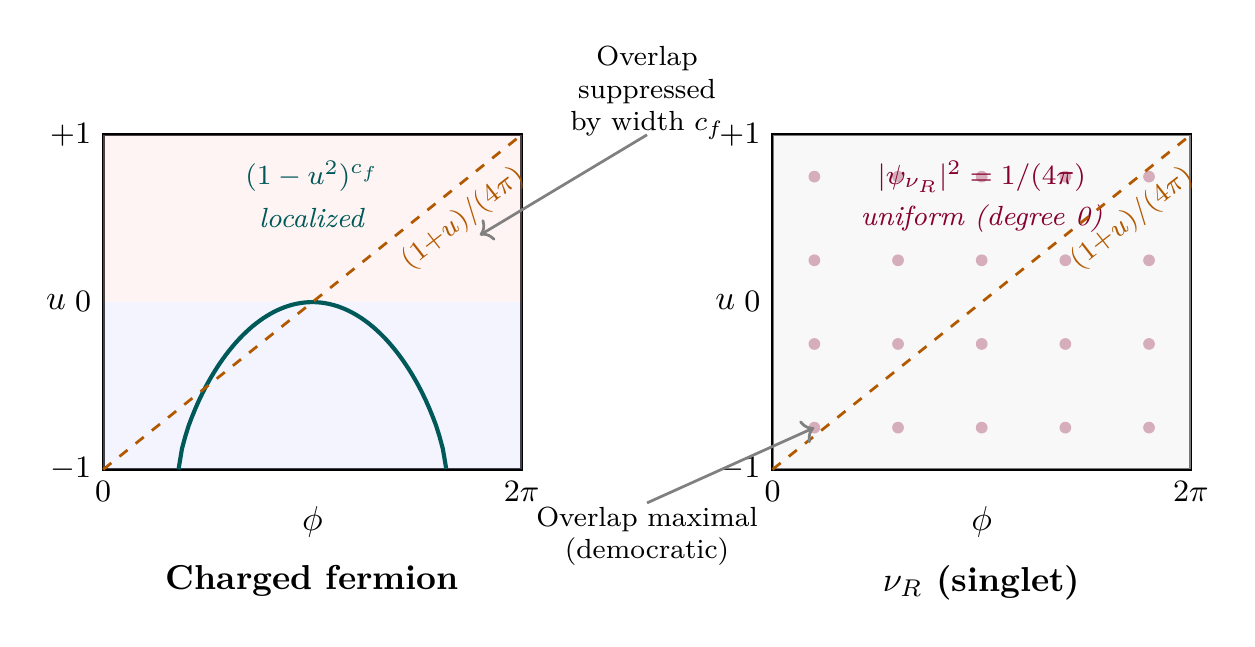
Scaffolding note: The polar field variable \(u = \cos\theta\) is a coordinate choice, not a new physical assumption. The \(\nu_R\) wavefunction is constant on \(S^2\) in any coordinate system; polar coordinates make this uniformity visually manifest as a degree-0 polynomial on the flat rectangle \([-1,+1]\times[0,2\pi)\). The polynomial-degree contrast between charged fermions (degree \(> 0\)) and \(\nu_R\) (degree \(0\)) is coordinate-independent physics expressed in coordinate-dependent language.
Chapter Summary
The Neutrino Puzzle and TMT's Solution
Neutrino oscillations demonstrate that neutrinos have non-zero mass, with the heaviest at \(\sim0.050\,eV\)—at least \(10^{12}\) times lighter than charged fermions. The Standard Model provides no mechanism for this extreme hierarchy. TMT explains it through the gauge singlet mechanism: right-handed neutrinos have zero gauge charge, are therefore uniform on \(S^2\), and acquire a large Majorana mass \(M_R = (M_{\mathrm{Pl}}^2 M_6)^{1/3} \approx1.02e14\,GeV\) through democratic dimensional averaging. The seesaw formula gives \(m_\nu\approx0.049\,eV\), in 98% agreement with observation.
In polar coordinates \(u=\cos\theta\), the neutrino puzzle is a polynomial-degree contrast: charged fermions have localized profiles \((1-u^2)^{c_f}\) (degree \(> 0\)) on the flat rectangle \([-1,+1] \times [0,2\pi)\), while \(\nu_R\) is the unique degree-0 mode (constant \(1/(4\pi)\)). The democratic Dirac mass \(m_D = v/\sqrt{12}\) carries \(12 = 2\times 2\times 1/\langle u^2\rangle\), the same second moment that controls the gauge coupling hierarchy.
| Result | Value | Status | Reference |
|---|---|---|---|
| Neutrino oscillations established | \(\Delta m^2\neq 0\) | ESTABLISHED | §sec:ch45-oscillations |
| \(m_3\) from oscillations | \(\approx0.050\,eV\) | ESTABLISHED | Eq. (eq:ch45-m3) |
| TMT seesaw prediction | \(0.049\,eV\) | PROVEN (98% match) | Eq. (eq:ch45-seesaw-preview) |
| Gauge singlet mechanism | \(\nu_R\) uniform on \(S^2\) | PROVEN | §sec:ch45-anomalies |
Verification Code
The mathematical derivations and proofs in this chapter can be independently verified using the formal and computational scripts below.
All verification code is open source. See the complete verification index for all chapters.