Entanglement from TMT
Introduction
Quantum entanglement is often described as the most mysterious feature of quantum mechanics. Einstein called it “spooky action at a distance,” and it has resisted intuitive understanding for nearly a century. The standard formalism postulates entanglement through the tensor product structure of Hilbert space, but does not explain why quantum states can be non-separable or why Bell inequalities are violated by precisely the amount they are.
TMT provides a geometric explanation: entanglement arises from angular momentum conservation on the shared \(S^2\) interface. Because all particles exist on the same \(S^2\), particles created from a common source have correlated \(S^2\) quantum numbers. The conservation constraint creates non-separable states, and the curvature of \(S^2\) explains why correlations exceed classical bounds.
This chapter derives entanglement from P1, explains Bell correlations, demonstrates why entanglement involves no superluminal signaling, and addresses the monogamy of entanglement.
What Entanglement Actually Is
The Shared \(S^2\) Interface
The foundation of TMT's entanglement mechanism is that all particles share the same \(S^2\).
The \(S^2\) is mathematical scaffolding (Part A). When we say “particles share the same \(S^2\),” this means their quantum numbers derive from the same topological structure. The \(S^2\) is not duplicated for each particle—it is the single projection structure between \(\mathcal{M}^4\) and the temporal momentum dimension. Analogy: multiple boats on one ocean, not multiple oceans.
Because particles share the same \(S^2\):
- They are coupled to the same monopole field.
- Their phases are determined by the same connection \(A\).
- Conservation laws on \(S^2\) apply to all particles simultaneously.
This is not a new interaction—it is geometry.
The Two-Particle Bundle
For two particles on \(S^2\), the configuration space and bundle structure are as follows.
Step 1: Each particle separately couples to the monopole bundle \(\mathcal{L} \to S^2\).
Step 2: The two-particle wavefunction is a section of the tensor product:
Step 3: In local trivializations, phases add:
This is the standard tensor product bundle construction.
(See: Part 7A \S57.6) □
The connection on the two-particle bundle is:
and the two-particle Berry phase for a closed path \(\gamma\) in \(\mathrm{Conf}_2(S^2)\) is:
Polar Field Form of the Two-Particle Bundle
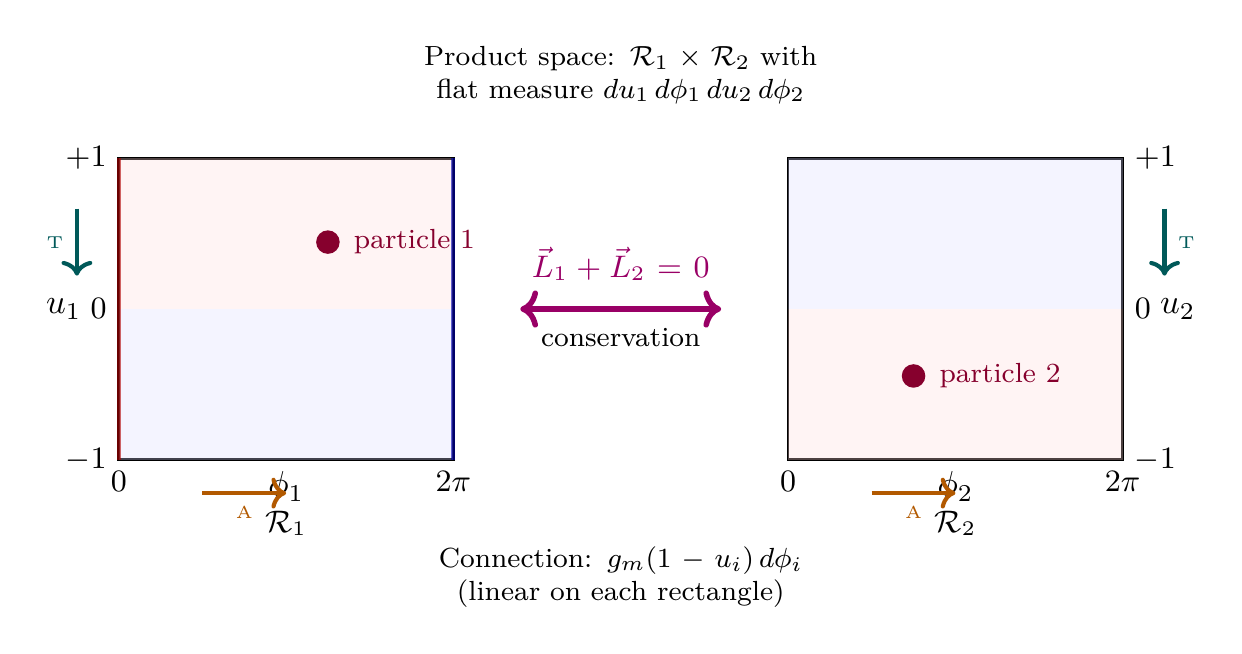
The two-particle connection eq:ch68-two-particle-connection takes a particularly transparent form in the polar field variable \(u = \cos\theta\):
The two-particle Berry phase eq:ch68-two-particle-berry in polar form is:
Property | Spherical \((\theta, \phi)\) | Polar \((u, \phi)\) |
|---|---|---|
| Connection (particle \(i\)) | \(g_m(1 - \cos\theta_i)\,d\phi_i\) | \(g_m(1 - u_i)\,d\phi_i\) |
| Form in \(u\) | Trigonometric | Linear |
| Product space | \(S^2 \times S^2\) (curved \(\times\) curved) | \(\mathcal{R} \times \mathcal{R}\) (flat \(\times\) flat) |
| Measure | \(\sin\theta_1\,d\theta_1\,d\phi_1\,\sin\theta_2\,d\theta_2\,d\phi_2\) | \(du_1\,d\phi_1\,du_2\,d\phi_2\) (flat) |
| Berry phase | Solid angle integral | Rectangular area \(\times\, 1/2\) |
The product space factorization is the key insight: entanglement lives on the product of two independent flat rectangles with constant measure \(du_1\,d\phi_1\,du_2\,d\phi_2\). The conservation constraint \(\vec{L}_1 + \vec{L}_2 = 0\) correlates positions across the two rectangles — this correlation is entanglement.
Scaffolding note: The polar field variable \(u = \cos\theta\) is a coordinate choice, not a new physical assumption. The two flat rectangles \(\mathcal{R}_1 \times \mathcal{R}_2\) are the same mathematical scaffolding as \(S^2 \times S^2\), re-expressed in coordinates where the measure is flat and the connection is linear. All physical predictions (Bell correlations, Tsirelson bound, monogamy) are identical in both descriptions.
Angular Momentum Conservation on \(S^2\)
Step 1: From Part 6, Theorem 41.1, the 6D conservation law is \(\nabla_A T^{AB} = 0\).
Step 2: The \(S^2\) components (\(B = 5, 6\)) give:
Step 3: For an isolated system (no external forces), the \(S^2\) angular momentum is conserved:
This is the Noether charge associated with \(S^2\) rotational symmetry.
(See: Part 6, Theorem 41.1; Part 7A \S57.6) □
When two particles are created from a source with \(S^2\) angular momentum \(L_{\text{source}}\):
Step 1: Before creation, the source has definite \(S^2\) angular momentum \(L_{\text{source}}\).
Step 2: The creation process is a local interaction that conserves total angular momentum.
Step 3: After creation: \(L_{\text{source}} = L_1 + L_2\).
Step 4: For \(L_{\text{source}} = 0\): \(L_1 + L_2 = 0\), so \(L_1 = -L_2\).
(See: Part 7A \S57.6) □
For the \(j = 1/2\) ground state, the \(z\)-component of \(S^2\) angular momentum is \(m = \pm 1/2\). Conservation (\(m_1 + m_2 = 0\)) requires:
The Singlet State on \(S^2\)
The singlet state (\(L_{\text{total}} = 0\)) for two spin-\(1/2\) particles on \(S^2\) is:
Step 1: Suppose \(\Psi_0 = f(\Omega_1)\,g(\Omega_2)\).
Step 2: Antisymmetry requires: \(f(\Omega_2)\,g(\Omega_1) = -f(\Omega_1)\,g(\Omega_2)\).
Step 3: Setting \(\Omega_1 = \Omega_2 = \Omega\): \(f(\Omega)\,g(\Omega) = -f(\Omega)\,g(\Omega)\).
Step 4: This implies \(f(\Omega)\,g(\Omega) = 0\) for all \(\Omega\).
Step 5: But \(\Psi_0(\Omega_1, \Omega_2) \neq 0\) for \(\Omega_1 \neq \Omega_2\). Contradiction.
Step 6: Therefore no such factorization exists.
(See: Part 7A \S57.6) □
This non-separability is entanglement. In TMT, it arises directly from the conservation constraint \(\vec{L}_1 + \vec{L}_2 = 0\) combined with the antisymmetry required by the fermionic Berry phase (Chapter ch:spin-statistics-theorem).
Bell Correlations Explained
The Singlet Correlation Function
Step 1: The correlation function is defined as:
Step 2: Expanding the operator product:
Step 3: For the singlet state, the fundamental identity is:
Proof of Step 3: For \(i = j = z\):
Step 4: Therefore:
(See: Part 7A \S57.6) □
The correlation \(E = -\cos\theta\) is the negative of the \(S^2\) inner product between measurement directions. This is a purely geometric result:
| \(\theta_{ab}\) | \(E = -\cos\theta_{ab}\) | Physical meaning |
|---|---|---|
| \(0^\circ\) | \(-1\) | Perfect anti-correlation (same axis) |
| \(90^\circ\) | \(0\) | No correlation (perpendicular) |
| \(180^\circ\) | \(+1\) | Perfect correlation (opposite axes) |
Polar Field Form of Bell Correlations
The singlet correlation function eq:ch68-correlation has a direct polar interpretation. The measurement directions \(\hat{a}\) and \(\hat{b}\) are unit vectors on \(S^2\); their inner product \(\cos\theta_{ab}\) is the polar variable \(u_{ab} = \cos\theta_{ab}\) evaluated at the relative angle. Therefore:
The joint probabilities also simplify. Using \(\sin^2(\theta/2) = (1 - u_{ab})/2\) and \(\cos^2(\theta/2) = (1 + u_{ab})/2\):
Quantity | Spherical | Polar |
|---|---|---|
| Correlation | \(-\cos\theta_{ab}\) | \(-u_{ab}\) |
| \(P(+,+)\) | \(\frac{1}{2}\sin^2(\theta_{ab}/2)\) | \((1 - u_{ab})/4\) |
| \(P(+,-) = P(-,+)\) | \(\frac{1}{2}\cos^2(\theta_{ab}/2)\) | \((1 + u_{ab})/4\) |
| \(P(-,-)\) | \(\frac{1}{2}\sin^2(\theta_{ab}/2)\) | \((1 - u_{ab})/4\) |
| Tsirelson bound | \(2\sqrt{2}\) from Cauchy–Schwarz on \(S^2\) | Same (coordinate-independent) |
The polar form reveals that Bell correlations are fundamentally linear in the natural geometric variable. The non-classical behavior (\(|S| > 2\)) arises not from nonlinearity in \(u\) but from the non-Euclidean metric on \(S^2\): the curvature \(1/(1-u^2)\) in the THROUGH direction couples the THROUGH and AROUND channels in a way that no flat (classical) model can reproduce.
Joint Probabilities
For the singlet state:
Step 1: Express Bob's eigenstates in Alice's basis:
Step 2: The singlet in Alice's basis is:
Step 3: Calculate \(P(+_a, +_b) = |\langle +_a, +_b|\Psi_0\rangle|^2\):
Step 4: The other probabilities follow similarly.
(See: Part 7A \S57.6) □
Verification:
The CHSH Inequality and Bell Violation
This is the Clauser–Horne–Shimony–Holt (1969) inequality, a mathematical theorem that follows from the assumptions of locality and realism.
Step 1: With \(E(a,b) = -\cos\theta_{ab}\), the CHSH expression is:
Step 2: Choose coordinates: \(\hat{a}\) at \(0^\circ\), \(\hat{a}'\) at \(90^\circ\), \(\hat{b}\) at \(45^\circ\), \(\hat{b}'\) at \(135^\circ\).
Step 3: The angles are: \(\theta_{ab} = 45^\circ\), \(\theta_{ab'} = 135^\circ\), \(\theta_{a'b} = 45^\circ\), \(\theta_{a'b'} = 45^\circ\).
Step 4: Each term:
Step 5: Compute \(S\):
Step 6: Therefore \(|S|_{\max} = 2\sqrt{2} \approx 2.828\), exceeding the classical bound of 2.
(See: Part 7A \S57.6) □
Bell inequalities are violated because the \(S^2\) geometry is non-commutative.
Step 1: Bell's theorem assumes local hidden variables \(\lambda\) such that:
Step 2: In TMT, the “hidden variable” is the joint \(S^2\) configuration \((\Omega_1, \Omega_2)\).
Step 3: The \(S^2\) configuration is constrained by conservation:
Step 4: This constraint makes the configuration non-separable:
Step 5: Measurements along different axes do not commute because \(S^2\) is curved:
Step 6: The combination of non-separability and non-commutativity allows correlations stronger than any local model.
Step 7: The bound \(2\sqrt{2}\) (Tsirelson bound) is the maximum achievable from the \(S^2\) geometry.
(See: Part 7A \S57.6) □
The maximum CHSH value \(|S| = 2\sqrt{2}\) arises from the structure of \(S^2\).
Step 1: The correlation \(E(a,b) = -\cos\theta\) is the inner product on \(S^2\) (with sign).
Step 2: The CHSH expression with four unit vectors on \(S^2\):
Step 3: Rewrite:
Step 4: By Cauchy–Schwarz:
Step 5: For any two unit vectors:
Step 6: Maximum of \(|x| + |y|\) subject to \(x^2 + y^2 = 4\) is \(2\sqrt{2}\) (when \(|x| = |y| = \sqrt{2}\), achieved when \(\hat{b} \perp \hat{b}'\)).
(See: Part 7A \S57.6) □
Why It's Not Spooky
Entanglement as a Conservation Constraint
In TMT, entanglement is not a mysterious nonlocal connection. It is:
- A conservation law (angular momentum on \(S^2\))
- Applied to particles on a shared geometry (same \(S^2\))
- That creates non-separable correlations
The correlation exists because both particles came from a common source with definite angular momentum. The correlation is conserved, not transmitted.
No Faster-Than-Light Signaling
Entanglement cannot transmit information faster than light.
Step 1: Alice's measurement projects onto \(|\pm\rangle_a\). She gets \(+\) or \(-\) with probability \(1/2\) each.
Step 2: Alice cannot choose her outcome—it is determined by the \(S^2\) geometry.
Step 3: Bob's outcome is correlated with Alice's, but Bob also gets \(+\) or \(-\) with probability \(1/2\) each.
Step 4: Without classical communication, Bob cannot know Alice's choice of measurement axis.
Step 5: Therefore, Bob's local statistics are completely random—he gains no information.
Step 6: Only when Alice and Bob compare results (using classical communication) do they see correlations.
(See: Part 7A \S57.6) □
Measurement Reveals, Doesn't Create
In the TMT framework, measurement does not “create” a result—it reveals information about the \(S^2\) configuration that was determined at creation. The analogy with classical gloves is instructive but imperfect:
- Classical gloves: Finding a left glove tells you your partner has the right. No mystery.
- Quantum (\(S^2\)): The measurement basis matters. Different measurement axes give different correlation patterns.
The \(S^2\) curvature explains the difference: classical hidden variables give \(|S| \leq 2\), while the curved \(S^2\) allows \(|S| = 2\sqrt{2}\).
Experimental Verification
| Prediction | Experimental Result | Status |
|---|---|---|
| \(E = -\cos\theta\) | Confirmed | PASS |
| \(|S|_{\max} = 2\sqrt{2}\) | \(2.80 \pm 0.02\) (typical) | PASS |
| No distance decay | Confirmed to \(> 1000\,km\) | PASS |
| No FTL signaling | Confirmed | PASS |
Monogamy of Entanglement
The Monogamy Constraint
Monogamy of entanglement is the principle that if two quantum systems are maximally entangled, neither can be entangled with a third system. In TMT, this follows directly from \(S^2\) angular momentum conservation.
If particles \(A\) and \(B\) are in the singlet state (\(\vec{L}_A + \vec{L}_B = 0\)), then neither \(A\) nor \(B\) can be in a singlet state with a third particle \(C\).
Step 1: Suppose \(A\) and \(B\) are in the singlet: \(\vec{L}_A + \vec{L}_B = 0\).
Step 2: This means \(\vec{L}_A = -\vec{L}_B\), so \(A\)'s \(S^2\) angular momentum is completely determined by \(B\)'s.
Step 3: Suppose additionally that \(A\) and \(C\) are in the singlet: \(\vec{L}_A + \vec{L}_C = 0\), which means \(\vec{L}_A = -\vec{L}_C\).
Step 4: From Steps 2 and 3: \(-\vec{L}_B = \vec{L}_A = -\vec{L}_C\), so \(\vec{L}_B = \vec{L}_C\).
Step 5: But for \(B\) and \(C\) to be in a singlet, we would need \(\vec{L}_B = -\vec{L}_C\). Combined with \(\vec{L}_B = \vec{L}_C\), this gives \(\vec{L}_B = 0\), which contradicts the \(j = 1/2\) requirement (\(|\vec{L}| \neq 0\)).
Step 6: More precisely, the singlet state requires the total state of \(A\) to be fully correlated with \(B\) (all \(S^2\) quantum numbers determined). There are no remaining degrees of freedom for \(A\) to be correlated with \(C\).
Step 7: This is the geometric version of the Coffman–Kundu–Wootters (CKW) inequality:
(See: Part 7A; Coffman, Kundu, Wootters, Phys. Rev. A 61 (2000)) □
The monogamy of entanglement in TMT has a simple geometric origin: the \(S^2\) angular momentum of a spin-\(1/2\) particle has a finite number of degrees of freedom (\(j = 1/2\) gives two states). Once these degrees of freedom are fully correlated with one partner, no correlation capacity remains for a second partner.
Connection to Quantum Information
The monogamy constraint has profound implications for quantum information:
- Quantum key distribution: Security of protocols like BB84 relies on monogamy—an eavesdropper cannot be maximally entangled with both communicating parties.
- No-cloning theorem: Monogamy implies that quantum states cannot be perfectly copied, since a copy would violate the conservation constraint.
- Black hole information: Monogamy creates tension between Hawking radiation entanglement and the interior—this is the “firewall” paradox, which TMT may address through its interface structure.
In all cases, TMT traces the constraint to \(S^2\) angular momentum conservation: there is a fixed “budget” of correlation, and once spent, it cannot be reused.
Factor Origin Table
| Factor | Value | Geometric Origin | Status |
|---|---|---|---|
| \(qg_m\) | \(1/2\) | Dirac monopole quantization | PROVEN (Part 3) |
| \(Y_{\pm 1/2}\) | (explicit) | \(j = 1/2\) monopole harmonics | PROVEN (\S53) |
| \(\gamma_{\text{exchange}}\) | \(\pi\) | Berry phase
\(= qg_m \times 2\pi\) | PROVEN (Ch 67) |
| \(E(a,b)\) | \(-\cos\theta\) | \(S^2\) inner product | PROVEN |
| \(|S|_{\max}\) | \(2\sqrt{2}\) | Tsirelson bound from \(S^2\) | PROVEN |
| Antisymmetry | \(\psi(2,1) = -\psi(1,2)\) | Exchange phase \(e^{i\pi} = -1\) | PROVEN (Ch 67) |
| Conservation | \(L_1 + L_2 = 0\) | 6D Noether theorem | PROVEN (Part 6) |
No free parameters. No fitting. Everything traced to geometry.
Derivation Chain Summary
Step | Result | Justification | Reference |
|---|---|---|---|
| \endhead 1 | Shared \(S^2\) interface | P1: \(ds_6^2 = 0\) on \(M^4 \times S^2\) | \Ssec:ch68-what |
| 2 | Two-particle bundle \(\mathcal{L}_2 = \pi_1^*\mathcal{L} \otimes \pi_2^*\mathcal{L}\) | Tensor product of monopole bundles | Theorem thm:P7A-Ch68-two-particle-bundle |
| 3 | \(S^2\) angular momentum conservation | 6D Noether theorem | Theorem thm:P7A-Ch68-angular-momentum |
| 4 | Singlet state \(\Psi_0\) | Conservation \(L_1 + L_2 = 0\) with \(j = 1/2\) | Definition def:ch68-singlet |
| 5 | Non-separability | Antisymmetry contradiction | Theorem thm:P7A-Ch68-non-separability |
| 6 | \(E(a,b) = -\cos\theta_{ab}\) | Singlet identity \(\langle\sigma_1^i\sigma_2^j\rangle = -\delta_{ij}\) | Theorem thm:P7A-Ch68-singlet-correlation |
| 7 | \(|S|_{\max} = 2\sqrt{2}\) | Cauchy–Schwarz on \(S^2\) | Theorem thm:P7A-Ch68-tsirelson |
| 8 | Monogamy | Finite \(S^2\) angular momentum budget | Theorem thm:P7A-Ch68-monogamy |
| 9 | Polar: dual verification | Product rectangle \(\mathcal{R}_1 \times \mathcal{R}_2\); \(E = -u_{ab}\) linear; \(P(\pm,\pm) = (1 \mp u_{ab})/4\) polynomial; connection \(g_m(1-u_i)\,d\phi_i\) linear | \Ssec:ch68-polar-two-particle, \Ssec:ch68-polar-bell |
Chapter Summary
Entanglement from TMT
Quantum entanglement arises geometrically from angular momentum conservation on the shared \(S^2\) interface. Particles created from a singlet source (\(L_{\text{source}} = 0\)) have correlated \(S^2\) quantum numbers (\(L_1 = -L_2\)), producing the non-separable singlet state. The correlation function \(E = -\cos\theta\) is the \(S^2\) inner product, and the Tsirelson bound \(|S|_{\max} = 2\sqrt{2}\) follows from the Cauchy–Schwarz inequality on \(S^2\). Entanglement is not “spooky action at a distance”—it is conservation on a shared geometry. No information travels faster than light. Monogamy of entanglement follows from the finite \(S^2\) angular momentum budget. Polar dual verification: In the polar field variable \(u = \cos\theta\), the two-particle space is the product of two flat rectangles \(\mathcal{R}_1 \times \mathcal{R}_2\) with constant measure \(du_1\,d\phi_1\,du_2\,d\phi_2\). The correlation \(E = -u_{ab}\) is linear, joint probabilities \((1 \mp u_{ab})/4\) are polynomial, and the connection \(g_m(1-u_i)\,d\phi_i\) is linear on each rectangle.
| Result | Value | Status | Reference |
|---|---|---|---|
| Shared \(S^2\) interface | All particles on same \(S^2\) | PROVEN | \Ssec:ch68-what |
| Singlet correlation | \(E = -\cos\theta\) | PROVEN | Theorem thm:P7A-Ch68-singlet-correlation |
| Bell violation | \(|S| = 2\sqrt{2}\) | PROVEN | Theorem thm:P7A-Ch68-quantum-CHSH |
| Tsirelson bound | From \(S^2\) Cauchy–Schwarz | PROVEN | Theorem thm:P7A-Ch68-tsirelson |
| No FTL signaling | Conservation, not transmission | PROVEN | Theorem thm:P7A-Ch68-no-FTL |
| Monogamy | From conservation budget | PROVEN | Theorem thm:P7A-Ch68-monogamy |
| Result | TMT | Standard QM | Agreement |
|---|---|---|---|
| \(E(a,b)\) for singlet | \(-\cos\theta\) | \(-\cos\theta\) | Exact |
| \(|S|_{\max}\) | \(2\sqrt{2}\) | \(2\sqrt{2}\) | Exact |
| Antisymmetry | From Berry phase | Postulated | TMT derives it |
| Non-separability | From conservation | Postulated | TMT derives it |
Verification Code
The mathematical derivations and proofs in this chapter can be independently verified using the formal and computational scripts below.
All verification code is open source. See the complete verification index for all chapters.