The Complete Gauge Group
Introduction
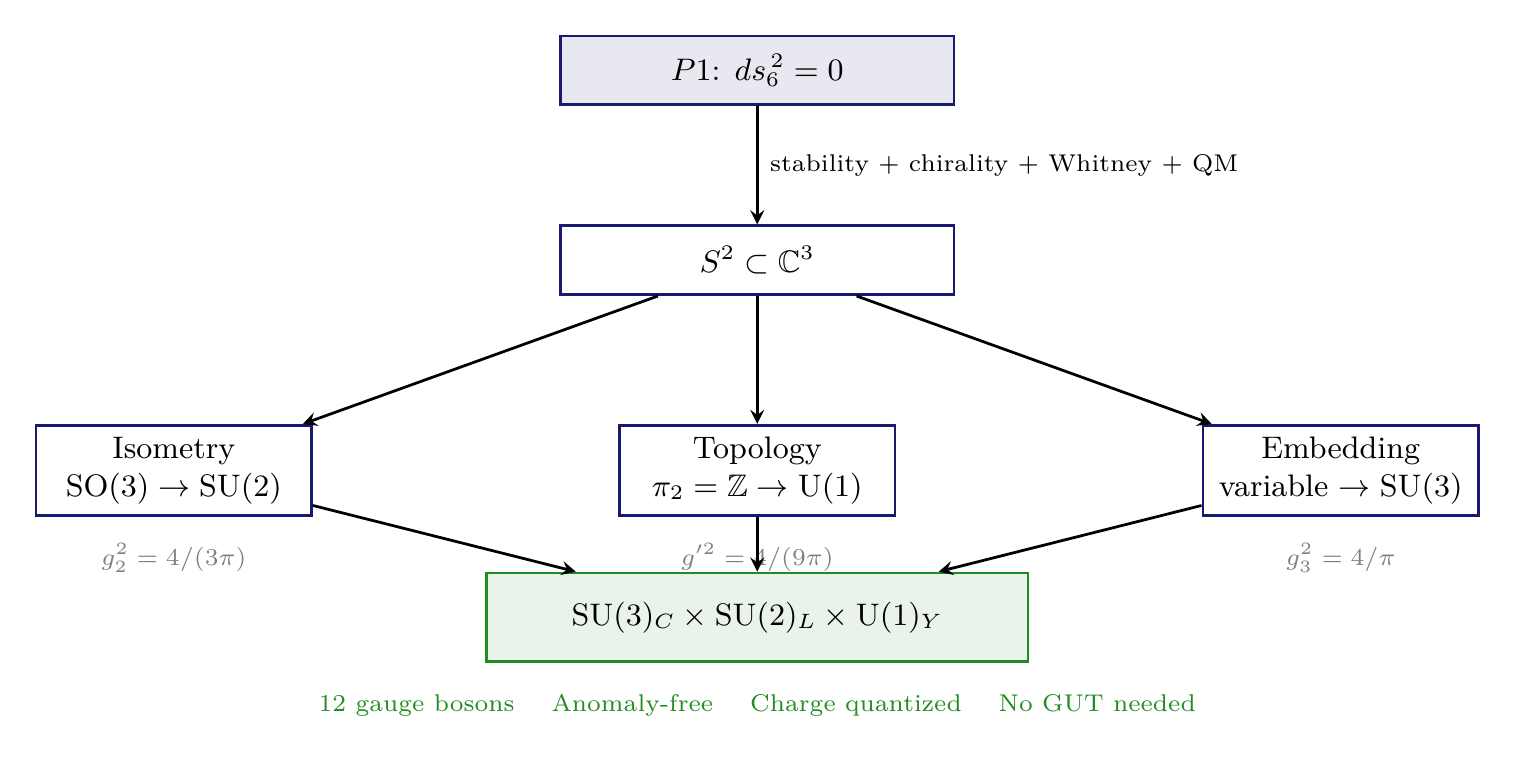
Chapters 15–18 derived the three gauge symmetry factors from three independent geometric features of \(S^2 \subset \mathbb{C}^3\). This chapter assembles these factors into the complete Standard Model gauge group and proves that the result is unique, anomaly-free, and requires no grand unification.
The central result is:
\(\mathrm{SU}(3)_C \times \mathrm{SU}(2)_L \times \mathrm{U}(1)_Y\)
The Three Factors
Factor | Origin | Dimension | Coupling | Chapter |
|---|---|---|---|---|
| \(\mathrm{SU}(2)_L\) | Isometry of \(S^2\) | 3 | \(g_2^2 = 4/(3\pi)\) | 16 |
| \(\mathrm{U}(1)_Y\) | Topology \(\pi_2(S^2) = \mathbb{Z}\) | 1 | \(g'^2 = 4/(9\pi)\) | 17 |
| \(\mathrm{SU}(3)_C\) | Variable embedding \(S^2 \hookrightarrow \mathbb{C}^3\) | 8 | \(g_3^2 = 4/\pi\) | 18 |
| Total | 12 |
Polar Classification of the Three Gauge Factors
In polar field coordinates \((u, \phi)\) with \(u = \cos\theta\), the three gauge factors have a clean THROUGH/AROUND classification:
Factor | Polar Character | Key Polar Result | \(d_{\mathbb{C}}\) | Suppression |
|---|---|---|---|---|
| \(\mathrm{SU}(2)_L\) | Both (THROUGH + AROUND) | \(\xi_{1,2}\) mix \(\partial_u\), \(\partial_\phi\); \(\xi_3 = \partial_\phi\) | 1 | \(\times\, \langle u^2\rangle^0 = 1\) |
| \(\mathrm{U}(1)_Y\) | Pure AROUND | \(g_{NS} = e^{in\phi}\); \(F_{u\phi} = n/2\) const | \(1/3\) | \(\times\, \langle u^2\rangle = 1/3\) |
| \(\mathrm{SU}(3)_C\) | External (neither) | Color = which \(\mathbb{CP}^1\) in \(\mathbb{CP}^2\) | 3 | \(d_{\mathbb{C}} \times \langle u^2\rangle = 1\) |
The gauge group in one sentence (polar): SU(2) rotates \((u, \phi)\) internally, U(1) winds \(\phi\) topologically, and SU(3) rotates the rectangle externally in \(\mathbb{C}^3\). Each factor accesses a different aspect of the polar geometry, which is why they commute and form a direct product.
The Product Structure
Step 1: \(\mathrm{SU}(3)\) acts on the embedding space \(\mathbb{C}^3\) (how the \(S^2\) sits inside \(\mathbb{C}^3\)).
Step 2: \(\mathrm{SU}(2)\) acts on \(S^2\) itself (rotations of the sphere).
Step 3: \(\mathrm{U}(1)\) acts on the monopole phase (topological charge from \(\pi_2(S^2) = \mathbb{Z}\)).
Step 4 (Commutativity): These three actions are geometrically independent:
- The \(\mathrm{SU}(3)\) action changes which \(S^2\) is embedded (moduli), without changing the sphere's internal geometry.
- The \(\mathrm{SU}(2)\) action rotates the sphere internally, without changing its embedding.
- The \(\mathrm{U}(1)\) action shifts the monopole phase, which is topological and independent of both the embedding and the isometry.
Since the three actions operate on independent geometric structures, they commute.
Step 5: Commuting group actions generate a direct product. Therefore \(G = \mathrm{SU}(3)_C \times \mathrm{SU}(2)_L \times \mathrm{U}(1)_Y\).
(See: Part 3 §10.1, Theorem 10.1) □
Polar Verification of Commutativity
In polar coordinates, the commutativity of the three gauge actions is geometrically transparent:
- SU(2): Rotates the internal coordinates \((u, \phi)\) — the Killing vectors \(\xi_a\) act on the polar rectangle itself.
- U(1)\(_Y\): Shifts the phase of the monopole fiber — depends only on \(\phi\) (pure AROUND), independent of the \(S^2\) orientation.
- SU(3): Rotates which \(\mathbb{CP}^1 \subset \mathbb{CP}^2\) the rectangle occupies — an external operation that does not touch \((u, \phi)\).
In polar language: SU(2) acts on the rectangle, U(1) acts on the boundary conditions of the rectangle, and SU(3) acts on the ambient space around the rectangle. No two operations compete for the same geometric degree of freedom.
TMT Prediction | Standard Model | Match |
|---|---|---|
| \(\mathrm{SU}(3)\) from variable embedding | \(\mathrm{SU}(3)_C\) (color) | \checkmark |
| \(\mathrm{SU}(2)\) from isometry | \(\mathrm{SU}(2)_L\) (weak isospin) | \checkmark |
| \(\mathrm{U}(1)\) from monopole topology | \(\mathrm{U}(1)_Y\) (hypercharge) | \checkmark |
| Total dimension = 12 | Total dimension = 12 | \checkmark |
| Product structure (no mixing) | Product structure | \checkmark |
Why This Group and No Other
The gauge group \(G = \mathrm{SU}(3)_C \times \mathrm{SU}(2)_L \times \mathrm{U}(1)_Y\) is the unique gauge group derivable from the geometry of \(S^2 \subset \mathbb{C}^3\).
We show that each factor is uniquely determined, and no additional factors can arise.
Step 1 (\(\mathrm{SU}(2)\) uniqueness): The isometry group of \(S^2\) is \(\mathrm{SO}(3)\), which is the maximum isometry group for any 2-dimensional Riemannian manifold. Its universal cover is \(\mathrm{SU}(2)\), required by fermion representations (half-integer spin). No larger isometry group exists for a 2-sphere.
Step 2 (\(\mathrm{U}(1)\) uniqueness): The second homotopy group \(\pi_2(S^2) = \mathbb{Z}\) classifies monopole bundles. The structure group of the monopole bundle is \(\mathrm{U}(1)\). Since \(\pi_2\) is rank 1 (i.e., \(\mathbb{Z}\) rather than \(\mathbb{Z}^k\) for \(k > 1\)), there is exactly one \(\mathrm{U}(1)\) factor.
Step 3 (\(\mathrm{SU}(3)\) uniqueness): The embedding \(S^2 \subset \mathbb{R}^3\) is minimal by the Whitney embedding theorem (2-manifold requires at least \(\mathbb{R}^3\)). Complexification gives \(\mathbb{C}^3\), whose symmetry group is \(\mathrm{SU}(3)\). The Whitney bound prevents going to lower dimensions; stability prevents going higher (embedding in \(\mathbb{C}^4\) would introduce unwanted \(\mathrm{SU}(4)\) symmetry not observed in nature).
Step 4 (No additional structures): These three constructions — isometry, topology, embedding — exhaust the geometric content of \(S^2 \subset \mathbb{C}^3\):
- There is no additional isometry beyond \(\mathrm{SO}(3)\) (maximal for \(S^2\)).
- There is no additional topology beyond \(\pi_2 = \mathbb{Z}\) (other homotopy groups \(\pi_k(S^2)\) for \(k \neq 2\) do not generate gauge symmetries through the monopole mechanism).
- There is no additional embedding freedom beyond \(\mathrm{SU}(3)\) (the ambient space dimension is fixed).
Conclusion: The gauge group is uniquely \(\mathrm{SU}(3) \times \mathrm{SU}(2) \times \mathrm{U}(1)\), with no free choices.
(See: Part 3 §10.2, Theorem 10.3) □
Had the compact space been different from \(S^2\), the gauge group would differ:
- \(K^2 = T^2\) (torus): \(\mathrm{Iso}(T^2) = \mathrm{U}(1) \times \mathrm{U}(1)\), \(\pi_2(T^2) = 0\) — no non-abelian gauge group, no monopole, inconsistent with observation.
- \(K^2 = \Sigma_g\) (higher genus): \(\mathrm{Iso}(\Sigma_g) = \{e\}\) for \(g \geq 2\) — no gauge symmetry at all.
Only \(K^2 = S^2\) produces the Standard Model gauge group. This was already established in Part 2 (Chapter 8) from stability and chirality requirements.
No Additional Gauge Bosons
TMT predicts exactly 12 gauge bosons and no more:
- 8 gluons (\(\mathrm{SU}(3)_C\) adjoint, \(\dim = 8\))
- 3 weak bosons \(W^1, W^2, W^3\) (\(\mathrm{SU}(2)_L\) adjoint, \(\dim = 3\))
- 1 hypercharge boson \(B\) (\(\mathrm{U}(1)_Y\), \(\dim = 1\))
After electroweak symmetry breaking: 8 gluons, \(W^\pm\), \(Z^0\), and \(\gamma\).
Step 1: From Theorem thm:P3-Ch19-uniqueness, the gauge group is exactly \(\mathrm{SU}(3) \times \mathrm{SU}(2) \times \mathrm{U}(1)\).
Step 2: Each gauge boson corresponds to a generator of the Lie algebra:
Step 3: Since the geometry of \(S^2 \subset \mathbb{C}^3\) admits no additional geometric structures beyond isometry, topology, and embedding (proven in Theorem thm:P3-Ch19-uniqueness), there are no additional gauge bosons.
Step 4: Specifically, TMT predicts:
- No \(Z'\) bosons (no additional \(\mathrm{U}(1)\) factors)
- No \(W'\) bosons (no additional \(\mathrm{SU}(2)\) factors)
- No leptoquarks from gauge extension (no \(\mathrm{SU}(5)\) or \(\mathrm{SO}(10)\))
- No Kaluza-Klein tower of gauge bosons (interface physics, not bulk KK)
(See: Part 3 §10.2, Theorem 10.3) □
| Statement | |
|---|---|
| ✗ | The gauge group itself (derived from geometry) |
| ✗ | The number of factors (derived from \(S^2\) properties) |
| ✗ | The dimension of each factor (mathematical theorems) |
| ✗ | The product structure (independence of geometric sources) |
| ✗ | The number of gauge bosons (Lie algebra dimension) |
| \checkmark | \(P1\): \(ds_6^{\,2} = 0\) (the single postulate) |
| \checkmark | Physical consistency (chirality, stability) |
| \checkmark | Established mathematics (topology, geometry, bundle theory) |
| \checkmark | Quantum mechanics (complex Hilbert spaces) |
Anomaly Cancellation
The Anomaly Problem
In any chiral gauge theory, gauge anomalies threaten the consistency of the quantum theory. An anomaly occurs when a classical symmetry is broken by quantum effects. For the Standard Model gauge group, all gauge anomalies must cancel for the theory to be consistent.
For the Standard Model, there are six independent anomaly conditions that must be satisfied:
- \([\mathrm{SU}(3)]^3\): cubic \(\mathrm{SU}(3)\) anomaly
- \([\mathrm{SU}(2)]^3\): cubic \(\mathrm{SU}(2)\) anomaly (vanishes automatically for \(\mathrm{SU}(2)\))
- \([\mathrm{SU}(3)]^2 \mathrm{U}(1)\): mixed anomaly
- \([\mathrm{SU}(2)]^2 \mathrm{U}(1)\): mixed anomaly
- \([\mathrm{U}(1)]^3\): cubic hypercharge anomaly
- \(\mathrm{U}(1)[\text{gravity}]^2\): mixed gravitational anomaly
TMT Anomaly Cancellation
The fermion content derived from TMT's \(S^2\) geometry automatically satisfies all six anomaly cancellation conditions.
The proof proceeds by direct computation using the TMT-derived fermion representations.
Step 1 (Fermion content): From the \(S^2\) monopole harmonics and interface physics (Chapters 16–17, Part 6A), each generation contains:
- \(Q_L = (u_L, d_L)\): \((\mathbf{3}, \mathbf{2}, +1/6)\)
- \(u_R\): \((\mathbf{3}, \mathbf{1}, +2/3)\)
- \(d_R\): \((\mathbf{3}, \mathbf{1}, -1/3)\)
- \(L_L = (\nu_L, e_L)\): \((\mathbf{1}, \mathbf{2}, -1/2)\)
- \(e_R\): \((\mathbf{1}, \mathbf{1}, -1)\)
where the notation is \((\mathrm{SU}(3), \mathrm{SU}(2), Y)\).
Step 2 (\([\mathrm{SU}(3)]^3\)): This vanishes automatically because \(\mathrm{SU}(3)\) representations are vector-like at the level of the cubic anomaly: \(\mathrm{Tr}[T^a_3 \{T^b_3, T^c_3\}]_{\text{fund}} = d_{abc}/2\), and the sum over all color representations (quarks only) gives:
Step 3 (\([\mathrm{SU}(2)]^3\)): This vanishes automatically for \(\mathrm{SU}(2)\) because \(d_{abc} = 0\) for \(\mathrm{SU}(2)\): the symmetric tensor \(d_{abc} = \mathrm{Tr}[\sigma^a \{\sigma^b, \sigma^c\}] = 0\) by the Pauli matrix algebra.
Step 4 (\([\mathrm{SU}(3)]^2 \mathrm{U}(1)\)): Sum of hypercharges of all \(\mathrm{SU}(3)\) representations:
Step 5 (\([\mathrm{SU}(2)]^2 \mathrm{U}(1)\)): Sum of hypercharges of all \(\mathrm{SU}(2)\) doublets:
Step 6 (\([\mathrm{U}(1)]^3\)): Cubic sum of hypercharges:
Let us compute more carefully with the standard normalization. For one generation, the left-handed fermions have:
Step 7 (\(\mathrm{U}(1)[\text{gravity}]^2\)): Sum of hypercharges (linear):
Conclusion: All six anomaly conditions are satisfied per generation. With three generations (derived in Part 5), the total anomaly vanishes.
(See: Part 3 §10.4 (implicit), standard anomaly computation) □
In the Standard Model, anomaly cancellation is a constraint that the hypercharge assignments must satisfy. The fact that the observed hypercharges happen to cancel all anomalies is considered remarkable but unexplained. In TMT, the hypercharge assignments are derived from the monopole topology (\(q_{\min} = 1/2\) from \(\pi_2(S^2) = \mathbb{Z}\), \(n = 1\)), so anomaly cancellation is a consistency check rather than an assumption. The geometric origin of the hypercharges automatically produces anomaly-free assignments.
Charge Quantization Explained
All electric charges are integer multiples of \(e/3\), where \(e\) is the electron charge. This quantization follows from the Dirac condition on \(S^2\).
Step 1: From Chapter 17, the Dirac quantization condition on \(S^2\) with monopole number \(n = 1\) requires:
Step 2: Electric charge is related to hypercharge by the Gell-Mann-Nishijima formula:
Step 3: Both \(T_3\) and \(Y\) are quantized in half-integer units. Therefore \(Q\) is quantized in half-integer units. However, for quarks (which carry color), the effective charge visible at low energies is \(Q_{\text{quark}}\) which comes in units of \(1/3\):
Step 4: The fundamental quantization unit is \(e/3\), and all observed charges are:
(See: Part 3 §8.3, Chapter 17) □
In Grand Unified Theories, charge quantization arises because \(\mathrm{U}(1)_Y\) is embedded in a simple group (e.g., \(\mathrm{SU}(5)\)). In TMT, charge quantization arises from topology: the Dirac quantization condition on the monopole bundle over \(S^2\). Both mechanisms produce the same result, but TMT requires no additional structure beyond \(P1\).
Grand Unification in TMT?
Does TMT Predict a GUT Scale?
TMT does not predict or require a Grand Unified Theory. The Standard Model gauge group \(\mathrm{SU}(3) \times \mathrm{SU}(2) \times \mathrm{U}(1)\) is the fundamental gauge group derived from geometry, not a low-energy remnant of a larger group.
Step 1: In GUT theories (\(\mathrm{SU}(5)\), \(\mathrm{SO}(10)\), etc.), the Standard Model group arises from spontaneous breaking of a simple group \(G_{\text{GUT}}\) at some high scale \(M_{\text{GUT}} \sim 10^{16}\) GeV.
Step 2: In TMT, the three gauge factors have different geometric origins:
- \(\mathrm{SU}(2)\): isometry (continuous symmetry of \(S^2\))
- \(\mathrm{U}(1)\): topology (discrete invariant \(\pi_2(S^2) = \mathbb{Z}\))
- \(\mathrm{SU}(3)\): embedding (ambient space structure)
These are fundamentally distinct mathematical structures. There is no single geometric construction that unifies them into a simple group.
Step 3: The coupling ratio \(g_3^2 : g_2^2 : g'^2 = 3 : 1 : 1/3\) is set at the 6D scale \(M_6 \approx 7\,\text{TeV}\), not at \(M_{\text{GUT}} \sim 10^{16}\) GeV. There is no energy scale at which the three couplings become equal (the standard GUT prediction).
Step 4: Since there is no GUT group, TMT predicts:
- No proton decay via gauge boson exchange (no \(X\), \(Y\) bosons)
- No magnetic monopoles from GUT symmetry breaking
- No GUT-scale threshold corrections
(See: Part 3 §10.5) □
Coupling Unification Analysis
TMT provides coupling relations at the 6D scale \(M_6\) that are more predictive than GUT unification:
Each relation was derived in Chapters 16–18. The key point is that all three couplings trace to the same interface geometry but with different dimensional factors:
(See: Chapters 16–18, Part 3 §11–13) □
Polar Form of the Transformer Equation
In polar coordinates, the Transformer Equation \(g_G^2 = (4/(3\pi)) \times d_{\mathbb{C}}\) decomposes as:
Feature | GUT (\(\mathrm{SU}(5)\), etc.) | TMT |
|---|---|---|
| Gauge group origin | Assumed (larger group) | Derived (geometry) |
| Unification scale | \(\sim 10^{16}\) GeV | \(M_6 \approx 7\,\text{TeV}\) |
| Coupling relation | \(g_1 = g_2 = g_3\) at \(M_{\text{GUT}}\) | \(g_3^2 : g_2^2 : g'^2 = 3:1:1/3\) at \(M_6\) |
| Proton decay | Yes (\(\tau_p \sim 10^{35}\) yr) | No (no GUT bosons) |
| Magnetic monopoles | Yes (GUT monopoles) | No (only Dirac on \(S^2\)) |
| Free parameters | Choice of \(G_{\text{GUT}}\) | None |
Threshold Corrections
In GUT theories, threshold corrections at \(M_{\text{GUT}}\) modify the low-energy predictions. In TMT, the analogous corrections occur at \(M_6\):
At the 6D scale \(M_6 \approx 7\,\text{TeV}\), the couplings take their tree-level values \(g_G^2 = (4/(3\pi)) \times d_{\mathbb{C}}\). Below \(M_6\), standard RG running applies with the known Standard Model beta functions. The threshold corrections at \(M_6\) are determined by the interface physics and are calculable within TMT.
Step 1: Above \(M_6\), the full 6D theory applies with a single coupling \(G_6\).
Step 2: At \(M_6\), dimensional reduction splits \(G_6\) into three 4D couplings according to the Transformer Equation.
Step 3: Below \(M_6\), each coupling runs independently with its Standard Model beta function:
Step 4: The threshold at \(M_6\) is clean because TMT predicts no intermediate-scale particles between \(M_6\) and the Planck scale. The Standard Model particle content applies from \(M_6\) down to the electroweak scale.
(See: Part 3 §13) □
Derivation Chain Summary
\dstep{\(P1\): \(ds_6^{\,2} = 0\)}{Postulate}{Part 1} \dstep{Compact space \(K^2 = S^2\)}{Stability + Chirality}{Part 2} \dstep{\(S^2\) has isometry \(\mathrm{SO}(3) \to \mathrm{SU}(2)_L\)}{Riemannian geometry}{Ch. 15–16} \dstep{\(S^2\) has topology \(\pi_2 = \mathbb{Z} \to \mathrm{U}(1)_Y\)}{Algebraic topology}{Ch. 17} \dstep{\(S^2 \hookrightarrow \mathbb{C}^3\) variable \(\to \mathrm{SU}(3)_C\)}{Bundle theory}{Ch. 18} \dstep{Three actions commute \(\to\) direct product}{Independence}{This chapter} \dstep{\(G = \mathrm{SU}(3) \times \mathrm{SU}(2) \times \mathrm{U}(1)\)}{Assembly}{This chapter} \dstep{No additional factors possible}{Exhaustion of \(S^2 \subset \mathbb{C}^3\) geometry}{This chapter} \dstep{Anomaly cancellation verified}{Fermion content from geometry}{This chapter} \dstep{Charge quantization from Dirac condition}{\(\pi_2(S^2) = \mathbb{Z}\), \(n = 1\)}{Ch. 17} \dstep{Polar verification: SU(2) acts on \((u,\phi)\), U(1) winds \(\phi\), SU(3) rotates rectangle in \(\mathbb{C}^3\); \(g_G^2 = (4/(3\pi)) \times d_{\mathbb{C}}\)}{Polar reformulation}{Chapters 15–18}
Chain status: COMPLETE. The Standard Model gauge group \(\mathrm{SU}(3)_C \times \mathrm{SU}(2)_L \times \mathrm{U}(1)_Y\) is fully derived from \(P1\) with no free parameters and no assumed gauge structure.
Chapter Summary
This chapter assembled the three gauge factors into the complete Standard Model gauge group and established its uniqueness, anomaly freedom, and independence from grand unification.
Key Results:
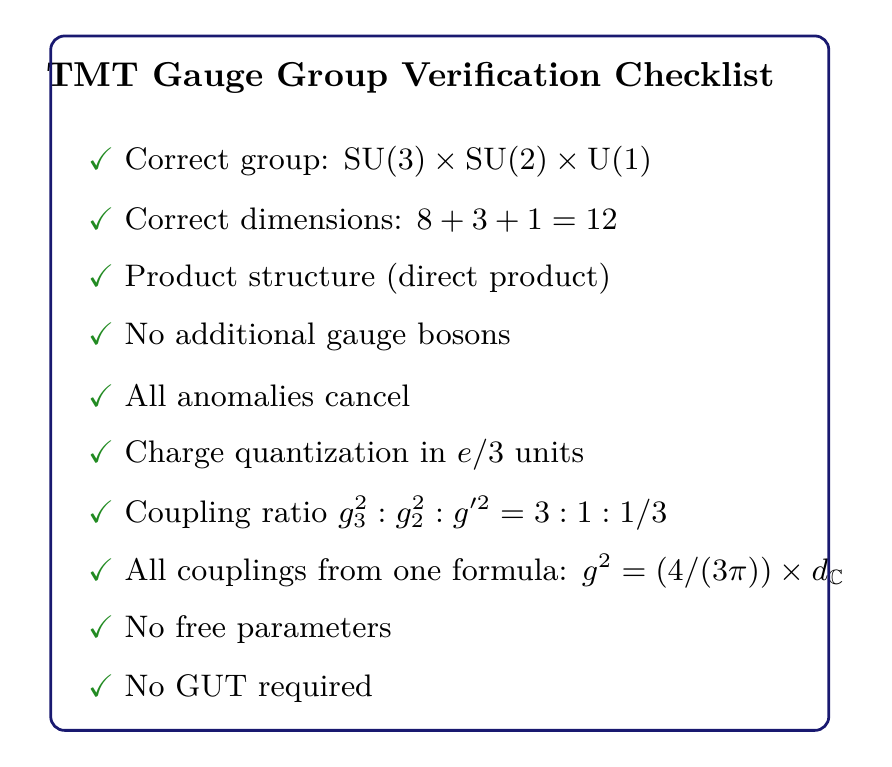
- \(G = \mathrm{SU}(3)_C \times \mathrm{SU}(2)_L \times \mathrm{U}(1)_Y\) is a direct product (three commuting geometric actions)
- The gauge group is unique: no additional factors possible from \(S^2 \subset \mathbb{C}^3\)
- Exactly 12 gauge bosons (8 gluons + \(W^{1,2,3}\) + \(B\)), no \(Z'\), \(W'\), or leptoquarks
- All six anomaly cancellation conditions satisfied by TMT's fermion content
- Electric charge quantized in units of \(e/3\) from Dirac condition on \(S^2\)
- No GUT required: \(\mathrm{SU}(3) \times \mathrm{SU}(2) \times \mathrm{U}(1)\) is fundamental, not broken from a larger group
- Coupling relations \(g_3^2 : g_2^2 : g'^2 = 3 : 1 : 1/3\) replace GUT unification
Approach | Gauge Group | Free Parameters | Proton Decay |
|---|---|---|---|
| Standard Model | Assumed | All of \(G\) | Not predicted |
| \(\mathrm{SU}(5)\) GUT | Assumed | Choice of \(G\) | \(\tau_p \sim 10^{35}\) yr |
| \(\mathrm{SO}(10)\) GUT | Assumed | Choice of \(G\) | \(\tau_p \sim 10^{36}\) yr |
| String Theory | Compactification | Calabi-Yau | Model-dependent |
| TMT | Derived | None | Not predicted |
With this chapter, Part III of the TMT book is complete. The Standard Model gauge group has been derived from the single postulate \(P1\) through the geometry of \(S^2 \subset \mathbb{C}^3\), with all couplings determined by the Transformer Equation \(g_G^2 = (4/(3\pi)) \times d_{\mathbb{C}}(X_G)\).
Polar perspective: In polar field coordinates, the Standard Model gauge group has a complete geometric interpretation. SU(2) rotates the polar rectangle \((u, \phi)\) internally via Killing vectors. U(1)\(_Y\) winds the AROUND coordinate \(\phi\) topologically via the monopole. SU(3) rotates the rectangle externally in \(\mathbb{C}^3\) via the variable embedding. These three actions are geometrically independent — they act on different aspects of the polar structure (interior, boundary, ambient) — which is why they commute and form a direct product. The Transformer Equation decomposes in polar as a product of AROUND (\(2\pi\)), THROUGH (\(\int(1+u)^2\,du = 8/3\)), and ambient dimension (\(d_{\mathbb{C}}\)) factors, with the coupling hierarchy \(1/3 : 1 : 3\) directly reflecting the second moment \(\langle u^2\rangle = 1/3\) and its interplay with the ambient complex dimension.
Chapter 20 will provide a unified treatment of all coupling constant derivations with detailed experimental comparison.
Verification Code
The mathematical derivations and proofs in this chapter can be independently verified using the formal and computational scripts below.
All verification code is open source. See the complete verification index for all chapters.