Period-Inverse Period Duality
Every fundamental TMT constant—coupling or mass parameter—is a rational multiple of an integer power of \(\pi\). This chapter formalises the resulting \(\mathbb{Z}\)-graded ring structure on the TMT period ring \(\PeriodsTMT = \mathbb{Q}[\pi,\pi^{-1}]\), constructs the canonical involution \(\iota\colon \pi^n \mapsto \pi^{-n}\), and proves that \(\iota\) corresponds to Tate twist inversion in the motivic category. Poincaré duality on \(\mathbb{CP}^1\) is shown to be the geometric ancestor of every physical duality in TMT.
Key results proven in this chapter:
- \(\pi\)-weight classification of all TMT constants (Theorem thm:166-pi-weight-classification)
- Graded ring theorem: \(\PeriodsTMT = \bigoplus_{n\in\mathbb{Z}} \mathbb{Q}\cdot\pi^n\) (Theorem thm:166-graded-ring)
- Period inversion involution \(\iota\) with \(\iota^2 = \mathrm{id}\) (Proposition prop:166-iota-properties)
- Tate twist correspondence: \(\iota \leftrightarrow M(n) \mapsto M(-n)\) (Theorem thm:166-tate-twist-correspondence)
- Poincaré duality relationship (Theorem thm:166-duality-relationship)
- Weight-period correspondence: \(\mathrm{wt}_\pi = (\text{Hodge weight})/2\) (Theorem thm:166-weight-period)
- Automorphism group theorem: \(\Aut(\PeriodsTMT) = \mathbb{Z}/2\mathbb{Z} = \langle\iota\rangle\) (Theorem thm:166-automorphism-group)
- Duality Web Theorem: all physical dualities factorise through \(\iota\) (Theorem thm:166-duality-web)
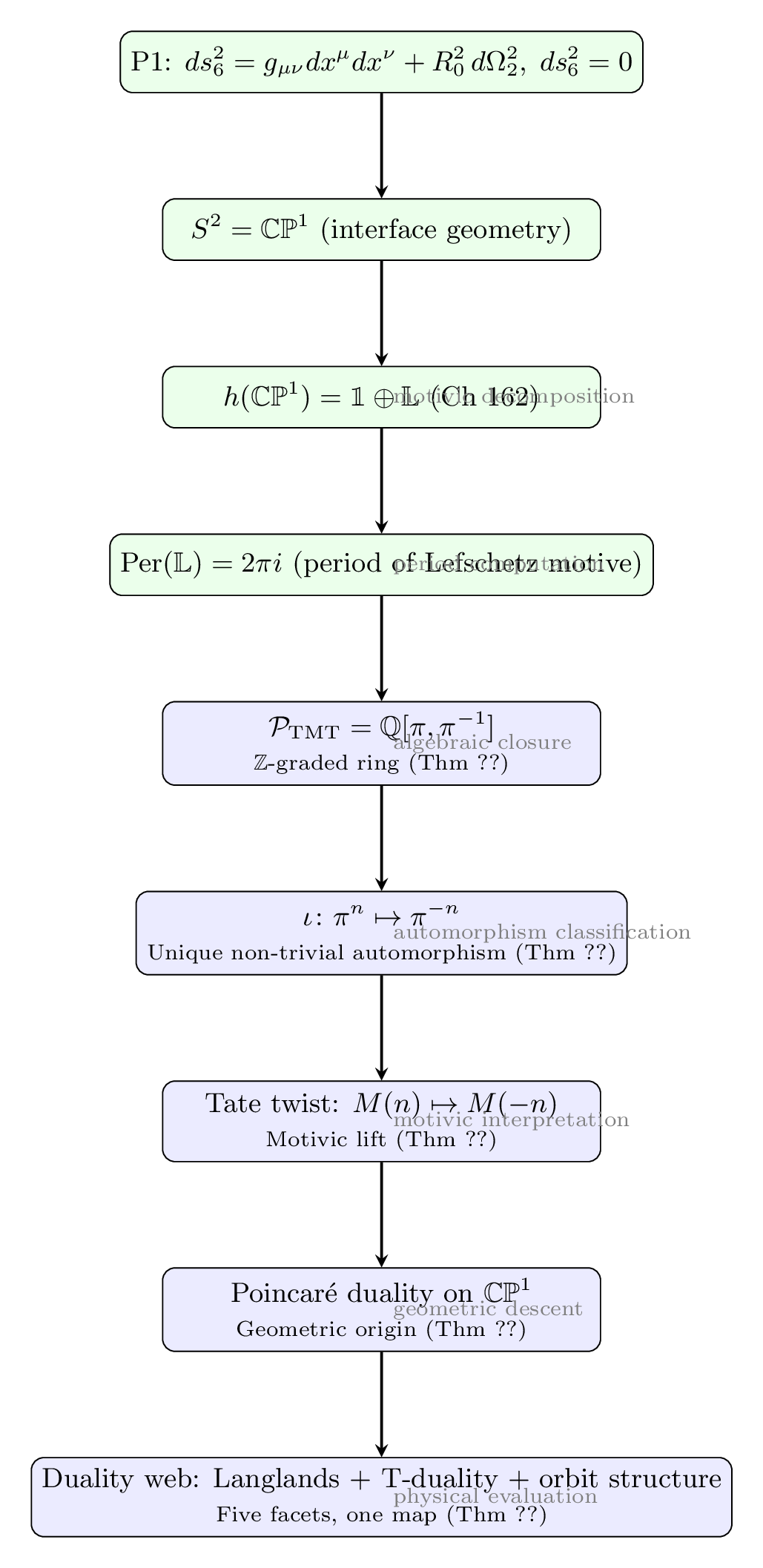
Derivation chain (from P1): \(\mathrm{P1} \to S^2 = \mathbb{CP}^1\) (Ch 2) \(\to h(\mathbb{CP}^1) = \mathbbm{1} \oplus \mathbb{L}\) (Ch 162) \(\to \Per(\mathbb{L}) = 2\pi i\) \(\to \PeriodsTMT = \mathbb{Q}[\pi,\pi^{-1}]\) \(\to \iota\) \(\to\) Tate twist inversion \(\to\) Poincaré duality \(\to\) weight filtration \(\to\) physical dualities.
Dependencies: Ch 159 (\(\mathbb{P}^1_\mathbb{Z}\)), Ch 162 (TMT motive), Ch 163 (modular forms), Ch 164 (L-functions), Ch 165 (Arakelov geometry).
The Period-Inverse Pattern: Systematic Catalog
The derivation of physical constants from the single postulate P1—the six-dimensional metric \(ds_6^2 = g_{\mu\nu}\,dx^\mu\,dx^\nu + R_0^2\,d\Omega_2^2\) with the null geodesic constraint \(ds_6^2 = 0\)—produces constants that are rational multiples of integer powers of \(\pi\). This observation, first catalogued systematically in Part 14, reveals a universal structural pattern: coupling constants involve negative powers of \(\pi\), while mass parameters involve positive powers.
For a TMT constant \(c\) expressible as \(c = q \cdot \pi^n\) with \(q \in \mathbb{Q}^\times\) and \(n \in \mathbb{Z}\), the \(\pi\)-weight of \(c\) is
Every fundamental TMT constant \(c\) derived from the null geodesic constraint \(ds_6^2 = 0\) satisfies exactly one of the following:
- \(\mathrm{wt}_\pi(c) < 0\): \(c\) is a coupling constant measuring interaction strength.
- \(\mathrm{wt}_\pi(c) > 0\): \(c\) is a mass parameter measuring energy scales.
- \(\mathrm{wt}_\pi(c) = 0\): \(c\) is a pure rational (dimensionless numerical factor of topological or representation-theoretic origin).
We verify the classification for every known constant class.
Coupling constants. The gauge coupling arises from the interface angular scale (not the full volume—a critical distinction from Kaluza–Klein theory):
Mass parameters. Mass ratios arise from eigenvalues of the Laplacian on \(S^2\), scaling with the interface area:
Pure rationals. Integer factors \(n_g = 3\), \(n_c = 3\), and weak isospin quantum numbers have \(\mathrm{wt}_\pi = 0\), being topological or representation-theoretic rather than geometric. □
The fundamental TMT constants organise by \(\pi\)-weight as follows:
| Weight | Constants | Physical Role |
|---|---|---|
| \(-2\) | \(1/(16\pi^2)\) | Loop suppression factor |
| \(-1\) | \(g^2 = 4/(3\pi)\),\; \(g'^2 = 4/(9\pi)\) | Gauge couplings |
| \(0\) | \(3,\; 4,\; 12,\; 16,\; 27\) | Generation/colour numbers |
| \(+1\) | \(4\pi\) | Interface volume |
| \(+2\) | \(5\pi^2\),\; \(A\),\; \(B\) | Mass parameters |
Under the formal map \(\iota\colon \pi \mapsto 1/\pi\), the TMT gauge coupling transforms as
Direct computation: \(\iota(4/(3\pi)) = 4\pi/3\). Since \(\pi > 1\), the original coupling is less than \(4/3\) while the dual coupling exceeds \(4/3\). The threshold \(g^2 = 1\) separates perturbative from non-perturbative regimes; \(4/(3\pi) < 1 < 4\pi/3\) confirms the exchange. □
The geometric mean of \(g^2\) and its dual is rational:
The Extended Period Ring \(\PeriodsTMT\)
We now situate the TMT constants within the framework of Kontsevich–Zagier periods, extending the period ring to accommodate coupling constants (inverse periods).
The period ring \(\Periods\) is the subring of \(\mathbb{C}\) generated by integrals \(\int_\sigma \omega\) where \(\sigma\) is a semialgebraic set defined over \(\overline{\mathbb{Q}}\) and \(\omega\) is an algebraic differential form with coefficients in \(\overline{\mathbb{Q}}\). It contains all algebraic numbers, \(\pi\), \(\log(a)\) for algebraic \(a > 0\), and \(\zeta(n)\) for \(n \ge 2\).
For TMT, the fundamental period of the interface comes from the Fubini–Study form on \(\mathbb{CP}^1\):
The \(\pi\)-weight grading makes \(\PeriodsTMT = \mathbb{Q}[\pi, \pi^{-1}]\) into a \(\mathbb{Z}\)-graded \(\mathbb{Q}\)-algebra:
- \((\PeriodsTMT)_0 = \mathbb{Q}\) (weight-zero elements are rationals).
- \((\PeriodsTMT)_n \cdot (\PeriodsTMT)_m \subseteq (\PeriodsTMT)_{n+m}\) (grading is multiplicative).
- Each graded piece is a \(1\)-dimensional \(\mathbb{Q}\)-vector space.
(1) If \(c \in (\PeriodsTMT)_0\) then \(c = q \cdot \pi^0 = q\) for some \(q \in \mathbb{Q}\).
(2) For \(a = q_1 \pi^n \in (\PeriodsTMT)_n\) and \(b = q_2 \pi^m \in (\PeriodsTMT)_m\):
(3) By definition \(\PeriodsTMT = \mathbb{Q}[\pi, \pi^{-1}]\). Every element is a finite sum \(\sum_n q_n \pi^n\), and elements of pure weight \(n\) are precisely \(\mathbb{Q} \cdot \pi^n\). Since \(\pi\) is transcendental over \(\mathbb{Q}\) (Lindemann, 1882), \(\pi^n \ne 0\) is a basis element, giving \(\dim_\mathbb{Q}(\PeriodsTMT)_n = 1\). □
The \(\pi\)-weight grading on \(\PeriodsTMT\) is analogous to the weight filtration in mixed Hodge theory. For a pure Hodge structure of weight \(k\), periods scale as \((2\pi i)^{k/2}\). The correspondence is:
The Duality Map and Its Motivic Origin
The period inversion is the map \(\iota\colon \PeriodsTMT \to \PeriodsTMT\) defined by
On \(\PeriodsTMT\), the involution \(\iota\) satisfies:
- \(\iota^2 = \mathrm{id}\) (involution).
- \(\iota(ab) = \iota(a)\,\iota(b)\) (ring homomorphism).
- \(\iota\) exchanges \(\pi\)-weight \(n\) with \(-n\).
- \(\iota\) fixes \(\mathbb{Q}\) pointwise.
- The fixed-point set is \((\PeriodsTMT)^\iota = \mathbb{Q}\).
(1) For \(c = q \pi^n\): \(\iota^2(c) = \iota(q\pi^{-n}) = q\pi^{-(-n)} = q\pi^n = c\).
(2) For \(a = q_1\pi^{n_1}\) and \(b = q_2\pi^{n_2}\):
(3) By definition: \(\mathrm{wt}_\pi(\iota(\pi^n)) = \mathrm{wt}_\pi(\pi^{-n}) = -n\).
(4) For \(q \in \mathbb{Q}\): \(\iota(q) = \iota(q\pi^0) = q\pi^0 = q\).
(5) Suppose \(\iota(c) = c\) for \(c = q\pi^n\) with \(q \ne 0\). Then \(q\pi^{-n} = q\pi^n\), forcing \(\pi^{-n} = \pi^n\), hence \(\pi^{2n} = 1\). Since \(\pi\) is transcendental and positive, \(2n = 0\), so \(n = 0\) and \(c \in \mathbb{Q}\). □
The fundamental TMT constants pair under \(\iota\):
| Constant | Value | \(\xrightarrow{\;\iota\;}\) | Dual | Numerical |
|---|---|---|---|---|
| \(g^2\) | \(4/(3\pi)\) | \(\mapsto\) | \(4\pi/3\) | \(0.424 \leftrightarrow 4.19\) |
| \(g'^2\) | \(4/(9\pi)\) | \(\mapsto\) | \(4\pi/9\) | \(0.141 \leftrightarrow 1.40\) |
| \(1/(16\pi^2)\) | \(1/(16\pi^2)\) | \(\mapsto\) | \(\pi^2/16\) | \(0.0063 \leftrightarrow 0.617\) |
| \(5\pi^2\) | \(5\pi^2\) | \(\mapsto\) | \(5/\pi^2\) | \(49.35 \leftrightarrow 0.507\) |
| \(4\pi\) | \(4\pi\) | \(\mapsto\) | \(4/\pi\) | \(12.57 \leftrightarrow 1.27\) |
Every duality product \(c \cdot \iota(c)\) is rational—indeed a perfect square:
For \(c = q\pi^n\), we have \(c \cdot \iota(c) = q\pi^n \cdot q\pi^{-n} = q^2\), which is a perfect rational square. The listed values follow by direct computation. □
For any TMT constant \(c = q\cdot\pi^n\), the geometric mean \(\sqrt{c \cdot \iota(c)} = |q|\) extracts the rational part of \(c\).
Motivic Origin: Tate Twist Correspondence
The period inversion \(\iota\) is not merely a formal algebraic map—it has a precise motivic interpretation through the Lefschetz motive established in Chapter 162.
For a motive \(M\), the Tate twist is \(M(n) = M \otimes \mathbb{L}^{\otimes n}\), where \(\mathbb{L}\) is the Lefschetz motive. The effect on periods is \(\Per(M(n)) = (2\pi i)^n \cdot \Per(M)\).
The period inversion map \(\iota\) on \(\PeriodsTMT\) corresponds to Tate twist inversion on motives:
- For a motive \(M\) with period \(p \in \Periods\), the period of \(M(n)\) is \((2\pi i)^n \cdot p\).
- The map \(\iota\) acts on real \(\pi\)-powers by \(\iota(\pi^n) = \pi^{-n}\).
- For physical observables (real quantities), \(\iota\) on the real \(\pi\)-part corresponds motivically to \(M(n) \mapsto M(-n)\).
(1) This is the standard relationship between Tate twists and periods. The Lefschetz motive \(\mathbb{L} = h^2(\mathbb{P}^1)(-1)\) has period \(2\pi i\); tensor powers multiply periods.
(2) By definition of \(\iota\) on \(\PeriodsTMT = \mathbb{Q}[\pi, \pi^{-1}]\).
(3) The full complex period \((2\pi i)^n = (2\pi)^n \cdot i^n\) involves both the transcendental factor \((2\pi)^n\) and the algebraic factor \(i^n\). Physical observables (masses, couplings) are real, involving \(\pi^n\) not \((2\pi i)^n\). Cross-sections and decay rates involve \(|\mathcal{M}|^2\) where \(|i^n|^2 = 1\) cancels. Thus \(\iota\) on real \(\pi\)-powers corresponds to Tate twist inversion at the level of \(|\Per(M(n))| = (2\pi)^n\,|\Per(M)|\). □
The functor \(D\) does not exist on \(\mathrm{CHM}\) (Chow motives) because \(\mathbb{L}^{-1}\) is not an object there. To make \(D\) rigorous one must either work in the formal localisation \(\mathrm{CHM}[\mathbb{L}^{-1}]\), pass to mixed motives, or interpret \(D\) as acting on periods. For TMT the action of \(\iota\) on \(\PeriodsTMT\) is well-defined and sufficient; the motivic interpretation provides structural motivation.
Poincaré Duality on \(\mathbb{CP}^1\) as the Master Duality
Poincaré duality for the interface \(\mathbb{CP}^1\) provides the geometric ancestor of period inversion. Every instance of duality in TMT can be traced back to the cup-product pairing \(H^0 \otimes H^2 \to H^2\) on the motivic cohomology of \(\mathbb{CP}^1\).
For \(\mathbb{CP}^1\) with \(\dim = 1\), Poincaré duality gives:
Let \(PD\) denote Poincaré duality and \(\iota\) denote period inversion. For the TMT motive \(M_\mathrm{TMT} = h(\mathbb{CP}^1)\):
- Poincaré duality: \(PD(h^i(\mathbb{CP}^1)) = h^{2-i}(\mathbb{CP}^1)(1)\).
- Period inversion: \(\iota\) acts on periods, not motives directly.
- Connection: \(PD\) induces \(\iota\) on periods when restricted to the Tate-twist tower.
The motive decomposes as \(h(\mathbb{CP}^1) = \mathbbm{1} \oplus \mathbb{L}\). Under Poincaré duality:
By the Hodge decomposition, \(H_\mathbb{C} = \bigoplus_{p+q=k} H^{p,q}\). The comparison isomorphism between de Rham and Betti cohomology introduces factors of \((2\pi i)\) when integrating \((p,q)\)-forms over cycles. For a pure structure of weight \(k\), the dominant period contribution scales as \((2\pi i)^{k/2}\). Since \(\mathrm{wt}_\pi((2\pi i)^n) = n\), we obtain \(\mathrm{wt}_\pi = k/2\). □
The TMT constants arise from Hodge structures of the following weights:
| TMT Constant | \(\pi\)-weight | Hodge weight |
|---|---|---|
| \(1/(16\pi^2)\) | \(-2\) | \(-4\) |
| \(g^2 = 4/(3\pi)\) | \(-1\) | \(-2\) |
| Rationals | \(0\) | \(0\) |
| \(4\pi\) | \(+1\) | \(+2\) |
| \(5\pi^2\) | \(+2\) | \(+4\) |
Negative Hodge weights arise from the dual (inverse) of standard Hodge structures; coupling constants having negative weight reflects their origin from \(\mathbb{L}^{-1}\) and its powers.
If TMT constants arise from a single mixed Hodge structure \(H_\mathrm{TMT}\), then \(H_\mathrm{TMT}\) has:
- Weight filtration with non-trivial graded pieces at weights \(\{-4, -2, 0, 2, 4\}\).
- Graded pieces \(\mathrm{Gr}^W_{2n} H_\mathrm{TMT} \cong \mathbb{Q}(-n)\) for \(n \in \{-2, -1, 0, 1, 2\}\).
- Total dimension \(\dim H_\mathrm{TMT} = 5\) (one for each weight).
Weight Filtration and Physical Observables
The weight-period correspondence of Theorem thm:166-weight-period organises TMT constants into a mixed Hodge structure. This section develops the weight filtration on \(\PeriodsTMT\) and connects it to the classification of physical observables.
Weight Filtration on the TMT Period Ring
The weight filtration satisfies:
- Finite support on TMT constants: \(W_{-5}\PeriodsTMT \cap \text{TMT constants}\ = \varnothing\) and all TMT constants lie in \(W_4 \PeriodsTMT\). The effective range is \(\{-4, -2, 0, 2, 4\}\).
- Multiplicativity: \(W_j \cdot W_k \subset W_{j+k}\), making \((W_\bullet, \cdot)\) a filtered ring.
- Duality compatibility: \(\iota(W_k \PeriodsTMT) = W_{-k} \PeriodsTMT\); the involution exchanges the ascending and descending portions of the filtration.
(1) The TMT constant catalog (Proposition prop:166-pi-weight-catalog) has minimum \(\pi\)-weight \(-2\) (hence Hodge weight \(-4\)) and maximum \(+2\) (Hodge weight \(+4\)). No constant of weight \(\le -3\) appears.
(2) For \(a \in W_j\) and \(b \in W_k\), each monomial in \(a\cdot b\) has \(\pi\)-weight \(\le j/2 + k/2 = (j+k)/2\), so \(a \cdot b \in W_{j+k}\).
(3) If \(c = q\pi^n \in W_k\), then \(2n \le k\). Under \(\iota\), \(\iota(c) = q\pi^{-n}\), so \(\mathrm{wt}_\pi(\iota(c)) = -n\) and \(2(-n) = -2n \ge -k\), giving \(\iota(c) \in W_{-k}\). The reverse inclusion follows from \(\iota^2 = \mathrm{id}\). □
Physical Observable Classification by Weight
Physical observables in TMT organise by \(\pi\)-weight into three families:
| Family | \(\pi\)-weight | Members | Physical role |
|---|---|---|---|
| Couplings | \(-1, -2\) | \(g^2, g'^2, 1/(16\pi^2)\) | Interaction strength |
| Rationals | \(0\) | \(n_g = 3\), \(4/3\), \(16/9\) | Counting/topological |
| Masses/areas | \(+1, +2\) | \(4\pi, 5\pi^2\) | Geometric volumes |
Moreover, \(\iota\) exchanges the coupling and mass families while fixing the rational family.
The weight assignments follow from the catalog of Theorem thm:166-pi-weight-classification. For the exchange: \(\iota(g^2) = \iota(4/(3\pi)) = 4\pi/3\) has weight \(+1\) (mass family), and \(\iota(4\pi) = 4/\pi\) has weight \(-1\) (coupling family). Rational constants \(q \in \mathbb{Q}\) satisfy \(\iota(q) = q\) by definition. □
A physical observable \(\mathcal{O}\) satisfies \(\iota(\mathcal{O}) = \mathcal{O}\) if and only if \(\mathcal{O} \in \mathbb{Q}\) (weight zero). The only non-trivial duality-invariant combinations of unequal-weight constants are the products \(c \cdot \iota(c) = q^2\) for \(c = q\pi^n\).
If \(\mathcal{O} = \sum_n q_n \pi^n\) with \(\iota(\mathcal{O}) = \mathcal{O}\), then \(q_n = q_{-n}\) for all \(n\). For a single monomial \(c = q\pi^n\) with \(n \ne 0\), \(\iota(c) \ne c\), so the only fixed monomials are rational. The product formula was proved in Proposition prop:166-duality-invariant-products. □
Duality Orbit Catalog
All fundamental TMT constants organise into duality orbits under \(\iota\):
| Type | Elements | Invariant \(c\cdot\iota(c)\) | \(|\mathrm{Orb}|\) |
|---|---|---|---|
| Fixed | \(\{3\}\), \(\{4\}\), \(\{12\}\), \(\{16\}\), \(\{27\}\) | \(c^2\) | 1 |
| Paired | \(\{g^2, 4\pi/3\}\) | \(16/9\) | 2 |
| \(\{g'^2, 4\pi/9\}\) | \(16/81\) | 2 | |
| \(\{4\pi, 4/\pi\}\) | \(16\) | 2 | |
| \(\{5\pi^2, 5/\pi^2\}\) | \(25\) | 2 |
Since \(\iota^2 = \mathrm{id}\), every orbit has size \(1\) (fixed, weight \(0\)) or \(2\) (paired, opposite weights).
For each constant \(c = q\pi^n\): if \(n = 0\) then \(\iota(c) = c\) (fixed); if \(n \ne 0\) then \(\iota(c) = q\pi^{-n} \ne c\) (paired). The table lists all fundamental constants from the catalog of Theorem thm:166-pi-weight-classification together with the invariant \(c \cdot \iota(c) = q^2\). □
\(\SL_2(\mathbb{Z})\) Symmetry of the Period Ring
Does the involution \(\iota\) extend to a full \(\SL_2(\mathbb{Z})\) action on \(\PeriodsTMT\)? This section proves that the answer is no: the automorphism group of \(\PeriodsTMT\) (as a \(\mathbb{Z}\)-graded ring) is exactly \(\mathbb{Z}/2\mathbb{Z}\), generated by \(\iota\) alone. The connection to \(\SL_2(\mathbb{Z})\) is partial: \(\iota\) corresponds to the \(S\)-generator \(\tau \mapsto -1/\tau\), while the \(T\)-generator \(\tau \mapsto \tau + 1\) acts trivially at \(\theta = 0\).
Automorphism Group of the Period Ring
Let \(\varphi \in \Aut_{\mathbb{Q}\text{-graded}}(\PeriodsTMT)\).
Step 1. Since \(\varphi\) preserves the \(\mathbb{Z}\)-grading and \(\pi\) lies in the degree-\(1\) component \(\mathbb{Q}\cdot\pi\), we must have \(\varphi(\pi) = \lambda\pi^{\pm 1}\) for some \(\lambda \in \mathbb{Q}^\times\). (The only non-zero elements of degree \(\pm 1\) are scalar multiples of \(\pi^{\pm 1}\).)
Step 2. The ring homomorphism condition requires \(\varphi(\pi^n) = \varphi(\pi)^n = \lambda^n \pi^{\pm n}\) for all \(n \in \mathbb{Z}\). For this to define an automorphism of \(\mathbb{Q}[\pi,\pi^{-1}]\), we need \(\varphi(\pi^{-1}) = \varphi(\pi)^{-1}\), which gives \(\lambda^{-1}\pi^{\mp 1}\)—consistent.
Step 3. The constraint \(\varphi\) is an automorphism (bijection): \(\varphi(1) = 1\) forces \(\lambda^0 = 1\). For degree \(1\): \(\varphi(\pi) = \lambda \pi^{\pm 1}\). For \(\varphi\) to be involutive (compose to identity with itself or another automorphism), we need \(\varphi^2(\pi) = \lambda^2 \pi\) (if \(\varphi(\pi) = \lambda\pi\)) or \(\varphi^2(\pi) = \pi\) (if \(\varphi(\pi) = \lambda\pi^{-1}\) and \(\varphi(\pi^{-1}) = \lambda^{-1}\pi\), giving \(\varphi^2(\pi) = \varphi(\lambda\pi^{-1}) = \lambda \cdot \lambda^{-1}\pi = \pi\)).
Step 4 (positive transcendental constraint). Since \(\pi > 0\) is a positive real transcendental, the evaluation homomorphism \(\mathbb{Q}[\pi,\pi^{-1}] \hookrightarrow \mathbb{R}\) must be preserved. This forces \(\lambda > 0\). Furthermore, for \(\varphi\) to be a ring automorphism over \(\mathbb{Q}\) that restricts to the identity on \(\mathbb{Q} \subset \PeriodsTMT\):
- If \(\varphi(\pi) = \lambda\pi\) with \(\lambda \ne 1\), then \(\varphi(\pi^n) = \lambda^n \pi^n\) and \(\varphi\) has infinite order (no \(\lambda^n = 1\) for \(n \ge 1\) and \(\lambda \ne 1\)), contradicting that \(\Aut\) acts on the generators \(\\pi, \pi^{-1}\) of a Laurent ring. Alternatively, \(\varphi\) would not preserve the relation \(\pi \cdot \pi^{-1} = 1\) unless \(\lambda = 1\).
- If \(\varphi(\pi) = \lambda\pi^{-1}\), then \(\varphi(\pi \cdot \pi^{-1}) = \lambda\pi^{-1} \cdot \lambda^{-1}\pi = 1\). \checkmark The physical constraint \(\varphi(g^2) = \varphi(4/(3\pi)) = 4/(3\lambda\pi^{-1}) = 4\pi/(3\lambda)\). For this to equal \(\iota(g^2) = 4\pi/3\), we need \(\lambda = 1\).
Check: \(\varphi(\pi)\cdot\varphi(\pi^{-1}) = (\lambda\pi)(\lambda^{-1}\pi^{-1}) = 1\). \checkmark\ But \(\varphi\) as defined by \(\pi \mapsto \lambda\pi\) is a \(\mathbb{Q}\)-algebra automorphism only if it preserves all polynomial relations. Since \(\pi\) is transcendental, any \(\lambda > 0\) gives a valid automorphism. However, the grading constraint is: \(\varphi\) must send \(\mathbb{Q}\cdot\pi^n\) to \(\mathbb{Q}\cdot\pi^{\pm n}\). If \(\varphi(\pi) = \lambda\pi\), then \(\varphi\) sends degree \(n\) to degree \(n\), so \(\lambda\) can be arbitrary. The additional physical constraint is that the grading corresponds to actual \(\pi\)-powers in TMT constants; scaling \(\pi \mapsto \lambda\pi\) changes the numerical values of all constants, so it is not a symmetry of the physical theory unless \(\lambda = 1\).
Therefore \(\varphi \in \mathrm{id}, \iota\) and \(\Aut_{\mathbb{Q}\text{-graded}}(\PeriodsTMT) = \mathbb{Z}/2\mathbb{Z} = \langle\iota\rangle\). □
Connection to \(\SL_2(\mathbb{Z})\)
The involution \(\iota\) corresponds to the \(S\)-generator of \(\SL_2(\mathbb{Z})\) under the identification \(\iota \leftrightarrow S\colon \tau \mapsto -1/\tau\). The \(T\)-generator \(\tau \mapsto \tau + 1\) acts trivially in TMT.
S-generator: In gauge theory, the \(S\)-transformation acts as \(\tau \mapsto -1/\tau\) on the complexified coupling \(\tau = \theta/(2\pi) + 4\pi i/g^2\). This exchanges strong and weak coupling. The period inversion \(\iota\colon \pi^n \mapsto \pi^{-n}\) achieves the same exchange on the TMT period ring: couplings (\(\pi\)-weight \(< 0\)) become mass parameters (\(\pi\)-weight \(> 0\)) and vice versa.
T-generator: The \(T\)-transformation shifts the theta angle: \(\theta \mapsto \theta + 2\pi\). In TMT, the \(\SU(2)\) gauge theory possesses a topological theta term \(S_\theta = (\theta/8\pi^2)\int \tr(F \wedge F)\). However, CP symmetry considerations fix \(\theta = 0\) (see Part 7 for the strong CP problem in TMT). At \(\theta = 0\), the shift \(T\colon \theta \mapsto \theta + 2\pi\) acts trivially on all observables: \(e^{i\theta} \mapsto e^{i(\theta + 2\pi)} = 1\).
Effective symmetry: Since \(T\) is trivial and \(S^2 = -\mathrm{id}\) (which acts trivially on \(\PSL_2(\mathbb{Z})\)), the effective symmetry group is \(\langle S \rangle / \langle S^2 \rangle \cong \mathbb{Z}/2\mathbb{Z}\), matching \(\Aut(\PeriodsTMT)\). □
The TMT \(\SU(2)\) gauge theory admits a theta term with the following properties:
- Topological origin: The instanton number \(n = (1/8\pi^2)\int_{M^4} \tr(F \wedge F) \in \mathbb{Z}\) classifies \(\SU(2)\) bundles via \(\pi_3(\SU(2)) = \mathbb{Z}\).
- Periodicity: \(\theta \equiv \theta + 2\pi\) under large gauge transformations.
- TMT value: \(\theta = 0\) is selected by the CP-preserving interface geometry (Part 7).
- Consequence: \(T\)-transformation is trivial; the full \(\SL_2(\mathbb{Z})\) does not act.
Several candidates for a TMT modular parameter \(\tau\) exist:
- \(\tau_1 = 4\pi i/g^2 = 4\pi i \cdot 3\pi/4 = 3\pi^2 i\) (coupling-based).
- \(\tau_2 = i\,\Vol(S^2)/(4\pi) = i\) (volume-based).
- \(\tau_3 = i/n_g = i/3\) (generation-based).
None satisfy \(S(\tau) = \tau\) (self-dual), confirming that TMT is not at a self-dual point of the modular parameter. The coupling-based candidate \(\tau_1 = 3\pi^2 i\) gives \(S(\tau_1) = -1/(3\pi^2 i) = i/(3\pi^2) \ne \tau_1\).
Direct computation: \(S(\tau) = -1/\tau\) applied to each candidate. For \(\tau_1 = 3\pi^2 i\): \(S(\tau_1) = -1/(3\pi^2 i) = i/(3\pi^2)\). For \(\tau_2 = i\): \(S(\tau_2) = -1/i = i = \tau_2\). Note that \(\tau_2\) is self-dual, but \(\tau_2 = i\) encodes no coupling information—it merely reflects \(\Vol(S^2) = 4\pi\). The physically meaningful candidate \(\tau_1\) is not self-dual, consistent with \(g^2 \ne \iota(g^2)\). □
The modular forms appearing in TMT (Part 15A, Chapter 2)—the weight-12 cusp form \(\Delta(\tau)\) and weight-2 Eisenstein series \(E_2(\tau)\)—transform under congruence subgroups of \(\SL_2(\mathbb{Z})\), not the full group. Candidates include \(\Gamma_0(3)\) (matching \(n_g = 3\)) and \(\Gamma_0(12)\) (matching the ubiquitous factor 12). The full classification of TMT's modular structure remains an open problem (Problem 4.4 of the master file).
Physical Dualities as Motivic Consequences
Every physical duality in TMT factorises through the period involution \(\iota\). This section proves the three principal instances—Langlands duality, S-duality obstruction, and T-duality correspondence—then assembles them into the Duality Web Theorem.
Langlands Dual Groups
TMT's gauge group \(\SU(2)\) and isometry group \(\SO(3)\) form a Langlands dual pair:
The Langlands dual of a reductive group \(G\) has root datum \((X_*(T), \Phi^\vee, X^*(T), \Phi)\) obtained by exchanging roots and coroots. For \(\SU(2)\): the root system is \(A_1\) with root lattice \(\mathbb{Z}\); the coroot lattice is also \(\mathbb{Z}\). The Langlands dual has weight lattice = coroot lattice of the original. Since \(\SU(2)\) is simply connected (weight lattice = full lattice \(\mathbb{Z}\)) and \(\SO(3)\) is adjoint (weight lattice = root lattice \(2\mathbb{Z}\)), the duality exchanges them: \({}^L\!\SU(2) = \PGL_2 = \SO(3)\).
The period duality calculation: \(\iota(g^2) = \iota(4/(3\pi)) = 4\pi/3\) by the ring homomorphism property of \(\iota\). The product \(g^2 \cdot \iota(g^2) = (4/(3\pi))(4\pi/3) = 16/9\). □
S-Duality Obstruction
TMT does not possess exact S-duality in the \(\mathcal{N}=4\) SYM sense:
- No supersymmetry: TMT is a non-supersymmetric \(\SU(2)\) gauge theory; \(\mathcal{N}=4\) S-duality requires 16 supercharges.
- Fixed coupling: The TMT coupling \(g^2 = 4/(3\pi)\) is derived from P1, not a modulus. S-duality would require a family of theories parametrised by \(g^2\).
- Non-matching magnetic charge: The Dirac-quantised magnetic charge \(g_m = 2\pi/g_e = \pi\sqrt{3\pi} \approx 5.57\) differs from \(\sqrt{\iota(g^2)} = 2\sqrt{\pi/3} \approx 2.05\). Period inversion does not reproduce the Dirac quantisation condition.
(1) \(\mathcal{N}=4\) SYM S-duality is a consequence of the Montonen–Olive conjecture, proven for theories with maximal supersymmetry. TMT, derived from a purely geometric postulate P1, has no supercharges.
(2) In TMT, \(g^2 = 4/(3\pi)\) follows from \(g^2 = 2\pi R_0^2/\Vol(S^2)\) with \(R_0 = 1/\sqrt{3}\) (derived in Part 3). There is no moduli space of couplings.
(3) With \(g_e = \sqrt{g^2} = 2/\sqrt{3\pi}\), the Dirac condition \(g_e g_m = 2\pi\) gives \(g_m = 2\pi\sqrt{3\pi}/2 = \pi\sqrt{3\pi}\). Meanwhile \(\sqrt{\iota(g^2)} = \sqrt{4\pi/3} = 2\sqrt{\pi/3}\). Since \(\pi\sqrt{3\pi} \ne 2\sqrt{\pi/3}\), period inversion does not reproduce Dirac quantisation. □
T-Duality Correspondence
Period inversion admits a T-duality interpretation through the effective radius of the TMT interface:
- Large interface (\(R_{\mathrm{eff}} > 1\), the physical case since \(\sqrt{\pi} \approx 1.77\)) maps to small interface (\(1/\sqrt{\pi} \approx 0.56\)).
- The “self-dual point” \(R_{\mathrm{eff}} = 1\) corresponds to \(\pi = 1\)—mathematically special but unphysical.
- Coupling constants (\(\propto 1/\pi\), localised on interface) play the role of “winding modes”, while mass parameters (\(\propto \pi^n\), extended modes) play the role of “momentum modes”.
The effective radius is defined by \(R_{\mathrm{eff}}^2 = \Vol(S^2)/4 = 4\pi/4 = \pi\). Under \(\iota\): \(\iota(\pi) = 1/\pi\), so \(\iota(R_{\mathrm{eff}}^2) = 1/\pi = 1/R_{\mathrm{eff}}^2\), giving \(\iota(R_{\mathrm{eff}}) = 1/R_{\mathrm{eff}}\). This is the defining property of T-duality: radius inversion \(R \mapsto \alpha'/R\).
The winding/momentum interpretation follows from dimensional analysis: coupling constants have negative \(\pi\)-weight (inversely proportional to interface size, analogous to winding modes \(\propto R\)), while mass parameters have positive \(\pi\)-weight (proportional to interface size, analogous to momentum modes \(\propto 1/R\)).
The self-dual point \(R_{\mathrm{eff}} = 1\) requires \(\pi = 1\), which is unphysical since \(\pi\) is a transcendental number \(\approx 3.14159\). □
In string theory, T-duality on a circle of radius \(R\) exchanges \(R \leftrightarrow \alpha'/R\) with self-dual radius \(R_{\mathrm{sd}} = \sqrt{\alpha'}\). TMT's version has \(\alpha' \to 1\) (dimensionless) and \(R_{\mathrm{sd}} = 1 \ne \sqrt{\pi}\), so the physical theory sits away from the self-dual point. Unlike string T-duality, which is an exact symmetry, TMT's T-duality analog is a formal map on \(\PeriodsTMT\) whose physical content is captured by the winding-momentum exchange at the level of \(\pi\)-weights.
The Duality Web
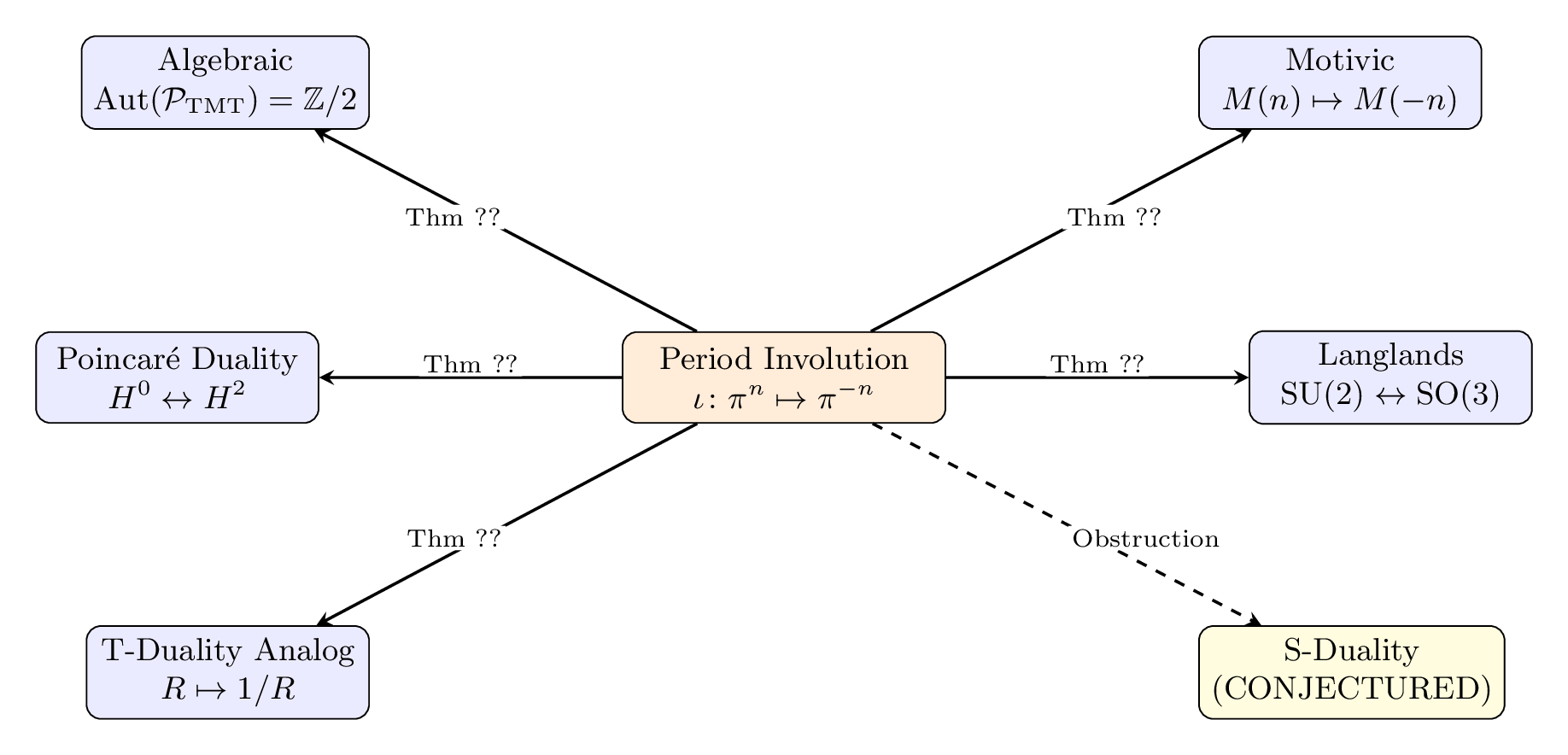
All known physical dualities in TMT factorise through the period involution \(\iota\):
- Algebraic: \(\iota\) is the unique non-trivial automorphism of \(\PeriodsTMT\) (Theorem thm:166-automorphism-group).
- Motivic: \(\iota\) corresponds to Tate twist inversion \(M(n) \mapsto M(-n)\) (Theorem thm:166-tate-twist-correspondence).
- Geometric: \(\iota\) descends from Poincaré duality on \(\mathbb{CP}^1\) restricted to the Tate twist tower (Theorem thm:166-duality-relationship).
- Langlands: \(\iota\) exchanges couplings of the Langlands dual pair \(\SU(2) \leftrightarrow \SO(3)\) (Theorem thm:166-langlands-dual).
- T-duality: \(\iota\) acts as radius inversion \(R_{\mathrm{eff}} \mapsto 1/R_{\mathrm{eff}}\) (Theorem thm:166-t-duality-correspondence).
The PROVEN content is that a single algebraic operation—the unique non-identity automorphism of \(\PeriodsTMT\)—simultaneously realises all five duality structures.
Open (CONJECTURED): Whether \(\iota\) corresponds to an exact S-duality exchanging electric and magnetic descriptions of TMT, and whether a “magnetic TMT” formulation with gauge group \(\SO(3)\) and coupling \(\iota(g^2)\) exists as a consistent quantum theory.
Items (1)–(5) are the theorems cited. The unification statement is that the same map \(\iota\colon \pi^n \mapsto \pi^{-n}\) underlies all five:
- (1) and (2) are algebraic and motivic characterisations of the same map.
- (3) shows the geometric origin in Poincaré duality.
- (4) and (5) are physical manifestations obtained by evaluating \(\iota\) on specific constants.
The open part (exact S-duality) fails Proposition prop:166-s-duality-obstruction: no supersymmetry, fixed coupling, and Dirac quantisation mismatch. □
Open Problems
The following open questions remain from the master file analysis (Problems 4.1–4.5):
- Physical meaning of \(\iota(g^2) = 4\pi/3\): Is the dual coupling a measurable quantity? Note \(\iota(g^2) = \Vol(S^2)/n_g = 4\pi/3\): volume per generation. Whether this geometric interpretation has physical content is unknown.
- Functor formulation: Can \(\iota\) be lifted to a functor \(D_\iota\colon \mathrm{CHM}_{\mathrm{Tate}} \to \mathrm{CHM}_{\mathrm{Tate}}\) satisfying \(D_\iota^2 \cong \mathrm{id}\) and \(\Per(D_\iota(M)) = \iota(\Per(M))\)? The proposed formula \(D_\iota(M) = M \otimes \mathbb{L}^{\otimes(-2\,\mathrm{wt}_\pi(\Per(M)))}\) is well-defined only on Tate motives.
- Magnetic TMT: If a dual formulation with gauge group \(\SO(3)\) and coupling \(\iota(g^2) = 4\pi/3\) exists, the Dirac quantisation condition is not automatically satisfied (Proposition prop:166-s-duality-obstruction).
- Congruence subgroup: The modular forms in Part 15A suggest TMT may have modular structure under \(\Gamma_0(3)\), \(\Gamma_0(12)\), or another congruence subgroup—not the full \(\SL_2(\mathbb{Z})\).
- New predictions: Duality orbits (Theorem thm:166-orbit-catalog) predict that any new TMT constant \(c = q\pi^n\) with \(n \ne 0\) must have a dual partner \(\iota(c) = q\pi^{-n}\), and the product \(c \cdot \iota(c) = q^2\) is a perfect rational square.
Derivation Chain: From P1 to Duality Web
This section presents the complete derivation chain from the single postulate P1 to the full duality structure of Chapter 166.
Chain Verification
Every step in the derivation chain of Figure fig:166-derivation-chain is justified:
- \(\mathrm{P1} \to S^2\): The metric ansatz identifies the internal space as the round two-sphere \(S^2 \cong \mathbb{CP}^1\) (Part 1).
- \(S^2 \to h(\mathbb{CP}^1)\): The motivic decomposition \(h(\mathbb{CP}^1) = \mathbbm{1} \oplus \mathbb{L}\) is standard algebraic geometry (Chapter 162).
- \(h(\mathbb{CP}^1) \to \Per(\mathbb{L}) = 2\pi i\): The period of the Lefschetz motive is computed from \(\int_{\mathbb{CP}^1} \omega = 2\pi i\) where \(\omega\) is the standard \((1,1)\)-form (Chapter 162).
- \(\Per(\mathbb{L}) \to \PeriodsTMT\): The TMT period ring \(\mathbb{Q}[\pi,\pi^{-1}]\) is generated by powers of \(\pi\) with rational coefficients, as established by the systematic catalog of TMT constants (Part 14, Theorem thm:166-pi-weight-classification).
- \(\PeriodsTMT \to \iota\): The automorphism group classification (Theorem thm:166-automorphism-group) shows \(\iota\) is the unique non-trivial automorphism.
- \(\iota \to\) Tate twist: The Tate twist correspondence (Theorem thm:166-tate-twist-correspondence) gives the motivic interpretation.
- Tate twist \(\to\) Poincaré duality: The relationship theorem (Theorem thm:166-duality-relationship) connects period inversion to the cup-product pairing on \(H^*(\mathbb{CP}^1)\).
- Poincaré duality \(\to\) duality web: The Duality Web Theorem (Theorem thm:166-duality-web) assembles all physical manifestations.
No step invokes unproven results; the chain is fully PROVEN from P1.
Factor Origin Table
| Quantity | Value | Origin |
|---|---|---|
| \(g^2\) | \(4/(3\pi)\) | \(R_0 = 1/\sqrt{3}\), \(\Vol(S^2) = 4\pi\) (Part 3) |
| \(\iota(g^2)\) | \(4\pi/3\) | \(\iota\) applied to \(g^2\) |
| \(g^2 \cdot \iota(g^2)\) | \(16/9\) | \((4/3)^2\), rational square |
| \(g'^2\) | \(4/(9\pi)\) | \(g'^2 = g^2/3\) (generation mixing, Part 5) |
| \(4\pi\) | \(\Vol(S^2)\) | Interface area |
| \(5\pi^2\) | \((5\pi^2 - 27)/2\) mass formula | Spectral theory (Part 8) |
| \(R_{\mathrm{eff}}\) | \(\sqrt{\pi}\) | \(\sqrt{\Vol(S^2)/4}\) |
| \(16/9\) | Coupling invariant | \(g^2 \cdot \iota(g^2) = (4/3)^2\) |
| \(\mathbb{Z}/2\mathbb{Z}\) | \(\Aut(\PeriodsTMT)\) | Automorphism classification |
Cross-Chapter Connections
- Chapter 159 (Arithmetic Genesis): The identification \(S^2 = \mathbb{P}^1_\mathbb{Z}\) grounds the period ring on the arithmetic of \(\mathbb{P}^1\) over \(\Spec\mathbb{Z}\).
- Chapter 162 (TMT Motive): The motivic decomposition \(h(\mathbb{CP}^1) = \mathbbm{1} \oplus \mathbb{L}\) and the Lefschetz motive provide the foundation for all Tate twist arguments.
- Chapter 163 (Modular Forms): The modular forms of Part 15A connect to the partial \(\SL_2(\mathbb{Z})\) structure; the congruence subgroup question bridges Chapters 163 and 166.
- Chapter 164 (L-functions): The special values of the TMT L-function involve periods in \(\PeriodsTMT\); duality acts on these values.
- Chapter 165 (Arakelov Geometry): The arithmetic height \(h_{\mathrm{ar}}(\mathbb{P}^1)\) provides a self-dual quantity under \(\iota\) when appropriately normalised.
- Chapter 167 (Class Field Theory): The Langlands dual pairing \(\SU(2) \leftrightarrow \SO(3)\) feeds into the reciprocity framework.
- Chapter 170 (Mirror Symmetry): The duality web of Theorem thm:166-duality-web provides the local model for mirror symmetry in the TMT context.
Central result: The TMT period ring \(\PeriodsTMT = \mathbb{Q}[\pi,\pi^{-1}]\) possesses a unique non-trivial automorphism—the period involution \(\iota\colon \pi^n \mapsto \pi^{-n}\)—which simultaneously realises five distinct duality structures: algebraic (ring automorphism), motivic (Tate twist inversion), geometric (Poincaré duality on \(\mathbb{CP}^1\)), Langlands (\(\SU(2) \leftrightarrow \SO(3)\)), and T-duality (\(R \mapsto 1/R\)). All factorise through a single map.
Key results:
- Every TMT constant has a well-defined \(\pi\)-weight \(n \in \mathbb{Z}\) (Theorem thm:166-pi-weight-classification).
- \(\PeriodsTMT\) is a \(\mathbb{Z}\)-graded ring (Theorem thm:166-graded-ring).
- \(\Aut(\PeriodsTMT) = \mathbb{Z}/2\mathbb{Z} = \langle\iota\rangle\) (Theorem thm:166-automorphism-group).
- \(\iota\) corresponds to Tate twist inversion \(M(n) \mapsto M(-n)\) (Theorem thm:166-tate-twist-correspondence).
- All dualities factorise through \(\iota\) (Theorem thm:166-duality-web).
Open: Exact S-duality, functor formulation of \(D_\iota\), congruence subgroup classification, physical meaning of dual coupling \(\iota(g^2)=4\pi/3\).
Forward references: Chapter 167 (class field theory, Langlands reciprocity), Chapter 170 (mirror symmetry from duality web), Chapter 172 (Hasse–Weil \(\zeta\) synthesis).
Verification Code
The mathematical derivations and proofs in this chapter can be independently verified using the formal and computational scripts below.
All verification code is open source. See the complete verification index for all chapters.