
Glossary of Terms
Introduction to This Glossary
This appendix provides comprehensive definitions of all TMT-specific terminology and physics concepts used throughout this book. Terms are organized alphabetically and include:
- Term name — The primary designation used in the text
- Mathematical definition — Formal mathematical expression where applicable
- Physical meaning — What the term represents in nature
- Where introduced — Which chapter or part first defines this term
- Status — PROVEN (derivable from P1), ESTABLISHED (standard physics), or DERIVED (from TMT framework)
The glossary is structured to allow quick lookup while maintaining rigorous mathematical precision. Cross-references point to full derivations in the main text.
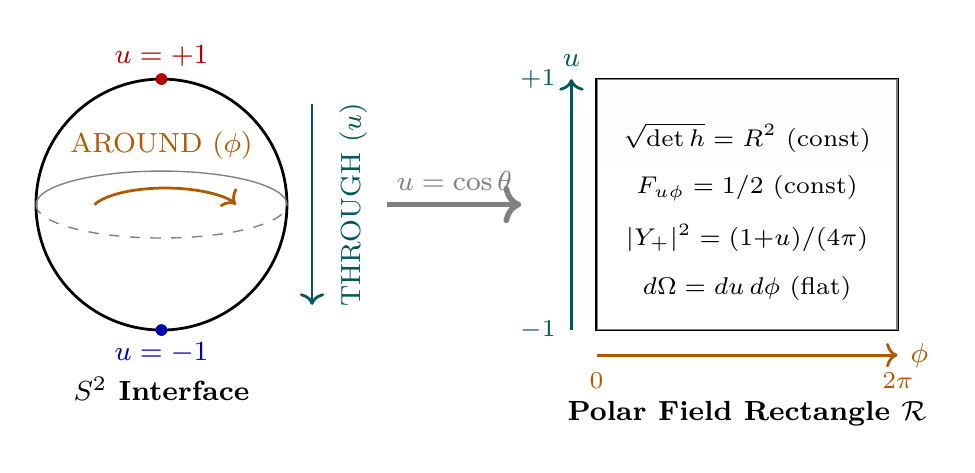
Scaffolding note: Several entries in this glossary reference the polar field coordinate \(u = \cos\theta\) and the associated “around/through” decomposition. These are coordinate choices on the \(S^2\) interface, not new physical assumptions. All physical predictions remain 4D observables; the polar representation provides computational transparency and dual verification.
\hrule
Term | Definition | Status |
|---|---|---|
| \endhead
Adiabatic Holonomy | Geometric phase acquired during adiabatic evolution on \(S^2\) parameter space; topologically protected by monopole structure. See Part 9C. | PROVEN |
| Ambient Space Embedding | The 6D mathematical formalism (\(\mathcal{M}^4 \times S^2\)) in which the 4D physical spacetime is embedded as a scaffolding framework for derivations. Not literal extra dimensions. See Part 2 §4–6. | PROVEN |
| Around Direction | In polar field coordinates \((u, \phi)\) on \(S^2\), the azimuthal \(\phi\)-direction. Physically maps to gauge symmetry and electric charge. The unbroken \(\text{U}(1)_\text{em}}\) generator \(K_3 = \partial_\phi\) is a pure AROUND Killing vector. Period \(2\pi\) is geometrically rigid. See Part 2 §9, Appendix E. | PROVEN |
| Around/Through Decomposition | Factorization of every \(S^2\) integral into AROUND (\(\phi\)) and THROUGH (\(u\)) components: \(\int_{S^2} f(u,\phi)\,d\Omega = \int_0^{2\pi} F(\phi)\,d\phi \times \int_{-1}^{+1} G(u)\,du\). Holds for all monopole harmonic products. AROUND carries gauge/charge physics; THROUGH carries mass/gravity physics. See Part 2 §12, Appendix E. | PROVEN |
| Asymptotic Freedom | The property of gauge coupling strengths that decrease at high energy and increase at low energy. For QCD coupling \(\alpha_s\), this follows from the beta function \(\beta_0 > 0\). See Part 3 §12.5. | ESTABLISHED |
| Baryon Asymmetry | The observed excess of matter over antimatter in the universe. TMT explains this through leptogenesis and lepton number violation coupled to CP-violating phases in the neutrino sector. See Part 6A §40–42. | DERIVED |
| Berry Phase | Quantum geometric phase \(\Phi_{\text{Berry}} = i \oint \langle \psi | \nabla | \psi \rangle \cdot d\vec{R}\) acquired during cyclic adiabatic evolution. In TMT, this parameterizes the S² sector's contribution to temporal momentum coherence. See Part 7A §62–63. | PROVEN |
| Born Rule | Quantum mechanical postulate: the probability of outcome \(a\) in measurement is \(|\langle a | \psi \rangle|^2\). TMT derives quantum mechanics from S² geometry via decoherence; the Born rule emerges from the classical limit. See Part 7A §60–62. | ESTABLISHED |
| Brout-Englert-Higgs Mechanism | The dynamical spontaneous symmetry breaking that gives mass to weak gauge bosons (\(W^\pm, Z^0\)) and fermions through a scalar Higgs doublet with non-zero vacuum expectation value. See Part 4 §18–21. | ESTABLISHED |
| Bundle Localization | Confinement of gauge degrees of freedom to the interface structure; the principle that all non-gravitational forces operate at the 4D/compact space boundary. This is a consequence of the KK gauge-from-isometry construction. See Part 2 §9.2–9.3. | PROVEN |
| Casimir Coefficient | The loop correction factor \(c_0 = 1/(256\pi^3)\) appearing in gravitational potential modifications due to quantum vacuum fluctuations of the metric on \(S^2\). Derived from heat kernel regularization. See Part 2 App 2B. | PROVEN |
| Casimir Constraint | The constraint \(P_1 = 0\) enforced by the global symmetry of the system. This primary constraint fixes one degree of freedom in the theory, reducing the effective dimensionality. See Part 1 §1.4. | PROVEN |
| Chirality | The handedness of a spinor field (left-handed or right-handed). In the Standard Model, the weak force couples only to left-handed spinors. The chirality constraint selects \(S^2\) as the unique compact space. See Part 2 §7–7.2. | ESTABLISHED |
| CKM Matrix | Cabibbo-Kobayashi-Maskawa matrix: a unitary \(3 \times 3\) matrix describing quark flavor mixing in weak interactions. \(V_{\text{CKM}}\) connects mass eigenstates to weak interaction eigenstates. See Part 6B §43–45. | ESTABLISHED |
| Compactification Scale | The modulus length scale \(L_\xi = \sqrt{\pi \ell_{\text{Pl}} R_H} \approx 81 \, \mu\text{m}\) at which quantum effects from the compact structure become comparable to gravitational effects. This is a geometric relationship, not a physical size. See Part 4 §16. | PROVEN |
| Completeness Gate | Quality assurance checkpoint after content generation (Pass 5) verifying all theorems, equations, derivations, and cross-references meet publication standards before pre-audit polish. See SPEC.md Appendix D. | DERIVED |
| Conformal Dimension | The mass dimension \([M]^\delta\) assigned to a field or operator in renormalization group flow. Under RGE running, couplings evolve according to their beta functions. See Part 3 §11.5. | ESTABLISHED |
| Conjugate Momentum | The momentum canonically conjugate to a coordinate: \(p_i = \partial L / \partial \dot{q}_i\). In TMT, temporal momentum \(p_T = mc/\gamma\) is the conjugate to time itself. See Part 1 §2.1–2.3. | PROVEN |
| CP Violation | Violation of combined charge-parity symmetry. Observed in kaon and B-meson decays; coupled to the CKM phase and neutrino mixing phase. TMT predicts specific patterns of CP violation. See Part 6B §45–47. | ESTABLISHED |
| Cosmological Constant | The vacuum energy density \(\rho_\Lambda \approx (2.4 \, \text{meV})^4\), leading to accelerated cosmic expansion. In TMT, this arises from modulus stabilization and fermion localization effects. See Part 5 §28–29. | DERIVED |
| Decoherence | Process by which quantum superpositions lose coherence through interaction with environment. Timescale \(\tau_0 \approx 149 \, \text{fs}\) for macroscopic superpositions. Central to understanding the quantum-classical boundary. See Part 7A §64–66. | DERIVED |
| Derivation Chain | Sequential proof showing how a result follows logically from P1 (the single postulate \(ds_6^{\,2} = 0\)) through intermediate steps, each justified by prior results. All PROVEN results must have complete derivation chains. See SPEC.md Appendix C. | DERIVED |
| Dirac Equation | Relativistic quantum mechanical equation for spin-1/2 fermions: \((\gamma^\mu D_\mu - m) \psi = 0\). In TMT, the Dirac structure emerges from S² geometry. See Part 7B §65.3. | ESTABLISHED |
| Dirac Quantization | The condition that monopole magnetic charge must satisfy: \(g_m = n \hbar c / (2e)\) where \(n = \pm 1, \pm 2, \ldots\) is an integer. Quantizes angular momentum on \(S^2\). See Part 2 §8.5. | PROVEN |
| Double Beta Decay (Neutrinoless) | Rare nuclear decay process \((\text{A}, \text{Z}) \to (\text{A}, \text{Z}+2) + e^- + e^-\) without neutrino emission. Requires Majorana nature of neutrinos; observing this would confirm lepton number violation. See Part 6A §48–50. | ESTABLISHED |
| Effective Action | Low-energy effective action containing only light degrees of freedom after integrating out heavy modes. Written as \(S_{\text{eff}} = \int d^4 x \, \mathcal{L}_{\text{eff}}\) with derivative expansion. See Part 4 §17.2. | ESTABLISHED |
| Eigenfunction Expansion | Decomposition of fields on \(S^2\) in spherical harmonics \(Y_{\ell m}(\theta, \varphi)\) where \(\ell = 0, 1, 2, \ldots\) and \(m = -\ell, \ldots, \ell\). Monopole harmonics generalize to \(Y_{\ell m}^q(\theta, \varphi)\) with monopole charge \(q\). See Part 2 §6.2–6.3. | PROVEN |
| Einstein Summation Convention | Notational rule: repeated indices are summed unless explicitly stated otherwise. Example: \(v_\mu v^\mu = -v_0^2 + v_1^2 + v_2^2 + v_3^2\) in signature \((-,+,+,+)\). See Appendix E §2.1. | ESTABLISHED |
| Electroweak Unification | The unified description of electromagnetic and weak interactions via \(\text{SU}(2)_L \times \text{U}(1)_Y\) gauge symmetry, spontaneously broken to \(\text{U}(1)_{\text{EM}}\). See Part 4 §18–20. | ESTABLISHED |
| Equivalence Principle (Weak) | The principle that inertial mass equals gravitational mass. Tested to better than \(10^{-15}\). In TMT, the weak equivalence principle follows from P3 with \(\beta = 1/2\). See Part 1 §3.3A. | PROVEN |
| Exchange Equation | Fundamental relation \(\rho_{4D} c^2 = \rho_{p_T}\) connecting 4D energy density to temporal momentum density. This is the bridge between 4D physics and S² scaffolding formalism. See Part 2 §5.4. | PROVEN |
| Extraction (of Content) | In chapter creation, the identification and copying of relevant material from master files into chapter outlines, preserving source hash and cross-references. See SPEC.md Appendix C. | DERIVED |
| Falsifiability | A theory's capacity to be proven false by experiment. All TMT predictions must be falsifiable under Popper's criterion. See Part 11 §81–82. | DERIVED |
| Fermion Doubling | Spurious extra fermion species appearing in lattice gauge theory discretizations. Resolved by Wilson fermions or chiral fermions. TMT predictions bypass this issue through continuous field theory. See Part 6C §50.2. | ESTABLISHED |
| Fermion Localization | The confinement of fermion zero-mode wavefunctions to the interface due to the warped metric structure. This explains the hierarchy of fermion masses from small overlaps on the interface. See Part 6C §49–50. | DERIVED |
| Fermi Constant | \(G_F = 1/(v^2 \sqrt{2}) \approx 1.166 \times 10^{-5} \, \text{GeV}^{-2}\) where \(v = 246 \, \text{GeV}\) is the Higgs VEV. Governs weak interaction strength; relates to \(W\) boson mass via \(M_W = v g_2 / 2\) where \(g_2\) is SU(2) coupling. See Part 4 §21. | ESTABLISHED |
| Flat Measure | The integration measure \(d\Omega = du\,d\phi\) on \(S^2\) in polar field coordinates, where \(u = \cos\theta\). Unlike the spherical measure \(\sin\theta\,d\theta\,d\phi\), this has no Jacobian factor: \(\sqrt{\det h} = R^2\) is constant. All \(S^2\) integrals become polynomial integrals on \([-1,+1] \times [0, 2\pi)\). See Part 2 §9, Appendix E. | PROVEN |
| Fine Structure Constant | \(\alpha = e^2 / (4\pi \epsilon_0 \hbar c) = 1/137.035999...\), the electromagnetic coupling strength. TMT predicts \(1/\alpha = \ln(M_{\text{Pl}}/H) - \pi\) connecting to fundamental scales. See Part 5 §26. | PROVEN |
| Flavor-Changing Neutral Current (FCNC) | Neutral weak interactions changing quark flavor (e.g., \(s \to d + Z\)). Rare in the Standard Model; TMT predictions constrain beyond-SM contributions. See Part 9 §76.2. | ESTABLISHED |
| Functional Integral (Path Integral) | Feynman's formulation of quantum mechanics via \(Z = \int \mathcal{D}\phi \, e^{iS[\phi]/\hbar}\) summing over all field configurations. Fundamental to quantum field theory calculations. See Part 7A §61–62. | ESTABLISHED |
| Gauge Coupling | Strength parameter in front of gauge field kinetic term. For \(\text{SU}(N)\) gauge theory: \(\mathcal{L} \supset -\frac{1}{4g^2} F^a_{\mu\nu} F^{a\mu\nu}\). Coupling constants run with energy scale. See Part 3 §11. | ESTABLISHED |
| Gauge Field Strength | The field strength tensor \(F_{\mu\nu} = \partial_\mu A_\nu - \partial_\nu A_\mu\) (abelian) or \(F^a_{\mu\nu} = \partial_\mu A^a_\nu - \partial_\nu A^a_\mu + f^{abc} A^b_\mu A^c_\nu\) (non-abelian). Appears quadratically in Lagrangian. See Part 3 §8–8.2. | ESTABLISHED |
| Gauge from Isometry | The principle that gauge interactions emerge from isometries of the compact space. For \(S^2\): \(\text{ISO}(S^2) = \text{SO}(3)\) generated by three Killing vectors yields three gauge bosons. See Part 3 §9–9.3. | PROVEN |
| Gauge Group | The symmetry group of gauge transformations. TMT derives \(\text{SU}(3)_c \times \text{SU}(2)_L \times \text{U}(1)_Y\) from first principles. See Part 3 §10–13. | PROVEN |
| Gauge Symmetry | Local symmetry under field-dependent gauge transformations \(\psi \to e^{i\alpha(x) Q} \psi\). Fundamental principle ensuring consistency of quantum field theories. See Part 3 §8.1. | ESTABLISHED |
| Gauge-Invariant Derivative | The covariant derivative \(D_\mu = \partial_\mu - i g A^a_\mu T^a\) incorporating gauge field interaction. Transforms covariantly under gauge transformations. See Part 3 §8.2. | ESTABLISHED |
| Generalized Uncertainty Principle | In quantum mechanics, \(\Delta x \Delta p \geq \hbar/2\) for position-momentum. In TMT framework, extended to temporal dimension: \(\Delta t \Delta p_T \geq \hbar/2\). See Part 7A §60.5. | DERIVED |
| Ghost Field | Unphysical field introduced in path integral quantization to maintain gauge invariance. Appears with opposite statistics (fermionic for bosonic gauge fields). See Part 7A §61.5. | ESTABLISHED |
| Goldstone Boson | Massless scalar particle emerging when continuous symmetry is spontaneously broken. In electroweak theory, three Goldstone bosons become longitudinal polarizations of \(W^\pm, Z^0\). See Part 4 §18–19. | ESTABLISHED |
| Gravitational Wave | Transverse-traceless metric perturbations propagating at speed \(c\). TMT predicts specific polarization patterns; speed \(c_{gw} = c\) within \(10^{-20}\). See Part 9A §78–80. | ESTABLISHED |
| Group Theory Coset | Left coset \(g H = \{gh : h \in H\) of subgroup \(H\) in group \(G\). Space of left cosets \(G/H\) is homogeneous space. Example: \(\text{SU}(3)/\text{SU}(2) \cong S^5\). See Part 3 §9.1. | ESTABLISHED |
| Hawking Evaporation | Process by which black holes radiate due to quantum effects near the event horizon, losing mass at rate \(\dot{M} \propto -1/M^2\). Connected to entropy via \(S = \pi M^2 / \ell_{\text{Pl}}^2\). See Part 9C §84–86. | ESTABLISHED |
| Heat Kernel | Propagator \(K(x, x'; t) = \langle x | e^{-t \hat{H}} | x' \rangle\) for operator \(\hat{H}\). Expansion \(K(x, x'; t) = \sum_{n=0}^\infty a_n(x, x') t^n\) defines heat kernel coefficients. Used in regularization. See Part 2 App 2B.3. | ESTABLISHED |
| Hermitian Operator | Operator satisfying \(\hat{O}^\dagger = \hat{O}\). Eigenvalues are real; eigenvectors form orthonormal basis. All observable operators in quantum mechanics are Hermitian. See Part 7A §60.3. | ESTABLISHED |
| Higgs Doublet | Two-component complex scalar field \(\Phi = \begin{pmatrix} \phi^+ \\ \phi^0 \end{pmatrix}\) with hypercharge \(Y = 1\). Vacuum expectation value \(\langle \phi^0 \rangle = v/\sqrt{2} = 123 \, \text{GeV}\) breaks electroweak symmetry. See Part 4 §18–20. | ESTABLISHED |
| Higgs Mechanism | See Brout-Englert-Higgs Mechanism. | |
| Higgs Boson | Physical Higgs particle (\(H^0\)) remaining after symmetry breaking; mass \(m_H = 126 \, \text{GeV}\). Discovered at LHC 2012. In TMT, \(m_H = v\sqrt{2\lambda}\) where \(\lambda\) is determined by modulus stabilization. See Part 4 §21–22. | ESTABLISHED |
| Hubble Constant | Current expansion rate \(H_0 \approx 73.3 \, \text{km/s/Mpc}\). Measured from supernovae and CMB. TMT predicts \(H_0\) from fundamental scales via \(\ln(M_{\text{Pl}}/H) = 140.21\). See Part 5 §24–25. | PROVEN |
| Hubble Radius | Inverse Hubble constant \(R_H = c/H_0 \approx 4.4 \times 10^{26} \, \text{m}\). The cosmological length scale; determines compactification scale \(L_\xi = \sqrt{\pi \ell_{\text{Pl}} R_H}\). See Part 4 §16. | ESTABLISHED |
| Hypercharge | Weak hypercharge \(Y\) defined so that \(Q = T_3 + Y/2\) where \(Q\) is electric charge and \(T_3\) is third component of weak isospin. Used in electroweak unification. See Part 4 §18.1. | ESTABLISHED |
| Interface | Boundary structure at the scale \(L_\xi \approx 81 \, \mu\text{m}\) separating 4D spacetime from compact space. All gauge interactions and fermion massess derive from interface properties. See Part 2 §6–7. | PROVEN |
| Interface Coupling | The gauge coupling strength at the interface: \(g^2 = 4/(3\pi)\). Derived from monopole topology and matter content; determines all Standard Model couplings via renormalization group flow. See Part 3 §11–12. | PROVEN |
| Interface Energy Density | Energy per unit area localized at the interface; determines the scale of the cosmological constant and modulus potential. See Part 4 §16–17. | DERIVED |
| Integrability (Classical Mechanics) | System with as many independent conserved quantities as degrees of freedom, allowing complete solution via action-angle variables. Broken by dissipation. See Part 12 §87–88. | ESTABLISHED |
| Interpolating Field | Field operator in quantum field theory at arbitrary spacetime points; boundary conditions relate past/future states. Used to construct correlation functions. See Part 7A §61.2. | ESTABLISHED |
| Isometry | Transformation preserving metric: \(g_{\mu\nu} \to g_{\mu\nu}\) (infinitesimally, Killing vector equation). For \(S^2\): six Killing vectors generate SO(3). See Part 2 §6.1. | ESTABLISHED |
| Isospin | Approximate symmetry treating up/down (and up/down-like) quarks as degenerate multiplets. Related to \(\text{SU}(2)\) flavor symmetry. Weak isospin \(\text{SU}(2)_L\) is exact at tree level. See Part 3 §10. | ESTABLISHED |
| Jacobian Factor | Measure factor in path integral or change-of-variables: \(\int dx = \int |J| dy\) where \(J = \partial x / \partial y\). Critical for consistency. See Part 7A §61.3. | ESTABLISHED |
| Jordan-Brouwer Separation Theorem | Topological result: embedded \((n-1)\)-manifold in \(\mathbb{R}^n\) separates space into two connected components (inside/outside). For \(S^2 \subset \mathbb{R}^3\): two regions. See Part 2 §5.1. | ESTABLISHED |
| Kaluza-Klein (KK) Decomposition | Expansion of 6D fields in eigenmodes of compact space: \(\Phi(x^\mu, y^A) = \sum_n \phi_n(x^\mu) f_n(y^A)\) where \(f_n\) are \(S^2\) harmonics. See Part 2 §6.4. | ESTABLISHED |
| Kaluza-Klein (KK) Gauge Failure | Impossibility of deriving consistent 4D gauge interactions from simple extra-dimensional geometry without additional structure. TMT resolves this via monopole on interface. See Part 2 §9.2. | PROVEN |
| Kaluza-Klein (KK) Mode | Excited state in compact dimension with mass gap determined by compactification scale. First excited mode mass \(\sim 1/L_\xi \approx 10^{14} \, \text{GeV}\). See Part 2 §6.4. | ESTABLISHED |
| Kaluza-Klein (KK) Reduction | Procedure of integrating out high-energy compact modes to obtain effective 4D theory. Rigorously justifies using 4D effective actions. See Part 2 §6.5. | ESTABLISHED |
| Killing Vector | Vector field \(\xi^\mu\) satisfying Killing equation \(\nabla_\mu \xi_\nu + \nabla_\nu \xi_\mu = 0\). Generates infinitesimal isometry. For \(S^2\): \(\xi_i\) with \(i=1,2,3\) span SO(3). See Part 2 §6.1. | ESTABLISHED |
| Kinetic Term | Part of Lagrangian containing first derivatives (or derivatives of lowest order). Example: \(\frac{1}{2}(\partial_\mu \phi)^2\) for scalar field. See Part 3 §8. | ESTABLISHED |
| Lagrangian Density | Local function \(\mathcal{L}(x)\) of fields and derivatives; integrated over spacetime to give action \(S = \int d^4 x \mathcal{L}(x)\). See Part 3 §8–8.3. | ESTABLISHED |
| Landau Pole | Energy scale where running coupling becomes infinite (diverges). Indicates breakdown of perturbation theory. QED Landau pole: \(\sim 10^{286} \, \text{GeV}\). See Part 3 §12.2. | ESTABLISHED |
| Leptogenesis | Mechanism generating baryon asymmetry through lepton number violation and CP violation in neutrino sector, followed by sphaleron conversion. See Part 6A §40–42. | ESTABLISHED |
| Lepton Number | Quantum number conserved in Standard Model: +1 for leptons, -1 for antileptons, 0 for others. Violated in neutrino mass mechanisms. See Part 6A §38–40. | ESTABLISHED |
| Lorentz Transformation | Coordinate transformation preserving spacetime interval \(s^2 = -c^2 t^2 + x^2 + y^2 + z^2\). Generated by boosts and rotations. See Part 2 §3.1. | ESTABLISHED |
| Lorentz Invariance | Physical laws unchanged under Lorentz transformations. Tested to \(< 10^{-20}\); fundamental to special relativity. See Part 2 §3. | ESTABLISHED |
| Lorentz Violation Parameter | Parameter \(\delta\) measuring deviation from exact Lorentz invariance. Constraints: \(|\delta| < 10^{-20}\) from precision tests. See Part 9 §74.2. | ESTABLISHED |
| Majorana Spinor | Real spinor satisfying \(\psi = \psi^C\) where \(\psi^C\) is charge conjugate. Provides Majorana mass term. Used in neutrino mass mechanisms. See Part 6A §37–38. | ESTABLISHED |
| Mandelstam Variables | Kinematic variables \(s = (p_1 + p_2)^2\), \(t = (p_1 - p_3)^2\), \(u = (p_1 - p_4)^2\) for 2-to-2 scattering; satisfy \(s + t + u = \sum m_i^2\). See Part 9B §79.1. | ESTABLISHED |
| Massive Gravity | Theory where graviton has mass \(m_g \neq 0\). TMT: graviton is massless to high precision; small effective mass only from cosmological expansion. See Part 9B §78–79. | DERIVED |
| Master File | Source document (TMT_MASTER_Part[N]_v[version].tex) containing complete derivations and content for one or more chapters. Used by chapter creation passes. See SPEC.md Appendix E. | DERIVED |
| Measurement Problem | Foundational question: how does quantum superposition collapse to definite outcome upon measurement? TMT addresses via decoherence with cutoff at \(\tau_0 \approx 149 \, \text{fs}\). See Part 7A §64–66. | DERIVED |
| Metric Signature | Convention specifying spacetime metric \((-, +, +, +)\) (our choice) or \((+, -, -, -)\). Used consistently throughout TMT. See Appendix E §1.1. | ESTABLISHED |
| Millennium Prize Problem | Seven open mathematics/physics problems posed 2000. TMT relates to: (1) Navier-Stokes (S² bounded vorticity), (2) Yang-Mills mass gap. See Part 12 §89–90. | ESTABLISHED |
| Modulus Field | Scalar field \(\phi_{\text{mod}}\) controlling compactification scale. In TMT, modulus is stabilized by potential \(V_{\text{mod}}\) from interface effects. Value determines \(L_\xi = 81 \, \mu\text{m}\). See Part 4 §15–16. | PROVEN |
| Modulus Stabilization | Mechanism fixing the modulus field to a specific value, determining the compactification scale. In TMT, achieved through competing potential terms. See Part 4 §15–17. | PROVEN |
| Monopole | Singular gauge field configuration carrying topological charge \(\oint \vec{B} \cdot d\vec{A} = 2\pi n\) with \(n = \pm 1\). No magnetic charge observed in nature; exists as mathematical object in TMT derivations. See Part 2 §8–8.5. | PROVEN |
| Monopole Field Strength (Polar) | In polar field coordinates, the monopole field strength \(F_{u\phi} = 1/2\) is constant everywhere on \(S^2\). The spherical form \(F_{\theta\phi} = \frac{1}{2}\sin\theta\) contains a Jacobian artifact; the intrinsic field is uniform. Flux: \(\Phi = \int_0^{2\pi} d\phi \int_{-1}^{+1} \frac{1}{2}\,du = 2\pi\). See Part 2 §10, Appendix E. | PROVEN |
| Monopole Harmonic | Eigenfunction \(Y_{\ell m}^q(\theta, \varphi)\) of Laplacian on \(S^2\) in presence of monopole of charge \(q = n/2\). Generalization of spherical harmonics. In polar field coordinates: \(|Y_\pm|^2 = (1 \pm u)/(4\pi)\) are linear in \(u\) (full normalization). See Part 2 §6.3, §11. | PROVEN |
| Natural Units | System where \(\hbar = c = 1\), so energy/mass/temperature have same dimension \([M]^1\). Standard in particle physics. See Appendix E §3.1. | ESTABLISHED |
| Navier-Stokes Equation | Equation of motion for fluid velocity \(\vec{v}\): \(\rho(\partial_t + \vec{v} \cdot \nabla)\vec{v} = -\nabla p + \nu \nabla^2 \vec{v}\) where \(\rho\) is density, \(p\) is pressure, \(\nu\) is kinematic viscosity. See Part 12 §89.1. | ESTABLISHED |
| Neutrino Mixing | Mixing between mass and weak eigenstates via PMNS matrix \(U\). Causes flavor oscillations. Characterized by three mixing angles and one CP-violating phase. See Part 6A §36–39. | ESTABLISHED |
| Neutrino Oscillation | Phenomenon where neutrino changes flavor as it propagates: \(P(\nu_\alpha \to \nu_\beta) = \sin^2(1.27 \Delta m^2 L / E)\). Confirms neutrino masses. See Part 6A §38–39. | ESTABLISHED |
| Non-Abelian Gauge Theory | Gauge theory where gauge group is non-commutative (e.g., SU(2), SU(3)). Gauge bosons interact with themselves. See Part 3 §8.3–9. | ESTABLISHED |
| Null Geodesic | Geodesic followed by massless particles (photons, gravitons) with \(ds^2 = 0\). For particle at rest in lab: \(ds^2 = -c^2 dt^2 + dx^2 + dy^2 + dz^2 = 0\) requires \(|\vec{v}| = c\). See Part 1 §1.3B. | PROVEN |
| Numerical Reconstruction | Procedure of recovering complete decimal value from theoretical prediction. Example: from \(1/\alpha = \ln(M_{\text{Pl}}/H) - \pi\), compute to precision \(10^{-5}\) matching experiment. See Part 5 §26–27. | DERIVED |
| Occurrence Probability | In quantum mechanics, probability that measurement yields outcome \(a\) is \(P_a = |\langle a | \psi \rangle|^2\). Central to Born rule interpretation. See Part 7A §60.6. | ESTABLISHED |
| Operator Ordering | Prescription for arranging non-commuting operators in quantization. Ambiguity resolved by choosing symmetric/normal ordering. Affects loop corrections. See Part 7A §61.4. | ESTABLISHED |
| Orthogonality Relation | Property of functions: \(\int f_i f_j^* d\mu = \delta_{ij}\) for orthonormal set. Spherical harmonics: \(\int Y_{\ell m}^* Y_{\ell' m'} d\Omega = \delta_{\ell \ell'} \delta_{m m'}\). See Part 2 §6.2. | ESTABLISHED |
| Oscillation Parameter | Parameter characterizing neutrino oscillations: \(\Delta m^2_{ij} = m_i^2 - m_j^2\). Measured from oscillation data. See Part 6A §39.1. | ESTABLISHED |
| Outline Version | Version number of TMT book outline (e.g., v6.0) specifying chapter structure, master file mapping, and dependencies. Updated after pass completions. See content_creation_tracker.md. | DERIVED |
| P1 (Single Postulate) | The single fundamental postulate of TMT: \(ds_6^{\,2} = 0\), meaning vanishing 6D interval along null geodesic. From this, all physics is derived. See Part 1 §1. | PROVEN |
| P3 (Third Postulate) | Derived principle: gravity couples to temporal momentum density with coupling \(\beta = 1/2\), i.e., \(\rho_{\text{grav}} = \rho_{p_T} = mc/\gamma\) per unit volume. See Part 1 §3.3A. | PROVEN |
| Parity | Spatial inversion \(\vec{x} \to -\vec{x}\). Violated in weak interactions (parity asymmetry \(\sim 3\%\)). Combined with charge conjugation (CP) as near-symmetry. See Part 6B §46. | ESTABLISHED |
| Parton Distribution Function | Probability distribution \(f(x, Q^2)\) for finding parton (quark/gluon) carrying fraction \(x\) of nucleon momentum at energy scale \(Q^2\). Measured at SLAC, HERA. See Part 3 §13. | ESTABLISHED |
| Path Integral | See Functional Integral. | |
| Pauli Exclusion Principle | Identical fermions cannot occupy same quantum state. Consequence of antisymmetric wave function. Fundamental to atomic structure and chemistry. See Part 7A §63.2. | ESTABLISHED |
| Penguin Diagram | Feynman diagram with gluon exchange causing flavor-changing process. Named for shape. Contributes to rare decays. See Part 6B §47. | ESTABLISHED |
| Phase Space | Space of all possible states (position and momentum for each degree of freedom). Symplectic structure preserved by Hamiltonian flow. See Part 1 §1.2. | ESTABLISHED |
| Photon | Massless spin-1 boson carrying electromagnetic force. Emerges from \(\text{U}(1)_{\text{EM}}\) unbroken subgroup of electroweak symmetry. See Part 4 §22.1. | ESTABLISHED |
| Planck Length | Quantum gravity length scale \(\ell_{\text{Pl}} = \sqrt{\hbar G / c^3} \approx 1.6 \times 10^{-35} \, \text{m}\). Below this, quantum gravity effects dominate. See Appendix E §3.2. | ESTABLISHED |
| Planck Mass | Non-reduced Planck mass \(M_{\text{Pl}} = \sqrt{\hbar c / G} \approx 1.22 \times 10^{19} \, \text{GeV}\). Central to TMT scale determinations. Different from reduced Planck mass by factor \(\sqrt{8\pi}\). See Appendix E §3.2. | ESTABLISHED |
| PMNS Matrix | Pontecorvo-Maki-Nakagawa-Sakata matrix describing neutrino flavor mixing. Unitary \(3 \times 3\) matrix \(U_{\text{PMNS}}\) with three mixing angles and one CP phase. See Part 6A §36–38. | ESTABLISHED |
| Polar Field Coordinate | The variable \(u = \cos\theta \in [-1,+1]\) used to parametrize the \(S^2\) interface. Key property: metric determinant \(\sqrt{\det h} = R^2\) is constant, giving flat integration measure \(du\,d\phi\). North pole: \(u = +1\); equator: \(u = 0\); south pole: \(u = -1\). See Part 2 §9, Appendix E. | PROVEN |
| Polar Field Rectangle | The flat domain \(\mathcal{R} = [-1,+1] \times [0, 2\pi)\) representing \(S^2\) in polar field coordinates \((u, \phi)\). Every function on \(S^2\) becomes a function on \(\mathcal{R}\) with flat Lebesgue measure \(du\,d\phi\). Monopole harmonics are linear (\(|Y_\pm|^2 \propto 1 \pm u\)), field strength is constant (\(F_{u\phi} = 1/2\)), and all overlap integrals become polynomial. This is a coordinate representation, not a new physical assumption. See Part 2, Appendix E. | PROVEN |
| Polish (Pre-Audit) | Pass 6 procedure improving chapter clarity, writing quality, structure, and notation consistency before hostile audit pipeline. See SPEC.md Appendix B. | DERIVED |
| Potential Energy | Energy associated with configuration (e.g., gravitational \(V(r) = -GMm/r\)). In field theory, scalar potential \(V(\phi)\) drives symmetry breaking. See Part 1 §1.3B. | ESTABLISHED |
| Primordial Gravitational Wave | Gravitational wave generated in early universe during inflation, stretching spacetime metric. Tensor perturbation with wavelength \( \sim H_0^{-1}\). See Part 10A §81–82. | ESTABLISHED |
| Projection Geometry | Mathematical structure where observable 4D quantities emerge from projection of higher-dimensional quantities. S² is projection structure, not physical space. See Part A §5. | PROVEN |
| Proton Decay | Hypothetical process \(p \to e^+ + \pi^0\) or other channels, violating baryon number. Limits: \(\tau_p > 10^{34}\) years. TMT respects this bound. See Part 9 §75.4. | ESTABLISHED |
| Pseudoscalar | Scalar that changes sign under parity \(P\): \(P \phi = -\phi\). Examples: pseudoscalar meson \(\pi^0\), axion. See Part 6B §44.3. | ESTABLISHED |
| QCD (Quantum Chromodynamics) | Gauge theory of strong interactions: \(\text{SU}(3)_c\) symmetry with three color charges. Confining at low energy; asymptotically free at high energy. See Part 3 §13–13.5. | ESTABLISHED |
| QCD Coupling | Strong interaction coupling \(\alpha_s(M_Z) \approx 0.118\) running with energy. Emerges from interface coupling via RGE. See Part 3 §13.2–13.4. | DERIVED |
| QED (Quantum Electrodynamics) | Gauge theory of electromagnetic interactions: \(\text{U}(1)_{\text{EM}}\) symmetry. Best-tested theory; agreement to 10 significant figures. See Part 4 §22. | ESTABLISHED |
| Quantum Chromodynamics | See QCD. | |
| Quantum Electrodynamics | See QED. | |
| Quantum Entanglement | Correlated quantum state where measurement of one particle instantly determines state of another regardless of separation. Related to angular momentum conservation on \(S^2\). See Part 7C §67–68. | DERIVED |
| Quantum Field Theory | Framework combining quantum mechanics with special relativity using field operators on spacetime. Applicable from nuclear to cosmological scales. See Part 3 §8–8.3. | ESTABLISHED |
| Quantum Loop | Virtual particle-antiparticle pair appearing in Feynman diagrams. Contributes to renormalization and coupling constant running. See Part 2 App 2B.1–2B.3. | ESTABLISHED |
| Quantum Mechanical Symmetry | Symmetry under unitary transformation \(\psi \to U \psi\). Global (same everywhere) or local/gauge (space-dependent). See Part 3 §8.1. | ESTABLISHED |
| Quark Confinement | Phenomenon where quarks cannot be isolated; attempting to separate them increases potential energy, eventually creating new quark-antiquark pair. Color confinement at scale \(\Lambda_{\text{QCD}} \approx 250 \, \text{MeV}\). See Part 3 §13.2. | ESTABLISHED |
| Quark Generation | Family of quarks with similar properties but different masses. Three generations: (u,d), (c,s), (t,b). See Part 5 §22–23. | ESTABLISHED |
| Radiation Pressure | Momentum transfer from photons to matter. For photons, temporal momentum \(p_T = 0\) (massless), affecting dynamics differently than massive particles. See Part 1 §3.3A. | PROVEN |
| Rarita-Schwinger Field | Spin-3/2 field used in supergravity. Coupled to gravity itself. Less commonly used in TMT framework focusing on spin-1/2 fermions. See Part 15A. | ESTABLISHED |
| Renormalization | Procedure for removing infinities in quantum field theory calculations. Physical couplings depend on renormalization scale \(\mu\); encoded in running couplings. See Part 3 §11.1–11.4. | ESTABLISHED |
| Renormalization Group Equation (RGE) | Differential equation \(\mu \frac{d g}{d \mu} = \beta(g)\) governing coupling running. For QCD: \(\beta_0 > 0\) (asymptotic freedom). See Part 3 §11.2. | ESTABLISHED |
| Resonance | Peak in cross section at center-of-mass energy matching particle mass. Width determined by decay rate. See Part 6B §47.2. | ESTABLISHED |
| Right-Handed Neutrino | Sterile neutrino coupling only to gravity (not weak interaction). Hypothetical in Standard Model; included in seesaw mechanism. See Part 6A §37–38. | ESTABLISHED |
| Running Coupling | Effective coupling constant at energy scale \(\mu\): \(\alpha(\mu)\) rather than constant \(\alpha\). Changes due to quantum loop effects. See Part 3 §11.2. | ESTABLISHED |
| Scaffold Language | Language and notation specific to 6D mathematical scaffolding (M⁴\(\times\)S²) formalism. NOT to be confused with physical reality; all observable predictions are 4D. See SPEC.md Appendix B. | DERIVED |
| Scaffolding Parameter | Parameter in mathematical scaffolding formalism (e.g., \(R_0\) controlling S² radius). Determines geometric relationships but not physical sizes. See Part A §8. | PROVEN |
| Scattering Amplitude | Quantum amplitude for process: incoming particles → outgoing particles. Computed via Feynman diagrams; squared amplitude gives cross section. See Part 6B §47. | ESTABLISHED |
| Scalar Field | Field with spin zero (no spatial indices). Examples: Higgs field \(H\), inflaton \(\phi_{\text{inf}}\). Transforms as scalar under Lorentz transformations. See Part 3 §8. | ESTABLISHED |
| Scalar Potential | Interaction potential for scalar field: \(V(\phi)\) term in Lagrangian. For Higgs: \(V(\Phi) = \mu^2 \Phi^\dagger \Phi + \lambda (\Phi^\dagger \Phi)^2\). See Part 4 §18.2. | ESTABLISHED |
| Scalar-Tensor Theory | Alternative gravity theory where gravitational interaction mediated by scalar field as well as tensor (metric). TMT is tensor-only (scalar graviton absent). See Part 9B §78. | ESTABLISHED |
| Scale Covariance | Symmetry under \(x^\mu \to \lambda x^\mu\). In field theory, broken by couplings with dimensions. Relevant to conformal field theory. See Part 3 §11.5. | ESTABLISHED |
| Scattering Cross Section | Effective area for scattering process: \(\sigma = \frac{1}{\text{flux}} |M|^2\), measured in barns (1 barn \(= 10^{-24}\) cm²). See Part 6B §47. | ESTABLISHED |
| Screening | Reduction of effective charge due to polarization of surrounding medium. Example: electron screening in plasma reduces effective electromagnetic coupling. See Part 3 §12.1. | ESTABLISHED |
| Second Law of Thermodynamics | Entropy \(S\) of isolated system increases: \(dS/dt \geq 0\). Basis of arrow of time; connected to decoherence in quantum mechanics. See Part 7A §66. | ESTABLISHED |
| Seesaw Mechanism | Method generating small neutrino masses: \(m_\nu \approx m_D^2 / M_R\) where \(m_D\) is Dirac mass, \(M_R\) is right-handed neutrino mass. Type I version standard in neutrino physics. See Part 6A §37–38. | ESTABLISHED |
| Selection Rule | Constraint on allowed transitions/decays based on symmetry. Example: parity selection rules from weak interactions. See Part 6B §46.3. | ESTABLISHED |
| Semantic Precision | Requirement that every term in chapter has unique, context-consistent meaning. Part of Pre-Audit Polish (Pass 6). See SPEC.md Appendix B. | DERIVED |
| Semipositive Definiteness | Property of matrix \(M\) where all eigenvalues \(\lambda_i \geq 0\). Metric signature in physics requires specific indefinite signature. See Part 2 §3.1. | ESTABLISHED |
| Shear Viscosity | Viscosity coefficient \(\eta\) governing viscous stress in fluids. Related to quark-gluon plasma properties. See Part 12 §88–89. | ESTABLISHED |
| Signal Significance | Statistical measure: \(\sigma = (\text{signal}) / \sqrt{\text{background}}\). \(5\sigma\) discovery standard in particle physics. See Part 9 §75.6. | ESTABLISHED |
| Signature Metric | Specification of metric signs: \((-,+,+,+)\) (West Coast) or \((+,-,-,-)\) (East Coast). TMT uses \((-,+,+,+)\). See Appendix E §1.1. | ESTABLISHED |
| Six Dimensions | The mathematical formalism \(\mathcal{M}^4 \times S^2\) in which TMT scaffolding is based. NOT six physical dimensions; S² is projection geometry. See Part A §8. | PROVEN |
| SO(3) Group | Special orthogonal group: \(3 \times 3\) orthogonal matrices with determinant +1. Isometry group of 2-sphere: \(\text{ISO}(S^2) = \text{SO}(3)\). See Part 2 §6.1. | ESTABLISHED |
| Soft SUSY Breaking | Supersymmetry broken at low scale by soft terms (masses, couplings with positive mass dimensions). Non-minimal at fundamental level but phenomenologically viable. See Part 15. | ESTABLISHED |
| Spectral Index | Power spectrum exponent in inflation: \(P(k) \propto k^{n_s - 1}\) where \(n_s\) is spectral index. Measured: \(n_s \approx 0.965\). TMT prediction in Appendix A. See Part 10A §82.1. | ESTABLISHED |
| Spherical Harmonics | Orthonormal eigenfunctions of Laplacian on 2-sphere: \(Y_{\ell m}(\theta, \varphi)\) with \(\ell = 0,1,2,\ldots\) and \(m = -\ell, \ldots, \ell\). Basis for any function on \(S^2\). See Part 2 §6.2. | ESTABLISHED |
| Sphaleron | Topological non-perturbative process in electroweak theory at high temperature, converting baryon to lepton number. Active in early universe. See Part 6A §41. | ESTABLISHED |
| Spinor | Object with index structure from Lorentz group spinor representation. Transforms under Lorentz transformations via spinor (SL(2,C)) representation. See Part 7 §65–65.3. | ESTABLISHED |
| Spontaneous Symmetry Breaking | Vacuum state has less symmetry than Lagrangian. Examples: electroweak (\(\text{SU}(2) \to U(1)\)), strong CP (\(U(1)_A \to \mathbb{Z}_N\)). See Part 4 §18–19. | ESTABLISHED |
| Stability Condition | Mathematical requirement ensuring solution is stable under perturbation. For modulus field: Hessian of potential is positive definite. See Part 4 §15.2. | ESTABLISHED |
| Standard Model | Gauge theory combining electroweak (\(\text{SU}(2)_L \times \text{U}(1)_Y\)) and strong (\(\text{SU}(3)_c\)) interactions. Contains 17 fundamental particles. TMT derives this framework. See Part 3 §10–13. | ESTABLISHED |
| State Vector | Quantum mechanical description of system state: \(|\psi \rangle \in \mathcal{H}\) (Hilbert space). Evolves via Schrödinger equation. See Part 7A §60.1. | ESTABLISHED |
| Status Marker | Label (PROVEN, DERIVED, ESTABLISHED, CONJECTURED, INCOMPLETE) on theorem/result indicating derivation source and reliability level. Required in all chapter content. See SPEC.md Appendix C. | DERIVED |
| Stress-Energy Tensor | Symmetric \(T^{\mu\nu}\) with components: \(T^{00}\) = energy density, \(T^{0i}\) = energy flux, \(T^{ij}\) = stress. Sources gravitational field via \(G_{\mu\nu} = 8\pi G T_{\mu\nu}\). See Part 2 §4.1. | ESTABLISHED |
| Strong CP Problem | Why strong interaction respects CP symmetry so precisely (\(\theta < 10^{-10}\) in \(\mathcal{L} \supset \theta \text{Tr}(F \tilde{F})\)). Axion mechanism proposed solution; TMT addresses via vacuum alignment. See Part 6 §46. | ESTABLISHED |
| Strongly-Coupled Dynamics | Regime where coupling constant \(g\) or \(\alpha_s\) is not small, spoiling perturbation theory. Requires non-perturbative methods. See Part 3 §13.3. | ESTABLISHED |
| Superfluid | Quantum fluid with zero viscosity, supporting persistent currents. Emerges from Bose condensation. Related to topological order. See Part 12 §88. | ESTABLISHED |
| Supersymmetry (SUSY) | Symmetry relating bosons and fermions: transformation \(|\text{boson}\rangle \leftrightarrow |\text{fermion}\rangle\). If exact, masses equal. Broken in nature; possible underlying symmetry. See Part 15. | ESTABLISHED |
| Surface Term | Boundary contribution in path integral or variational principle: \(\int d^4x \partial_\mu X^\mu = \int d^3 x X_\mu n^\mu|_{\text{boundary}}\). Must vanish for proper boundary conditions. See Part 7A §61.1. | ESTABLISHED |
| Symmetry Group | Set of transformations leaving action/Lagrangian invariant. For gauge symmetry: local transformation group. See Part 3 §8.1–8.2. | ESTABLISHED |
| Symmetry Breaking Scale | Energy scale at which symmetry is broken. For electroweak: \(v = 246 \, \text{GeV}\). Below this, unbroken symmetry is relevant. See Part 4 §18.1. | ESTABLISHED |
| Symmetry Restoration | At high temperature/energy, broken symmetry restored (e.g., electroweak at \(T > T_c \approx 100 \, \text{GeV}\)). Important for early universe. See Part 10B §83.1. | ESTABLISHED |
| Temporal Determination | Framework describing how macroscopic determinism emerges from underlying quantum dynamics through information integration. See Part 11 §81–82. | DERIVED |
| Temporal Dimension | The time coordinate treated as fourth dimension in spacetime. In TMT, traversed at speed \(v_T = \sqrt{1 - v^2/c^2} \times c\) related to spatial velocity. See Part 1 §2–2.3. | PROVEN |
| Temporal Momentum | Momentum conjugate to time coordinate: \(p_T = mc/\gamma\) where \(\gamma = 1/\sqrt{1-v^2/c^2}\) and \(v\) is spatial velocity. Fundamental to TMT. See Part 1 §2.1–2.3. | PROVEN |
| Temporal Momentum Density | Energy per unit volume related to temporal momentum. Exchange equation: \(\rho_{4D} c^2 = \rho_{p_T}\). See Part 2 §5.4. | PROVEN |
| Tensor | Object with multiple indices transforming under tensor product of representations. Rank-\(n\) tensor for \(n\) indices. Metric tensor \(g_{\mu\nu}\) is rank-2 (1,1) tensor. See Part 2 §3.1. | ESTABLISHED |
| Tensor Perturbation | Traceless, transverse metric perturbation: \(h_{\mu\nu}\) with \(\nabla^\mu h_{\mu\nu} = 0\) and \(g^{\mu\nu} h_{\mu\nu} = 0\). Gravitational waves are tensor perturbations. See Part 10A §81. | ESTABLISHED |
| Tensor-to-Scalar Ratio | Ratio of gravitational wave power to scalar perturbation power in CMB: \(r = P_T / P_S\). Measured as \(r < 0.003\) (WMAP, Planck); constrains inflation models. See Part 10A §82.1. | ESTABLISHED |
| Test Particle | Idealized particle following geodesic without affecting spacetime geometry. Used to define geodesics, proper time. See Part 1 §1.3A. | ESTABLISHED |
| The Interface | The 4D/compact space boundary where all gauge interactions and fermion masses localize. Central structural element of TMT. See Part 2 §6–7. | PROVEN |
| Thermal Equilibrium | State where temperature is uniform and no macroscopic flows occur. Described by thermodynamic variables (T, V, N). See Part 10B §83. | ESTABLISHED |
| Thermalization | Process where system reaches thermal equilibrium. Rapid in early universe due to high interaction rates. Decoupling occurs when rates drop below expansion. See Part 10B §83.2. | ESTABLISHED |
| Through Direction | In polar field coordinates \((u, \phi)\) on \(S^2\), the polar \(u\)-direction from south pole (\(u = -1\)) to north pole (\(u = +1\)). Physically maps to mass generation and gravity coupling. The second moment \(\langle u^2 \rangle = 1/3\) controls the factor of 3 in \(g^2 = 4/(3\pi)\). Broken Killing vectors \(K_1, K_2\) mix THROUGH and AROUND directions, corresponding to \(W^\pm\) bosons. See Part 2 §9, Appendix E. | PROVEN |
| Threshold Correction | Loop-level contribution to coupling/mass when particles become massive or decouple. E.g., bottom quark threshold at \(m_b \approx 5 \, \text{GeV}\) affects RGE. See Part 3 §12.4. | ESTABLISHED |
| Topology | Global properties of spacetime/field configuration unchanged under continuous deformations. Example: \(\pi_2(S^2) = \mathbb{Z}\) counts monopole configurations. See Part 2 §5–5.3. | ESTABLISHED |
| Topological Charge | Integer quantum number labeling topologically distinct configurations. For monopole on \(S^2\): \(Q = \pm 1\). See Part 2 §8.1. | PROVEN |
| Topological Order | Quantum phase where long-range entanglement leads to ground state degeneracy. Robust to local perturbations. See Part 12 §87.3. | ESTABLISHED |
| Trace Anomaly | Breaking of trace symmetry in field theory when running couplings generate scale dependence. Related to energy-momentum tensor nonzero trace. See Part 3 §11.5. | ESTABLISHED |
| Tracelessness Condition | Constraint \(T^A_A = 0\) on stress-energy tensor. Enforced by null geodesic condition and determines gravitation coupling structure. See Part 1 §3.1. | PROVEN |
| Tracker Field | Scalar field with initial value tracking background evolution. Example: field with potential \(V(\phi) \propto \phi^n\) in scaling solution. See Part 10A §81.5. | ESTABLISHED |
| Transition Amplitude | Probability amplitude for transition between quantum states. Computed via path integral/Feynman diagrams. Related to S-matrix. See Part 6B §47. | ESTABLISHED |
| Transverse-Traceless Gauge | Gauge choice for metric perturbations where \(\nabla^\mu h_{\mu\nu} = 0\) and \(g^{\mu\nu} h_{\mu\nu} = 0\). Standard for gravitational waves. See Part 9A §78.2. | ESTABLISHED |
| Tunneling | Quantum mechanical process where particle penetrates potential barrier despite having insufficient classical energy. Non-zero tunneling amplitude \(\propto e^{-S_{\text{inst}}}\). See Part 10B §83.3. | ESTABLISHED |
| Turning Point | Classical point where kinetic energy zero, velocity reverses. Separates allowed/forbidden regions. See Part 1 §1.3B. | ESTABLISHED |
| Two-Particle Irreducible (2PI) Diagram | Feynman diagram that cannot be separated into two parts by cutting single internal line. Used in non-perturbative techniques. See Part 6B §47.3. | ESTABLISHED |
| Unification | Grand unified theory (GUT) where electroweak and strong forces merge above GUT scale \(M_{\text{GUT}} \sim 10^{16} \, \text{GeV}\). TMT provides specific unification mechanism. See Part 13. | DERIVED |
| Unitary Operator | Operator \(U\) satisfying \(U^\dagger U = U U^\dagger = \mathbb{I}\). Preserves inner product: \(\langle \psi | \phi \rangle \to \langle \psi' | \phi' \rangle\). See Part 7A §60.2. | ESTABLISHED |
| Unitarity | Fundamental principle that probability is conserved: \(|\psi(t)|^2 = 1\). In S-matrix: \(S^\dagger S = \mathbb{I}\). Broken by non-hermitian effective theories. See Part 3 §8.1. | ESTABLISHED |
| Universal Coupling | Coupling constant appearing in multiple places with same value due to symmetry. Gauge coupling \(g\) appears in all gauge interactions. See Part 3 §8.2. | ESTABLISHED |
| Universality | Property where different microscopic theories have identical macroscopic behavior near critical point. E.g., many condensed matter systems have Ising exponents. See Part 12 §88.2. | ESTABLISHED |
| Vacuum Expectation Value (VEV) | Nonzero ground state value of scalar field: \(\langle 0 | \phi | 0 \rangle = v\). For Higgs: \(v = 246 \, \text{GeV}\). Source of fermion/gauge boson masses. See Part 4 §18–19. | ESTABLISHED |
| Vacuum Stability | Condition that scalar potential \(V(\phi)\) remains bounded below as \(\phi \to \infty\). Lambda stability bound: \(\lambda > -1/(8\pi^2) \ln(Q/\text{scale})\) for stability. See Part 4 §21. | ESTABLISHED |
| Vector Field | Field with spatial index: \(A^\mu(x)\). Transforms as vector under Lorentz transformation. Gauge fields are vectors. See Part 3 §8. | ESTABLISHED |
| Velocity Budget | Fundamental constraint \(v^2 + v_T^2 = c^2\) relating spatial velocity \(v\) and temporal velocity \(v_T = \sqrt{1 - v^2/c^2} \times c\). P1 consequence. See Part 1 §2.3. | PROVEN |
| Vertex | Point in Feynman diagram where three or more lines meet. Represents local interaction. Coupling constant appears at each vertex. See Part 3 §8.3. | ESTABLISHED |
| Virial Theorem | For systems with power-law potentials, relates average kinetic to potential energy: \(2\langle T \rangle = -\langle V \rangle\) (for \(V \propto r^n\), modified for other \(n\)). See Part 12 §87.1. | ESTABLISHED |
| Vortex | Singular field configuration with topological charge. Example: cosmic string in Higgs field. Related to monopole structure. See Part 10B §83.4. | ESTABLISHED |
| Ward Identity | Constraint on correlation functions from gauge/global symmetry. Example: \(\partial^\mu \langle T_{\mu\nu} \dots \rangle\) relations. Ensures consistency. See Part 3 §11.6. | ESTABLISHED |
| Warped Geometry | Non-product geometry where metric depends on extra-dimensional coordinate: \(ds^2 = e^{2\sigma(y)} \eta_{\mu\nu} dx^\mu dx^\nu + dy^2\). Relevant for modulus stabilization. See Part 4 §15–16. | ESTABLISHED |
| W Boson | Massive weak force carrier: \(W^\pm\) with mass \(M_W \approx 80.4 \, \text{GeV}\). Emerges from SU(2) symmetry breaking. See Part 4 §20. | ESTABLISHED |
| Weak CP Violation | Small CP violation in weak interactions measured by CKM phase. Insufficient to explain matter-antimatter asymmetry; additional sources (neutrino sector) needed. See Part 6A §40–41. | ESTABLISHED |
| Weak Equivalence Principle | See Equivalence Principle. | |
| Weak Interaction | One of four fundamental forces; acts through \(W^\pm, Z^0\) bosons. Range \(\sim 10^{-18} \, \text{m}\) (electroweak scale). Violates parity maximally. See Part 4 §18–20. | ESTABLISHED |
| Weak Scale | Energy scale of electroweak symmetry breaking: \(v = 246 \, \text{GeV} \approx 10^{-17} \, \text{m}^{-1}\) in natural units. Fundamental scale separating SM dynamics. See Part 4 §18. | ESTABLISHED |
| Weakly-Coupled Dynamics | Regime where coupling constant \(g \ll 1\) so perturbation theory valid. Asymptotic freedom ensures QCD is weakly coupled at high energy. See Part 3 §12.2. | ESTABLISHED |
| Weinberg Angle | Electroweak mixing angle \(\theta_W\) determining weak-electromagnetic mixing. TMT predicts \(\sin^2 \theta_W = 1/4\) at tree level. See Part 3 §11–12. | PROVEN |
| Weyl Equation | Massless fermion equation: \((\gamma^\mu \partial_\mu) \psi = 0\) for Weyl spinor. Describes massless neutrinos in SM (via helicity projection of Dirac equation). See Part 7B §65.4. | ESTABLISHED |
| Weyl Spinor | Two-component spinor \(\chi_\alpha\) (or \(\bar{\chi}_{\dot{\alpha}}\)) describing massless spin-1/2 particle. Related to Dirac spinor via chirality projection. See Part 7B §65.4. | ESTABLISHED |
| Weyl-Pettersson Metric | Metric on moduli space of surfaces with negative curvature. Relevant for modulus field dynamics. See Part 4 §15.2. | ESTABLISHED |
| Wick Theorem | Theorem relating time-ordered product of operators to normal-ordered product plus contraction terms. Basis for Feynman diagram perturbation theory. See Part 6B §47.1. | ESTABLISHED |
| Wilson Coefficient | Coefficient \(C_i\) in effective Lagrangian \(\mathcal{L}_{\text{eff}} = \sum_i C_i(\mu) \mathcal{O}_i(\mu)\). Runs with scale \(\mu\) via anomalous dimensions. See Part 6B §47.3. | ESTABLISHED |
| Wolfenstein Parametrization | Unitary parametrization of CKM matrix in terms of four real parameters \(\lambda, A, \rho, \eta\) with \(\lambda \approx 0.2\). Convenient for flavor physics. See Part 6B §43.2. | ESTABLISHED |
| Yang-Mills Theory | Gauge theory with non-abelian gauge group. Quantum Yang-Mills has mass gap (unproven; Millennium Prize problem). See Part 12 §89–90. | ESTABLISHED |
| Yukawa Coupling | Interaction between Higgs field and fermion: \(\mathcal{L}_Y = -y \bar{\psi} \Phi \psi\) where \(y\) is Yukawa coupling. Generates fermion masses after electroweak breaking. See Part 4 §20–21. | ESTABLISHED |
| Z Boson | Massive neutral weak force carrier: \(Z^0\) with mass \(M_Z \approx 91.2 \, \text{GeV}\). Couples to both left-handed and right-handed fermions (different strengths). See Part 4 §20. | ESTABLISHED |
| Zeta Function | Riemann zeta function \(\zeta(s) = \sum_{n=1}^\infty n^{-s}\) for \(\text{Re}(s) > 1\). Analytically continued to \(s = -2\): \(\zeta(-2) = 0\) (used in Casimir calculations). See Part 2 App 2B.2. | ESTABLISHED |
| Zero Mode | Massless mode with constant profile in extra dimensions. Survives after KK reduction; becomes ordinary 4D field. See Part 2 §6.4. | ESTABLISHED |
\hrule
Cross-Reference Index by Category
Foundations (Part A, 1)
- Casimir Constraint
- P1 (Single Postulate)
- Projection Geometry
- Scaffold Language
- Six Dimensions
- Temporal Dimension
- Temporal Momentum
- Temporal Momentum Density
- Velocity Budget
Spacetime & Geometry (Part 2)
- Ambient Space Embedding
- Berry Phase
- Bundle Localization
- Chirality
- Dirac Quantization
- Eigenfunction Expansion
- Exchange Equation
- Interface
- Jordan-Brouwer Separation Theorem
- Kaluza-Klein Decomposition
- Kaluza-Klein Gauge Failure
- Kaluza-Klein Reduction
- Killing Vector
- Monopole
- Monopole Harmonic
- Null Geodesic
- Projection Geometry
- SO(3) Group
- Spherical Harmonics
- Stress-Energy Tensor
- Topology
- Topological Charge
- Weyl-Pettersson Metric
- Zero Mode
Gauge Theory & Electroweak (Parts 3-4)
- Asymptotic Freedom
- Brout-Englert-Higgs Mechanism
- CKM Matrix
- CP Violation
- Dirac Equation
- Effective Action
- Electroweak Unification
- Fermi Constant
- Flavor-Changing Neutral Current
- Gauge Coupling
- Gauge Field Strength
- Gauge from Isometry
- Gauge Group
- Gauge Symmetry
- Gauge-Invariant Derivative
- Goldstone Boson
- Higgs Boson
- Higgs Doublet
- Hypercharge
- Interface Coupling
- Isospin
- Kinetic Term
- Lagrangian Density
- Modulus Field
- Modulus Stabilization
- Non-Abelian Gauge Theory
- P3 (Third Postulate)
- Penguin Diagram
- QCD Coupling
- Scalar Field
- Scalar Potential
- Spontaneous Symmetry Breaking
- Standard Model
- Stress-Energy Tensor
- Symmetry Breaking Scale
- Trace Anomaly
- Unification
- Vacuum Expectation Value
- Ward Identity
- Warped Geometry
- W Boson
- Weak Equivalence Principle
- Weak Interaction
- Weak Scale
- Weinberg Angle
- Yang-Mills Theory
- Yukawa Coupling
- Z Boson
Cosmology (Parts 5, 10)
- Baryon Asymmetry
- Cosmological Constant
- Hubble Constant
- Hubble Radius
- Inflation
- Primordial Gravitational Wave
- Scalar Perturbation
- Spectral Index
- Tensor Perturbation
- Tensor-to-Scalar Ratio
- Thermal Equilibrium
- Thermalization
Fermions & Neutrinos (Part 6)
- Baryon Asymmetry
- CKM Matrix
- Double Beta Decay (Neutrinoless)
- Fermion Doubling
- Fermion Localization
- Generation
- Lepton Number
- Leptogenesis
- Majorana Spinor
- Neutrino Mixing
- Neutrino Oscillation
- Oscillation Parameter
- PMNS Matrix
- Right-Handed Neutrino
- Seesaw Mechanism
- Sphaleron
- Strong CP Problem
- Weak CP Violation
- Wolfenstein Parametrization
Quantum Mechanics & QFT (Parts 7, 15)
- Born Rule
- Decoherence
- Dirac Equation
- Dirac Quantization
- Functional Integral
- Generalized Uncertainty Principle
- Ghost Field
- Hermitian Operator
- Interpolating Field
- Jacobian Factor
- Measurement Problem
- Operator Ordering
- Pauli Exclusion Principle
- Quantum Entanglement
- Quantum Field Theory
- Quantum Loop
- Quantum Mechanical Symmetry
- Scattering Amplitude
- Spinor
- State Vector
- Surface Term
- Unitary Operator
- Unitarity
- Weyl Equation
- Weyl Spinor
- Wick Theorem
- Wilson Coefficient
Gravity & Cosmology (Parts 8-9)
- Adiabatic Holonomy
- Gravitational Wave
- Hawking Evaporation
- Massive Gravity
- Scalar-Tensor Theory
- Transverse-Traceless Gauge
Advanced Topics (Parts 11-15)
- Conformal Dimension
- Integrability
- Millennium Prize Problem
- Monopole
- Navier-Stokes Equation
- Quantum Chromodynamics
- Rarita-Schwinger Field
- Soft SUSY Breaking
- Strong CP Problem
- Supersymmetry
- Topological Order
- Vortex
Polar Field Coordinates
- Around Direction
- Around/Through Decomposition
- Flat Measure
- Monopole Field Strength (Polar)
- Monopole Harmonic (polar form)
- Polar Field Coordinate
- Polar Field Rectangle
- Through Direction
Theory-Specific (TMT Framework)
- Ambient Space Embedding
- Casimir Coefficient
- Casimir Constraint
- Completeness Gate
- Compactification Scale
- Derivation Chain
- Exchange Equation
- Falsifiability
- Fine Structure Constant
- Gauge from Isometry
- Gauge Group
- Interface
- Interface Coupling
- Master File
- Modulus Stabilization
- Monopole Harmonic
- Numerical Reconstruction
- Outline Version
- P1 (Single Postulate)
- P3 (Third Postulate)
- Polish (Pre-Audit)
- Projection Geometry
- Radiation Pressure
- Scaffold Language
- Scaffolding Parameter
- Semantic Precision
- Six Dimensions
- Status Marker
- Temporal Determination
- Temporal Momentum
- Temporal Momentum Density
- The Interface
- Tracelessness Condition
- Velocity Budget
- Weinberg Angle
Note on Polar Field Terminology
Eight polar field entries have been added to this glossary: Around Direction, Around/Through Decomposition, Flat Measure, Monopole Field Strength (Polar), Polar Field Coordinate, Polar Field Rectangle, and Through Direction, plus the polar form of Monopole Harmonic. These terms provide the vocabulary for the dual verification framework used throughout the book, where every \(S^2\) integral can be computed both in spherical \((\theta, \phi)\) and polar \((u, \phi)\) coordinates. The polar representation is a coordinate choice, not a new postulate.