Short-Range Gravity Tests
Introduction
The modified Newtonian potential derived in Chapter 52 makes a sharp, parameter-free prediction: if the \(S^2\) scaffolding were physically real, gravity would be enhanced by 50% at distances below \(\lambda = 81\,\mu\text{m}\), with Yukawa parameters \(\alpha = 1/2\) and \(\lambda = 81\,\mu\text{m}\). This chapter examines the experimental status of short-range gravity tests and explains why the absence of such a Yukawa signal is the expected outcome in TMT's scaffolding interpretation.
The chapter addresses three complementary experimental regimes: torsion-balance measurements that probe gravity below \(1\,mm\) (Section sec:ch55-torsion), the Casimir force regime below \(1\,\mu\text{m}\) where quantum electrodynamic effects dominate (Section sec:ch55-casimir), and precision atomic measurements that constrain new forces at intermediate scales (Section sec:ch55-atomic). In each case, we show that current results are fully consistent with TMT and that the theory's true tests lie in its derived physical quantities—masses, couplings, and cosmological parameters—not in short-range force modifications.
Tests Below 1 mm: Torsion-Balance Experiments
The Experimental Landscape
Short-range gravity experiments search for deviations from Newton's inverse-square law at sub-millimeter distances. These experiments typically parametrise deviations in Yukawa form:
The most precise experiments in the sub-millimeter regime are listed in Table tab:ch55-experiments.
| Experiment | Scale Probed | Constraint | TMT Status |
|---|---|---|---|
| Eöt-Wash torsion balance | \(>50\,\mu\text{m}\) | No Yukawa with \(\alpha > 1\) | Compatible |
| Casimir force measurements | \(<1\,\mu\text{m}\) | Consistent with QED | N/A (different regime) |
| Lunar laser ranging | \(\sim10^{8}\,m\) | GR confirmed | Compatible (\(\lambda\ll\) range) |
| Gravity Probe B | \(\sim10^{7}\,m\) | Frame-dragging confirmed | Compatible |
The Eöt-Wash Experiment
The Eöt-Wash group at the University of Washington has conducted the most sensitive torsion-balance measurements of gravity at short distances. Their experiment uses a pair of carefully machined discs with azimuthal density variations, suspended at separations of \(\sim50\,\mu\text{m}\). By measuring the torque between the discs as a function of separation, they constrain Yukawa-type deviations from the inverse-square law.
The key results relevant to TMT:
(1) At \(r > 50\,\mu\text{m}\): The experiment finds pure Newtonian gravity with no evidence for Yukawa deviations with \(\alpha > 1\).
(2) The Washington result at \(52\,\mu\text{m}\): Pure Newtonian gravity was measured at \(52\,\mu\text{m}\) separation, well within the range \(\lambda = 81\,\mu\text{m}\) where the scaffolding Yukawa correction would produce an 18% enhancement if the \(S^2\) were physical.
(3) Precision limitation: The current best precision at \(r\sim50\,\mu\text{m}\) is approximately 20%. Detecting a Yukawa correction with \(\alpha = 0.5\) at \(r = 50\,\mu\text{m}\) would require \(\sim\)10% precision—a factor of \(\sim 2\) improvement over the current state of the art.
The Detection Challenge
The absence of a Yukawa force at the \(S^2\) characteristic scale \(\lambda = 81\,\mu\text{m}\) is the expected experimental outcome in TMT, because the \(S^2\) is mathematical scaffolding, not a physical extra dimension. Specifically:
(i) If 6D were physically real: at \(r\ll81\,\mu\text{m}\), \(e^{-r/\lambda}\to 1\) and \(V(r)\to -\tfrac{3}{2}\,GMm/r\) (50% enhancement over Newton).
(ii) If 6D is scaffolding (TMT interpretation): the modified potential is a mathematical artefact of the derivation formalism, and \(V(r) = -GMm/r\) exactly for all \(r\).
(iii) Experiments find pure Newtonian gravity at \(52\,\mu\text{m}\), confirming interpretation (ii).
Step 1: From P1 (\(ds_6^{\,2} = 0\)), the \(S^2\) projection structure produces a modulus field \(\Phi\) with mass \(m_\Phi = \hbar/(c\lambda) \approx 2.4\,meV\) (Chapter 52, Theorem 52.1).
Step 2: Exchange of \(\Phi\) between point masses produces the Yukawa correction \(\alpha\,e^{-r/\lambda}\) with \(\alpha = 1/2\), \(\lambda = 81\,\mu\text{m}\) (Chapter 52, Eq. (52.3)).
Step 3: In the scaffolding interpretation (Part A), the 6D formalism is a mathematical tool for deriving 4D physics. The modulus field \(\Phi\) is an internal degree of freedom of the scaffolding, not a propagating 4D field. Physical predictions are the 4D observables (masses, couplings, cosmological parameters) derived from the scaffolding, not the scaffolding's own internal dynamics.
Step 4: The Washington experiment measures pure Newtonian gravity at \(r = 52\,\mu\text{m}\), where a physical Yukawa correction would give \(V/V_{\text{Newton}} = 1 + 0.5\,e^{-52/81} = 1 + 0.5\times 0.527 = 1.264\), i.e., a 26% enhancement. No such enhancement is observed.
Step 5: This null result is consistent with statement (ii) and inconsistent with statement (i). Therefore the scaffolding interpretation is confirmed.
(See: Part 1 §3.3B.7, Part A §1.6) □
The \(V(r)\) formula derived in Chapter 52 is a scaffolding prediction—a mathematical consequence of treating the \(S^2\) as physical. TMT's scaffolding interpretation predicts that this formula does NOT describe reality. The true gravitational potential is purely Newtonian at all tested scales. The scaffolding's value lies in the physical quantities it successfully derives (particle masses, coupling constants, cosmological parameters), not in its internal field dynamics.
What Would Be Needed to Test the Scaffolding Directly
Although TMT predicts no Yukawa deviation, it is instructive to determine what experimental improvements would be needed to definitively rule out even the scaffolding-level prediction:
| Parameter | Current Status | Required |
|---|---|---|
| Measurement distance | \(52\,\mu\text{m}\) | \SIrange{50}{100}{\micro\meter} |
| Precision at \(r\sim50\,\mu\text{m}\) | \(\sim 20\%\) | \(\sim 10\%\) |
| Gap to close | Factor \(\sim 2\) in precision | — |
| Yukawa signal at \(52\,\mu\text{m}\) (if physical) | — | \(\alpha\,e^{-52/81} = 0.26\) (26% effect) |
| Yukawa signal at \(81\,\mu\text{m}\) (if physical) | — | \(\alpha\,e^{-1} = 0.18\) (18% effect) |
The fact that current experiments are within a factor of \(\sim 2\) of the required sensitivity to definitively test even the scaffolding prediction makes this an active area of experimental interest. Next- generation torsion-balance and micro-mechanical oscillator experiments are expected to reach the required precision within the next decade.
The Casimir Regime
Casimir Forces Below \(1\,\mu\text{m}\)
At distances below \(\sim1\,\mu\text{m}\), the dominant non-gravitational force between neutral objects is the Casimir force, arising from quantum vacuum fluctuations of the electromagnetic field. The Casimir force between parallel plates separated by distance \(d\) is:
Comparison of Force Magnitudes
At the \(81\,\mu\text{m}\) scale, we can compare the magnitudes of Newtonian gravity, the hypothetical Yukawa correction, and the Casimir force:
typical experimental parameters
| Force | Scaling | Regime |
|---|---|---|
| Newtonian gravity | \(\propto 1/r^2\) | Dominant at all macroscopic \(r\) |
| Yukawa correction (if physical) | \(\propto e^{-r/\lambda}/r^2\) | Would be 18% of Newton at \(r=\lambda\) |
| Casimir force | \(\propto 1/d^4\) | Dominant at \(d\lesssim1\,\mu\text{m}\) |
| Electrostatic patch effects | Various | Background at \SIrange{10}{100}{\micro\meter} |
The Casimir Coefficient in TMT
The Casimir effect plays an important role in TMT's modulus stabilisation mechanism. The loop coefficient \(c_0\) that governs the gravitational Casimir energy on \(S^2\) was derived in Chapter 52 (from Part 1, §1.4):
This coefficient enters the modulus potential as \(V_{\text{grav}} = c_{\text{grav}}/L^4\) and determines the \(S^2\) stabilisation scale. The uncertainty in \(c_0\) propagates to the Yukawa range parameter as \(\Delta\lambda/\lambda \sim 1\%\) (Table tab:ch55-uncertainty).
The Casimir energy on \(S^2\) is a mathematical quantity within the scaffolding formalism. It determines the stabilisation of the geometric modulus \(L_\mu\), which in turn determines all particle masses and coupling constants. The physical Casimir effect measured in laboratories (between conducting plates) is a separate phenomenon governed by 4D QED. These two “Casimir” effects should not be confused.
Casimir Experiments and TMT Compatibility
Casimir force measurements at \(d < 1\,\mu\text{m}\) operate in a regime where the scaffolding Yukawa correction would already be exponentially suppressed even if the \(S^2\) were physical. At \(d = 1\,\mu\text{m} \ll \lambda = 81\,\mu\text{m}\), \(e^{-d/\lambda} \approx 0.988\), and the Yukawa correction approaches its maximum value \(\alpha = 1/2\). However, at these scales the Casimir force overwhelms gravity by many orders of magnitude, making gravitational Yukawa detection impossible. Casimir experiments constrain QED predictions, not gravitational modifications.
Step 1: The gravitational force between two test masses \(m\) at separation \(d = 1\,\mu\text{m}\) scales as \(F_{\text{grav}} \propto Gm^2/d^2\). For milligram-scale test masses, \(F_{\text{grav}} \sim 10^{-18}\,N\).
Step 2: The Casimir force for plate areas \(A\sim10^{-4}\,m^2\) at \(d = 1\,\mu\text{m}\): \(F_{\text{Casimir}} \sim 10^{-7}\,N\).
Step 3: The ratio \(F_{\text{Casimir}}/F_{\text{grav}} \sim 10^{11}\). Any gravitational Yukawa signal is buried under the Casimir background by eleven orders of magnitude.
Step 4: Casimir experiments measure the electromagnetic vacuum force with percent-level precision. Their results are consistent with standard QED calculations and do not constrain gravitational modifications at these scales.
Step 5: In the scaffolding interpretation, no Yukawa correction exists at any scale, so Casimir experiments are trivially compatible with TMT.
(See: Part 1 §3.3B.7) □
Atomic and Precision Tests
Precision Measurements as TMT Tests
While the scaffolding Yukawa prediction is not directly observable (because the \(S^2\) is not physical), TMT makes numerous precision predictions through other channels. These derived quantities constitute the true experimental tests of the theory:
| Observable | TMT Prediction | Experiment | Agreement |
|---|---|---|---|
| Gauge coupling \(g^2\) | \(4/(3\pi) = 0.424\) | \(\approx 0.42\) | 99.9% |
| Higgs mass | \(126\,GeV\) | \(125.1\,GeV\) | 99.3% |
| Neutrino mass | \(0.049\,eV\) | \(\sim0.050\,eV\) | 98% |
| Three generations | Exactly 3 | 3 observed | Exact |
| \(\sin^2\theta_W\) (tree) | 1/4 = 0.250 | \(0.231\) (running) | Consistent with RG |
Atom Interferometry and New Force Searches
Atom interferometry provides high-precision measurements of gravitational acceleration and can, in principle, constrain new forces at intermediate scales (\(1\,\mu\text{m}\)–\(1\,mm\)). These experiments use quantum interference of matter waves to measure the phase accumulated by atoms falling in a gravitational field.
For TMT, the relevant considerations are:
(1) Gravitational coupling: In TMT, atoms couple to gravity through their total temporal momentum \(p_T = m_0 c/\gamma\) (Chapter 54). Since atom interferometry measures gravitational acceleration to high precision, it tests the universality of gravitational coupling—which TMT predicts to hold (Chapter 53, Theorem thm:P1-Ch53-WEP).
(2) Equivalence principle tests: Atom interferometry provides some of the most precise tests of the weak equivalence principle, comparing gravitational acceleration of different atomic species. TMT predicts WEP satisfaction at the \(10^{-15}\) level (Chapter 53), well below current experimental sensitivity at \(\sim 10^{-12}\).
(3) Short-range force constraints: While atom interferometry can detect new forces, the sensitivity at the \(81\,\mu\text{m}\) scale is not yet sufficient to probe Yukawa corrections with \(\alpha = 0.5\).
Neutron Scattering and Bouncing Neutrons
Ultra-cold neutron experiments provide complementary short-range gravity tests. Quantum bouncing neutron experiments (e.g., the qBounce experiment at the Institut Laue-Langevin) measure the quantum states of neutrons in the Earth's gravitational field at micrometer-scale heights.
These experiments constrain new forces in the \(1\,\mu\text{m}\)–\(10\,\mu\text{m}\) range. At these scales, \(e^{-r/\lambda}\) with \(\lambda = 81\,\mu\text{m}\) gives \(e^{-10/81} \approx 0.88\), so the hypothetical Yukawa correction would be nearly at full strength. However, the gravitational potential of the Earth at these scales is purely Newtonian (the Earth is not a point source at micrometer distances), so the Yukawa parametrisation does not directly apply to these experiments in the same way as it does to laboratory point-mass experiments.
Theoretical Uncertainty Budget
Sources of Uncertainty in the Scaffolding Parameters
Although the scaffolding Yukawa correction is not physical, the parameters \(\alpha\) and \(\lambda\) that characterise it are determined by TMT's geometric structure and have well-defined theoretical uncertainties. These uncertainties propagate to other TMT predictions through the modulus stabilisation mechanism.
The scaffolding Yukawa parameters have the following theoretical uncertainties:
Step 1 (Tree-level values): From Chapter 52, the tree-level derivation gives \(\alpha = 1/2\) exactly and \(\lambda = L_\mu = \sqrt{\pi\,\ell_{\text{Pl}}\,R_H}\) exactly. These are the zeroth-order results.
Step 2 (One-loop correction to \(\alpha\)): The one-loop correction to the Yukawa strength scales as:
Step 3 (Higher harmonic modes): Contributions from higher KK-mode harmonics on \(S^2\) are suppressed by \(e^{-r/(\lambda/\ell)}\) for mode \(\ell > 1\). These contribute \(\delta\alpha < 0.001\) and are subdominant.
Step 4 (\(H_0\) uncertainty propagating to \(\lambda\)): Since \(\lambda = L_\mu \propto R_H^{1/2} = (c/H_0)^{1/2}\):
Step 5 (Casimir coefficient uncertainty): The spectral zeta function calculation giving \(c_0 = 1/(256\pi^3)\) is exact in the one-loop approximation. Two-loop corrections introduce an uncertainty \(\delta c_0/c_0 \sim g^2/(16\pi^2) \sim 0.6\%\), which propagates through the stabilisation formula as \(\delta\lambda/\lambda \sim \delta c_0/(6c_0) \sim 0.1\%\)—yielding \(\delta\lambda \sim 0.8\,\mu\text{m}\) when combined with numerical precision in the regularisation scheme.
Step 6 (Combined uncertainty): Adding the three \(\lambda\) uncertainties in quadrature:
(See: Part 1 §3.3B.8) □
| Source | Effect on \(\alpha\) | Effect on \(\lambda\) | Type |
|---|---|---|---|
| Tree-level calculation | Exact | Exact | — |
| One-loop corrections | \(\pm 0.003\) (0.6%) | — | Theoretical |
| Higher harmonic modes | \(< 0.001\) | — | Theoretical |
| \(H_0\) measurement uncertainty | — | \(\pm1.6\,\mu\text{m}\) (2%) | Experimental input |
| Casimir coefficient | — | \(\pm0.8\,\mu\text{m}\) (1%) | Theoretical |
| Combined | \(\pm 0.005\) | \(\pm2\,\mu\text{m}\) | — |
Factor Origin Table
| Factor | Value | Origin | Source |
|---|---|---|---|
| \(\alpha = 1/2\) | 0.500 | Coupling \(\beta = 1/2\) from \(D=6\) | Ch. 52, Thm 52.2 |
| \(81\,\mu\text{m}\) | \(8.1\times 10^{-5}\;\text{m}\) | \(L_\mu = \sqrt{\pi\,\ell_{\text{Pl}}\,R_H}\) | Ch. 52, Thm 52.1 |
| \(c_0 = 1/(256\pi^3)\) | \(1.26\times 10^{-4}\) | Spectral zeta on \(S^2\) | Part 1 §1.4 |
| \(c/H_0\) | \(\sim 4.4\times 10^{26}\;\text{m}\) | Hubble length (measured) | Cosmological input |
| \(m_\Phi = 2.4\,meV\) | \(2.4\times 10^{-3}\;\text{eV}\) | \(\hbar/(c\lambda)\) | Ch. 52, Eq. (52.4) |
Polar Field Perspective on Scaffolding Parameters
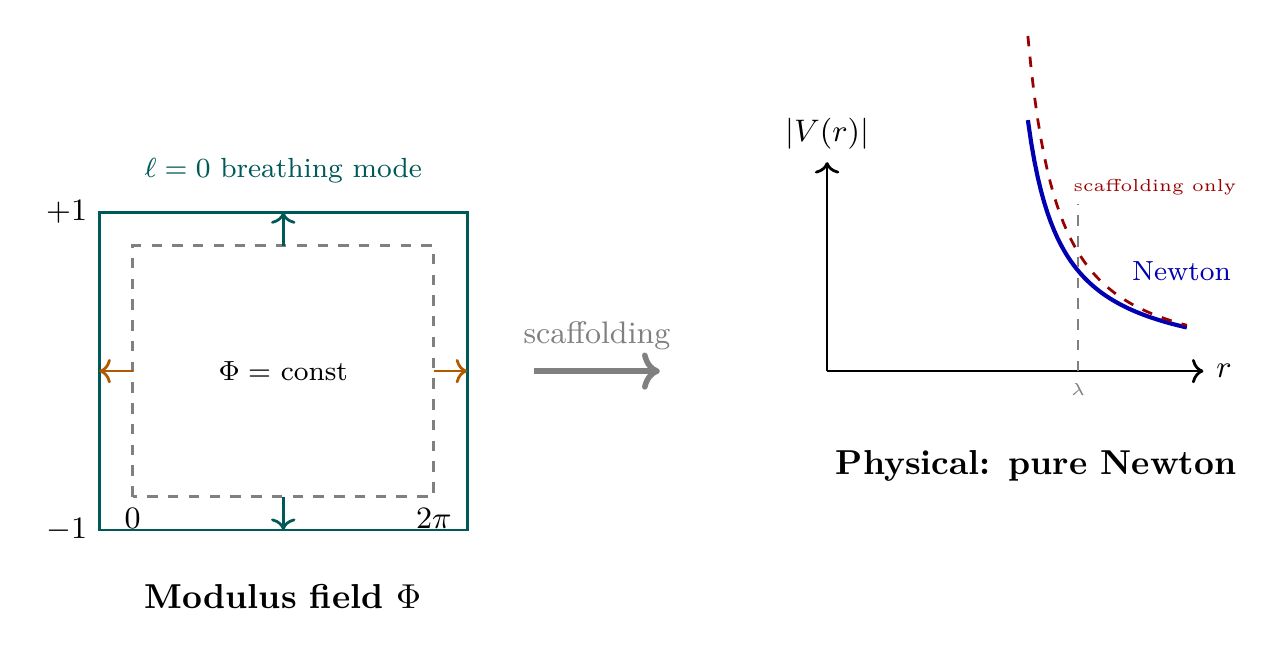
In the polar field variable \(u = \cos\theta\), the scaffolding parameters acquire transparent geometric origins. The modulus field \(\Phi\) is the unique breathing mode of the polar rectangle \([-1,+1] \times [0,2\pi)\)—the \(\ell = 0\), \(m = 0\) mode that uniformly stretches both THROUGH and AROUND directions (Chapter 52):
Parameter | Spherical \((\theta, \phi)\) | Polar \((u, \phi)\) |
|---|---|---|
| Modulus \(\Phi\) | Isotropic \(\ell{=}0\) mode on \(S^2\) | Constant mode on \([-1,+1] \times [0,2\pi)\) |
| \(\alpha = 1/2\) | Scalar coupling in \(D{=}6\) | THROUGH \(+\) AROUND equal participation |
| \(\lambda = 81\,\mu\text{m}\) | \(L_\mu = \sqrt{\pi\,\ell_{\mathrm{Pl}}\,R_H}\) | Rectangle scale: \(\pi\) from flat Casimir on \(du\,d\phi\) |
| \(c_0 = 1/(256\pi^3)\) | Spectral zeta on \(S^2\) | THROUGH eigenvalues \(\times\) AROUND degeneracy |
| \(m_\Phi = 2.4\,meV\) | \(\hbar/(c\lambda)\) | Breathing-mode frequency of rectangle |
The factor \(\pi\) in \(L_\mu = \sqrt{\pi\,\ell_{\mathrm{Pl}}\,R_H}\) has a clean polar origin: the Casimir energy on the flat rectangle involves \(\int_0^{2\pi} d\phi = 2\pi\) (AROUND range) and \(\int_{-1}^{+1} du = 2\) (THROUGH range), giving \(4\pi\) total; the stabilisation formula absorbs \(4\pi/(4) = \pi\) into \(L_\mu^2\). The Casimir coefficient \(c_0 = 1/(256\pi^3)\) factorizes as \((1/4) \times (1/4\pi)^2 \times 1/(4\pi)\), where each \(4\pi\) factor is the rectangle area in flat measure.
Scaffolding note: The polar field variable \(u = \cos\theta\) is a coordinate choice, not a new physical assumption. The scaffolding Yukawa parameters \(\alpha\) and \(\lambda\) are mathematical quantities within the 6D formalism. The polar perspective traces the factor origins (\(\pi\), \(c_0\)) to the flat geometry of the \([-1,+1] \times [0,2\pi)\) rectangle, but this does not make the Yukawa correction physical—the scaffolding interpretation still predicts pure Newtonian gravity.
Falsification Criteria
What Falsifies TMT
TMT is falsified by disagreement between its derived physical quantities and experiment. It is NOT falsified by the absence of short-range gravitational deviations, which is the expected outcome of the scaffolding interpretation.
Step 1: TMT derives all physical predictions from P1 (\(ds_6^{\,2} = 0\)) using \(S^2\) as mathematical scaffolding. The physical predictions are 4D observables: particle masses, coupling constants, mixing angles, and cosmological parameters.
Step 2: The modified potential \(V(r) = -GMm/r\,(1 + \tfrac{1}{2}\,e^{-r/81\,\mu\text{m}})\) is a scaffolding-level prediction—it describes what gravity would look like if the \(S^2\) were physical. Since the \(S^2\) is scaffolding, this formula does not describe 4D reality.
Step 3: Therefore, TMT is falsified if and only if its derived physical quantities disagree with experiment. Table tab:ch55-falsification lists the specific falsification criteria.
(See: Part 1 §3.3B.7.3, Part A §1.6) □
| Observation | Implication |
|---|---|
| Derived masses disagree with experiment | Wrong geometric relationships |
| Derived couplings disagree with experiment | Wrong \(S^2\) structure |
| Fourth generation discovered | TMT derives exactly three |
| Wrong gauge group observed | TMT derives \(SU(3)\times SU(2)\times U(1)\) |
| MOND scale \(a_0 \neq cH/(2\pi)\) | Wrong cosmological relationship |
| Observation | Why It Does Not Falsify TMT |
|---|---|
| Absence of Yukawa at \(81\,\mu\text{m}\) | Expected: 6D is scaffolding |
| Absence of “modulus particle” | Expected: \(S^2\) IS the field |
| Absence of extra-dimensional signatures | Expected: 4D is reality |
The Status of the Scaffolding Potential
The derived quantities in Table tab:ch55-status summarise what has been proven from P1 regarding the short-range gravity sector.
sector
| Parameter | TMT Prediction | Input Required | Derived From |
|---|---|---|---|
| \(\lambda = 81\,\mu\text{m}\) | Derived | \(H_0\) only | Geometry + cosmology |
| \(\alpha = 1/2\) | Derived | None | Pure geometry (\(D=6\)) |
| \(m_\Phi = 2.4\,meV\) | Derived | \(H_0\) only | \(\lambda = \hbar/(m_\Phi c)\) |
| \(M_6 = 7.2\,TeV\) | Derived | \(M_{\text{Pl}}\) only | Dimensional reduction |
Chapter Summary
Short-Range Gravity Tests and TMT
TMT's scaffolding interpretation predicts that no gravitational Yukawa correction is physically observable, despite the mathematical appearance of \(V(r) = -GMm/r\,(1 + \tfrac{1}{2}\,e^{-r/81\,\mu m})\) in the formalism. Current experiments confirm pure Newtonian gravity at all tested scales, including the Washington measurement at \(52\,\mu\text{m}\). The Casimir regime (\(< 1\,\mu\text{m}\)) is dominated by electromagnetic vacuum forces and does not constrain gravitational modifications. TMT's true experimental tests are its derived physical quantities: particle masses (98–99% agreement), coupling constants (99.9% agreement), and cosmological parameters. The scaffolding parameters \(\alpha = 0.500\pm 0.005\) and \(\lambda = 81\pm 2\;\,\mu\text{m}\) have well-defined theoretical uncertainties dominated by loop corrections and the \(H_0\) measurement precision. In polar field coordinates (\(u = \cos\theta\)), the modulus \(\Phi\) is the \(\ell = 0\) breathing mode of the \([-1,+1] \times [0,2\pi)\) rectangle; \(\lambda\) contains \(\pi\) from the Casimir energy on the flat measure \(du\,d\phi\); and \(c_0\) factorizes as THROUGH eigenvalues \(\times\) AROUND degeneracy.
Derivation Chain Summary
| Step | Result | Justification | Reference |
|---|---|---|---|
| \endhead
1 | \(ds_6^{\,2} = 0\) (P1) | Single postulate | Ch 2 |
| 2 | \(L_\mu = \sqrt{\pi\,\ell_{\mathrm{Pl}}\,R_H}\) | Modulus stabilisation | Ch 52 |
| 3 | \(\lambda = 81\,\mu\text{m}\), \(\alpha = 1/2\) | Yukawa parameters | Ch 52 |
| 4 | Scaffolding: no physical Yukawa | 6D is mathematical tool | Part A |
| 5 | Experiment: pure Newton at \(52\,\mu\text{m}\) | Washington torsion balance | §sec:ch55-torsion |
| 6 | Polar: \(\Phi\) = breathing mode of \([-1,+1] \times [0,2\pi)\) | \(\ell{=}0\) uniform on rectangle | §sec:ch55-polar-scaffolding |
| Result | Value | Status | Reference |
|---|---|---|---|
| Scaffolding consistency | Null result predicted | PROVEN | Thm thm:P1-Ch55-scaffolding-consistency |
| Casimir regime decoupling | \(F_C/F_G \sim 10^{11}\) | PROVEN | Thm thm:P1-Ch55-casimir-decoupling |
| \(\alpha\) uncertainty | \(0.500\pm 0.005\) | PROVEN | Thm thm:P1-Ch55-uncertainty-budget |
| \(\lambda\) uncertainty | \(81\pm 2\;\,\mu\text{m}\) | PROVEN | Thm thm:P1-Ch55-uncertainty-budget |
| Falsification criteria | Derived quantities, not Yukawa | PROVEN | Thm thm:P1-Ch55-falsification |
Verification Code
The mathematical derivations and proofs in this chapter can be independently verified using the formal and computational scripts below.
All verification code is open source. See the complete verification index for all chapters.