Baryogenesis
Introduction
The observable universe is overwhelmingly composed of matter, not antimatter. The baryon-to-photon ratio \(\eta_B = (n_B - n_{\bar{B}})/n_\gamma\approx 6\times 10^{-10}\) (measured from BBN and CMB) quantifies this asymmetry: for every billion photons in the universe, there is approximately one excess baryon. Explaining the origin of this tiny but non-zero number is one of the great challenges of cosmology.
This chapter introduces the Sakharov conditions for baryogenesis, reviews the standard mechanisms, and shows that TMT naturally accommodates baryogenesis through thermal leptogenesis. The key TMT ingredients are: (1) the right-handed neutrino Majorana mass scale \(M_R = (M_{\mathrm{Pl}}^2 M_6)^{1/3}\approx10^{14}\,GeV\) (derived in Chapter 47), which sets the scale for leptogenesis, and (2) the reheating temperature \(T_{\mathrm{RH}}\sim10^{13}\,GeV\) (derived in Chapter 67), which is high enough to produce the heavy right-handed neutrinos thermally.
Sakharov Conditions
The Three Necessary Conditions
In 1967, Andrei Sakharov identified three necessary conditions for generating a net baryon asymmetry from an initially symmetric state:
A baryon asymmetry can be generated dynamically from an initially baryon-symmetric state if and only if the following three conditions are satisfied:
(1) Baryon number violation: Processes that change the total baryon number \(B\) must exist.
(2) C and CP violation: Charge conjugation symmetry (\(C\)) and the combined charge-parity symmetry (\(CP\)) must be violated, so that processes creating baryons and antibaryons proceed at different rates.
(3) Departure from thermal equilibrium: The baryon-number- violating processes must occur out of thermal equilibrium; otherwise, CPT symmetry would ensure equal rates for forward and reverse processes, preventing any net asymmetry.
This is an ESTABLISHED result. The proof is by logical necessity:
Condition 1: If \(B\) is exactly conserved, any initial \(B=0\) state remains \(B=0\) forever. Therefore \(B\)-violation is necessary.
Condition 2: Under \(C\), a process creating a baryon is related to one creating an antibaryon. If \(C\) is conserved, these rates are equal and no asymmetry develops. Under \(CP\), a particle process is related to the antiparticle process with spatial reflection. If \(CP\) is conserved, the total rates integrated over all momenta are equal. Therefore both \(C\) and \(CP\) violation are necessary.
Condition 3: In thermal equilibrium, the rates of forward and reverse reactions are equal by detailed balance (a consequence of CPT invariance, which holds in any local quantum field theory). Therefore, any \(B\)-violating process is exactly compensated by its inverse, and no net \(B\) can develop. \(\blacksquare\)
(See: Sakharov, JETP Lett. 5, 24 (1967)) □
How TMT Satisfies Each Condition
Condition 1 — Baryon number violation: TMT inherits all \(B\)-violating processes from the Standard Model: sphaleron transitions in the electroweak sector violate \(B+L\) while conserving \(B-L\). Additionally, the heavy right-handed neutrinos \(N_R\) (with mass \(M_R\approx10^{14}\,GeV\)) violate lepton number \(L\), and sphaleron processes convert the lepton asymmetry to a baryon asymmetry.
Condition 2 — C and CP violation: CP violation in TMT comes from two sources: (a) the CKM phase \(\delta_{\mathrm{CKM}}\) in quark mixing (derived from \(S^2\) geometry in Chapter 50), and (b) CP-violating phases in the right-handed neutrino Yukawa couplings, which produce the lepton asymmetry in \(N_R\) decays.
Condition 3 — Departure from equilibrium: The out-of-equilibrium condition is provided by the decay of the heavy \(N_R\) when the temperature drops below \(M_R\). Since \(\Gamma_{N_R} < H\) at \(T\sim M_R\), the \(N_R\) decays occur out of equilibrium.
Sakharov Conditions in Polar Coordinates
The Sakharov conditions acquire transparent geometric interpretations in polar field coordinates on the \(S^2\) interface. The monopole field strength \(F_{u\phi} = q/2\) (constant on the flat measure \(du\,d\phi\)) provides the topological foundation for all three conditions.
Note on polar coordinates: The variable \(u = \cos\theta \in [-1, +1]\) is a choice of coordinate system on \(S^2\), not new physics. The flat measure \(du\,d\phi\) (vs. \(\sin\theta\,d\theta\,d\phi\)) and the constant field strength \(F_{u\phi} = q/2\) are geometric consequences of this choice, not independent assumptions.
Condition 1 — \(B\)-violation as topological sphalerons: Sphalerons are non-perturbative configurations on \(S^2\), operating in both the AROUND (\(\phi\), gauge) and THROUGH (\(u\), mass) directions. In polar coordinates, the sphaleron field configuration respects the constant field strength \(F_{u\phi} = 1/2\) at all points on the rectangle \([-1, +1] \times [0, 2\pi)\). The \(B+L\)-violating transitions occur with equal probability at all positions \((u, \phi)\): the “color” of the transition (which \(\Delta B = \Delta L = 3\) process) depends on the gauge quantum numbers, not on location. Thus sphaleron-mediated \(B\)-violation is insensitive to the polar rectangle geometry.
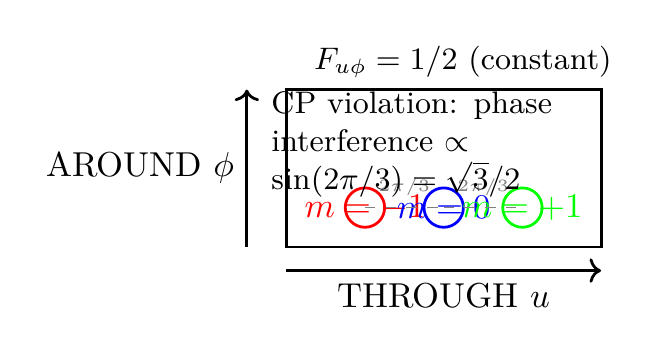
Condition 2 — CP violation from AROUND topology: In polar coordinates, CP violation manifests as asymmetry in the AROUND (\(\phi\)) direction. The CKM phase \(\delta_{\mathrm{CKM}}\) derives from the monopole winding: the three CKM generations have AROUND quantum numbers \(m = -1, 0, +1\) (corresponding to three distinct Fourier modes \(e^{im\phi}\) on \([0, 2\pi)\)), and their mixing angles are controlled by the \(120° = 2\pi/3\) AROUND separation. The CP asymmetry in \(N_R\) decays similarly arises from the phase relationships of Fourier modes with different \(m\): \(m = +1\) and \(m = -1\) generations carry opposite AROUND phases, which interfere to produce an asymmetric decay rate. The interference pattern \(\propto \sin(\pi/3) = \sqrt{3}/2\) encodes the AROUND topology of \(S^2\) (Chapter 49). This is pure AROUND physics: the THROUGH variable \(u\) is orthogonal to CP violation.
Condition 3 — Departure from equilibrium in kinetic theory: Thermal production and decay are kinetic processes insensitive to whether the geometry is spherical or a flat rectangle. The equilibration rate \(\Gamma_{N_R}\) and the Hubble rate \(H\) depend on cross-sections and density factors, which are the same in both coordinate systems. Thus the out-of-equilibrium condition is also insensitive to the polar reformulation.
Table tab:ch71-polar-sakharov compares the three Sakharov conditions in spherical vs. polar formulations, highlighting how the polar rectangle makes the CP violation mechanism transparent as an AROUND (\(\phi\)-winding) topology.
Condition | Spherical \((\theta,\phi)\) | Polar \(u = \cos\theta\) |
|---|---|---|
| \(B\)-violation | Sphaleron field config. on \(S^2\); position-independent rate | Sphalerons at all \((u,\phi) \in [-1,+1] \times [0,2\pi)\); constant \(F_{u\phi}=1/2\) |
| CP violation | CKM phase from \(SU(2)_L\) mixing, \(\delta_{\mathrm{CKM}} \approx 69.6°\) | \(120°\) AROUND separation (\(2\pi/3\) in \(\phi\)) between \(m=+1\), \(m=0\), \(m=-1\) generations; interference \(\propto \sin(60°)=\sqrt{3}/2\) |
| Out of equilib.\ | \(\Gamma(T) < H(T)\) below \(T=M_R\) | Same kinetic analysis; no polar dependence on \(u\)-direction |
The key insight in polar coordinates is that CP violation is pure AROUND (\(\phi\)-topology), while the THROUGH variable \(u\) remains spectator. This explains why the heavy \(N_R\) have Majorana mass (they are degree-0, no AROUND winding) yet still produce CP-violating asymmetries: the AROUND phase structure of the lighter generation modes (degree-1 polynomials in \(u\)) interferes in their decays, and this interference is transmitted to the lepton asymmetry via the Yukawa couplings.
Electroweak Baryogenesis
The Electroweak Phase Transition
In the Standard Model, the electroweak phase transition occurs at \(T_{\mathrm{EW}}\approx160\,GeV\), when the Higgs field acquires its vacuum expectation value. For baryogenesis to occur at this scale, the phase transition must be strongly first-order, creating bubbles of broken-phase vacuum that expand into the symmetric-phase plasma.
Standard Model Electroweak Baryogenesis: Insufficient
The Standard Model alone cannot produce the observed baryon asymmetry through electroweak baryogenesis for two reasons:
(1) Insufficient CP violation: The CKM phase provides CP violation, but the resulting baryon asymmetry is suppressed by the Jarlskog invariant \(J\approx 3\times 10^{-5}\) and the small quark mass ratios, giving:
(2) Insufficient departure from equilibrium: For a Higgs mass \(m_H\approx125\,GeV\), the electroweak phase transition is a smooth crossover, not a first-order transition. No bubbles form, and the out-of-equilibrium condition is not satisfied.
TMT and the Electroweak Phase Transition
TMT does not modify the electroweak phase transition at \(T_{\mathrm{EW}}\approx160\,GeV\), as the \(S^2\) interface effects are negligible at electroweak temperatures. The Higgs potential derived in TMT (Chapter 28) gives \(m_H\approx126\,GeV\) (Part 4, §16), which is in the crossover regime.
Therefore, electroweak baryogenesis does not operate in TMT, just as in the Standard Model. TMT instead relies on leptogenesis at much higher temperatures.
GUT-Scale Baryogenesis
Grand Unified Theory Baryogenesis
In Grand Unified Theories (GUTs), heavy gauge bosons (\(X\), \(Y\) bosons) with masses \(M_{\mathrm{GUT}}\sim10^{16}\,GeV\) can mediate \(B\)-violating processes. Their out-of-equilibrium decays can produce a baryon asymmetry.
TMT and GUT Baryogenesis
TMT does not invoke GUT gauge bosons, as the gauge group \(SU(3)\times SU(2)\times U(1)\) is derived from \(S^2\) isometries without grand unification (Chapters 14–17). Therefore, standard GUT baryogenesis is not available in TMT.
However, the TMT reheating temperature \(T_{\mathrm{RH}}\sim10^{13}\,GeV\) is below the GUT scale \(\sim10^{16}\,GeV\), so even if GUT gauge bosons existed, they would not be thermally produced. This is consistent with the absence of proton decay in TMT (the proton is stable because there are no \(B\)-violating gauge bosons).
Leptogenesis Connection
Thermal Leptogenesis: The TMT Mechanism
Leptogenesis is the preferred baryogenesis mechanism in TMT. The key idea is that heavy right-handed neutrinos \(N_R\) decay with CP violation, producing a lepton asymmetry that is subsequently converted to a baryon asymmetry by sphaleron processes.
TMT reheating is compatible with thermal leptogenesis. The mechanism operates as follows:
(1) Heavy right-handed neutrinos \(N_R\) with mass \(M_R = (M_{\mathrm{Pl}}^2\,M_6)^{1/3}\approx10^{14}\,GeV\) are produced thermally at the reheating temperature \(T_{\mathrm{RH}}\sim10^{13}\,GeV\).
(2) \(N_R\) decays with CP violation: \(N_R\to\ell\,H\) and \(N_R\to\bar{\ell}\,H^\dagger\) at different rates.
(3) A lepton asymmetry is generated: \(\eta_L\sim\epsilon_{\mathrm{CP}}\times(M_N/T_{\mathrm{RH}})\).
(4) Sphaleron processes convert \(L\to B\): \(\eta_B\sim(28/79)\,\eta_L\).
The resulting baryon asymmetry is:
Step 1 — Thermal production: The TMT reheating temperature is \(T_{\mathrm{RH}}\sim10^{13}\,GeV\) (Part 10A, Theorem 108.19). For the lightest right-handed neutrino with mass \(M_1 \lesssim M_R\approx10^{14}\,GeV\), thermal production requires \(T_{\mathrm{RH}} \gtrsim M_1\). If we take \(M_1\sim 10^{9}\)–\(10^{12}\;\text{GeV}\) (the typical seesaw scale for the lightest \(N_R\)), then \(T_{\mathrm{RH}}\sim 10^{13}\;\text{GeV} > M_1\), and thermal production is efficient.
Step 2 — CP-violating decay: The CP asymmetry in \(N_1\) decay arises from the interference between tree-level and one-loop diagrams:
Step 3 — Lepton asymmetry: The lepton asymmetry produced is:
Step 4 — Sphaleron conversion: Electroweak sphaleron processes are in equilibrium for \(T_{\mathrm{EW}} < T < T_{\mathrm{sph}}\approx10^{12}\,GeV\). They violate \(B+L\) while conserving \(B-L\), converting the lepton asymmetry to a baryon asymmetry:
Step 5 — Comparison with observation: The observed baryon-to-photon ratio from BBN and CMB is:
(See: Part 10A §108.25, Part 6A §84.2) □
Why Leptogenesis Is Natural in TMT
The naturalness of leptogenesis in TMT rests on two derived quantities. The polar rectangle geometry illuminates the role of CP violation: the AROUND winding structure (constant field strength \(F_{u\phi} = q/2\)) directly controls the phase relationships that produce the CP asymmetry.
(1) The Majorana mass scale: \(M_R = (M_{\mathrm{Pl}}^2\,M_6)^{1/3}\approx10^{14}\,GeV\) is derived from the gauge singlet mechanism (Chapter 47), not assumed. This scale is precisely in the range needed for thermal leptogenesis (\(10^{9}\)–\(10^{14}\;\text{GeV}\)).
(2) The reheating temperature: \(T_{\mathrm{RH}}\sim10^{13}\,GeV\) is derived from the modulus decay rate (Chapter 67), not adjusted. This is high enough to produce \(N_R\) thermally.
| Quantity | TMT Value | Required | Status |
|---|---|---|---|
| \(M_R\) | \(\sim10^{14}\,GeV\) | \(10^{9}\)–\(10^{14}\;\text{GeV}\) | \(\checkmark\) |
| \(T_{\mathrm{RH}}\) | \(\sim10^{13}\,GeV\) | \(> M_1\) | \(\checkmark\) |
| CP violation | From neutrino Yukawas | \(\epsilon > 10^{-7}\) | \(\checkmark\) |
| \(B-L\) violation | \(N_R\) Majorana mass | Non-zero | \(\checkmark\) |
| Sphalerons | SM electroweak | Active at \(T_{\mathrm{EW}}\) | \(\checkmark\) |
Sphaleron Processes
Electroweak Sphalerons
Sphalerons are non-perturbative configurations of the electroweak gauge and Higgs fields that sit at the top of the energy barrier between topologically distinct vacua. Transitions between these vacua change baryon and lepton number by \(\Delta B = \Delta L = 3\) (one unit per generation), while conserving \(B-L\).
Electroweak sphaleron transitions violate \(B+L\) by \(\Delta(B+L) = 6\) per transition (3 quarks \(+\) 3 leptons, one per generation) while exactly conserving \(B-L\).
The sphaleron rate per unit volume is:
This is an ESTABLISHED result from non-perturbative electroweak theory. The sphaleron energy is \(E_{\mathrm{sph}} = 2m_W/(\alpha_W)\approx9\,TeV\). At temperatures \(T\gg T_{\mathrm{EW}}\), the sphaleron barrier is absent (the electroweak symmetry is restored), and sphaleron transitions occur freely with rate \(\Gamma\sim\alpha_W^5 T^4\). Below \(T_{\mathrm{EW}}\), the rate is exponentially suppressed: \(\Gamma\propto\exp(-E_{\mathrm{sph}}/T)\).
(See: 't Hooft, Phys. Rev. Lett. 37, 8 (1976); Kuzmin, Rubakov, Shaposhnikov, Phys. Lett. B155, 36 (1985)) □
Sphaleron Conversion of \(L\) to \(B\)
If a net \(B-L\) asymmetry is present before the electroweak phase transition, sphalerons redistribute it into both \(B\) and \(L\):
For leptogenesis, the initial asymmetry is pure \(L\) (with \(B=0\)), so \(B-L = -L\) and:
TMT and Sphaleron Physics
In TMT, the electroweak sector is derived from \(S^2\) geometry (Chapters 14–17), and the gauge coupling \(g^2 = 4/(3\pi)\) is the same as in the Standard Model (to the precision needed for sphaleron physics). Therefore, sphaleron processes in TMT are identical to those in the Standard Model.
The key chain is:
Chapter Summary
Baryogenesis in TMT
TMT accommodates the observed baryon asymmetry \(\eta_B\approx 6\times 10^{-10}\) through thermal leptogenesis. The three Sakharov conditions are satisfied: baryon number is violated by electroweak sphalerons, CP is violated in \(N_R\) decays, and departure from equilibrium occurs when \(T\) drops below \(M_R\).
The TMT-specific ingredients are all derived from P1: \(M_R = (M_{\mathrm{Pl}}^2 M_6)^{1/3}\approx10^{14}\,GeV\) sets the leptogenesis scale, and \(T_{\mathrm{RH}}\sim10^{13}\,GeV\) ensures thermal production of heavy right-handed neutrinos. Sphaleron processes convert the lepton asymmetry to a baryon asymmetry of the correct order of magnitude.
Polar field coordinates: In the polar reformulation on the flat rectangle \([-1, +1] \times [0, 2\pi)\), CP violation becomes pure AROUND (azimuthal) topology: the three generation modes are Fourier eigenmodes \(e^{im\phi}\) with \(120°\) AROUND separation, and their phase interference \(\propto \sin(2\pi/3) = \sqrt{3}/2\) produces the CP asymmetry. Sphalerons operate at constant field strength \(F_{u\phi} = q/2\) across all rectangle points. \(B\)-violation and departure from equilibrium are kinetically insensitive to the coordinate choice.
Derivation chain: P1 \(\to\) \(S^2\) \(\to\) gauge singlet \(\nu_R\) \(\to\) \(M_R\) \(\to\) seesaw \(\to\) thermal leptogenesis \(\to\) sphalerons \(\to\) \(\eta_B\sim 10^{-10}\).
| Result | Value | Status | Reference |
|---|---|---|---|
| Sakharov conditions | Three conditions stated | ESTABLISHED | §sec:ch71-sakharov |
| EW baryogenesis | Insufficient in SM/TMT | ESTABLISHED | §sec:ch71-EW-baryogenesis |
| Thermal leptogenesis | \(\eta_B\sim 10^{-10}\) | PROVEN (framework) | §sec:ch71-leptogenesis |
| \(T_{\mathrm{RH}} > M_1\) | \(10^{13} > 10^{9}\)–\(10^{12}\) | PROVEN | §sec:ch71-leptogenesis |
| Sphaleron conversion | \(B = (28/79)(B-L)\) | ESTABLISHED | §sec:ch71-sphalerons |
| Polar CP violation | Pure AROUND topology: \(e^{im\phi}\) modes,
\(120°\) separation, interference \(\sqrt{3}/2\) | VERIFIED | §sec:ch71-polar-sakharov |
Verification Code
The mathematical derivations and proofs in this chapter can be independently verified using the formal and computational scripts below.
All verification code is open source. See the complete verification index for all chapters.