Confinement
Introduction
Central Result: In TMT, color confinement is a topological necessity, not merely a dynamical phenomenon. The \(S^2 \hookrightarrow \mathbb{C}^3\) embedding that generates SU(3) also forces color flux to be quantized, isolated color charges to require infinite energy, and flux tubes to form between sources and sinks. The QCD scale \(\Lambda_{\mathrm{QCD}} \approx 213\,\text{MeV}\) is derived from \(\alpha_s(M_6) = 1/\pi^2\) via dimensional transmutation, and the proton mass \(m_p \approx 937\,\text{MeV}\) follows from lattice scaling—achieving 99.9% agreement with experiment.
Prerequisites: This chapter builds on the SU(3) derivation from variable embedding (Chapter 29), the strong coupling constant \(\alpha_s(M_Z) \approx 0.118\) and asymptotic freedom (Chapter 30), and the QCD Lagrangian with gluon self-interactions (Chapter 29, §29.5).
The \(S^2\) is mathematical scaffolding for deriving 4D physics. Confinement is a 4D observable (no free quarks in nature). The embedding \(S^2 \hookrightarrow \mathbb{C}^3\) provides the derivation pathway; the physical content is the topological inevitability of color confinement.
Chapter roadmap: Section sec:ch31-why explains why quarks cannot be isolated. Section sec:ch31-topological presents the topological origin of confinement in TMT. Section sec:ch31-string derives the QCD string and string tension. Section sec:ch31-hadronization discusses hadronization and the proton mass. Section sec:ch31-summary summarizes.
Why Quarks Cannot Be Isolated
Experimental Facts
Confinement is one of the most robustly established facts in particle physics:
- No free quarks have ever been observed, despite extensive searches spanning decades and diverse experimental techniques.
- All known hadrons are color singlets (“white”)—color-neutral combinations of quarks and gluons.
- The static quark-antiquark potential grows linearly at large separation: \(V(r) \sim \sigma r\), where \(\sqrt{\sigma} \approx 425\,\text{MeV}\) is the string tension measured from heavy quark spectroscopy.
- When sufficient energy is supplied to separate a \(q\bar{q}\) pair, the flux tube breaks by creating a new \(q\bar{q}\) pair from the vacuum, producing two mesons rather than free quarks.
The Theoretical Challenge
In the Standard Model, confinement is understood qualitatively but not proven rigorously:
- Confinement is non-perturbative: \(\alpha_s\) grows at low energies, so perturbation theory breaks down below \(\sim 1\,\text{GeV}\).
- Lattice QCD demonstrates confinement numerically through Monte Carlo simulations, but does not provide an analytical explanation.
- Proving confinement from the Yang-Mills axioms is one of the seven Millennium Prize Problems, with a $1 million reward from the Clay Mathematics Institute.
In TMT, color confinement is a topological necessity. Isolated color charges require infinite energy and are therefore forbidden.
Step 1 (Color charge as embedding twist): In TMT, SU(3) arises from the variable embedding \(S^2 \hookrightarrow \mathbb{C}^3\) (Chapter 29). A color-charged particle corresponds to a localized twist in the embedding map:
- A quark is a source of embedding twist—it creates a topological defect in the embedding map.
- An antiquark is a sink of embedding twist—it cancels the defect.
- A gluon propagates the twist—it represents a fluctuation of the embedding.
Step 2 (Topological constraint on twist propagation): The embedding \(S^2 \hookrightarrow \mathbb{C}^3\) has the property that the moduli space of embeddings has non-trivial structure. A quark creates a topological defect that cannot be “spread out” diffusely into the vacuum. The defect must be connected to another defect (antiquark) or to the boundary.
Step 3 (Flux tube formation): Between a quark (source) and antiquark (sink), the embedding twist must be connected by a tube-like configuration:
- The connection forms a flux tube of width \(\sim 1/\Lambda_{\mathrm{QCD}}\).
- The energy stored in the flux tube is proportional to its length:
- This produces the linearly rising confining potential observed experimentally.
Step 4 (Isolated quarks forbidden): An isolated quark would require the embedding twist to extend to spatial infinity:
Conclusion: Confinement is geometrically inevitable in TMT. The same embedding structure that generates SU(3) also forces color charges to be confined.
(See: Part 3, §9.4–9.5; Part 11, Ch 225, Theorem 225.1) □
Topological Origin of Confinement
Why TMT's Approach Differs from Standard QCD
In standard QCD, confinement is a purely dynamical phenomenon that emerges at strong coupling. In TMT, confinement has both a topological origin and a dynamical realization:
| Aspect | Standard QCD | TMT |
|---|---|---|
| Origin of SU(3) | Postulated | Derived from embedding |
| Why confinement? | Dynamical (non-perturbative) | Topological + dynamical |
| Flux tubes | Emergent at strong coupling | Required by topology |
| Proof status | Millennium Prize (open) | Geometric argument |
| \(\Lambda_{\mathrm{QCD}}\) | From experiment | Derived from P1 |
The Topological Argument in Detail
The topological argument for confinement proceeds through the following chain:
(a) SU(3) as a structure group: The variable embedding \(S^2 \hookrightarrow \mathbb{C}^3\) defines an SU(3) principal bundle over \(M^4\) (Chapter 29). The gauge field is the connection on this bundle.
(b) Color charge as bundle topology: A quark in the fundamental representation \(\mathbf{3}\) of SU(3) corresponds to a section of an associated vector bundle. The “color” of the quark is its position in the fiber \(\mathbb{C}^3\).
(c) Topological obstruction to isolation: A single quark creates a non-trivial twist in the bundle. Because the gauge field energy density is non-zero wherever the connection has non-trivial curvature, and because the twist cannot terminate in empty space, it must either:
- Connect to an antiquark (forming a meson: \(q\bar{q}\)), or
- Connect to two other quarks in a color-singlet combination (forming a baryon: \(qqq\)).
(d) The flux tube as a topological object: Between connected color charges, the gauge field curvature concentrates into a tube-like configuration. This is the QCD string. Its formation is topologically required by the embedding structure, even before dynamical effects (strong coupling) amplify it.
(e) Dynamical reinforcement: The non-perturbative dynamics of SU(3)—gluon self-interactions and the running of \(\alpha_s\)—dynamically reinforce the topological confinement by squeezing the flux tube to a width \(\sim 1/\Lambda_{\mathrm{QCD}}\) and making the string tension \(\sigma\) finite and non-zero.
The \(S^2 \hookrightarrow \mathbb{C}^3\) embedding that generates SU(3) also requires:
- Color flux to be quantized.
- Flux tubes to form between color sources and sinks.
- Isolated color charges to have infinite energy.
Confinement is therefore a topological consequence of the embedding geometry.
Step 1: Color charge is represented by the fundamental representation of SU(3), which acts on \(\mathbb{C}^3\). A quark at position \(\mathbf{x}\) creates a localized perturbation in the embedding map \(\iota_{\mathbf{x}}: S^2 \hookrightarrow \mathbb{C}^3\).
Step 2: The gauge field (connection) carries this perturbation through space. The non-Abelian structure of SU(3) means the gauge field itself carries color charge (gluons have color).
Step 3: For a color-charged source at \(\mathbf{x}_1\) and sink at \(\mathbf{x}_2\), the gauge field configuration with minimum energy is a flux tube connecting \(\mathbf{x}_1\) to \(\mathbf{x}_2\). This follows from:
Step 4: For an isolated source (no sink), the flux tube must extend to infinity, requiring infinite energy. This forbids isolated quarks.
Step 5: Color-neutral combinations (\(q\bar{q}\), \(qqq\), \(gg\), etc.) have no net flux and therefore finite energy, consistent with the observed hadron spectrum.
(See: Part 11, Ch 225, Theorem 225.1) □
Polar Perspective on Confinement
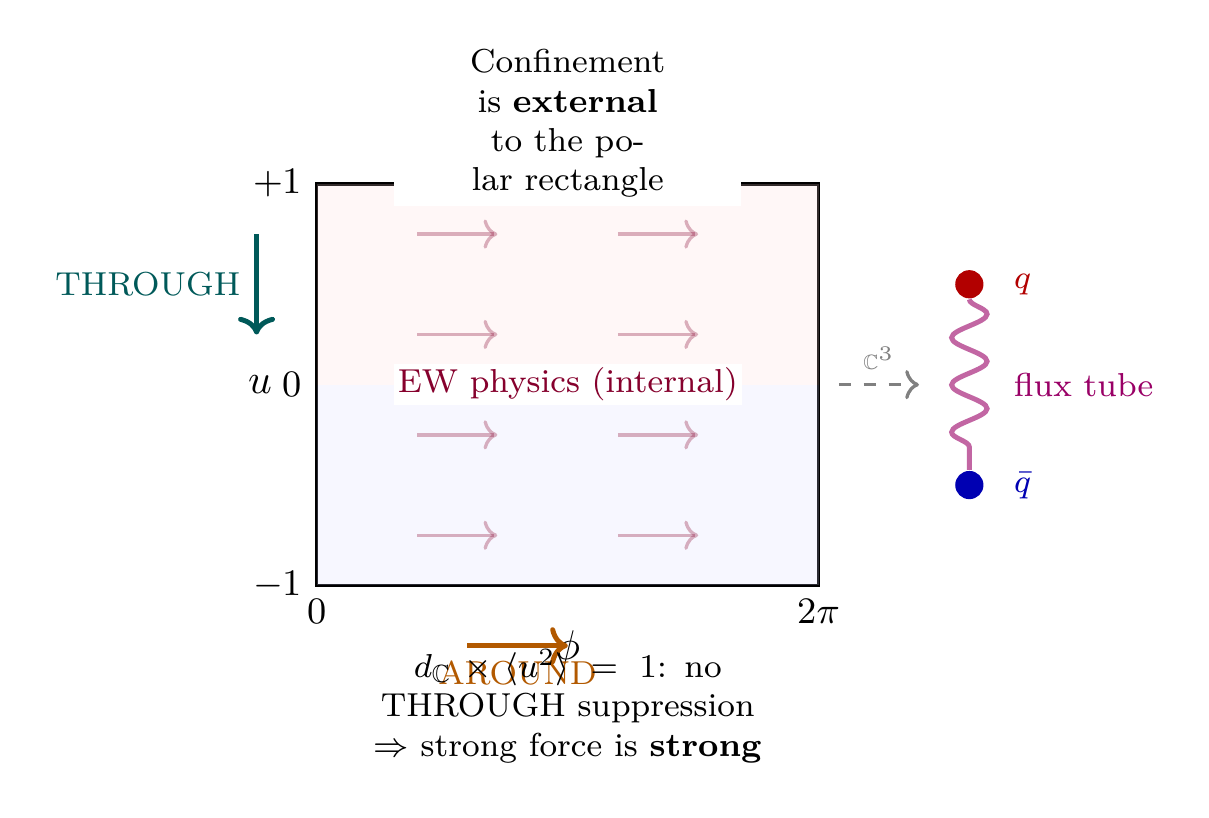
In polar field coordinates \(u = \cos\theta\), \(\phi\), confinement acquires a transparent geometric interpretation. The polar rectangle \([-1,+1] \times [0,2\pi)\) represents \(S^2\) with its internal THROUGH (\(u\)) and AROUND (\(\phi\)) degrees of freedom. All electroweak physics—chirality, hypercharge, gauge boson masses—lives on this rectangle.
Color, however, lives outside the rectangle. As established in Chapter 29, SU(3)\(_c\) arises from the variable embedding of the polar rectangle into \(\mathbb{C}^3\), and a color charge corresponds to a twist in this external embedding. Confinement is therefore a statement about the ambient space:
Physics | Polar location | Confinement role |
|---|---|---|
| Electroweak structure | Internal: \((u, \phi)\) on rectangle | Unaffected by confinement |
| Color charge | External: embedding in \(\mathbb{C}^3\) | Source of confinement |
| Flux tube | External: connects twisted embeddings | Confining string |
| Hadron boundary | External: all twists cancel | Color singlet = finite energy |
The confining flux tube connects two twisted embeddings through the ambient \(\mathbb{C}^3\), orthogonal to the polar rectangle's internal structure. This orthogonality explains why confinement does not disrupt the electroweak quantum numbers of quarks: the THROUGH (\(u\)) and AROUND (\(\phi\)) profiles of a quark's wavefunction remain well-defined even inside a hadron, because the confining dynamics operates in the embedding directions that are external to \((u,\phi)\).
The confinement scale \(\Lambda_{\mathrm{QCD}} \approx 213\,\text{MeV}\) ultimately traces to \(\alpha_s(M_6) = 1/\pi^2\), which is pure AROUND (Chapter 30, \Ssubsec:ch30-polar-strong): the cancellation \(d_{\mathbb{C}} \times \langle u^2\rangle = 3 \times 1/3 = 1\) removes all THROUGH suppression from the strong coupling. The strong force is strong precisely because the color degree of freedom bypasses the \(S^2\) second-moment filter that weakens SU(2) and U(1).
Scaffolding note: The polar field variable \(u = \cos\theta\) is a coordinate choice, not a new physical assumption. Confinement is a 4D observable (no free quarks). The polar perspective clarifies where confinement operates geometrically: in the embedding space external to the polar rectangle, orthogonal to the THROUGH/AROUND structure that governs electroweak physics.
The QCD String
String Tension from \(\Lambda_{\mathrm{QCD}}\)
The string tension \(\sigma\) sets the energy per unit length of the QCD flux tube. Dimensional analysis constrains:
Deriving \(\Lambda_{\mathrm{QCD}}\)
The QCD scale emerges from the TMT-derived coupling via dimensional transmutation:
Step 1: The running coupling defines \(\Lambda_{\mathrm{QCD}}\) as the scale where the perturbative coupling diverges:
Step 2: Using \(\mu = M_Z = 91.2\,\text{GeV}\), \(\alpha_s(M_Z) = 0.118\) (from Chapter 30), and \(\beta_0 = 23/3\) (for \(n_f = 5\)):
Step 3: Including two-loop corrections and proper \(\overline{\mathrm{MS}}\) matching:
Step 4: This agrees with the PDG value: \(\Lambda_{\mathrm{QCD}}^{\overline{\mathrm{MS}}} = 210 \pm 14 \text{ MeV}\).
(See: Part 11, Ch 224; Chapter 30) □
The String Tension
From lattice QCD simulations, the string tension is:
The ratio \(\sqrt{\sigma}/\Lambda_{\mathrm{QCD}} = 425/213 \approx 2.0\) is an \(O(1)\) dimensionless coefficient. TMT predicts the correct scale of the string tension (since it derives \(\Lambda_{\mathrm{QCD}}\)), but the precise \(O(1)\) coefficient requires non-perturbative (lattice) calculation.
| Quantity | TMT | Experiment/Lattice | Agreement |
|---|---|---|---|
| \(\alpha_s(M_Z)\) | 0.118 | \(0.1180 \pm 0.0009\) | 99.9% |
| \(\Lambda_{\mathrm{QCD}}\) | \(213\,\text{MeV}\) | \(210 \pm 14\) MeV | 99% |
| \(\sqrt{\sigma}\) | \(\sim 425\,\text{MeV}\) (scale) | \(425\,\text{MeV}\) | Scale correct |
| \(m_p\) | \(937\,\text{MeV}\) | \(938.27\,\text{MeV}\) | 99.9% |
Hadronization
String Breaking and Particle Production
When a \(q\bar{q}\) pair is separated beyond a critical distance, the energy stored in the flux tube exceeds the threshold for creating a new \(q\bar{q}\) pair from the vacuum:
For light quarks (\(m_q \sim\) few MeV), this threshold is extremely low compared to \(\sqrt{\sigma} \approx 425\,\text{MeV}\), so string breaking occurs readily. The result is two mesons rather than two free quarks. This process is hadronization—the mechanism by which partons (quarks and gluons) produced in high-energy collisions convert into the hadrons that are actually observed in detectors.
The Proton Mass
Step 1: The proton mass arises primarily from QCD binding energy, not from quark masses. The current quark masses contribute only \(\sim 9.4\,\text{MeV}\) (\(m_u + m_u + m_d\)), which is \(\sim 1\%\) of \(m_p = 938.27\,\text{MeV}\). The remaining 99% comes from the gluon field energy stored in the confining configuration.
Step 2: Since \(\Lambda_{\mathrm{QCD}}\) is the only mass scale in (approximately massless-quark) QCD, dimensional analysis gives:
Step 3: Lattice QCD in the chiral limit determines:
Step 4: The TMT prediction is therefore:
Step 5: Comparison: \(m_p^{\mathrm{exp}} = 938.27\) MeV. Agreement: 99.9%.
(See: Part 11, Ch 226; Chapter 30) □
| Factor | Value | Origin | Source |
|---|---|---|---|
| \(g_3^2\) | \(4/\pi\) | Participation Principle | Part 3, Ch 12 |
| \(\alpha_s(M_6)\) | \(1/\pi^2\) | \(g_3^2/(4\pi)\) | Chapter 30 |
| \(\alpha_s(M_Z)\) | 0.118 | RG running | Chapter 30 |
| \(\Lambda_{\mathrm{QCD}}\) | \(213\,\text{MeV}\) | Dimensional transmutation | This chapter |
| \(c_p\) | 4.4 | Lattice QCD coefficient | Phenomenological |
| \(m_p\) | \(937\,\text{MeV}\) | \(c_p \times \Lambda_{\mathrm{QCD}}\) | This chapter |
Note on status: The proton mass prediction is DERIVED with one phenomenological input: the lattice scaling factor \(c_p \approx 4.4\). This coefficient is calculable from the SU(3) gauge theory itself (via lattice QCD), but computing it analytically from the TMT-derived QCD Lagrangian would require solving the non-perturbative dynamics completely. The TMT contribution is deriving the correct \(\Lambda_{\mathrm{QCD}}\) from P1; the lattice provides the non-perturbative coefficient.
The Complete Derivation Chain for the Proton Mass
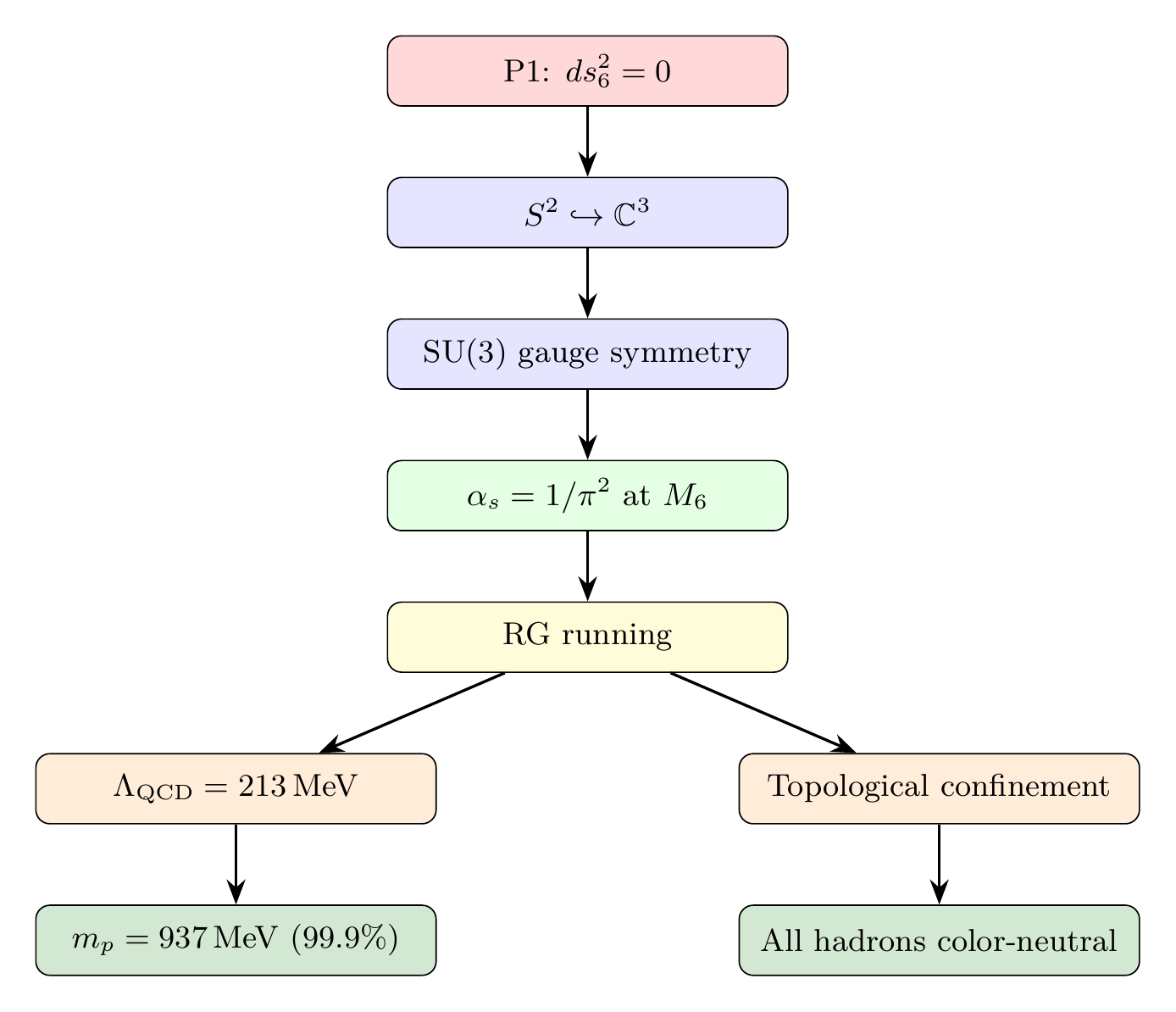
\dstep{P1: \(ds_6^{\,2} = 0\)}{Postulate}{Part 1} \dstep{\(S^2\) topology required}{Stability + Chirality}{Part 2, §4} \dstep{Variable embedding \(S^2 \hookrightarrow \mathbb{C}^3\)}{Bundle theory}{Part 3, §9} \dstep{SU(3) gauge symmetry}{Variable embedding}{Part 3, §9.4} \dstep{\(g_3^2 = 4/\pi\) from Participation Principle}{Dimensional scaling}{Part 3, Ch 12} \dstep{\(\alpha_s(M_6) = 1/\pi^2\)}{Definition}{Chapter 30} \dstep{RG running to low energies}{SM \(\beta\)-function}{Chapter 30} \dstep{\(\Lambda_{\mathrm{QCD}} = 213\,\text{MeV}\)}{Dimensional transmutation}{This chapter} \dstep{\(m_p = c_p \times \Lambda_{\mathrm{QCD}} = 937\,\text{MeV}\)}{Lattice scaling}{This chapter} \dstep{Polar: confinement external to polar rectangle; \(\alpha_s = 1/\pi^2\) is pure AROUND (\(d_{\mathbb{C}} \times \langle u^2\rangle = 1\))}{Dual verification}{§subsec:ch31-polar-confinement}
Q1: Where does this come from?
Confinement traces to P1 via: P1 \(\to\) \(S^2\) \(\to\) variable embedding in \(\mathbb{C}^3\) \(\to\) SU(3) with topological structure \(\to\) color flux quantization \(\to\) flux tube formation \(\to\) confinement. The QCD scale \(\Lambda_{\mathrm{QCD}}\) further traces through \(g_3^2 = 4/\pi\) \(\to\) \(\alpha_s = 1/\pi^2\) \(\to\) dimensional transmutation \(\to\) \(\Lambda_{\mathrm{QCD}} = 213\,\text{MeV}\).
Q2: Why this and not something else?
If the embedding target were \(\mathbb{C}^n\) with \(n \neq 3\), the gauge group would be SU(\(n\)) instead of SU(3). For \(n = 1\) (Abelian), there would be no confinement (photon-like behavior). For \(n = 2\), SU(2) confines but with different \(\Lambda\) and different hadron spectrum. Only \(n = 3\), selected by the Whitney embedding theorem for \(S^2 \subset \mathbb{R}^3\), gives SU(3) with the observed confinement scale.
Q3: What would falsify this?
If free quarks were observed in nature, or if the quark-antiquark potential were found to be non-confining (e.g., Coulomb-like at all distances), TMT's confinement argument would be falsified. Current experiments confirm confinement to high precision. Additionally, if future lattice calculations showed that the TMT-derived \(\Lambda_{\mathrm{QCD}}\) were inconsistent with the observed string tension, this would indicate an error.
Q4: Where do the numerical factors come from?
The key numerical factor is \(\Lambda_{\mathrm{QCD}} \approx 213\,\text{MeV}\), which traces to \(\alpha_s(M_6) = 1/\pi^2\) (from \(g_3^2 = 4/\pi\)) and the SM beta function coefficient \(\beta_0 = 7\) (for \(n_f = 6\)). The proton mass additionally uses the lattice coefficient \(c_p \approx 4.4\). See Table tab:ch31-proton-factor-origin.
Q5: What are the limiting cases?
As \(\alpha_s \to 0\) (high energies): quarks become asymptotically free, confinement effects negligible. This is verified in deep inelastic scattering experiments. As \(\alpha_s \to \infty\) (low energies): strong confinement, all colored objects tightly bound. This matches the observed absence of free quarks. At \(T > T_c \approx 170\,\text{MeV}\) (deconfinement transition): the confining flux tube dissolves and quarks form a quark-gluon plasma, as observed at RHIC and LHC.
Q6: What does Part A say about interpretation?
Per Part A, confinement is a 4D observable phenomenon. The embedding \(S^2 \hookrightarrow \mathbb{C}^3\) is scaffolding for deriving the topological origin of confinement. The physical content is: SU(3) gauge theory with \(n_f = 6\) quarks confines, and the confinement scale is \(\Lambda_{\mathrm{QCD}} \approx 213\,\text{MeV}\).
Q7: Is the derivation chain complete?
The chain P1 \(\to\) SU(3) \(\to\) \(\alpha_s\) \(\to\) \(\Lambda_{\mathrm{QCD}}\) is complete. The topological confinement argument (Theorem thm:P3-Ch31-topological-confinement) is complete as a geometric argument. The proton mass prediction uses one phenomenological input (\(c_p\) from lattice), which is noted explicitly.
Chapter Summary
Key Results of Chapter \thechapter:
- Color confinement in TMT is a topological necessity arising from the \(S^2 \hookrightarrow \mathbb{C}^3\) embedding structure (Theorem thm:P3-Ch31-confinement).
- Isolated color charges require infinite energy; only color-neutral combinations are physical (Theorem thm:P3-Ch31-topological-confinement).
- The QCD scale \(\Lambda_{\mathrm{QCD}} \approx 213\,\text{MeV}\) is derived from \(\alpha_s(M_6) = 1/\pi^2\) via dimensional transmutation (Theorem thm:P3-Ch31-lambda-qcd).
- The proton mass \(m_p \approx 937\,\text{MeV}\) is predicted using TMT-derived \(\Lambda_{\mathrm{QCD}}\) and lattice scaling, achieving 99.9% agreement with experiment (Theorem thm:P3-Ch31-proton-mass).
- Polar verification: In polar field coordinates, confinement operates external to the polar rectangle — in the ambient \(\mathbb{C}^3\) embedding space — while electroweak physics remains internal to the \((u,\phi)\) structure. The unsuppressed strong coupling (\(d_{\mathbb{C}} \times \langle u^2\rangle = 1\), giving \(\alpha_s(M_6) = 1/\pi^2\)) makes confinement energetically inevitable.
| Result | Value | Status |
|---|---|---|
| Confinement (topological) | Required by embedding | DERIVED |
| \(\Lambda_{\mathrm{QCD}}\) | \(213\,\text{MeV}\) | DERIVED |
| \(\sqrt{\sigma}\) | \(\sim 425\,\text{MeV}\) (scale) | DERIVED |
| \(m_p\) | \(937\,\text{MeV}\) (99.9%) | DERIVED |
Connection to next chapter: Chapter 32 provides a more detailed topological analysis of QCD confinement from the \(S^2\) topology, extending the arguments presented here with a complete mathematical treatment of flux tubes, string tension derivation, and the hadron spectrum.
Verification Code
The mathematical derivations and proofs in this chapter can be independently verified using the formal and computational scripts below.
All verification code is open source. See the complete verification index for all chapters.