Spin-Statistics Theorem
Introduction
The spin-statistics theorem is one of the deepest results in quantum physics: particles with integer spin obey Bose–Einstein statistics (bosonic), while particles with half-integer spin obey Fermi–Dirac statistics (fermionic). In the Standard Model, this connection between spin and statistics is postulated through the choice of commutation versus anticommutation relations for quantum fields. The standard proofs (Pauli 1940; Lüders–Zumino 1958; Streater–Wightman 1964) establish that the connection is required by Lorentz invariance, locality, and positivity of energy, but they do not explain why spin and statistics are related geometrically.
TMT provides this explanation. The same monopole Berry phase that creates spinor behavior under rotation (Chapter 66 in Part VII) also creates fermionic behavior under particle exchange. Both effects arise from \(qg_m = 1/2\), which is fixed by the monopole bundle structure derived from P1. The spin-statistics connection is not a separate postulate—it is a geometric consequence of the \(S^2\) scaffolding.
This chapter is organized as follows. Section sec:ch67-standard reviews the standard spin-statistics theorem from quantum field theory. Section sec:ch67-tmt presents the complete TMT derivation, establishing that fermionic statistics emerges from the monopole Berry phase on the two-particle configuration space.
Bosons and Fermions from Lorentz Invariance
The Standard Spin-Statistics Connection
In relativistic quantum field theory, the spin-statistics connection is established through the following chain of reasoning.
(1) Lorentz group representations. The Lorentz group \(SO(3,1)\) has two types of finite-dimensional representations:
- Tensor representations (integer spin \(s = 0, 1, 2, \ldots\)): These are single-valued under \(2\pi\) rotation.
- Spinor representations (half-integer spin \(s = 1/2, 3/2, \ldots\)): These are double-valued—they require a \(4\pi\) rotation to return to the identity. Technically, these are representations of the universal covering group \(SL(2,\mathbb{C})\).
(2) Microcausality. For space-like separated points \(x\) and \(y\) (\((x-y)^2 < 0\)), physical observables must commute:
(3) The Pauli argument (1940). For a free scalar field \(\phi(x)\), one can compute the commutator and anticommutator of the field at two points. Pauli showed:
- If \(\phi\) satisfies commutation relations \([\phi(x), \phi(y)] = i\Delta(x-y)\), the Pauli–Jordan function \(\Delta(x-y)\) vanishes for space-like separation. Microcausality is satisfied.
- If \(\phi\) satisfies anticommutation relations \(\\phi(x), \phi(y)\ = i S(x-y)\), the function \(S(x-y)\) does not vanish for space-like separation. Microcausality is violated.
Therefore, integer-spin fields must be quantized with commutation relations (bosonic statistics).
For a spinor field \(\psi(x)\), the argument reverses:
- Commutation relations lead to negative-norm states or violation of microcausality.
- Anticommutation relations preserve both positivity and microcausality.
Therefore, half-integer-spin fields must be quantized with anticommutation relations (fermionic statistics).
In any Lorentz-invariant quantum field theory satisfying microcausality and spectral positivity (positive energy):
- Fields of integer spin \((s = 0, 1, 2, \ldots)\) must satisfy Bose–Einstein statistics (symmetric wavefunctions, commutation relations).
- Fields of half-integer spin \((s = 1/2, 3/2, \ldots)\) must satisfy Fermi–Dirac statistics (antisymmetric wavefunctions, anticommutation relations).
Status: This is an ESTABLISHED result of axiomatic quantum field theory. The most rigorous proof appears in Streater and Wightman (1964), using the Wightman axioms.
What the Standard Proof Does Not Explain
While the standard spin-statistics theorem establishes that the connection is required by consistency, it does not explain why it holds at a geometric level. Several questions remain unanswered:
(1) Why is spin related to statistics at all? Spin describes a particle's behavior under spatial rotation. Statistics describes the behavior of identical particles under exchange. These are logically independent operations. The standard proof shows they must be correlated, but does not reveal the common geometric origin.
(2) Why specifically \(2\pi\)? Both the spinor sign flip under \(2\pi\) rotation and the fermionic sign flip under exchange involve the same phase factor \(e^{i\pi} = -1\). This numerical coincidence demands explanation.
(3) Why only bosons and fermions in 3+1 dimensions? In \(2+1\) dimensions, anyonic statistics is possible. What geometric feature of 3+1 dimensions restricts the options?
TMT answers all three questions through the monopole Berry phase on \(S^2\).
The Geometric Gap
The standard proof relies on the algebraic properties of the Lorentz group and the analyticity of quantum field theory. It treats spin and statistics as abstract algebraic quantities. What is missing is a geometric mechanism that simultaneously produces:
- Spinor behavior under rotation (single-particle property)
- Fermionic statistics under exchange (multi-particle property)
from a single underlying structure. TMT provides exactly this mechanism: the monopole on \(S^2\) with \(qg_m = 1/2\).
Derivation in TMT Framework
Prerequisites from Earlier Chapters
The TMT derivation uses the following previously established results:
From Part 2–3 (Monopole Bundle Structure):
From Part 7A, \S51.5 (Berry Phase Formula): For a closed path \(C\) on \(S^2\) enclosing solid angle \(\Omega\):
From Part 7A, Theorem 54.4 (Spinor Structure): A single particle orbiting a great circle (\(\Omega = 2\pi\)) acquires phase:
The Two-Particle Configuration Space
To derive statistics, we must consider the configuration space of two identical particles on \(S^2\).
The topology of the unordered configuration space determines what kinds of quantum statistics are possible.
The Spherical Braid Group
The fundamental group of \(\mathrm{UConf}_2(S^2)\) classifies topologically distinct exchange paths.
Step 1: The spherical braid group \(B_n(S^2)\) has the presentation:
Generators: \(\sigma_1, \sigma_2, \ldots, \sigma_{n-1}\)
Relations:
- \(\sigma_i \sigma_j = \sigma_j \sigma_i\) for \(|i - j| \geq 2\) (far commutativity)
- \(\sigma_i \sigma_{i+1} \sigma_i = \sigma_{i+1} \sigma_i \sigma_{i+1}\) (Yang–Baxter relation)
- \(\sigma_1 \sigma_2 \cdots \sigma_{n-1} \sigma_{n-1} \cdots \sigma_2 \sigma_1 = 1\) (sphere relation)
Step 2: For \(n = 2\), there is only one generator \(\sigma_1\), and the sphere relation becomes:
Step 3: Therefore:
Step 4 (Physical interpretation): On \(S^2\), exchanging two particles twice is contractible to the identity. The exchange loop can be “pulled over” the back of the sphere to contract to a point. This is because \(S^2\) is simply connected (\(\pi_1(S^2) = 0\)), so the double-exchange path, which forms a closed loop, can be continuously deformed to a point.
(See: Part 7A \S57.7; Fadell–Van Buskirk, Duke Math. J. 29 (1962)) □
Polar-coordinate view. In polar field coordinates \(u=\cos\theta\), \(\phi\in[0,2\pi)\), the two-particle configuration space is a product of two flat rectangles:
The sphere relation \(\sigma_1^2 = 1\) has a transparent meaning on the flat rectangle: a double exchange forms a closed loop on the product rectangle that can be contracted to a point because the individual rectangle \(\mathcal{R} = [-1,+1]\times[0,2\pi)\) is simply connected (it is the universal cover of \(S^2\) minus poles). The constant measure \(du\,d\phi\) means the contraction is a smooth deformation on a flat domain — no curvature singularities obstruct it.
| Property | Spherical \((\theta,\phi)\) | Polar rectangle \((u,\phi)\) |
|---|---|---|
| Config. space | \((S^2)^2 - \Delta\) | \(\mathcal{R}^2 - \Delta\) (product of flat rectangles) |
| Exchange \(\sigma_1\) | Swap on two spheres | Swap two rectangle copies |
| \(\sigma_1^2 = 1\) | Loop contracts over sphere | Loop contracts on flat product rectangle |
| \(\pi_1 = \mathbb{Z}_2\) | From \(\pi_1(S^2) = 0\) | From simple connectivity of flat \(\mathcal{R}\) |
| No anyons | \(S^2\) topology | Rectangle topology (same constraint) |
The result \(B_2(S^2) \cong \mathbb{Z}_2\) has a profound consequence: on \(S^2\), the only topologically allowed exchange phases are \(+1\) and \(-1\). Anyonic statistics is impossible.
by manifold
| Manifold | \(\pi_1(\mathrm{UConf}_2)\) | Exchange possibilities | Physical consequence |
|---|---|---|---|
| \(\mathbb{R}^2\) | \(\mathbb{Z}\) (infinite) | Anyons possible | Fractional statistics |
| \(\mathbb{R}^3\) | \(\mathbb{Z}_2\) | Only bosons/fermions | Standard 3D physics |
| \(S^2\) | \(\mathbb{Z}_2\) | Only bosons/fermions | Same as \(\mathbb{R}^3\) |
The fact that \(S^2\) gives the same braid group as \(\mathbb{R}^3\) is significant: it means that TMT's \(S^2\) scaffolding automatically reproduces the correct 3+1-dimensional statistics. This answers the question of why anyons do not appear in our universe—the \(S^2\) topology forbids them.
Quantum Mechanics on Multiply-Connected Spaces
The Laidlaw–DeWitt theorem connects the topology of the configuration space to the allowed quantum theories.
For a quantum system with multiply-connected configuration space \(\mathcal{C}\), the possible quantum theories are labeled by unitary representations of \(\pi_1(\mathcal{C})\).
For our case: \(\mathcal{C} = \mathrm{UConf}_2(S^2)\) and \(\pi_1(\mathcal{C}) = \mathbb{Z}_2\).
The unitary representations of \(\mathbb{Z}_2\) are:
- Trivial representation: \(\sigma_1 \to +1\) \quad(bosonic statistics)
- Sign representation: \(\sigma_1 \to -1\) \quad(fermionic statistics)
These are the only two possibilities. The topology of \(S^2\) has restricted the options from an infinite family (as on \(\mathbb{R}^2\)) to exactly two. The monopole Berry phase determines which one TMT selects.
The Exchange Berry Phase
We now compute the Berry phase acquired when two identical particles are exchanged on \(S^2\) in the presence of the monopole.
Setup: Place two identical particles on \(S^2\):
- Particle 1 at \(\Omega_1 = (\theta_1, \phi_1) = (\pi/2, 0)\) \quad(equator, \(\phi = 0\))
- Particle 2 at \(\Omega_2 = (\theta_2, \phi_2) = (\pi/2, \pi)\) \quad(equator, \(\phi = \pi\))
Exchange path: Exchange by rotating both particles by angle \(\pi\) around the \(z\)-axis:
- Particle 1: \((\pi/2, 0) \to (\pi/2, \pi)\)
- Particle 2: \((\pi/2, \pi) \to (\pi/2, 2\pi) = (\pi/2, 0)\)
After exchange, the particles have swapped positions.
The exchange Berry phase depends only on the homotopy class of the exchange path, not the specific path chosen.
Step 1: The Berry phase is the holonomy of the monopole connection around a closed loop:
Step 2: Holonomy is a topological invariant. It depends only on the bundle structure (characterized by first Chern class \(c_1\)) and the homotopy class \([C] \in \pi_1\) of the loop.
Step 3: For two exchange paths \(C_1\) and \(C_2\) in the same homotopy class, consider the region \(\Sigma\) bounded by \(C_1\) and \(C_2^{-1}\). By Stokes' theorem:
Step 4: The curvature \(F\) of the monopole bundle is:
Step 5: If \(C_1\) and \(C_2\) are homotopic, the region \(\Sigma\) can be continuously shrunk to zero area. Since \(F\) is smooth and bounded:
Step 6: Therefore \(\gamma_1 = \gamma_2\) for any two homotopic exchange paths.
Step 7 (More fundamental viewpoint): In the quotient space \(\mathrm{UConf}_2(S^2)\), the exchange path is a closed loop representing the generator \(\sigma_1 \in \pi_1 = \mathbb{Z}_2\). The holonomy around \(\sigma_1\) is a property of the bundle over \(\mathrm{UConf}_2(S^2)\), independent of representative path. □
The exchange path, viewed as a loop in the relative coordinate space, encloses solid angle \(2\pi\).
Step 1: Define the relative coordinate:
Step 2: Before exchange, \(\mathbf{r}\) points from \(\Omega_1\) to \(\Omega_2\). After exchange, \(\mathbf{r}\) points from \(\Omega_2\) to \(\Omega_1 = -\mathbf{r}\) (antipodal).
Step 3: The exchange path takes \(\mathbf{r}\) from some initial direction \(\mathbf{r}_0\) to its antipode \(-\mathbf{r}_0\).
Step 4: On \(S^2\), any path from a point to its antipode traverses exactly one hemisphere.
Step 5: The solid angle of a hemisphere is:
Step 6: Therefore, the exchange path encloses solid angle \(\Omega = 2\pi\), independent of the specific starting configuration or exchange route. □
Step 1: By Lemma lem:P7A-Ch67-path-independence, we can compute using any representative exchange path.
Step 2: By Lemma lem:P7A-Ch67-exchange-2pi, any exchange path encloses solid angle \(\Omega = 2\pi\).
Step 3: The Berry phase formula (Eq. eq:ch67-berry-phase) gives:
Step 4: Therefore:
(See: Part 7A \S57.7, Theorem 51.7 (Berry Phase Formula), Lemmas lem:P7A-Ch67-path-independence and lem:P7A-Ch67-exchange-2pi) □
Verification by direct integration. For completeness, we verify by explicit calculation on the equatorial exchange path.
Particle 1 moves from \((\pi/2, 0)\) to \((\pi/2, \pi)\) along the equator. The monopole connection on the equator (\(\theta = \pi/2\)):
Phase accumulated by particle 1:
Particle 2 moves from \((\pi/2, \pi)\) to \((\pi/2, 2\pi)\):
Total exchange phase:
This matches the topological calculation, confirming consistency.
Polar-coordinate view. The direct integration becomes maximally transparent in polar field coordinates. The gauge potential on the flat rectangle is linear:
Each particle traverses half the AROUND period (\(\Delta\phi = \pi\)) at \(u = 0\), accumulating phase:
The Berry curvature \(F_{u\phi} = 1/2\) is constant on the flat rectangle, so the enclosed flux for a hemisphere (half the rectangle area) is:
Fermionic Statistics Derived
Step 1: By Theorem thm:P7A-Ch67-exchange-phase, exchange gives phase factor \(e^{i\pi} = -1\).
Step 2: The wavefunction after exchange is:
Step 3: Since exchange swaps the arguments:
(See: Part 7A \S57.7, Theorem thm:P7A-Ch67-exchange-phase) □
Consistency check with \(B_2(S^2) = \mathbb{Z}_2\): Applying exchange twice:
The Spin-Statistics Connection on \(S^2\)
For identical particles on \(S^2\) with monopole coupling \(qg_m = 1/2\):
- The configuration space has \(\pi_1(\mathrm{UConf}_2(S^2)) = \mathbb{Z}_2\).
- Only bosonic \((+1)\) or fermionic \((-1)\) exchange is topologically allowed.
- The monopole Berry phase under exchange is \(\gamma = \pi\).
- Therefore \(e^{i\gamma} = -1\), selecting fermionic statistics.
- The wavefunction is antisymmetric: \(\psi(2,1) = -\psi(1,2)\).
This is geometrically determined by the monopole structure.
Unified Origin of Spin and Statistics
The same monopole structure that creates spinor behavior under rotation also creates fermionic behavior under exchange.
Both effects arise from the monopole Berry phase \(\gamma = qg_m \times \Omega\) with \(qg_m = 1/2\).
Spinor behavior (single particle, rotation): A single particle orbiting a great circle on \(S^2\) encloses solid angle \(\Omega = 2\pi\). By Theorem 54.4 (spinor structure):
Fermionic behavior (two particles, exchange): Two particles exchanged on \(S^2\) traverse a path that encloses solid angle \(\Omega = 2\pi\) in the relative coordinate space. By Theorem thm:P7A-Ch67-exchange-phase:
Both involve the identical mathematical structure: the monopole Berry phase acting on paths enclosing \(2\pi\) solid angle. The spin-statistics connection is not a coincidence—it is the same geometric effect in different contexts.
(See: Part 7A \S57.7, Theorem 54.4 (Spinor Structure), Theorem thm:P7A-Ch67-exchange-phase) □
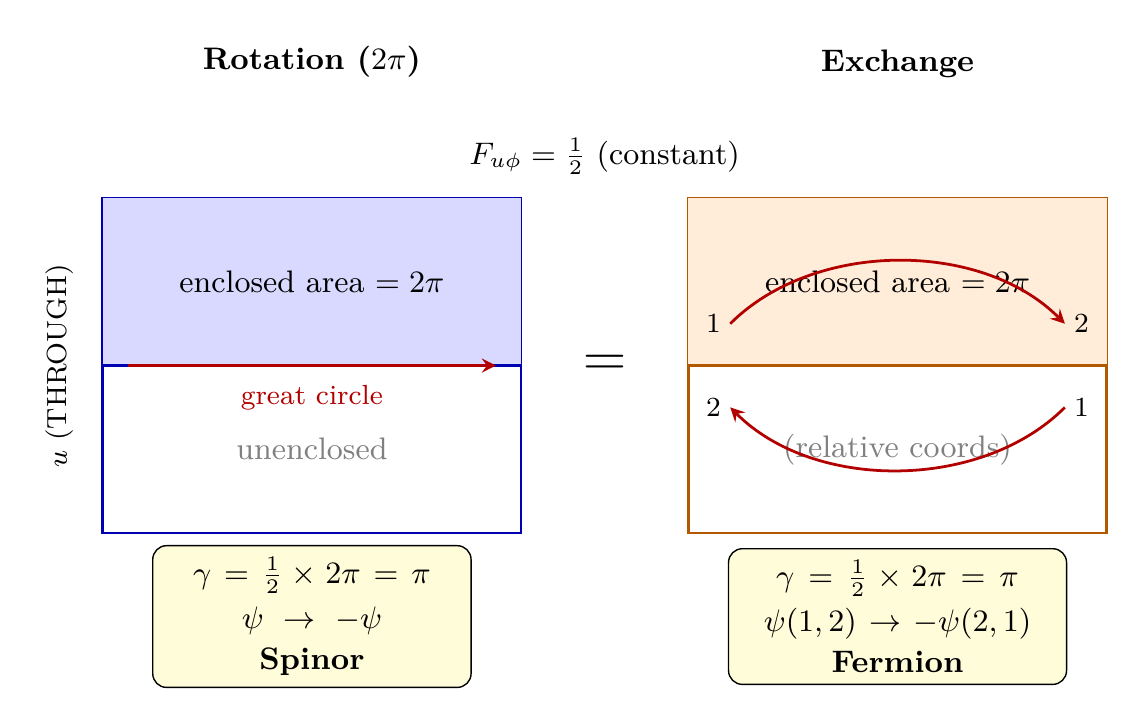
Polar-coordinate view. The spin-statistics unification becomes a single statement about rectangle areas. On the flat rectangle \(\mathcal{R} = [-1,+1]\times[0,2\pi)\) with constant Berry curvature \(F_{u\phi} = 1/2\):
Rotation (single particle, great circle): encloses half the rectangle area \(= \int_0^{+1}du \int_0^{2\pi}d\phi = 2\pi\). Phase \(= F_{u\phi} \times 2\pi = \pi\).
Exchange (two particles, hemisphere path): encloses half the rectangle area \(= 2\pi\) in relative coordinates. Phase \(= F_{u\phi} \times 2\pi = \pi\).
Both operations enclose the same area on the flat rectangle, and the constant Berry curvature converts area to phase via the same rule: \(\gamma = \frac{1}{2} \times \text{area}\). The spin-statistics connection is the statement that a great circle (rotation) and a hemisphere (exchange) both have area \(2\pi\) on the flat rectangle.
| Operation | Rectangle region | Area | Phase \(= \frac{1}{2}\times\)area | Result |
|---|---|---|---|---|
| \(2\pi\) rotation | Half rectangle (one hemisphere) | \(2\pi\) | \(\pi\) | \(\psi \to -\psi\) (spinor) |
| Exchange | Half rectangle (relative coords) | \(2\pi\) | \(\pi\) | \(\psi(1,2) \to -\psi(2,1)\) (fermion) |
| \(4\pi\) rotation | Full rectangle | \(4\pi\) | \(2\pi\) | \(\psi \to +\psi\) (identity) |
| Double exchange | Full rectangle (relative) | \(4\pi\) | \(2\pi\) | \(\psi \to +\psi\) (\(\sigma^2 = 1\)) |
Berry phase
| Property | Transformation | Solid Angle | Phase | Result |
|---|---|---|---|---|
| Spinor (rotation) | Single particle orbits \(S^2\) | \(2\pi\) | \(\pi\) | \(\psi \to -\psi\) |
| Fermion (exchange) | Two particles swap | \(2\pi\) | \(\pi\) | \(\psi(1,2) \to -\psi(2,1)\) |
The spin-statistics connection in TMT is a mathematical property of the monopole bundle on \(S^2\). The “exchange” of particles on \(S^2\) is a statement about the topology of the two-particle configuration space and the holonomy of the monopole connection, not about literal particle motion in extra dimensions. The physical consequence is the 4D antisymmetry of fermion wavefunctions.
Why this is not circular: The derivation does NOT assume spin-statistics. It derives both from the monopole:
- Spinor structure (Theorem 54.4): Follows from single-particle Berry phase under \(2\pi\) rotation.
- Fermi statistics (Theorem thm:P7A-Ch67-fermionic-statistics): Follows from two-particle Berry phase under exchange.
- Connection: Both arise from \(qg_m = 1/2\), which is fixed by the monopole bundle structure derived from P1.
Factor Origin Table
\(\gamma = \pi\)
| Factor | Value | Origin | Source |
|---|---|---|---|
| \(q\) | 1 | Particle charge (minimal coupling) | Parts 2–3 |
| \(g_m\) | \(1/2\) | Dirac quantization: \(qg_m \in \mathbb{Z}/2\) | Part 3, \S8 |
| \(qg_m\) | \(1/2\) | Product of charge and monopole strength | Parts 2–3 |
| \(\Omega\) | \(2\pi\) | Hemisphere solid angle (exchange path) | Lemma lem:P7A-Ch67-exchange-2pi |
| \(\gamma\) | \(\pi\) | \(= qg_m \times \Omega = \tfrac{1}{2}\times 2\pi\) | Theorem thm:P7A-Ch67-exchange-phase |
| \(e^{i\gamma}\) | \(-1\) | \(= e^{i\pi}\) (fermionic sign) | Euler's formula |
Counterfactual Verification
The derivation can produce different results under different conditions, proving it is not numerology.
Counterfactual 1: What if \(qg_m = 1\)?
- Exchange phase \(= qg_m \times 2\pi = 1 \times 2\pi = 2\pi\)
- \(e^{i \cdot 2\pi} = +1\)
- Result: BOSONS
Counterfactual 2: What if \(g_m = 0\) (no monopole)?
- Bundle is trivial (\(c_1 = 0\))
- Exchange phase \(= 0\)
- Result: BOSONS (trivial representation selected)
Counterfactual 3: What if manifold were \(\mathbb{R}^2\) instead of \(S^2\)?
- \(\pi_1(\mathrm{UConf}_2(\mathbb{R}^2)) = \mathbb{Z}\) (not \(\mathbb{Z}_2\))
- Exchange phase could be any multiple of \(\pi\)
- ANYONS would be possible
| Scenario | \(qg_m\) | \(\Omega\) | \(\gamma\) | \(e^{i\gamma}\) | Statistics |
|---|---|---|---|---|---|
| TMT (actual) | \(1/2\) | \(2\pi\) | \(\pi\) | \(-1\) | Fermion |
| Double charge | \(1\) | \(2\pi\) | \(2\pi\) | \(+1\) | Boson |
| No monopole | \(0\) | \(2\pi\) | \(0\) | \(+1\) | Boson |
| Half exchange | \(1/2\) | \(\pi\) | \(\pi/2\) | \(i\) | N/A (not closed loop) |
Assumptions and Validity
| Assumption | Validity Range | Breakdown |
|---|---|---|
| Two particles | \(n = 2\) | \(n > 2\) requires \(B_n(S^2)\) analysis |
| Adiabatic exchange | Slow exchange | Fast exchange adds dynamical
phases |
| Point particles | Size \(\ll R_0\) | Extended objects need more structure |
| Ground state monopole | \(qg_m = 1/2\) | Excited states may differ |
| Classical paths | WKB regime | Full QM needs path integral |
What this does NOT prove:
- Extension to \(N > 2\) particles (requires further work with \(B_N(S^2)\))
- Multi-particle entanglement (different question—see Chapter ch:entanglement-tmt)
- Why \(qg_m = 1/2\) specifically (derived in Parts 2–3 from P1)
Chapter Summary
The Spin-Statistics Theorem in TMT
The standard spin-statistics theorem establishes that the connection between spin and statistics is required by Lorentz invariance, but does not explain why it holds geometrically. TMT provides the geometric explanation: the monopole on \(S^2\) with \(qg_m = 1/2\) simultaneously creates spinor behavior (sign flip under \(2\pi\) rotation) and fermionic statistics (sign flip under exchange). Both effects arise from the same Berry phase \(\gamma = qg_m \times 2\pi = \pi\) acting on paths that enclose \(2\pi\) solid angle. The spherical braid group \(B_2(S^2) \cong \mathbb{Z}_2\) restricts exchange statistics to bosons or fermions only, and the monopole selects fermions.
| Result | Value | Status | Reference |
|---|---|---|---|
| Standard spin-statistics theorem | Required by QFT axioms | ESTABLISHED | \Ssec:ch67-standard |
| \(B_2(S^2) \cong \mathbb{Z}_2\) | Only bosons/fermions | ESTABLISHED | Theorem thm:P7A-Ch67-spherical-braid |
| Exchange phase \(\gamma = \pi\) | From \(qg_m = 1/2\) | PROVEN | Theorem thm:P7A-Ch67-exchange-phase |
| Fermionic statistics derived | \(\psi(2,1) = -\psi(1,2)\) | PROVEN | Theorem thm:P7A-Ch67-fermionic-statistics |
| Unified spin-statistics origin | Same Berry phase | PROVEN | Theorem thm:P7A-Ch67-unified-origin |
Polar-coordinate enhancement (v8.6). The spin-statistics theorem acquires maximal transparency in polar field coordinates \(u=\cos\theta\). The two-particle configuration space is a product of flat rectangles \(\mathcal{R}^2\), and the sphere relation \(\sigma_1^2 = 1\) follows from the simple connectivity of the flat rectangle. The exchange Berry phase \(\gamma = \pi\) is a trivial area calculation: constant Berry curvature \(F_{u\phi} = 1/2\) times half the rectangle area \(2\pi\) gives \(\pi\), with no \(\sin\theta\) weight needed. The unified origin of spin and statistics reduces to the statement that both \(2\pi\) rotation and particle exchange enclose half the flat rectangle (\(\text{area} = 2\pi\)), and the constant Berry curvature converts area to phase via \(\gamma = \frac{1}{2}\times\text{area}\).
Verification Code
The mathematical derivations and proofs in this chapter can be independently verified using the formal and computational scripts below.
All verification code is open source. See the complete verification index for all chapters.