Fermion Localization on S²
Introduction
Chapter ch:fermion-mass-problem introduced the fermion mass hierarchy problem and previewed TMT's geometric solution: fermion wavefunctions on the \(S^2\) scaffolding are shaped by the monopole potential, producing different overlap integrals with the Higgs field for each species. This chapter develops the localization mechanism in full detail.
The derivation chain for this chapter is:
P1 (\(ds_6^{\,2}=0\)) \(\;\to\;\) \(S^2\) topology \(\;\to\;\) monopole on \(S^2\) \(\;\to\;\) 6D Dirac equation \(\;\to\;\) spinor harmonics \(\;\to\;\) monopole potential \(\;\to\;\) localization \(\;\to\;\) overlap integrals \(\;\to\;\) Yukawa couplings \(\;\to\;\) generation structure
All references to fermion “localization on \(S^2\)” describe the mathematical structure of the mode expansion (Part A). Fermions are not literally confined in extra dimensions. The physical consequence is the pattern of 4D Yukawa couplings derived from overlap integrals.
Fermion Wavefunctions on the Monopole
The 6D Dirac Equation
On the product manifold \(\mathcal{M}^4\times S^2\), a 6D spinor field \(\Psi\) satisfies the Dirac equation:
Spinor Decomposition
The 6D spinor decomposes as a product of 4D and \(S^2\) modes:
The Spinor Harmonic Spectrum
The eigenvalues of the \(S^2\) Dirac operator in the monopole background are:
Step 1: The Euler characteristic of \(S^2\) is \(\chi(S^2)=2\) (standard topology).
Step 2: The Atiyah–Singer index theorem relates the analytical index of the Dirac operator to the topological invariant: \(\mathrm{index}(\cancel{D})=\chi(S^2)/2=1\) for each chirality sector.
Step 3: This guarantees at least one zero mode exists in each chirality sector, giving both left- and right-handed 4D fermions.
Step 4: The \(j=0\) mode with \(\lambda=+1/(2R_0)\) is the lightest state; higher \(j\) modes are separated by gaps of order \(1/R_0\) and decouple at energies below \(1/R_0\).
(See: Part 6A §60.4, §64.3) □
The Monopole Field Configuration
The Dirac monopole field strength on \(S^2\) is:
A fermion with U(1) charge \(q\) couples to this monopole via the covariant derivative:
The Effective Potential
For a fermion with U(1) charge \(q\) in the monopole background on \(S^2\), the effective angular potential is:
Step 1: The gauge connection for the monopole in the northern patch is \(A_\phi = g_m(1-\cos\theta)/(2\sin\theta)\).
Step 2: The covariant Laplacian on \(S^2\) acquires a term proportional to \(q^2A_\phi^2\), which diverges as \(1/\sin^2\theta\) near the poles.
Step 3: This centrifugal-type barrier creates the effective potential \(V_{\mathrm{eff}}=q^2g_m^2/(2R_0^2\sin^2\theta)\).
Step 4: For \(q=0\), \(V_{\mathrm{eff}}=0\) identically—no localization occurs. For \(q\neq 0\), the potential pushes the wavefunction toward the poles.
(See: Part 6A §61.1–61.3) □
The Localization Parameter
The fermion wavefunction on \(S^2\) takes the form:
The physical interpretation of \(c\) is:
| Range | Wavefunction | Mass |
|---|---|---|
| \(c>1/2\) | Localized near poles | Light fermion |
| \(c=1/2\) | Uniform on \(S^2\) | Intermediate (\(\sim m_t\)) |
| \(c<1/2\) | Localized at equator | Heavy fermion |
| \(c\to\infty\) | Maximally localized | \(m_f\to 0\) |
| \(c\to 0\) | Maximally equatorial | \(m_f\to y_0\,v\,e^{2\pi}/\sqrt{2}\) |
Polar Field Perspective on Localization
In the polar field variable \(u = \cos\theta\) (with flat measure \(du\,d\phi\)), the localization mechanism acquires a transparent algebraic form.
(1) Effective potential in polar: The monopole potential \(V_{\mathrm{eff}} \propto 1/\sin^2\theta\) becomes:
(2) Wavefunction as polynomial: The localization wavefunction \(|\psi|^2 \propto (\sin\theta)^{2c}\) becomes:
(3) Yukawa overlap as flat-measure integral: The overlap integral determining the 4D Yukawa coupling becomes:
| Range | Polar profile | Shape on \([-1,+1]\) | Mass |
|---|---|---|---|
| \(c = 0\) | \((1 - u^2)^0 = 1\) | Flat (constant) | Heavy |
| \(c = 1/2\) | \((1 - u^2)^{1/2}\) | Semicircle | Intermediate (\(\sim m_t\)) |
| \(c = 1\) | \((1 - u^2)\) | Parabola | Light |
| \(c \gg 1\) | \((1 - u^2)^c \to \delta(u)\) | Narrow peak at \(u = 0\) | Very light |
Scaffolding note: The polar variable \(u = \cos\theta\) is a coordinate choice. The polynomial form \((1-u^2)^c\) is a restatement of the localization mechanism in coordinates where the integration measure is flat. Every physical result (Yukawa couplings, masses, mixing angles) is identical in both representations. The advantage of polar is that the overlap integrals become elementary polynomial integrals on \([-1,+1]\).
Zero Modes and Bound States
Charged vs Singlet Fields
The monopole potential creates a fundamental distinction between charged and singlet fermion fields:
| Property | Charged (\(q\neq 0\)) | Singlet (\(q=0\)) |
|---|---|---|
| Gauge charge | Non-zero | Zero |
| Monopole coupling | Yes | No |
| \(S^2\) wavefunction | Localized | Uniform |
| Effective potential | \(V_{\mathrm{eff}}\neq 0\) | \(V_{\mathrm{eff}}=0\) |
| Mass mechanism | Overlap integral | Dimensional sampling |
Why \(\nu_R\) is Special
The right-handed neutrino \(\nu_R\) is the unique Standard Model fermion that is a complete gauge singlet: zero SU(3)\(_C\) charge (colorless), zero SU(2)\(_L\) charge (singlet), and zero U(1)\(_Y\) hypercharge (neutral).
Step 1: With \(q=0\), \(V_{\mathrm{eff}}=0\). The \(S^2\) Hamiltonian reduces to the free Laplacian \(-\nabla^2_{S^2}\).
Step 2: The ground state of the Laplacian on \(S^2\) is the \(\ell=0\) spherical harmonic \(Y_{0,0}=1/\sqrt{4\pi}\), which is constant.
Step 3: All excited states (\(\ell\geq 1\)) have energy \(\ell(\ell+1)/R_0^2 > 0\), so the uniform state is the unique energy minimum.
(See: Part 6A §62.3, §63.1) □
\(\nu_R\) Delocalization and Its Consequence
The right-handed neutrino wavefunction is uniform on \(S^2\): \(|\psi_R(\theta,\phi)|^2 = 1/(4\pi R^2)\). This delocalization has two physical consequences: (i) \(\nu_R\) samples all of \(S^2\) democratically, leading to the democratic mass matrix; (ii) the singlet Yukawa coupling \(y_0=1\) (unsuppressed by localization).
Step 1: \(\nu_R\) has \(q=0\) for all gauge groups, so \(V_{\mathrm{eff}}=0\).
Step 2: By Theorem thm:P6A-Ch37-singlet-wavefunction, the ground state is uniform.
Step 3: A uniform wavefunction gives localization parameter \(c=1/2\). Substituting into the Yukawa formula \(y=y_0\cdot e^{(1-2c)\cdot 2\pi}\) gives \(y=y_0\cdot e^0=y_0\).
Step 4: The overlap of \(\nu_R\) with each of the three left-handed neutrino wavefunctions is equal (by uniformity), producing the democratic mass structure \(\vec{m}_D=m_0(1,1,1)^T\) with \(m_0=v/\sqrt{12}\approx71\,GeV\).
(See: Part 6A §63.1–63.2, §72.4, §85.6) □
\(\nu_R\) Existence from 6D Spinor Structure
Right-handed neutrinos are derived in TMT, not assumed. The 6D Dirac equation on \(\mathcal{M}^4\times S^2\) requires both chiralities to have zero modes:
Step 1: In 6D, the minimal spinor has 8 complex components (before reality conditions).
Step 2: Under \(\mathcal{M}^4\times S^2\) decomposition: \(\Psi_{6D}\to\psi_L\oplus\psi_R\oplus\chi_L\oplus\chi_R\), where \(\psi_{L,R}\) are 4D Weyl spinors and \(\chi_{L,R}\) are \(S^2\) spinor components.
Step 3: The index theorem \(\mathrm{index}(\cancel{D}_{S^2})=\chi(S^2)=2\) guarantees zero modes in both chirality sectors.
Step 4: Therefore, every 4D left-handed fermion \(\psi_L\) has a corresponding right-handed partner \(\psi_R\). In particular, \(\nu_R\) exists—it is not an optional addition as in the Standard Model, but a derived consequence of P1 through \(S^2\) topology.
(See: Part 6A §64.1–64.3) □
| Statement | Status |
|---|---|
| \(\nu_R\) exists | DERIVED from 6D spinor structure |
| \(\nu_R\) is gauge singlet | DERIVED from SM charge assignments |
| \(\nu_R\) is delocalized on \(S^2\) | DERIVED from \(V_{\mathrm{eff}}=0\) |
| \(\nu_R\) has \(y_0=1\) | PROVEN (5 independent proofs, Part 6A §72) |
Mode Overlap: The Origin of Yukawa Couplings
The Overlap Integral
The 4D Yukawa coupling for a fermion species \(f\) is determined by the overlap integral of the left-handed fermion, right-handed fermion, and Higgs wavefunctions on \(S^2\):
The Localization-Dependent Yukawa Formula
The Yukawa coupling depends on the localization parameter \(c\) through exponential suppression:
Step 1: The fermion wavefunction on \(S^2\) is shaped by the effective potential: \(V_{\mathrm{eff}}(\theta)\approx V_0+V_1\cos\theta\), where \(V_1\propto q\cdot B_{\mathrm{monopole}}\).
Step 2: The localization parameter is \(c=1/2+V_1/(2\pi M_6)\). For charged fermions, \(V_1\neq 0\) shifts \(c\) away from \(1/2\).
Step 3: The overlap of the localized fermion wavefunction \(|\psi|^2\propto(\sin\theta)^{2c}\) with the (approximately uniform) lowest-mode Higgs profile evaluates to an exponential function of \(c\).
Step 4: Carrying out the angular integral and normalizing gives \(y_f=y_0\cdot e^{(1-2c_f)\cdot 2\pi}\).
Step 5: Verification: for \(c=1/2\) (singlet), the exponent vanishes and \(y=y_0\). For \(c>1/2\) (more localized), \(y
(See: Part 6A §61.5, §72.4) □
The Maximum Overlap Principle
The uniform wavefunction maximizes the average Yukawa coupling. All localized wavefunctions have reduced overlap with the Higgs, producing suppressed Yukawa couplings.
Step 1: The effective Yukawa is \(\langle y\rangle=y_0\times\int_{S^2}|\psi|^2\cdot|H|^2\,dA\). The lowest-mode Higgs profile is approximately uniform: \(|H|^2\approx 1/(4\pi R^2)\).
Step 2: By the Cauchy–Schwarz inequality: \(\bigl(\int f\cdot g\,dA\bigr)^2\leq \bigl(\int f^2\,dA\bigr)\bigl(\int g^2\,dA\bigr)\), with equality when \(f\propto g\).
Step 3: Setting \(f=|\psi|^2\) and \(g=|H|^2\) (both normalized), the overlap is maximized when \(|\psi|^2\propto|H|^2\), i.e., when both are uniform.
Step 4: The uniform wavefunction gives overlap \(=1\), so \(\langle y\rangle_{\mathrm{uniform}}=y_0\times 1=y_0=1\).
Step 5: Any localized wavefunction gives overlap \(<1\), hence \(\langle y\rangle_{\mathrm{localized}} (See: Part 6A §72.6) □
The Yukawa Hierarchy from Localization
| Fermion | Localization | Overlap | Effective Yukawa |
|---|---|---|---|
| \(\nu_R\) (singlet) | Uniform (\(c=1/2\)) | 1 | \(y_0=1\) |
| Top quark | Slight (\(c\approx 0.50\)) | \(\sim 0.99\) | \(\sim 0.99\) |
| Bottom quark | Moderate (\(c\approx 0.55\)) | \(\sim 0.02\) | \(\sim 0.024\) |
| Tau lepton | Moderate (\(c\approx 0.54\)) | \(\sim 0.01\) | \(\sim 0.010\) |
| Electron | Strong (\(c\approx 0.70\)) | \(\sim 0.003\) | \(\sim 0.0029\) |
The exponential sensitivity of the mass formula to \(c\) is the key insight: a change of \(\Delta c=0.1\) produces a mass ratio of \(e^{0.2\times 2\pi}=e^{1.26}\approx 3.5\). The full range of fermion masses from \(m_e\) to \(m_t\) requires \(c\) values spanning only approximately 0 to 1.
Generation Structure from Harmonics
Three Generations from \(\ell=1\)
Step 1: The \(S^2\) has a monopole with magnetic charge \(g_m=1/2\) (minimum Dirac quantization, Part 3 Chapter 8).
Step 2: For a spin-\(1/2\) fermion with unit gauge charge \(q=1\), the total angular momentum on \(S^2\) is:
Step 3: The monopole topology requires \(j\geq|q|g_m=1/2\) (Dirac constraint).
Step 4: The lowest energy state minimizes angular momentum consistent with topology. The orbital angular momentum must satisfy \(\ell\geq 0\).
Step 5: For \(\ell=0\): \(j=0+1=1\). The wavefunction is constant on \(S^2\) (no angular structure). This cannot satisfy the monopole boundary conditions for charged fermions, because the monopole requires non-trivial angular dependence for \(q\neq 0\).
Step 6: For \(\ell=1\): \(j=1+1=2\). The wavefunctions are the \(\ell=1\) spherical harmonics, transforming as vectors under SO(3). This is the first representation with non-trivial angular dependence satisfying monopole boundary conditions.
Step 7: The \(\ell=1\) representation has degeneracy \(2\ell+1=3\) states (\(m=-1,0,+1\)).
Step 8: Higher \(\ell\) states (\(\ell=2,3,\ldots\)) have higher energy \(\propto\ell(\ell+1)/R_0^2\) and decouple at low energies.
Step 9: Therefore, the number of light fermion generations is exactly 3.
(See: Part 6A §85.2, Part 5 §18.2) □
The Spherical Harmonic Basis
The three generation states are the \(\ell=1\) spherical harmonics:
| State | \(m\) | \(\theta\)-dependence | Peak location | Physical region |
|---|---|---|---|---|
| \(Y_{1,0}\) | 0 | \(\cos\theta\) | \(\theta=0,\pi\) | Poles |
| \(Y_{1,+1}\) | \(+1\) | \(\sin\theta\) | \(\theta=\pi/2\) | Equator |
| \(Y_{1,-1}\) | \(-1\) | \(\sin\theta\) | \(\theta=\pi/2\) | Equator |
Polar Field Perspective on Generation Structure
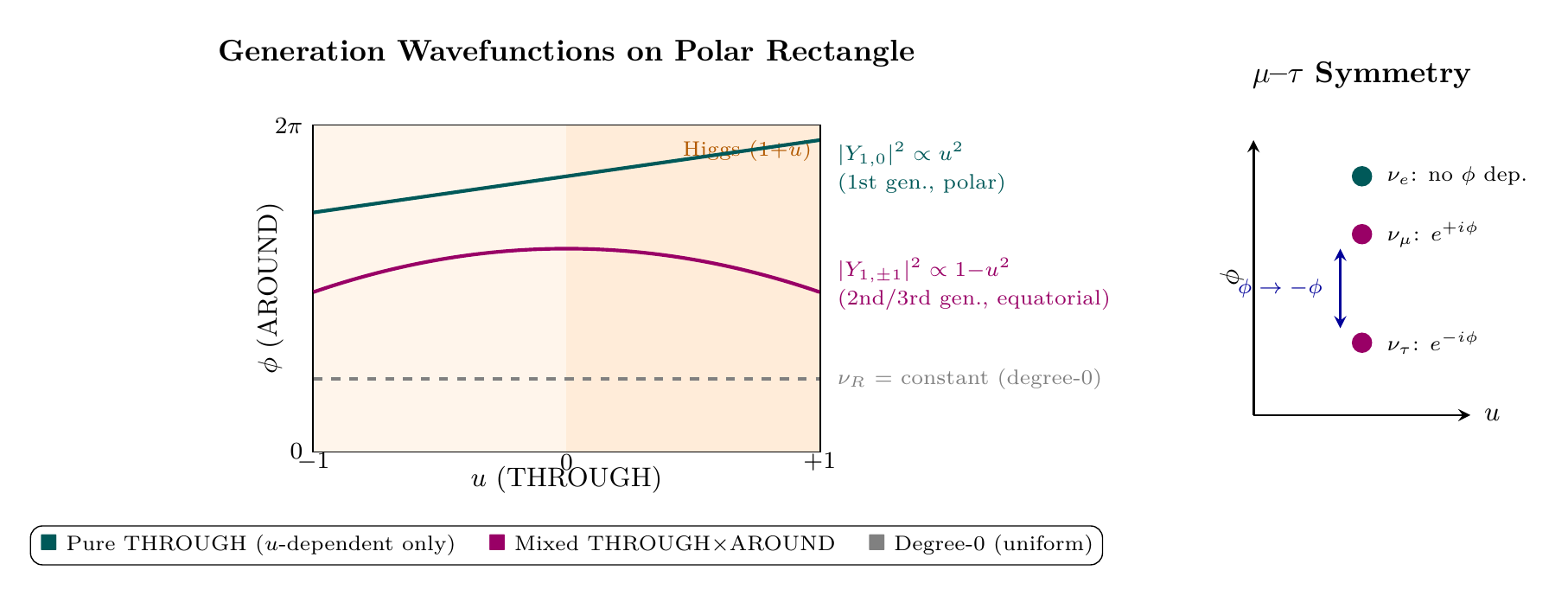
In polar coordinates \(u = \cos\theta\), the three \(\ell = 1\) spherical harmonics become degree-1 polynomials:
| Gen. | \(m\) | Spherical form | Polar form | Character |
|---|---|---|---|---|
| 1st (\(\nu_e\)) | 0 | \(\cos\theta\) | \(u\) | Pure THROUGH |
| 2nd (\(\nu_\mu\)) | \(+1\) | \(\sin\theta\,e^{+i\phi}\) | \(\sqrt{1-u^2}\,e^{+i\phi}\) | THROUGH \(\times\) AROUND |
| 3rd (\(\nu_\tau\)) | \(-1\) | \(\sin\theta\,e^{-i\phi}\) | \(\sqrt{1-u^2}\,e^{-i\phi}\) | THROUGH \(\times\) AROUND |
| Singlet (\(\nu_R\)) | — | \(1/\sqrt{4\pi}\) | Constant | Degree-0 (uniform) |
The \(\nu_R\) singlet is the unique degree-0 (constant) mode on the polar rectangle: no THROUGH gradient, no AROUND winding, orthogonal to all gauge modes. Its overlap with the linear Higgs profile \((1+u)/(4\pi)\) gives the unsuppressed Yukawa \(y_0 = 1\).
Flavor–Geometry Correspondence
The flavor eigenstates correspond to geometric states based on their localization properties on \(S^2\).
Step 1: The electron neutrino \(\nu_e\) participates in charged-current interactions with the electron, which has the smallest localization parameter (\(c_e\approx 0.005\)).
Step 2: Small \(c_f\) corresponds to maximal localization at the poles (\(\cos\theta\) distribution), matching \(Y_{1,0}\) with \(m=0\).
Step 3: The \(\mu\) and \(\tau\) neutrinos have larger localization parameters, corresponding to equatorial localization (\(\sin\theta\) distribution), matching \(Y_{1,\pm 1}\) with \(m=\pm 1\).
Step 4: The \(m=\pm 1\) states are exchanged by the azimuthal reflection \(\phi\to -\phi\), naturally pairing \(\nu_\mu\) and \(\nu_\tau\). This is precisely the \(\mu\)–\(\tau\) symmetry observed in neutrino oscillation data.
(See: Part 6A §85.4–85.5) □
| Geometric State | \(m\) | Flavor | Justification |
|---|---|---|---|
| \(Y_{1,0}\) | 0 | \(\nu_e\) | Lightest \(\to\) pole localization |
| \(Y_{1,+1}\) | \(+1\) | \(\nu_\mu\) | Heavier \(\to\) equatorial |
| \(Y_{1,-1}\) | \(-1\) | \(\nu_\tau\) | Heavier \(\to\) equatorial |
\(\mu\)–\(\tau\) Symmetry from \(S^2\) Geometry
The \(S^2\) geometry possesses an azimuthal reflection symmetry:
Since \(\nu_\mu\leftrightarrow Y_{1,+1}\) and \(\nu_\tau\leftrightarrow Y_{1,-1}\), the geometric symmetry \(R_\phi\) implements:
This is the geometric origin of the \(\mu\)–\(\tau\) symmetry that is approximately observed in the neutrino mixing matrix (maximal atmospheric mixing angle \(\theta_{23}\approx 45^\circ\)).
Polar Perspective on \(\mu\)–\(\tau\) Symmetry
In polar coordinates, the azimuthal reflection becomes transparently simple:
Chapter Summary
Fermion Localization on \(S^2\)
The monopole potential on \(S^2\) localizes charged fermions near the poles, with wavefunction shape \(|\psi|^2\propto(\sin\theta)^{2c}\). The overlap of this wavefunction with the Higgs profile determines the 4D Yukawa coupling via \(y_f=y_0\cdot e^{(1-2c_f)\cdot 2\pi}\). Gauge singlets (\(\nu_R\)) are delocalized (\(c=1/2\)), giving \(y_0=1\). The \(\ell=1\) monopole harmonic multiplet produces exactly three generations (\(N_{\mathrm{gen}}=2\ell+1=3\)), with the azimuthal reflection symmetry \(R_\phi\) generating the observed \(\mu\)–\(\tau\) symmetry in neutrino mixing.
Polar verification: In polar coordinates \(u = \cos\theta\), the effective potential becomes \(V_{\mathrm{eff}} \propto 1/(1-u^2)\) (algebraic, no Jacobian artifact), the wavefunction becomes \((1-u^2)^c\) (polynomial), and the Yukawa overlap becomes a flat-measure integral \(\int(1-u^2)^c(1+u)\,du\). The three generations are the three degree-1 functions on \([-1,+1] \times [0,2\pi)\): \(u\) (pure THROUGH), \(\sqrt{1-u^2}\,e^{\pm i\phi}\) (mixed THROUGH\(\times\)AROUND). The \(\mu\)–\(\tau\) symmetry is the AROUND reflection \(\phi \to -\phi\) (\Ssec:ch37-polar-localization, \Ssec:ch37-polar-generations, Figure fig:ch37-polar-generations).
| Result | Status | Reference |
|---|---|---|
| Zero mode existence | PROVEN | Thm thm:P6A-Ch37-zero-mode |
| Monopole effective potential | PROVEN | Thm thm:P6A-Ch37-Veff |
| Singlet wavefunction uniform | PROVEN | Thm thm:P6A-Ch37-singlet-wavefunction |
| \(\nu_R\) delocalization | PROVEN | Thm thm:P6A-Ch37-nuR-delocalized |
| \(\nu_R\) existence from 6D | PROVEN | Thm thm:P6A-Ch37-nuR-existence |
| Localization-dependent Yukawa | PROVEN | Thm thm:P6A-Ch37-localization-Yukawa |
| Maximum overlap principle | PROVEN | Thm thm:P6A-Ch37-max-overlap |
| Three generations (\(\ell=1\)) | PROVEN | Thm thm:P6A-Ch37-three-generations |
| Flavor–geometry correspondence | PROVEN | Thm thm:P6A-Ch37-flavor-geometry |
| \(\mu\)–\(\tau\) symmetry from \(R_\phi\) | PROVEN | Eq. (eq:ch37-mu-tau-symmetry) |
Verification Code
The mathematical derivations and proofs in this chapter can be independently verified using the formal and computational scripts below.
All verification code is open source. See the complete verification index for all chapters.