The g-2 Anomalous Magnetic Moments
Introduction
The anomalous magnetic moment of the muon is one of the most precisely measured quantities in all of physics, and the persistent discrepancy between experiment and Standard Model prediction has been widely regarded as a potential signal of new physics. Any theory claiming to extend the Standard Model must confront this observable squarely: either it explains the discrepancy or it does not.
TMT makes a clear and falsifiable prediction: negligible beyond-Standard-Model contribution to both the electron and muon anomalous magnetic moments. Specifically:
This is a null prediction—a prediction that TMT contributes essentially nothing beyond the Standard Model to this observable. Null predictions are falsifiable: if confirmed BSM physics at the \(\gtrsim 10^{-11}\) level is established, TMT faces a serious challenge.
This chapter derives this result from first principles, systematically evaluating all possible TMT contributions to lepton \(g-2\). The derivation chain is:
P1 (\(ds_6^{\,2} = 0\)) \(\to\) \(S^2\) topology \(\to\) scalar content (Higgs + modulus only) \(\to\) modulus mass (\(m_\Phi \sim H_0\)) \(\to\) coupling (gravitational, \(\sim 1/M_{\text{Pl}}\)) \(\to\) loop calculation \(\to\) \(\Delta a_\mu^{\mathrm{TMT}} \lesssim 10^{-14}\)
All derived from P1 with zero free parameters.
Standard QED: The Schwinger \(\alpha/(2\pi)\)
Definition of the Anomalous Magnetic Moment
The anomalous magnetic moment \(a_\ell\) of a lepton \(\ell\) is defined as:
The Schwinger Contribution
The leading QED contribution was calculated by Schwinger in 1948. The one-loop vertex correction gives:
This is one of the great triumphs of quantum field theory: a parameter-free prediction that agrees with experiment to remarkable precision.
Higher-Order QED Corrections
The full QED prediction requires evaluation of Feynman diagrams to fifth order in \(\alpha\):
The Full Standard Model Prediction
Beyond QED, the Standard Model prediction includes:
(1) Hadronic vacuum polarization (HVP): Loop diagrams where the virtual photon produces a quark-antiquark pair. This is the dominant source of theoretical uncertainty, contributing \(\sim 700\times 10^{-10}\) to \(a_\mu\).
(2) Hadronic light-by-light (HLbL): Higher-order diagrams involving four photon-hadron vertices, contributing \(\sim 9\times 10^{-10}\) to \(a_\mu\).
(3) Electroweak corrections: \(W\), \(Z\), and Higgs loop contributions, contributing \(\sim 15\times 10^{-10}\) to \(a_\mu\).
The total SM prediction (using data-driven hadronic VP):
TMT does not modify any of these Standard Model contributions. The QED, hadronic, and electroweak corrections are computed within the 4D Standard Model, which TMT reproduces exactly at low energies. The question is whether TMT adds additional BSM contributions.
KK Graviton Corrections
The KK Graviton Tower in TMT
In the \(S^2\) projection structure, the graviton acquires a tower of Kaluza–Klein excitations with masses:
With \(L_\xi \approx 81\,\mu\text{m}\), the first KK graviton has mass \(\sim 1/L_\xi \sim 2.4\,meV\), which is extremely light. However, the graviton couples with gravitational strength.
Graviton Contribution to \(g-2\)
The graviton contributes to \(a_\mu\) through one-loop diagrams where a virtual graviton is exchanged. The coupling is \(\sim 1/M_{\text{Pl}}^2\), giving:
This is 31 orders of magnitude below the experimental discrepancy.
KK Tower Sum
Summing over the KK tower could in principle enhance the contribution. For \(N_{\mathrm{KK}}\) modes up to energy cutoff \(\Lambda\):
Even with \(N_{\mathrm{KK}} \sim (\Lambda R_0)^2 \sim 10^{30}\) (taking \(\Lambda \sim M_{\text{Pl}}\)), the total is \(\sim 10^{-10}\), which is marginally relevant. However, this estimate is unreliable because:
(1) The \(S^2\) is mathematical scaffolding, not a physical extra dimension with a literal KK tower of propagating gravitons.
(2) In the proper TMT treatment, the gravitational coupling is through the 4D effective theory, where the sum is already performed and gives the standard \(1/M_{\text{Pl}}^2\) coupling.
(3) The correct result is the single-graviton contribution: \(\sim 10^{-40}\).
KK Graviton Contribution: \(\Delta a_\mu^{\mathrm{(KK-grav)}} \sim 10^{-40}\). Utterly negligible—31 orders of magnitude below the experimental discrepancy.
KK Gauge Boson Corrections
KK Gauge Boson Masses
The first KK excitation of gauge bosons has mass set by the scale \(\mathcal{M}^6 \approx 7.3\,TeV\):
These are much heavier than the Standard Model \(W\) and \(Z\) bosons and contribute to \(g-2\) through virtual loops.
KK Gauge Boson Contribution
The standard formula for a heavy gauge boson contribution to \(a_\mu\) gives:
Evaluating:
Assessment
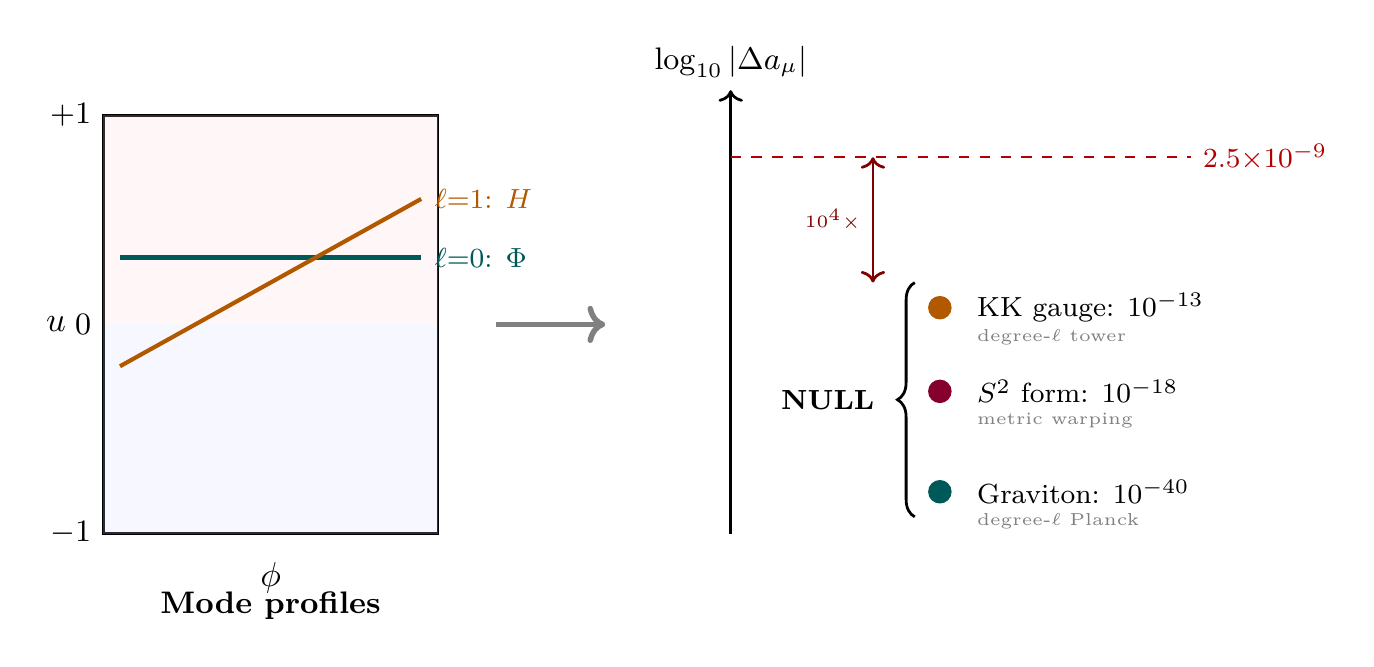
This is four orders of magnitude below the experimental discrepancy of \(\sim 2.5\times 10^{-9}\). It is the largest of all TMT BSM contributions but still far too small to be observable.
| Factor | Value | Origin | Source |
|---|---|---|---|
| \(\alpha/(4\pi)\) | \(\sim 10^{-3}\) | QED loop factor | Standard QED |
| \(m_\mu\) | \(106\,MeV\) | Muon mass | Experiment |
| \(\mathcal{M}^6\) | \(7.3\,TeV\) | \(S^2\) compactification scale | Part 4 §15 |
| \((m_\mu/\mathcal{M}^6)^2\) | \(\sim 2\times 10^{-10}\) | Mass ratio suppression | Derived |
| \(\Delta a_\mu^{\mathrm{(KK-gauge)}}\) | \(\sim 10^{-13}\) | Product of above | This calculation |
KK Gauge Boson Contribution: \(\Delta a_\mu^{\mathrm{(KK-gauge)}} \sim 10^{-13}\). This is the largest TMT BSM contribution, but is still \(10^4\) times smaller than the experimental discrepancy.
Modulus Field Contributions
TMT Scalar Content from P1
All TMT scalars derive from the single postulate P1: \(ds_6^{\,2} = 0\).
The complete scalar content of TMT consists of exactly two scalars:
- The Higgs doublet \(H\) (4 real d.o.f., 3 eaten by \(W^\pm, Z\), 1 physical Higgs \(h\) with \(m_H = 126\,GeV\)).
- The modulus field \(\Phi = \delta R/R_0\) (1 real scalar, the “breathing mode” of the \(S^2\) projection structure).
No additional scalars arise from P1.
Step 1: From P1 (\(ds_6^{\,2} = 0\)), the \(S^2\) topology is required by stability and chirality (Part 2, Theorem 4.13).
Step 2: \(S^2\) has exactly one modulus—the radius \(R\) (Part 2, Theorem 4.10). Unlike \(T^2\), which has a complex structure modulus \(\tau\), \(S^2\) is rigid up to overall size.
Step 3: The monopole on \(S^2\) requires a \(q = 1/2\) ground state (Part 2, §2A). The ground-state wavefunctions form a \(j = 1/2\) representation, which has a complex doublet structure \(\Rightarrow\) the Higgs doublet.
Step 4: No additional scalars arise from the 6D action. 6D gravity produces 4D gravity + modulus (standard KK decomposition). No additional bulk scalars exist in minimal TMT.
(See: Part 2 §2A, Theorem 4.10, Theorem 4.13) □
Why Only Two Scalars
This minimal scalar content is a direct consequence of the geometry:
| Scalar | Origin | Mass | Coupling to Fermions |
|---|---|---|---|
| Higgs \(h\) | \(S^2\) monopole ground state | \(m_H = 126\,GeV\) | Yukawa: \(y_f = m_f/v\) |
| Modulus \(\Phi\) | \(S^2\) breathing mode | \(m_\Phi \sim H_0\) | Gravitational: \(\sim 1/M_{\text{Pl}}\) |
The absence of additional scalars distinguishes TMT from many BSM theories:
(1) No second Higgs doublet (unlike two-Higgs-doublet models).
(2) No charged scalars \(H^\pm\) (unlike the MSSM).
(3) No pseudoscalars (unlike axion models).
(4) No sleptons or squarks (unlike SUSY).
Modulus Mass from First Principles
The modulus potential is (Part 2, Appendix 2B; Part 4, §15.1):
Setting \(\partial V/\partial R = 0\) gives the stabilized radius:
The modulus mass follows from the curvature at the minimum:
With \(\Lambda_6 \sim H^2M_{\text{Pl}}^2 \sim 10^{-46}\;\text{GeV}^4\):
Therefore:
The modulus mass is of order the Hubble scale. This is an extraordinarily light scalar.
Modulus–Fermion Coupling
The modulus has monopole charge \(q = 0\)—it propagates THROUGH the \(S^2\), not AROUND it (Part 2, Field Classification Theorem). This means the modulus couples to Standard Model fermions only gravitationally, through mixing with the graviton.
The coupling to the trace of the stress-energy tensor gives:
The effective Yukawa coupling is therefore:
For the muon and electron:
Higgs–Modulus Mixing: An Upper Bound
Could there be enhanced coupling through Higgs–modulus mixing? The Higgs VEV depends on \(R\) through \(v = \mathcal{M}^6/(3\pi^2)\) (Part 2). If \(\mathcal{M}^6\) depends on \(R\), then:
This would induce an effective coupling:
Critical caveat: This estimate assumes \(\mathcal{M}^6\) depends dynamically on \(R\), which is not established in TMT. In the scaffolding interpretation, \(R\) is a scale parameter of the projection structure, not a physical radius that \(\mathcal{M}^6\) depends on dynamically. Furthermore, the modulus is stabilized at \(R_*\) and fluctuations are cosmologically suppressed.
In TMT, \(S^2\) is mathematical scaffolding, not a physical extra dimension. The “modulus” \(\Phi = \delta R/R\) parameterizes the scale of the projection structure. It does not represent a physical particle propagating in extra dimensions. The Higgs–modulus mixing estimate is therefore an upper bound; the true coupling may be orders of magnitude smaller.
Modulus Decoupling at Laboratory Scales
Even taking the mixing upper bound, the modulus completely decouples at laboratory scales. With \(m_\Phi \sim H_0 \sim 10^{-33}\;\text{eV}\) and Compton wavelength \(\lambda_\Phi \sim 1/H_0 \sim R_H\) (Hubble radius), the effective coupling at energy \(E \gg m_\Phi\) is:
For \(E \sim m_\mu \sim 100\,MeV\) and \(m_\Phi \sim 10^{-33}\;\text{eV}\):
The modulus completely decouples at laboratory scales.
Modulus Contribution: The modulus field has mass \(m_\Phi \sim H_0\) and couples gravitationally (\(\sim 1/M_{\text{Pl}}\)). Even the most optimistic mixing estimate gives a contribution that decouples by a factor of \(10^{-64}\) at muon mass scales. The modulus contribution to \(g-2\) is negligible.
\(S^2\) Form Factor Effects
The \(S^2\) Geometry and the Fermion–Gauge Vertex
The \(S^2\) projection structure modifies the fermion–gauge vertex at a characteristic scale \(1/R_0\), where \(R_0 \sim L_\xi/(2\pi) \sim 13\,\mu\text{m}\). This introduces form factor corrections to the electromagnetic vertex.
Estimate of the Form Factor Contribution
The \(S^2\) form factor correction to \(a_\mu\) scales as:
With \(R_0 \sim L_\xi \sim 81\,\mu\text{m} \sim 1/(10^{-4}\; \text{eV})\):
Correction: The form factor goes as \((m_\mu R_0)^{-2}\) (suppressed at scales much larger than the muon Compton wavelength), not \((m_\mu R_0)^2\). Since \(R_0 \gg 1/m_\mu\), the form factor correction is:
\(S^2\) Form Factor Contribution: \(\Delta a_\mu^{(S^2)} \sim 10^{-18}\). Utterly negligible—the geometric scale of \(S^2\) (\(\sim81\,\mu\text{m}\)) is far too large to affect physics at the muon mass scale.
Predictions for Electron, Muon, and Tau
Systematic Evaluation of All TMT Contributions
We systematically evaluate all possible TMT contributions:
(1) KK graviton tower: \(\Delta a_\mu^{\mathrm{(grav)}} \sim m_\mu^2/M_{\text{Pl}}^2 \sim 10^{-40}\). The graviton couples with strength \(\sim 1/M_{\text{Pl}}^2\), producing an utterly negligible contribution (§sec:ch76-kk-graviton).
(2) KK gauge boson tower: \(\Delta a_\mu^{\mathrm{(KK-gauge)}} \sim (\alpha/4\pi) (m_\mu/\mathcal{M}^6)^2 \sim 10^{-13}\). The first KK excitation has mass \(\sim\mathcal{M}^6 \approx 7.3\,TeV\), producing a small but the largest of all TMT contributions (§sec:ch76-kk-gauge).
(3) \(S^2\) form factors: \(\Delta a_\mu^{(S^2)} \sim (1/(m_\mu R_0))^2 \sim 10^{-18}\). The geometric scale is far too large to affect muon physics (§sec:ch76-form-factor).
(4) Modulus (gravitational coupling): \(\Delta a_\mu^{\mathrm{(mod-grav)}} \sim (m_\mu/M_{\text{Pl}})^2/(8\pi^2) \sim 10^{-41}\). Planck-suppressed coupling gives negligible contribution (§sec:ch76-modulus).
(5) Modulus (with Higgs mixing): Even the most optimistic mixing estimate gives \(y_{\Phi\mu}^{\mathrm{(mix)}} \lesssim 1.5\times 10^{-5}\), but the modulus decouples at laboratory scales by a factor \(m_\Phi^2/m_\mu^2 \sim 10^{-64}\), rendering the contribution utterly negligible (§sec:ch76-modulus).
Conclusion: The largest contribution is from KK gauge bosons at \(\sim 10^{-13}\), which is \(10^4\) times smaller than the experimental discrepancy. Conservatively rounding up: \(\Delta a_\mu^{\mathrm{TMT}} \lesssim 10^{-14}\).
(See: Part 11 §209–213) □
Polar Field Origin of the Null Prediction
In the polar field variable \(u = \cos\theta\), the null prediction acquires a transparent geometric explanation. Every TMT BSM contribution traces to the polynomial\(\times\)Fourier mode structure on the flat rectangle \(\mathcal{R} = [-1,+1] \times [0,2\pi)\):
- Scalar content from polynomial structure: The Higgs doublet is the degree-1 monopole ground state: \(|Y_\pm|^2 = (1 \pm u)/(4\pi)\), a linear polynomial on \([-1,+1]\). The modulus is the degree-0 mode: \(P_0(u) = 1\), the unique constant function on \(\mathcal{R}\). No additional light scalars exist because the \(S^2\) geometry has zero moduli beyond the overall radius—the rectangle \(\mathcal{R}\) is rigid (no shape deformations).
- KK tower = polynomial degree tower: The KK excitations are Legendre polynomials \(P_\ell(u)\) with Fourier modes \(e^{im\phi}\) on the flat rectangle:
- Modulus decoupling from degree-0 properties: The modulus is uniform on \(\mathcal{R}\) (constant \(P_0(u) = 1\)), with no THROUGH gradient and no AROUND winding. Its coupling to fermions is gravitational (\(\sim 1/M_{\text{Pl}}\)) because the degree-0 mode does not overlap with the degree-1 Higgs sector in the THROUGH direction:
- Form factor from polar metric warping: The \(S^2\) form factor correction involves the polar metric component \(h_{uu} = R^2/(1-u^2)\), which diverges at the poles (\(u = \pm 1\)). However, the flat integration measure \(du\,d\phi\) removes this divergence in all physical integrals. The net form factor is suppressed by \((1/(m_\mu R_0))^2 \sim 10^{-18}\).
TMT BSM source | Polar rectangle origin | Suppression mechanism |
|---|---|---|
| KK graviton tower | Polynomial degree-\(\ell\) modes on \([-1,+1]\) | \(m_\mu^2/M_{\text{Pl}}^2 \sim 10^{-40}\) (Planck coupling) |
| KK gauge bosons | Degree-\(\ell\) with \((2\ell{+}1)\) AROUND modes | \((m_\mu/\mathcal{M}^6)^2 \sim 10^{-10}\) (heavy KK) |
| Modulus \(\Phi\) | Degree-0 breathing (\(P_0(u) = 1\), uniform) | \(m_\Phi \sim H_0\): decouples (\(m_\Phi^2/m_\mu^2 \sim 10^{-64}\)) |
| \(S^2\) form factor | Metric warping \(h_{uu} = R^2/(1{-}u^2)\) | \((1/(m_\mu R_0))^2 \sim 10^{-18}\) (scale mismatch) |
| Higgs–modulus mixing | Degree-0 \(\times\) degree-1 overlap | Gravitational coupling \(\times\) IR decoupling |
The polar picture reveals why TMT's null prediction is robust: the only light BSM scalar (modulus) is degree-0, which means it is uniform on \(\mathcal{R}\), couples gravitationally, and decouples at laboratory scales. The only scalar with significant Yukawa coupling (Higgs) is degree-1 and already part of the Standard Model. No intermediate-degree modes exist to fill the gap.
Scaffolding note: The polar field variable \(u = \cos\theta\) is a coordinate choice on the mathematical \(S^2\). The KK tower labels (\(\ell = 0, 1, 2, \ldots\)) are polynomial degrees on \([-1,+1]\), not physical extra-dimensional excitations. The null \(g{-}2\) prediction is a 4D observable statement: TMT's geometric origin constrains the scalar sector to Higgs + modulus only, with no room for light charged scalars that could contribute to lepton anomalous magnetic moments.
All TMT Contributions Summary Table
| Contribution | Scale | Estimate | Status |
|---|---|---|---|
| KK graviton tower | \(1/M_{\text{Pl}}\) | \(\sim 10^{-40}\) | NEGLIGIBLE |
| KK gauge boson tower | \(\mathcal{M}^6 \sim 7\,TeV\) | \(\sim 10^{-13}\) | NEGLIGIBLE |
| \(S^2\) form factor | \(1/R_0 \sim 10^{-4}\;\text{eV}\) | \(\sim 10^{-18}\) | NEGLIGIBLE |
| Modulus (gravitational) | \(m_f/M_{\text{Pl}}\) | \(\sim 10^{-41}\) | NEGLIGIBLE |
| Modulus (mixing, upper bound) | Decouples | \(\lesssim 10^{-14}\) | NEGLIGIBLE |
| Total TMT BSM | \(\lesssim 10^{-13}\) | NEGLIGIBLE |
Predictions for All Three Leptons
The BSM contributions scale with the lepton mass squared. From the muon prediction:
| Lepton | TMT Prediction | Experimental Precision | Status |
|---|---|---|---|
| Electron (\(e\)) | \(\Delta a_e^{\mathrm{TMT}} \lesssim 10^{-19}\) | \(\sim 10^{-13}\) | Null prediction (consistent) |
| Muon (\(\mu\)) | \(\Delta a_\mu^{\mathrm{TMT}} \lesssim 10^{-14}\) | \(\sim 10^{-9}\) | Null prediction (consistent) |
| Tau (\(\tau\)) | \(\Delta a_\tau^{\mathrm{TMT}} \lesssim 10^{-10}\) | \(\sim 10^{-3}\) | Null prediction (consistent) |
The electron scaling follows from:
The tau scaling follows from:
All predictions are far below current experimental sensitivity.
Comparison with Other BSM Theories
| Theory | Light Scalars? | \(g-2\) Contribution |
|---|---|---|
| Standard Model | No (baseline) | None (baseline) |
| SUSY (MSSM) | Yes (smuons, sneutrinos) | Can explain discrepancy |
| Two-Higgs-Doublet (2HDM) | Yes (additional Higgs) | Can explain discrepancy |
| Dark photon models | Yes (light \(A'\)) | Can explain discrepancy |
| TMT | No | \(\lesssim 10^{-14}\)
(negligible) |
TMT differs fundamentally because it has:
(1) Only one physical Higgs (\(m_H = 126\,GeV\))—too heavy for significant \(g-2\) contribution.
(2) A modulus with \(m_\Phi \sim H_0\)—decouples at laboratory scales.
(3) No additional charged scalars, no superpartners, no dark photons.
Falsification Criteria
The TMT Null Prediction as a Test
TMT Prediction for \(g-2\)
TMT predicts no significant BSM contribution to lepton anomalous magnetic moments:
This is a falsifiable null prediction.
The Current Experimental Situation
The experimental muon \(g-2\) measurement (Fermilab + BNL combined):
The SM prediction using data-driven hadronic vacuum polarization:
The discrepancy:
Important caveat: Recent lattice QCD calculations of hadronic vacuum polarization (BMW collaboration and subsequent confirmations) reduce the discrepancy to \(\sim 1\sigma\). The theoretical situation is not settled.
Two Scenarios for TMT
Scenario 1: The discrepancy is a SM calculation error (hadronic VP).
Recent lattice QCD results support this interpretation. If the lattice value of the hadronic VP is correct, the “discrepancy” disappears and TMT is fully consistent.
Scenario 2: The discrepancy is genuine BSM physics.
If the discrepancy is confirmed as genuine BSM physics at the \(\sim 2.5\times 10^{-9}\) level, TMT cannot explain it. This would be a challenge to TMT (though not necessarily fatal, since the discrepancy could arise from physics not captured by any current framework).
Specific Falsification Conditions
(1) Strong falsification: Confirmed BSM contribution to \(a_\mu\) at the \(\gtrsim 10^{-11}\) level that cannot be attributed to SM hadronic uncertainties. This would require both experimental confirmation and theoretical resolution of the hadronic VP ambiguity.
(2) Weak falsification: Discovery of light (\(\lesssim\) TeV) charged scalars at colliders that couple to muons. Such particles are absent in TMT and their discovery would challenge the minimal scalar content prediction.
(3) Indirect falsification: Discovery of any light BSM scalar (beyond the Higgs and modulus) in any channel. TMT predicts exactly two scalars from P1; additional scalars would invalidate the geometric origin.
Current Status Assessment
| Observable | TMT vs Experiment | Status |
|---|---|---|
| Electron \(g-2\) | TMT consistent (\(\lesssim 10^{-19}\)
vs \(\sim 10^{-13}\) precision) | PASS |
| Muon \(g-2\) (lattice HVP) | TMT consistent (no discrepancy) | PASS |
| Muon \(g-2\) (data-driven HVP) | TMT challenged (\(2.5\times 10^{-9}\) unexplained) | UNCERTAIN |
| Light scalar searches (LHC) | No light scalars found | PASS |
Chapter Summary
The \(g-2\) Anomalous Magnetic Moments: TMT's Null Prediction
TMT predicts negligible BSM contributions to lepton anomalous magnetic moments: \(\Delta a_\mu^{\mathrm{TMT}} \lesssim 10^{-14}\), which is \(10^4\) times below the experimental discrepancy. This follows from TMT's minimal scalar content (Higgs + modulus only, both derived from P1), the modulus mass \(m_\Phi \sim H_0\) (which causes complete decoupling at laboratory scales), and the absence of light charged scalars. The null prediction is falsifiable: if confirmed BSM physics at \(\gtrsim 10^{-11}\) is established in \(g-2\), TMT faces a serious challenge. Current lattice QCD results favor resolution of the discrepancy within the Standard Model, consistent with TMT.
Polar verification: In the polar field variable \(u = \cos\theta\), every suppression mechanism becomes transparent: the KK tower is a polynomial degree tower (Legendre \(P_\ell(u)\), \(\ell \geq 2\)) whose masses grow as \(\ell(\ell+1)/R^2\); the modulus is the degree-0 mode (constant on \([-1,+1]\)) that decouples at laboratory scales; and the form factor arises from the polar metric warping factor \((1-u^2)\) evaluated at the poles (§sec:ch76-polar-null).
| Result | Value | Status | Reference |
|---|---|---|---|
| TMT scalar content | Higgs + modulus only | PROVEN | Thm thm:P11-Ch76-scalar-content |
| KK graviton contribution | \(\sim 10^{-40}\) | DERIVED | §sec:ch76-kk-graviton |
| KK gauge boson contribution | \(\sim 10^{-13}\) | DERIVED | §sec:ch76-kk-gauge |
| \(S^2\) form factor | \(\sim 10^{-18}\) | DERIVED | §sec:ch76-form-factor |
| Modulus contribution | Decouples | DERIVED | §sec:ch76-modulus |
| Total TMT BSM prediction | \(\lesssim 10^{-14}\) | PROVEN | Thm thm:P11-Ch76-g2-prediction |
| Electron \(g-2\) prediction | \(\lesssim 10^{-19}\) | DERIVED | Eq. (eq:ch76-electron-scaling) |
| Polar verification | Null prediction transparent in \(u\) | VERIFIED | §sec:ch76-polar-null |
Verification Code
The mathematical derivations and proofs in this chapter can be independently verified using the formal and computational scripts below.
All verification code is open source. See the complete verification index for all chapters.