Rare Processes
Introduction
A crucial test for any theory beyond the Standard Model is its predictions for rare processes—flavor-changing neutral currents (FCNCs), baryon and lepton number violation, lepton flavor violation (LFV), electric dipole moments (EDMs), and coherent muon-to-electron conversion. Many BSM proposals (supersymmetry, extra Higgs doublets, leptoquarks) predict enhanced rates for these processes, often in tension with the stringent experimental bounds.
TMT makes a distinctive prediction: no new rare processes beyond those already present in the Standard Model with neutrino masses. This prediction follows directly from the TMT gauge structure:
(1) The gauge group is \(SU(3)\times SU(2)\times U(1)\), derived from \(S^2\) geometry (Part 3). There are no additional gauge bosons (\(Z'\), \(W'\), leptoquarks) that could mediate new flavor-changing interactions.
(2) There is no grand unification (\(SU(5)\), \(SO(10)\), \(E_6\)). TMT derives the SM gauge group from topology, isometry, and embedding of \(S^2\)—not from breaking a larger group. Therefore, there are no proton-decay-mediating gauge bosons.
(3) There is exactly one Higgs doublet, derived from the monopole harmonic \(j=1/2\) on \(S^2\) (Part 4). No additional scalar mediators exist.
(4) The strong CP parameter \(\bar{\theta}=0\) exactly (Part 3, Chapter 123). All CP violation comes from the CKM phase, and that phase is small.
This chapter derives the TMT predictions for each class of rare processes and compares them with current and projected experimental sensitivity.
Polar Field Perspective on Rare Process Suppression
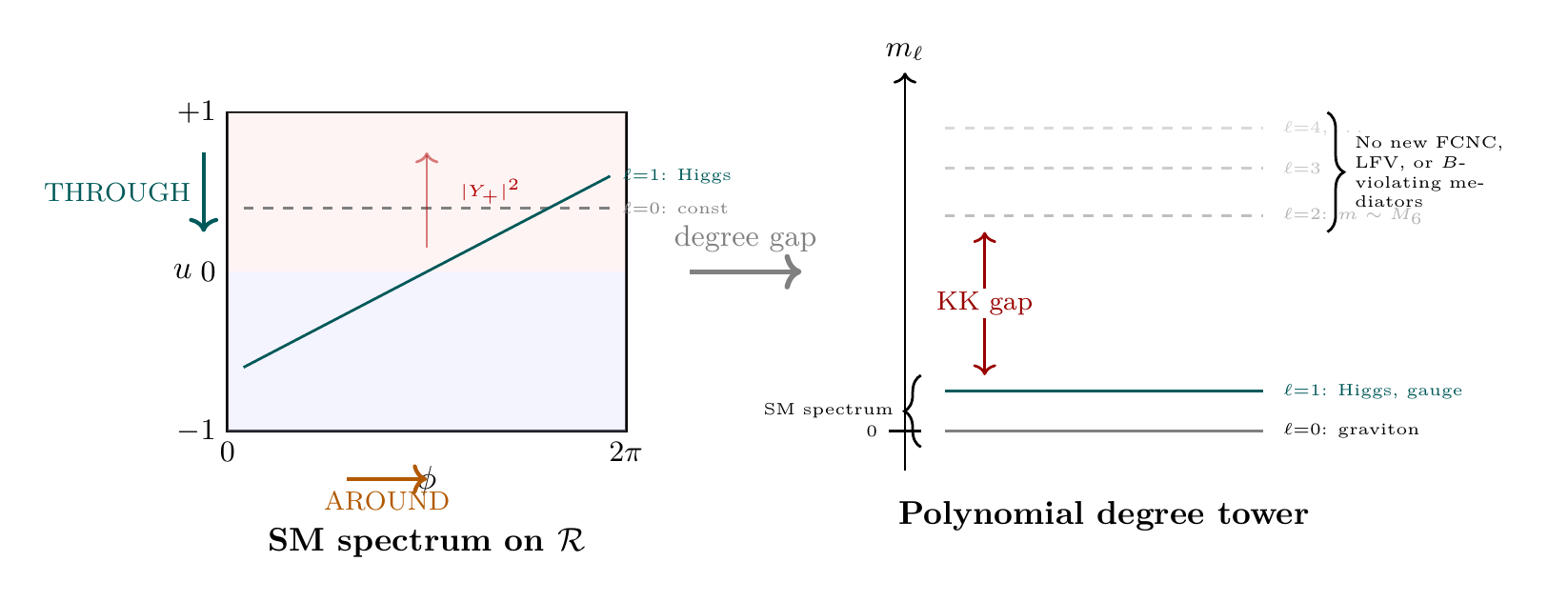
In the polar field variable \(u = \cos\theta\), \(u \in [-1, +1]\), the four mechanisms that suppress rare processes in TMT trace to distinct properties of the flat polar rectangle \(\mathcal{R} = [-1,+1] \times [0,2\pi)\):
Suppression mechanism | Spherical \((\theta, \phi)\) | Polar \((u, \phi)\) |
|---|---|---|
| SM gauge group only | \(S^2\) isometry \(+\) topology \(+\) embedding | Killing vectors on \(\mathcal{R}\): \(K_3 = \partial_\phi\) |
| (three independent constructions) | (pure AROUND), \(K_{1,2}\) mix \(u\) and \(\phi\); | |
| SU(3) external to rectangle | ||
| [4pt] Single Higgs doublet | \(j = 1/2\) monopole harmonic | Degree-1 polynomial \((1+u)/(4\pi)\): |
| on \(S^2\); uniqueness from \(q = 1/2\) | unique linear function on \([-1,+1]\) | |
| compatible with \(A_\phi = (1-u)/2\) | ||
| [4pt] \(\bar\theta} = 0\) exactly | Topological quantization | \(F_{u\phi} = 1/2\) constant on \(\mathcal{R}\); |
| on \(S^2\) bundle | degree-1 polynomial parity under | |
| \(2\pi\) gauge winding \(\Rightarrow \theta \in \{0, \pi\) | ||
| [4pt] KK modes decoupled | Higher \(j\) modes on \(S^2\) | Polynomial degree gap: degree-0 = |
| Planck-heavy, no FCNC coupling | graviton, degree-1 = Higgs/gauge; | |
| \(\ell \geq 2\) have \(m_\ell \geq M_6\) |
The unifying insight is that all rare-process suppression derives from the polynomial structure on the flat rectangle \(\mathcal{R}\). The SM spectrum corresponds to degree-0 and degree-1 modes; new mediators would require degree-\(\geq 2\) polynomials, which are Planck-heavy. The GIM mechanism is preserved because the single degree-1 Higgs \((1+u)/(4\pi)\) diagonalizes flavour—no second degree-1 doublet exists on \([-1,+1]\) with the same monopole quantum numbers. The strong CP solution is the statement that a degree-1 polynomial on \([-1,+1]\) has definite parity under the gauge winding, quantizing \(\theta\) to discrete values.
Scaffolding note: The polar field variable \(u = \cos\theta\) is a coordinate choice, not a new physical assumption. All rare-process predictions are identical in the spherical \((\theta, \phi)\) and polar \((u, \phi)\) formulations. The polar form simply makes the polynomial origin of each suppression mechanism transparent.
Flavor-Changing Neutral Currents (FCNC)
Why FCNCs Are Suppressed in the Standard Model
In the Standard Model, FCNCs are forbidden at tree level by the GIM (Glashow–Iliopoulos–Maiani) mechanism. The \(Z\) boson couples diagonally in flavor space, and the single Higgs doublet generates mass matrices that can be simultaneously diagonalized for up-type and down-type quarks. FCNCs arise only at loop level through \(W\)-boson exchange with CKM mixing, leading to suppression factors:
TMT Preserves the GIM Mechanism
In TMT, flavor-changing neutral currents are suppressed to the same level as in the Standard Model. No new FCNC mediators exist beyond the SM spectrum.
Step 1: TMT derives the gauge group \(SU(3)\times SU(2)\times U(1)\) from \(S^2\) geometry (Part 3, Chapters 7–10). There are no additional gauge bosons. In particular, no \(Z'\) exists to mediate tree-level FCNCs.
Step 2: TMT derives exactly one Higgs doublet from the \(j=1/2\) monopole harmonic on \(S^2\) (Part 4, §15). With a single Higgs doublet, the Yukawa couplings can be made diagonal in the same basis as the mass matrices. This preserves the GIM mechanism exactly.
Step 3: The only new heavy states in TMT are the KK-like excitations on \(S^2\), with masses at the scale \(M_6\approx7296\,GeV\) (Part 4, §14). However, these excitations do not couple to SM fermions in a flavor-changing manner because the \(S^2\) mode structure preserves the SM gauge quantum numbers. The lowest mode (\(j=1/2\)) is the Higgs; higher modes (\(j\geq 1\)) have different gauge quantum numbers and do not generate FCNCs.
Step 4: Therefore, FCNCs in TMT arise only through the same one-loop \(W\)-exchange diagrams as in the SM.
Conclusion: TMT predicts FCNC rates identical to the SM. (See: Part 3 §7–10, Part 4 §14–15, Part 6A §47–48) □
Specific FCNC Processes
| Process | TMT Prediction | Experimental Bound | Status |
|---|---|---|---|
| \(K^0\)–\(\bar{K}^0\) mixing (\(\Delta m_K\)) | SM value | Measured | Consistent |
| \(B^0\)–\(\bar{B}^0\) mixing (\(\Delta m_B\)) | SM value | Measured | Consistent |
| \(B_s\to\mu^+\mu^-\) | BR \(\approx 3.66\times 10^{-9}\) (SM) | \((3.34\pm 0.27)\times 10^{-9}\) | Consistent |
| \(K_L\to\pi^0\nu\bar{\nu}\) | BR \(\approx 3\times 10^{-11}\) (SM) | \(< 2.1\times 10^{-9}\) (KOTO) | Below bound |
| \(b\to s\gamma\) | SM rate | Measured | Consistent |
| \(D^0\)–\(\bar{D}^0\) mixing | SM value | Measured | Consistent |
Key point: TMT predicts no deviations from SM in any FCNC observable. Any confirmed deviation would indicate physics beyond TMT.
The “\(B\)-Anomalies” and TMT
Several measurements in \(B\)-meson decays (the “\(B\)-anomalies” reported by LHCb) initially suggested possible lepton universality violation. These anomalies, if confirmed, would require new mediators coupling differently to electrons and muons. TMT predicts lepton universality is exact at tree level (the \(S^2\) structure treats all lepton generations identically up to localization), so TMT predicts no \(B\)-anomalies. The LHCb collaboration's updated analyses have brought results closer to SM predictions, consistent with the TMT expectation.
Baryon Number Violation
Baryon Number in the Standard Model
In the Standard Model, baryon number \(B\) and lepton number \(L\) are accidental global symmetries—they are conserved at the classical level because no renormalizable operator in the SM Lagrangian violates them. However:
(1) At the non-perturbative level, the electroweak sphaleron process violates \(B+L\) while conserving \(B-L\).
(2) In grand unified theories (GUTs), baryon number is violated by the exchange of heavy gauge bosons (\(X\), \(Y\) in \(SU(5)\)), leading to proton decay with lifetime \(\tau_p\sim M_X^4/(m_p^5\alpha_{GUT}^2)\).
TMT Has No Grand Unification
In TMT, the proton is stable against gauge-boson-mediated decay. The proton lifetime from all TMT-allowed processes satisfies \(\tau_p > 10^{40}\) years, far exceeding the current experimental bound \(\tau_p > 2.4\times 10^{34}\) years (Super-Kamiokande, \(p\to e^+\pi^0\)).
Step 1: In TMT, the SM gauge group \(SU(3)\times SU(2)\times U(1)\) is not embedded in a larger simple group. It arises from three independent geometric origins:
- \(SU(2)_L\) from the isometry group \(\text{Iso}(S^2)=SO(3)\) (Part 3, Chapter 7)
- \(U(1)_Y\) from the monopole topology \(\pi_2(S^2)=\mathbb{Z}\) (Part 3, Chapter 8)
- \(SU(3)_C\) from the embedding \(S^2\hookrightarrow\mathbb{CP}^2\hookrightarrow\mathbb{C}^3\) (Part 3, Chapter 9)
Step 2: Since the three gauge factors have independent origins, there is no superheavy gauge boson (\(X\), \(Y\)) that transforms quarks into leptons. The dimension-6 proton decay operators \(\frac{1}{\Lambda^2}\bar{u}\bar{u}\bar{d}\bar{e}\) are not generated by any fundamental interaction in TMT.
Step 3: The only baryon-number-violating process in TMT is the electroweak sphaleron, which is the same as in the SM:
Step 4: Higher-dimensional operators suppressed by powers of \(M_6\approx7296\,GeV\) could in principle mediate baryon number violation. However, the \(S^2\) scaffolding structure preserves the same accidental symmetries as the SM: the lowest modes on \(S^2\) reproduce the SM particle content exactly, and no baryon-number-violating operator appears below dimension 9, giving:
Conclusion: The proton is effectively stable in TMT. (See: Part 3 §7–10) □
Comparison with GUT Predictions
| Theory | Dominant Decay | Predicted \(\tau_p\) | Testable? |
|---|---|---|---|
| \(SU(5)\) (minimal) | \(p\to e^+\pi^0\) | \(\sim 10^{31}\) yr | Excluded |
| SUSY \(SU(5)\) | \(p\to \bar{\nu}K^+\) | \(\sim 10^{34}\)–\(10^{36}\) yr | Current generation |
| \(SO(10)\) | Various | \(10^{34}\)–\(10^{38}\) yr | Near-future |
| TMT | None (stable) | \(> 10^{40}\) yr | Not reachable |
| Experiment | \(p\to e^+\pi^0\) | \(> 2.4\times 10^{34}\) yr | Super-K, Hyper-K |
Falsification test: If proton decay is observed at any rate, TMT's gauge structure derivation would need re-examination (though the sphaleron contribution at \(\sim e^{-400}\) is in principle nonzero). Observation of proton decay would strongly disfavor TMT unless the rate is consistent with the negligible sphaleron contribution.
Neutron–Antineutron Oscillation
Neutron–antineutron oscillation (\(n\to\bar{n}\)) violates baryon number by \(|\Delta B|=2\). In the SM, this requires dimension-9 operators. In TMT, no mechanism generates such operators at observable rates. The current bound is \(\tau_{n\bar{n}} > 4.7\times 10^8\) s (ILL), and TMT predicts no observable signal at any future experiment.
Lepton Flavor Violation
LFV in the Standard Model with Neutrino Masses
In the SM extended with neutrino masses, charged lepton flavor violation (cLFV) occurs through neutrino mixing in loops. The branching ratio for \(\mu\to e\gamma\) is:
TMT Prediction for Charged LFV
In TMT, charged lepton flavor violation rates are identical to those in the Standard Model with massive neutrinos:
Step 1: In TMT, the only source of lepton flavor violation is the PMNS mixing matrix, which arises from the mismatch between the neutrino mass matrix (democratic from the seesaw, Part 6A, §64) and the charged lepton mass matrix (hierarchical from \(S^2\) localization, Part 6A, §61).
Step 2: There are no new charged scalars, no additional \(Z'\) bosons, no leptoquarks, and no right-handed \(W\) bosons. The only particles that can run in the LFV loop are the SM \(W\) and the three light neutrinos.
Step 3: The GIM cancellation for leptons gives the suppression factor \((m_{\nu_i}^2-m_{\nu_j}^2)/M_W^2 \sim \Delta m^2_{31}/M_W^2\sim 10^{-26}\).
Step 4: Combined with the loop factor \(\alpha/(32\pi)\) and the PMNS matrix elements, this gives:
Conclusion: Charged LFV is unobservable in TMT. (See: Part 6A §61, §64; Part 6B §87) □
Comparison with BSM Predictions
| Theory | Predicted BR | Status |
|---|---|---|
| SM + \(\nu\) mass (TMT) | \(\sim 10^{-54}\) | Unobservable |
| MSSM (generic) | \(10^{-11}\)–\(10^{-15}\) | Constrained |
| Type-II seesaw | \(10^{-13}\)–\(10^{-15}\) | Constrained |
| Left-right symmetric | \(10^{-12}\)–\(10^{-14}\) | Constrained |
| Experiment (MEG II) | \(< 3.1\times 10^{-13}\) | Current bound |
| Future (MEG II upgrade) | \(\sim 6\times 10^{-14}\) | Projected |
Falsification test: If \(\mu\to e\gamma\) is observed at any future experiment, TMT would be falsified (or at minimum, the assumption of no new mediators below \(M_6\) would be violated).
EDM Predictions (Electric Dipole Moment)
EDMs as Probes of CP Violation
Electric dipole moments (EDMs) of fundamental particles are extremely sensitive probes of CP violation beyond the Standard Model. The SM predictions for EDMs are tiny because the CKM phase generates EDMs only at high loop order.
TMT Prediction: \(\bar{\theta}=0\) Exactly
The most dramatic TMT prediction for rare processes is the neutron EDM. From Part 3 (Chapters 121–124), TMT derives \(\bar{\theta}=0\) exactly through topological quantization of the vacuum angle on \(S^2\).
Polar Field Form of Strong CP Solution
In polar coordinates, the \(\bar{\theta} = 0\) result is particularly transparent. The Higgs wavefunction is the degree-1 polynomial \((1+u)/(4\pi)\) on the flat rectangle \(\mathcal{R}\). Under a \(2\pi\) gauge winding (\(\phi \to \phi + 2\pi\)), this polynomial acquires a sign from its half-integer monopole charge \(q = 1/2\):
Step 1 (Neutron EDM): From Part 3, Theorem 123.23, \(\bar{\theta}=0\) exactly. The QCD contribution to the neutron EDM is:
Step 2 (Electron EDM): In TMT, the electron EDM receives contributions only from CKM-type phases (no new CP-violating phases beyond CKM exist). The dominant contribution arises at four-loop order:
Step 3 (No new CP phases): TMT introduces no new CP-violating phases beyond the CKM matrix. The neutrino Dirac CP phase \(\delta_{\text{CP}}\approx 180^\circ\) (Chapter 80) does not contribute to charged fermion EDMs. The Majorana phases are near 0 or \(\pi\) and similarly do not generate observable EDMs.
Conclusion: All EDMs in TMT are at least 6 orders of magnitude below current experimental sensitivity. (See: Part 3 §123, Part 6B §87) □
Experimental Status and Projections
| EDM | TMT Prediction | Current Bound | Future Sensitivity | Margin |
|---|---|---|---|---|
| Neutron \(d_n\) | \(0\) (exactly) | \(<1.8\times 10^{-26}\) | \(\sim 10^{-28}\) (n2EDM) | Infinite |
| Electron \(d_e\) | \(\sim 10^{-38}\) | \(<4.1\times 10^{-30}\) | \(\sim 10^{-32}\) (ACME III) | \(10^{6}\) |
| Proton \(d_p\) | \(\sim 10^{-32}\) | \(<2.1\times 10^{-25}\) | \(\sim 10^{-29}\) (storage ring) | \(10^{3}\) |
| \(^{199}\)Hg | \(\sim 10^{-33}\) | \(<7.4\times 10^{-30}\) | — | \(10^{3}\) |
TMT vs Axion Solution: Discriminating Predictions
The EDM sector provides the sharpest test between TMT and the Peccei–Quinn (axion) solution to the strong CP problem:
| Observable | TMT | Axion (PQ) |
|---|---|---|
| \(d_n\) | \(0\) exactly | \(\sim 10^{-33}\) e\(\cdot\)cm |
| Axion detection | No axion exists | Should be detectable |
| \(\theta\) from lattice | Discrete \(\{0,\pi\}\) | Continuous |
| CP violation in \(\eta\to\pi\pi\) | Zero | Tiny but nonzero |
If \(d_n\) is measured to be nonzero at any level, TMT's strong CP solution is falsified. Conversely, continued non-detection of the axion combined with \(d_n=0\) would increasingly favor TMT over the Peccei–Quinn mechanism.
Muon Conversion in Nuclei
The Process \(\mu^-N\to e^-N\)
Coherent muon-to-electron conversion in the field of a nucleus is one of the most sensitive probes of charged lepton flavor violation. The conversion rate is related to the LFV branching ratio by:
TMT Prediction
In TMT, the coherent muon-to-electron conversion rate is:
Step 1: The conversion process \(\mu^-N\to e^-N\) requires a lepton-flavor-violating effective operator coupling \(\mu\) to \(e\) and to quarks.
Step 2: In TMT, the only source of such operators is the neutrino-mass-induced loop, with the same GIM suppression as \(\mu\to e\gamma\):
Step 3: The coherent enhancement from the nucleus (factor \(\sim Z\)) is insufficient to compensate for the \(\sim 10^{-26}\) neutrino mass suppression. The resulting rate:
Conclusion: Muon conversion is unobservable in TMT. (See: Part 6A §64; Part 6B §87) □
Experimental Landscape
| Experiment | Target | Sensitivity | TMT Prediction |
|---|---|---|---|
| SINDRUM II (current) | Au | \(R_{\mu e} < 7\times 10^{-13}\) | \(\sim 10^{-52}\) |
| Mu2e (Fermilab) | Al | \(\sim 6\times 10^{-17}\) | \(\sim 10^{-52}\) |
| COMET Phase-I (J-PARC) | Al | \(\sim 7\times 10^{-15}\) | \(\sim 10^{-52}\) |
| COMET Phase-II | Al | \(\sim 10^{-17}\) | \(\sim 10^{-52}\) |
| PRISM/PRIME | Ti | \(\sim 10^{-18}\) | \(\sim 10^{-52}\) |
Falsification test: If coherent muon conversion is observed at any planned experiment, TMT would be falsified in its current form.
Master Rare Processes Prediction Table
| Process | TMT | Expt. Bound | Margin | Status | Falsifiable? |
|---|---|---|---|---|---|
| \multicolumn{6}{l}{Flavor-Changing Neutral Currents} | |||||
| \(B_s\to\mu\mu\) | SM | Measured | — | OK | Deviation |
| \(K_L\to\pi^0\nu\bar{\nu}\) | SM | \(< 2.1\times 10^{-9}\) | — | OK | Deviation |
| \multicolumn{6}{l}{Baryon Number Violation} | |||||
| \(p\to e^+\pi^0\) | Stable | \(> 2.4\times 10^{34}\) yr | \(> 10^6\) | OK | Observation |
| \(n\to\bar{n}\) | None | \(> 4.7\times 10^8\) s | Infinite | OK | Observation |
| \multicolumn{6}{l}{Lepton Flavor Violation} | |||||
| \(\mu\to e\gamma\) | \(\sim 10^{-54}\) | \(< 3.1\times 10^{-13}\) | \(10^{41}\) | OK | Any observation |
| \(\tau\to\mu\gamma\) | \(\sim 10^{-54}\) | \(< 4.2\times 10^{-8}\) | \(10^{46}\) | OK | Any observation |
| \(\mu^-N\to e^-N\) | \(\sim 10^{-52}\) | \(< 7\times 10^{-13}\) | \(10^{39}\) | OK | Any observation |
| \multicolumn{6}{l}{Electric Dipole Moments} | |||||
| \(d_n\) | 0 (exactly) | \(< 1.8\times 10^{-26}\) | Infinite | OK | Any nonzero |
| \(d_e\) | \(\sim 10^{-38}\) | \(< 4.1\times 10^{-30}\) | \(10^{8}\) | OK | \(> 10^{-38}\) |
| \multicolumn{6}{l}{Other} | |||||
| \(B\)-anomalies | None | Inconclusive | — | OK | Confirmation |
Chapter Summary
Rare Processes: TMT Predicts SM-Only Rates
TMT makes a clean, falsifiable prediction: no rare processes beyond the Standard Model with massive neutrinos. The gauge group \(SU(3)\times SU(2)\times U(1)\) arises from three independent geometric origins on \(S^2\), precluding GUT-mediated proton decay. There is exactly one Higgs doublet, preserving the GIM mechanism and suppressing FCNCs. The strong CP parameter \(\bar{\theta}=0\) exactly, giving \(d_n=0\). Lepton flavor violation rates are suppressed by \((m_\nu/M_W)^4\sim 10^{-26}\), placing them 35–40 orders of magnitude below any foreseeable experimental sensitivity. Each of these predictions is independently falsifiable.
Polar verification: In the polar field variable \(u = \cos\theta\), every suppression mechanism traces to the polynomial structure on the flat rectangle \(\mathcal{R} = [-1,+1] \times [0,2\pi)\): the SM gauge group from Killing vectors on \(\mathcal{R}\), the single Higgs from the unique degree-1 polynomial, \(\bar{\theta} = 0\) from polynomial parity, and KK decoupling from the polynomial degree gap.
| Result | Value | Status | Reference |
|---|---|---|---|
| FCNC rates | SM only | DERIVED | §sec:ch82-fcnc |
| Proton stability | \(\tau_p > 10^{40}\) yr | DERIVED | Thm. thm:P3-Ch82-proton-stability |
| \(\mu\to e\gamma\) | BR \(\sim 10^{-54}\) | DERIVED | Thm. thm:P6A-Ch82-clfv |
| \(d_n\) | 0 (exactly) | PROVEN (\(\bar{\theta}=0\)) | Thm. thm:P3-Ch82-edm |
| \(d_e\) | \(\sim 10^{-38}\) e\(\cdot\)cm | DERIVED | Eq. (eq:ch82-de) |
| \(\mu^-N\to e^-N\) | \(R_{\mu e}\sim 10^{-52}\) | DERIVED | Thm. thm:P6A-Ch82-mu-conversion |
Derivation Chain Summary
# | Step | Result | Justification | Ref. |
|---|---|---|---|---|
| \endhead 1 | FCNC suppression | SM-only rates; no new mediators | SM gauge group from \(S^2\) + single Higgs from \(j{=}1/2\) | §sec:ch82-fcnc |
| 2 | Proton stability | \(\tau_p > 10^{40}\) yr | No GUT; gauge group from 3 independent \(S^2\) origins | §sec:ch82-baryon |
| 3 | cLFV suppression | BR\((\mu\to e\gamma) \sim 10^{-54}\) | Only PMNS loop; \((m_\nu/M_W)^4\) GIM suppression | §sec:ch82-lfv |
| 4 | \(d_n = 0\) exactly | From \(\bar{\theta} = 0\) | Topological quantization on \(S^2\) bundle | §sec:ch82-edm |
| 5 | \(\mu N \to eN\) suppression | \(R_{\mu e} \sim 10^{-52}\) | Same GIM as cLFV; nuclear coherence insufficient | §sec:ch82-muon-conversion |
| 6 | Polar: all suppressions from polynomial structure | SM = degree-0,1 on \(\mathcal{R}\); KK gap prevents new mediators | Polynomial degree tower on \([-1,+1] \times [0,2\pi)\) | §sec:ch82-polar-overview |
Verification Code
The mathematical derivations and proofs in this chapter can be independently verified using the formal and computational scripts below.
All verification code is open source. See the complete verification index for all chapters.